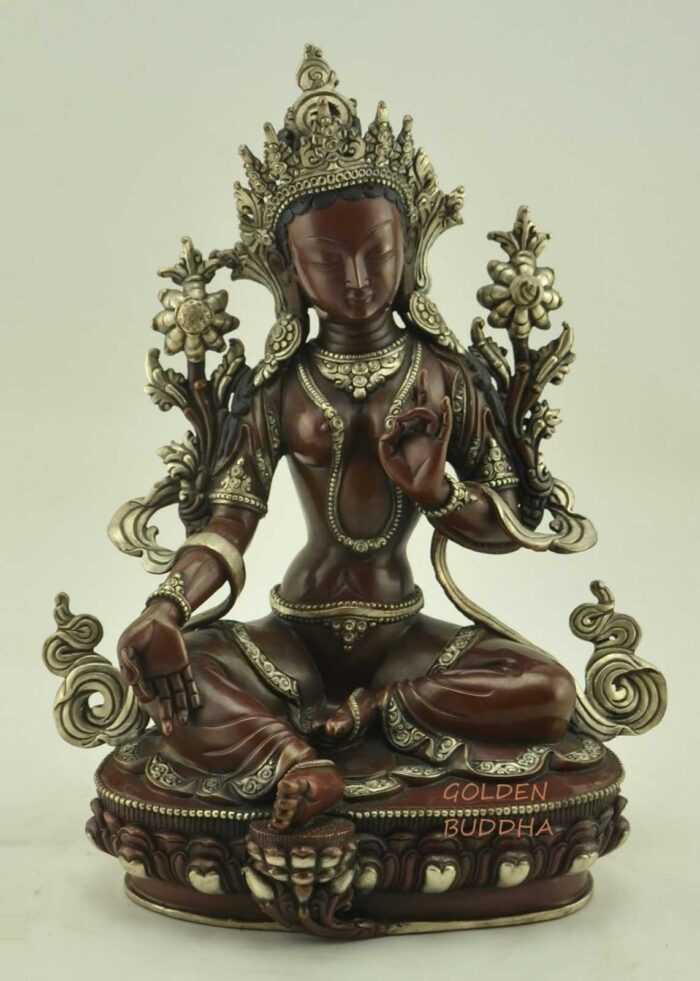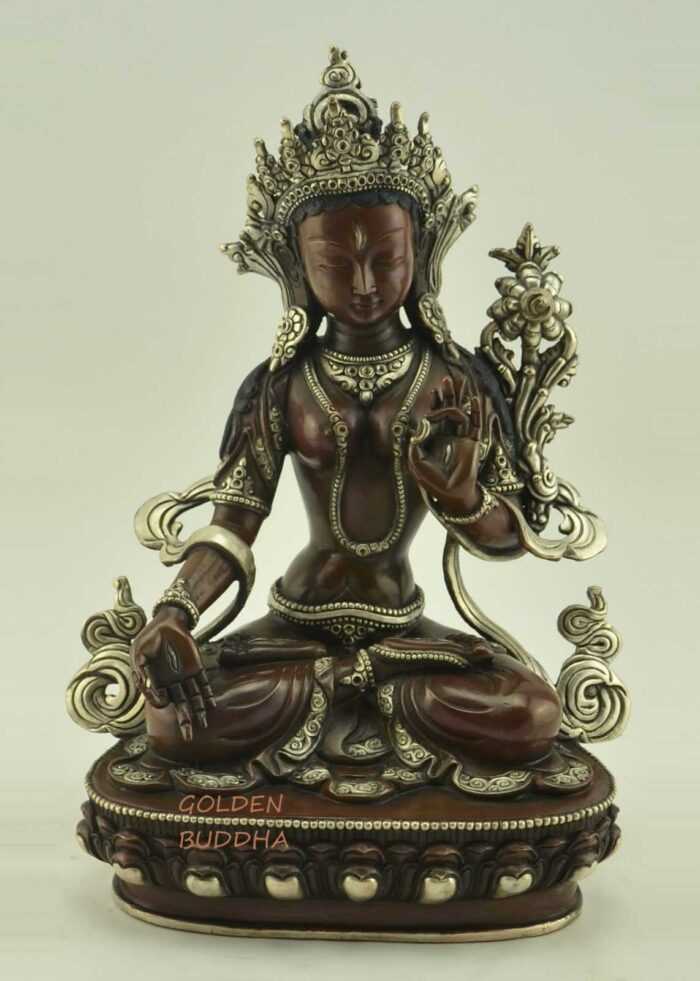
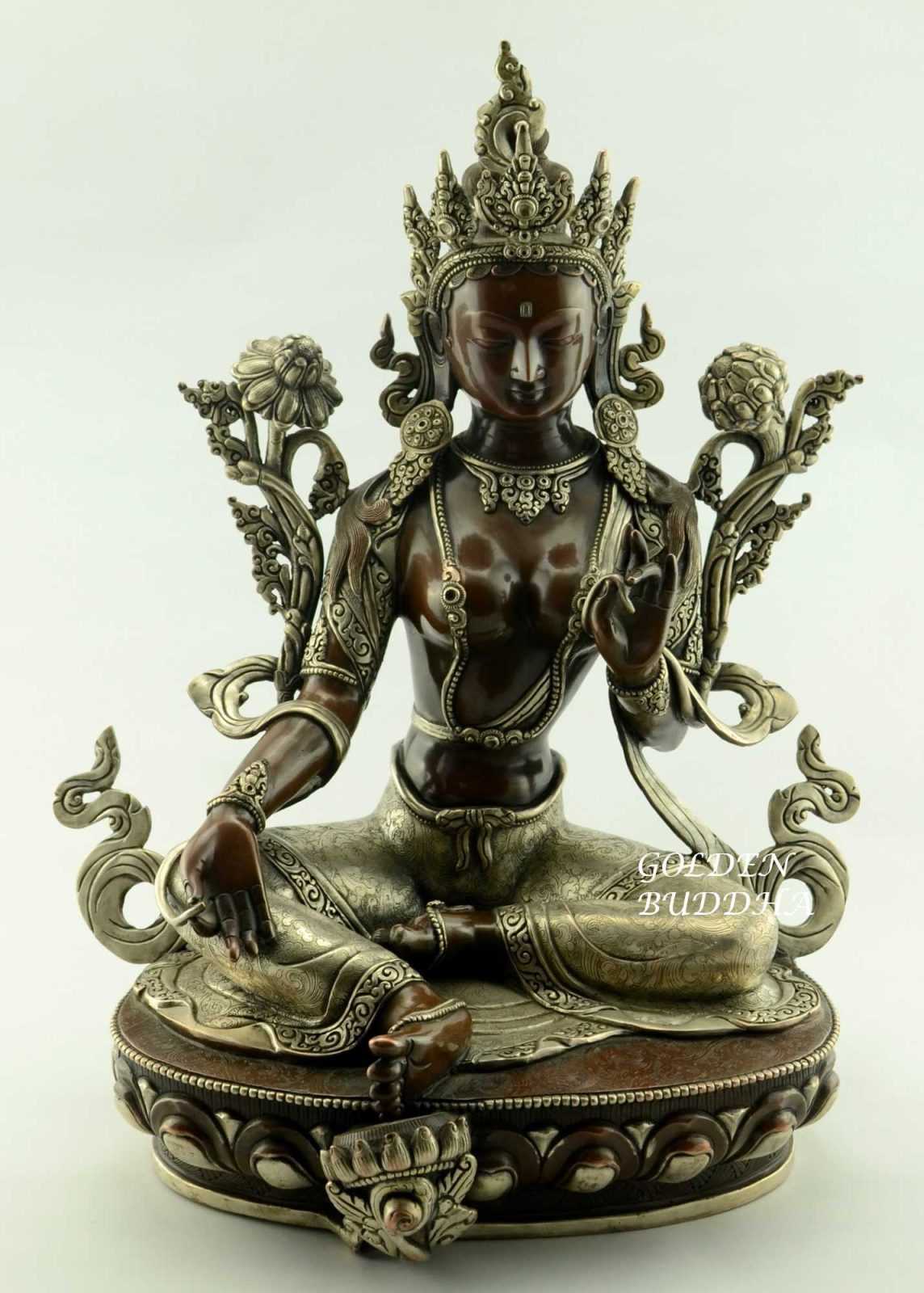
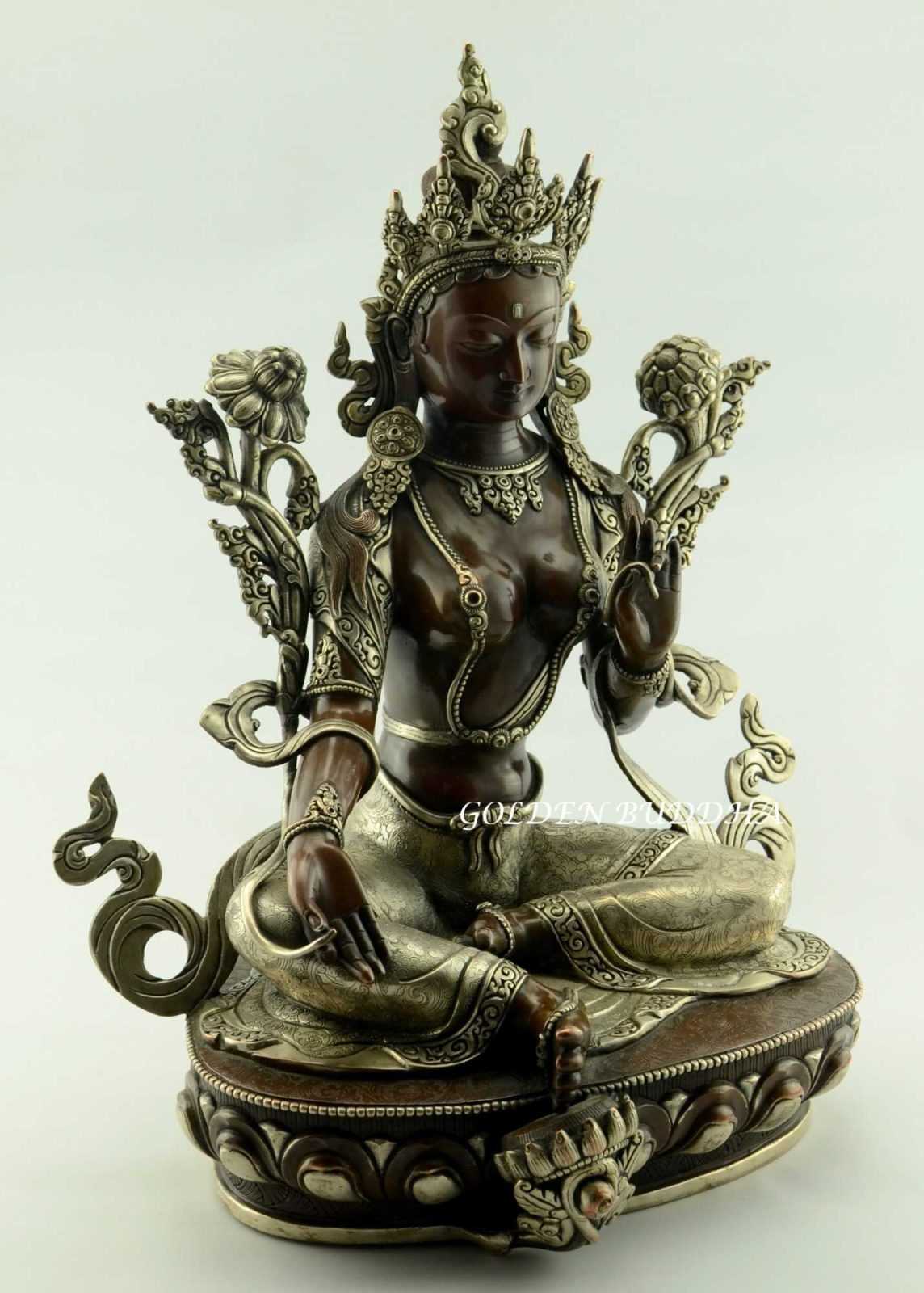
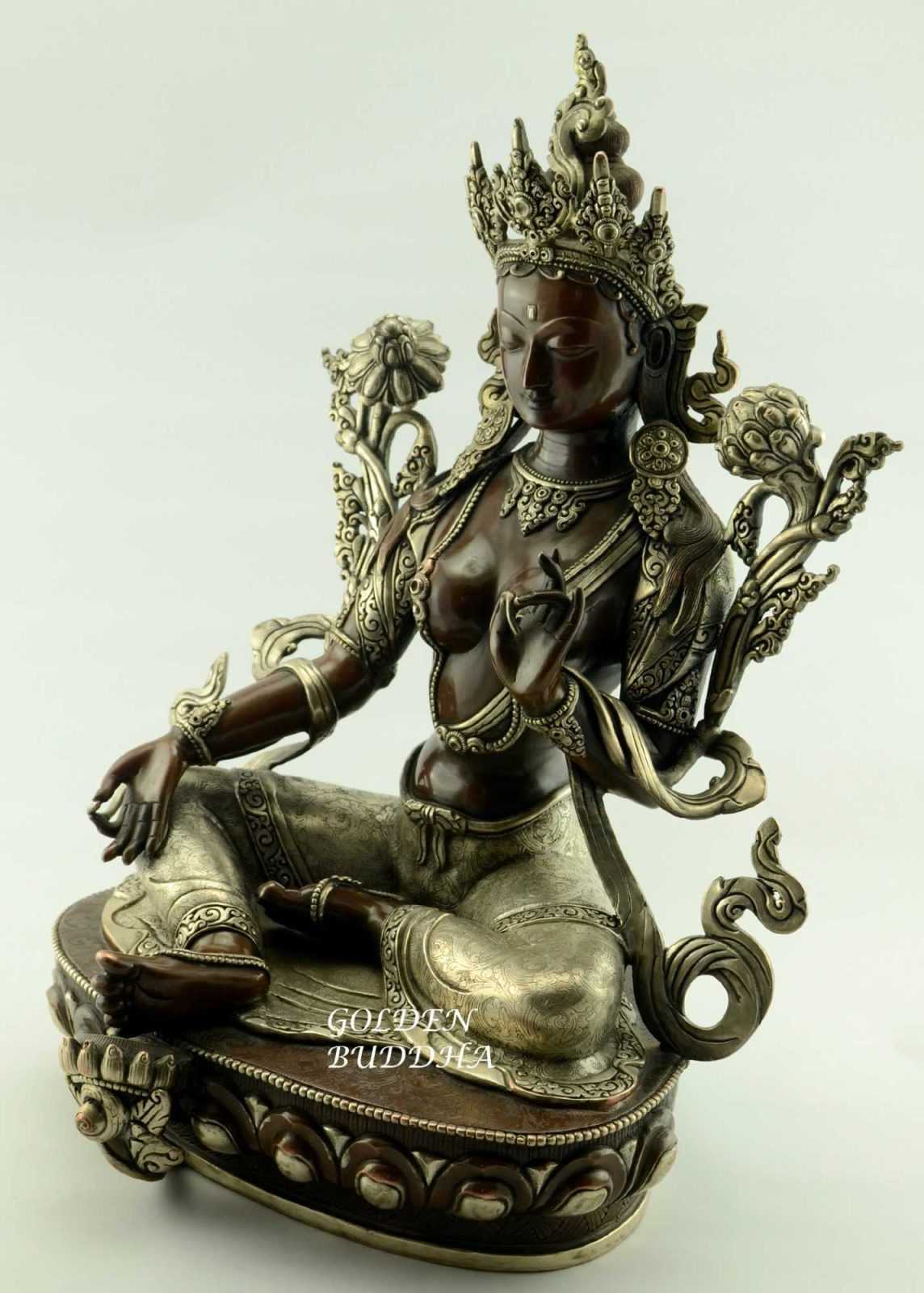
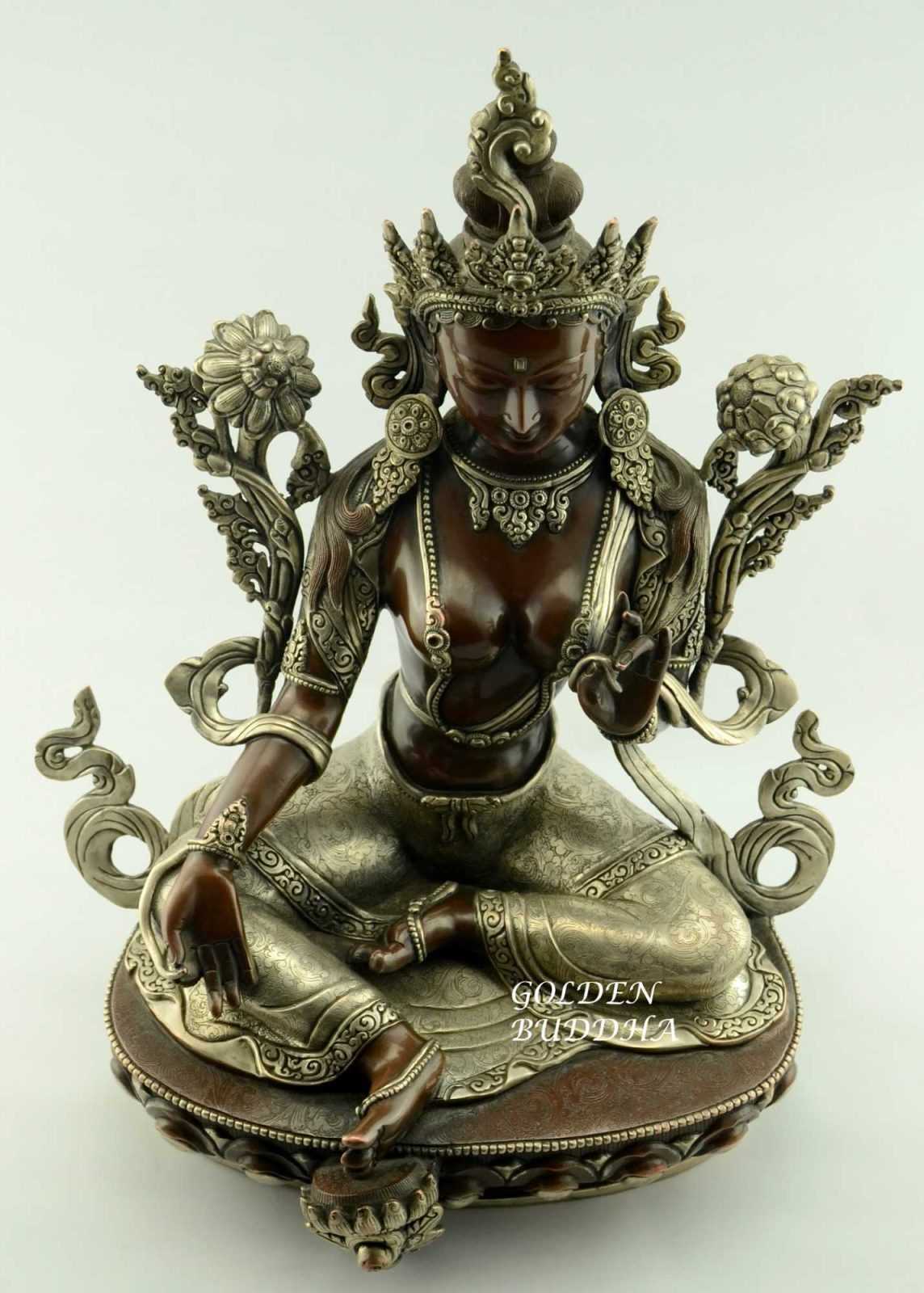


This magnificent 16-inch Silver Green Tara sculpture portrays Jetsun Dolma, the swift and compassionate Mother of Liberation, in a refined two-tone combination of dark oxidized copper alloy and finely engraved silver plating. Handmade in Patan, Nepal, the sculpture is distinguished by its graceful proportions, richly ornamented garments, elaborate Bodhisattva crown, flowering utpala lotuses and broad single lotus throne. At 12.5 inches wide and 8.75 inches deep, it has the scale and presence required to serve as the principal image on a home altar, in a meditation room or within a collection of traditional Himalayan Buddhist art.
The warm, lustrous copper finish has been preserved across Tara’s face, torso, arms and hands, allowing her serene expression and smooth bodily contours to remain visually distinct from the surrounding ornamentation. Silver plating has been applied selectively to the crown, earrings, necklaces, celestial ribbons, garment borders, lotus flowers, engraved dhoti and details of the throne. This carefully balanced contrast emphasizes the craftsmanship without overwhelming the peaceful character of the deity.
The Silver Green Tara sculpture was cast from copper alloy by master Newar artisans using the traditional lost wax method. Upon request before shipping, the crown and jewelry may also be embellished with genuine turquoise or red stones at no additional charge. These optional stones would introduce traditional Himalayan color while standing out clearly against both the dark copper body and the silver-plated ornaments.
Silver Green Tara Sculpture in Lalitasana
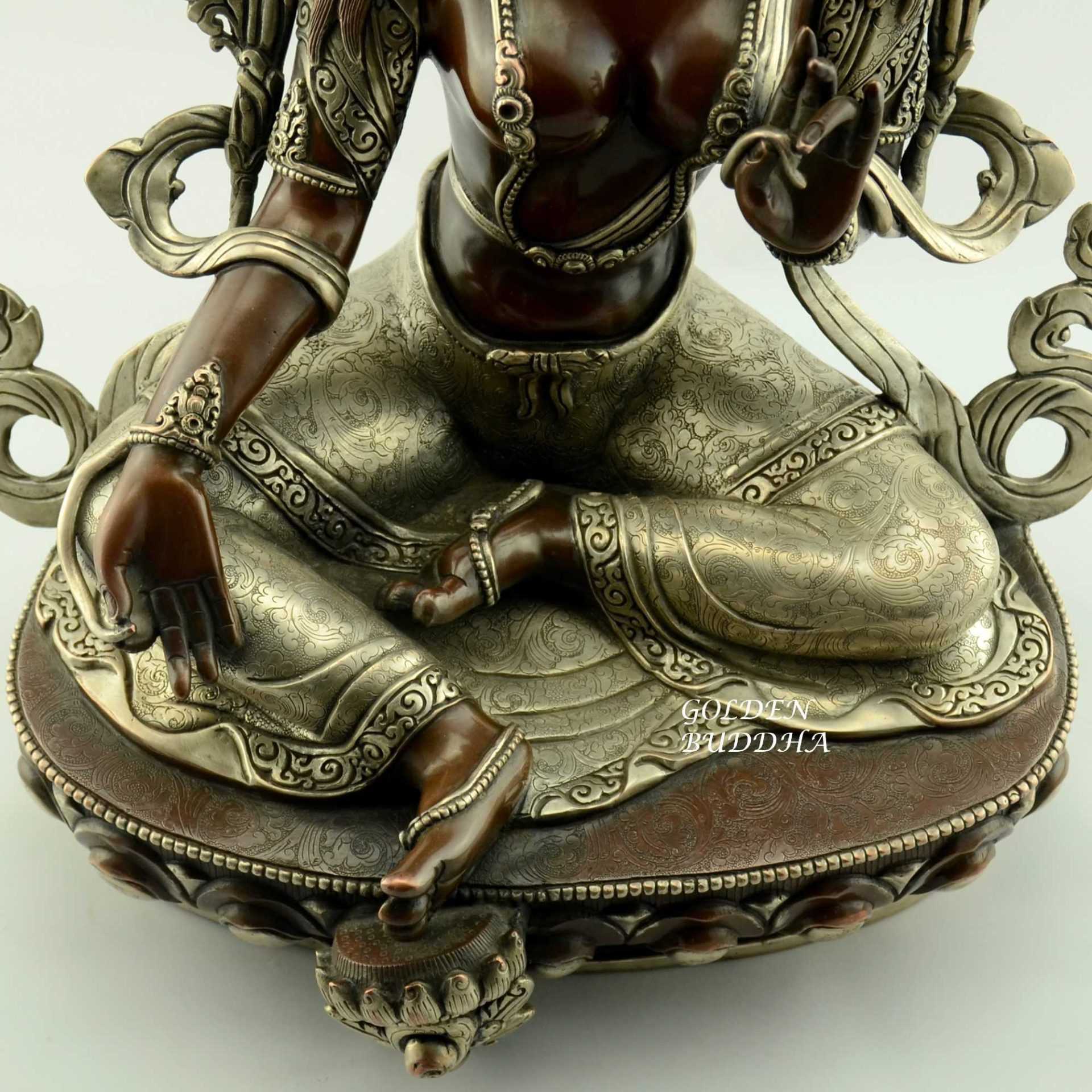
Green Tara is seated in lalitasana, the posture of royal ease. Her left leg remains folded in meditation, while her right leg extends forward and rests upon a smaller lotus support at the front of the throne. This distinctive posture expresses the union of contemplative wisdom and compassionate action. Tara remains inwardly established in meditation, yet her extended leg shows that she is prepared to rise immediately when sentient beings call upon her for protection and assistance.
Her lowered right hand displays the Varada Mudra, the gesture of generosity, compassionate giving and the bestowal of blessings. The palm faces outward toward the devotee, with the fingers extending naturally toward the earth. An eye is visible in the open palm, expressing Tara’s awakened ability to perceive suffering and respond without delay. Learn more about this gesture in our guide to the meaning of the Varada Mudra.
Her raised left hand forms a graceful gesture of refuge and teaching while holding the stem of an utpala lotus between the thumb and finger. The position communicates reassurance, spiritual guidance and protection. Together, the two hands present Green Tara as both the giver of compassionate blessings and the guide who leads practitioners away from fear and toward liberation.
Silver Utpala Lotuses and Enlightened Activity
Two prominent utpala lotuses rise beside Green Tara’s shoulders on long, curling stems. Both blossoms are shown open, although each flower has been modeled with a distinct arrangement of petals. The blossom beside her right shoulder opens broadly toward the viewer, while the more compact flower beside her left shoulder displays tightly layered petals. Their different forms introduce natural variation and prevent the otherwise symmetrical composition from appearing rigid.
The blossoms, stems and surrounding leaves receive extensive silver-plated detailing. Individual petals are modeled in relief, while the leaves curl outward around the shoulders and upper arms. The polished silver flowers stand prominently against the darker body and create a visual connection between the crown, jewelry, garments and lower pedestal.
The lotus is one of the most enduring symbols in Buddhist art. It grows from muddy water yet opens cleanly above the surface, representing the ability of awakened qualities to emerge without being stained by samsara. In Green Tara’s iconography, the utpala also expresses compassionate activity that remains rooted in wisdom. Tara enters the difficult conditions of the world without becoming bound by them, responding to suffering while remaining established in enlightened awareness.
Engraved Silver Dhoti and Shoulder Covering
The finely engraved silver-plated dhoti is among the most impressive features of this statue. Delicate floral and foliate patterns extend across both legs, following the natural curves of the garment as it gathers around the knees and descends toward the center of the seat. The borders are defined by deeper scrolling engravings, creating the appearance of a richly woven ceremonial textile rendered in metal.
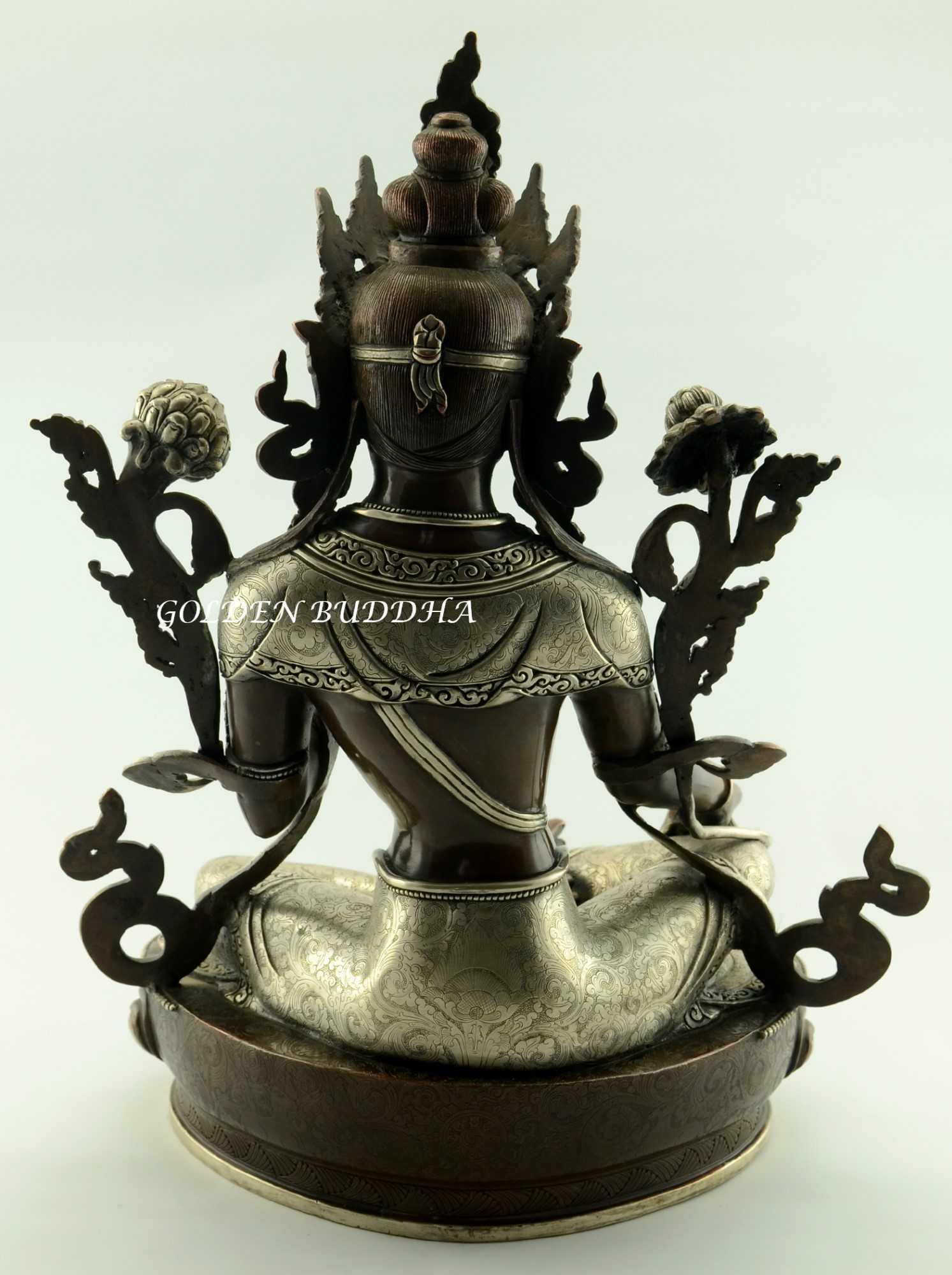
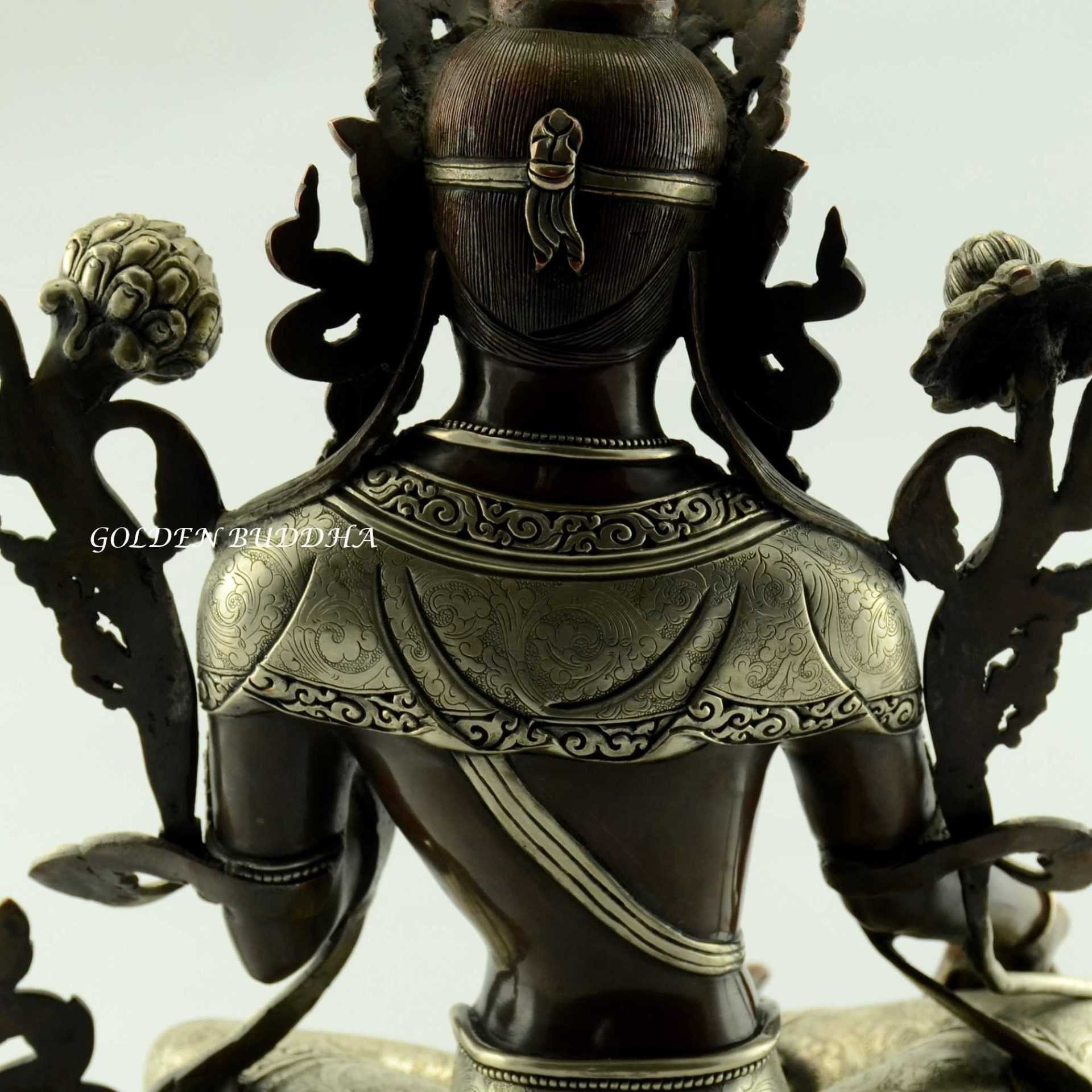
The silver work continues around the reverse. Tara’s garment is not treated merely as a front-facing decoration; botanical engraving covers the back of the seated legs and the lower garment, demonstrating that the sculpture was designed as a complete devotional image to be viewed from every direction. The densely patterned silver surfaces contrast with the smooth oxidized copper of the waist and back, preserving a clear distinction between body and clothing.
A silver-plated shoulder covering extends across the upper back, divided into layered panels edged with scrolling borders. Fine engraving is visible within these panels, while a narrow sash crosses diagonally behind the torso. The combination of the engraved shoulder covering, dhoti and long ribbons gives the sculpture the visual richness of Himalayan brocade without concealing Tara’s elegant bodily proportions.
Bodhisattva Crown, Jewelry and Celestial Ribbons
Green Tara wears the crown and jewelry of a Bodhisattva, symbolizing the complete qualities of enlightened compassion rather than worldly luxury. Her tall silver crown rises in a series of flame-shaped points around the dark gathered hair and culminates in an ornate central finial. Circular ornaments, scrolling leaves and raised decorative borders create depth across the crown, while the darker hair provides contrast behind the bright silver work.
Large silver earrings frame Tara’s face, complemented by a broad collar necklace and a longer beaded strand descending across the torso. Matching armbands, bracelets and a narrow jeweled girdle repeat the ornamental design throughout the body. These adornments are distributed carefully, leaving sufficient areas of smooth copper visible so that Tara’s calm expression and graceful posture remain the visual center of the sculpture.
Long celestial ribbons emerge near the shoulders, pass around the arms and curl outward beside the lotus throne. Their silver-plated surfaces produce a flowing rhythm around the otherwise stable seated figure. Viewed from behind, the ribbons continue around the elbows and open toward the sides, giving the statue a sense of movement and awakened activity even when seen from the reverse.
Green Tara as the Mother of Liberation
Green Tara is known in Tibetan as Jetsun Dolma. “Jetsun” is a title of reverence, while “Dolma” means “she who liberates.” Her Sanskrit name, Tara, carries the sense of a guiding star and of helping beings cross over the ocean of cyclic existence. She is therefore revered not only as a protector from temporary dangers but as a guide toward freedom from the deeper causes of fear and suffering.
Tara is particularly associated with swift compassionate activity. Unlike a passive symbol of sympathy, she represents compassion already moving toward the person who needs help. Her posture, open palm and flourishing lotuses all reinforce this readiness to act. Practitioners invoke her through the mantra Om Tare Tuttare Ture Svaha, traditionally recited for protection, the removal of obstacles and the cultivation of courageous compassion.
She is also invoked for protection from the Eight Great Fears. These may be understood as external dangers, but they also symbolize inner afflictions such as pride, anger, ignorance, envy, attachment, distorted views, greed and doubt. Tara’s protection therefore includes both relief from threatening circumstances and the wisdom needed to recognize and overcome the mental habits that perpetuate suffering. Additional practice information is available in our guide to the Green Tara mantra and meditation.
Silver-Accented Single Lotus Throne
The statue rests upon a broad single lotus throne with deeply modeled petals arranged around the front and sides. Selected petal centers are highlighted in silver, creating a rhythmic contrast against the dark oxidized copper. A silver beaded rim traces the upper edge of the pedestal, while a matching silver border defines the lower perimeter.
At the front of the throne, Green Tara’s extended foot rests upon a projecting lotus support framed by an ornamental relief. This feature reinforces the symbolism of her active posture while bringing visual emphasis to the center of the pedestal. Fine engraving is also visible on the flat upper surface beneath the figure and along the lower border of the throne.
The reverse of the base is more restrained than the heavily decorated garments but remains carefully finished. Subtle engraved patterns follow the lower edge, while the silver rim continues around the full circumference. The consistent treatment of the front, sides and back reflects the Newar tradition of completing sacred images as fully developed objects rather than decorating only the portions most visible in photographs.
Traditional Lost Wax Casting in Nepal
This Silver Green Tara sculpture was created in Patan, Nepal, through the traditional lost wax casting method. The artisan first forms a detailed wax model according to established Himalayan iconometric proportions. The wax figure is enclosed within a heat-resistant mould and fired, allowing the wax to melt away and leave a hollow cavity. Molten copper alloy is then poured into the mould to create the metal casting.
After cooling, the mould is broken and the sculpture is refined by hand. The artisan chases the contours, cleans each edge, engraves the garments and prepares selected surfaces for silver plating. The remaining copper alloy is finished to create its dark oxidized appearance. Because the original wax model is destroyed and much of the finishing is completed individually, each statue possesses subtle variations that distinguish it from mass-produced reproductions.
The completed statue measures approximately 16 inches high, 12.5 inches wide and 8.75 inches deep, with an approximate shipping weight of 9 kilograms. Its large lotus flowers, extended leg, wide celestial ribbons and elevated crown give it a substantial presence beyond its stated height. Each statue is accompanied by a certificate of authenticity issued through Nepal’s Department of Archaeology, verifying its materials, traditional production method and Nepali origin.
Silver Green Tara Sculpture and Amitayus Set
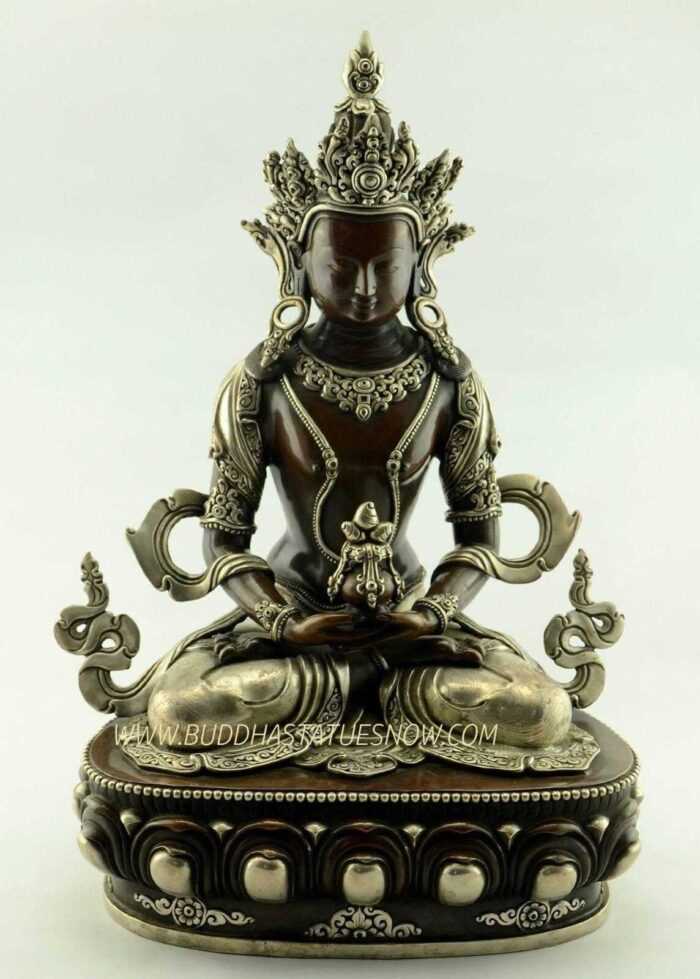
This Silver Green Tara sculpture forms an especially harmonious two-piece altar set with the matching Silver Amitayus statue. Both sculptures were created by the same Nepali master artisan and share closely related dimensions, oxidized copper-alloy bodies and extensively engraved silver-plated garments. Their crowns, jewelry, celestial ribbons, throne rims and selected lotus petals are highlighted in silver, giving the two pieces a unified visual identity.
The artisan’s work continues around the reverse of both statues. Green Tara’s silver dhoti and shoulder covering are engraved across the back, while the Amitayus sculpture includes finely engraved silver garments and ornamental work continuing across the reverse of its throne. Placed together, their related proportions, finishes and recurring silver details create a balanced altar arrangement without making the two figures appear identical.
Their doctrinal relationship is equally meaningful. Amitayus, the Buddha of Immeasurable Life, embodies longevity, accumulated merit and the preservation of favorable conditions for Dharma practice. His long-life vase contains the nectar associated with sustaining life and restoring depleted vitality. Green Tara embodies swift compassion, protection and the immediate removal of obstacles. Her extended right leg communicates readiness to respond whenever sentient beings require assistance.
Together, Green Tara and Amitayus unite the compassionate protection of life with the enrichment and extension of life’s beneficial conditions. Amitayus helps establish the time, merit and vitality needed for continued practice, while Tara protects those conditions from fear, adversity and obstruction. This pairing is therefore especially appropriate for an altar dedicated to health, long life, protection and the aspiration to use one’s remaining years for spiritual development and the benefit of others.
Custom Made Silver Green Tara Sculpturess
A custom made Green Tara statue may be commissioned for a private altar, Buddhist temple, Dharma center or collection. The statue may be recreated at a preferred height while preserving Tara’s essential iconography, including her lalitasana posture, extended right leg, Varada Mudra, raised left hand, paired utpala lotuses, Bodhisattva crown and celestial adornments.
Available options may include an oxidized copper finish with silver plating similar to this sculpture, a plain antiquated finish, partial gilding, 24K fire gilding, a face hand painted with 18K gold and natural pigments, gemstone embellishments, additional garment engraving or a specially designed lotus throne. The placement and extent of the silver work may also be adapted to highlight the crown, jewelry, flowers, ribbons, dhoti or pedestal according to the intended altar.
A coordinated two-piece commission may also be arranged so that Green Tara and the Silver Amitayus statue share matching dimensions, crown proportions, silver finishes, garment engraving and lotus-throne details. Such a set would preserve each deity’s correct individual attributes while creating a unified devotional ensemble dedicated to Tara’s swift protection and Amitayus’s blessings of longevity, merit and favorable conditions for practice.
Authentic, Handmade in Nepal
Every statue is handcrafted in Patan, Nepal, using traditional lost wax casting and comes with a certificate of authenticity issued by Nepal’s Department of Archaeology, verifying its materials, technique, and origin.