

In Tibetan Buddhism, the three long life deities — White Tara, Amitayus, and Namgyalma — form the most important triad of longevity deities in the entire Vajrayana Buddhist pantheon. Each embodies a distinct dimension of the power to extend life, purify the obstacles that shorten it, and support the spiritual vitality needed for meaningful practice. Together they are invoked in longevity rituals (tse drub) conducted throughout the Tibetan Buddhist world — from the great monasteries of Tibet and Nepal to Dharma centers in Europe and North America.
The human realm is considered the most precious of the six realms of existence in Buddhist cosmology — because only in the human realm is the full range of spiritual practice possible. Even the heavenly realms have their drawbacks: the gods are so absorbed in pleasure that they neglect practice, and when their merit is exhausted they fall back into lower rebirths. It is precisely because human life is so rare, so precious, and so uniquely suited to spiritual development that long life practice is considered one of the most important of all Buddhist rituals — not for the sake of clinging to life, but for the sake of using it well.
This guide covers the meaning, iconography, mantra, and practice of each of the three long life deities — with everything you need to understand their individual roles and how to work with their statues and mantras in daily practice.
Contents
- The Three Causes of Premature Death
- Longevity Ritual — How Long Life Practice Works
- White Tara — Long Life Deity of Compassion & Healing
- White Tara Iconography & Seven Eyes
- White Tara Long Life Mantra
- Amitayus — Buddha of Infinite Life
- Amitayus Iconography & Immortality Vase
- Amitayus Long Life Mantra
- Namgyalma — Goddess of Victory Over Death
- Namgyalma Iconography & Eight Arms
- Namgyalma Long Life Mantra
- Frequently Asked Questions About Long Life Deities
The Three Causes of Premature Death
Tibetan Buddhist teaching identifies three causes of premature death — the depletion of any one of which can cut short a practitioner’s life before its natural completion. Understanding these three causes explains why long life practice is considered so important and how the three long life deities address each cause specifically:
- Exhaustion of merit — Merit (punya) is the positive karmic energy accumulated through virtuous action, generosity, and ethical conduct. When a person’s store of merit is depleted — through non-virtuous actions, neglect of practice, or simple exhaustion — their protection dissolves and they become vulnerable to illness, accident, and untimely death. Long life practice replenishes merit directly.
- Exhaustion of karma — Every being is born with a specific karmic inheritance — a pattern of causes and conditions set in motion by past actions. When the positive karmic conditions supporting the current life are used up, life ends. Long life practice and mantra recitation are understood to extend and replenish these karmic conditions.
- Exhaustion of life force — The vital energy (prana or lung in Tibetan) that animates the physical body can be depleted by illness, emotional upheaval, broken samaya vows, spirit interference, or extreme physical hardship. The longevity rituals of Tibetan Buddhism specifically target this vital force — replenishing and strengthening it through visualization, mantra, and the consumption of consecrated substances.
The depletion of any single one of these three elements can result in premature death — even if the other two are still intact. This is why the three long life deities work as a triad: each addresses a different dimension of vulnerability, and their combined practice provides comprehensive protection.
Longevity Ritual — How Long Life Practice Works
Long life rituals (tse drub in Tibetan) are centered around statues or thangka paintings of the three long life deities — White Tara, Amitayus, and Namgyalma — placed prominently on the altar. The ceremony is presided over by a qualified guru or lama who uses a combination of common methods (mantra recitation, visualization, offerings) and supreme methods (direct transmission of longevity blessings) during the ritual.
The key ritual elements of a formal longevity practice include:
- Long life pills (rilbu) — small dough pills consecrated through mantra recitation and blessing, consumed by participants to receive the healing and purifying power of the long life deities.
- Consecrated wine (amrita) — the immortality vase of Amitayus is filled with specially prepared wine, consecrated through mantra and visualization, and then consumed by devotees as the nectar of long life.
- Mantra recitation — each of the three long life mantras is recited in sequence, with the practitioner maintaining visualization of the corresponding deity throughout.
- Deity visualization — practitioners visualize each deity in vivid detail — their color, attributes, and the light they radiate — as the most effective method of connecting with their blessing energy.
Long life rituals are also considered deeply beneficial for spiritual and psychological wellbeing — the combination of community practice, sacred substances, mantra, and visualization produces a sense of renewal, wholeness, and connection to the enlightened qualities of the long life deities that naturally repels illness and supports robust health.
White Tara — Long Life Deity of Compassion & Healing
White Tara (Sanskrit: Sitatara; Tibetan: Drolkar) is the most beloved of the three long life deities — revered as the divine mother of all Buddhas and the embodiment of compassionate healing. She is one of the 21 emanations of the Tara Bodhisattva, empowered with Tara’s supreme attribute of compassion for all sentient life. White Tara’s compassion for her devotees is described as exceeding even the unconditional love of a mother for her child — boundless, selfless, and immediately responsive to suffering.
In Tibetan Buddhism, White Tara is already considered a fully enlightened female Buddha — not merely a Bodhisattva — whose specific mandate is the protection of life, the healing of illness, the removal of obstacles to longevity, and the granting of long life blessings to faithful practitioners. She is known as the Cintachakra — the “Wish-Fulfilling Wheel” — reflecting her capacity to grant the sincere wishes of devoted practitioners. Faithful performance of the White Tara longevity puja is said to protect devotees from contagious diseases, fire, flood, and other disasters that threaten life.
White Tara Iconography & Seven Eyes
The most immediately recognizable feature of every White Tara statue is her seven eyes — two on her face, one on her forehead (the third eye of wisdom), one on each palm, and one on each sole of her feet. Together the seven eyes represent her omnidirectional compassionate awareness: she simultaneously perceives every form of suffering in every realm, leaving no being unnoticed and no suffering unaddressed.
White Tara sits in full vajrasana (full lotus pose) — distinguishing her at a glance from Green Tara, who always has her right leg extended. Her right hand displays the Varada mudra (“boon-granting”) over her right knee — palm open and facing outward, freely offering her blessings. Her left hand holds the stem of a white lotus at her chest in the Abhaya mudra variation — simultaneously expressing protection and purity. Her white body represents the pristine purity of her compassion, untainted by self-interest.
White Tara Long Life Deity Statue

White Tara Long Life Mantra
“Om Tare Tuttare Ture Mama Ayuh Punya Jñana Pustim Kuru Svaha”
The White Tara mantra meaning is unusually explicit — the purpose of the practice is stated directly within the mantra itself. Mama Ayuh Punya Jñana Pustim Kuru translates as “Please increase my lifespan, merit, and wisdom.” The opening syllables Om Tare Tuttare Ture are the root mantra of all 21 Taras, invoking liberation from mundane suffering, the eight great fears, and spiritual ignorance. Svaha seals the mantra with blessing, establishing its power in the heart of the practitioner.
The White Tara mantra benefits are most powerfully activated through regular practice — traditionally 108 recitations per session using a mala, ideally while seated before a White Tara statue. The practice is also commonly performed on behalf of sick or elderly loved ones, making it one of the most compassionate applications of Buddhist mantra practice.
Amitayus — Buddha of Infinite Life
Amitayus (Sanskrit: “Infinite Life”; Tibetan: Tsepame; also known as Aparmita) is the sambhogakaya embodiment of Amitabha Buddha in his longevity aspect. While Amitabha in his standard form holds an alms bowl, Amitayus manifests specifically to bestow the blessings of long life, vitality, and the extension of the lifespan of practitioners and all sentient beings. His very name — “Infinite Life” — defines his function: he embodies the inexhaustible life force of an enlightened mind that has permanently transcended death and rebirth.
Amitayus is invoked not only for the extension of physical life but for spiritual vitality — the clear, energized consciousness that supports sustained meditation practice, study, and virtuous action. His practice is particularly recommended for practitioners who are recovering from serious illness, who feel their energy depleted by negative karma or broken vows, or who wish to accumulate the longevity needed to complete a major practice commitment such as a three-year retreat.
Amitayus Iconography & Immortality Vase
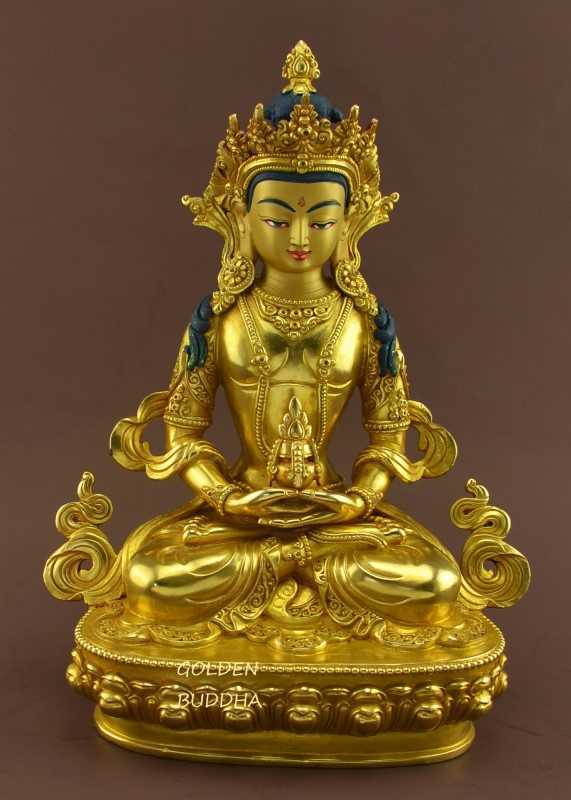
Amitayus statues are immediately distinguished from standard Amitabha statues by the immortality vase (bumpa) cradled in his meditation gesture. He sits in full lotus pose (vajrasana), both hands resting flat in the lap in the Dhyana mudra — palms facing upward, right hand resting on left. Upon the right palm sits the immortality vase, filled with amrita — the nectar of deathlessness.
His body is depicted in deep ruby red — the color of the life force, vitality, and pure awareness. He wears the thirteen sambhogakaya ornaments of an enlightened being — crown, earrings, necklaces, armlets, bracelets, anklets, and flowing silks — reflecting his status as the celestial, luminous manifestation of Amitabha rather than the nirmanakaya (physical) form. The five-pointed crown he wears represents the transformation of the five mental poisons into the five enlightened wisdoms.
Amitayus Long Life Deity Statue
Amitayus Long Life Mantra
“Om A Ma Ra Ni Dzi Wan Ti Ye Soha”
The Amitayus mantra is among the most powerful longevity mantras in all of Vajrayana Buddhism. Its recitation during the formal longevity ritual is accompanied by visualization of Amitayus above the practitioner’s crown, radiating deep red healing light that flows down through the body — filling every cell with the nectar of infinite life and purifying all karmic causes of illness and premature death. The mantra directly invokes the infinite life force of Amitayus and calls upon his vow-power to extend and protect the lifespan of the practitioner.
The Amitayus mantra benefits include: extension of the natural lifespan, healing of illness arising from karmic causes, replenishment of vital life force (prana), purification of the three causes of premature death, and the gradual development of the clear, stable consciousness that supports deep meditation practice. When recited with sincere motivation and faith, the mantra is considered one of the most direct methods for receiving Amitayus’s longevity blessing.
Namgyalma — Goddess of Victory Over Death
Namgyalma (Sanskrit: Ushnishavijaya — “Victorious Crown Protrusion”) is the third and most complex of the three long life deities — a powerful female yidam (meditational deity) from the Kriya Tantra class, revered across all four major schools of Tibetan Buddhism. Her Sanskrit name means “Victorious One of the Ushnisha” — the ushnisha being the cranial protuberance that symbolizes supreme wisdom on all Buddha statues. The name itself proclaims her defining attribute: victory over the causes of premature death through the power of wisdom.
Namgyalma emerged from a beam of light radiating from the ushnisha of Shakyamuni Buddha himself — making her origin the most direct of the three long life deities, arising directly from the enlightened wisdom of the historical Buddha. She is regarded as the Buddhist goddess of purification — specifically targeting the karmic causes of illness, untimely death, and lower rebirth. Her practice belongs to the Action Tantra school, focusing on ceremonial invocation rather than purely internal yogic discipline, making it accessible to practitioners at all levels.
Namgyalma Iconography & Eight Arms
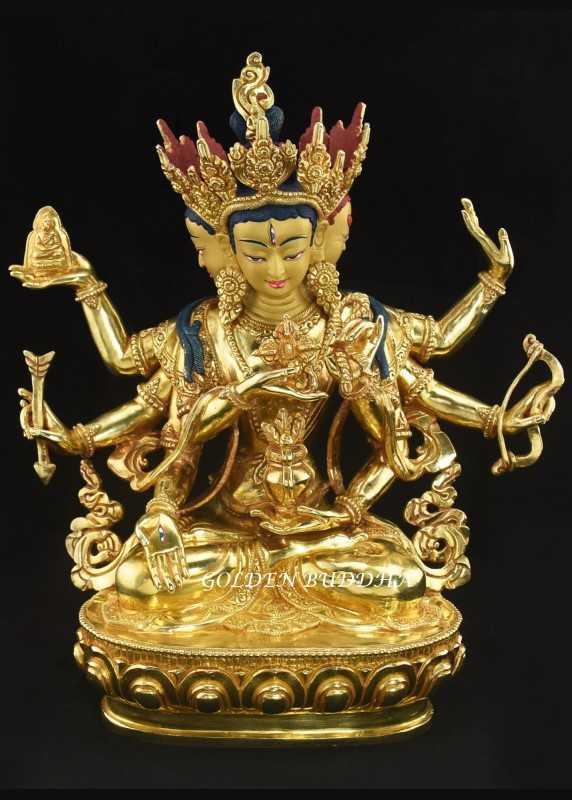
Namgyalma statues are the most visually complex of the three long life deities — immediately recognizable by their three faces and eight arms, making them unique among all Tibetan Buddhist longevity deities. Her three faces represent her capacity to perceive and address suffering across three realms simultaneously. Her eight arms each hold a specific symbolic implement:
- Double dorje (vajra cross) at her chest — the basis of the physical universe; a protective symbol that dispels negative forces and evil karma
- Amitabha Buddha statue in her upper right hand — representing the longevity blessing of the Buddha of Infinite Light directly transmitted through her practice
- Immortality vase in her lap — containing the nectar of deathlessness, shared with Amitayus as the central vessel of long life rituals
- Lotus — representing purity of motivation and the enlightened wisdom that arises from compassionate practice
- Bow and arrow — representing directed energy and the focused intention that makes long life practice effective
- Abhaya mudra hand — protection gesture, dispelling fear and obstacles
- Varada mudra hand — boon-granting gesture, freely offering her longevity blessings
- Dhyana mudra hands — meditation gesture, supporting the internalization of longevity practice
Namgyalma Long Life Deity Statue
Namgyalma Long Life Mantra
“Om Bhrum Soha Om Amrita Ayur Da Dai Soha”
The Namgyalma mantra is among the most powerful purification and longevity mantras in Vajrayana Buddhism. Amrita means “nectar of immortality” and Ayur means “life” — making the mantra’s intention explicit: the granting of long life through the nectar of deathlessness. Unlike the other two long life mantras which focus primarily on the practitioner, the Namgyalma mantra has a uniquely broad scope of application.
A remarkable teaching in the Namgyalma tradition holds that whispering her mantra into the ear of an animal — even a dying animal — can ensure that animal’s rebirth into the higher realms. Similarly, reciting the mantra over the body of a recently deceased person is considered highly beneficial for their passage through the bardo (intermediate state) and for securing a favorable rebirth. These applications make the Namgyalma mantra one of the most practically generous practices in Tibetan Buddhism — extending its benefit beyond the practitioner to all beings in their circle of care.
The Namgyalma mantra benefits include: powerful karma purification, removal of obstacles to longevity, protection from rebirth into lower realms, healing of illness, purification of broken vows, and — for the dedicated practitioner — the gradual development of the wisdom that directly overcomes the fear of death itself.
Frequently Asked Questions About Long Life Deities
Who are the three long life deities in Tibetan Buddhism?
The three long life deities in Tibetan Buddhism are White Tara (Sitatara/Drolkar), Amitayus (Tsepame/Aparmita), and Namgyalma (Ushnishavijaya). Each embodies a distinct aspect of longevity: White Tara represents compassionate healing and the wish-fulfilling dimension of long life; Amitayus represents the inexhaustible life force of an enlightened mind and the nectar of infinite life; and Namgyalma represents victory over the karmic causes of premature death through purification and the wisdom of enlightenment. Together they are invoked in formal longevity rituals (tse drub) as a triad, providing comprehensive protection against all three causes of premature death.
What is the purpose of long life practice in Buddhism?
Long life practice in Buddhism is not motivated by attachment to life or fear of death — it is motivated by the recognition that the human realm is uniquely precious for spiritual development. A longer life means more time to accumulate merit, purify karma, study the Dharma, complete practice commitments, and benefit other beings. The three long life deities are invoked to remove the obstacles that shorten life prematurely — specifically the exhaustion of merit, karma, and vital life force — so that practitioners can use their remaining life in the most spiritually productive way possible. Long life practice is also considered deeply beneficial for healing illness and maintaining the physical and mental vitality needed for sustained meditation.
What is the difference between Amitabha and Amitayus?
Amitabha and Amitayus are two aspects of the same Buddha. Amitabha (“Infinite Light”) is the standard nirmanakaya or cosmic form — typically depicted holding an alms bowl in the Dhyana mudra, associated primarily with the Western Pure Land of Sukhavati and rebirth practice. Amitayus (“Infinite Life”) is his sambhogakaya form, manifesting specifically to bestow longevity blessings — depicted holding an immortality vase filled with amrita (nectar of deathlessness) instead of the alms bowl. Amitayus wears the thirteen sambhogakaya ornaments (crown, jewels, silks) while Amitabha wears simple monk’s robes. Both are legitimate and widely venerated forms; they differ in their specific function and iconography rather than their fundamental enlightened nature.
What does the Namgyalma mantra do?
The Namgyalma mantra “Om Bhrum Soha Om Amrita Ayur Da Dai Soha” is one of the most powerful purification and longevity mantras in Vajrayana Buddhism. Its recitation purifies negative karma that causes illness and premature death, removes obstacles to longevity, protects practitioners from rebirth in lower realms, and invokes Namgyalma’s specific power to grant victory over the causes of untimely death. Uniquely, the mantra can also be whispered into the ear of a dying animal or recited over a recently deceased person to support a favorable rebirth. It is practiced across all four schools of Tibetan Buddhism and is considered especially effective when combined with visualization of Namgyalma’s three-faced, eight-armed form.
Can anyone practice with long life deity statues?
Yes — the basic practice of mantra recitation before a long life deity statue is accessible to practitioners at all levels, without requiring special initiation. Reciting the mantra of White Tara, Amitayus, or Namgyalma before their statue with sincere motivation and faith is a complete practice in itself. The more elaborate formal longevity rituals (tse drub) — involving consecrated wine, long life pills, and direct transmission of longevity blessings — are traditionally conducted under the guidance of a qualified lama or guru. Having an authentic statue on a home altar and reciting the mantra daily is an excellent starting point for any practitioner wishing to engage with long life practice.
Where can I find authentic long life deity statues from Nepal?
Authentic long life deity statues are produced by the traditional shakya craftsmen of Patan (Lalitpur) in the Kathmandu Valley — the world center for handcrafted Himalayan Buddhist statuary for over a thousand years. Each statue is created using the lost-wax casting (cire perdue) method, finished with 24K fire gilding and hand face painting using real gold. All statues are certified by the Department of Archaeology in Kathmandu, and consecration (rabne) at a recognized monastery is available upon request. Browse our complete collection of White Tara statues, Amitayus statues, and Namgyalma statues directly from Nepal.