
This is the comprehensive Buddha statue buyer’s guide — with the best answers to every important question about how to buy a Buddha statue authentically, respectfully, and confidently. Buying a Buddha statue is an important decision that deserves thorough research. Whether you are a first-time buyer looking for home décor, a dedicated Buddhist practitioner seeking an altar centerpiece, or a collector sourcing an authentic Nepali statue, this guide covers everything you need to know.
From understanding Buddha statue meaning and mudras to placement etiquette, identifying authentic gold gilding, consecration services, and choosing which deity is right for you — every question is addressed below. Use the table of contents to jump directly to any topic.
Contents
- Are Decorative Buddha Statues Offensive?
- What is the Meaning of a Buddha Statue?
- Do Buddha Statues Have Rules of Etiquette?
- What Direction Should a Buddha Statue Face?
- How Do I Identify My Buddha Statue?
- Do Some Buddha Statues Complement Each Other?
- Where Do You Buy a Buddha Statue?
- Why Do I Need a Buddha Statue?
- Why Are Some Buddha Statues Fat?
- What is the Man and Woman in Embrace? (Yab Yum)
- Why Are There So Many Buddha Statues?
- Can I Receive a Buddha Statue as a Gift?
- How Do I Know I Bought the Right Buddha Statue?
- Why Do People Pray to Buddha Statues?
- What Goes on a Buddhist Altar?
- Why Are Some Buddha Statues Standing?
- Are Your Statues Gilded with Pure Gold?
- Why Isn’t the Face Fire Gilded?
- How Do I Spot a Fake Gold Buddha Statue?
- What Did the Buddha Really Look Like?
- Why Are Some Buddha Statues Lying Down?
- Why is the Buddha’s Head Pointed?
- Why Are the Buddha’s Ears So Large?
- What is the Oval on the Buddha’s Forehead?
- Why Are Some Buddha Statues Holding a Bowl?
- Can Buddha Statues Be Filled with Mantras?
- Do You Cover the Face of the Buddha Statue?
- Do You Offer Filling and Consecration Services?
- Are Your Nepali Statues Certified?
- Fire Gilded vs Electroplated — What is the Difference?
Are Decorative Buddha Statues Offensive?
No — there is nothing offensive about Buddha statues or ritual items created from precious metals. Our Nepali statues and Tibetan ritual items use the same designs and sculpting techniques that have supplied Tibetan monasteries for many centuries. The use of 24K gold gilding preserves the statue’s beauty indefinitely and prevents tarnish. Additionally, purchasing a high-quality Buddha statue reflects sacrifice and dedication — both of which help accumulate merit in the Buddhist understanding of karma.
The key principle is respectful treatment: a statue placed thoughtfully on a clean altar at chest height or above, in a space of quiet dignity, is universally considered appropriate — whether the owner is a practicing Buddhist, a collector, or someone drawn to Buddhist art for aesthetic reasons. Intent and treatment together determine whether a statue is used respectfully.
What is the Meaning of a Buddha Statue?
The most important aspect to consider before purchasing a Buddha statue is its meaning. Fortunately, the Buddha statue meaning is revealed directly by the statue’s mudras (hand gestures) and posture. These gestures identify which Buddhist deity the statue represents and communicate specific teachings about events in the life of the historical Buddha or qualities of enlightened awareness. For a complete guide to every mudra, see our post on Buddha statue poses and mudras.
The most common mudras in Nepali Buddhist statuary are: the Bhumisparsha mudra (earth-touching — enlightenment of Shakyamuni), the Dhyana mudra (meditation — used by Amitabha, Shakyamuni, and many others), the Abhaya mudra (raised palm — protection and fearlessness), the Varada mudra (open downward palm — generosity and gift-giving), and the Dharmachakra mudra (both hands at chest — the First Teaching). Reading the mudra correctly is the single most reliable way to identify any statue.
Do Buddha Statues Have Rules of Etiquette?
Yes — traditional Buddhist etiquette for statue placement applies whether you are a practitioner or a first-time buyer. Following these guidelines ensures the statue is treated respectfully and functions effectively as a focal point for positive energy:
- Do not place a Buddha statue in the bedroom, kitchen, or bathroom — these spaces are associated with sleep, food preparation, and bodily functions, making them inappropriate for a sacred object.
- Always place the statue at least 2.5 feet off the floor — elevation signals respect. A dedicated altar shelf, bookcase, or cabinet is ideal.
- Position the statue in good light where it can be seen and appreciated. The statue’s beauty and detail are meant to inspire — a dark corner defeats this purpose.
- If possible, situate the statue so it faces the front door of your home from the inside. This arrangement attracts positive energy as you enter and deflects negative energy outward.
- Acquire your Buddha statue in a positive spirit and with confidence. The sincerity of your intention is the most important element of placement.
- Keep the surrounding area clean and clutter-free. Regular cleaning of the altar space is itself considered a form of practice — a daily act of care and respect.
For more information on creating positive energy (qi) in your home using Buddha statues and Tibetan ritual items, see our guide on qi energy and Buddha statues.
What Direction Should a Buddha Statue Face?
The most beneficial general placement is to have the Buddha statue facing the front door of your home from the inside — so it is the first thing you see when you enter. The Buddha’s presence at the threshold encourages you to leave all bitterness, negativity, and stress outside before entering your home. This applies equally to a hallway, meditation room, or office entrance.
For buyers interested in auspicious feng shui directions, consulting a feng shui expert is recommended for personalized guidance. As a general principle, the entrances to most venerable Buddhist and Hindu temples face East (toward sunrise) — a direction associated with new beginnings, clarity, and the rising light of wisdom. One famous exception is Angkor Wat in Cambodia, which faces West — a directional choice that still perplexes archaeologists.
Additionally, certain Buddhas are guardians of specific directions associated with their pure lands: Amitabha Buddha presides over the West (Pure Land of Sukhavati); Medicine Buddha is the guardian of the East (Lapis Lazuli Pure Land); Akshobhya Buddha rules the Eastern paradise of Abhirati; and Ratnasambhava Buddha resides in the South. Placing a statue so the practitioner faces the deity’s corresponding direction during practice is considered particularly auspicious.
How Do I Identify My Buddha Statue?
Many Buddha statues have similar serene facial expressions which can conceal their true identity. Therefore, we rely on the statue’s mudras, posture, color, and held objects for identification. For a complete guide to identification see our Buddha statue poses and mudras guide. Some reliable general identification rules:
- Shakyamuni Buddha — Bhumisparsha mudra (right hand touching earth), left hand in Dhyana mudra with alms bowl
- Amitabha Buddha — Dhyana mudra, both hands in lap, often holding alms bowl; red or saffron body color
- Medicine Buddha — deep blue body, right hand in Varada mudra holding myrobalan herb, left hand holding lapis lazuli medicine bowl
- Manjushri — holds flaming sword in right hand, lotus supporting the Prajnaparamita Sutra in left hand
- Avalokiteshvara — four arms (Tibetan form): mala beads upper right, lotus upper left, cintamani jewel held at chest between lower hands; white body
- Green Tara — right leg extended forward off the lotus throne, right hand in Varada mudra, left hand at chest in Abhaya variation holding lotus stem; green body
- Vajrasattva — holds vajra at heart (right hand), bell at hip (left hand); white body
- Vajradhara — Diamond mudra, holds vajra and bell with hands crossed in front of heart; deep blue body
Do Some Buddha Statues Complement Each Other?
Yes — certain Buddha statues complement each other beautifully and are commonly displayed together on Buddhist altars. The combination used will vary by tradition and geographic location. Here are the most commonly seen and recommended groupings:
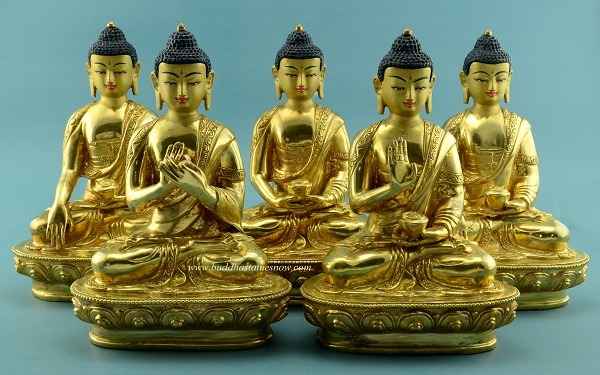
Five Dhyani Buddhas
In Tibetan Buddhism, the Five Dhyani Buddhas (also called the Five Wisdom Buddhas or Five Transcendent Buddhas) represent the complete transformation of the five mental poisons into five corresponding enlightened wisdoms. Each Buddha is associated with a specific color, direction, animal, and mudra. The five are: Vairochana (center, white), Amitabha (west, red), Ratnasambhava (south, yellow), Akshobhya (east, blue), and Amoghasiddhi (north, green). Displaying all five together creates a complete mandala of enlightened awareness on the altar.
Medicine Buddha Trinity
The Medicine Buddha Trinity is one of the most meaningful statue groupings in Mahayana Buddhism, drawn directly from the Medicine Buddha Sutra. Shakyamuni Buddha occupies the center (slightly elevated) representing the foundational Buddha principle and the Dharma itself. Amitabha Buddha on his right represents the western pure land — offering heavenly rebirth and liberation after death. Medicine Buddha on his left is the guardian of the east — protecting devotees during their earthly life, healing illness, and removing karmic obstacles. Together the trinity covers the complete arc of a practitioner’s path.
Shakyamuni Buddha Trinity
A third powerful combination pairs Shakyamuni Buddha at center (elevated at the back of the altar) with Manjushri (wisdom) and Avalokiteshvara (compassion) in the foreground on either side. This grouping represents the three indispensable qualities of an enlightened mind — historical Buddhahood, wisdom, and compassion — and creates a visually balanced, spiritually complete altar arrangement.
Where Do You Buy a Buddha Statue?
The finest handcrafted Buddha statues in the world are created in the Kathmandu Valley, Nepal — specifically in the artisan city of Patan (Lalitpur), where the traditional shakya craftsmen have practiced the lost-wax casting method (cire perdue) for over a thousand years. If possible, I recommend traveling to Nepal and purchasing your statue in person — the experience of choosing a statue directly from a Patan workshop is extraordinary.
If travel is not possible, you can purchase authentic Nepali Buddha statues directly on this website — with free international express shipping, a certificate of authenticity from the Department of Archaeology in Kathmandu, and optional consecration service at Sangye Choeling Monastery. My local partners and I have worked directly with Patan’s best artisans for over three generations, ensuring you receive monastery-grade quality at the best possible price.
Why Do I Need a Buddha Statue?
Visual aids have been used as motivational tools throughout human history. A Buddha statue personifies the virtuous qualities of the Buddhist deity it embodies — giving practitioners something tangible to focus on during meditation, mantra recitation, and daily life. A beautiful statue allows devotees to visualize virtue concretely, which gradually creates lifestyle changes that result in the accumulation of merit and positive karma. This accumulation creates happiness — and can even, according to Buddhist tradition, produce miraculous results.
Beyond its role in formal practice, a Buddha statue can also be a powerful generator of positive energy in any home or office environment — appreciated equally by Buddhists and non-Buddhists. The serene, luminous quality of an authentic gold-gilded Nepali statue creates an atmosphere of calm, clarity, and elevated intention that naturally influences the mood of any space it inhabits.
Why Are Some Buddha Statues Fat?
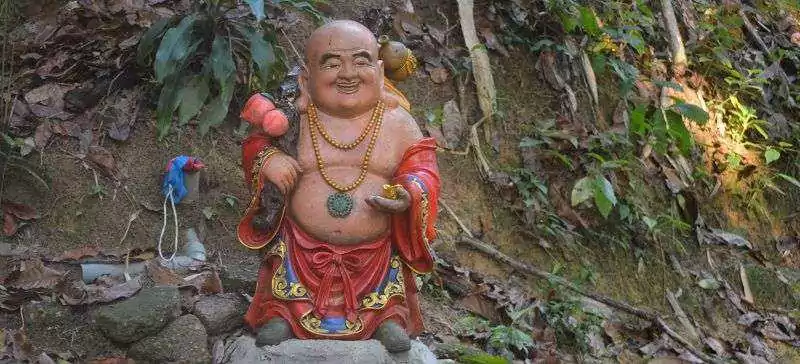
The fat Buddha statue — known as Budai (or Hotei in Japanese) — is one of the most misidentified figures in Buddhist art. Many people assume he is the historical Buddha (Shakyamuni), but they are completely different figures. The Laughing Buddha is based on a real Chinese Buddhist monk who lived during the Later Liang Dynasty (907–923 CE). His name Budai means “cloth sack” — a reference to the large sack he carried everywhere, filled with candy and small gifts for children and the poor.
Budai’s large belly symbolizes abundance, contentment, and the capacity to hold great joy. He is commonly depicted surrounded by children — symbols of wealth and prosperity in Chinese culture — and Chinese Buddhists believe he is an earthly incarnation of the future Buddha Maitreya. His widespread association with wealth, good luck, and happiness makes Laughing Buddha statues especially popular in businesses and homes as symbols of prosperity. Rubbing his belly is a traditional folk practice for invoking good fortune.
What is the Man and Woman in Embrace? (Yab Yum)
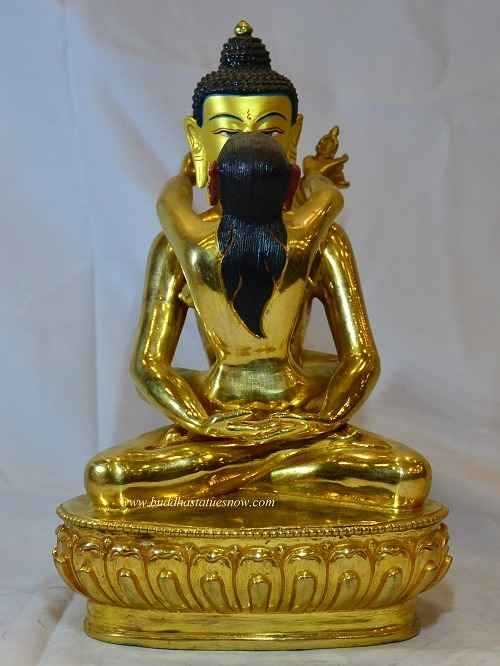
The union of male and female deities depicted in Himalayan Buddhist art is known as Yab Yum (Tibetan for “father-mother”) — also referred to in Sanskrit as Shakti. It is a depiction of the primordial, inseparable union of wisdom and compassion — the two qualities that together constitute full enlightenment. The origins of this iconography are found in the Anuttarayoga Tantra of Vajrayana Buddhism.
In the Yab Yum image, the male deity represents compassion (skillful means) and the female deity represents wisdom (prajna). Their embrace is not a depiction of physical intimacy in the ordinary sense — it is a profound philosophical statement: enlightenment is achieved only when compassion and wisdom are completely integrated and inseparable, each giving rise to and sustaining the other. Yab Yum statues can be depicted in peaceful or wrathful form, depending on the deity pair and the practice context.
Why Are There So Many Buddha Statues?
Although there is only one historical Buddha (Shakyamuni), there are many other Buddhas, Bodhisattvas, and Buddhist deities — each representing a specific dimension of enlightened awareness. As a result, many “Buddha statues” are not actually depictions of the historical Buddha at all, but of a different Buddhist deity entirely. The most common case of mistaken identity is the Laughing Buddha (Budai) — a beloved Chinese folk deity — being confused with Shakyamuni.
Additional confusion arises because many Buddhas and Bodhisattvas are known by several different names depending on the Buddhist school or geographic region. For example, the historical Buddha is called Shakyamuni, Gautama Buddha, Siddhartha, and simply “the Buddha” — all referring to the same person. Similarly, Avalokiteshvara is called Chenrezig in Tibet and Guanyin in China, while referring to the same Bodhisattva of Compassion. The mudras and postures of the statue remain the most reliable way to cut through the confusion and discover the true identity of any figure.
Can I Receive a Buddha Statue as a Gift?
Yes — receiving a Buddha statue as a gift is entirely acceptable and carries no negative karma. The only practical issue is that waiting for someone else to give you a specific statue can result in significant delays. If you feel drawn to a particular statue, there is no reason to wait — purchasing your own statue is itself considered a meritorious act. The self-sacrifice involved in acquiring a valuable statue shows genuine commitment, and this intention is recognized in Buddhist teaching as a source of merit in its own right.
How Do I Know I Bought the Right Buddha Statue?
In addition to the information contained in this Buddha statue buyer’s guide, all product listings on this site are clearly identified and described in detail. If you are unsure about a specific statue — its identity, meaning, or suitability for your purposes — please contact me before committing to a purchase. I am always available to answer questions and provide personalized guidance. The right statue is the one that resonates with you, is correctly identified, and is placed and used with sincerity.
Why Do People Pray to Buddha Statues?
Buddhism does not require that devotees pray to Buddhist deities or even to the Buddha himself. The Buddha’s own teaching emphasizes personal responsibility — “one’s own karma is one’s own property” — and the path of meditation, ethical conduct, and wisdom as the means of liberation. Nonetheless, many devotees do offer prayers to statues and deities for inspiration, blessings, and favor. This is analogous to Christians praying to the Virgin Mary or saints — a devotional practice that arises from sincere faith even when not doctrinally mandated. Read more about whether Buddhists worship Buddha statues.
In Vajrayana (Tibetan) Buddhism, formal practice before a statue is highly structured — including mantra recitation, visualization, prostrations, and offerings. The statue serves as the focal point for invoking the deity’s qualities and receiving their blessing. In this context, praying to or before a Buddha statue is not worship of an idol but a sophisticated method of training the mind to embody the qualities the statue represents.
What Goes on a Buddhist Altar?
Beyond a Buddha statue, common offerings on a Buddhist altar include flowers, incense, candles, fruit, a bowl of water, and a lotus. Each offering carries specific Buddhist significance:
- Incense — the sweet fragrance of incense represents morality — a pure, pleasant quality that permeates one’s surroundings naturally, as virtue does. It encourages pure moral conduct.
- Flowers — embody impermanence: their beautiful colors and fragrance will soon fade and decay, teaching practitioners not to cling to pleasant experiences.
- Fruit — symbolizes the rewards of Nirvana that await the faithful practitioner who follows the path to its fruition.
- Water — represents purity, clarity, and calmness. A mind like still, clear water can reflect reality accurately and resist the defilements of samsara.
- Lotus — symbolizes the Buddha himself and the potential of all beings: the lotus grows from muddy pond water yet blossoms into perfect purity above the surface — an image of enlightenment arising from samsara.
- Candles / butter lamps — the burning flame signifies the triumph of wisdom (light) over ignorance (darkness).
Why Are Some Buddha Statues Standing?
The standing or walking posture of a Buddha statue simply reflects one of the physical positions the Buddha or a Bodhisattva uses when actively teaching, walking between communities, or engaging with the world. The meaning of any standing statue is primarily determined by its mudra (hand gesture) — the most common mudras for standing figures are the Abhaya mudra (protection — right hand raised, palm forward) and the Varada mudra (generosity — right arm extended downward, open palm). Many standing Buddhas display both simultaneously.
A celebrated tradition of standing Buddha statues is the Sukhothai style, which originated in 13th-century Thailand. Sukhothai standing Buddhas are elegant and distinctive — the pointed ushnisha on their head reaches toward the sky like a flame ascending toward enlightenment. The first known standing Tara statue, however, predates Sukhothai by six centuries — dating to the 7th century CE and still visible today at the Ellora Cave complex in India.
Are Your Statues Gilded with Pure Gold?
Yes — as indicated in each product description, our gold Buddha statues are gilded with 24 karat pure gold. The primary benefit of 24K gold gilding is that it will never tarnish — the statue preserves its luminous beauty indefinitely. Many of our finest statues also feature gold face painting using real liquid gold mixed into the pigment — contributing to the lifelike, luminous quality that distinguishes authentic Nepali statues from all inferior alternatives.
In contrast, Buddha statues gilded with less than 22 karat gold will tarnish and discolor over time. Collectors and practitioners who invest in a statue for lifetime use consistently prefer the 24K gold standard — not only for its permanence but for the unparalleled depth and warmth of its luster, which lower-quality gold simply cannot replicate.
Why Isn’t the Face Fire Gilded?
Although the metal surfaces of our finest Buddha statues are traditionally fire gilded in 24K pure gold, the face is finished using a different technique. Rather than fire gilding, master Newar artisans hand-paint the face with genuine 18K gold mixed into natural pigments. This centuries-old method produces the warm, soft complexion characteristic of authentic Himalayan Buddhist sculpture while allowing the artisan to create the subtle shading, lifelike expression, and delicate facial features that would be impossible to achieve with fire gilding alone.
Using real gold in the facial paint preserves the traditional appearance expected of monastery-quality statues while complementing the brilliant 24K fire gilding on the crown, jewelry, robes, and other ornamental details. Together, these two techniques represent the highest standard of craftsmanship practiced by the master artisans of Patan, Nepal, and are among the distinguishing characteristics of an authentic handcrafted Nepali Buddha statue.
How Do I Spot a Fake Gold Buddha Statue?
Fake gold Buddha statues using imitation gold are usually identifiable on close inspection. Placed side by side with an authentic 24K gold gilded statue, the difference is unmistakable — authentic 24K gold leaf shines brilliantly in all the right places, most effectively illuminating the prominent carved features of the statue. Imitation gold appears flat, uneven, or artificially bright in comparison.
Additional signs of an imitation gold statue include visible brush strokes where the finish has been applied with a brush rather than the traditional fire gilding process. Common forms of imitation gold include composition gold leaf and Dutch metal — neither contains real gold; instead they are composed of brass, copper, and zinc. Over time these materials oxidize to a dull green luster. To prevent this, sellers sometimes apply a clear topcoat sealant — which itself appears unnatural and can be detected by an experienced eye.
What Did the Buddha Really Look Like?
Based on traditional Buddhist textual accounts and historical scholarship, we can describe with reasonable confidence that the historical Buddha had blue eyes, long dark hair, light golden-brown skin, and was likely above average in height — consistent with his royal Shakya lineage in what is now southern Nepal. The Buddha’s appearance changed significantly after his Great Renunciation at age 29.
Before renunciation, Prince Siddhartha would have worn his hair in a royal topknot, carried facial jewelry in his elongated earlobes, worn fine silk robes and elaborate adornments, and been generally indistinguishable from other Indian royalty of his era. After renunciation, he adopted the simple robes of a wandering monk, shaved his head and face, and kept this appearance for the remaining 45 years of his life. For a detailed discussion, see our guide to the physical characteristics of the Buddha.
Why Are Some Buddha Statues Lying Down?
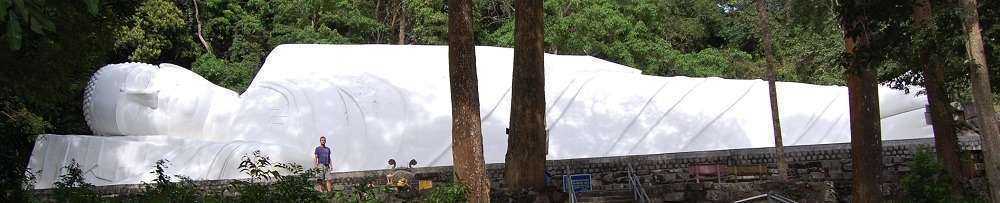
Reclining Buddha statues depict the historical Buddha in the final moments of his mortal life — lying on his right side, head resting on a pillow or supported by his right hand propped on his elbow. This is the image of the Buddha entering Parinirvana at Kushinagar, India, approximately 483 BCE, at the age of 80.
Parinirvana is not death in the ordinary sense — it is the permanent, irreversible release from the cycle of rebirth that occurs when a fully enlightened being’s physical body dissolves at the end of their final life. The Buddha had achieved Nirvana (full enlightenment) 45 years earlier at Bodh Gaya; Parinirvana is the final stage — the dissolution of the last physical body while the enlightened mind rests permanently beyond samsara. Reclining Buddha statues are therefore also called Nirvana Buddha statues — representing not death, but the ultimate liberation from suffering.
Why is the Buddha’s Head Pointed?
The cranial protuberance on the head of a Buddha statue is called the ushnisha. Originally the topknot hairstyle worn by Hindu royalty in ancient India, the ushnisha became associated with the historical Buddha because Prince Siddhartha was born into royal lineage in the Shakya kingdom (present-day Lumbini, Nepal). Over time, the ushnisha evolved in Buddhist iconography to become a stylized cranial protrusion — no longer a hairstyle but a permanent auspicious mark symbolizing the supreme wisdom of a fully enlightened being.
The ushnisha meaning in Buddhist iconography is described in ancient texts as “the attainment of reliance on the spiritual guide” — the quality of wisdom that arises from deep learning, practice, and the teacher-student transmission. It is now common to all Buddhas and Bodhisattvas in Himalayan Buddhist art, not exclusively to Shakyamuni.
Why Are the Buddha’s Ears So Large?
As Prince Siddhartha Gautama, the historical Buddha wore large, heavy rings in his earlobes — the customary symbol of wealth and royalty among the nobility of ancient India. When he renounced his kingdom at age 29 and went to live as a wandering renunciant, he removed the rings — but his earlobes had been permanently stretched by years of wearing heavy jewelry, and they remained elongated for the rest of his life.
Over time, the elongated earlobes of the Buddha became one of the auspicious physical marks attributed to all Buddhas and Bodhisattvas. The elongated ear meaning evolved beyond their historical origin to carry a deeper significance: enlightened beings can hear all the suffering of the world — their enlarged ears symbolizing infinite compassion and the capacity to perceive distress in every realm and direction simultaneously.
What is the Oval on the Buddha’s Forehead?
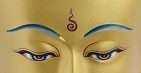
The oval or circular mark between the eyebrows of a Buddha statue is called the urna — also commonly known as the third eye. It is one of the traditional auspicious physical marks of the Buddha recorded in ancient texts, and it appears on virtually every Buddhist statue from the earliest period of Buddhist art (2nd century CE) to the present day.
The urna meaning is the capacity to see into the divine realms — the enlightened wisdom that perceives reality beyond the ordinary six senses. Buddhas and Bodhisattvas possess ultimate insight knowledge, and the urna visually communicates this omniscient vision. It also functions as an auspicious mark in its own right, widely believed to generate positive energy and protective blessings in the environment where the statue is placed.
Why Are Some Buddha Statues Holding a Bowl?
There are two types of bowls depicted in Buddha statues — each with a distinct meaning:
Alms Bowl
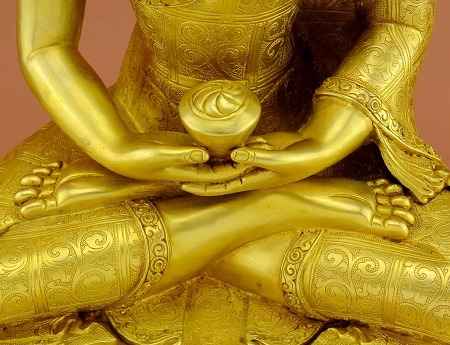
The alms bowl (patra) is what Buddhist monks use to collect food and donations from the local community — a direct expression of the reciprocal relationship between monastics (who preserve and teach the Dharma) and laypeople (who provide material support). Symbolically, the alms bowl is associated with the three nectars that eliminate the three poisons: greed, hatred, and ignorance — the root causes of all suffering. The Buddhas most commonly depicted holding the alms bowl are Shakyamuni and Amitabha Buddha.
Medicine Bowl
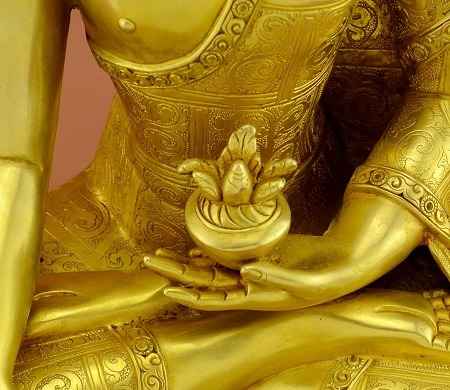
The lapis lazuli medicine bowl is the defining attribute of Medicine Buddha (Bhaisajyaguru). His bowl is filled with the lapis nectar that heals all suffering — both physical illness and the deeper sicknesses of greed, hatred, and ignorance that Buddhist teaching identifies as the ultimate source of all disease. The blue of the bowl mirrors the color of Medicine Buddha’s own body, connecting the vessel of healing to the healer himself.
Can Buddha Statues Be Filled with Mantras?
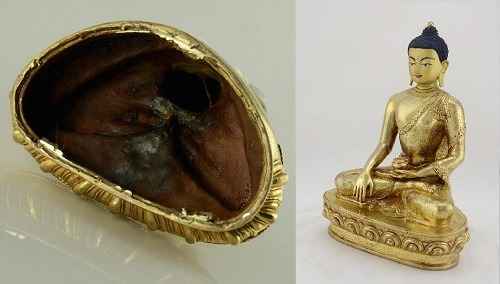
Yes — all of our Nepali Buddha statues come with a removable base and are hollow inside, allowing them to be filled with mantras, sacred herbs, precious substances, and other traditional filling materials. Filling a statue before sealing the base is a traditional practice that activates the statue spiritually — transforming it from a beautiful art object into a fully consecrated object of refuge with genuine merit-generating power.
Do You Cover the Face of the Buddha Statue?
Yes. We understand that for some buyers — particularly those in Tibetan Buddhist lineages — it is traditional not to see the face of a statue before it has been blessed by their personal guru or consecrated in a formal ritual. If this is your preference, please let us know and we will safely wrap the face of the statue before shipping. This wrapping serves the dual purpose of protecting the delicate gold face painting during transit and covering the face for ritual purposes upon arrival.
Do You Offer Filling and Consecration Services?
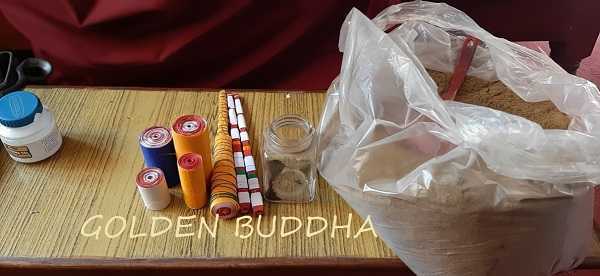
Yes — we work with qualified lamas and gurus in Nepal who are specially trained to perform the traditional filling and consecration (rabne) of Buddhist statues. The cost for filling materials is a fixed price based on the size of the statue. The consecration service is offered as a voluntary contribution (dana) to the monastery — not a commercial charge. Please contact us before shipping if you would like to arrange filling and consecration of your statue at Sangye Choeling Monastery in Kathmandu prior to export.
Are Your Nepali Statues Certified?
Yes — all of our Nepali Buddha statues are certified by the Department of Archaeology in Kathmandu before export. This government certification confirms the statue’s authenticity as a legitimate handcrafted Nepali artifact and ensures compliance with Nepal’s cultural heritage export regulations. All ritual items and Tibetan thangkas requiring certification will have the relevant documentation included with your purchase. Read more about government certification and statue authenticity.
Fire Gilded vs Electroplated — What is the Difference?
We use both methods on our Buddha statues and ritual items, with the vast majority of our finest statues being fire gilded. Here is what each method means:
Fire gilding (24K gold gilded): The traditional method used by Patan’s shakya artisans for centuries. Pure 24K gold is mixed with mercury to form an amalgam, applied to the copper statue by hand, and then fired at high temperature — the mercury burns away, leaving a flawless, pure gold finish bonded directly to the metal. The result is a deep, luminous golden surface that will never tarnish. Statues labeled “24K gold gilded” or “fire gilded” have been finished using this method.
Electroplating (gold plated): A modern industrial process in which a thin layer of gold is deposited onto the surface of the statue using an electrical current. Electroplating is less expensive and produces a uniform surface, but the gold layer is thinner and may eventually wear or discolor over time. Statues labeled “gold plated” have been finished using this method.