

Every statue in the Golden Buddha collection is a handcrafted original — but for collectors, practitioners, and Dharma centers with specific iconographic requirements, we also accept fully customized commissions. A custom Tibetan Buddhist statue created by our Shakya master artisans in Patan, Nepal is not simply a made-to-order product. It is a one-of-a-kind sacred object, carved by hand in wax, cast in copper alloy, and fire gilded in 24K gold — executed to your exact specifications, with photo documentation at every stage of the process from the first wax carving through to the final face painting before shipping.
The three statues featured on this page — a Chenrezig with a hand-carved floating mala, a Manjushri in a dynamic non-traditional posture, and a fully gold gilded Vajrasattva — are all custom commissions created by the same master artisan. They represent the full range of what is possible: from structurally unique features that require custom wax engineering, to dynamic sculptural poses that sit at the intersection of Himalayan iconographic precision and pure artistic mastery.
Contents
- The Shakya Artisans — Descendants of the Historical Buddha
- The Lost Wax Method — Why Every Statue is an Original
- A Custom Chenrezig with Floating Mala
- A Custom Manjushri — Himalayan Iconography Meets Classical Mastery
- A Custom Vajrasattva — A Masterpiece in Traditional Form
- 24K Gold Fire Gilding — A Finish That Lasts Indefinitely
- The Custom Order Process — From Brief to Delivery
- Why Commission a Custom Statue from Golden Buddha?
- Frequently Asked Questions
The Shakya Artisans — Descendants of the Historical Buddha
The Shakya artisans of Patan are the primary sculptors of sacred Tibetan Buddhist statues and have been for over a thousand years. The word Shakya derives from Sanskrit — “the one who is capable” — and the history of the Shakya caste predates the birth of Gautama Buddha himself. The historical Buddha was born into the Shakya Kingdom in what is now Lumbini, Nepal. The Newar Shakya artisans of Patan are his direct descendants — making them, uniquely in the world, the inheritors of both the blood lineage of Shakyamuni Buddha and the thousand-year craft tradition of creating his image in metal, gold, and stone.
The Shakya caste forms the core pillar of the Newar artisan community in Patan — the historic city in the Kathmandu Valley that has functioned as the production center for Tibetan monastery statues since at least the 10th century CE. The sculpting techniques of the master Shakya artisans have been passed down through family lineages for generations, refined over centuries of monastic commissions, and protected as closely guarded family knowledge. When you commission a custom statue through Golden Buddha, you are placing your order directly in the hands of this living tradition.
The Lost Wax Method — Why Every Statue is an Original
All custom statues — and every statue in the Golden Buddha collection — are created using the traditional lost wax casting method (cire perdue), the same technique used by Newar artisans to supply Tibetan monasteries for over a millennium. The process begins with a master sculptor carving a precise wax replica of the deity entirely by hand. The quality of this wax carving determines everything — the depth of engraving, the expressiveness of the face, the accuracy of iconographic details, and the fineness of the crown jewels, robes, and implements. No shortcuts are possible at this stage; the wax must be perfect before the cast is made.
Once the wax carving meets the artisan’s standard, it is coated in a specially prepared mixture of clay that hardens around every surface. A small hole is left at the base. When heat is applied, the wax melts and drains out entirely — this is the “lost wax” step that gives the method its name. The result is a hollow clay mould in the exact form of the deity. Molten copper alloy is then poured in, allowed to cool, and the mould is carefully broken away to reveal the metal statue within. Because the clay mould is destroyed in this process, no two statues cast from different wax originals can ever be identical. Every statue is a one-of-a-kind original sculpture.
For custom commissions, the wax carving stage is also the critical window for structural modifications. Features such as a floating mala, a removable implement, an unusual posture, or a non-standard iconographic element must be designed and integrated at the wax stage — because once the statue is cast in copper, structural changes of this kind cannot be implemented without creating an entirely new wax mould from scratch. This is why we send detailed wax-stage photographs to every custom order customer before proceeding to the cast.
A Custom Chenrezig with Floating Mala
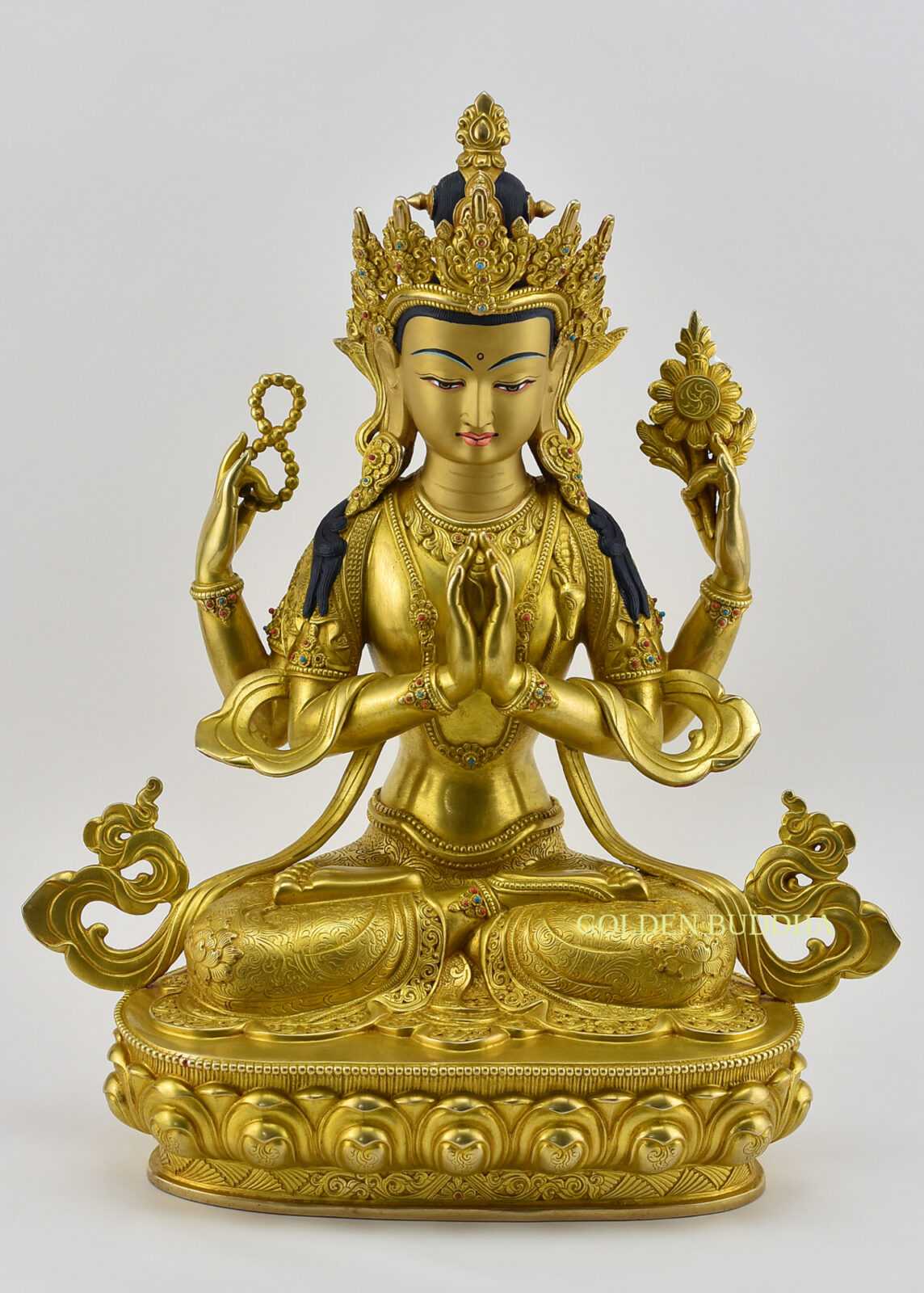
The most technically demanding feature requested in a custom commission is often something that appears, to the eye, almost effortlessly simple. The Chenrezig statue below was commissioned with a floating crystal mala — a strand of hand-carved beads suspended in space between two of his four hands, connected to neither, appearing to hang freely in the air. This is not a standard feature of Chenrezig iconography. It required the artisan to engineer the mala directly into the wax carving, supported by the most slender of connections, before the statue was cast. The result is a technically remarkable piece that reads, spiritually, as entirely natural — Chenrezig eternally reciting the Om Mani Padme Hum mantra, mala in motion.
A Custom Manjushri — Where Himalayan Iconography Meets Classical Mastery
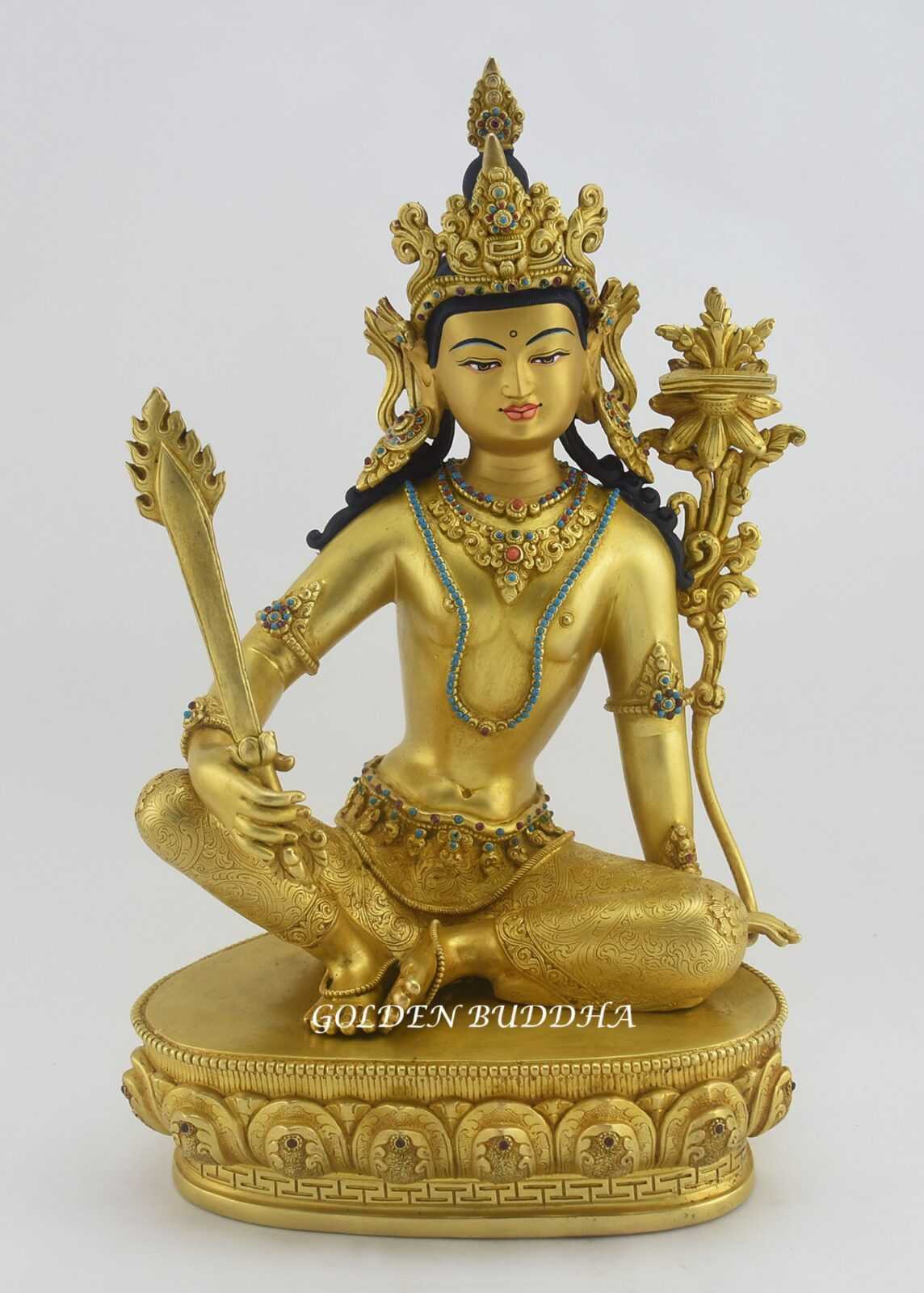
The Manjushri statue below was commissioned with a specific sculptural brief: a dynamic, asymmetric posture that departs from the formal frontal seated conventions of traditional Himalayan iconography while preserving every element of correct Manjushri iconography — the sword of wisdom, the Prajnaparamita sutra, the lotus stems, the Bodhisattva crown and jewels. The result sits at a rare intersection: it is unmistakably Manjushri, iconographically precise in every detail, yet executed with a naturalistic, almost Renaissance quality of physical movement and weight that brings the figure alive in a way rarely seen in traditional Tibetan Buddhist statuary. The pose itself is a custom design; the iconographic content is classical. Together, they produce a piece that is as much fine art as sacred object.
This is the kind of commission our Shakya artisans genuinely excel at — not departing from the tradition, but moving within it with the freedom that comes from complete mastery of it.
A Custom Vajrasattva — A Masterpiece in Traditional Form
Not every custom commission involves structural innovation or non-traditional posture. The Vajrasattva statue below is a masterpiece of the classical form — traditional mudra, traditional iconography, traditional seat — but executed at a level of detail and finish that places it firmly in the category of monastic commission rather than standard production. Every element of the engraving on the lotus throne, the robes, and the crown has been hand-worked with exceptional precision. The 24K gold fire gilding has been applied with the even, deep luster that only comes from a master artisan with decades of experience. The face painting, in real gold pigment, gives the statue its serene, lifelike quality. Custom commissions of this kind — where the brief is simply “the best possible version of this deity” — are often the most quietly extraordinary pieces we produce.

24K Gold Fire Gilding — A Finish That Lasts Indefinitely
Every custom statue we produce is finished using the traditional fire gilding method — the same technique used by Newar artisans to gild Tibetan monastery statues for centuries. A mixture of 18K gold and mercury is applied evenly across the copper surface, then high heat is applied using a flame torch. The mercury evaporates completely, leaving a residual finish of 24K pure gold permanently bonded to the copper. The result is a finish that will never tarnish, never fade, and retains its warm, deep golden luster indefinitely — unlike electroplated gold, which is a surface coating and will wear over time. All Golden Buddha custom statues are fire gilded; we use electroplating on one or two standard listings in the collection, but never for custom commissions.
Finish options for custom commissions include: fully 24K gold fire gilded, partly gold gilded with oxidized or antiqued copper on robes or hair, antique copper finish with selective gold gilding on the face and crown, or silver plating. The finish can be adjusted and refined after the copper cast is complete — this stage is more flexible than the wax stage, and we welcome customer input at this point before the final face painting is applied.
The Custom Order Process — From Brief to Delivery
Our custom statue process is transparent at every stage. Once we receive your brief — deity, size, iconographic requirements, finish preferences, and any special features — we commission the wax carving with the artisan and send you photographs of the completed wax model before the cast is made. This is the most important review point in the entire process. Structural features such as floating implements, removable objects, unusual postures, or non-standard iconographic elements can only be incorporated at this stage. After the cast is made, these changes are not possible without starting the wax carving again from scratch.
After the copper cast is complete and polished, we send a second round of photographs showing the statue in its raw copper state. At this point, finishing decisions — gilding extent, antique treatment, silver plating — can be confirmed or adjusted. Once the gilding and face painting are complete, we send a final set of photographs before shipment. The statue in those photographs is the exact statue you will receive — no substitutions, no variations. Every custom statue ships directly from Kathmandu with a certificate of authenticity issued by Nepal’s Department of Archaeology, verifying the statue’s materials, technique, and country of origin. Consecration (rabne) at Sangye Choeling Monastery in Kathmandu is also available upon request before shipping.
Timeline
The timeline for a custom commission depends on its complexity. A fully custom masterpiece statue — carved from scratch in wax by the master artisan, incorporating unique structural features or a non-standard posture — requires approximately 6 weeks from commission to completion. A smaller statue of a deity that the artisan regularly produces, requiring standard iconography with a custom finish, can typically be completed in 2–3 weeks. If a statue already exists in copper form and requires only a custom finish and face painting, the timeline is shorter still — in some cases as few as 7–10 days depending on the finish complexity. We will always confirm an accurate timeline with you before accepting the commission.
Why Commission a Custom Statue from Golden Buddha?
The Shakya artisans who create our statues have spent their lives — and their family lineages have spent centuries — perfecting the art of sacred Buddhist sculpture. They understand iconographic requirements at the level of trained practitioners, not simply as design specifications. They can work with iconographic texts, thangka references, teacher instructions, or your own descriptions of what a statue needs to be. Their flexibility is not the flexibility of a generic manufacturer; it is the flexibility of a master craftsperson who has complete command of a tradition and can therefore move freely within it.
If you have a specific deity, size, iconographic requirement, finish preference, or structural feature in mind — or if you simply want the finest possible version of a statue for your altar, Dharma center, or monastery — we welcome your inquiry. Contact us directly to discuss your commission.
Frequently Asked Questions
Can I commission a statue of any Tibetan Buddhist deity?
Yes. Our Shakya master artisans have produced statues of the full range of Tibetan Buddhist deities — Buddhas, Bodhisattvas, Dharmapalas, Dakinis, Tibetan Gurus, and Yidams. If you have a specific deity in mind, including less commonly depicted forms or regional iconographic traditions, we can work with you to establish the correct iconographic specifications before the wax carving begins. Iconographic references — thangkas, texts, photographs of existing statues — are welcome and helpful.
How long does a custom Tibetan Buddhist statue take to produce?
A fully custom masterpiece statue carved from scratch in wax — including structural features, custom posture, or non-standard iconographic elements — takes approximately 6 weeks from commission to completion. A smaller statue of a regularly produced deity with a custom finish typically requires 2–3 weeks. If a statue already exists in copper form and only requires a custom finish and face painting, the timeline can be as short as 7–10 days. We confirm the timeline with you before accepting the commission.
What custom features can be incorporated into a statue?
Structural features — such as floating implements, removable objects (a hat, a removable offering item), unusual postures, floating malas, or non-standard iconographic elements — must be designed and integrated at the wax carving stage. After the copper cast is made, structural changes of this kind are not possible without creating a new wax mould. Finish decisions — extent of gilding, antique or oxidized treatment, silver plating, selective gold highlighting on specific elements — are more flexible and can be adjusted after the cast is complete. Face painting details are finalized in the last stage and can also be refined to your requirements.
What is the difference between fire gilding and electroplating?
Fire gilding (also called mercury gilding) is the traditional Newar method in which 18K gold is mixed with mercury and applied to the copper surface, then heated with a flame torch until the mercury evaporates completely, leaving 24K pure gold permanently bonded to the copper. The result never tarnishes and retains its luster indefinitely. Electroplating applies gold as a surface coating using an electric current — the coating is thinner, will wear over time, and does not produce the same depth of color or longevity as fire gilding. All Golden Buddha custom commissions use 24K gold fire gilding.
Will I receive photos during the production process?
Yes — photo documentation is a standard part of our custom order process. We send photographs of the completed wax carving before the cast is made (the most critical review stage for structural features), photographs of the copper cast before gilding, and final photographs of the completed and finished statue before shipment. The statue in those final photographs is the exact statue you will receive. No substitutions are made between the final approval and shipping.
Do custom statues come with a certificate of authenticity?
Yes. Every custom statue ships from Kathmandu with a certificate of authenticity issued by Nepal’s Department of Archaeology, verifying the statue’s materials, technique, and country of origin. This is a standard export requirement for all Nepali handicrafts and is included with every order. Consecration (rabne) at Sangye Choeling Monastery in Kathmandu is also available upon request, formally activating the statue as an object of devotional practice before it ships.