
White and Green Tara Thangka Paintings
Tara is the mother of liberation, the most beloved female figure in Tibetan Buddhism and the deity to whom practitioners turn first in difficulty. Tradition holds that she was born from a tear shed by Avalokiteshvara as he wept over the endless suffering of beings – and that when she was advised to pray for rebirth as a man in order to progress, she vowed instead to attain enlightenment in female form, and to keep appearing in female form until samsara itself is empty. Read the full account in our guide to Tara’s origins and meaning. This collection holds thangka paintings of her two most widely practiced emanations, White Tara and Green Tara, each with its own iconography, mantra, and purpose.
White Tara, known as Dolkar in Tibetan and Cintachakra in Sanskrit – the wish-fulfilling wheel – is the goddess of long life, healing, and serenity. She is painted a luminous moon white, seated in full lotus pose, one hand open at the knee in the Varada gift-giving mudra and the other raised at the heart holding the stem of an utpala lotus. Her defining feature is her seven eyes: two on her face, a third upright on her forehead, and one on each palm and each sole, so that her compassionate awareness extends in every direction at once – the reason she is called the Seven-Eyed goddess. She is one of the three Tibetan long life deities alongside Amitayus and Namgyalma, and her practice is undertaken for recovery from illness, for the removal of obstacles to life and practice, and frequently on behalf of someone else who is unwell. Learn more about the meaning of her seven eyes.
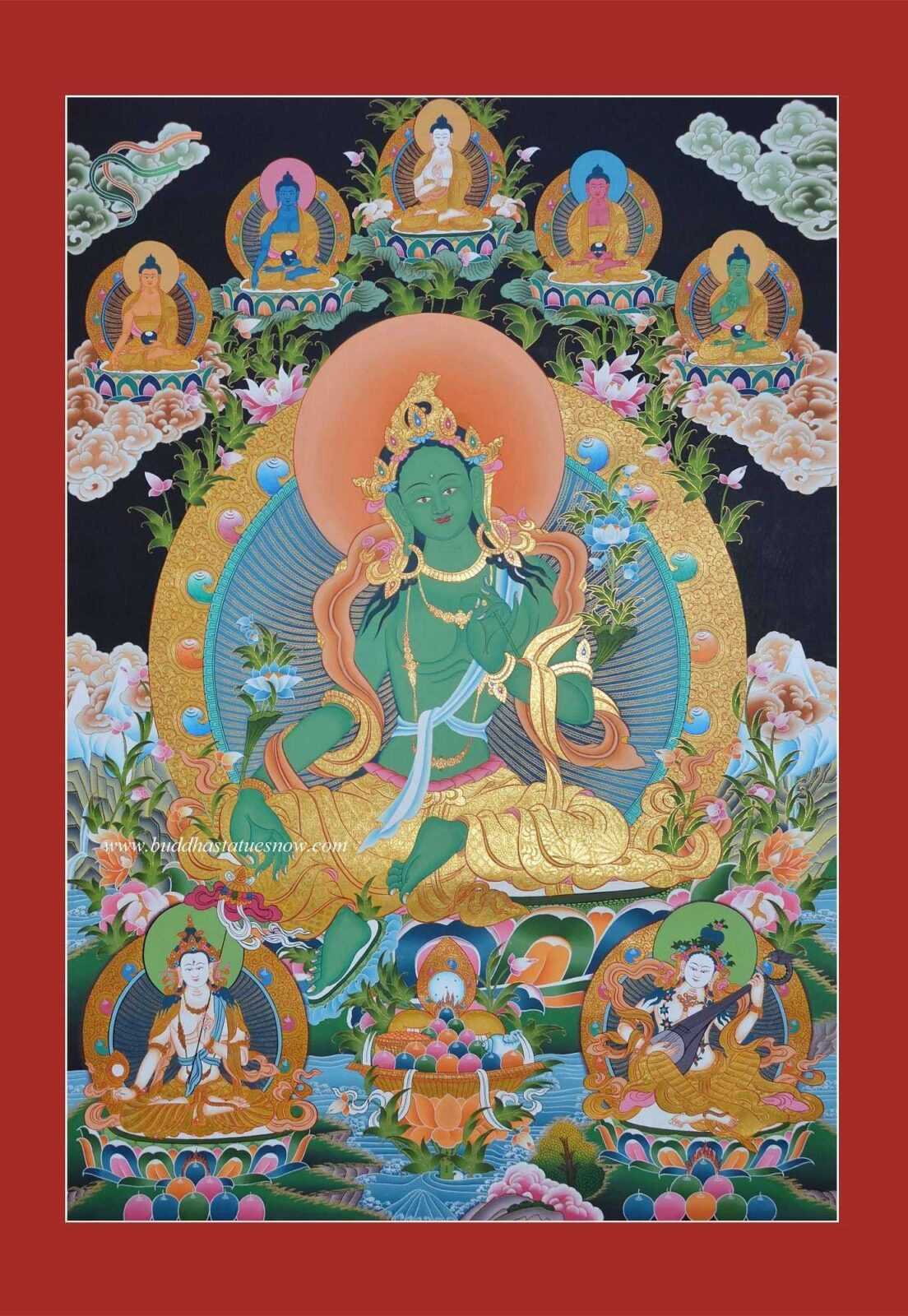
Green Tara, Jetsun Dolma in Tibetan, expresses the same compassion in its swift and active aspect. Where White Tara sits in full meditation, Green Tara is painted in lalitasana, the posture of royal ease, with her right leg extended toward the ground – a gesture understood to mean she is already rising to step forward and answer the call of a being in distress. She holds the stem of an utpala lotus at her heart, and her right hand rests open in the Varada mudra. She is invoked above all for protection, traditionally from the eight great fears – the outer dangers of lions, elephants, fire, snakes, thieves, imprisonment, water and demons, and the inner afflictions each of them represents.
Every painting in this category is hand painted in Nepal by Himalayan artists trained in the traditional schools, working to the iconometric grids that govern each form’s proportions, posture, and attributes, and finished with genuine 24K gold detailing applied by hand to the jewelry, lotus throne, and aureole. Sizes run from 22 inches, well suited to a personal altar or meditation room, up to a 50 inch work mounted in traditional silk brocade and ready to hang as the central image of a shrine room or Dharma center. Many practitioners keep both forms, since the two express complementary aspects of the same Bodhisattva. Browse the full range of Tibetan thangka paintings, or see Tara rendered in copper alloy among our White Tara statues and Green Tara statues.
Showing all 6 resultsSorted by popularity
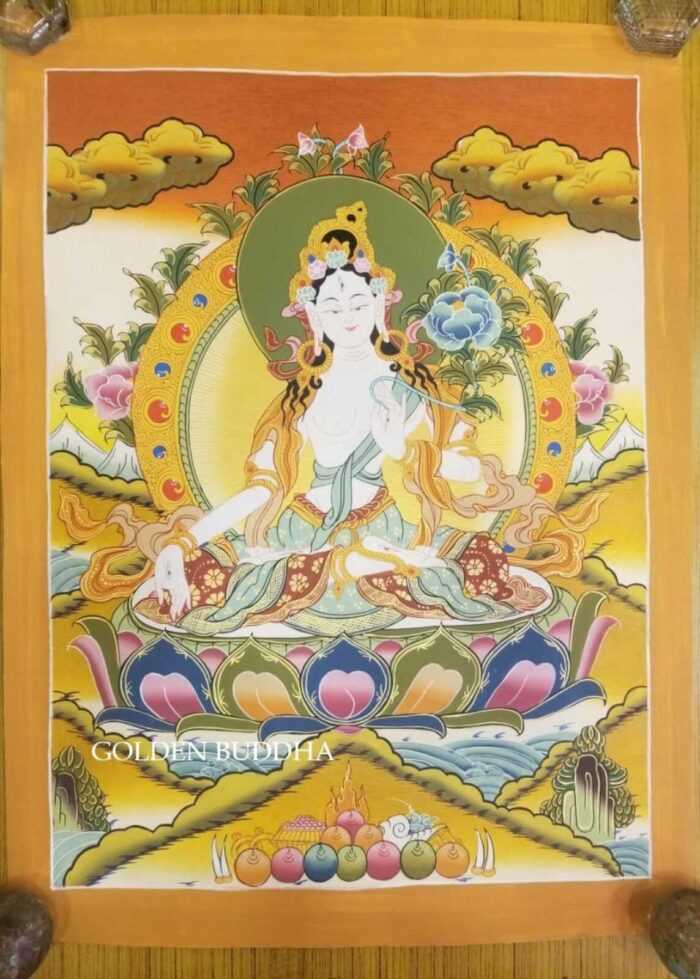
White Tara Tibetan Thangka, 22″ x 16.5″, Hand Painted with Gold Detail
Original price was: $219.00.$179.00Current price is: $179.00.Add to Cart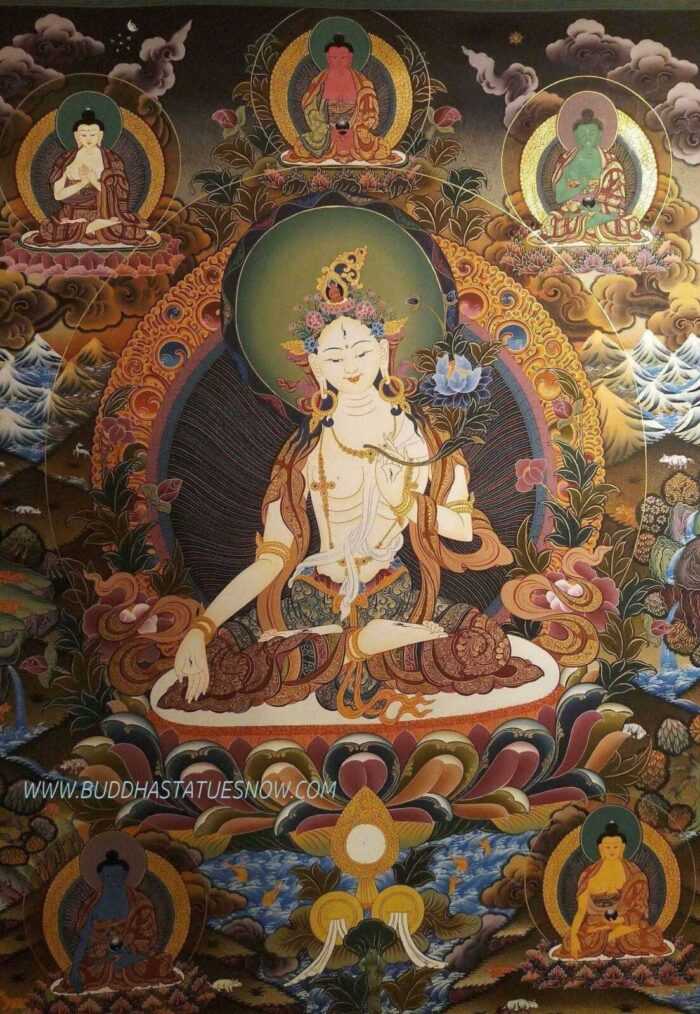
White Tara Thangka Painting, 37.5″ x 27.5″, Hand Painted 24k Gold Detailing
Original price was: $1,199.00.$899.00Current price is: $899.00.Add to Cart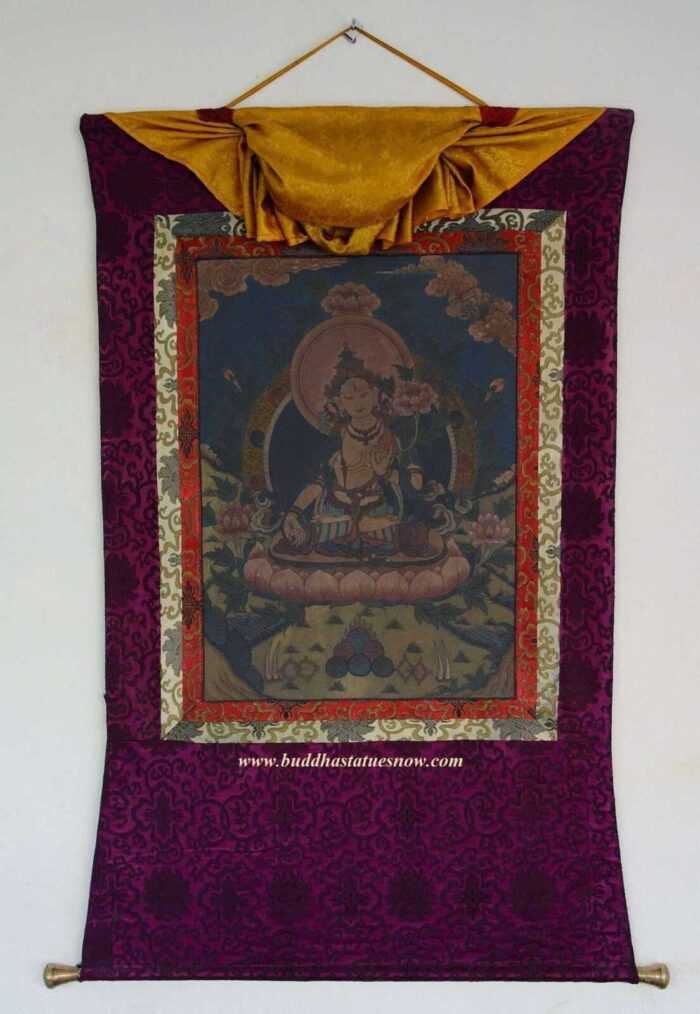
White Tara Thangka, 50.25″ x 32.75″, Silk Brocade Frame, 24K Gold Detailing
Original price was: $799.00.$599.00Current price is: $599.00.Add to Cart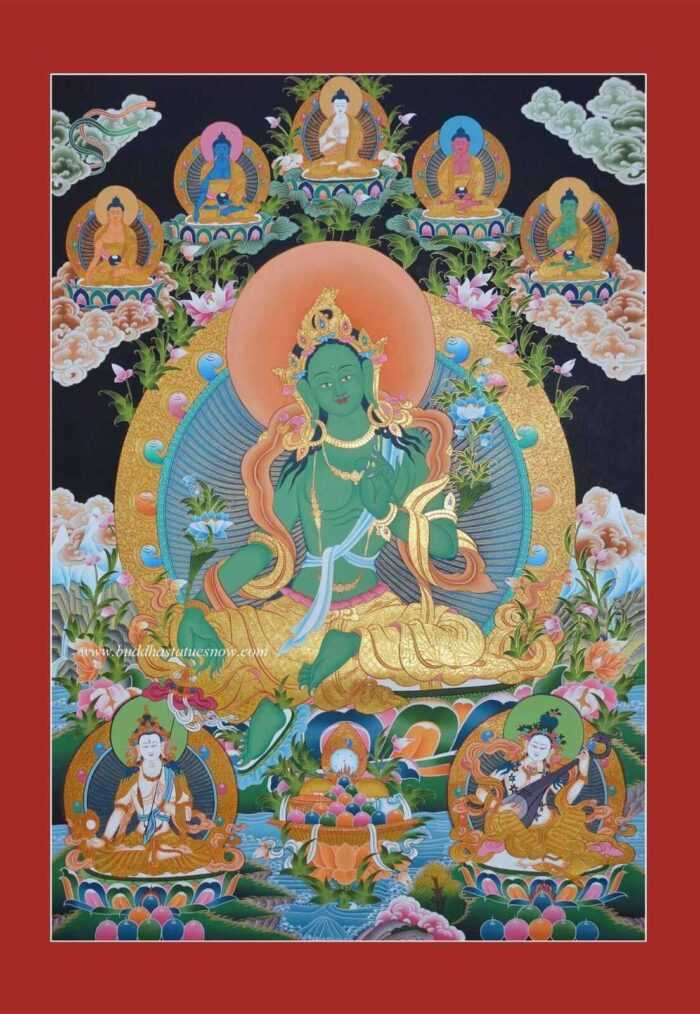
Green Tara Tibetan Thangka, 32.5″ x 23.5″, Hand Painted 24k Gold Detailing
Original price was: $1,299.00.$799.00Current price is: $799.00.Add to Cart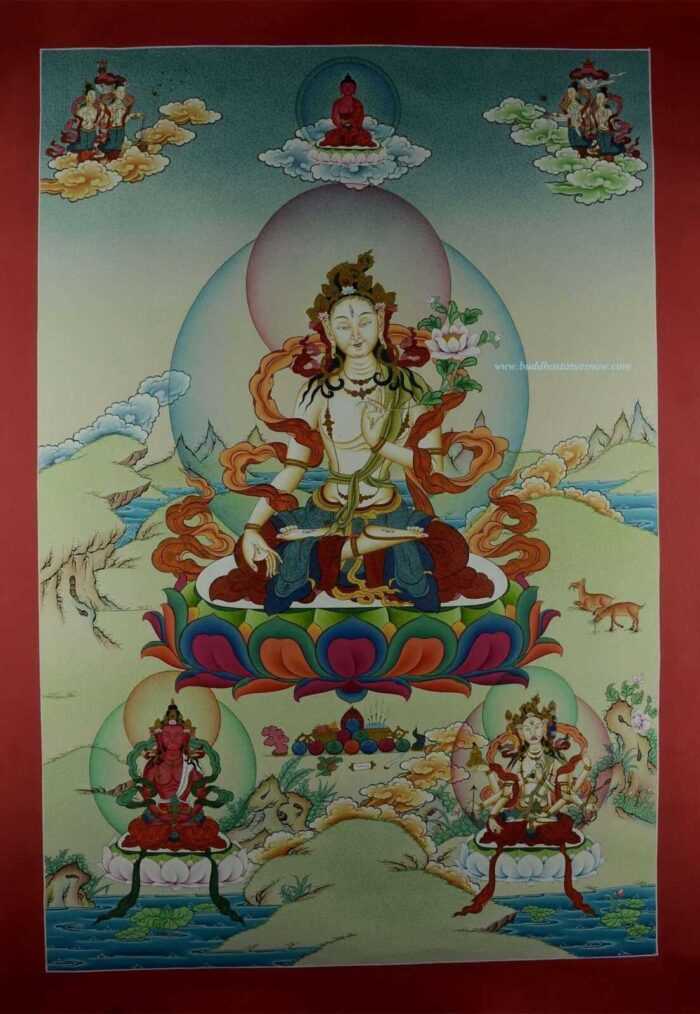
White Tara Thangka, 33.25″ x 23″, Hand Painted 24k Gold Detailing
Original price was: $859.00.$599.00Current price is: $599.00.Add to Cart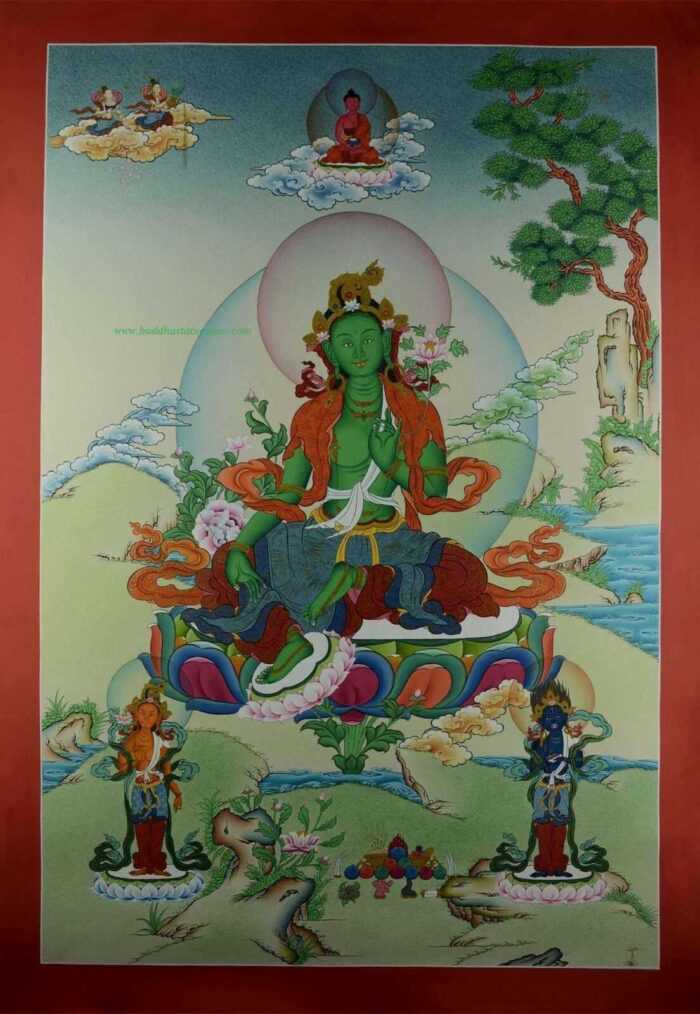
Green Tara Thangka Painting, 33″ x 23″, Hand Painted 24k Gold Detailing
Original price was: $899.00.$599.00Current price is: $599.00.Add to Cart




White Tara and Green Tara in Thangka Painting
Thangka painters work to strict iconometric grids, and the two Taras are distinguished by posture and color before any other detail. White Tara is painted a luminous moon white, seated in full lotus pose on a moon disc above a lotus throne, one hand open at the knee in the Varada gift-giving mudra and the other raised at the heart holding the stem of an utpala lotus. Green Tara is painted in the deep green of active compassion, seated in lalitasana with her right leg extended toward the ground. Both wear the crown, necklaces, armbands and bracelets of a Bodhisattva, and in a fine painting each stone and each strand of the beadwork is rendered individually in 24K gold.
The lotus each Tara holds is the utpala, the blue night lotus, and painters often show one blossom fully open and another still in bud - a pairing traditionally read as the Dharma flowering across past, present and future. For a broader introduction to these symbols, see our guides to White Tara, Green Tara, and the Buddhist pantheon.
Tara Practice, Protection and Placement
Green Tara is invoked above all for protection, traditionally from the eight great fears - lions, elephants, fire, snakes, thieves, imprisonment, water and demons - each of which stands for an inner affliction as much as an outer danger, so that the lion represents pride, the snake envy, and so on. Her mantra, Om Tare Tuttare Ture Soha, is the foundation of Tara practice and among the first a student learns. White Tara practice is directed instead at long life, healing, and the removal of obstacles to practice, and is very often undertaken on behalf of another person who is ill.
A Tara thangka is usually hung where it can be seen from the seat used for daily practice, at or above eye level as a mark of respect. Beyond that, the considerations are the ones that protect the painting: keep it out of direct sunlight, away from damp, and clear of cooking smoke and open incense, all of which dull hand-ground mineral pigments over time. If a painting must be stored, roll it around a wide tube rather than folding it. You can also see both Taras rendered in copper alloy among our White Tara statues and Green Tara statues.
Frequently Asked Questions
What does a Tara thangka represent?
Tara is the mother of liberation, and a thangka of her serves as a support for practice rather than as decoration. Tradition holds that she was born from a tear shed by Avalokiteshvara as he wept over the suffering of beings, and that she vowed to attain enlightenment in female form and to keep appearing in female form until samsara is empty. Practitioners turn to her first in difficulty, which is why her image appears on more Tibetan shrines than almost any other.
What is the difference between White Tara and Green Tara?
White Tara is associated with long life, healing, and serenity. She sits in full lotus pose in complete meditation, painted a luminous moon white, and is one of the three Tibetan long life deities. Green Tara expresses the same compassion in its swift and active aspect: she is painted in lalitasana, the posture of royal ease, with one leg extended toward the ground to show she is already rising to answer a call for help. Many practitioners keep both, since the two forms are complementary rather than alternative.
Why does White Tara have seven eyes?
White Tara is known as the Seven-Eyed goddess. Beyond the two eyes of her face, a third stands upright on her forehead, and one appears on each palm and on the sole of each foot. The arrangement means her compassionate awareness extends in every direction at once, so that no suffering escapes her notice. In a hand painted thangka the palm and sole eyes are picked out individually, and they are one of the surest ways to identify her - read more about the meaning of her seven eyes.
Why is Green Tara shown with one leg extended?
The posture is called lalitasana, the pose of royal ease, and on Green Tara it is read as a gesture of readiness. Where a fully seated figure signifies settled meditation, her extended right leg means she is already in the act of rising - about to step down from the lotus throne to answer a being in distress. It is the visual expression of what distinguishes her: compassion that does not wait, but responds immediately.
What are the mantras of White Tara and Green Tara?
Green Tara's mantra is Om Tare Tuttare Ture Soha, one of the most widely recited mantras in Tibetan Buddhism and the foundation of Green Tara practice. White Tara's mantra extends the same root with syllables invoking long life, merit, and wisdom - see our guide to the White Tara mantra. It is recited for recovery from illness and for the removal of obstacles to life and practice, frequently on behalf of someone else who is unwell.
Which Tara should I choose for my shrine?
Choose according to intention rather than preference. White Tara is the traditional choice where long life, healing, or recovery is the concern, whether for yourself or for someone you are practicing on behalf of. Green Tara is chosen for protection, for the removal of obstacles, and by practitioners beginning or deepening a Tara practice, since her mantra is the foundation of it. If you are drawn to both, that is not indecision - the two forms are traditionally kept together, and many shrines hold both.