

Palden Lhamo — the Glorious Goddess (dPal ldan lha mo) — is the principal female Dharmapala of Tibetan Buddhism and the sole female among the eight great protector deities of the tradition. Classified as a Shri Devi — a fierce female protector of the highest order — she is also known by the Tibetan name Magzor Gyalmo: “the glorious goddess, the queen who repels armies.” Her reputation is the most extreme of all the Dharmapalas: she murdered her own son and drank his blood in defense of the Dharma, fought her way out of hell, and was appointed by the Buddha himself as the personal protector of the Dalai Lama lineage. She is at once the most terrifying and the most intimately trusted of all Tibet’s protector deities — the guardian whose counsel has guided the selection of every Dalai Lama since the fifteenth century.
Contents
Dharma Protectress of Lhasa
Palden Lhamo’s relationship with the Gelug school and with the Dalai Lama lineage is one of the most specific and consequential in all of Tibetan Buddhist history. Her connection to Tibet predates the Gelug school by many centuries: she was the chosen protector of the Trulang Shrine in the seventh century, the shrine of the Tibetan King Songtsen Gampo — the king responsible for establishing Buddhism as Tibet’s national religion. When Tibetan Buddhism entered a period of severe disintegration following the ninth century, Palden Lhamo is believed to have advised the Tibetan monk Lhalung Pelgyi Dorje to assassinate the anti-Buddhist King Langdarma in 841 CE — and the king was killed, after which Tibetan Buddhism experienced a sustained renaissance. The pattern is consistent throughout her history: when the Dharma is genuinely threatened, Palden Lhamo acts, and she does not hesitate.
Her formal dedication to the Gelug school emerged in a vision of the first Dalai Lama while he was meditating near her sacred mountain home — Lhamo La-Tso, the Oracle Lake outside Lhasa. In his vision, Palden Lhamo appeared and promised to protect the reincarnation lineage of the Dalai Lamas. That promise has been honoured continuously since the fifteenth century: regents and monks charged with identifying each new Dalai Lama have made pilgrimage to Lhamo La-Tso, where visions appearing on the surface of the lake guide the search for the reincarnation. The selection of every Dalai Lama since the founding of the Gelug school has been influenced by the visions she reveals there — making her not merely a symbolic protector but an active participant in the transmission of the highest Tibetan Buddhist lineage across generations.
Palden Lhamo Iconography
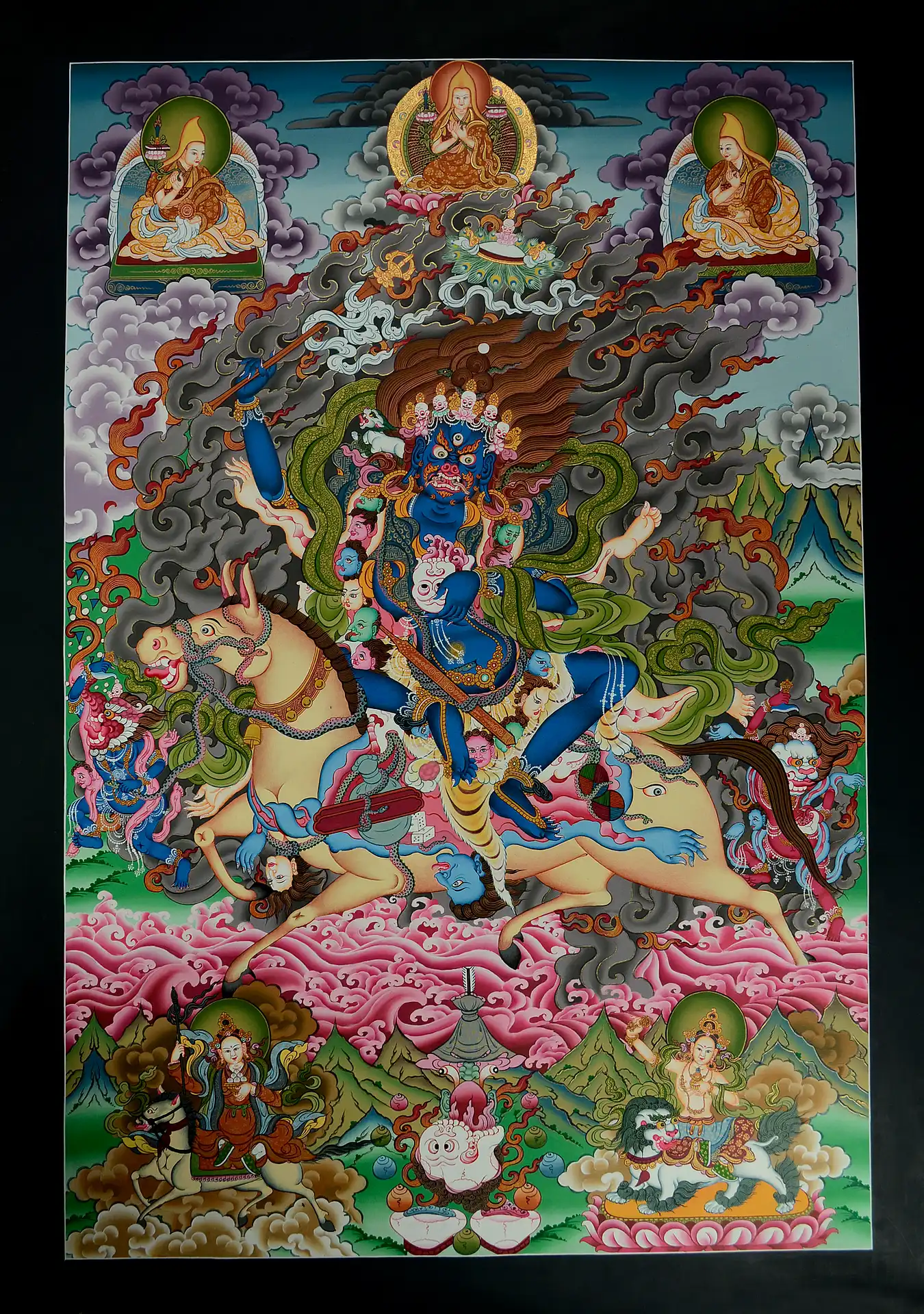
Palden Lhamo is depicted riding a wild mule across a sea of blood — the mount gifted to her by the gods for her escape from Lanka, with an eye on its haunch where a poison arrow struck and was transformed by her magic. She holds a kapala skull cup of blood in her left hand and a demon-taming club in her right. She wears a crown of skulls and a belt of skulls around her waist. A third eye of omniscient wisdom appears on her forehead. Her saddle is made from the skin of her own son — the most extreme possible reminder of the cost of her commitment to the Dharma. She is accompanied by her retinue: Simha Mukhi (the lion-faced Dakini) at the rear, and Maharavaktra leading the mule by its serpent reins at the front. She is the consort of Mahakala — the principal male Dharmapala of the tradition — and together they represent the complete field of wrathful protective awareness that guards the Dharma from dissolution.

The Ferocious Nature of the Dharmapala
The Dharmapalas — the great protector deities of Tibetan Buddhism — are depicted in Himalayan art as beings of surpassing ferocity. This ferocity is not arbitrary: it is the visual language through which the tradition expresses the unconditional, uncompromising quality of enlightened awareness in its protective mode. These are not beings who threaten or harm practitioners — they are the forces of awakened compassion deployed against the defilements, harmful influences, and karmic obstructions that prevent practitioners from achieving realization. Their wrathful appearance serves as a direct confrontation with the ego’s habit of seeking comfort and avoiding the extremity of the commitment that genuine Dharma practice requires.
Palden Lhamo’s reputation is the most extreme of all the Dharmapalas. She is depicted with human skulls, skin, blood, and bones — the morbid accoutrements that signal a being operating entirely beyond the ordinary categories of pleasant and unpleasant, acceptable and unacceptable. She drinks blood from a skull cup, wears the flayed skin of her own child as a saddle, and emerged from hell itself without repentance. In the Tibetan understanding, this is not depravity but its opposite: the absolute refusal to be stopped by any consequence, any suffering, or any cost in the defense of the Dharma. Of all the Dharmapalas, Palden Lhamo is the one whose commitment to that defense has been most completely tested — and most completely demonstrated.
The Origins of the Wrathful Palden Lhamo
In a past existence, Palden Lhamo was known as Remati, and she was married to the King of Lanka — a ruler who was violently hostile to Buddhism and had killed many Dharma practitioners. Despite her own deep commitment to the Buddha’s teachings, her husband had turned their son against Buddhists, and the two of them continued persecuting practitioners against her will. Remati made a vow: if the king would not convert to Buddhism and cease his persecution, she would personally destroy his lineage. The king was not moved. He continued with his campaign against the Dharma.
Revenge of the Glorious Goddess
One day while the king was out hunting, Remati acted on her vow. She killed their son, flayed him, and used his skin to make a saddle. She ate his flesh and drank his blood from his skull — the original kapala cup that she carries to this day as the emblem of her sacrifice. She then mounted a mule gifted to her by the gods and fled Lanka.
When the king returned and discovered what had happened, he became enraged and shot a poison arrow at Remati as she galloped away. The arrow struck the mule in its hindquarter. Remati pulled out the arrow, healed the wound with her magical powers, and transformed it into an eye — cursing her husband as she did so: “May the wound of my mount become an eye large enough to watch over the twenty-four regions, and may I myself be the one to extirpate the lineage of the malignant kings of Lanka.” The eye on the mule’s haunch remains one of Palden Lhamo’s most distinctive iconographic features in both thangka painting and sculpture. She then rode her mule all the way to eastern Siberia, passing through India, Tibet, China, and Mongolia — the journey that established her as the protector not of one region but of the entire Buddhist world.
The Redemption of Palden Lhamo
After her death, Palden Lhamo was reborn in hell — the karmic consequence of killing her own child, even in defense of the Dharma. She was unrepentant. She fought her way out of hell, seizing a bag of diseases and a sword as she emerged into the charnel grounds. Exhausted and despairing, she prayed to the Buddha and asked for a reason to continue. Buddha Vajradhara — the tantric form of Shakyamuni Buddha, the primordial Buddha of the Vajrayana tradition — appeared before her and suggested she become a Dharma protector. She accepted. In that acceptance, the entire arc of her story — the murder, the escape, the hell realm, the emergence — was transformed from catastrophe into vocation. She had demonstrated, at the most extreme possible cost, that nothing would stop her commitment to the Dharma. The Buddha recognized exactly that quality and gave it a permanent form.
Palden Lhamo’s story is one of the most psychologically and morally extreme in the entire Tibetan Buddhist tradition. It is not a comfortable story, and it is not meant to be. It is a story about what unconditional commitment to the Dharma actually looks like when it is tested by the most impossible circumstances imaginable — and what kind of being emerges from that testing. She is the protector whose trust is earned not by perfection but by the willingness to pay the price that protection requires, however extreme that price proves to be. For this reason, practitioners of the Gelug school — and Tibetan Buddhists across all traditions — regard her with a combination of awe, devotion, and the specific kind of trust that is only given to a being who has been tested beyond all limits and has not broken.
“JO RAMO JO RAMO JO JO RAMO TUNJO KALA RACHENMO RAMO AJA DAJA TUNJO RULU RULU HUNG JO HUNG”
Frequently Asked Questions
Who is Palden Lhamo in Tibetan Buddhism?
Palden Lhamo, the Glorious Goddess, is the principal female Dharmapala (protector deity) of Tibetan Buddhism and the only female among the eight great protectors of the tradition. She is the personal protector of the Dalai Lama lineage and the wrathful consort of Mahakala.
What does Palden Lhamo ride?
Palden Lhamo rides a wild mule across a sea of blood. The mule was a gift from the gods and bears a distinctive eye on its haunch, formed when she transformed the wound from a poison arrow using her magical powers.
Why does Palden Lhamo carry a skull cup (kapala)?
The kapala she carries originated from the skull of her own son, whom she killed in a past life as Remati to fulfill her vow against her husband, the anti-Buddhist King of Lanka. She drinks blood from it as a permanent emblem of the sacrifice she made in defense of the Dharma.
How is Palden Lhamo connected to the Dalai Lama?
Palden Lhamo appeared in a vision to the first Dalai Lama at Lhamo La-Tso, the Oracle Lake outside Lhasa, and promised to protect the reincarnation lineage. Since the fifteenth century, regents and monks have made pilgrimage to the lake to receive visions that guide the search for each new Dalai Lama.
Who is Palden Lhamo’s consort?
Palden Lhamo is the consort of Mahakala, the principal male Dharmapala of Tibetan Buddhism. Together they represent the complete field of wrathful protective awareness that guards the Dharma.
What does Palden Lhamo’s wrathful appearance symbolize?
Her wrathful appearance — skulls, blood, bones, and human skin — is not depravity but the visual language of unconditional enlightened awareness. It represents the absolute refusal to be stopped by any consequence in the defense of the Dharma, rather than literal violence or harm toward practitioners.
What does the Palden Lhamo mantra mean?
The mantra “JO RAMO JO RAMO JO JO RAMO TUNJO KALA RACHENMO RAMO AJA DAJA TUNJO RULU RULU HUNG JO HUNG” is recited by practitioners to invoke her protective power and is chanted in Gelug monasteries as part of protector practice.
Which school of Tibetan Buddhism reveres Palden Lhamo most closely?
Palden Lhamo is most closely associated with the Gelug school, the tradition of the Dalai Lamas, though she is revered as a protector across Tibetan Buddhist traditions more broadly.