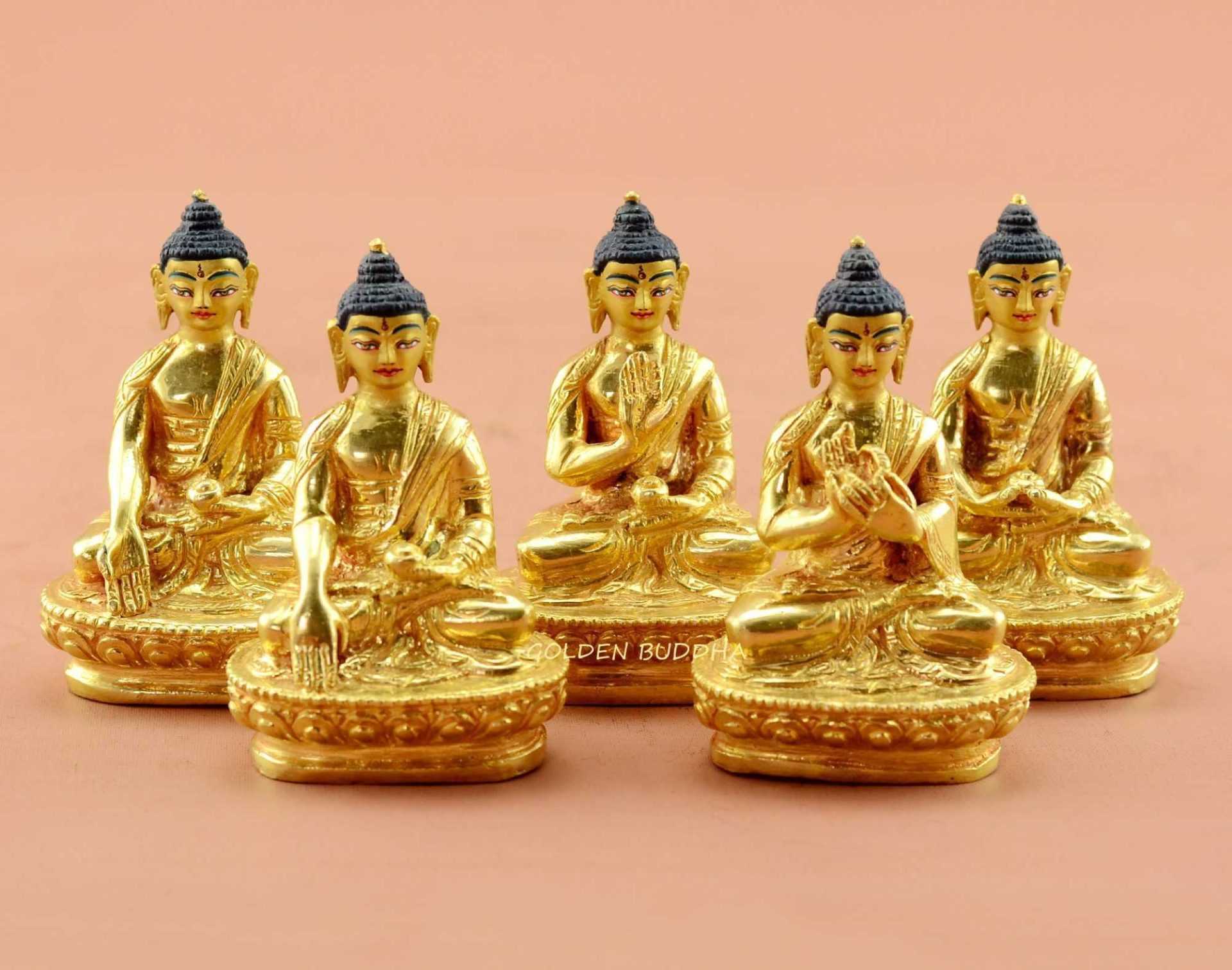
Five Dhyani Buddha Statues — The Five Aspects of Enlightened Mind
The Five Dhyani Buddhas (Sanskrit: Pañcatathāgata — the Five Transcendent Buddhas) are the five cosmic Buddhas who together represent the complete mandala of enlightened mind — the five aspects of fully awakened awareness whose union constitutes Buddhahood in its totality. They are not five separate beings who happen to be grouped together but five dimensions of a single enlightened reality, displayed as five in order to make visible what would otherwise be beyond iconographic representation: the complete spectrum of wisdom that transcends and transforms the five root poisons at the source of all suffering. In Tibetan Buddhist art they appear across every major iconographic context — in the crowns of Bodhisattvas, at the center and four directions of every mandala, and in the Bardo Thodol (Tibetan Book of the Dead) as the five lights of wisdom that arise at the moment of death to guide the consciousness of the deceased toward liberation. Learn more about the Buddhist pantheon in our complete guide.
Each of the five is associated with a direction, a color, a mudra, and most critically a specific transformation — the conversion of one of the five poisons into one of the five transcendent wisdoms: Vairocana (center, white) transforms ignorance into all-encompassing wisdom; Akshobhya (east, blue) transforms anger into mirror-like wisdom that reflects reality without distortion; Ratnasambhava (south, yellow) transforms pride into the wisdom of equality that sees all beings as equally precious; Amitabha (west, red) transforms desire and attachment into discriminating wisdom that perceives the unique qualities of all phenomena without grasping; and Amoghasiddhi (north, green) transforms jealousy into all-accomplishing wisdom that acts spontaneously and perfectly for the benefit of beings. The five are the complete map of the path from ordinary mind — driven by its five poisons — to enlightened mind, in which those same five energies have been recognized and freed into their natural state as wisdom. Amitabha, whose pure land tradition is among the most widely practiced in East Asian and Tibetan Buddhism, is the most individually venerated of the five. All Five Dhyani Buddha statues in the Golden Buddha collection are handcrafted in Patan, Nepal by master Newar artisans of the Shakya caste using the traditional lost wax sculpting method.
Showing all 4 resultsSorted by popularity
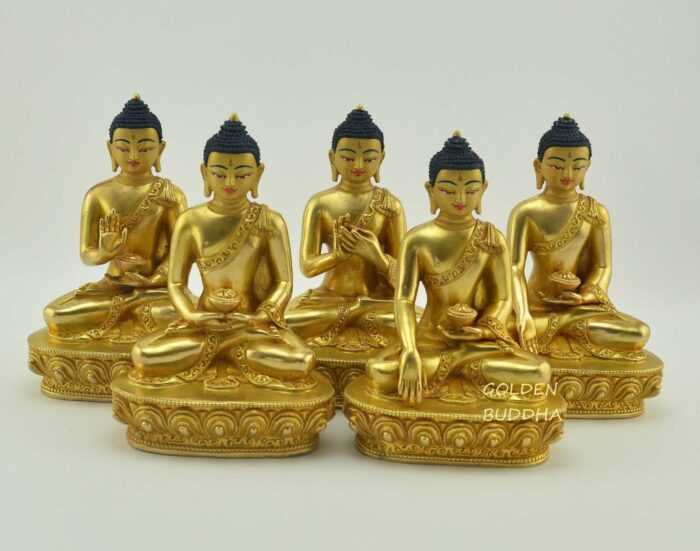
Dhyani Buddha Statues Set | 5.5-inch | Fully 24K Gold Gilded
Original price was: $3,399.00.$2,699.00Current price is: $2,699.00.Add to Cart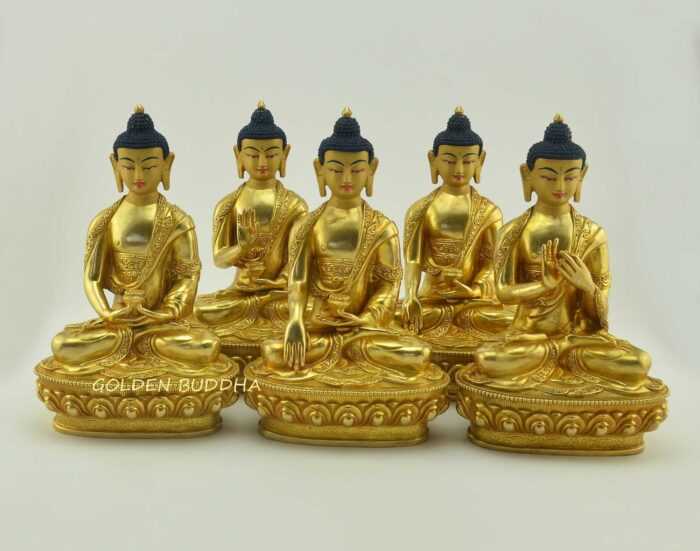
Five Dhyani Buddha Statues Set | 8.5-inch | 24K Gold Gilded
Original price was: $4,199.00.$3,299.00Current price is: $3,299.00.Add to Cart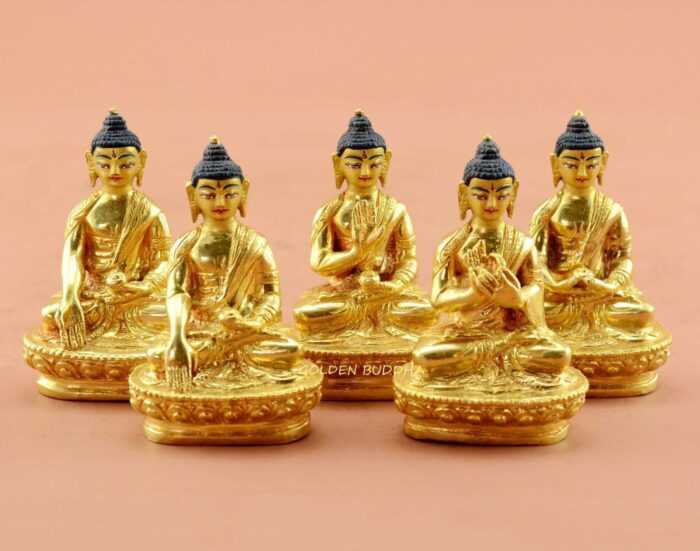
Small Dhyani Buddhas Set | 3.25-inch | 24K Gold Gilded
Original price was: $2,399.00.$1,699.00Current price is: $1,699.00.Add to Cart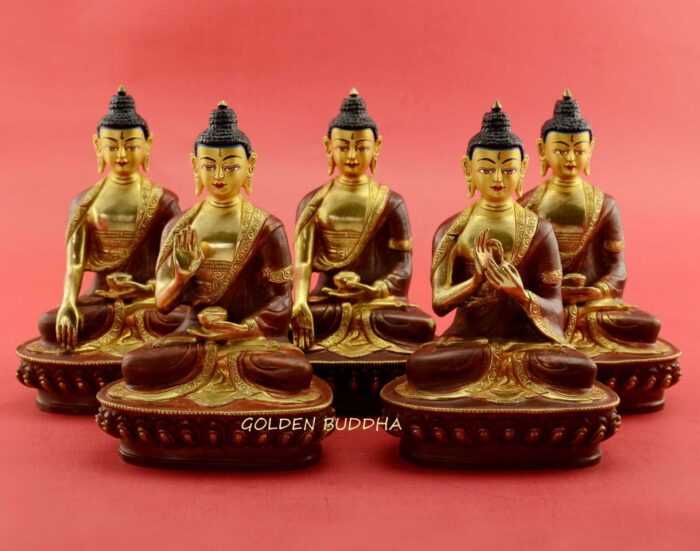
Set of Dhyani Buddha Statues | 6-inch | Partly Gold Gilded
Original price was: $3,099.00.$2,199.00Current price is: $2,199.00.Add to Cart