
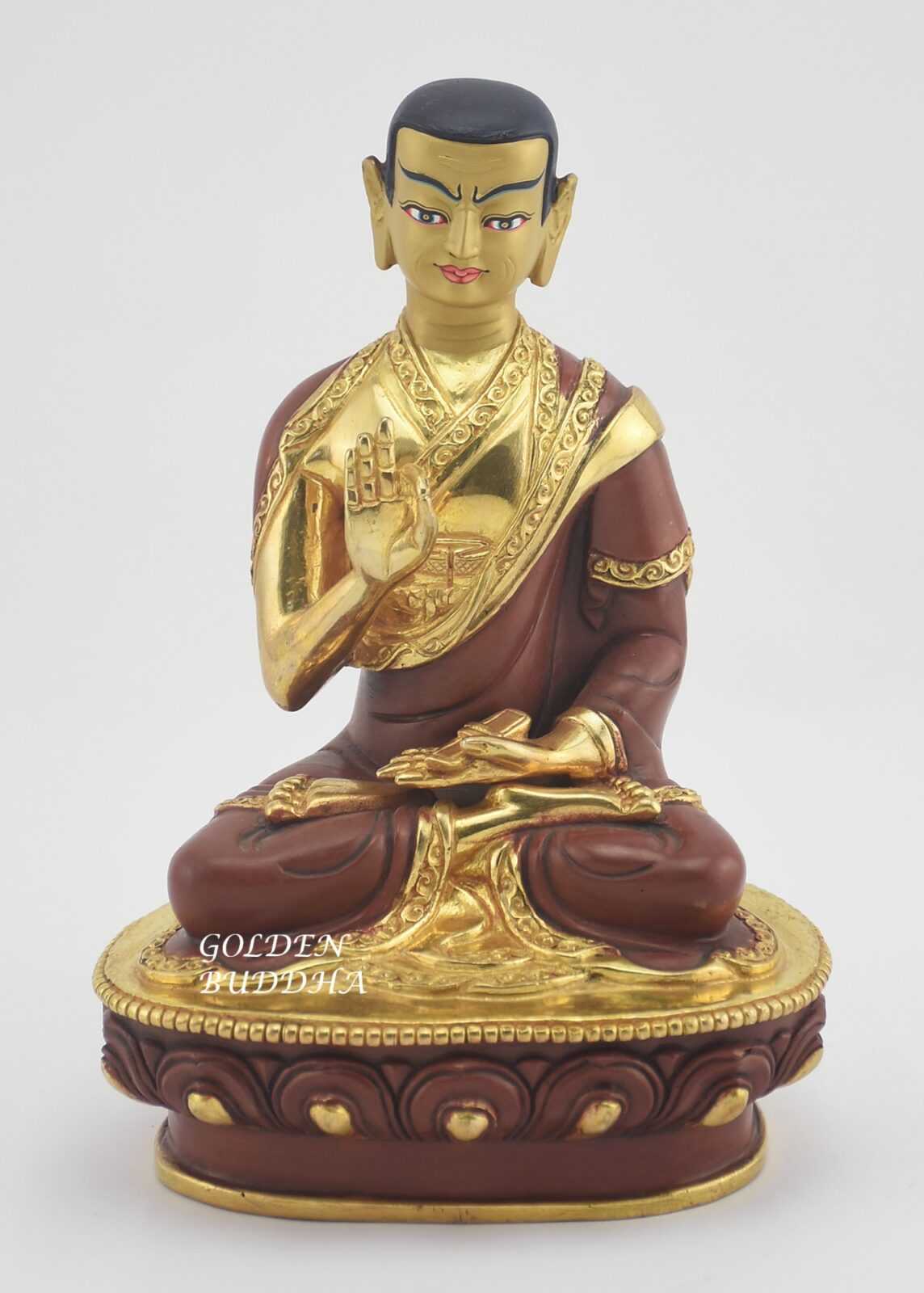
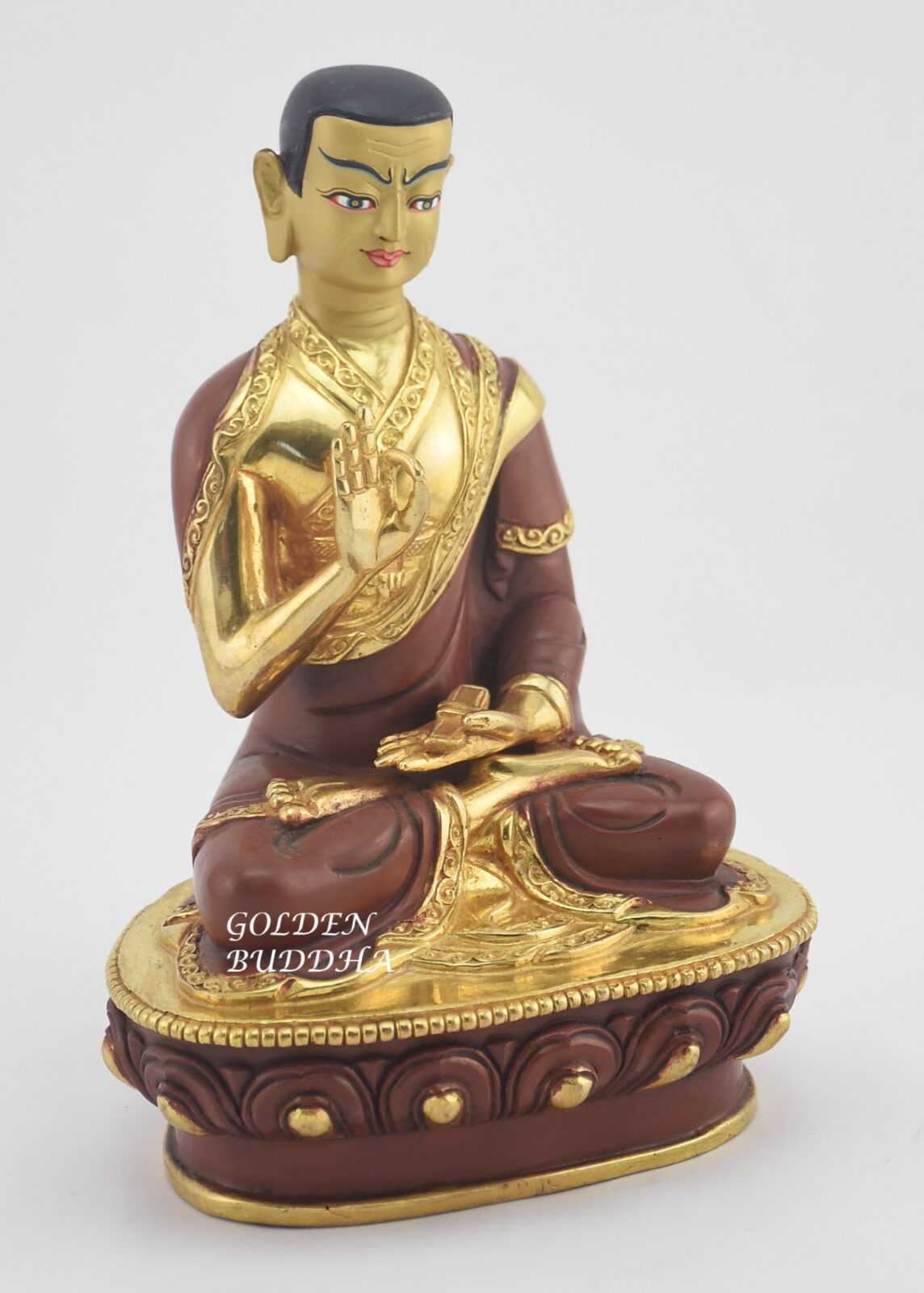
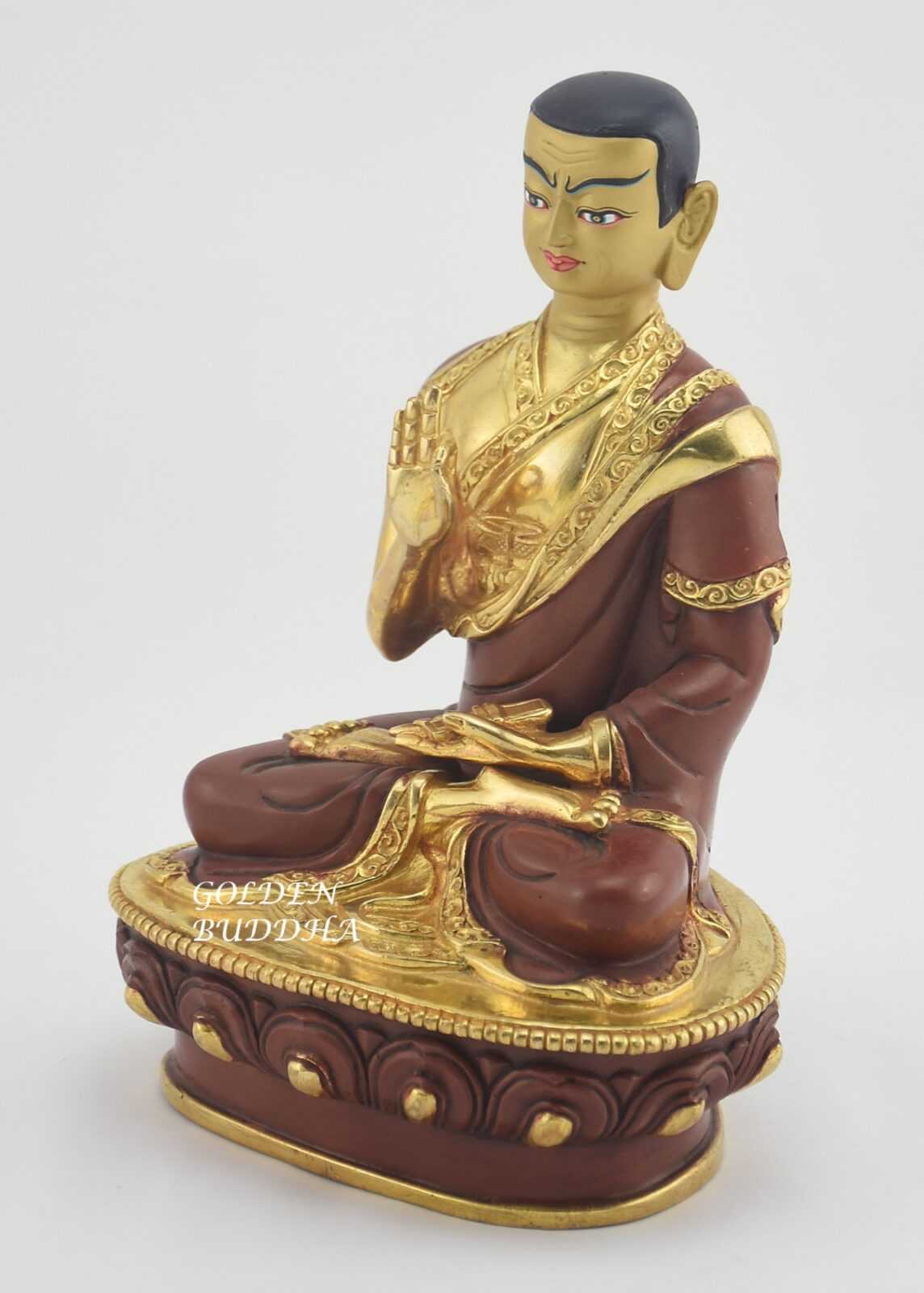
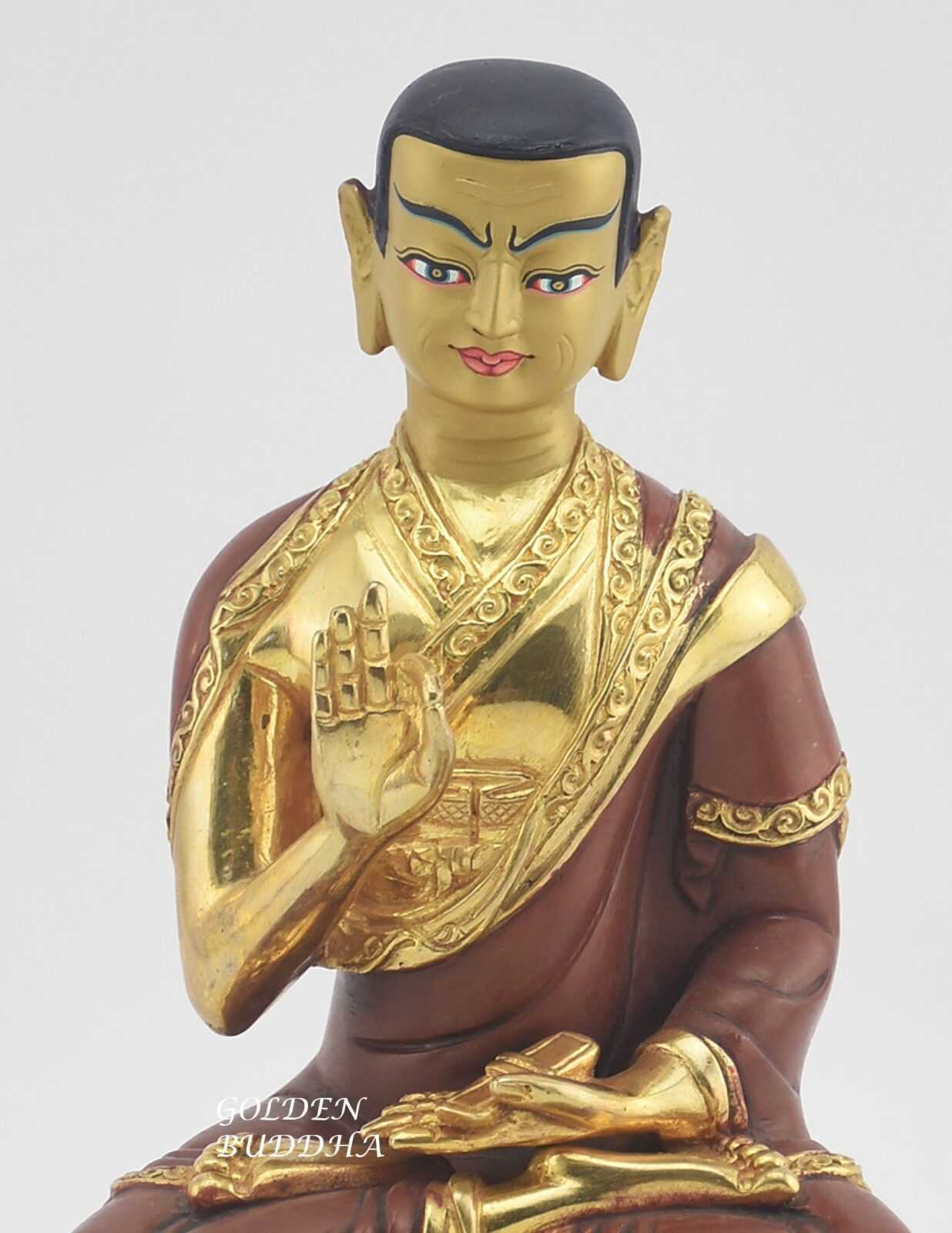
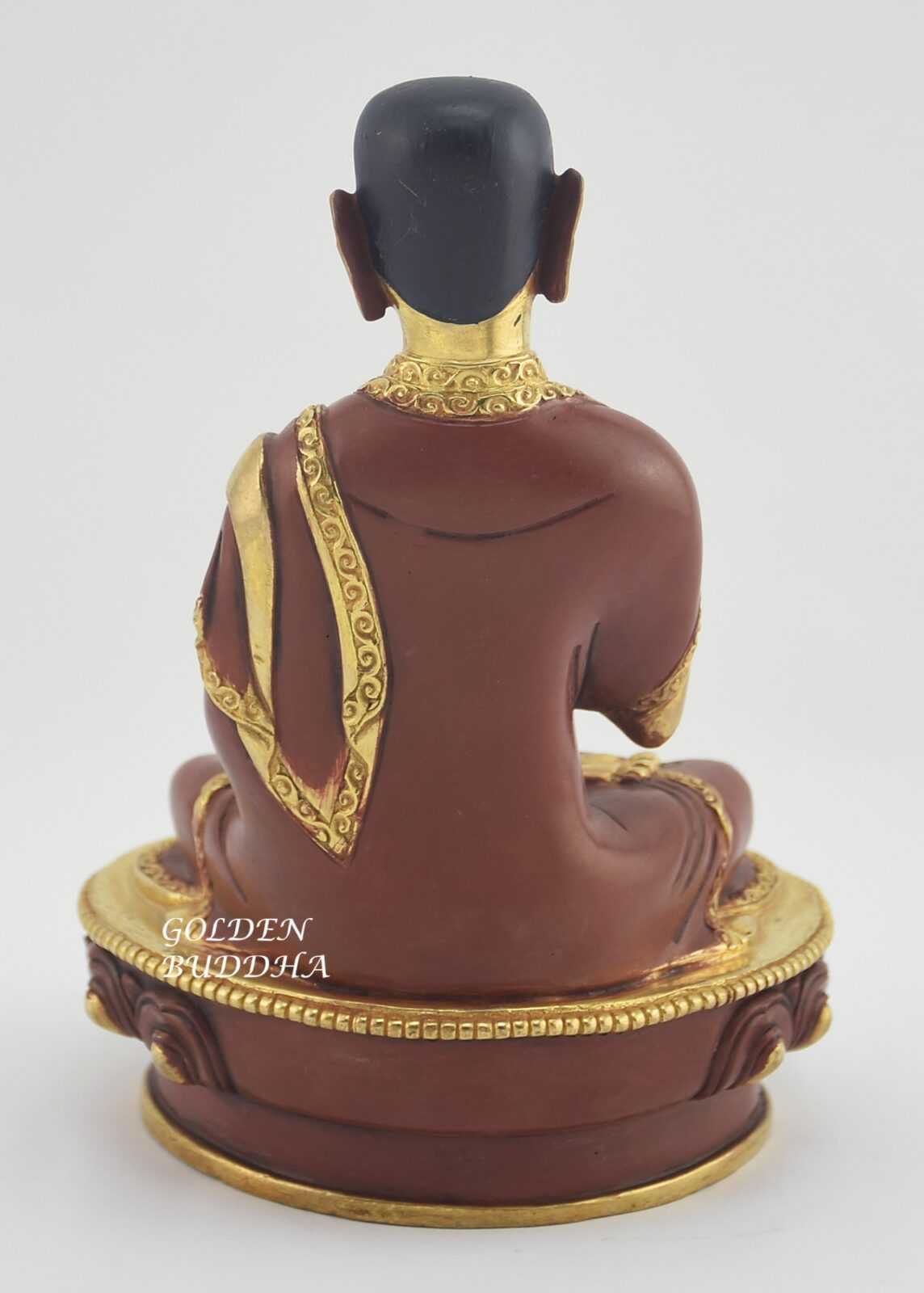
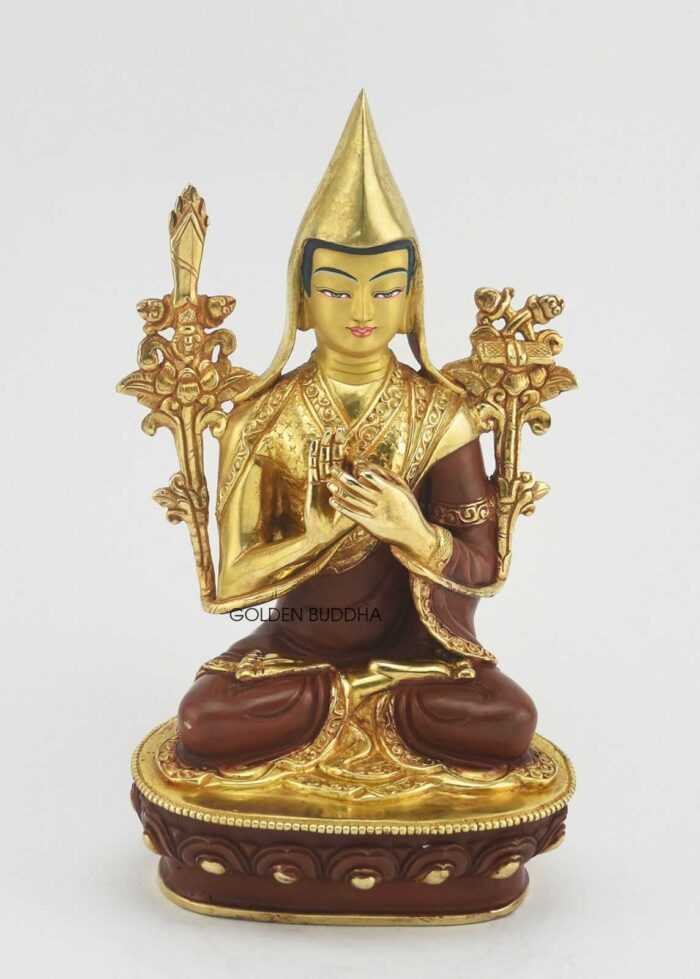
This 7.5-inch Geshe Langri Tangpa Statue portrays the renowned Kadampa master Geshe Langri Tangpa Dorje Senge (1054–1123), author of the Eight Verses of Training the Mind. Handmade in Patan, Nepal from copper alloy using the traditional lost-wax casting method, the figure is partly fire gilded in 24K gold with contrasting reddish-brown oxidized robe sections. His face is hand painted in 18K gold and natural pigments, creating the distinctive alert expression visible in the photographs. The gilded chest, hands, robe borders and throne details stand out against the darker monastic robes, giving this compact statue the visual presence of a much larger lineage image.
Geshe Langri Tangpa Statue | Kadampa Mind-Training Master
Geshe Langri Tangpa was a disciple of Potowa Rinchen Sal and one of the celebrated early Kadampa teachers. His enduring legacy is the Eight Verses of Training the Mind, a concise lojong text centered on bodhicitta, humility, transforming adversity and exchanging self-concern for concern for others. Traditional biographies describe him as so deeply conscious of the suffering of sentient beings that he became known as the “Gloomy-Faced” or “Sour-Faced” master. Rather than presenting an idealized smiling teacher, this sculpture preserves that serious, concentrated character through the strong brows, wide painted eyes and subtle lines around the cheeks.
Iconography, Teaching Gesture and Monastic Detail
The photographs show Langri Tangpa seated cross-legged on a single lotus throne in the robes of an ordained monk. His shaved head and absence of a crown or elaborate jewelry emphasize the disciplined simplicity associated with the Kadampa tradition. The right hand is raised before the chest in a teaching gesture closely corresponding to Vitarka mudra, the gesture of explanation, discussion and transmission of the Dharma. His left hand rests palm-up in the lap and visibly supports a small rectangular scripture, an important detail not reflected in the earlier description. A small patterned vessel is also sculpted against the front of the robe beneath the raised hand. These attributes reinforce the image of Langri Tangpa as a scholar-practitioner whose teachings were grounded equally in study and contemplative training.
The robe treatment is unusually refined for a 7.5-inch figure. Raised scrolling borders follow the crossed upper robe, neckline, sleeve band and lower textile edges, while the broad reddish-brown surfaces remain comparatively restrained. The lotus throne repeats the same two-tone vocabulary, with dark lotus petals surrounding bright gold centers, a gilded beaded upper rim and a narrow gold foot around the base. Optional turquoise and red coral accents may be requested before shipment where the artisan determines that they can be incorporated without disturbing the monastic iconography.
Eight Verses and the Practice of Lojong
Langri Tangpa’s Eight Verses became one of the best-known expressions of Tibetan mind training. The practice directs attention toward cherishing others, observing the mind when destructive emotions arise, accepting difficult circumstances as opportunities for training, and cultivating compassionate method together with wisdom. The first seven verses principally develop the method side of the Mahayana path, while the final verse turns explicitly toward wisdom. This makes Langri Tangpa especially meaningful for an altar devoted to the practical cultivation of bodhicitta rather than to philosophical study alone.
A Manjushri, Geshe Langri Tangpa Statue and Tsongkhapa Altar Grouping
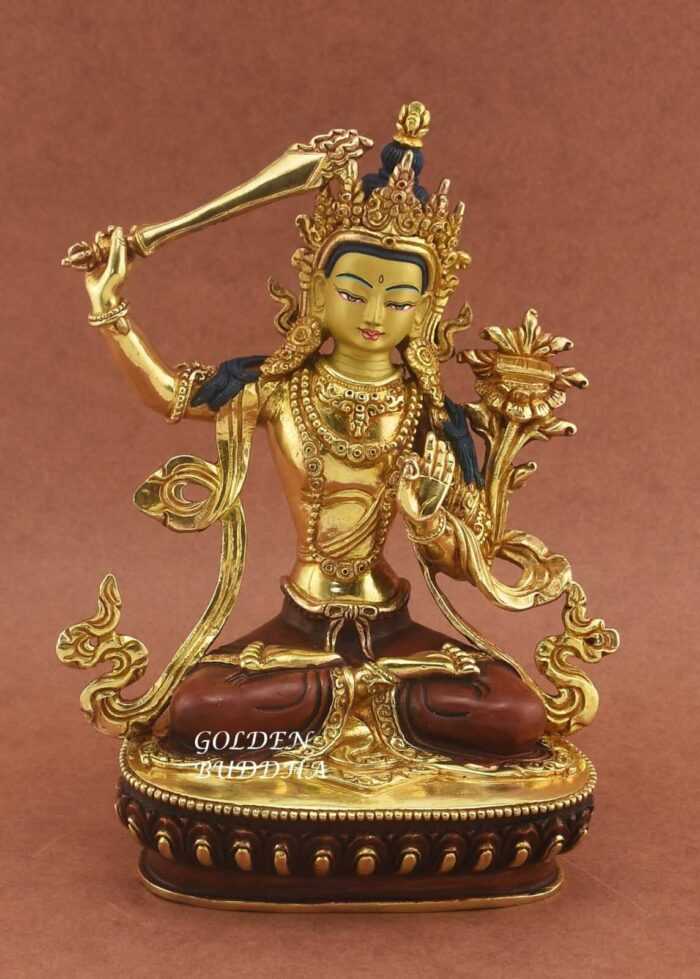
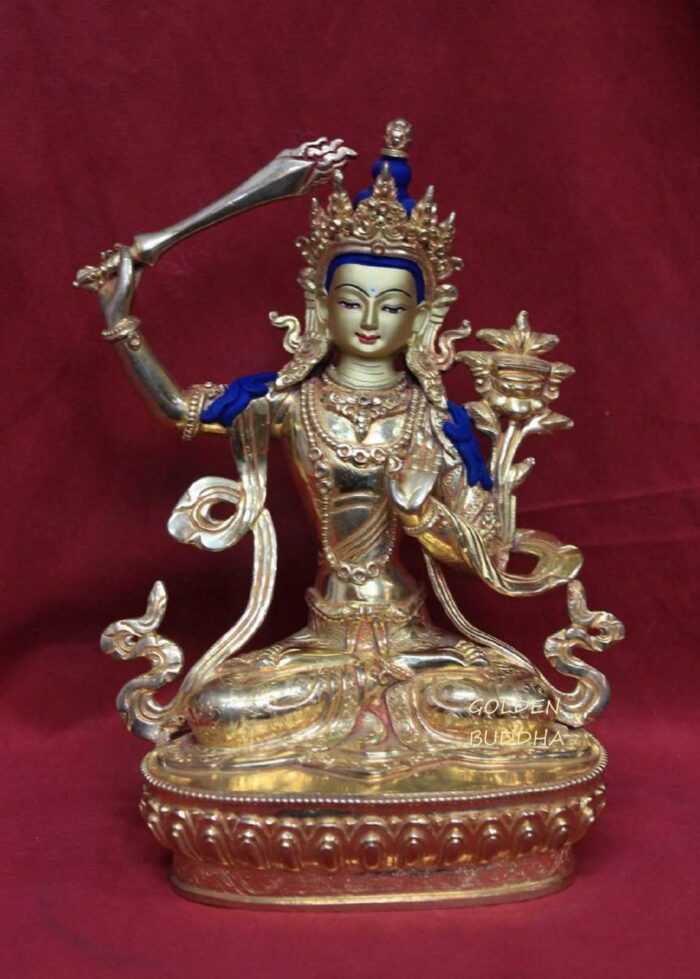
This statue can form a thoughtful three-piece wisdom and mind-training arrangement with a matching Manjushri statue and Guru Tsongkhapa statue. Manjushri represents transcendent wisdom at the Bodhisattva level; Langri Tangpa represents the earlier Kadampa lojong tradition and disciplined cultivation of bodhicitta; and Tsongkhapa, a later master revered as an emanation of Manjushri, represents the systematic integration of method and wisdom within the Gelug tradition. This is best understood as a lineage-inspired thematic grouping rather than a canonical three-figure set. For visual hierarchy, Manjushri may occupy the center or a slightly elevated position, with the earlier Langri Tangpa to the viewer’s left and Tsongkhapa to the viewer’s right.
Filling and Consecration in Kathmandu, Nepal
For practitioners preparing the statue for devotional use, traditional statue filling, blessing and consecration in Kathmandu can be arranged before shipment. Sacred mantras, texts and appropriate consecration substances may be placed within the hollow interior before the statue is ritually sealed and blessed, preparing it as a formal support for meditation, offerings and lojong practice.
Custom Tibetan Buddhist Statues
Collectors, Dharma centers and practitioners may also commission custom Tibetan Buddhist statues handmade in Nepal. Langri Tangpa can be commissioned in alternate sizes and finishes, or produced as part of a coordinated Kadampa or lineage-master grouping. Proportions, robe treatment, gilding, lotus-throne design and related figures can be planned together so that the completed altar has consistent craftsmanship and visual balance.
Authentic, Handmade in Nepal
Every statue is handcrafted in Patan, Nepal, using traditional lost wax casting and comes with a certificate of authenticity issued by Nepal’s Department of Archaeology, verifying its materials, technique, and origin.
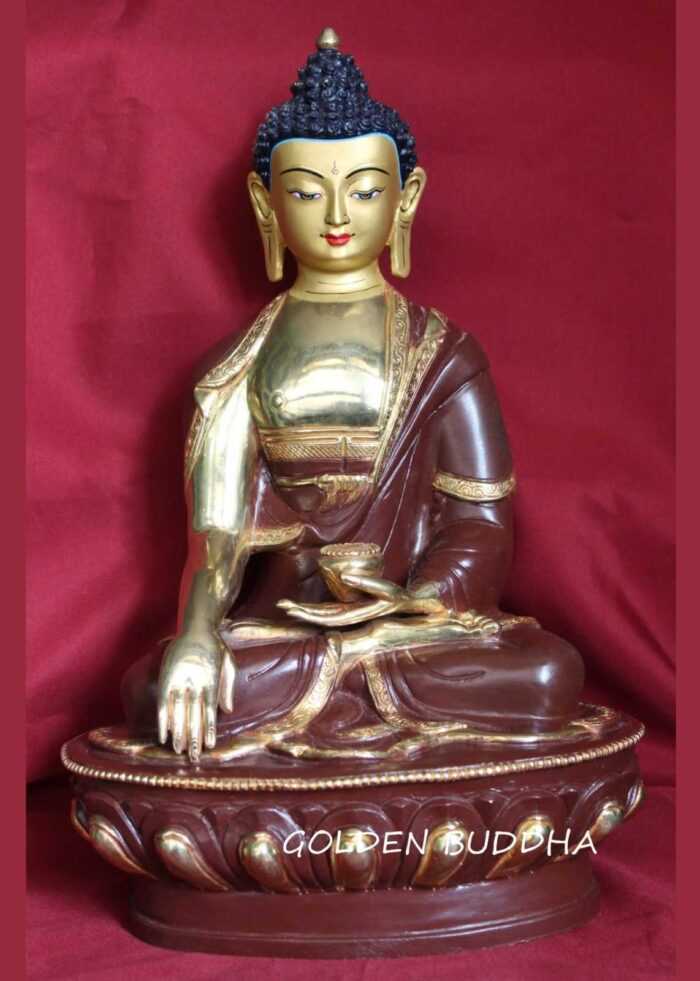
Carolyn Miller (verified owner) –
Lovely statue. Excellent communication. Quick DHL delivery. Thank you so much! C Miller