
Amitabha Buddha — the Buddha of Infinite Light — first appeared in Mahayana Buddhist scriptures in the 1st century CE. Specifically, the Larger Sutra of Immeasurable Life (Sukhavativyuha Sutra) describes Amitabha and his magnificent Pure Land of Sukhavati in extraordinary detail. He is one of the most universally revered figures in all of Buddhism — venerated across Tibetan, Chinese, Japanese, and Nepalese Buddhist traditions as the compassionate gateway to liberation.
Evidence of the first Amitabha statues did not emerge until the 2nd century CE — not surprising, since early Buddhist art initially avoided depicting the physical body of the Buddha entirely, using symbols such as footprints, the Bodhi tree, and the Dharma wheel instead. This changed as Buddhist art evolved in tandem with the rapidly expanding Mahayana movement, and statues of the Buddhas and Bodhisattvas became the defining feature of temples and monasteries throughout Asia.
The establishment of Tibetan Buddhism accelerated this tradition further. Beginning in the 10th century, the master artisans of Patan, Nepal began producing the finest Amitabha Buddha statues for Tibetan monasteries — a tradition they continue to this day, making Nepal world-renowned as the global center for authentic Himalayan Buddhist statuary.
Contents
- Popular Appeal of Amitabha Buddha Statues
- Amitabha’s Long Path to Becoming a Buddha
- Amitabha Buddha Statue Meaning & Symbolism
- Amitabha Statue Iconography: Mudra, Color & Form
- Longevity Attribute — Amitabha as Amitayus
- The Pure Land of Sukhavati — Western Paradise
- Amitabha & the Five Dhyani Buddhas
- Amitabha Mantra: How to Use It & Its Benefits
- Frequently Asked Questions About Amitabha Buddha
- Buy Authentic Amitabha Statues Direct from Nepal
Popular Appeal of Amitabha Buddha Statues
Mahayana Buddhism emerged several hundred years after the original Buddha entered Nirvana. Some of the Buddha’s disciples believed that the earlier Theravada teachings, while profound, were not sufficiently inclusive for the full range of humanity. As a result, a new movement emerged — Mahayana, meaning “Great Vehicle” in Sanskrit — which opened the path to liberation to all beings, not just monastics, and introduced a vast array of enlightened Buddhas and Bodhisattvas to assist practitioners.
No figure was more central to this expansion than Amitabha Buddha. The Amitabha meaning — infinite light, infinite life, boundless compassion — proved deeply reassuring to ordinary people who might struggle with strict monastic discipline. His Pure Land of Sukhavati offered a realistic and accessible path: rather than requiring decades of solitary meditation practice, devotees could aspire to rebirth in Sukhavati simply by reciting his name with sincere faith. This radical inclusivity — comparable in its cultural impact to the emergence of devotional Christianity in the West — drove the extraordinary spread of Pure Land Buddhism across China, Japan, Korea, Tibet, and Vietnam.
Tibetan Amitabha Statue
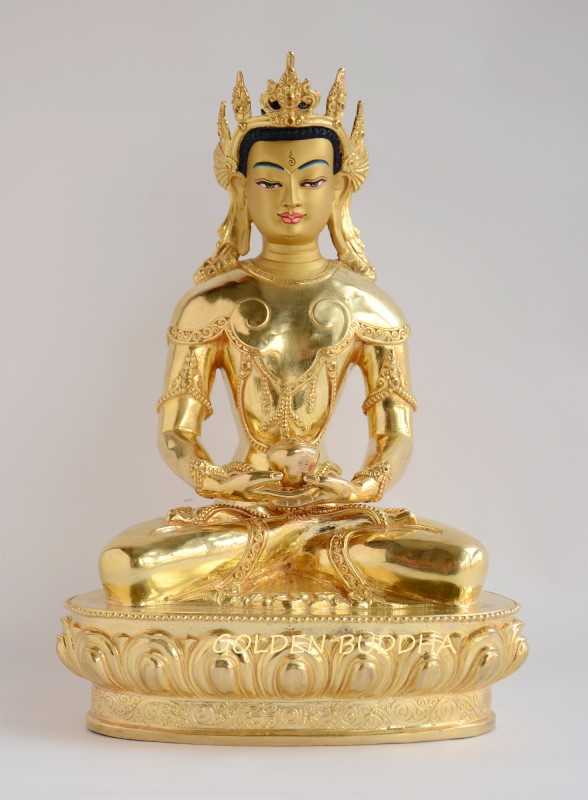
Amitabha statues typically depict him sitting in full lotus pose (padmasana) in the Dhyana Mudra (meditation gesture) — both hands resting in the lap, right upon left, thumbs lightly touching. He is seated on a lotus pedestal and often holds an alms bowl filled with nectar. In his Amitayus form, he holds an immortality vase (bumpa) brimming with the nectar of long life.
Amitabha’s Long Path to Becoming a Buddha
Mahayana Buddhist texts describe the past lives of Amitabha as a Bodhisattva named Dharmakara — a Sanskrit word meaning “Treasury of Dharma.” The story of Dharmakara is one of the most moving narratives in all of Buddhist literature, and it underpins the entire doctrine of Pure Land Buddhism.
Like Shakyamuni Buddha, Dharmakara was once a great king who renounced his throne, his palace, and all material wealth to pursue the life of a wandering renunciant monk. Motivated by limitless compassion for all suffering beings, he made a series of extraordinary vows before his teacher, the Buddha Lokesvararaja, declaring that he would not accept Buddhahood until he could guarantee liberation to every being who sincerely called upon him.
Dharmakara then served countless lifetimes as a Bodhisattva, crossing many eons and world systems, accumulating an almost inconceivable store of merit through acts of compassion, generosity, and wisdom. The result of this vast accumulation was the creation of Sukhavati — a pure land of extraordinary beauty and spiritual power — and the attainment of Buddhahood as Amitabha, the Buddha of Infinite Light and Life. His path is considered among the longest and most arduous in Buddhist cosmology, which is precisely why his power to assist others is considered limitless.
Amitabha Buddha Statue Meaning & Symbolism
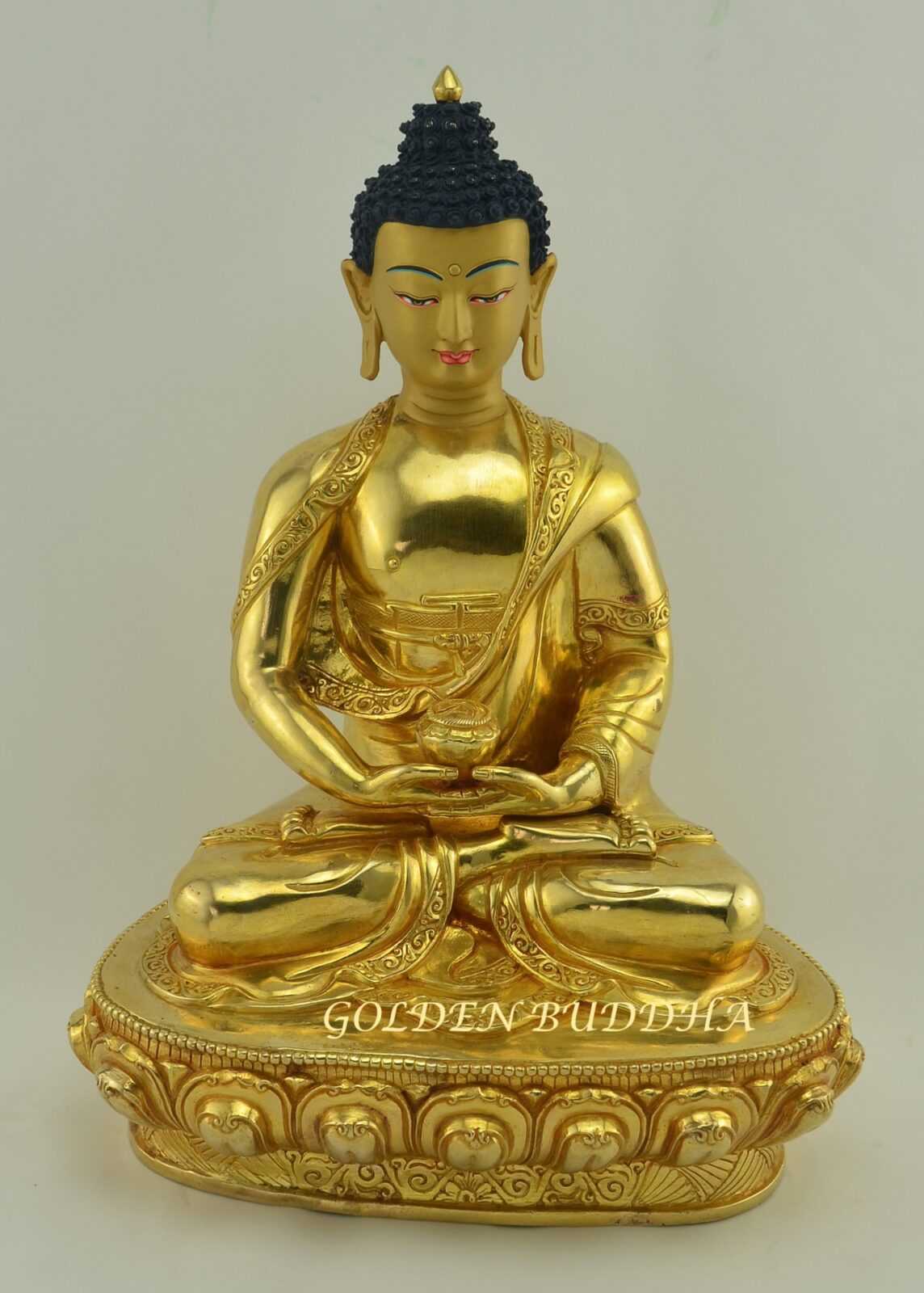
Due to the immeasurable merit accumulated by Dharmakara over countless lifetimes, the Amitabha statue meaning is established as “Immeasurable Light and Life.” In Sanskrit, Amitabha means “Infinite Light” — a reference to his boundless luminosity that illuminates all worlds without obstruction. His longevity aspect is called Amitayus, meaning “Infinite Life” — pointing to his transcendence of time and the cycle of death and rebirth.
The Amitabha meaning resonates across cultures and languages. In Chinese, Amitabha is Amituofo (阿彌陀佛) or Emituofo. Amituo is the transliteration of the Sanskrit Amida, meaning “boundless,” and fo means “Buddha” — so the Chinese meaning is “Boundless Buddha,” closely paralleling “Buddha of Infinite Light and Life.” In Japan he is known as Amida Butsu; in Tibet as Öpakmé (འོད་དཔག་མེད།), meaning “Boundless Light.” Across every tradition the core meaning remains constant: a Buddha whose wisdom and compassion know no limits.
In Tibetan Buddhism, the Amitabha statue meaning is strongly associated with discriminating wisdom (pratyavekṣaṇā-jñāna) — the enlightened faculty that perceives every phenomenon clearly, exactly as it is, without distortion, confusion, or the stain of conceptual elaboration. This wisdom is the antidote to the poison of attachment and desire. Amitabha is also one of the three long life deities alongside White Tara and Namgyalma.
Amitabha Statue Iconography: Mudra, Color & Form
Every element of a traditional Amitabha Buddha statue encodes a specific teaching. Understanding this iconography transforms the statue from a decorative object into a complete visual dharma teaching:
Color — Deep Red or Saffron: Amitabha is associated with the color red, representing the fire element and the transformation of the poison of desire and attachment into the wisdom of discernment. In thangkas and detailed statuary, his body is often depicted in deep ruby red or rich saffron — the warmest, most welcoming of the five Buddha family colors.
Dhyana Mudra (Meditation Gesture): Amitabha’s hands rest in his lap in the Dhyana Mudra — right hand on top of left, thumbs lightly touching to form a shallow oval. This gesture of deep meditation represents the unwavering concentration of an enlightened mind, the perfect stillness from which compassionate action spontaneously arises.
Alms Bowl: In the Dhyana Mudra, Amitabha’s hands often cradle a blue alms bowl (patra), filled with the nectar of immortality. The bowl represents both his life as a renunciant monk and the gift of sustenance — spiritual nourishment freely offered to all who call upon him.
Lotus Throne: Amitabha is always seated upon a lotus pedestal. The lotus — which grows from muddy water yet blooms in perfect purity — symbolizes the capacity of every sentient being to attain enlightenment regardless of their circumstances or past karma.
Radiant Halo: Depictions of Amitabha — whether in statues or thangka paintings — typically surround him with a luminous halo or mandorla of golden light. This represents his defining quality: the infinite, all-pervading light of his enlightened awareness that reaches every corner of every world system.
Longevity Attribute — Amitabha as Amitayus
In Tibetan Buddhism, the longevity aspect of Amitabha is expressed through his sambhogakaya form known as Amitayus (also spelled Aparmita) — meaning “Infinite Life.” While Amitabha in his standard form holds an alms bowl, Amitayus statues are distinguished by the immortality vase (bumpa) cradled in his Dhyana Mudra — a vessel filled with amrita, the nectar of long life and deathlessness.
Amitayus Statue
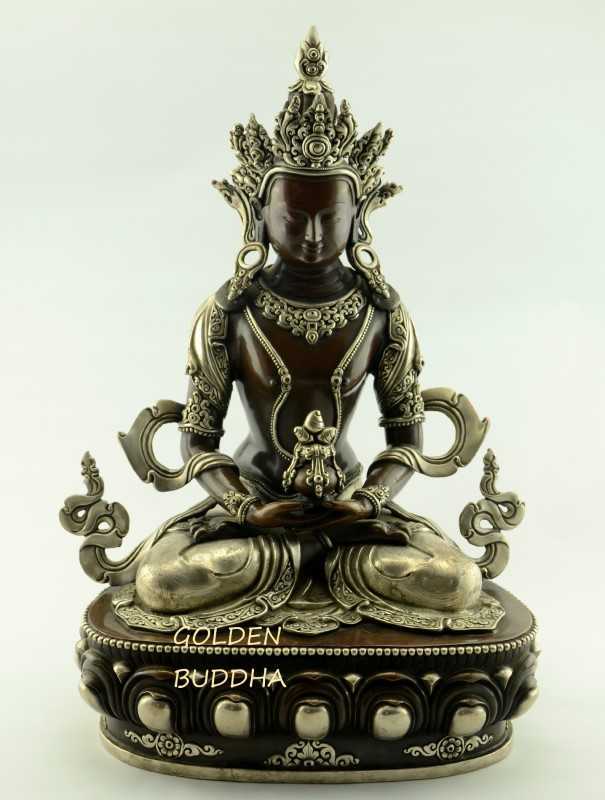
Devotees participate in Amitabha longevity rituals (tse drub) to invoke long life, good health, and the removal of obstacles to spiritual practice. Long life is considered valuable in Buddhist teaching not as an end in itself, but as an opportunity to accumulate merit, purify karma, and progress toward enlightenment — just as Dharmakara himself accumulated merit across countless lifetimes.
In these rituals, a replica of his immortality vase is filled with consecrated wine (amrita). Devotees consume a small amount of the consecrated wine along with small dough pills (rilbu) while reciting the Amitabha mantra. The ritual is considered most effective when all participants hold unwavering faith in Amitabha’s longevity attribute and his capacity to bestow long, meaningful life.
The Pure Land of Sukhavati — Western Paradise
The Bodhisattva Dharmakara was so utterly devoted to relieving the suffering of sentient beings that he concluded a pure land of his own would be the most effective vehicle. He spent five eons studying the pure lands of other Buddhas, learning their qualities and shortcomings, before designing his own. The result was Sukhavati — Sanskrit for “Land of Bliss” or “Land of Ultimate Happiness” — described in the Sukhavativyuha Sutras as a realm of extraordinary beauty, filled with jeweled trees, singing birds, fragrant lotus ponds, and the continuous sound of Dharma.
To bring Sukhavati into existence, Amitabha fulfilled 48 vows. The eighteenth vow is considered the most important — known as the Primal Vow: Dharmakara declared he would not accept Buddhahood until every being who recited his name or mantra with sincere faith (a minimum of ten times) could gain entrance to Sukhavati. Since his 48 vows were all fulfilled, Amitabha attained Buddhahood and the Western Pure Land of Sukhavati now exists as an active, accessible realm.
Once admitted to Sukhavati, devotees are under Amitabha’s direct guidance and protection. Buddhist teaching holds that beings born in Sukhavati will never fall back into samsara — they will progress steadily toward full enlightenment under the personal instruction of Amitabha Buddha and the great Bodhisattvas who reside there, including Avalokiteshvara (Chenrezig) and Mahasthamaprapta.
Amitabha & the Five Dhyani Buddhas
Amitabha is one of the Five Dhyani Buddhas (also called the Five Transcendent Buddhas or Five Wisdom Buddhas) — a mandala of five enlightened beings who together represent the complete transformation of the five poisons into five corresponding wisdoms. In this mandala:
- Amitabha — presides over the Western direction; transforms the poison of desire and attachment into the wisdom of discernment (pratyavekṣaṇā-jñāna); color red; element fire.
- Vairochana — center; transforms ignorance into the wisdom of Dharmadhatu; color white.
- Akshobhya — East; transforms anger into mirror-like wisdom; color blue.
- Ratnasambhava — South; transforms pride into the wisdom of equality; color yellow.
- Amoghasiddhi — North; transforms jealousy into all-accomplishing wisdom; color green.
Understanding Amitabha’s place in the Five Dhyani Buddhas mandala reveals the deeper dimension of the Amitabha statue meaning: he is not merely a compassionate deity who offers rebirth in a pleasant realm. He is a cosmic Buddha whose enlightened awareness encompasses and transforms the deepest root of human suffering — the craving and attachment that perpetuate the cycle of rebirth. Meditating on Amitabha is therefore both a devotional practice and a profound alchemical process.
Amitabha Mantra: How to Use It & Its Benefits
There are several accepted versions of the Amitabha mantra, each valid across different Buddhist traditions. In Sanskrit, the two principal forms are “Om Amitabha Hrih” and “Namo Amitabha Buddha” — both meaning “Homage to the Amitabha Buddha.” In Vajrayana Buddhism the Tibetan pronunciation is used: “Om Ami Dewa Hri.” In Chinese Pure Land Buddhism, the mantra is simply his name in Chinese — “Amituofo” — recited continuously in a practice called nianfo (Buddha recollection).
“Om Amitabha Hrih”
The objective of Amitabha mantra recitation is to generate sufficient one-pointed concentration and sincere aspiration to connect with Amitabha’s vow-power and gain access to Sukhavati at the moment of death. The minimal requirement is simply to recite his name or mantra at least 10 times in succession with unwavering sincerity, faith, and aspiration to be reborn in the Western Pure Land.
It is not important which version of the mantra is used — what matters is the quality of the practitioner’s intention. Amitabha mantra benefits as taught across Tibetan, Chinese, and Japanese Buddhist traditions include: purification of negative karma, particularly karma arising from desire and attachment; protection during the dying process and guidance through the bardo (intermediate state); rebirth in Sukhavati and freedom from lower rebirths; accumulation of merit; and the gradual development of discriminating wisdom.
Placing an Amitabha Buddha statue on a home altar or meditation space and reciting the mantra before it is one of the most traditional and effective methods of Amitabha practice — combining visualization, devotion, and mantra in a unified approach.
Frequently Asked Questions About Amitabha Buddha
What does an Amitabha Buddha statue represent?
An Amitabha Buddha statue represents the Buddha of Infinite Light and Life — the compassionate ruler of the Western Pure Land of Sukhavati. His iconography encodes specific teachings: the Dhyana Mudra (meditation gesture) expresses unwavering enlightened concentration; the red or saffron color represents the transformation of desire into discriminating wisdom; the lotus throne represents the purity that arises from the mud of samsara; and the alms bowl or immortality vase represents his infinite capacity to nourish and sustain all beings. Placing a statue on a home altar supports regular mantra practice and serves as a visual reminder of Amitabha’s boundless compassion and his vow to liberate all who sincerely call upon him.
What is the difference between Amitabha and Amitayus?
Amitabha and Amitayus are two aspects of the same Buddha. Amitabha (“Infinite Light”) is the nirmanakaya or standard form, typically depicted holding an alms bowl in the Dhyana Mudra. Amitayus (“Infinite Life,” also known as Aparmita) is his sambhogakaya form, specifically emphasizing the longevity attribute — depicted holding an immortality vase filled with the nectar of long life. In Tibetan Buddhism, Amitayus statues are the principal objects of longevity rituals, while Amitabha statues are used in Pure Land and general devotional practice. Both are legitimate and widely venerated forms.
What is the Amitabha Pure Land (Sukhavati)?
Sukhavati (Sanskrit: “Land of Bliss”) is the Western Pure Land created and presided over by Amitabha Buddha. It is described in the Sukhavativyuha Sutras as a realm of extraordinary beauty, free from suffering, filled with jeweled trees, fragrant lotus ponds, and the continuous sound of Dharma teachings. Beings born in Sukhavati are under Amitabha’s direct protection and guidance, and will not fall back into samsara. It is considered the most accessible of all Buddhist pure lands — entry requires only sincere faith and the recitation of Amitabha’s name or mantra, making it open to practitioners of all backgrounds and levels of spiritual development.
Who are the 48 vows of Amitabha?
The 48 vows of Amitabha (made while he was the Bodhisattva Dharmakara) form the foundational covenant of Pure Land Buddhism. Each vow specifies a quality or condition of Sukhavati, or a promise to beings who aspire to be reborn there. The most celebrated is the 18th vow — the Primal Vow — in which Dharmakara promised not to accept Buddhahood unless every being who sincerely recited his name or mantra (a minimum of ten times) could gain rebirth in his pure land. The fulfillment of all 48 vows brought Sukhavati into existence and confirmed Amitabha’s Buddhahood. These vows are recited and contemplated by Pure Land practitioners worldwide as the basis of their devotional practice.
What is the Amitabha mantra and how many times should I recite it?
The primary Amitabha mantra is “Om Amitabha Hrih” (Sanskrit) or “Om Ami Dewa Hri” (Tibetan). In Chinese Pure Land Buddhism, simply reciting “Amituofo” serves as the complete mantra. Amitabha’s 18th vow specifies a minimum of ten sincere recitations to activate his vow-power. In formal practice, mantras are typically recited in rounds of 21 or 108 using a mala (prayer beads). Many practitioners recite thousands of repetitions daily. The quality of concentration and sincerity is considered more important than quantity — though sustained daily practice over time is considered the most effective approach for building the connection with Amitabha that will guide the practitioner at death.
Where is the best place to position an Amitabha Buddha statue?
An Amitabha Buddha statue should be placed on a clean, elevated surface — never on the floor. A dedicated home altar or a high shelf in a meditation room is ideal. Because Amitabha presides over the Western direction, positioning the statue so it faces west, or so the practitioner faces west while reciting the mantra, is considered particularly auspicious in Pure Land tradition. Keep the area clean and, if possible, offer light (a candle or butter lamp), fresh water, and flowers as a simple daily offering practice. Authentic statues from Patan, Nepal can also be formally consecrated (rabne) at a recognized monastery before being placed on the altar.
Buy Authentic Amitabha Statues Direct from Nepal
Discover the world’s finest handcrafted Amitabha Buddha statues in Patan, Nepal — the historic center of Himalayan Buddhist artisanship for over a thousand years. My local partners and I have worked directly with Nepali shakya artisans for over three generations, ensuring that every statue meets the monastic quality standard found in the great Tibetan monasteries.
Each Amitabha statue is a handmade original — no two are alike. Created using the traditional lost-wax casting (cire perdue) method, every statue is finished with 24K fire gilding and hand face painting using real gold, imbuing it with the luminous, lifelike quality that photographs can only approximate. The golden luster of an authentic gold-gilded statue will remain free of tarnish, displaying the infinite glow of the Amitabha Buddha meaning for generations.
All statues are 100% authentic and come with a certificate of authenticity from the Department of Archaeology in Kathmandu. Consecration (rabne) at Sangye Choeling Monastery in Kathmandu is available upon request — formally activating the statue as a genuine object of refuge and devotional practice.