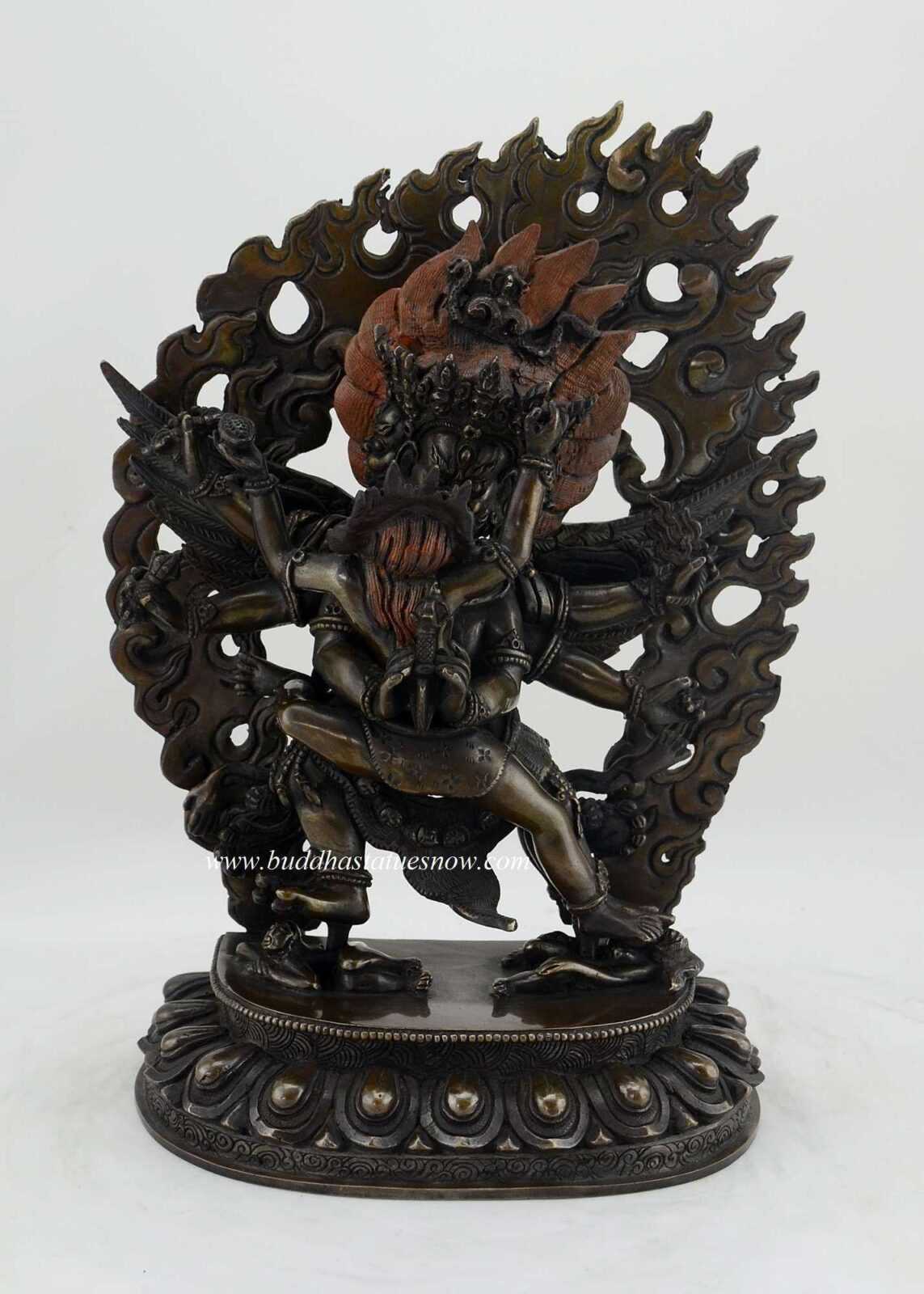
Vajrakilaya Statues — Dorje Phurba | Obstacle Removing Deity
Vajrakilaya (Sanskrit: Vajrakīlaya — “Vajra Dagger”; Tibetan: Dorje Phurba) is the wrathful yidam deity of the three-bladed ritual dagger — the phurba — and one of the most widely practiced obstacle-removing deities in Tibetan Buddhism. He is particularly central to the Nyingma school, where he is among the eight principal herukas of the Mahayoga Tantra cycle, and is also practiced in the Kagyu and Sakya traditions. His iconography is unique in the entire Tibetan Buddhist pantheon: his lower body does not end in legs but merges into the triangular blade of the phurba itself — he is not a deity who carries the dagger but a deity who IS the dagger, the wrathful intelligence of the vajra made physically present in the form of a weapon that cuts through all obstacles to realization. He is typically depicted with three faces — representing his all-encompassing awareness across past, present, and future, or his capacity to act in peaceful, semi-wrathful, and fully wrathful modes simultaneously — and six arms holding various implements, in the alidha warrior stance on the bodies of the obstacles he has subdued. He is depicted in yab-yum with his consort Diptachakra (Tib: Barwa Drolma), the union of wisdom and method that characterizes all highest yoga tantra practice. Learn more about wrathful deity statues in our collection.
The phurba ritual dagger is one of the most important and widely used objects in Tibetan Buddhist ceremonial practice. Its three blades represent the cutting of the three poisons — ignorance, desire, and aversion — at their root simultaneously. The act of driving the phurba into the ground, into a ritual target, or into space binds and immobilizes the harmful forces, negative karmic patterns, and spiritual obstacles that prevent practice and bring harm; the pointed tip represents the one-pointed awareness of Vajrakilaya that pierces through delusion without deviation. Vajrakilaya’s specific function is the most urgent and practically oriented of all yidam practices: where other deities address longevity, wisdom, or compassion, Vajrakilaya addresses the obstacles that prevent any practice at all — the harmful circumstances, internal resistances, and outer interferences that obstruct practitioners before they can establish a stable foundation. The practice is closely associated with Guru Rinpoche (Padmasambhava), who is said to have used Vajrakilaya practice to subdue the local deities and demons of Tibet and prepare the ground for Buddhism to take root — making Vajrakilaya the specific deity of establishing the conditions for the Dharma to flourish. Explore the four schools of Tibetan Buddhism and the Nyingma tradition in our complete guide.
Showing all 2 resultsSorted by popularity