

Dorje Shugden statues portray one of the most controversial, most debated, and most widely practiced Dharma protector deities in all of Tibetan Buddhism — a figure whose origins lie in 17th century Lhasa political intrigue, whose rise to prominence spanned three centuries of Gelug monastic practice, and whose practice has been the subject of the most significant theological dispute in contemporary Tibetan Buddhism. Yet for millions of devotees across Asia and the Western world, Dorje Shugden is simply their most trusted protector — a fierce, swift, and supremely effective guardian who removes obstacles, ensures the success of Dharma practice, and guards the purity of Tsongkhapa’s Gelug teachings with unwavering ferocity.
Known by his principal title Lord Duldzin — “Holder of the Vinaya” — Dorje Shugden is recognized as a wrathful emanation of Manjushri, the Bodhisattva of Wisdom, manifesting in the form of a ferocious protector deity riding a snow lion through a ring of wisdom fire. He is intimately connected to the Vajrayogini practice tradition and is considered by his practitioners to be a fully enlightened being whose protective activity is accessible to practitioners at every level. Dorje Shugden statues handcrafted in Nepal are among the most detailed and powerful protective deity statues in the Golden Buddha collection.
Contents
- Tulku Drakpa Gyaltsen — The Man Who Became Dorje Shugden
- The Dispute with the 5th Dalai Lama
- The Funeral Pyre Controversy
- Deification — From Spirit to Dharma Protector
- Rise to Prominence — Three Centuries of Gelug Practice
- The Sectarian Controversy — Evidence Examined
- Dorje Shugden & Manjushri — Wrathful Wisdom Emanation
- Dorje Shugden & Vajrayogini — The Protector Connection
- Dorje Shugden Statue Iconography — Complete Guide
- The Five Forms of Dorje Shugden — Rig Nga
- Dorje Shugden Mantra & Practice Benefits
- Authentic Dorje Shugden Statues from Nepal
- Frequently Asked Questions About Dorje Shugden
Tulku Drakpa Gyaltsen — The Man Who Became Dorje Shugden
The human story behind Dorje Shugden statues begins in 1619 CE — the year of Tulku Drakpa Gyaltsen’s birth in Lhasa. This extraordinary child showed such remarkable signs of spiritual attainment from infancy that he was recognized by the 4th Panchen Lama Lobsang Chokyi Gyaltsen as the 4th incarnation of the Zimkhang Gongma line. From the age of two or three he was already speaking clearly and playing with ritual instruments. By five or six he had vivid visions of meditational deities and could recall his past lives in detail. He was formally identified as a candidate for the 5th Dalai Lama reincarnation — a recognition that would set in motion the political tensions that would ultimately lead to his death and his transformation into the Dharma protector Dorje Shugden.
Drakpa Gyaltsen grew into one of the most respected lamas of his generation — a brilliant scholar, accomplished practitioner, and widely venerated teacher whose followers included Mongolian royalty and thousands of devoted disciples. He was the tulku of Drepung Monastery’s Zimkhang Gongma house and his spiritual reputation was so great that it rivaled the 5th Dalai Lama himself. It was precisely this widespread popularity — combined with his reputation for maintaining strict doctrinal purity within the Gelug tradition — that created the conditions for conflict with the Dalai Lama’s administration.
The Dispute with the 5th Dalai Lama
The 5th Dalai Lama Lobsang Gyatso (1617–1682 CE) — known as “the Great Fifth” — was one of the most politically brilliant and spiritually accomplished figures in Tibetan history. Under his leadership, the Dalai Lama institution achieved unprecedented political dominance over Tibet, backed by Mongol military support. He was also unusually ecumenical in his religious outlook, integrating Nyingma teachings and practices into his personal practice alongside the traditional Gelug curriculum — a position that generated significant controversy within the more conservative wing of the Gelug school.
Tulku Drakpa Gyaltsen represented the conservative Gelug position: the strict preservation of Tsongkhapa’s teachings without mixture with other schools’ methods. His enormous personal following and his doctrinal conservatism made him a focal point for those within the Gelug establishment who were uncomfortable with the 5th Dalai Lama’s ecumenical approach. Historical accounts suggest that this ideological tension — combined with the political rivalry inherent in having two highly revered lamas of roughly equal spiritual reputation operating simultaneously in Lhasa — created an environment of escalating court intrigue.
The precise nature of the conflict between Drakpa Gyaltsen and the 5th Dalai Lama’s administration remains disputed by historians. What is generally agreed is that shortly after the 5th Dalai Lama returned from a state visit to China — during which his absence from Lhasa created a period of reduced central control — Tulku Drakpa Gyaltsen died in circumstances that most accounts describe as suspicious or violent. Traditional Dorje Shugden sources state clearly that he was murdered by an attendant named Depa Norbu — who forced a ceremonial scarf (khata) down the lama’s throat. More skeptical historical accounts describe ambiguous circumstances but acknowledge that the death occurred in a politically charged atmosphere and that no specific crime was ever documented against the lama that would explain or justify such treatment.
The Funeral Pyre Controversy
The most dramatic and widely recounted episode in Dorje Shugden’s origin story involves his funeral pyre — an event whose details are preserved across multiple sources and which effectively forced the 5th Dalai Lama to take an explicit position on the nature of his rival’s death and afterlife.
Drakpa Gyaltsen’s remains were placed on a large cremation pyre in central Lhasa in accordance with tradition, with thousands of disciples, Mongolian royalty, and high lamas in attendance. When the pyre was lit, the wood refused to burn. No explanation could be found for this supernatural refusal — it was interpreted by those gathered as a sign that the deceased lama’s spirit had not departed peacefully and that something was profoundly unresolved. Some accounts describe attendants witnessing the smoke from the pyre rising to form a dark menacing cloud in the shape of an open hand — a sign, according to traditional interpretation, that the lama’s spirit had taken on a form of active spiritual presence in response to the circumstances of his death.
When news of the pyre’s refusal to burn reached the Potala Palace, the 5th Dalai Lama was deeply troubled. He had learned — or already knew — that his own attendants were responsible for Drakpa Gyaltsen’s death. Shocked and filled with remorse, he composed a poem of apology to the late Tulku Drakpa Gyaltsen, acknowledging the wrong that had been done. One of his attendants carried the poem down to the funeral assembly, where it was read aloud before the assembled crowd.
The moment the poem was read aloud, the wood on the pyre suddenly burst into flames. Strong winds blew, an earthquake shook the city, and from the fire a powerful swirling black tornado appeared — rising directly from the flames. Traditional accounts interpret this dramatic sequence of events as the definitive sign that Tulku Drakpa Gyaltsen had accepted the apology and transformed himself — willingly and with great spiritual power — into the Dharma protector Dorje Shugden.
Deification — From Spirit to Dharma Protector
In the immediate aftermath of these events, the situation was theologically ambiguous. Many — including initially the 5th Dalai Lama himself — believed that Drakpa Gyaltsen had become a gyalpo — a wrathful, potentially harmful worldly spirit driven by grievance rather than enlightened intention. The 5th Dalai Lama invited very powerful lamas including the senior Nyingma master Mindrolling Rinpoche to perform rituals to subdue what he described as a potentially dangerous spirit. This is one of the most cited facts in discussions of the Dorje Shugden controversy — that the very Dalai Lama administration credited with creating the conditions for Drakpa Gyaltsen’s death also initially classified his spirit as harmful.
The traditional Dorje Shugden account — preserved by masters including Kyabje Trijang Rinpoche, the longtime tutor of the 14th Dalai Lama and one of the most revered Gelug masters of the 20th century — offers a different interpretation: the 5th Dalai Lama clairvoyantly knew that Dorje Shugden was not an evil spirit but performed the subjugation rituals deliberately, knowing that if Dorje Shugden was truly enlightened he would not be destroyed by them. This “test” effectively revealed his enlightened status. Whether accepted or not, this interpretation is important context: it explains why Dorje Shugden practitioners do not view the 5th Dalai Lama as an adversary but rather as an unwitting instrument in the process that revealed Dorje Shugden’s true nature.
Eventually, the spirit associated with Drakpa Gyaltsen was recognized as Dorje Shugden — a fully enlightened Dharma protector and wrathful emanation of Manjushri. The 5th Dalai Lama himself subsequently wrote prayers to Dorje Shugden — several of which survive in the historical record and are cited by Dorje Shugden practitioners as definitive evidence of the Great Fifth’s ultimate recognition of the deity’s legitimacy.
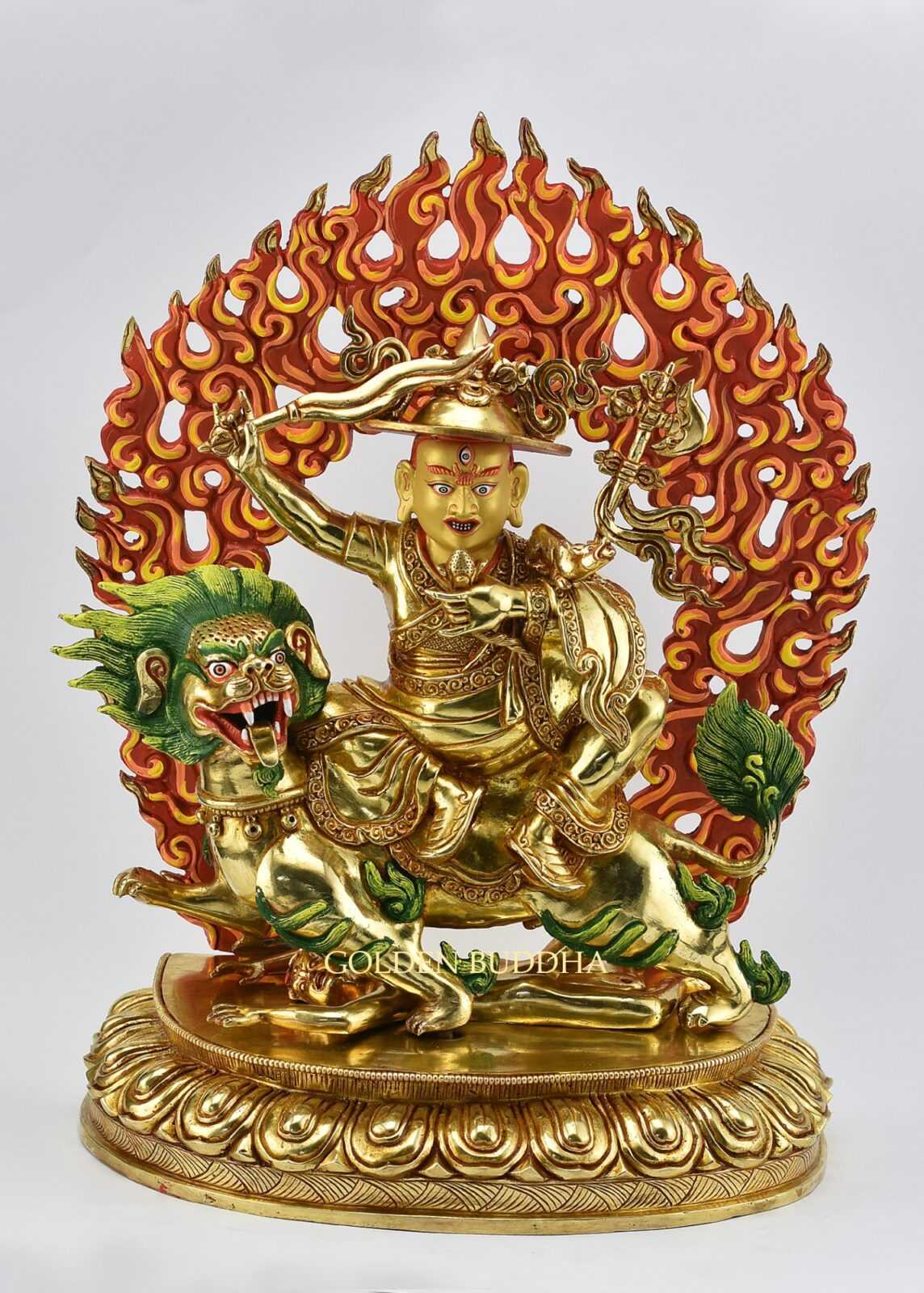
Masterpiece Dorje Shugden Statue — Fully Gold Gilded 15.5″
Rise to Prominence — Three Centuries of Gelug Practice
Despite the 5th Dalai Lama’s ambivalence, Dorje Shugden practice spread gradually through the Gelug monasteries over the following decades — adopted particularly by those monks who were uncomfortable with the Great Fifth’s ecumenical mixing of Nyingma and Gelug practices. Dorje Shugden became the protector of choice for those committed to what they understood as the pure transmission of Tsongkhapa’s teachings. After the 5th Dalai Lama’s death in 1682, explicit controversy faded and Dorje Shugden practice became increasingly mainstream within Gelug monasticism.
The decisive expansion of Dorje Shugden practice came in the late 19th and early 20th centuries through the enormous influence of Kyabje Pabongkha Rinpoche (1878–1941) — one of the most charismatic and influential Gelug masters of his era. Pabongkha actively promoted Dorje Shugden practice, incorporating it as a central element of his widely attended teachings and establishing it as a near-universal monthly practice in provincial Gelug monasteries throughout Tibet. During the period when four successive Dalai Lamas died young and Tibetan Buddhism faced extraordinary institutional instability, Dorje Shugden practice offered practitioners a sense of direct divine protection that had immediate practical appeal.
Pabongkha’s disciples — including Kyabje Trijang Rinpoche, the junior tutor of the 14th Dalai Lama for over thirty years — inherited and continued this transmission. Through Trijang Rinpoche’s extraordinary influence, Dorje Shugden practice became deeply embedded in Gelug institutional culture at the highest levels, practiced by many of the most respected lamas of the 20th century. It was estimated that by the time the controversy with the 14th Dalai Lama erupted in the 1990s, the majority of Gelug monks had some relationship with Dorje Shugden practice.
The Sectarian Controversy — Evidence Examined
The most persistent criticism of Dorje Shugden practice is that it promotes religious sectarianism — specifically, that practitioners are prohibited from receiving teachings from non-Gelug masters, creating a spiritual barrier that fragments the unity of Tibetan Buddhism. The 14th Dalai Lama has consistently cited this concern as the primary reason for his discouragement of the practice beginning in the 1970s and his formal ban within his community from 1996 onward. This is an important and serious question that deserves honest examination of the available evidence.
The case for sectarian influence: Historical evidence does support the view that Dorje Shugden’s practice became associated with an inward-looking, tradition-protecting orientation within the Gelug school. Kyabje Pabongkha Rinpoche — the primary 20th century promoter of Dorje Shugden — did actively promote a more exclusive Gelug identity and expressed concern about the mixing of traditions. Some practitioners have reported being told by teachers that receiving Nyingma or other non-Gelug transmissions was incompatible with their Dorje Shugden commitments. The correlation between Dorje Shugden practice and doctrinal conservatism in the Gelug school is historically demonstrable, even if direct causation is debated.
The case against mandatory sectarianism: Dorje Shugden practitioners — including senior lamas such as Kyabje Trijang Rinpoche and his successor Trijang Chocktrul Rinpoche — consistently maintain that Dorje Shugden practice carries no inherent prohibition against receiving teachings from other traditions. They point to historical Dorje Shugden practitioners who also held Nyingma, Kagyu, and Sakya transmissions. The sectarian tendency, in this view, reflects the personal orientation of some teachers — particularly Pabongkha Rinpoche — rather than any doctrinal requirement of the practice itself. Many contemporary Dorje Shugden practitioners worldwide do receive teachings across multiple Tibetan Buddhist lineages without apparent conflict.
The honest conclusion: The evidence suggests that the relationship between Dorje Shugden practice and sectarianism is historically correlated but not theologically necessary. The practice emerged from and was promoted within a specific conservative Gelug institutional context that did tend toward sectarian thinking — but the practice itself does not inherently require or mandate sectarianism. Like many religious controversies, the question is less about doctrine and more about the institutional culture that developed around a particular practice in a specific historical moment. Practitioners today, particularly in Western Dharma centers, often engage with Dorje Shugden practice in a non-sectarian context.
Dorje Shugden & Manjushri — Wrathful Wisdom Emanation
The identification of Dorje Shugden as a wrathful emanation of Manjushri is the most theologically significant aspect of his identity and the primary basis for his classification as a fully enlightened Dharma protector rather than an ordinary worldly deity. This identification is not merely symbolic — it is the foundation of the entire practice.
The connection operates through the incarnation lineage: Drakpa Gyaltsen’s mind-stream is traced back through previous incarnations to masters who are themselves considered emanations of Manjushri — including Panchen Sonam Drakpa (1478–1554), a renowned scholar who is considered part of Manjushri’s emanation stream. Since Dorje Shugden is understood to be Drakpa Gyaltsen’s enlightened after-death manifestation, and Drakpa Gyaltsen’s lineage traces to Manjushri, Dorje Shugden inherits the quality of Manjushri’s wisdom in its most forceful, protective, and wrathful expression.
This is why Dorje Shugden statues and Manjushri statues are sometimes placed together on the same altar — they represent the same wisdom in two complementary forms. Peaceful Manjushri represents wisdom as philosophical clarity and compassionate teaching. Dorje Shugden represents that same wisdom in its most protective, obstacle-removing, and tradition-guarding expression. The flaming sword of Manjushri that cuts through ignorance and the curved sword of Dorje Shugden that annihilates obstacles serve the same ultimate function — the complete liberation of the practitioner from every form of spiritual obstruction.
Dorje Shugden & Vajrayogini — The Protector Connection
The relationship between Dorje Shugden and Vajrayogini is one of the most distinctive and practically important aspects of the Gelug Tantric system. In traditional Gelug practice, Dorje Shugden is understood to function as the primary Dharma protector for practitioners engaged in the Vajrayogini Naro Kacho sadhana — one of the most advanced and widely practiced Anuttarayoga Tantra cycles in the Gelug school.
The complementary functions are elegantly defined: Vajrayogini’s practice transforms obstacles into the path — the very forces of desire and attachment become the fuel of enlightenment through the transformative power of her sadhana. Dorje Shugden’s protective function clears the external conditions that would prevent this transformation from proceeding — interference, obstacles, harmful influences, and disruptions to the practice environment. Together they form a complete system: the female Yidam transforms internal obstacles while the Dharma protector subdues external ones.
Both Vajrayogini and Dorje Shugden are connected to Manjushri‘s wisdom stream — Vajrayogini through the Chakrasamvara-Vajrayogini mandala, and Dorje Shugden through his incarnation lineage. This shared Manjushri connection gives their combined practice a specific doctrinal coherence within the Gelug system — and explains why serious Vajrayogini practitioners often maintain a concurrent Dorje Shugden practice as the natural protector for their primary Yidam sadhana.
Dorje Shugden Statue Iconography — Complete Guide
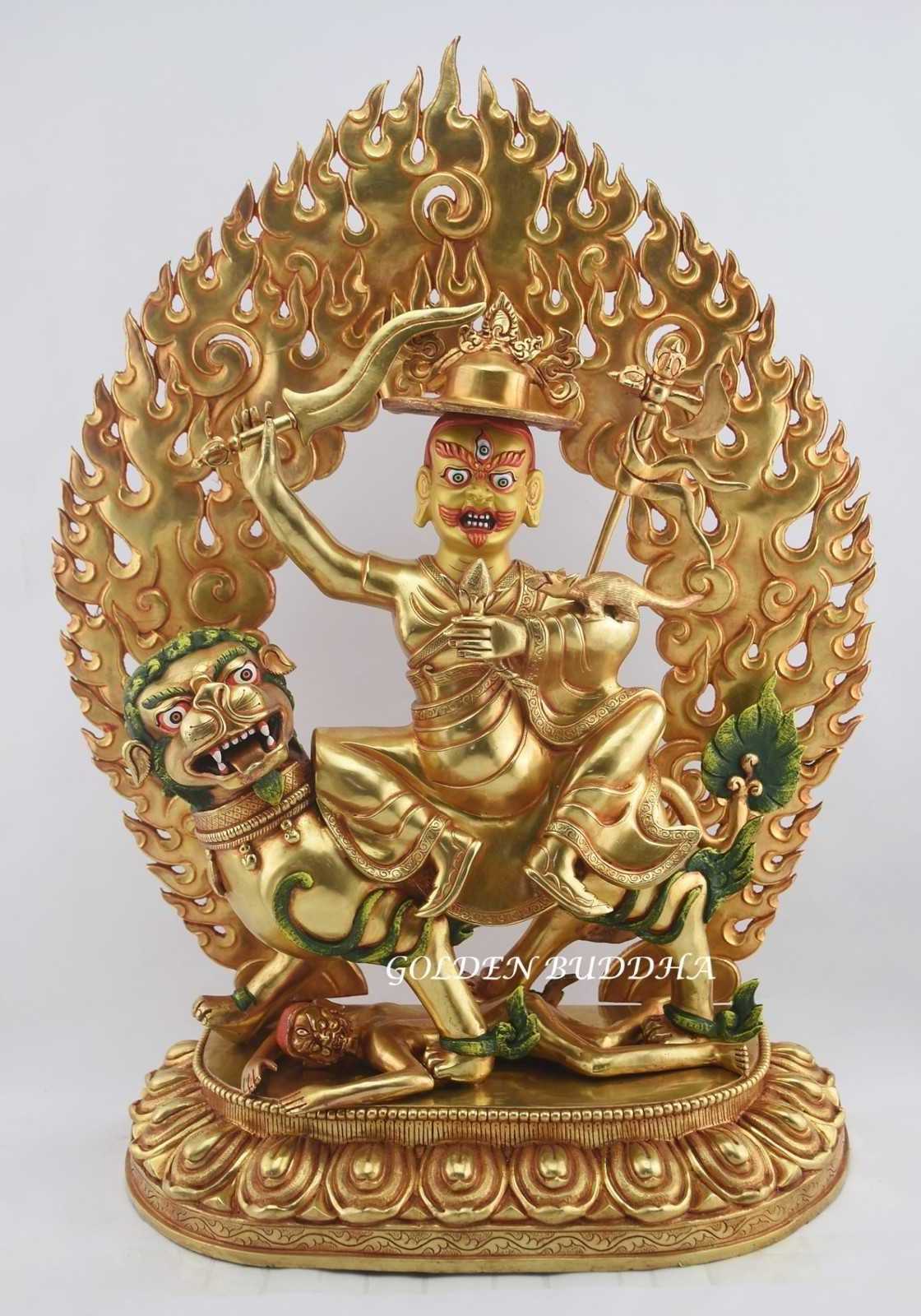
Dorje Shugden statues are among the most distinctive and iconographically specific in all of Tibetan Buddhist art — immediately recognizable even to those unfamiliar with the deity by his unique combination of features that blend the appearance of a Tibetan lama with the terrifying attributes of a wrathful protector:
Snow Lion Mount: Dorje Shugden rides a mythical Tibetan snow lion — the most powerful of all Tibetan mythological creatures, symbolizing fearlessness and the wild, untamed quality of the enlightened mind. The snow lion’s green mane indicates its power and its connection to the wisdom energies of the Himalayan peaks. The combination of Dorje Shugden’s controlled lama appearance seated atop the snow lion’s untameable energy communicates the mastery of the enlightened mind over the forces of chaos and obstruction.
Golden Domed Hat: The most visually distinctive feature of Dorje Shugden statues is the golden domed riding hat of Chinese or Mongolian origin — the type worn by traveling lamas for protection from the elements. This hat is unique to Dorje Shugden among Tibetan protective deities and immediately marks his identity. Symbolically it represents his swiftness in responding to practitioners’ needs and his constant mobility in traveling wherever protection is required.
Curved Sword of Wisdom: In his right hand Dorje Shugden wields a curved sword — more lethal than a straight blade — representing the annihilation of ignorance and every obstacle to Dharma practice. The curved blade’s enhanced cutting efficiency communicates the sharpness and speed of his protective wisdom.
Heart Jewel: Held near his mouth in his left hand is a bleeding human heart — representing the heart of ignorance that Dorje Shugden practice rips out of the practitioner’s experience. The heart also symbolizes the essential aspiration of the practitioner — offered completely to the Dharma and the liberation of beings.
Jewel-Spitting Mongoose: On his left forearm rests a mongoose spitting jewels — the universal Tibetan Buddhist symbol of wealth and abundance. The mongoose represents Dorje Shugden’s capacity to provide all of his devotees’ worldly and spiritual needs — both the material resources necessary for comfortable practice and the spiritual jewels of merit, wisdom, and realization.
Taming Hook: Resting in the crook of his left arm is the taming hook — the implement that captures and subdues all negativity, obstacles, and harmful forces that could obstruct the practitioner’s progress toward liberation.
Three Glaring Eyes: Dorje Shugden’s fierce expression features three eyes — the normal two plus a vertical third eye on the forehead — representing his simultaneous perception of past, present, and future and his direct access to ultimate wisdom beyond the ordinary duality of subject and object.
Monk’s Robes: Unlike most wrathful protectors who wear armor or animal skins, Dorje Shugden is clothed in the three types of monk’s robes worn by a fully ordained Buddhist monk — communicating his past lives as an ordained monastic master and his ongoing protection of those who uphold their Dharma vows. This monastic appearance in a wrathful context is unique to Dorje Shugden and is one of his most theologically significant iconographic features.
Ring of Wisdom Fire: Dorje Shugden and his snow lion mount are surrounded by a blazing ring of wisdom flames — the same all-consuming fire of primordial awareness that surrounds Yamantaka and Vajrapani, consuming all neurotic mental states and obscurations.
Trampled Figure: Under the snow lion’s feet, a human figure is often depicted — representing the elimination of the “enemy” ignorance through the realization of emptiness.
Nepali Dorje Shugden Statue — Fully Gold Gilded 22″
The Five Forms of Dorje Shugden — Rig Nga
As taught by Tsem Rinpoche and preserved in the Dorje Shugden tradition, there are five forms of Dorje Shugden — collectively known as Rig Nga (“Five Types”) — each corresponding to one of the five aggregates (skandhas) through which sentient beings experience existence:
- Lord Duldzin (Holder of the Vinaya) — Aggregate of Consciousness. The most widely practiced and most commonly depicted form, identifiable by his white body. This is the primary form depicted in most Dorje Shugden statues available today.
- Shize (Pacifier) — Aggregate of Form. White body, pacifying activity. Associated with the purification of physical existence and the elimination of illness and obstacles of a physical nature.
- Gyenze (Increaser) — Aggregate of Feeling/Sensation. Yellow body, increasing activity. Associated with the enhancement of merit, wealth, lifespan, and the positive qualities needed for practice.
- Wangze (Controller) — Aggregate of Perception/Discrimination. Red body, magnetizing activity. Associated with influence, attraction of favorable conditions, and the power to draw practitioners toward the Dharma.
- Trakze (Wrathful) — Aggregate of Mental Formations. Black body, wrathful activity. The most ferocious form, associated with the subjugation of the most entrenched obstacles and the most powerful negative forces.
The Lord Duldzin form — aggregate of consciousness — is the most popular because it addresses the most fundamental level of the practitioner’s experience: the consciousness that perceives, misidentifies, and generates karmic momentum. Purifying the aggregate of consciousness through Dorje Shugden practice is understood as the most direct approach to breaking the cycle of samsaric existence at its deepest level.
Lord Duldzin Dorje Shugden Statue — Fully Gold Gilded 10″

Dorje Shugden Mantra & Practice Benefits
“Om Benza Wiki Bitana Soha”
The Dorje Shugden mantra is considered one of the most effective and accessible in Tibetan Buddhist practice — a short, powerful invocation that can be recited by practitioners at any level. Om Benza Wiki Bitana Soha directly invokes Dorje Shugden’s protective presence and calls upon his enlightened activity to assist the practitioner. The mantra is recited as part of the formal Dorje Shugden puja (offering ceremony) and can also be recited independently as a daily protective practice.
Practice benefits attributed to Dorje Shugden by traditional sources include: the swift removal of obstacles to Dharma practice and daily life; protection against harmful influences, accidents, and illness; the enhancement of wisdom and clear understanding; the fulfillment of both worldly and spiritual needs; special protection for practitioners maintaining Dharmic commitments and Tantric vows; guidance during difficult life transitions; and the creation of auspicious conditions that support the completion of Dharma study and meditation practice. His practice is particularly recommended for practitioners who face persistent obstacles despite sincere effort — situations where the practitioner’s own capacity is insufficient to remove whatever is blocking progress.
Placing a Dorje Shugden statue on the meditation altar and reciting his mantra before practice sessions is a straightforward and accessible way to invite his protective presence into the practice environment. The statue functions as a support for the practitioner’s visualization and as a physical reminder of the protective commitment that Dorje Shugden is understood to have made to all practitioners who sincerely rely upon him.
Authentic Dorje Shugden Statues from Nepal
Dorje Shugden statues from Nepal are among the most difficult authentic Dharma protector statues to find — the complexity of his iconography (snow lion, all specific implements, robes, golden hat) requires the most accomplished level of artisan skill to execute correctly. Golden Buddha works directly with the master artisans of Patan to source Dorje Shugden statues of genuine monastic quality — each one created using the traditional lost wax casting method, finished in 24K fire gilding, and hand face painted using real gold.
Upon request, turquoise or red coral stones can be inserted to adorn the neck of the snow lion — a traditional embellishment that enhances both the statue’s beauty and its authenticity for serious practitioners. All statues are certified by the Department of Archaeology in Kathmandu before export. Consecration service (rabne) at Sangye Choeling Monastery is available upon request.
Frequently Asked Questions About Dorje Shugden
Who is Dorje Shugden?
Dorje Shugden is a Tibetan Buddhist Dharma protector revered as a wrathful emanation of Manjushri, the Bodhisattva of Wisdom. He is understood by his practitioners to be a fully enlightened protective deity whose human form was the 17th century Gelug lama Tulku Drakpa Gyaltsen — a scholar and practitioner of extraordinary attainment who died in mysterious circumstances in Lhasa and manifested as a Dharma protector. Known by his primary title Lord Duldzin (“Holder of the Vinaya”), he is depicted riding a mythical snow lion through a ring of wisdom fire, holding a curved sword, heart jewel, mongoose, and taming hook while wearing the golden domed hat and monk’s robes of a Tibetan lama. His practice spread through the Gelug school over three centuries — particularly through the influence of Kyabje Pabongkha Rinpoche in the early 20th century — and is practiced by millions of Tibetan Buddhist practitioners worldwide despite significant controversy with the 14th Dalai Lama.
What is the Dorje Shugden controversy?
The Dorje Shugden controversy is a theological and political dispute within Tibetan Buddhism — specifically within the Gelug school — over the nature and legitimacy of Dorje Shugden practice. The 14th Dalai Lama has discouraged the practice since the 1970s and banned it within his administration from 1996, citing concerns that Dorje Shugden practice promotes sectarianism that undermines Tibetan Buddhist unity and his own authority. Dorje Shugden practitioners — including the New Kadampa Tradition and numerous independent Gelug masters — dispute this characterization and continue to practice. The controversy has historical roots in 17th century tensions between Drakpa Gyaltsen and the 5th Dalai Lama’s administration, and contemporary dimensions involving questions of religious freedom, Tibetan politics, and the authority of the Dalai Lama institution.
What is the Dorje Shugden mantra?
The Dorje Shugden mantra is “Om Benza Wiki Bitana Soha” — a short, powerful invocation that directly calls upon Dorje Shugden’s protective presence. It is recited as part of the formal Dorje Shugden puja (offering ceremony) performed on the 10th, 15th, and 30th days of the lunar month in many Gelug monasteries. It can also be recited independently as a daily protective practice before meditation sessions or at any time when protection from obstacles is needed. Unlike the more advanced Vajrayogini mantra which requires formal initiation, the Dorje Shugden mantra is generally considered accessible to practitioners without specific initiation requirements, though receiving formal teachings from a qualified lama is always recommended.
How does Dorje Shugden relate to Vajrayogini practice?
In traditional Gelug practice, Dorje Shugden functions as the primary Dharma protector for practitioners engaged in the Vajrayogini Naro Kacho sadhana. The relationship is complementary: Vajrayogini transforms internal obstacles (desire, attachment, neurotic mental states) into the direct experience of great bliss and emptiness, while Dorje Shugden removes external obstacles that would prevent this transformation from proceeding — interference, disruptions, harmful conditions. Both are connected to the wisdom stream of Manjushri: Vajrayogini through the Chakrasamvara mandala, Dorje Shugden through his incarnation lineage. This shared Manjushri connection gives their combined practice doctrinal coherence. Many serious Vajrayogini practitioners maintain a concurrent Dorje Shugden practice for exactly this reason. Learn more about Vajrayogini statues and the Naro Kacho lineage.
What does a Dorje Shugden statue represent?
A Dorje Shugden statue represents the complete protective activity of an enlightened Dharma guardian who is simultaneously a fully ordained monastic master and a ferocious wrathful deity — a combination unique in Tibetan Buddhist iconography. The snow lion represents fearlessness; the ring of wisdom fire represents the consumption of all neurotic mental states; the golden domed hat represents swift response to practitioners’ needs; the curved sword represents the annihilation of ignorance; the heart jewel represents the conquest of the fundamental enemy ignorance; the mongoose represents abundance of worldly and spiritual wealth; the monk’s robes represent the protection of Dharma vows; and the three eyes represent omniscient wisdom across past, present, and future. Placing a Dorje Shugden statue on a home altar or meditation space invites his protective presence and signals the practitioner’s reliance on his enlightened activity.