

Jambhala statues depict the Buddhist God of Wealth — one of the most powerful and universally venerated deities in all of Tibetan Buddhism. Known in Sanskrit as Jambhala (also spelled Dzambhala, Zambala, or Jambala), he is the principal wealth deity of the Vajrayana Buddhist tradition, revered across the Gelug, Nyingma, Kagyu, and Sakya schools alike. His mandate is extraordinary: not simply to bestow material riches, but to eliminate the poverty that prevents practitioners from effectively following the Dharma path.
Jambhala statues originated from the Hindu god of wealth — Kubera. In Hinduism, Kubera’s mandate was straightforward material enrichment. However, as Kubera was assimilated into Buddhism as Jambhala, his purpose was profoundly transformed by the attributes of equanimity and compassion. He can still make devotees wealthy — but only when their desire for wealth is combined with the virtue of generosity. This is the defining principle of Jambhala’s teaching: wealth is not an end in itself but a means to support spiritual practice and benefit others.
In Buddhism, Jambhala’s purpose of wealth generation is to create opportunity for the impoverished — relieving their burden of debts, bad luck, and extreme deficiency so they can effectively practice the Dharma. This guide covers the meaning, iconography, mantra, and practice of every major form of Jambhala statue.
Contents
- Jambhala Statue Meaning — The Precious Golden Deity
- Five Types of Jambhala Statues
- Yellow Jambhala Statue — Most Popular Form
- Yellow Jambhala Mantra
- White Jambhala Statue — Healing & Longevity
- White Jambhala Mantra
- Black Jambhala Statue — Wrathful Wealth Deity
- Black Jambhala Mantra
- Red Jambhala Statue — Business Success & Magnetizing
- Green Jambhala Statue — Swift Abundance
- Jambhala Becomes a Protector of the Dharma
- Pouring Water on Jambhala Statues
- Frequently Asked Questions About Jambhala Statues
Jambhala Statue Meaning — The Precious Golden Deity
The name Dzambhala breaks down into three Sanskrit components: Dzam means “deity or assembly”; Bhah means “gold or wealth”; La means “to honor.” Together, Dzambhala translates as “Precious Golden Deity who gathers or brings the wealth of spirituality (Dharma) and material security to our lives.” This definition captures the dual nature of Jambhala’s purpose — he addresses both material and spiritual poverty with equal concern.
Jambhala is also understood as an emanation of Avalokiteshvara — the Bodhisattva of Compassion — manifesting in wealth deity form to address one of the most persistent practical obstacles to Dharma practice: poverty. His role as described by Gyalten Sogdzin Rinpoche is comprehensive: “Jambhala is the protector of all lineages and of all sentient beings from all sickness and difficulties.” He is simultaneously a Bodhisattva of material wealth, spiritual wealth, and the removal of every obstacle to both.
Five Types of Jambhala Statues
There are five Jambhala statues — each a member of the jewel family and each an emanation of one of the Five Dhyani Buddhas. The five forms are Yellow Jambhala, White Jambhala, Black Jambhala, Red Jambhala, and Green Jambhala. Each Jambhala embodies a different dimension of wealth and uses different means to accomplish his goals — yet all five share the common purpose of generating both material and spiritual prosperity for their devotees.
All five Jambhala statues share certain iconographic features: they are typically depicted with a large, protruding belly symbolizing abundance and contentment; they hold the mongoose Nehulay in one hand — a creature that perpetually spews precious jewels representing inexhaustible generosity; and they display various hand gestures and objects specific to their individual form and function.
Yellow Jambhala Statue — Most Popular Form
Yellow Jambhala statues represent the most popular and widely recognized form of the Buddhist God of Wealth. He is an emanation of Ratnasambhava Buddha — the Dhyani Buddha of the South whose defining quality is equanimity and the virtue of generosity — making Yellow Jambhala uniquely suited to the task of equitable wealth distribution. He is widely considered the most powerful of the five Jambhalas for eliminating poverty across all six realms of samsara.
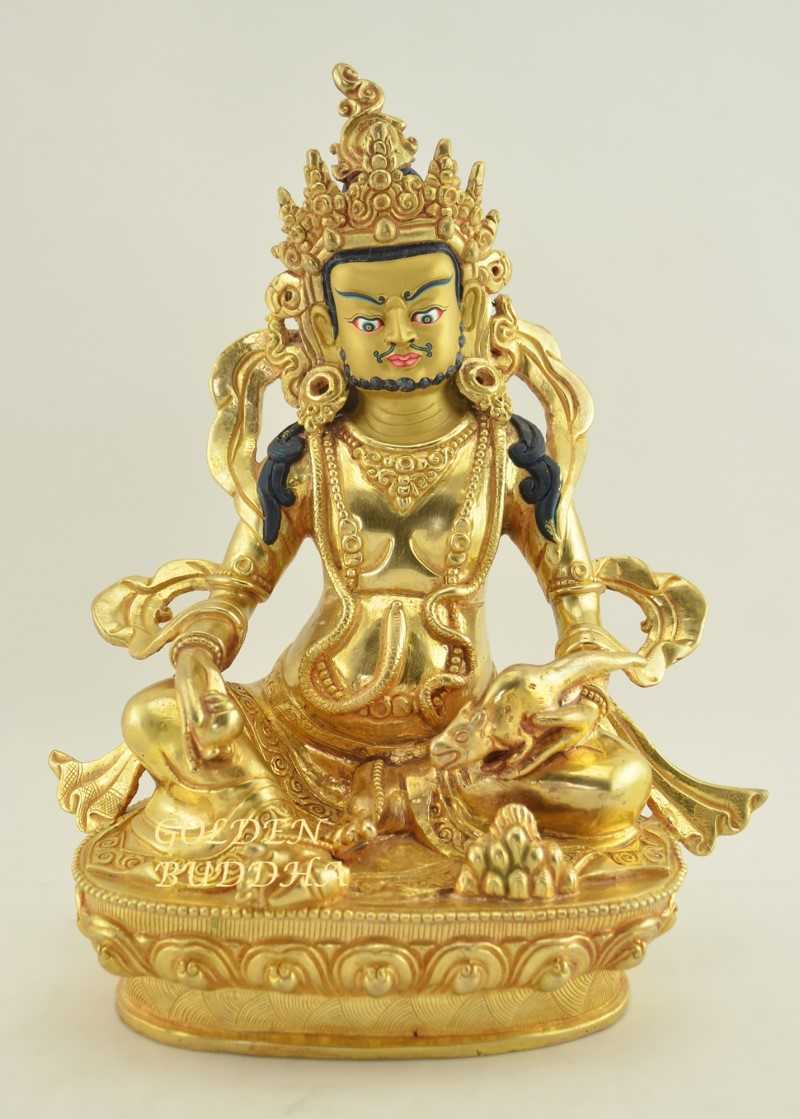
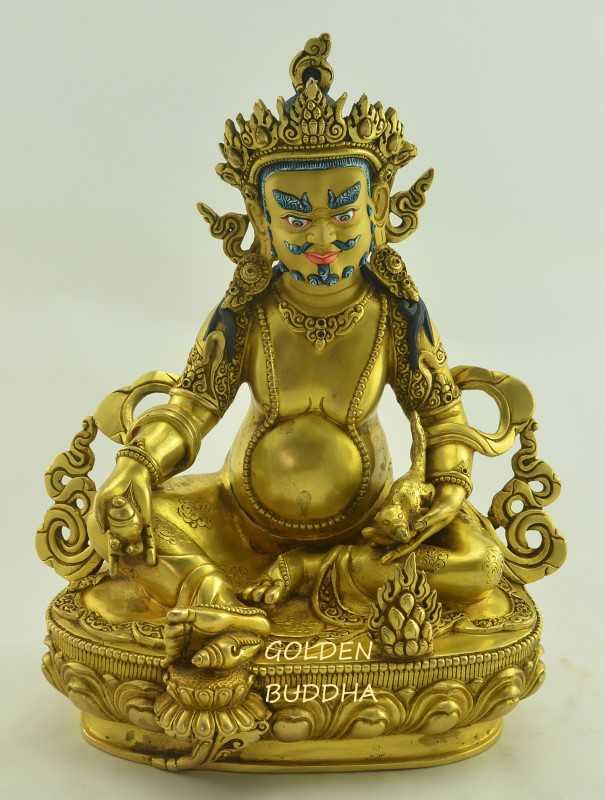
Yellow Jambhala iconography: He is typically seated with his right leg extended forward in a playful posture and his left leg pulled in, adorned with the crown and jewels of a Bodhisattva. His most distinctive feature is the mongoose Nehulay perched on his left forearm — perpetually spewing precious jewels representing Jambhala’s subjugation of the nagas (serpent spirits who guard underground wealth) and his capacity for inexhaustible generosity. In his right hand he holds medicinal citron fruit (bijapuraka) — a healing fruit known to relieve fever, representing the connection between material and physical wellbeing. He can generate virtue, wisdom, and long life for devotees alongside material abundance.
Yellow Jambhala Statue
Yellow Jambhala Mantra
“Om Jambhala Jalendraye Svaha”
Devotees are encouraged to recite the Yellow Jambhala mantra regularly — traditional teaching holds that sincere recitation will result in all material and spiritual needs being met. The mantra directly invokes Jambhala’s wealth-bestowing power and his vow to assist all devotees who call upon him with genuine generosity of spirit. Recitation is ideally combined with the Jambhala water pouring practice (see below) for maximum efficacy.
White Jambhala Statue — Healing & Longevity
White Jambhala is an emanation of Avalokiteshvara — the Bodhisattva of Compassion — making him particularly beloved among monastic practitioners and especially favored by monks. Unlike his yellow counterpart who focuses on eliminating poverty, White Jambhala’s emphasis is on health, longevity, and the purification of negative karma that creates poverty and illness simultaneously. He is the most compassionate of the five Jambhalas, addressing the subtle emotional and karmic roots of material insufficiency.
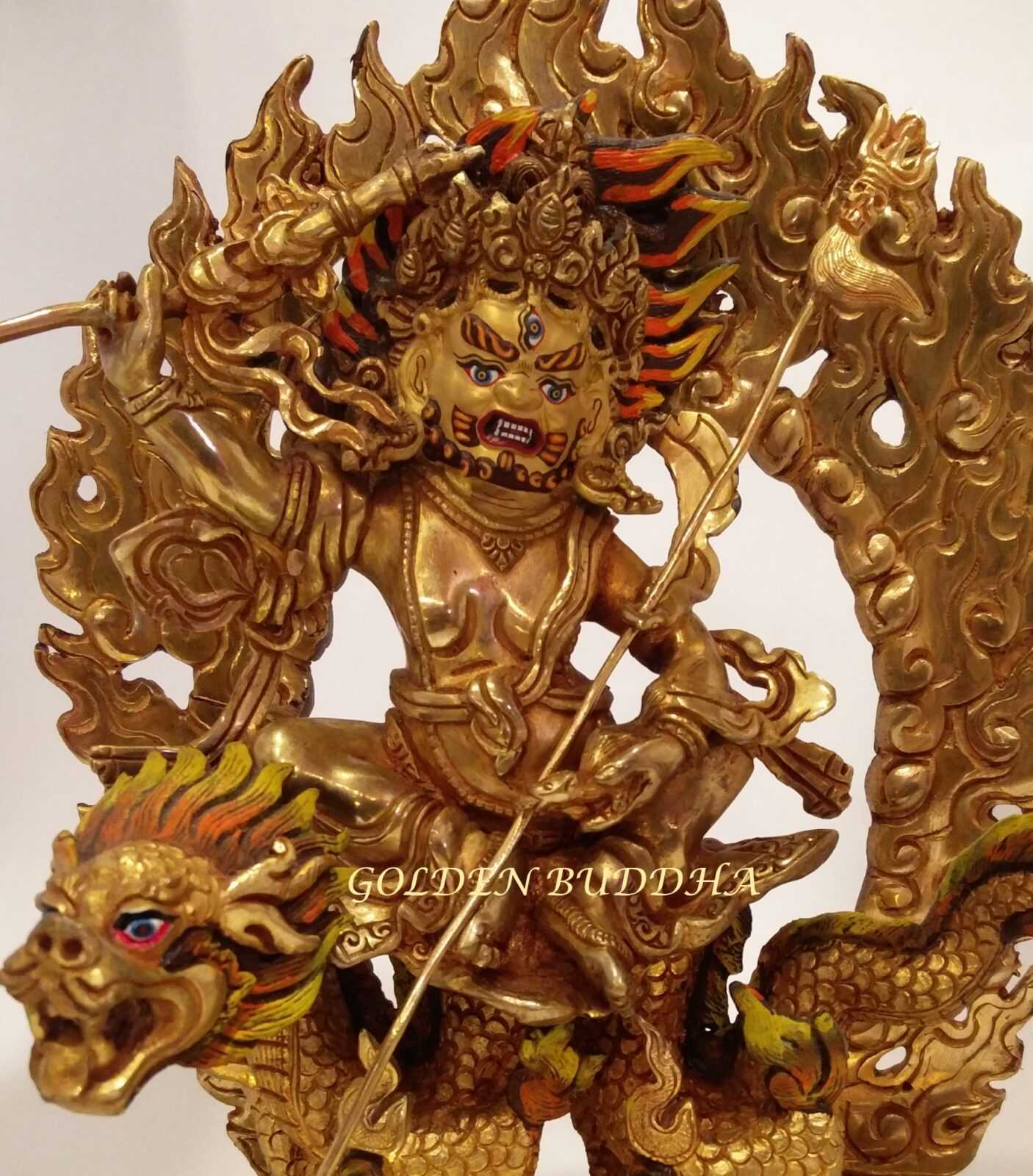
White Jambhala iconography: His most distinctive feature is that he rides a snow dragon — a symbol of great auspiciousness, power, and good fortune in Tibetan culture. His white body represents purity and the healing quality of his compassion. Like Yellow Jambhala he holds the mongoose Nehulay, but his overall energy is gentler and more healing-oriented. White Jambhala is the recommended form for practitioners dealing with illness alongside financial difficulty, as his practice addresses both simultaneously.
White Jambhala Statue
White Jambhala Mantra
“Om Padma Krodha Arya Jambhala Hridaya Hum Phat”
The White Jambhala mantra invokes his purifying and healing wealth-blessing simultaneously. Regular recitation is particularly recommended for those facing both health challenges and financial difficulties — as White Jambhala’s practice addresses both the karmic and the material dimensions of these conditions in a single practice.
Black Jambhala Statue — Wrathful Wealth Deity
Black Jambhala is the most wrathful and visually dramatic of the five — an emanation of Akshobhya Buddha, the Dhyani Buddha of the East associated with mirror-like wisdom and the transformation of anger. He is widely considered the most powerful of all five Jambhalas for overcoming severe obstacles — using forceful means when gentler approaches are insufficient.
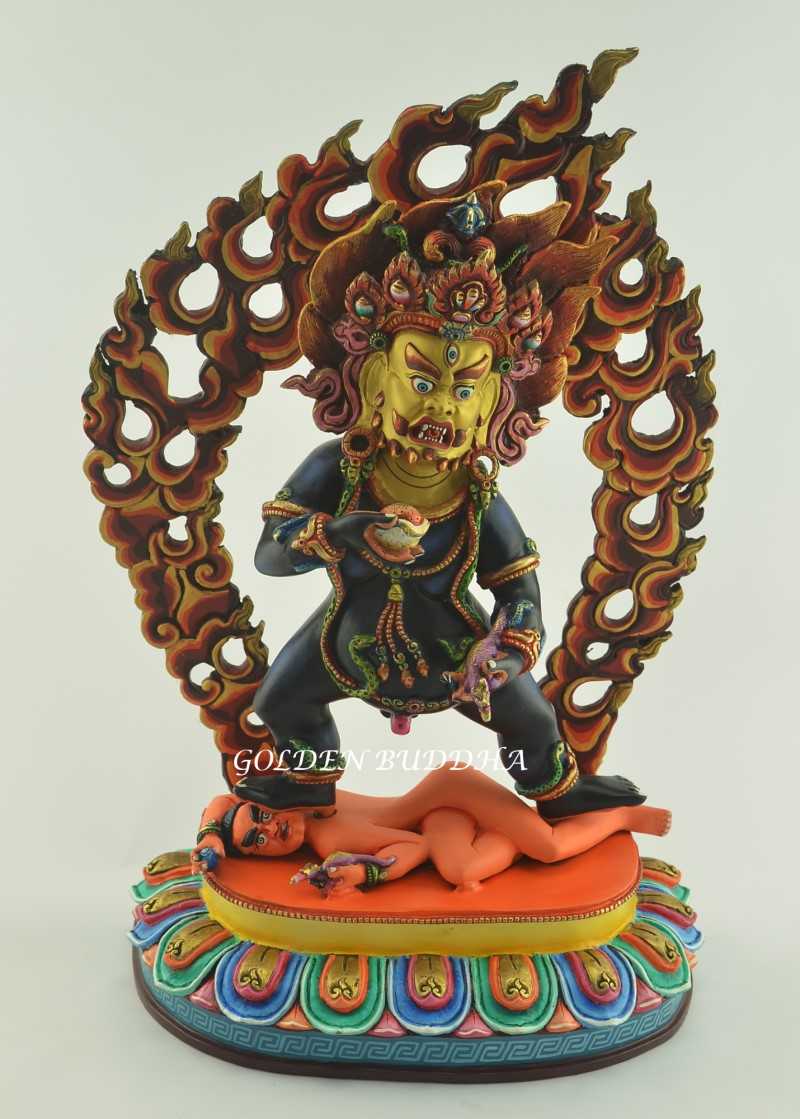
Black Jambhala iconography: He is depicted with three glaring eyes and fangs, a scowling mouth, and a ferocious expression. He holds a kapala skull cup in his right hand and stamps upon a “yellow rich man” — symbolically trampling greed, hoarding, and the misuse of wealth. He is naked and wears snakes wrapped around his neck, ankles, and wrists. His nakedness and serpent adornments — like those of Shiva in Hindu iconography — symbolize his transcendence of worldly attachment and his mastery over the forces that generate poverty and desperation.
As with all wrathful deities in Tibetan Buddhism, Black Jambhala’s fierce appearance belies a compassionate purpose. Extreme poverty sometimes generates extreme behavior — theft, anger, violence — driven by desperation. Black Jambhala uses aggressive means to subdue these impulses and preserve the good karma that is the true foundation of lasting wealth. He fights fire with fire, trampling temptation underfoot.
Black Jambhala Statue
Black Jambhala Mantra
“Om Indzali Mu Kam Dzamali Soha”
The Black Jambhala mantra is recommended for practitioners facing the most severe financial and karmic obstacles — situations where gentle approaches have been insufficient. His practice is particularly powerful for removing obstacles related to debt, theft of wealth, legal difficulties, and the negative karma generated by financial desperation. Recitation with sincere motivation and faith is the key to receiving his wrathful protective blessing.
Red Jambhala Statue — Business Success & Magnetizing
Red Jambhala (Tibetan: Dzambhala Mapo) is an emanation of Amitabha Buddha or, in some traditions, of Vajrasattva — and is sometimes identified with the Hindu deity Ganesha, the remover of obstacles. Red Jambhala specializes in business success, magnetizing wealth, overcoming greed, and attracting the circumstances and helpful people needed to succeed financially. He is the recommended Jambhala form for entrepreneurs, business owners, and those seeking to attract new income streams.
Red Jambhala iconography: He is depicted with a red body, two faces and four arms, seated in vajra position. He holds a khorlo (Dharma wheel) in his right hand and the mongoose Nehulay in his left. He is sometimes depicted in Yab Yum (union with his wisdom consort) — emphasizing the magnetizing, attractive power that draws wealth and favorable conditions like a magnet. Red Jambhala’s energy is dynamic, warm, and irresistibly attractive — the red color itself representing the magnetizing activities of an enlightened mind.
Green Jambhala Statue — Swift Abundance
Green Jambhala is the least commonly depicted of the five but represents swift, active wealth-generating energy — the green color resonating with the all-accomplishing activity of Amoghasiddhi Buddha, the Dhyani Buddha of the North. Green Jambhala is associated with bringing sudden, unexpected windfalls of good fortune and the swift removal of financial obstacles. His energy most closely mirrors that of Green Tara — immediate, responsive, and actively protective.
Green Jambhala statues are rarer than the other four forms and are considered particularly auspicious for those who need rapid financial relief or who are working to reverse a run of bad luck. Like all five Jambhalas, he holds the jewel-spitting mongoose Nehulay and displays a large, abundance-symbolizing belly.
Jambhala Becomes a Protector of the Dharma
A celebrated Buddhist legend explains how Jambhala became a Dharmapala — a Protector of the Dharma. The Jambhalas once attended a sermon of the Buddha Shakyamuni. While the Buddha was giving the teaching, a jealous dissident named Devadatta — the Buddha’s own cousin, who harbored deep rivalry and resentment — attempted to attack the Buddha by hurling stones. The stones missed the Buddha entirely and instead struck Yellow Jambhala on the head and Black Jambhala in the stomach.
When Shakyamuni Buddha saw what had happened, he came to Yellow Jambhala and blessed the wound on his head with his hand. A white, luminous fluid flowed from the Buddha’s palm as the blessing was given. After receiving this touch and being bathed in the white fluid, Jambhala felt deep happiness, calm, and bliss — his wound was healed and all obscurations were cleared. Jambhala immediately bowed down and expressed deep gratitude. After accepting their gratitude, the Buddha asked the Jambhalas whether they would become protectors of the Dharma — and they readily and joyfully agreed. This is the origin of the Jambhala Puja and the water pouring practice.
Pouring Water on Jambhala Statues
Following Jambhala’s agreement to become a Dharmapala, the Buddha gave special instructions — establishing the unique practice that distinguishes Jambhala worship from all other Buddhist deity practices. The Buddha instructed that when devotees pour water on the heads of their Jambhala statues, the Jambhalas are to respond by providing both material and spiritual wealth — especially spiritual wealth.
The Jambhala water pouring practice works as follows: the practitioner pours water continuously from a vase over the head of the Jambhala statue — traditionally 108 times in a continuous stream — while simultaneously reciting the appropriate Jambhala mantra. Each pour recreates the moment of the Buddha’s healing blessing, and each recitation invokes Jambhala’s vow to assist all who call upon him in this way. Traditional teaching holds that 109 recitations combined with the water offering creates significant merit, purifies negative karma related to wealth, and actively attracts prosperity.
The Jambhalas vowed to always fulfill this obligation — making the water pouring practice one of the most direct and reliable methods for connecting with Jambhala’s wealth-generating blessing energy. This has become the central ritual of the Jambhala Puja (wealth practice ceremony) conducted in Tibetan Buddhist monasteries and Dharma centers worldwide. Offerings of grains, fruits, water, incense, and butter lamps are also presented to Jambhala statues and thangkas as expressions of generosity and gratitude — the very virtues that activate Jambhala’s blessing.
Frequently Asked Questions About Jambhala Statues
What does a Jambhala statue represent?
A Jambhala statue represents the Buddhist God of Wealth — a Bodhisattva whose purpose is to eliminate poverty (both material and spiritual) and create the conditions necessary for effective Dharma practice. Key iconographic elements each carry specific meaning: the large belly symbolizes abundance and contentment; the mongoose Nehulay perpetually spewing jewels represents inexhaustible generosity and the subjugation of the nagas who guard underground wealth; the citron fruit (in Yellow Jambhala’s hand) represents healing; and the jewel-encrusted crown and robes represent the abundance of the jewel family. Placing a Jambhala statue on a home altar or in a business supports regular mantra practice and serves as a visual reminder that true wealth flows from the virtue of generosity.
What is the difference between Jambhala and Dzambhala?
Jambhala and Dzambhala are two spellings of the same deity’s name — there is no difference in meaning or identity. Jambhala is the Sanskrit spelling most commonly used in English-language Buddhist literature and in general web searches. Dzambhala is the Tibetan phonetic rendering of the same name. Other variant spellings include Zambala, Jambala, and Dzambala. All refer to the same Buddhist God of Wealth in his five forms. For SEO purposes, Jambhala is the higher-traffic English search term, while Dzambhala is more commonly used in Tibetan Buddhist monastery contexts and Tibetan-language sources.
Which Jambhala statue is best for wealth?
Yellow Jambhala is the most popular and widely recommended form for general wealth practice — he is the most powerful for eliminating poverty across all six realms and can generate virtue, wisdom, and long life alongside material abundance. White Jambhala is recommended when health issues accompany financial difficulties. Black Jambhala is recommended for severe obstacles and urgent financial crises. Red Jambhala is specifically recommended for business success and attracting favorable circumstances. Green Jambhala is recommended for rapid relief and unexpected windfalls. For most practitioners beginning Jambhala practice, Yellow Jambhala is the ideal starting point.
How do you use a Jambhala statue in practice?
The most traditional Jambhala practice involves placing the statue on a clean, elevated altar surface, then pouring water over the statue’s head from a vase 108 times while reciting the appropriate Jambhala mantra. The water is considered consecrated through the practice and can be offered to plants or the earth after the ritual. Daily mantra recitation before the statue is also highly effective — even without the water pouring practice, regular recitation with sincere motivation and a generous heart is considered sufficient to activate Jambhala’s blessing. Offerings of fruit, incense, butter lamps, and flowers on the altar enhance the practice further.
Is Jambhala the same as Kubera?
Jambhala and Kubera share the same historical origin but are distinct deities with different purposes. Kubera is the Hindu god of wealth — a divine king who rules the northern direction and guards the celestial treasuries. His mandate in Hinduism is relatively straightforward material enrichment. Jambhala developed from Kubera as Buddhism adopted and transformed him, adding the attributes of equanimity, compassion, and the Bodhisattva ideal. In Buddhism, Jambhala can generate wealth but only when the practitioner combines their desire for material improvement with genuine generosity of spirit. This transformation from Kubera to Jambhala represents the Buddhist principle that all worldly deities are elevated and purified when they enter the Buddhist path.
Are Jambhala statues from Nepal authentic?
The artisan city of Patan (Lalitpur) in Nepal’s Kathmandu Valley has been the world center for handcrafted Himalayan Buddhist statuary for over a thousand years. Authentic Jambhala statues from Nepal produced by the traditional shakya craftsmen of Patan are created using the lost-wax casting (cire perdue) method, finished with 24K fire gilding, and hand face painted using real gold — making them among the finest Buddhist wealth deity statues available worldwide. All statues are certified by the Department of Archaeology in Kathmandu, and consecration (rabne) at a recognized Kathmandu monastery is available upon request, activating the statue as a genuine object of wealth practice.