

Vajrayogini statues portray one of the most powerful and visually striking deities in all of Tibetan Buddhism — a fully enlightened female Buddha whose appearance simultaneously combines supreme beauty with the most fearsome aspects of Tantric iconography. She stands naked within a ring of wisdom fire, her red hair unfettered, her gaze fixed upward into the pure land of the Dakinis, her left hand raised holding a skull cup filled with the nectar of enlightenment, her right hand lowered grasping the curved kartika flaying knife — the blade that severs every attachment binding beings to samsara. She is at once the embodiment of great bliss and emptiness, the destroyer of all obscurations, and the most accessible path to enlightenment available to practitioners in this degenerate age.
Vajrayogini — also known as Vajravarahi in her wrathful form, Ugra Tara in her Newar Buddhist manifestation, and Naro Kacho in the specific lineage transmitted by the Indian mahasiddha Naropa — is the supreme Yidam (meditational deity) of the Anuttarayoga Tantra and the heart practice of countless high lamas, mahasiddhas, and Tantric practitioners across India, Nepal, Tibet, Mongolia, and the entire Himalayan Buddhist world. Her practice is uniquely suited to modern practitioners because she transforms the very forces of desire and attachment — the most powerful obstacles in contemporary life — into the direct path to liberation. Vajrayogini statues handcrafted in Nepal serve as the primary devotional and meditative support for this extraordinary practice.
Contents
- Sankhu — The Sacred Origin of Vajrayogini in Nepal
- Sankhu as the Tibet Trade Route — 7th Century
- Ugra Tara & Vajrayogini — The Newar Buddhist Identity
- Guru Naropa & the Naro Kacho Lineage
- The Three Vajrayogini Lineages
- Vajrayogini Meaning — Destroyer of Ego & Great Bliss
- Vajrayogini Statue Iconography — Complete Guide
- Vajravarahi — Vajrayogini’s Wrathful Form
- Vajrayogini & Dorje Shugden — The Protector Connection
- Vajrayogini Practice & Initiation Requirements
- Vajrayogini Mantra
- Authentic Vajrayogini Statues from Nepal
- Frequently Asked Questions About Vajrayogini
Sankhu — The Sacred Origin of Vajrayogini in Nepal
The story of Vajrayogini in Nepal is inseparable from the ancient town of Sankhu — a small Newar settlement in the northeastern corner of the Kathmandu Valley whose origins stretch back to at least the 5th century CE. Perched on the forested slopes of Manichunda Hill above the town stands the Sankhu Vajrayogini Temple — one of the most sacred Buddhist power places in Nepal and one of the principal transmission points through which Vajrayana teachings passed from India and Nepal into Tibet across more than a thousand years of living tradition.
The Sankhu shrine predates the town itself — it was originally known as Gum Vihara, an ancient monastery whose sacred presence attracted the establishment of the trading settlement below it. The surrounding hills contain four or five caves where the great Indian mahasiddhas are said to have practiced, earning the area the epithet “Place of the Eighty Siddhas.” One cave is specifically associated with the great Buddhist philosopher Nagarjuna — an image of the master once housed inside the cave has since been placed outside nearby. The entire hill of Manichunda is considered a shakti pitha — a power place of the sacred feminine — where the boundary between the ordinary world and the pure land of the Dakinis is thinner than anywhere else in the Kathmandu Valley.
The present Vajrayogini Temple complex at Sankhu was built by King Pratap Malla in the 17th century (1655 CE), though the sacred site it occupies is immeasurably older. The temple features upper and lower shrines — the lower temple housing a red-faced four-armed image of Ugra Tara holding a skull cup, knife, sword, and blue utpala lotus; the upper temple housing an identical form in bell metal with the left leg outstretched. In both temples, Vajrayogini is flanked by Baghini and Singhini — the Tiger-headed and Lion-headed Yoginis — her sacred retinue. The temple also preserves the legendary “Water of the Kalpa” — a basin of water that never dries — and an eternal flame, the “Fire of the Kalpa,” that has burned continuously for centuries.
Sankhu as the Tibet Trade Route — 7th Century
Sankhu’s spiritual significance was inseparable from its commercial and political importance. The town’s very name reveals its geographic destiny: the Newar name Sakwa combines Samdesh (Tibet) and Kvay (Below) — literally “the town below Tibet.” From the 7th century CE, a major trade route ran from Kathmandu northeast through Sankhu and into Tibet, connecting the Himalayan kingdoms of the Kathmandu Valley with Lhasa and the broader Tibetan plateau. The town grew and prospered precisely because of this position on the route between two great civilizations.
The trade route through Sankhu was not merely commercial — it was one of the primary channels through which Buddhist teachings, teachers, sacred texts, and sacred art passed from Nepal and India into Tibet. Merchants, pilgrims, scholars, and Tantric masters all traveled this route. The Sankhu Vajrayogini Temple on the hill above the town served as a spiritual waystation — a place where travelers paused to make offerings and receive blessings before the arduous mountain crossing into Tibet. In this way, the Vajrayogini shrine at Sankhu functioned simultaneously as a power place, a pilgrimage destination, a transmission site, and a gateway through which the Dharma entered the Land of Snows.
The significance of this transmission can hardly be overstated. The Vajrayogini teachings that Tibetan Buddhist masters received from Nepali and Indian teachers — many of them connected directly or indirectly to Sankhu — shaped the entire character of the Kagyu and Sakya schools of Tibetan Buddhism. The Naro Kacho lineage of Vajrayogini became one of the three most important practice lineages in all of Tibetan Vajrayana, practiced secretly by masters as exalted as Guru Tsongkhapa himself — who, after entering clear light, was discovered to have practiced Vajrayogini intensively despite publicly emphasizing Yamantaka, Guhyasamaja, and Chakrasamvara.
Ugra Tara & Vajrayogini — The Newar Buddhist Identity
One of the most theologically fascinating aspects of the Sankhu shrine is its dual identity. The goddess enshrined at Sankhu is simultaneously venerated as Vajrayogini in the Tibetan Buddhist tradition and as Ugra Tara — a form of the protective Buddhist dharmapala Ekajati — in the Newar Buddhist tradition of the Kathmandu Valley. In Newari language she is known by two names: Mhasukhwamaju (“Yellow-faced Mistress”) and Hyaunkhwaamaju (“Red-faced Mistress”) — reflecting the two forms housed in the upper and lower temples.
Ugra Tara is the wrathful, protective emanation of Tara — distinct from the peaceful Green Tara and White Tara of popular devotion, this is Tara in her most ferocious, boundary-dissolving aspect. As Ekajati, she is the single-toothed, single-eyed guardian of the Dzogchen teachings — one of the most powerful protective forces in the entire Buddhist pantheon. The identification of Vajrayogini with Ugra Tara at Sankhu represents the living synthesis between the Newar Buddhist tradition of the Kathmandu Valley and the Tibetan Vajrayana tradition — two streams that fed each other across centuries of mutual influence through exactly this kind of sacred site shared across both traditions.
According to Nepalese Buddhist cosmology, the Kathmandu Valley itself was once a great lake where Buddhas and Bodhisattvas came to meditate. When Manjushri came to the valley to meditate, he beheld a vision of Heruka Chakrasamvara together with his consort Vajrayogini — a vision that established the entire Kathmandu Valley as a sacred mandala of their union, with Sankhu as one of its principal power points. This mythological foundation gives the Sankhu shrine a cosmological significance that transcends ordinary pilgrimage — it is not merely a temple but a living window into the primordial reality of Chakrasamvara and Vajrayogini’s enlightened union.
Guru Naropa & the Naro Kacho Lineage
The Naro Kacho (“Naropa’s Sky-Goer”) lineage of Vajrayogini is considered the most supreme of the three major Vajrayogini transmission lineages — its practitioners have historically achieved the highest levels of realization most quickly. The lineage originates with one of the most consequential encounters in the history of Indian Tantric Buddhism: Guru Naropa’s (1016–1100 CE) direct vision of Vajrayogini herself.
Naropa — the great scholar-yogi of Nalanda University, whose Six Yogas became the foundational practice system of the Kagyu school — is closely associated with Nepal and the Kathmandu Valley. According to the traditional accounts, Naropa received his direct vision of Vajrayogini while meditating in a cave above the banks of the Bagmati River in Nepal — the sacred river that flows through the Kathmandu Valley past the great cremation ghats of Pashupatinath before descending south toward the Ganges plain. In this cave, Vajrayogini appeared to Naropa in her complete form — red body, ring of fire, skull cup, kartika flaying knife, khatvanga staff — and transmitted the complete Naro Kacho practice cycle directly to him as a mind-to-mind transmission of the highest order.
The transmission was then carried into Tibet through Naropa’s two Nepalese disciples — the Pamtingpa brothers (known in Tibetan as Phamthingpa), Dharmamati and Vagishvara — who were accomplished practitioners of both Chakrasamvara and Hevajra. Based in Pharping in the southern Kathmandu Valley, these brothers proliferated the Vajrayogini teachings to many disciples from Nepal and Tibet, establishing the transmission lineage that would eventually become one of the defining practices of both the Kagyu and Sakya schools of Tibetan Buddhism.
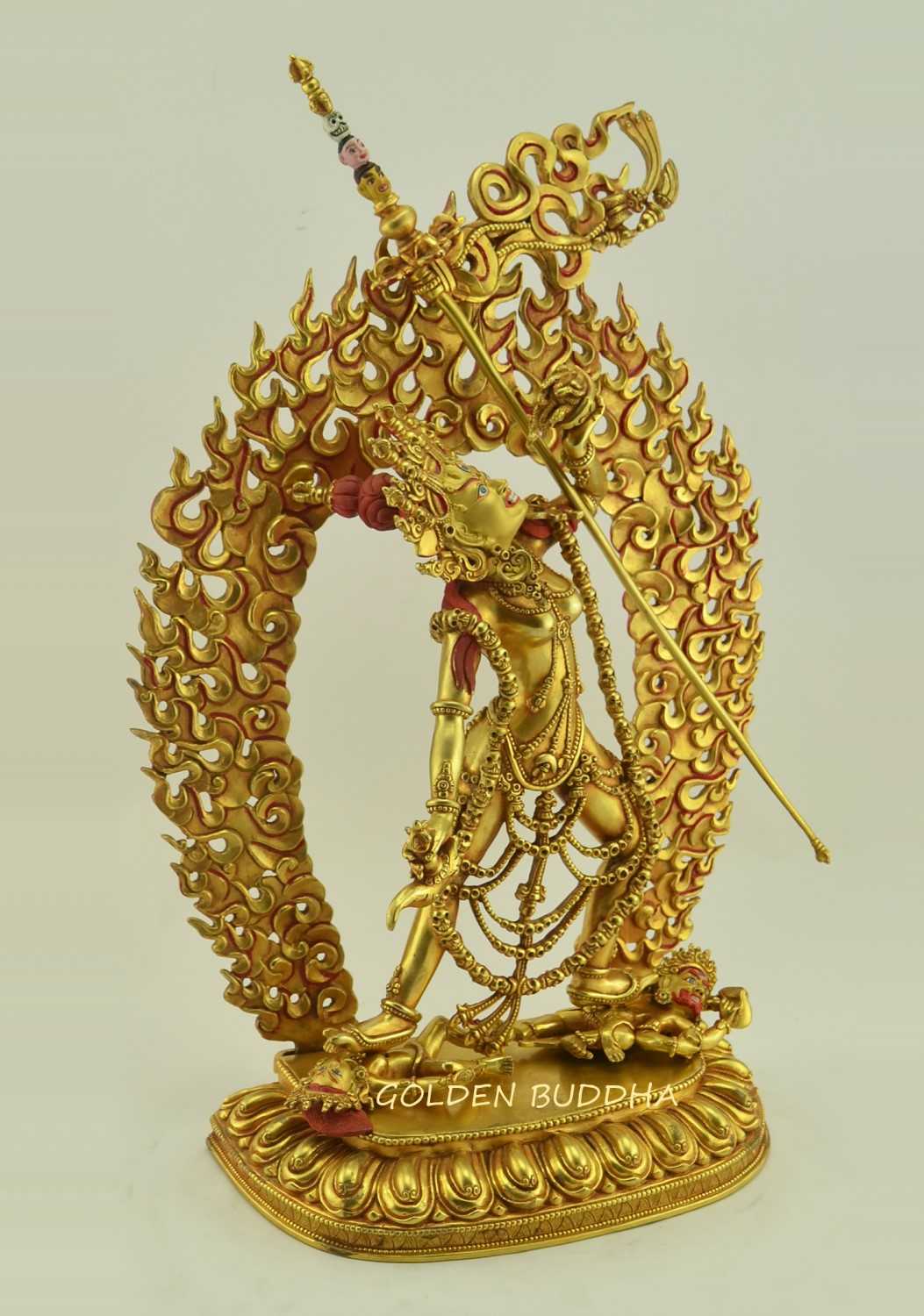
19.5″ Naro Kacho Vajrayogini Statue — Fully Gold Gilded 24K
The Three Vajrayogini Lineages
In the Tibetan tradition there are three major Vajrayogini lineages, collectively known as Kachö Marpo Korsum — the “Three Circles of the Red Dakini.” Each descends from one of three mahasiddhas who received direct transmission from Vajrayogini herself:
- Naro Kacho — transmitted from Vajrayogini to Naropa. Considered the most supreme lineage. Most widely practiced in the Kagyu and Gelug schools. The form depicted in authentic Nepali Vajrayogini statues today.
- Maitri Kacho — transmitted from Vajrayogini to Maitripa. Preserved primarily in the Sakya school.
- Indra Kacho — transmitted from Vajrayogini to Indrabodhi. Less widely practiced but preserved in certain Nyingma and Sakya lineages.
The Naro Kacho lineage’s supremacy is attributed to the directness of the transmission — Naropa received the complete practice from Vajrayogini herself rather than through any human intermediary. This directness gives the Naro Kacho form a quality of immediacy and power that practitioners describe as uniquely accessible — the deity’s blessing enters the practitioner’s stream of experience more directly than through any other Anuttarayoga Tantra practice.
Vajrayogini Meaning — Destroyer of Ego & Great Bliss
The name Vajrayogini combines two Sanskrit words: vajra (diamond/indestructible — representing the indestructible nature of enlightened awareness) and yogini (a female Tantric practitioner who has mastered the path). Together: “The Indestructible Female Practitioner” — a being who has completely mastered the Tantric path and achieved permanent union of great bliss and emptiness. She is sometimes described as maharaga — “great passion” — representing not ordinary desire but the sublime, transcendent form of passion that has been purified of all self-grasping and redirected entirely toward the liberation of all beings.
This quality of maharaga is why Vajrayogini practice is considered uniquely effective in modern times. The contemporary world generates desire and attachment at an unprecedented scale — through media, advertising, social pressure, and the constant stimulation of the senses. Where other practices work against these forces through renunciation, Vajrayogini practice engages them directly — transforming the very energy of desire into the fuel of enlightenment. This is the core paradox of her iconography: a form of beauty and sensuality that simultaneously exposes the impermanence and futility of all worldly beauty through the skulls, bones, and charnel ground elements that cover her body.
Vajrayogini Statue Iconography — Complete Guide
Every element of an authentic Vajrayogini statue encodes precise Tantric meaning. The Naro Kacho iconography as transmitted by Naropa and preserved in the traditional statues of Patan, Nepal includes the following features:
Red Body: Vajrayogini’s body is depicted in deep red — the color of compassionate activity and the transformation of desire into enlightened awareness. Unlike the cool blue of Medicine Buddha or the gold of Shakyamuni, Vajrayogini’s red communicates heat, urgency, and the burning quality of the wisdom fire that consumes all obscurations.
Ring of Wisdom Fire: Vajrayogini stands within an all-consuming ring of wisdom flames — the fire of primordial awareness (jnana) that burns away every neurotic mental state, every form of attachment, aversion, and confusion. This same ring of fire appears in Yamantaka and Vajrapani statues, where it performs the same function — the total consumption of ignorance by wisdom.
Skull Crown (Five Skulls): The five-skull diadem represents the transmutation of the five mental poisons (ignorance, pride, desire, jealousy, and anger) into the five transcendental wisdoms — the same symbolism carried by Vajrapani and Yamantaka. The skulls also represent the death of the five skandhas (aggregates of ego-clinging) and the direct realization of emptiness.
Kapala Skull Cup: Raised in her left hand, the skull cup is filled with blood and human brain matter — representing Vajrayogini’s complete transcendence of attachment to the body and her disdain for the impermanent, unsatisfactory, and selfless nature of worldly existence. In the traditional ceremony, the kapala functions as the libation vessel through which the practitioner offers the experiences of the five senses to the deity.
Kartika Flaying Knife: The curved flaying knife held downward in her right hand near her right thigh is the implement that severs every bond of attachment — cutting through the skin of ego and the tissues of conceptual grasping that keep beings trapped in samsara. The kartika is one of the most characteristic implements of Dakini iconography and appears in Vajravarahi statues as well.
Khatvanga Staff: Resting against her raised left arm, the khatvanga symbolizes her eternal union with her consort Heruka Chakrasamvara — the male deity who represents method and compassion to Vajrayogini’s wisdom. The three impaled heads on the khatvanga’s tip represent the three kayas (bodies) — the desire realm, the form realm, and the formless realm — all three of which Vajrayogini has transcended and conquered.
Two Deities Underfoot: Under her left foot is Bhairawa — the principal worldly god — and under her right foot is Red Kalarati — the principal worldly goddess. Vajrayogini’s standing on them communicates her complete transcendence of all worldly power, both divine and human.
Fifty-Skull Necklace: The garland of fifty dried human skulls represents the fifty letters of the Sanskrit alphabet — communication and speech purified of all self-serving intent — and the practitioner’s dedication to using the power of speech exclusively for the liberation of beings.
Unfettered Red Hair: Her long, loose red hair flowing freely represents her complete freedom from every form of conventional, worldly, and social constraint — she recognizes no authority other than the Dharma and no obligation other than the liberation of all sentient beings.
Third Eye of Wisdom: Set vertically on her forehead, the third eye represents her direct perception of the ultimate nature of reality — past, present, and future seen simultaneously without the filtering distortion of ordinary conceptual mind.
Bone Ornaments: Her bone earrings, bracelets, anklets, and sacred thread communicate her intimacy with the charnel grounds — the traditional practice environments of Tantric practitioners — and her complete mastery of the fear of death.
Fierce-Serene Expression: The face of an authentic Vajrayogini statue communicates the essential paradox of her nature — simultaneously the most beautiful expression of the youthful feminine and the most fearless gaze of an enlightened being who has looked directly into the face of death and desire and found them both to be empty of inherent existence.
9″ Tantric Vajrayogini Statue — Fire Gilded 24K Gold

Vajravarahi — Vajrayogini’s Wrathful Form
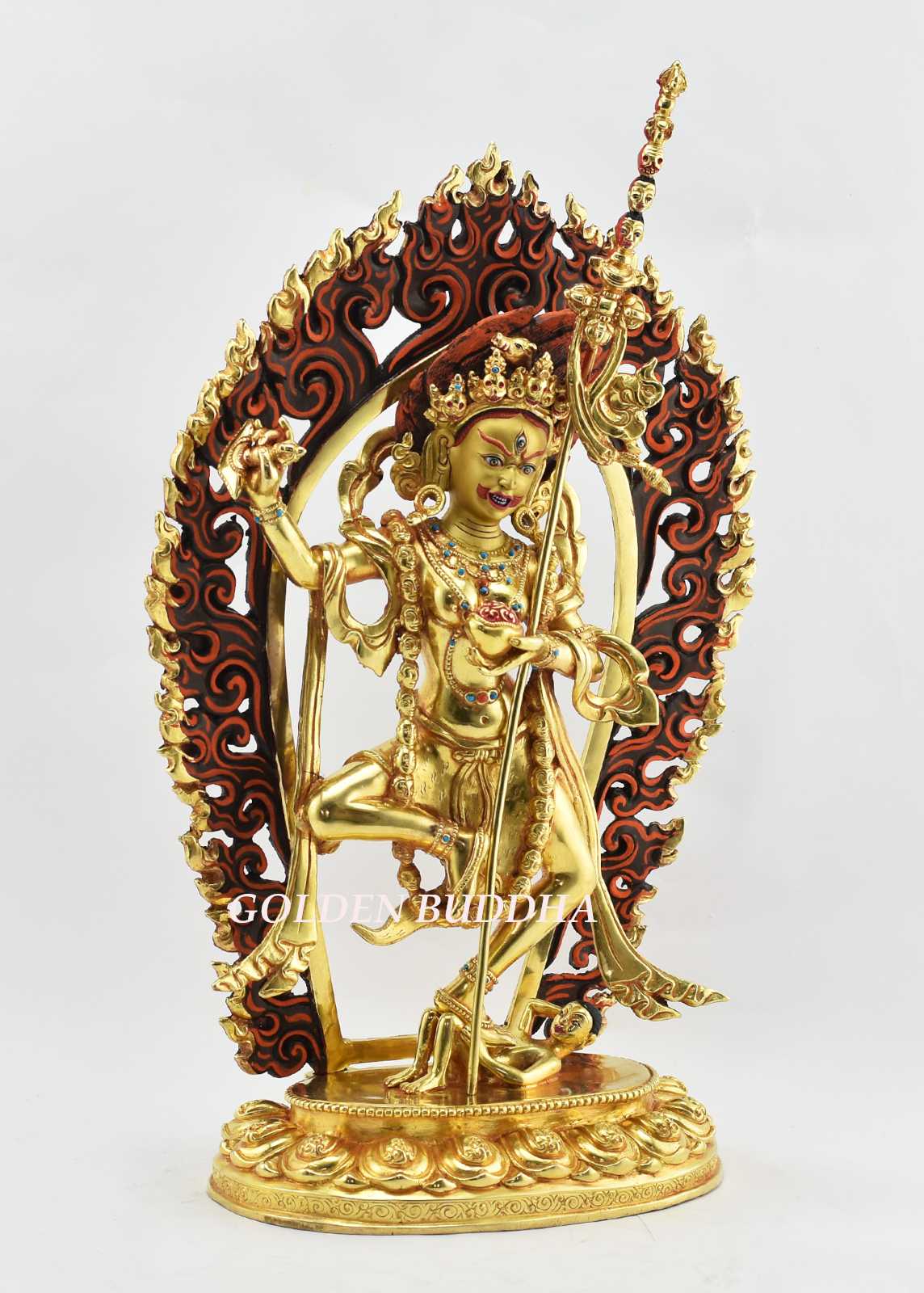
Vajravarahi (“Diamond Sow”) is the wrathful emanation of Vajrayogini — her most fierce and powerful form, distinguished by the presence of a sow’s head rising from behind her right ear. The sow is the animal associated with the most fundamental form of ignorance in Buddhist philosophy — the confused, rooting, instinct-driven consciousness that perpetuates samsara at its deepest level. Vajravarahi wears the sow’s head as a crown of conquest: the most primal form of ignorance has been absorbed and transformed into the clear light of awareness.
In iconographic terms, Vajravarahi statues share many features with Vajrayogini — the red body, ring of flames, skull crown, kartika, khatvanga — but her posture is typically more dynamic and her expression more overtly wrathful. She dances in the characteristic Dakini style on a human corpse representing the conquered forces of negativity. Vajravarahi is specifically associated with the subjugation of the most stubborn obstacles — the deeply embedded habitual patterns that resist even advanced practice — making her the preferred form for practitioners facing particularly entrenched karmic obstructions.
15.5″ Masterpiece Vajravarahi Statue — Partly Gold Gilded
Vajrayogini & Dorje Shugden — The Protector Connection
The relationship between Vajrayogini and Dorje Shugden is one of the most distinctive theological connections in the Gelug school of Tibetan Buddhism. Dorje Shugden — the wrathful Dharma protector who rides a snow lion surrounded by a ring of wisdom flames — is understood by his practitioners to be a protective emanation that specifically guards and assists practitioners engaged in advanced Vajrayana practice, including the Vajrayogini sadhana.
In traditional Gelug practice, Dorje Shugden’s protective function operates as a complement to Vajrayogini’s transformative function: where Vajrayogini transforms obstacles into the path, Dorje Shugden removes the external conditions that prevent practice from proceeding — clearing the path of interference so that the Vajrayogini sadhana can develop without obstruction. This protective relationship is why many serious Vajrayogini practitioners also maintain a Dorje Shugden practice alongside their primary sadhana — the two are considered mutually supportive.
Both Vajrayogini and Dorje Shugden are understood to be emanations connected to Manjushri — Vajrayogini through her role in the Chakrasamvara-Vajrayogini union that represents the complete Tantric mandala, Dorje Shugden as a wrathful protective emanation of Manjushri’s wisdom sword. This shared Manjushri connection gives their combined practice a specific coherence within the Gelug doctrinal framework. Learn more about Dorje Shugden statues and practice.
Vajrayogini Practice & Initiation Requirements
The Vajrayogini sadhana belongs to the Anuttarayoga Tantra class — the highest class of Tantric practice in the Tibetan Buddhist system. It is sometimes classified as a Mother Tantra — a Tantric cycle that emphasizes the wisdom (female principle) aspect of enlightenment over the method (male principle) aspect, making it particularly effective for working with the energies of desire, bliss, and the subtle body.
Initiation requirement — this is critical: The complete Vajrayogini sadhana — including mantra recitation — requires formal initiation (wang) from a qualified lama who holds the unbroken Naro Kacho lineage. Without this initiation, attempting the full practice is considered not only ineffective but potentially counterproductive. The Vajrayogini initiation is typically given in two stages: an outer initiation into the mandala of Vajrayogini, followed by a more extensive inner initiation into the complete practice cycle. Both must be received from a lineage holder — a teacher who has themselves received the initiation in an unbroken transmission from Naropa’s original vision.
The prerequisite practices for Vajrayogini initiation typically include the completion of the foundational Ngöndro practices (100,000 prostrations, 100,000 Vajrasattva mantras, 100,000 mandala offerings, and 100,000 guru yoga recitations) as well as stable experience with the generation stage of at least one other Anuttarayoga Tantra deity. Vajrayogini practice is available through recognized Kagyu, Sakya, and Gelug monasteries and Dharma centers worldwide — the Vajrayogini initiation is regularly offered at major Dharma centers affiliated with qualified lineage holders.
A Vajrayogini statue placed on a home altar serves as a powerful devotional and meditative support for qualified practitioners — and as an object of veneration, aspiration, and aesthetic appreciation for all who encounter it, regardless of practice level. For initiated practitioners, the statue becomes an essential support for the complete visualization — the three-dimensional form that anchors the deity’s presence in the practice environment. The turquoise and red coral stone embellishments available for Golden Buddha’s Vajrayogini statues upon request are traditional iconographic details that enhance the statue’s authenticity for serious practitioners.
Vajrayogini Mantra
“Om Om Om Sarva Buddha Dakiniye Vajra Warnaniye Vajra Berotzaniye Hum Hum Hum Phat Phat Phat Svaha”
The Vajrayogini mantra invokes her complete mandala assembly — calling upon Vajrayogini together with all the Dakinis of the three realms. Sarva Buddha Dakiniye — “All the Buddha Dakinis” — establishes the universal scope of the invocation. Vajra Warnaniye — “Diamond Splendor” — invokes Vajrayogini’s indestructible luminosity. The triple Om and triple Hum represent the purification of body, speech, and mind at the beginning and conclusion of the invocation. The concluding Svaha seals the offering and dedication.
Important note on mantra recitation: The complete Vajrayogini mantra and its associated visualization should only be recited by practitioners who have received the formal Vajrayogini initiation from a qualified lineage holder. Recitation of the mantra without initiation is considered outside the bounds of the traditional practice and is not recommended. For practitioners who have not yet received initiation but wish to develop a connection with Vajrayogini, venerating her statue and making aspirational prayers are considered appropriate preliminary practices.
Authentic Vajrayogini Statues from Nepal
The connection between Vajrayogini statues and Nepal is not incidental — it is historically and spiritually foundational. The Naro Kacho form of Vajrayogini that Naropa received above the banks of the Bagmati River was transmitted through Nepali masters, enshrined in Nepali temples, and has been depicted by Nepali artisans for over a thousand years. The Shakya caste of Patan — direct descendants of the Buddha’s own clan and the world’s premier producers of Himalayan Buddhist statuary — have been creating Vajrayogini statues for Tibetan monasteries since the 10th century CE, maintaining the iconographic tradition with the same precision that preserves the practice lineage itself.
Our Vajrayogini statues are created using the traditional lost wax casting method — the same technique used to produce monastery-quality statues for over a millennium. Each statue is finished using the 24K fire gilding method (a mercury-gold amalgam applied and heat-fired to permanently bond pure gold to the copper alloy surface) and hand face painted using real gold pigment. The sensual quality of Vajrayogini’s form — the full breasts, voluptuous body, unfettered red hair — is rendered with exactly the combination of beauty and fierce power that the traditional iconography requires. At the buyer’s request, the crown and jewelry can be embellished with turquoise and red coral stones before delivery at no additional cost.
All statues are certified by the Department of Archaeology in Kathmandu before export. Consecration service (rabne) at Sangye Choeling Monastery in Kathmandu is available upon request — formally activating the statue as a genuine object of devotional practice rather than merely a decorative object.
Frequently Asked Questions About Vajrayogini
Who is Vajrayogini in Tibetan Buddhism?
Vajrayogini is a fully enlightened female Buddha and the supreme Yidam (meditational deity) of the Anuttarayoga Tantra in Tibetan Buddhism. Her name means “Indestructible Female Practitioner” — a being who has achieved permanent union of great bliss and emptiness. She is the consort and wisdom principle of Heruka Chakrasamvara. She embodies maharaga — great passion purified of all self-grasping — which is why her practice is uniquely effective for practitioners in modern times who face powerful forces of desire and attachment. The most widely practiced form is Naro Kacho — the lineage transmitted directly from Vajrayogini to the Indian mahasiddha Naropa in Nepal, then carried into Tibet through Naropa’s Nepali disciples. She is venerated across the Kagyu, Sakya, and Gelug schools and was secretly practiced by Guru Tsongkhapa himself alongside his public emphasis on Yamantaka.
What is the difference between Vajrayogini and Vajravarahi?
Vajravarahi is the wrathful form of Vajrayogini — the same deity expressed through a more fierce and dynamic appearance. The primary iconographic difference is the sow’s head (varaha = sow) rising from behind Vajravarahi’s right ear — representing the conquest of the most primal form of ignorance (the instinct-driven sow consciousness) and its transformation into wisdom. Both share the red body, ring of flames, skull crown, kartika, and khatvanga. Vajrayogini in the Naro Kacho form tends toward a more balanced combination of beauty and ferocity — her expression simultaneously serene and fierce. Vajravarahi’s expression is more overtly wrathful and her posture more dynamic. Vajravarahi is specifically associated with the subjugation of deeply embedded habitual patterns that resist more gentle approaches, while Vajrayogini in the Naro Kacho form is the complete practice deity for the full sadhana cycle.
What is the significance of the Sankhu Vajrayogini Temple?
The Sankhu Vajrayogini Temple is one of the most sacred Vajrayogini shrines in the world and one of the primary transmission points through which Vajrayana teachings passed from Nepal into Tibet. Located in the northeastern corner of the Kathmandu Valley on the forested Manichunda hill, the shrine predates the town of Sankhu itself. The site has been associated with Buddhist practice since at least the 5th century CE, with the surrounding caves said to be practice sites of the great Indian mahasiddhas. From the 7th century CE, a major trade route from Kathmandu through Sankhu to Lhasa made the shrine a spiritual waystation for teachers, pilgrims, and practitioners traveling between Nepal and Tibet. The goddess enshrined there is simultaneously venerated as Vajrayogini (Tibetan Buddhist tradition) and Ugra Tara/Ekajati (Newar Buddhist tradition) — a living synthesis of two great Buddhist streams. The present temple was built by King Pratap Malla in 1655 CE, though the shrine it houses is far older.
Do I need initiation to practice with a Vajrayogini statue?
Formal initiation (wang) from a qualified lineage-holding lama is required to engage in the complete Vajrayogini sadhana — including mantra recitation and the full visualization practice. Without initiation, the practice is considered outside the traditional bounds and is not recommended. However, venerating a Vajrayogini statue, making offerings before it, and developing aspirational prayers for her qualities are considered appropriate for any practitioner regardless of initiation status. The statue serves as an object of devotion and inspiration at any level of practice. For practitioners who wish to receive the Vajrayogini initiation, it is regularly offered at recognized Kagyu, Sakya, and Gelug Dharma centers worldwide. The prerequisite practices typically include the completion of Ngöndro and experience with at least one other Anuttarayoga Tantra deity.
Why is Vajrayogini practice especially relevant for modern practitioners?
Vajrayogini practice is considered uniquely effective for modern practitioners because it works directly with desire and attachment rather than requiring their renunciation. In Buddhist teaching, the root of suffering is ignorance-driven craving — and in modern life these forces operate at unprecedented intensity through media, technology, advertising, and social pressure. Vajrayogini’s practice, rather than requiring the practitioner to suppress or avoid these forces, provides a method for transforming the energy of desire itself into the direct experience of great bliss — which, when properly understood as being empty of inherent existence, is recognized as the natural state of the enlightened mind. This “reverse psychology” approach — using the very forces that ordinarily bind beings to samsara as the fuel for liberation — is why many Tibetan masters recommend Vajrayogini practice as the most accessible path to rapid enlightenment in this degenerate age.
Are Vajrayogini statues from Nepal authentic?
Nepal — specifically the Shakya artisan caste of Patan in the Kathmandu Valley — is the traditional and historically definitive source of authentic Vajrayogini statues. The connection is not merely commercial: Vajrayogini’s Naro Kacho lineage was transmitted through Nepal, her principal shrine is in Nepal at Sankhu, and Nepali artisans have been creating Vajrayogini statues for Tibetan monasteries for over a thousand years. Golden Buddha’s Vajrayogini statues are created using the traditional lost wax casting method, finished in 24K fire gilding, and hand face painted using real gold — the same standard used for monastery-quality statues since the 10th century CE. All statues are certified by the Department of Archaeology in Kathmandu, and consecration at Sangye Choeling Monastery is available upon request. Browse our complete collection of authentic Vajrayogini statues from Nepal.