

Mahakala statues portray several of the most important wrathful Dharma protectors in Tibetan Buddhism, known collectively through the many forms of Mahakala — the Great Black One (Sanskrit: Mahākāla; Tibetan: Nag po chen po). Their fierce appearance expresses protective enlightened activity rather than ordinary anger. Bernagchen Mahakala is the special protector of the Karma Kagyu tradition and the Karmapa lineage. Panjarnata Mahakala — the Lord of the Pavilion — is the principal protector of the Sakya lineage and a special protector of the Hevajra cycle. Shadbhuja Mahakala (Black Mahakala), the six-armed form, is a wrathful emanation of Avalokiteshvara especially important in the Shangpa Kagyu and Gelug traditions. Each form is distinct in iconography, lineage, and practice — yet all share the protective function of removing obstacles to Dharma practice through wrathful enlightened activity.[3][4][5]
The history of Mahakala statues is closely connected with one of the most consequential episodes of Buddhist political history in East Asia: the strong patronage of Tibetan Buddhism by the Mongol Yuan court. According to Esoteric Buddhism and the Tantras in East Asia (Brill, 2011), Mahakala became a major state-protective deity under Kublai Khan’s Yuan dynasty, and Tibetan and Chinese court narratives credited Mahakala rites with aiding the Mongol conquest of the Southern Song. Mahakala temples and images were established in many parts of the Yuan realm, giving the protector an unusually prominent place in imperial religious culture without implying that the entire Mongol Empire converted uniformly to Tibetan tantra.[6][14]
This post covers the full story: Mahakala’s Indian roots and relationship to Hindu Shaivite and Bhairava traditions, his development as a Buddhist protector, his important role in the Yuan dynasty, the distinctive iconography and practice of several major forms, his varied relationship with Palden Lhamo (Shri Devi), and a complete guide to authentic Mahakala statues handcrafted in Patan, Nepal.
Contents
- Mahakala Statues — Indian Origins and Buddhist Protector Traditions
- Mahakala Statues and the Mongol Yuan Dynasty
- Sakya pa and Kagyu pa — Two Great Mahakala Lineages
- Wutai Shan — Where Manjushri and Mahakala Meet
- Vajravarahi — A Major Tantric Deity at the Yuan Court
- Chinese Literati Critiques and Tibetan Buddhism after the Yuan
- Palden Lhamo — Shri Devi in Mahakala Traditions
- Shadbhuja Mahakala Statues (Black Mahakala) — Iconography and Practice
- Bernagchen Mahakala Statues — The Black Cloaked Protector of the Kagyu
- Panjarnata Mahakala Statues — Lord of the Pavilion and the Sakya Lineage
- Chaturbhuja Mahakala Statues — Four-Armed Protector of the Chakrasamvara Cycle
- Differences Between Mahakala Forms at a Glance
- Mahakala Mantra and Practice Benefits
- Authentic Mahakala Statues from Nepal
- Frequently Asked Questions About Mahakala Statues
Mahakala Statues — Indian Origins and Buddhist Protector Traditions
The name and imagery of Mahakala have important roots in Indian Shaivite traditions, particularly in fierce forms of Shiva and Bhairava, but Buddhist Mahakala developed into a distinct tantric protector within Indian Buddhism. The name combines two Sanskrit roots: maha (great) and kala (a term carrying senses including time, death, and blackness), yielding “Great Time” or “Great Black One.” In Hindu traditions Mahakala is closely associated with Shiva’s power over time, death, and dissolution. By the Pala period, however, Mahakala was already established in Indian esoteric Buddhist art and ritual with specifically Buddhist protective functions.[1]
Mahakala’s incorporation into the Buddhist tantric pantheon occurred in India before Vajrayana Buddhism spread more widely through Tibet, the Himalayas, and Central and East Asia. Tibetan religious literature contains many narratives in which non-Buddhist gods or spirits are subdued and bound to protect the Dharma, but it is misleading to describe Buddhist Mahakala simply as a Hindu deity who was later subjugated and converted by Tibetans. In Buddhist tantra, Mahakala’s terrifying appearance, fire, weapons, and trampling imagery express enlightened protective activity in wrathful form — the forceful removal of ignorance, hindrances, and threats to the Dharma.[1]
According to Esoteric Buddhism and the Tantras in East Asia, Mahakala appears in Chinese Buddhist sources as the Great Black Heavenly Deity (Daheitian), and forms of his cult reached China before the Mongol conquest brought Tibetan Mahakala traditions into the imperial court on a much larger scale. In the Dali kingdom of Yunnan, Mahakala became an important court and protective deity, appearing in several forms and in religious settings that also included Vaishravana — evidence that Mahakala had already undergone significant regional Buddhist adaptations before the Yuan period.[2][14]
In Tibetan Buddhism, Mahakala is classified as a Dharmapala — a Dharma Protector — and major forms belong to the category of Wisdom Protectors, meaning enlightened rather than ordinary worldly protectors. Mahakala is not a single iconographic form with one universal origin. Some forms, notably Shadbhuja Mahakala (Black Mahakala), are identified as wrathful emanations of Avalokiteshvara; Panjarnata is rooted in the Hevajra and Vajrapanjara cycle, while Bernagchen has a distinct Nyingma treasure and Karma Kagyu transmission. Crown Buddhas also vary by form, so Amitabha should not be treated as a universal identifier of every Mahakala statue.[3][4][5]
Mahakala Statues and the Mongol Yuan Dynasty
The most dramatic chapter in the history of Mahakala statues unfolded in China during the Mongol Yuan dynasty (1271–1368), when the Yuan ruling house gave Tibetan Buddhism exceptional imperial patronage. Within that broader religious program, Mahakala — particularly Panjarnata Mahakala — acquired an important role in court ritual, military-protective symbolism, and the ideology of imperial protection.[6][14]
As Mongol rulers expanded their power, they formed relationships with Tibetan Buddhist lamas — particularly teachers of the Sakya pa and Kagyu pa traditions — whose ritual services included healing, rainmaking, divination, consecration, and protective rites. Mongol princes had established individual patron-priest relationships (yon mchod) with different Tibetan Buddhist schools well before Kublai Khan’s rise: Möngke Khan supported the ’Bri gung Kagyu, while Kublai initially patronized the Tshal pa Kagyu.[14]
The decisive relationship was between Kublai Khan and ‘Phags pa bla ma Blo gros rgyal mtshan (1235–1280) of the Sakya pa lineage. In 1270, ‘Phags pa became the first Imperial Preceptor of the Yuan dynasty, one of the most influential Tibetan Buddhist offices at the Mongol court. Later Imperial Preceptors continued to come from Sakya circles, although they were not all members of the Sakya ’Khon family. The Xuanzheng yuan, the Bureau of Buddhist and Tibetan Affairs, administered important Tibetan and Buddhist matters within the Yuan government and worked closely with Tibetan religious elites.[7]
Sakya teachers played a major role in the spread of Mahakala ritual at the Yuan court, although Mahakala was already known in other parts of the Buddhist world. A central figure was Dampa Kunga Drak (1230–1303), an influential Tibetan ritual specialist at Kublai Khan’s court. According to Esoteric Buddhism and the Tantras in East Asia and related historical sources, in 1275 Kublai asked ‘Phags pa for Mahakala’s ritual intervention against the Southern Song; Anige constructed a temple and image oriented toward the south, and Dampa consecrated it. The Song capital fell soon afterward, and later Chinese and Tibetan court narratives credited Mahakala rites with helping the Mongol campaign. These accounts are important evidence for Yuan religious history, but they should be presented as historical claims made by the sources rather than as proof of supernatural causation.[6]
Mahakala became a state-protective deity under Yuan imperial patronage, and Panjarnata in particular was closely associated with Kublai Khan’s imperial cult. Scholarly sources record that temples and images dedicated to Mahakala were built in many parts of the Yuan realm. A protector once rooted in Indian and Himalayan tantric traditions therefore acquired an exceptional public and political prominence within the Mongol imperial system.[6]
The celebrated Nepalese artist Anige (1245–1306), a Newar master brought into the Mongol court through ‘Phags pa in the early 1260s, played a major role in Yuan Buddhist art. He was appointed head of the imperial artisan workshops and became renowned as an architect, sculptor, and painter. Anige supervised the White Stupa in Beijing, constructed between 1270 and 1279, and later worked on the great stupa at Wutai Shan completed in 1301. He was also associated with an imperial Panjarnata Mahakala commission connected with Kublai’s conquest of the Southern Song, illustrating the important role Newar artistic traditions played in shaping Yuan Tibetan Buddhist visual culture.[6][8]
Sakya pa and Kagyu pa — Two Great Mahakala Lineages
Among the Tibetan Buddhist traditions most relevant to the Yuan-period story in this post are the Sakya pa and the Kagyu pa. Both maintained important Mahakala traditions, but their principal protector forms, textual sources, iconography, and ritual transmissions should not be treated as interchangeable.
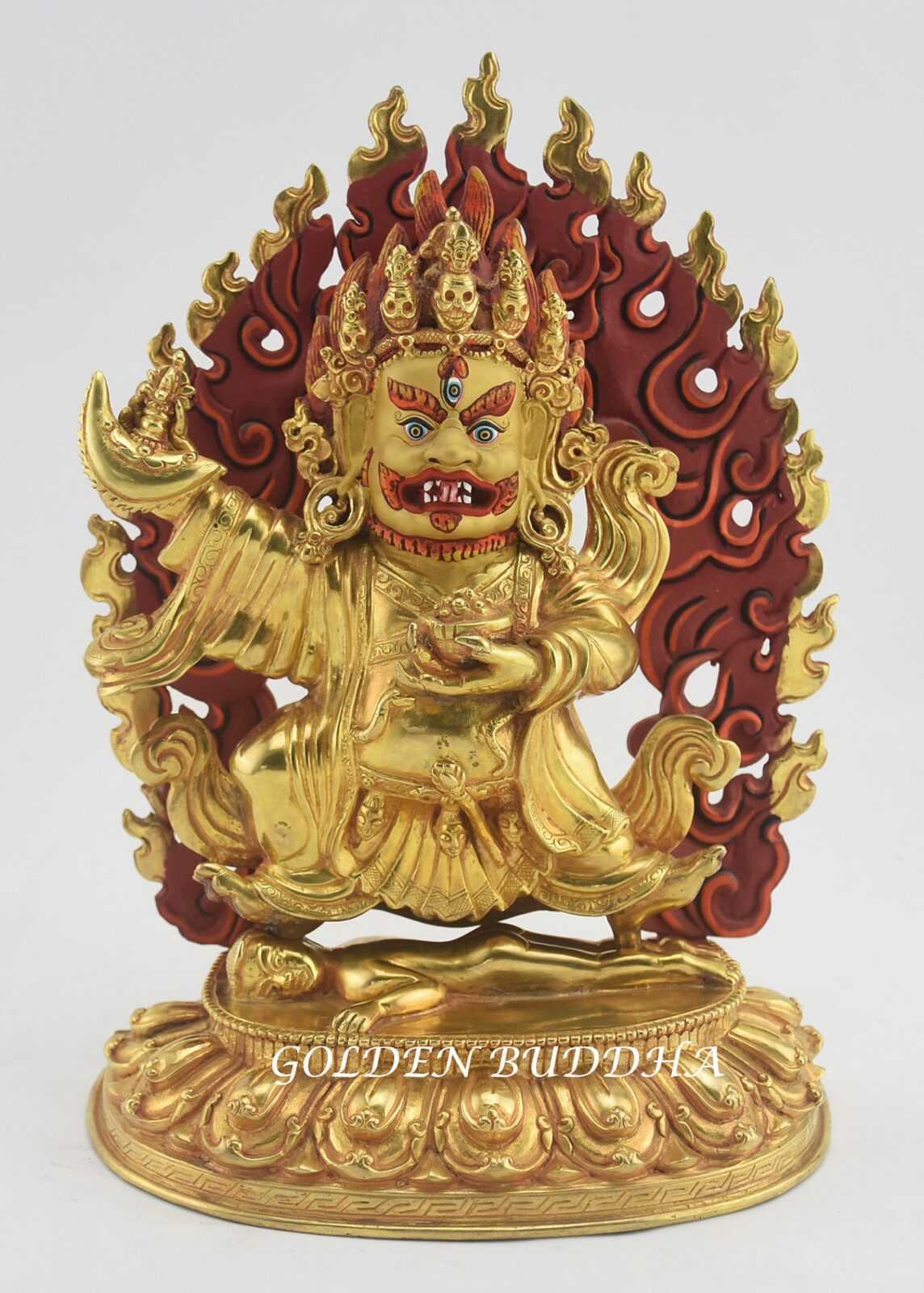
The Sakya pa lineage’s principal Mahakala is Panjarnata Mahakala — the two-armed Lord of the Pavilion and a special protector of the Hevajra cycle. Panjarnata’s connection to Sakya runs deep: the Hevajra Tantra is fundamental to the Sakya pa’s central lam ’bras (path and fruit) tradition transmitted through the lineage associated with the Indian mahasiddha Virupa. ‘Phags pa transmitted Hevajra teachings and initiation at Kublai Khan’s court, giving the Sakya protector tradition direct relevance to Yuan imperial patronage. Panjarnata Mahakala, however, should not be confused with the familiar six-armed form of Mahakala.[4]
The Kagyu pa lineage’s distinctive Mahakala discussed here is Bernagchen Mahakala — the two-armed Black Cloaked Mahakala, specifically the personal protector of the Karmapas and special protector of the Karma Kagyu tradition. Esoteric Buddhism and the Tantras in East Asia records Karma Kagyu participation in Yuan court networks. The third Karmapa Rang byung rdo rje (1284–1339) visited the Yuan court, and the fourth Karmapa Rol pa’i rdo rje (1340–1383) was invited by the last Yuan emperor Toɣon Temür (1320–1370; r. 1333–1368). Their court relationships demonstrate the wider reach of Karma Kagyu during the Yuan period, but they do not by themselves establish Bernagchen as an official Yuan imperial cult.[5][15]
Wutai Shan — Where Manjushri and Mahakala Meet
The sacred mountain complex of Wutai Shan (Mt. Wutai) in northern Shanxi province represents one of the most fascinating intersections of the Mahakala story with the broader history of esoteric Buddhism in China. According to Esoteric Buddhism and the Tantras in East Asia, from early in Chinese Buddhist history Mt. Wutai was identified as the holy abode of Mañjuśrī, the Bodhisattva of Wisdom — a connection that Amoghavajra (705–774 CE) formalized during the Tang dynasty through his translation of Manjushri scriptures and his promotion of the mountain’s cult.[8][14]
The Mongol-Yuan period added a major Tibetan Buddhist layer to Wutai Shan’s history. The Nepalese master artist Anige — the same Newar artist associated with Kublai Khan’s imperial Buddhist commissions, including Panjarnata Mahakala — worked on the great stupa at Wutai Shan completed in 1301. According to the scholarly record, after the Yuan dynasty, “both exoteric and Esoteric Buddhist forms of Mañjuśrī, including those associated with Tibetan Tantrism, were fused into a single cult” at Wutai Shan. The mountain became simultaneously a Chinese Buddhist holy site and a major destination for Tibetan and Mongolian Buddhist pilgrimage — a layered religious identity that continued long after the Yuan.[8]
The connection between Manjushri’s presence at Wutai Shan and the history of Mahakala is primarily historical rather than a fixed doctrinal pairing. Yuan emperors patronized Manjushri devotion at Wutai while also supporting Tibetan Buddhist protector rituals and Mahakala imagery at court. Their coexistence reflects the breadth of Yuan Buddhist patronage, but there is no need to posit a universal protective hierarchy in which Manjushri’s wisdom is formally paired with Mahakala’s defensive activity.
Vajravarahi — A Major Tantric Deity at the Yuan Court
One of the most illuminating findings in Esoteric Buddhism and the Tantras in East Asia concerns the deity who stood beside Mahakala in popularity and importance throughout the Yuan dynasty. The text states explicitly: “Next to Mahākāla, Vajravārāhī was the most popular protective deity, especially favored by followers in both Tangut Xia and Mongol Yuan.”[14]
Vajravarahi — the Vajra Sow, a form of the great dakini Vajrayogini — belongs principally to the Chakrasamvara and Yogini cycles of Buddhist tantra. She is not the female protector of the Hevajra cycle paired doctrinally with Panjarnata Mahakala. Her prominence during the Yuan period alongside Mahakala instead reflects the broad range of Tibetan tantric traditions patronized by Mongol elites. Sakya traditions preserve important Vajrayogini and Vajravarahi transmissions, but those practices should not be collapsed into a single Hevajra-Mahakala protective pair.[9]
To learn more about Vajravarahi’s iconography and her relationship to the Vajrayogini practice tradition, see our dedicated guide.
Chinese Literati Critiques and Tibetan Buddhism after the Yuan
The extraordinary influence of Tibetan Buddhism — and Mahakala — at the Mongol court did not go uncontested. From the very beginning of the Yuan period, Chinese scholars and officials of the Confucian literati tradition mounted a sustained critique of Tibetan lamas and their practices, documented in considerable detail in Esoteric Buddhism and the Tantras in East Asia.[14]
The most explosive element of the literati critique concerned the secret teaching of supreme bliss (bimi daxile fa) — practices associated in hostile or polemical Chinese accounts with the late Yuan court of Emperor Toɣon Temür (1320–1370; r. 1333–1368). Later descriptions often portrayed Tibetan tantra in sensational terms, and modern scholarship cautions that these reports are vague, distorted, or incomplete. Surviving Yuan-period Chinese texts show that Tibetan Buddhist activity at court included a complex range of teachings, including lam ’bras, Mahamudra, deity yoga, dream practices, and ritual texts. The polemical “secret teaching of supreme bliss” therefore should not be identified confidently with a single practice such as gtum mo or with the Hevajra Tantra’s path and fruit teaching.[14]
With the establishment of the Ming dynasty (1368–1644), the Yuan political system and Mahakala’s special status within the Mongol imperial cult did not continue in the same form. Tibetan Buddhism, however, was not simply removed from the Chinese court. Ming emperors — especially Yongle and several of his successors — continued to invite Tibetan hierarchs, sponsor Tibetan Buddhist art and monasteries, confer titles, and support tantric rituals. Tibetan Buddhist teachings and images therefore continued to circulate through the Ming and into the Qing dynasty (1644–1912 in China), when Tibetan Buddhism again received extensive imperial patronage under the Manchu emperors.[12][14]
Palden Lhamo — Shri Devi in Mahakala Traditions
No discussion of Mahakala traditions is complete without acknowledging the important place of Palden Lhamo (Shri Devi) — Tibetan: dPal ldan lha mo — one of the great female wisdom protectors of Tibetan Buddhism. Her relationship with Mahakala varies by lineage and iconographic cycle. In some Panjarnata compositions Shri Devi is presented as Mahakala’s consort or close companion, while in other traditions she functions as an independent protector or member of a larger retinue. It is therefore inaccurate to describe Palden Lhamo as the universal consort of every form of Mahakala.[10]
Shri Devi appears in the retinues of several Mahakala traditions, including Panjarnata and Six-Armed Mahakala compositions, but the precise form and relationship differ according to transmission. Ekajati, the Dzogchen protector belongs to distinct protector traditions and should not be treated as interchangeable with Palden Lhamo. The Magzor Gyalmo form of Shri Devi became especially important in the Gelug tradition and is historically associated as a special guardian of the Dalai Lama incarnation line.[16]
To learn more about Palden Lhamo’s iconography, the traditional legend identifying Remati as a Sri Lankan queen, and Magzor Gyalmo’s role as a protector of the Dalai Lama lineage, see our dedicated guide.[16]
Shadbhuja Mahakala Statues (Black Mahakala) — Iconography and Practice
Black Mahakala statues in the six-armed form discussed here depict Shadbhuja Mahakala (Black Mahakala), a wrathful emanation of Avalokiteshvara. This form is especially important as the principal protector of the Shangpa Kagyu and Gelug traditions, although related six-armed transmissions also occur in other Tibetan Buddhist schools.[3]
The Body and Posture: Six-Armed Mahakala is depicted with a blue-black or very dark body, powerfully built and standing within a mass of pristine-awareness fire. His prominent belly expresses the capacity to consume or overwhelm obstacles. In the standard Shangpa and Gelug iconography he stands upon the elephant-headed Ganapati, representing the subjugation of hindering forces within this tantric protector cycle. Other Mahakala forms may stand on corpses, so the support figure should be identified according to the specific lineage and image rather than generalized across all forms.[3]
The Three Eyes: Shadbhuja Mahakala is consistently described in the Shangpa iconographic tradition with three round, glaring red eyes. Symbolic explanations of the three eyes can differ among tantric texts and commentarial traditions, so no single interpretation should be treated as universal to every Mahakala form.[3]
Shadbhuja Mahakala (Black Mahakala) — Six-Armed Features
- Curved Kartrika (Flaying Knife) — held in the first right hand.
- Kapala (Skull Cup) — held in the first left hand and traditionally described as filled with blood.
- Skull Rosary (Mala) — held in the second right hand.
- Trident (Triśūla) — held in the second left hand; it is a trident rather than a khatvanga staff.
- Damaru (Small Drum) — held and played in the third right hand.
- Vajra Lasso — held in the third left hand.[3]
The Crown of Five Skulls: Shadbhuja Mahakala wears a crown of five dried skulls, a standard element of wrathful Vajrayana iconography. The five-skull crown is commonly explained as symbolizing the transformation of the five poisons into the five wisdoms.[3][17]
Mantra and Liturgical Practice: Shadbhuja Mahakala belongs to specific transmitted ritual cycles, and its mantras should not be replaced by a generic formula simply labeled “the Mahakala mantra.” Mahakala tantras themselves preserve different mantras for different forms.[13]
Formal Shadbhuja protector practice — especially deity visualization, torma rites, and restricted liturgies — is traditionally learned through the appropriate lineage transmission and instruction from a qualified teacher. This distinction is important because Six-Armed Mahakala exists in more than one transmission, and iconographic or ritual details can differ among them.[3]
Bernagchen Mahakala Statues — The Black Cloaked Protector of the Kagyu
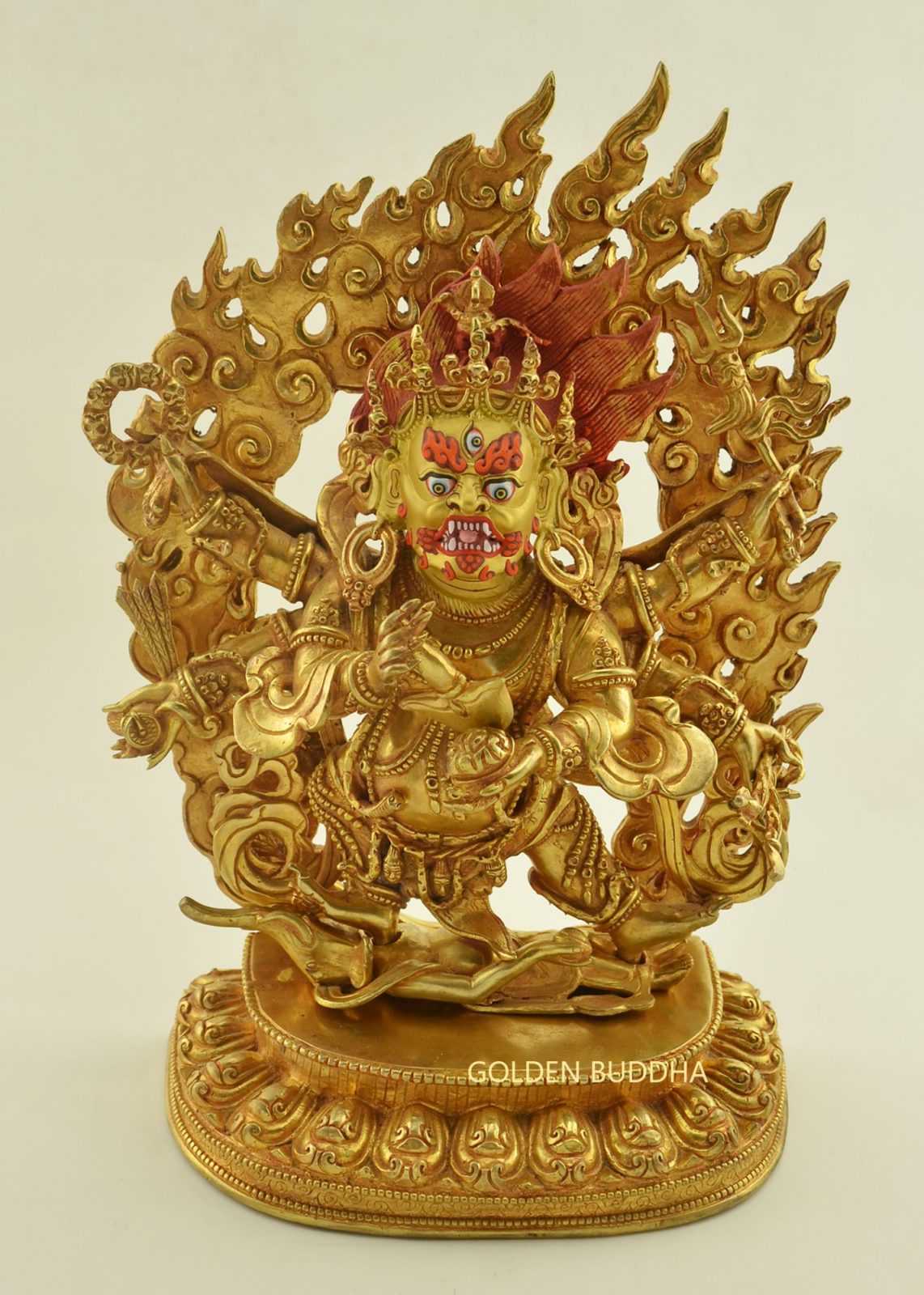
Bernagchen Mahakala — whose Tibetan name translates as “Wearing the Black Cloak” (Ber nag can) — is the special protector of the Karma Kagyu school of Tibetan Buddhism and the personal protector of the Karmapas. He is a two-armed Mahakala, distinguishing him immediately from Six-Armed Mahakala, and his most remarkable iconographic feature is the long black cloak that falls behind him. The specific Bernagchen tradition did not accompany the Karmapa lineage from its very beginning; Himalayan Art records that it entered the Karma Kagyu through the second Karmapa, Karma Pakshi.[5]
Iconography: Bernagchen is depicted as a powerful, dark-bodied figure with a wrathful expression, three glaring eyes, and a crown of five skulls. In his right hand he holds the kartrika (curved flaying knife) raised above his head, and in his left hand he holds a kapala (skull cup) at heart level. He stands within wrathful fire or smoke, and his dramatic black cloak billows behind him. The two arms and black cloak provide the clearest visual distinction from Six-Armed Mahakala and other major protector forms.
Bernagchen’s Connection to the Karma Kagyu: The specific Bernagchen tradition is traced to the Nyingma revealed-treasure tradition and was introduced into the Karma Kagyu by the second Karmapa, Karma Pakshi (1204/1206–1283). Bernagchen subsequently became the personal protector of the Karmapas and the special protector of the Karma Kagyu school. This lineage history is more precise than identifying Bernagchen universally as a wrathful Avalokiteshvara form or treating his symbolism as simply the Karmapa’s power externalized.[5]
Karma Kagyu hierarchs had important contacts with the Yuan court, including the third and fourth Karmapas. Those relationships demonstrate the court’s engagement with more than one Tibetan Buddhist school, but surviving evidence should not be used to claim that Bernagchen himself was established as a major imperial protector in the palaces of Beijing. The best documented Yuan imperial Mahakala association is with Panjarnata.[6][15]

Panjarnata Mahakala Statues — Lord of the Pavilion and the Sakya Lineage
Panjarnata Mahakala — whose Sanskrit name translates as “Lord of the Pavilion” (Skt: Pañjarānātha; Tib: gur gyi mgon po) — is a principal protector of the Sakya pa lineage of Tibetan Buddhism and a special guardian of the Hevajra Tantra cycle. He is a two-armed standing figure whose compact, wrathful form is one of the clearest visual identifiers of the Sakya Mahakala tradition.[4]
Panjarnata’s connection to the Hevajra Tantra is fundamental: his iconography and rituals are described in the eighteenth chapter of the Vajrapanjara Tantra, an exclusive explanatory tantra associated with the Hevajra cycle. Because Hevajra and lam ’bras were central to Sakya tradition, Panjarnata became one of Sakya’s most important protectors. Sakya teachers brought both Hevajra teachings and Mahakala rites into Yuan court culture, and Panjarnata acquired exceptional imperial significance under Kublai Khan.[4]
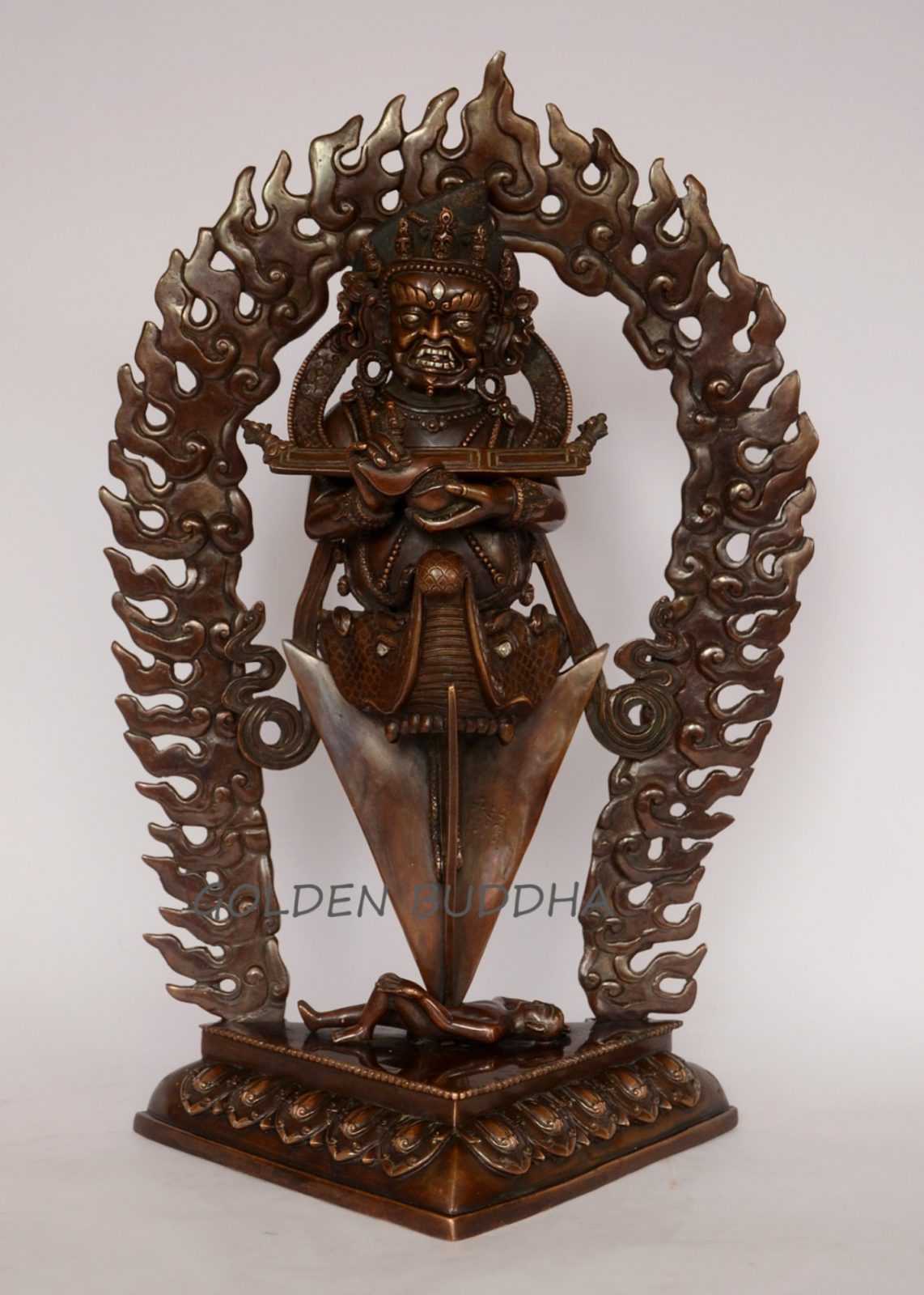
Iconography: Panjarnata is depicted as a two-armed, standing figure with a very dark body, three glaring eyes, and an expression of supreme ferocity. He stands on a human corpse in a compact posture described in traditional iconographic sources as dwarfish and thick. His crown features five dried skulls. In the right hand he holds a curved knife and in the left a skull cup. The gandi ritual staff is commonly balanced across the crooks of his forearms, although some Sakya variants omit it; the phurba is not the defining implement of standard Panjarnata iconography.[4]
Panjarnata in the Sakya Liturgical Tradition: Panjarnata Mahakala is the focus of extensive protector liturgies in the Sakya school. His title “Lord of the Pavilion” is connected with the Vajrapanjara Tantra — panjara carrying the sense of pavilion, canopy, or enclosure — rather than being derived simply from a ritual literally performed inside a tent. Sakya monasteries preserve important Panjarnata rites, but the exact liturgical schedule and ritual form vary among institutions and lineages.[4]

Chaturbhuja Mahakala Statues — Four-Armed Protector of the Chakrasamvara Cycle
Chaturbhuja Mahakala (Sanskrit: Caturbhuja Mahākāla; Tibetan: nag po chen po chag shi pa, “the Great Black One with Four Hands”) is a major four-armed form of Mahakala in Tibetan Buddhism. Himalayan Art identifies Chaturbhuja as a special protector of the Chakrasamvara cycle of tantras, while noting that the deity can also function as a meditational deity in particular transmissions. Numerous Chaturbhuja lineages are preserved in both the Nyingma and Sarma traditions. Some depict Mahakala in a solitary aspect, while others show him embracing the consort Chandika, so a consort is not required for the form to be doctrinally complete.[11]
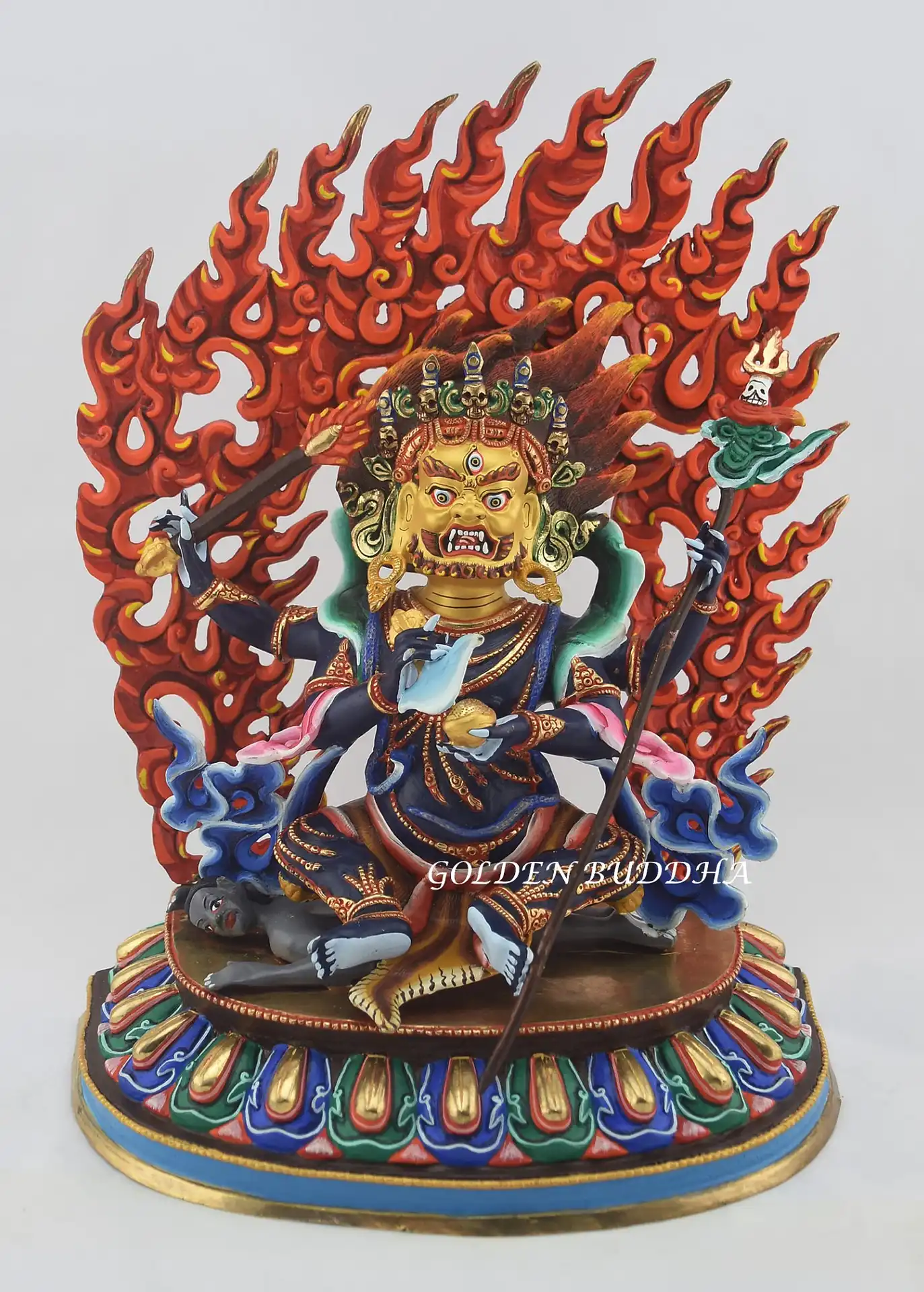
Iconography: Chaturbhuja Mahakala is typically shown with one wrathful face, three glaring eyes, a blue-black body, four arms, a five-skull crown, and hair rising like flame. Across different lineages, the primary hands may hold a heart-shaped coconut or curved kartika together with a kapala skull cup, while the secondary right hand raises a sword and the secondary left carries a khatvanga or trident-topped staff. He is commonly seated in a relaxed heroic posture above a lotus and corpse seat within the flames of pristine awareness. The 13.5-inch Multicolored Chaturbhuja Mahakala Statue shown below presents the solitary form with a dark blue-black body, gold-painted wrathful face, five-skull crown, an upraised dark ritual sword, a trident-topped khatvanga staff, a curved kartika, kapala, multicolored lotus throne, corpse seat, and large red-orange flaming aureole.[11]
Connection to Chakrasamvara and Vajravarahi: Chaturbhuja Mahakala’s role as a protector of the Chakrasamvara tantric cycle creates a particularly strong doctrinal relationship with Chakrasamvara and with Vajravarahi, a principal female meditational deity within the broader Chakrasamvara and Yogini traditions. A Chaturbhuja Mahakala and Vajravarahi pairing should therefore be understood as a harmonious yidam-and-protector relationship within a shared tantric framework, not as a consort pairing. This connection is one reason the solitary four-armed form works especially well beside Vajravarahi in a two-statue display.[9][11]
Differences Between Mahakala Forms at a Glance
Shadbhuja Mahakala (Black Mahakala, Six-Armed): Six arms carrying kartrika, kapala, skull mala, trident, damaru, and lasso. Dark blue-black body, three eyes, five-skull crown, commonly standing on Ganapati. A wrathful Avalokiteshvara form and principal protector of the Shangpa Kagyu and Gelug traditions, with additional transmissions elsewhere.[3]
Bernagchen Mahakala (Two-Armed, Black Cloaked): Distinctively two-armed — kartrika in right hand, kapala in left — with the iconic black cloak flowing behind. The personal protector of the Karmapas and special protector of the Karma Kagyu tradition, introduced into that school through the second Karmapa, Karma Pakshi.[5]
Panjarnata Mahakala (Two-Armed, Standing): One face and two arms, holding a curved knife and skull cup, commonly with a gandi ritual staff across the forearms, standing in a compact posture on a corpse. Principal protector of the Sakya tradition and special protector of the Hevajra cycle. He should not be confused with Six-Armed Mahakala, and the phurba is not his standard defining implement.[4]
Chaturbhuja Mahakala (Four-Armed): One face and four arms, usually blue-black in color, with the primary hands holding a heart-shaped coconut or curved kartika and a kapala, while the secondary hands raise a sword and a khatvanga or trident-topped staff. Chaturbhuja is a special protector of the Chakrasamvara cycle and appears in both solitary forms and forms embracing the consort Chandika.[11]
Mahakala Mantra and Practice Benefits
Mahakala mantras differ according to form, lineage, and ritual cycle. In The Glorious Sovereign Tantra of Mahakala, the mantra given for the two-armed form is:[13]
OM MAHAKALA HUM PHAT SVAHA
This mantra is specifically identified in that tantra with the two-armed form of Mahakala. Other Mahakala forms and lineages use different mantras, so no single formula should be presented as universal across all Mahakala traditions.[13]
Mahakala Practice Benefits
- Removal of Obstacles — to spiritual practice, material wellbeing, and all life activities.
- Protection — from negative external forces, harmful beings, and environmental obstacles.
- Swift Completion — of positive activities undertaken for the benefit of self and others.
- Transformation — of the five poisons into five wisdoms through the power of fierce compassionate activity.
- Support for the Dharma — the protection and continuation of Buddhist teachings and lineages.
Formal Mahakala practice is traditionally learned from a qualified teacher, and the required empowerment, reading transmission, or ritual instruction depends on the particular form and lineage. Offerings may include torma, incense, water bowls, and lamps, while a statue can serve as a sacred support for recollection, offerings, and visualization. The exact visualization procedure — including whether and how the deity is invited into or visualized in relation to the image — is determined by the specific sadhana rather than by one universal Mahakala practice.
Authentic Mahakala Statues from Nepal
The Mahakala statues in our collection are handcrafted in Patan (Lalitpur), Nepal — one of the Kathmandu Valley’s historic centers of Newar Buddhist metal sculpture. Newar artists have been renowned for many centuries for the quality of their religious sculpture, and their work profoundly influenced Buddhist art in Tibet and China. Patan’s hereditary craft traditions include Shakya artisan families and other Newar metalworking communities, many of whom continue to use the lost wax casting method (cire perdue) for copper-alloy Buddhist statuary.
Each authentic Mahakala statue begins as a hand-sculpted wax model, with iconographic details modeled according to the intended form — including the number of eyes and arms, hand implements, crown elements, posture, and expression. The wax model is cast in copper alloy, hand-finished by master craftsmen, and finished with 24K gold fire gilding using the traditional mercury-amalgam technique. Properly executed gilding creates a durable gold surface, but every sacred metal statue still benefits from careful handling and appropriate long-term care.
All statues are certified by the Department of Archaeology in Kathmandu and include a certificate of authenticity. Consecration (rabne) at a recognized Kathmandu monastery is available upon request. Patan’s Newar artists have supplied Buddhist communities throughout the Himalayan world for centuries, and the broader Newar artistic tradition had a major influence on Yuan Buddhist art through masters such as Anige at Kublai Khan’s imperial court.
Frequently Asked Questions About Mahakala Statues
What does Mahakala represent in Tibetan Buddhism?
Mahakala, meaning “Great Black One” or “Great Time,” refers to an important family of wrathful protectors in Tibetan Buddhism. Major Mahakala forms are understood as wisdom protectors whose fierce appearance expresses enlightened activity directed toward removing obstacles and safeguarding the Dharma. Some forms — especially Shadbhuja Mahakala (Black Mahakala), the six-armed form — are described as wrathful emanations of Avalokiteshvara, while other forms have different textual and lineage origins. Mahakala’s wrath should therefore be understood symbolically and ritually, not as ordinary anger or violence.[1][3]
What are the main differences between the Mahakala statue forms?
The primary differences between Mahakala forms lie in the number of arms, lineage association, textual source, posture, and ritual implements. Shadbhuja Mahakala (Black Mahakala), the six-armed form, is a wrathful Avalokiteshvara form especially important in Shangpa Kagyu and Gelug. Bernagchen Mahakala is two-armed, identifiable by his black cloak, and is the personal protector of the Karmapas and special protector of Karma Kagyu. Panjarnata Mahakala is also two-armed, holding a curved knife and skull cup and commonly a gandi staff across his forearms; he is the principal Sakya protector and a special protector of the Hevajra cycle. Chaturbhuja Mahakala is the four-armed form closely associated with the Chakrasamvara cycle; depending on the lineage, he may appear in a solitary aspect or embracing the consort Chandika.[3][4][5][11]
What is Bernagchen Mahakala and why is he called the “Black Cloaked” Mahakala?
Bernagchen Mahakala takes his name from the Tibetan ber nag can, meaning “wearing the black cloak” — referring to the distinctive long black garment that serves as his primary visual identifier. He is a two-armed form of Mahakala, the personal protector of the Karmapas and special protector of the Karma Kagyu school of Tibetan Buddhism. Himalayan Art traces this specific form to a Nyingma revealed-treasure tradition that was introduced into Karma Kagyu by the second Karmapa, Karma Pakshi. Karma Kagyu hierarchs later had important relations with the Yuan court, but this should not be confused with the better documented Yuan imperial cult of Panjarnata Mahakala.[5]
What role did Mahakala play in the Mongol Yuan dynasty?
According to Esoteric Buddhism and the Tantras in East Asia and related scholarship, under Kublai Khan’s Yuan dynasty, Mahakala — particularly Panjarnata — became an important state-protective deity and a focus of imperial ritual patronage. Chinese and Tibetan historical narratives credited Mahakala rites associated with ‘Phags pa, Dampa, and the Newar artist Anige with helping the Mongol campaign against the Southern Song; these accounts document what Yuan religious sources believed and promoted, rather than proving supernatural causation. Temples and images dedicated to Mahakala were established in many parts of the empire. Panjarnata’s close relationship with the Hevajra and Vajrapanjara cycle also linked the protector to the Sakya traditions that held exceptional influence at Kublai’s court.[6][14]
Is Palden Lhamo related to Mahakala?
Yes — but the relationship depends on the specific lineage and iconographic cycle. In some Panjarnata compositions, Palden Lhamo (Shri Devi) appears in Mahakala’s retinue and may be described as his consort or companion, while other Shri Devi traditions function independently. Shri Devi is a major female wisdom protector with many forms. The Magzor Gyalmo form became a special protector of the Dalai Lama incarnation line and the Ganden Phodrang government, but this later Gelug role should not be projected onto every Palden Lhamo or Mahakala tradition.[10]
Are the Mahakala statues from Nepal authentic and certified?
Yes. Every Mahakala statue in our collection is handcrafted in Patan, Nepal by artisans working within the traditional Newar metalworking heritage, including Shakya craft families, using the lost wax casting method and finished with 24K gold fire gilding when specified. Each statue comes with a certificate of authenticity from the Department of Archaeology in Kathmandu, verifying its materials, technique, and origin. Consecration (rabne) at a recognized Kathmandu monastery is available upon request. Patan’s Newar sculptural tradition has supplied Himalayan Buddhist communities for centuries and exerted major influence on Tibetan and Yuan Buddhist art, famously through the Newar master Anige at Kublai Khan’s court.
References
- The Metropolitan Museum of Art — Mahakala, India, Bihar, Pala period, 11th–12th century. Museum entry discussing Mahakala’s Indian Shaiva/Bhairava background and Buddhist protector context.
- Megan Bryson — “Between China and Tibet: Mahakala Worship and Esoteric Buddhism in the Dali Kingdom”. Scholarly discussion of Mahakala as an important Dali court and protective deity.
- Himalayan Art Resources — Shadbhuja Mahakala (Shangpa). Identifies the six-armed Great Black One as a wrathful Avalokiteshvara form, principal protector in the Shangpa Kagyu tradition, with its standard implements and Ganapati support.
- Himalayan Art Resources — Panjarnata Mahakala, Lord of the Pavilion. Documents the one-face, two-arm form, curved knife, skull cup, gandi staff tradition, Sakya association, and Vajrapanjara/Hevajra textual connection.
- Himalayan Art Resources — Bernagchen Mahakala, Black Cloak. Identifies Bernagchen as the Black-Cloaked Karma Kagyu protector and records the Nyingma revealed-treasure origin and transmission through the Second Karmapa, Karma Pakshi.
- Rubin Museum / Project Himalayan Art — Mahakala Stone Sculpture. Discusses Dampa, Kublai Khan, Yuan state-protective Mahakala rites, the 1275 Southern Song episode, and the construction of Mahakala temples and images.
- The Metropolitan Museum of Art — Safe Conduct Pass with Phakpa Script. Identifies Phakpa as the Tibetan monk and scholar who served as imperial preceptor during Kublai Khan’s reign.
- Rubin Museum / Project Himalayan Art — White Stupa, Attributed to Nepalese Artist Anige. Documents Anige’s Yuan-period architectural work, the Beijing White Stupa, and the Mount Wutai stupa completed in 1301.
- Himalayan Art Resources — Vajrayogini in the Form of Vajravarahi. Identifies Vajravarahi as a form of Vajrayogini within the Chakrasamvara/Yogini tantric tradition.
- Himalayan Art Resources — Panjarnata Mahakala and Retinue. Shows Shri Devi within the Panjarnata protector cycle and distinguishes specific retinue relationships from universal claims about all Mahakala forms.
- Himalayan Art Resources — Chaturbhuja Mahakala, Four Hands Main Page. Identifies Chaturbhuja/Chag shi pa as the four-armed Mahakala and special protector of the Chakrasamvara cycle, documents its Nyingma and Sarma transmissions, and distinguishes solitary forms from forms embracing the consort Chandika.
- The Metropolitan Museum of Art — Defining Yongle: Imperial Art in Early Fifteenth-Century China. Documents the Yongle emperor’s strong Tibetan Buddhist patronage during the Ming dynasty.
- 84000: Translating the Words of the Buddha — The Glorious Sovereign Tantra of Mahakala. Gives distinct mantras for two-armed, four-armed, six-armed, and other Mahakala forms, demonstrating that there is no single universal Mahakala mantra.
- Charles D. Orzech, Henrik H. Sørensen, and Richard K. Payne, eds. — Esoteric Buddhism and the Tantras in East Asia. Brill scholarly reference covering Tibetan Buddhism in Mongol-Yuan China, Ming-period tantric Buddhism, and related East Asian esoteric traditions.
- The Treasury of Lives — Karmapa Incarnation Line. Biographical entries documenting the Third Karmapa Rangjung Dorje’s two visits to the Yuan court and the Fourth Karmapa Rolpai Dorje’s invitation by Toghon Temur.
- Miranda Shaw — “Palden Lhamo: Supreme Guardian Goddess of the Dalai Lamas,” in As Long as Space Endures. Scholarly treatment of Palden Lhamo, particularly Magzor Gyalmo, as the guardian protector associated with the Dalai Lama incarnation line.
- Rubin Museum of Himalayan Art — “A Viewer’s Guide to Wrathful Iconography in Himalayan Art”. Explains the five-skull crown as a symbol of transforming the five poisons into the five wisdoms and provides context for wrathful Buddhist imagery.