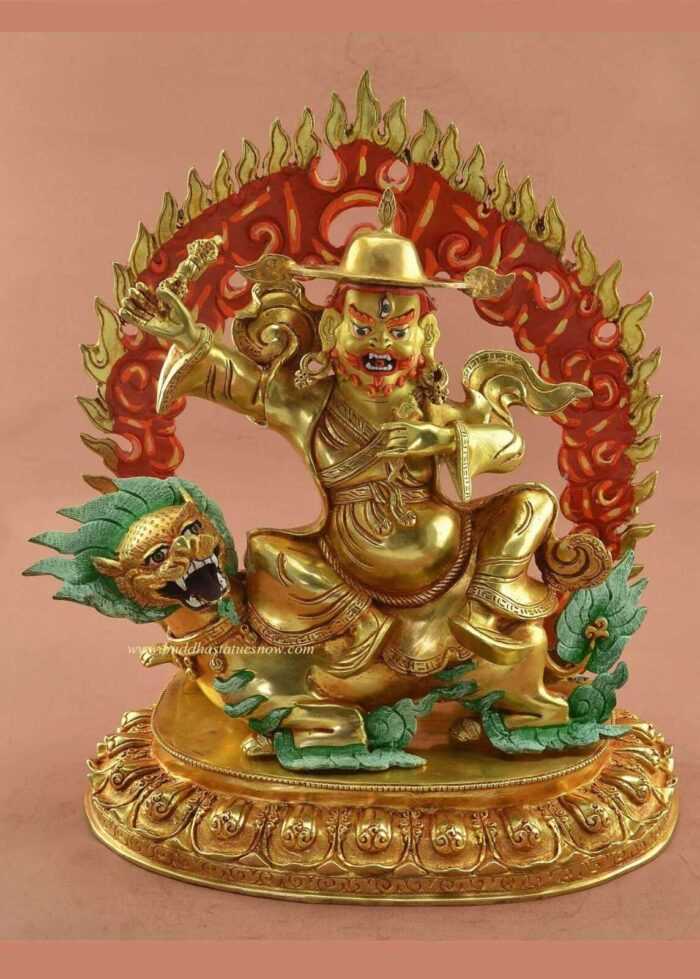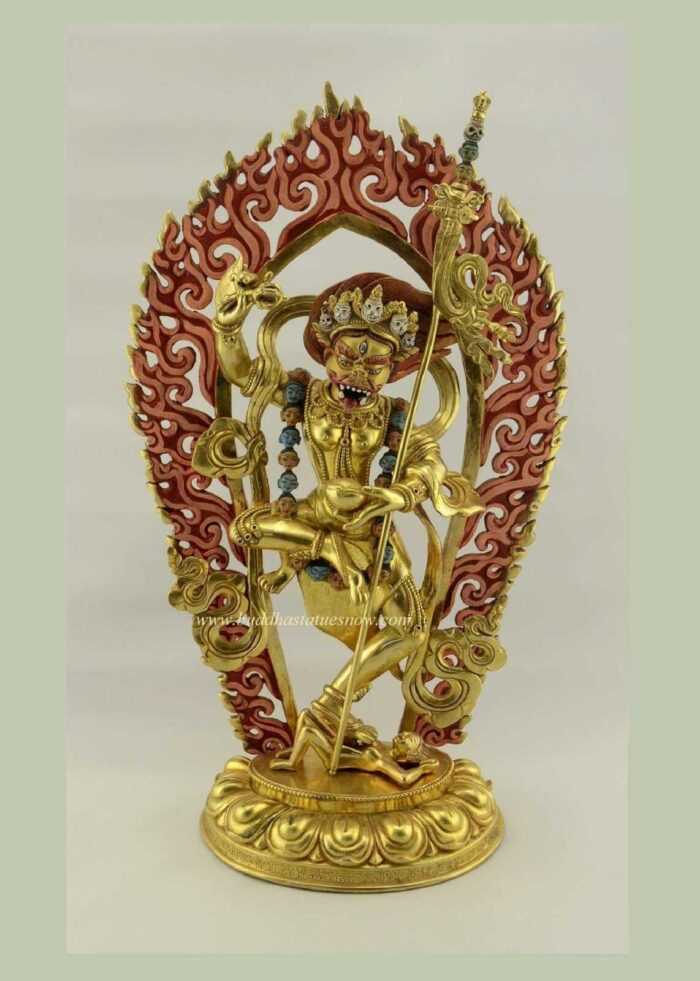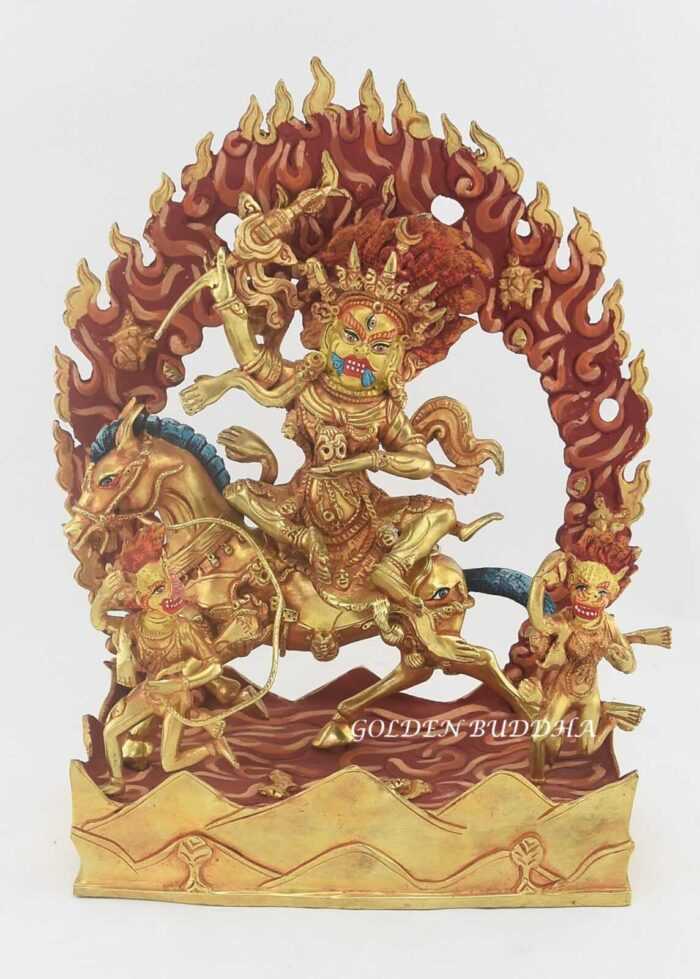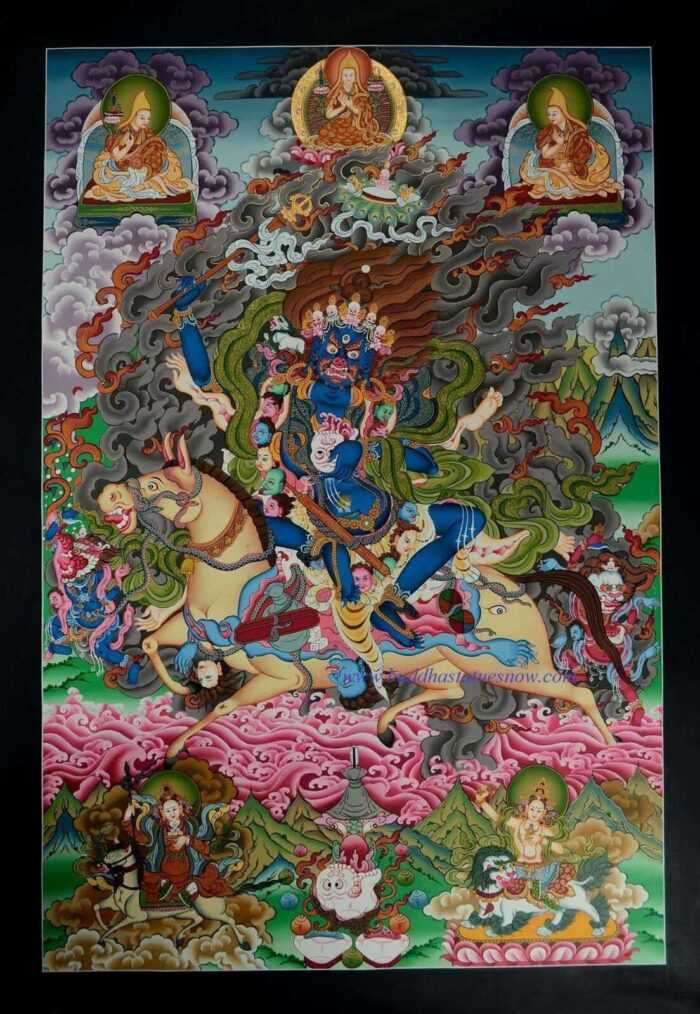


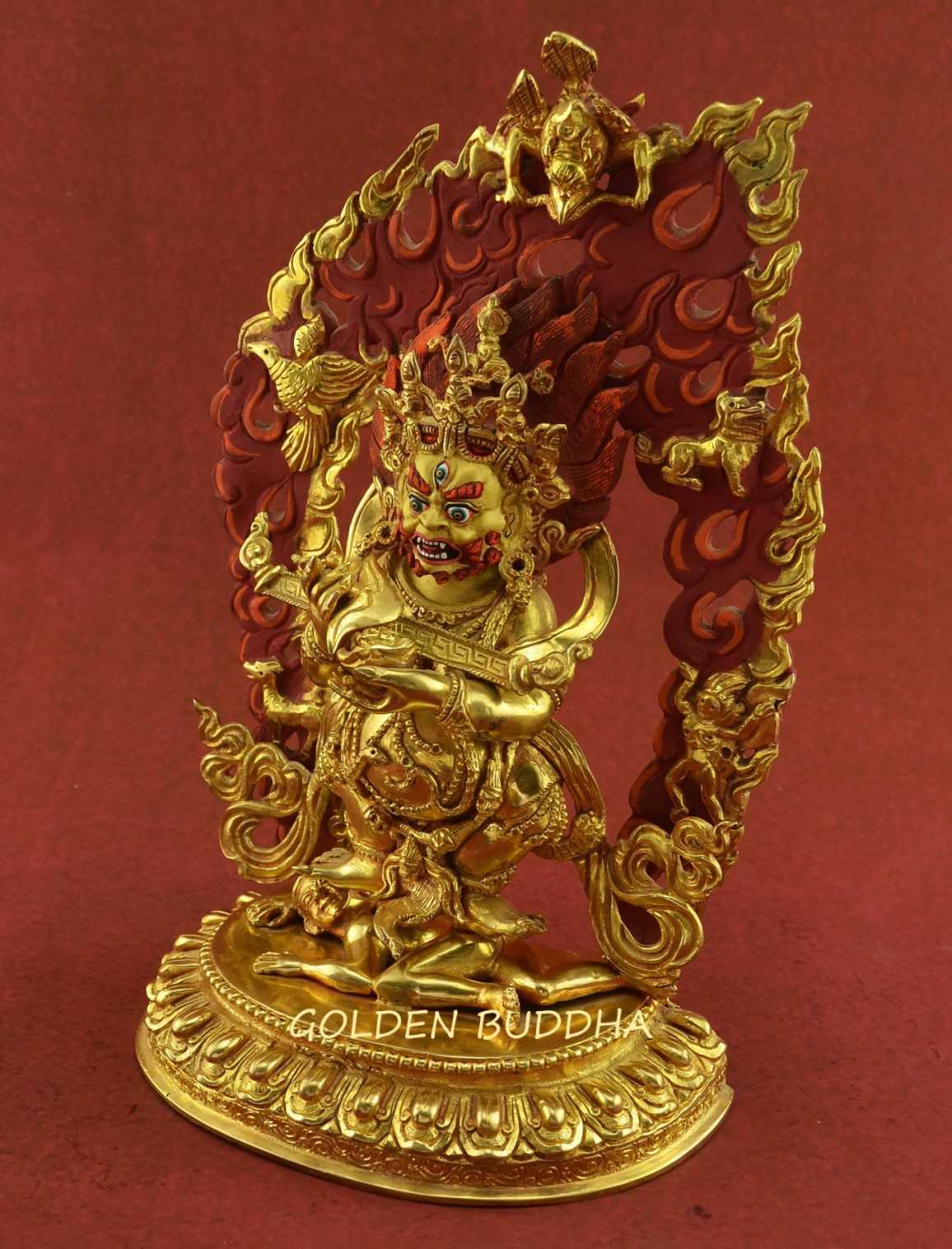

This 10.5-inch Panjarnata Mahakala Statue portrays the Lord of the Pavilion in his compact two-armed form, handmade in Patan, Nepal from copper alloy using the traditional lost wax casting method. The sculpture is fire gilded in 24K gold, while the face is hand painted with 18K gold and natural pigments. A removable red flame aureole rises around the deity with gilded tips and messenger figures. Panjarnata stands above a prone figure on an ornate lotus pedestal, with three wrathful eyes, bared fangs, a five-skull crown, upward-flaring hair, and the distinctive horizontal gandi staff resting across his forearms.
Panjarnata Mahakala Statue | 24K Gold Fire-Gilded Craftsmanship
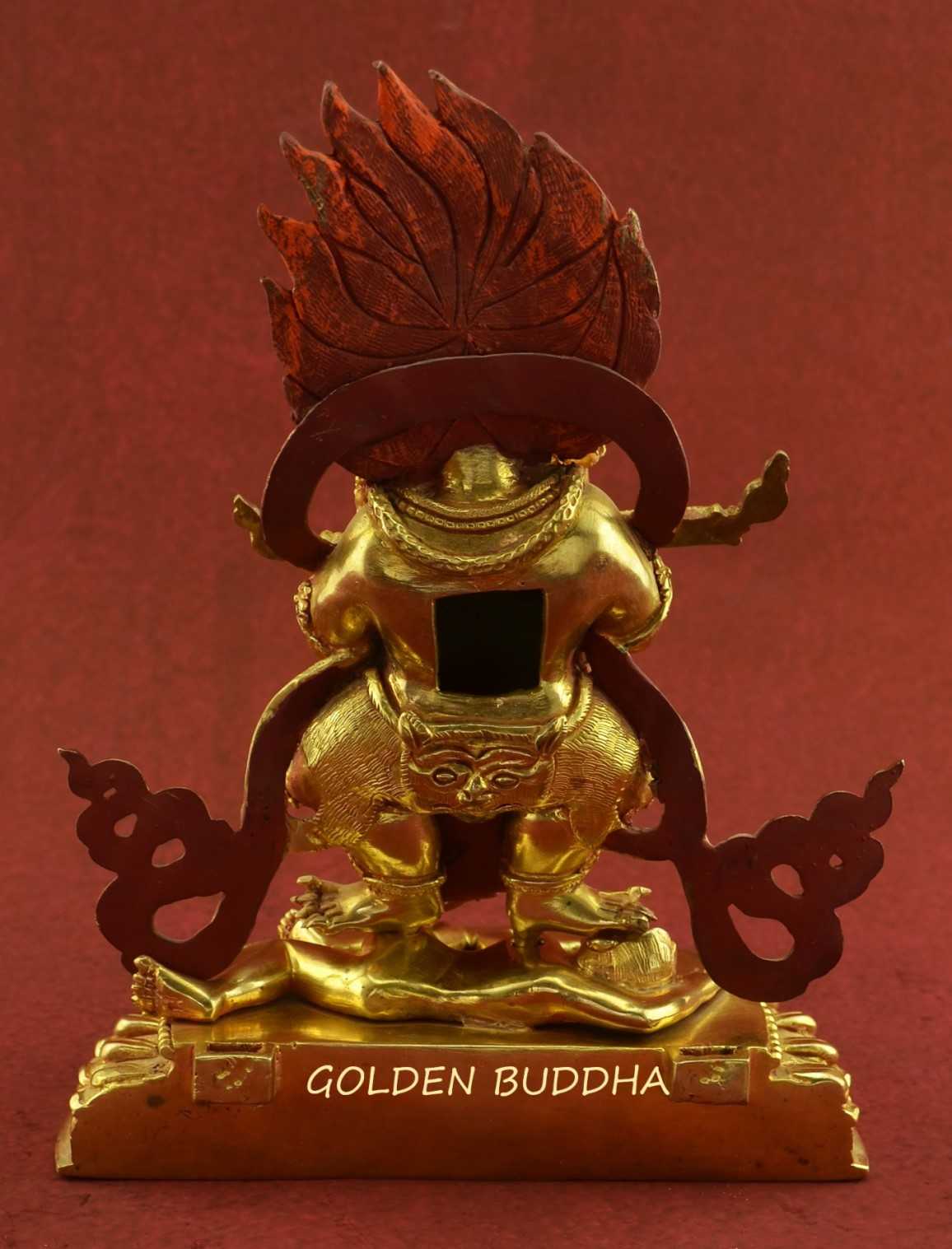
The gilded surface defines the crown, jewelry, ritual attributes, garment borders, and compact stance. Red and orange pigments emphasize Panjarnata’s brows, beard, mouth, and hair, while the eyes and teeth stand out against the gold-painted face. The openwork aureole is painted deep red with darker flame contours and gilded outer tips. Small messenger figures are integrated into the frame, including a Garuda above the deity and animal forms at the sides. From the rear, the substantial copper-alloy casting and separate flame frame are clearly visible. A square access opening appears at the back of the figure for traditional filling. Optional turquoise and red coral gemstones may be embedded into suitable crown or jewelry settings upon request.
Lord of the Pavilion | Sakya and Hevajra Iconography
Panjarnata Mahakala, Sanskrit Pañjaranātha Mahākāla and Tibetan Gur gyi Gönpo, means “Mahakala, Lord of the Pavilion.” He is the principal Mahakala protector of the Sakya tradition and a special protector of the Hevajra cycle. His rites and iconography arise from the Vajrapanjara explanatory tantra associated with Hevajra. Standard Panjarnata iconography presents one face, two arms, three eyes, a crown of five dry skulls, a curved kartika in the right hand and a kapala in the left, with the gandi resting horizontally across the forearms. This sculpture follows that recognizable two-armed form rather than a phurba-bodied variant. Learn more in our guide to Panjarnata Mahakala and the Sakya protector tradition.
Panjarnata Mahakala Statue | Gandi Staff and Protector Attributes
The gandi is the most visually distinctive attribute of Panjarnata and spans the front of this sculpture across his forearms. His kartika and kapala are held close to the heart within the compact arrangement of the hands and staff. The five-skull crown is commonly associated with transformation of the five poisons into the five wisdoms. Beneath Panjarnata lies a subdued human figure, representing the overcoming of obstructive forces rather than ordinary violence. The surrounding flames signify the forceful activity of pristine awareness, while the messenger figures incorporated into the aureole reinforce his role as an active Dharma protector.
Panjarnata Mahakala Statue | Pairing with Palden Lhamo
This sculpture makes a strong protector pairing with our Palden Lhamo Statue in the Magzor Gyalmo form, but the relationship is not that of a consort pair. Panjarnata is the principal Sakya Mahakala, while Shri Devi, or Palden Lhamo, appears repeatedly in traditional Sakya Panjarnata compositions. Established protector assemblies place Shri Devi among Panjarnata’s accompanying deities, and Magzor Gyalmo also appears within broader Sakya protector environments associated with Panjarnata. Displayed together, the statues therefore form a doctrinally coherent pairing of major wrathful Dharma protectors whose traditions overlap within Sakya protector cycles. Their similar upright compositions and surrounding flame imagery also create strong visual harmony while preserving their distinct ritual identities.
Filling and Consecration in Kathmandu, Nepal
For practitioners preparing the image for shrine use, we can arrange traditional statue filling and consecration in Kathmandu, Nepal before shipment. The visible rear access opening allows rolled mantras, incense, and other sacred substances to be placed within the hollow copper-alloy image according to the requested ceremony. After filling, the opening can be sealed and the statue consecrated by a qualified Buddhist practitioner or monastery in accordance with the relevant ritual tradition.
Custom Panjarnata Mahakala Statue | Handmade in Nepal
Collectors, practitioners, monasteries, and Dharma centers may commission a custom Tibetan Buddhist statue handmade in Nepal. Panjarnata can be produced in another scale or finish while preserving his defining one-faced, two-armed form, kartika, kapala, gandi staff, skull crown, compact posture, and Sakya lineage attributes. Options may include 24K gold fire gilding, antiquated oxidized finishes, silver-plated highlights, removable flame aureoles, and turquoise or red coral gemstone embellishments. A coordinated Palden Lhamo sculpture may also be commissioned with complementary height, finish, pedestal proportions, and flame treatment for a balanced two-statue protector display.
Authentic, Handmade in Nepal
Every statue is handcrafted in Patan, Nepal, using traditional lost wax casting and comes with a certificate of authenticity issued by Nepal’s Department of Archaeology, verifying its materials, technique, and origin.