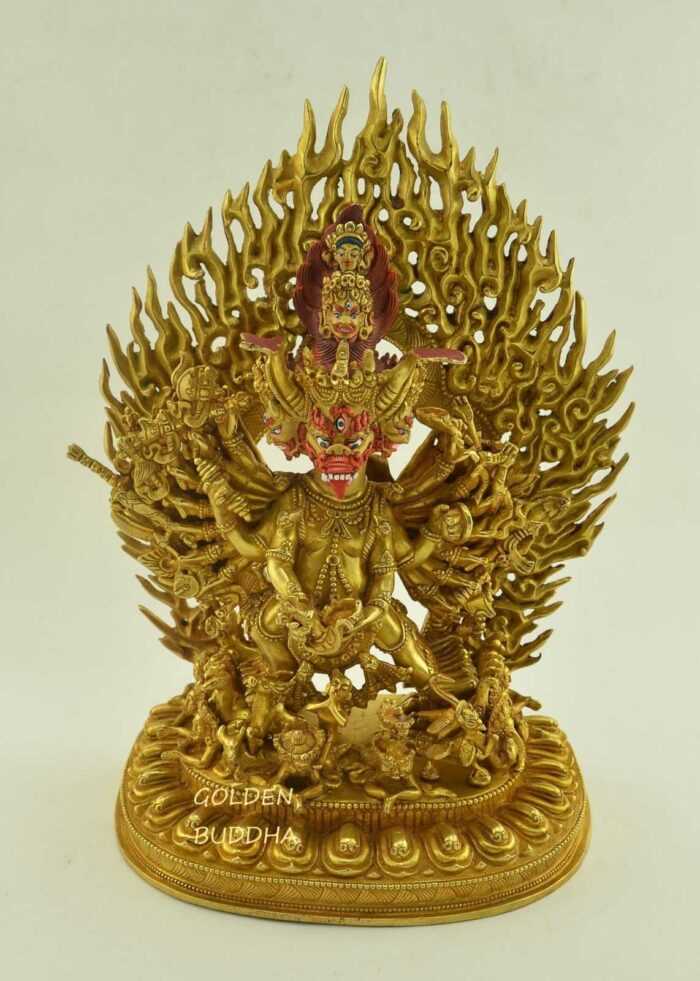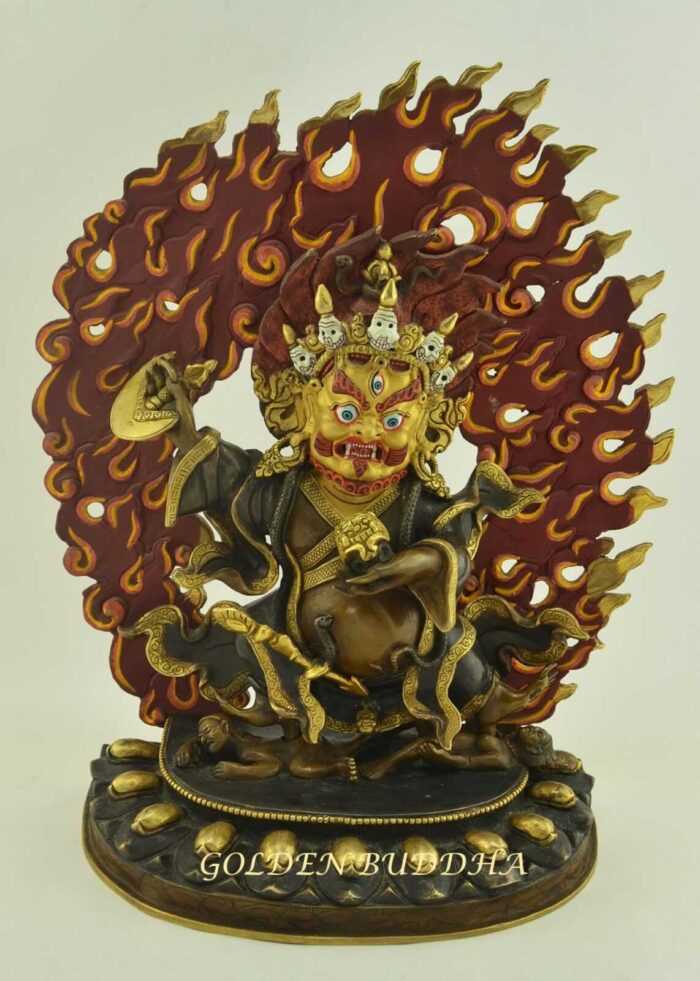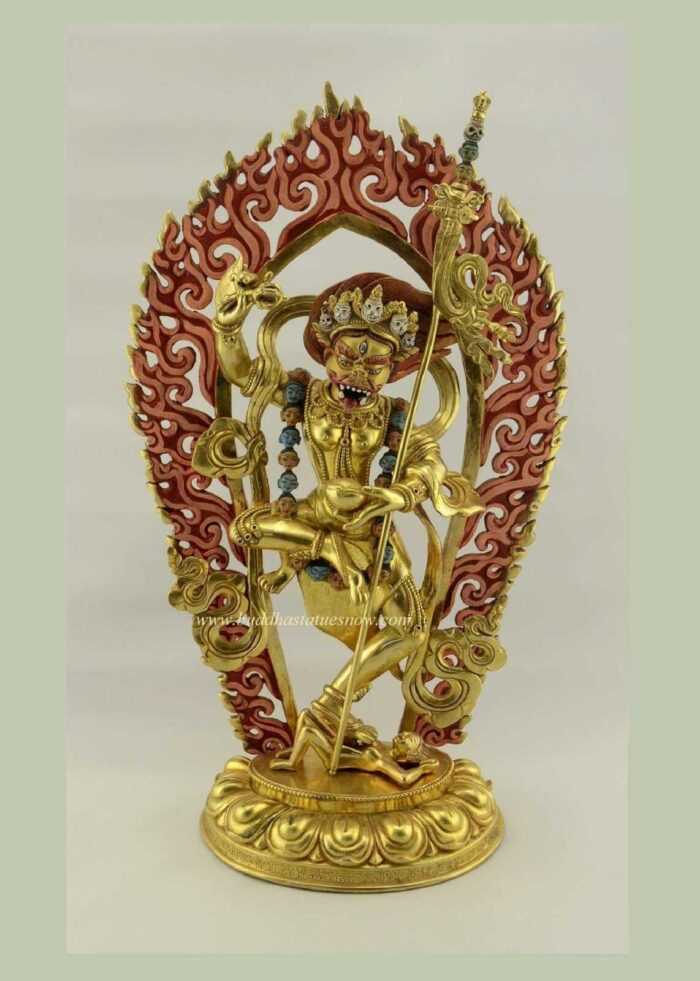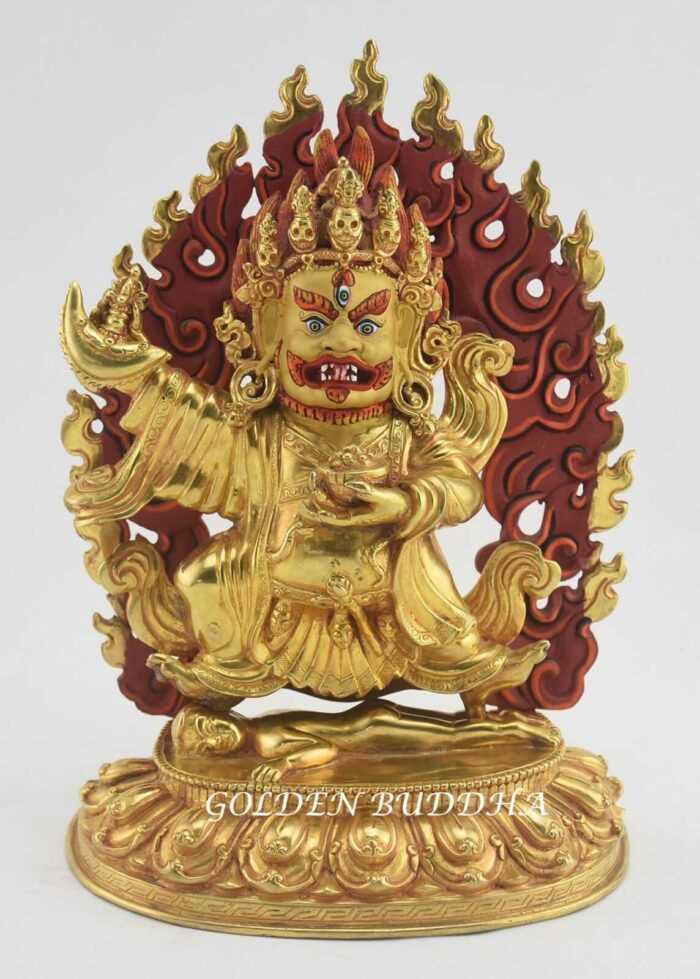
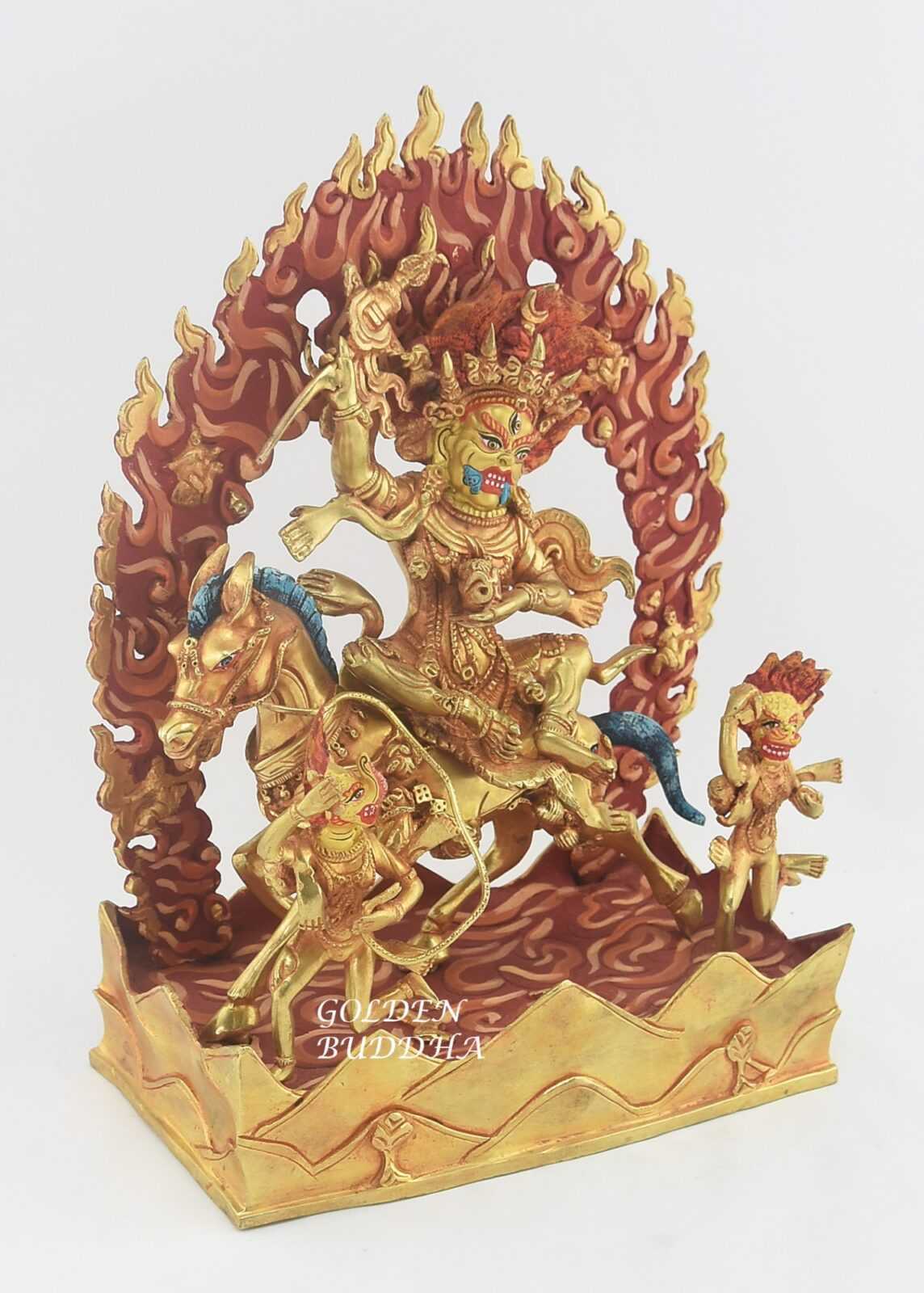
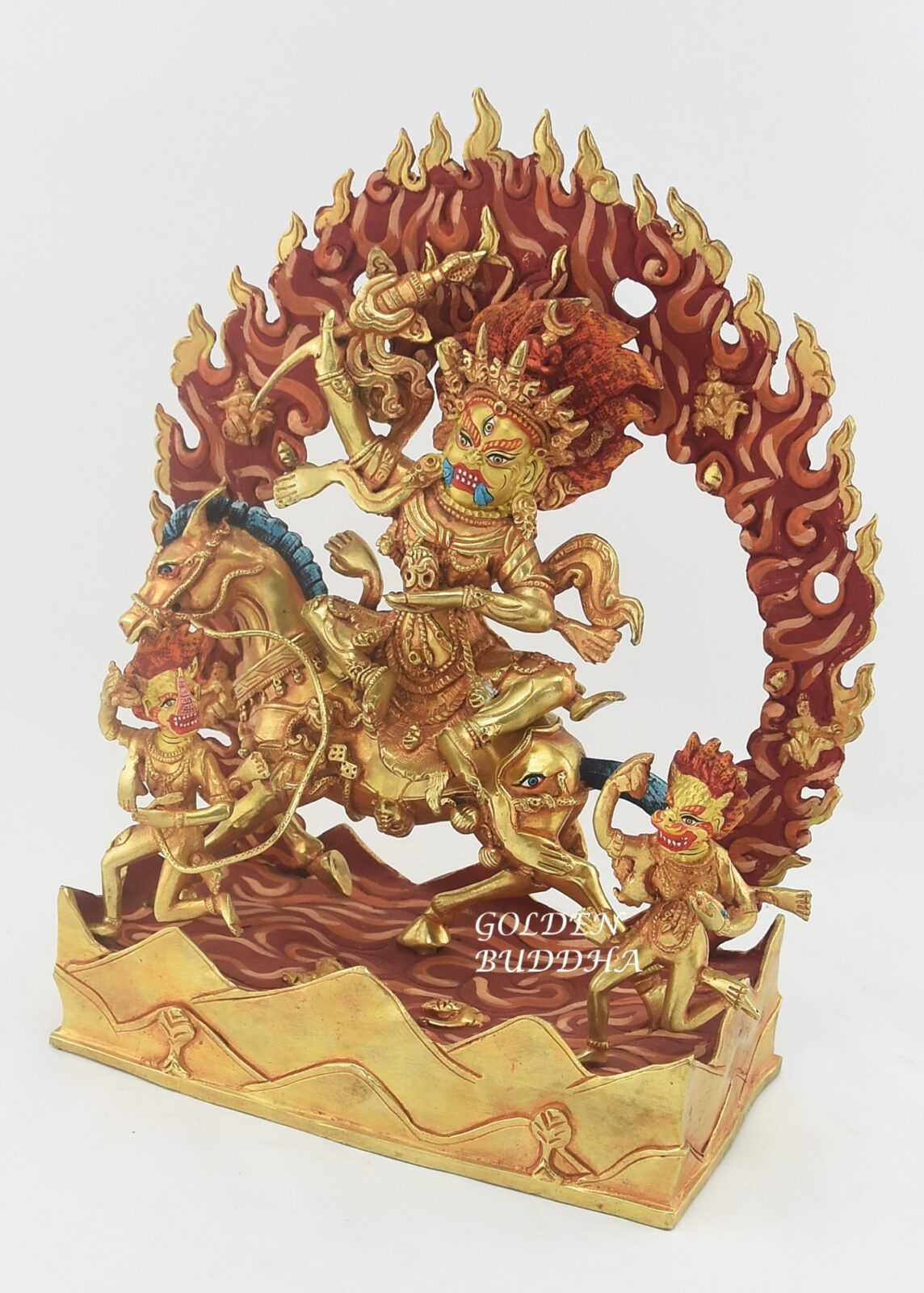
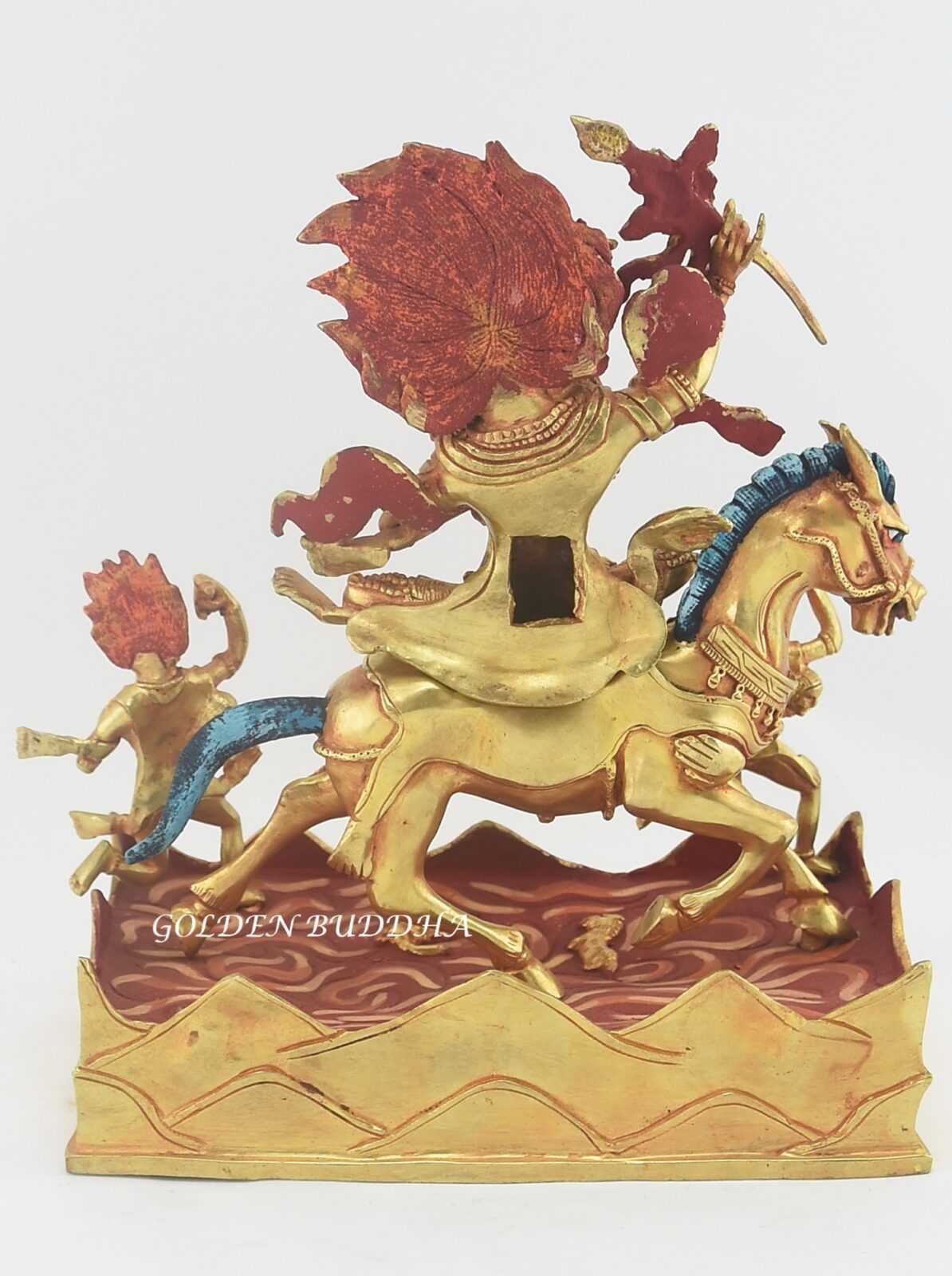
This elaborate Palden Lhamo statue portrays the Glorious Goddess in her fierce form as Magzor Gyalmo, “The Queen Who Repels Armies,” riding her wild mule through a turbulent sea of blood and surrounded by a removable mandorla of blazing awareness. Palden Lhamo occupies the center of a complex three-figure composition, accompanied by the lion-faced attendant Simha Mukhi behind the mule and Maharavaktra guiding the animal from the front with its serpent reins. Measuring approximately 11.75 inches with the frame and 9.75 inches without it, the sculpture has a substantial altar presence while preserving the density and precision of traditional Tibetan protector iconography.
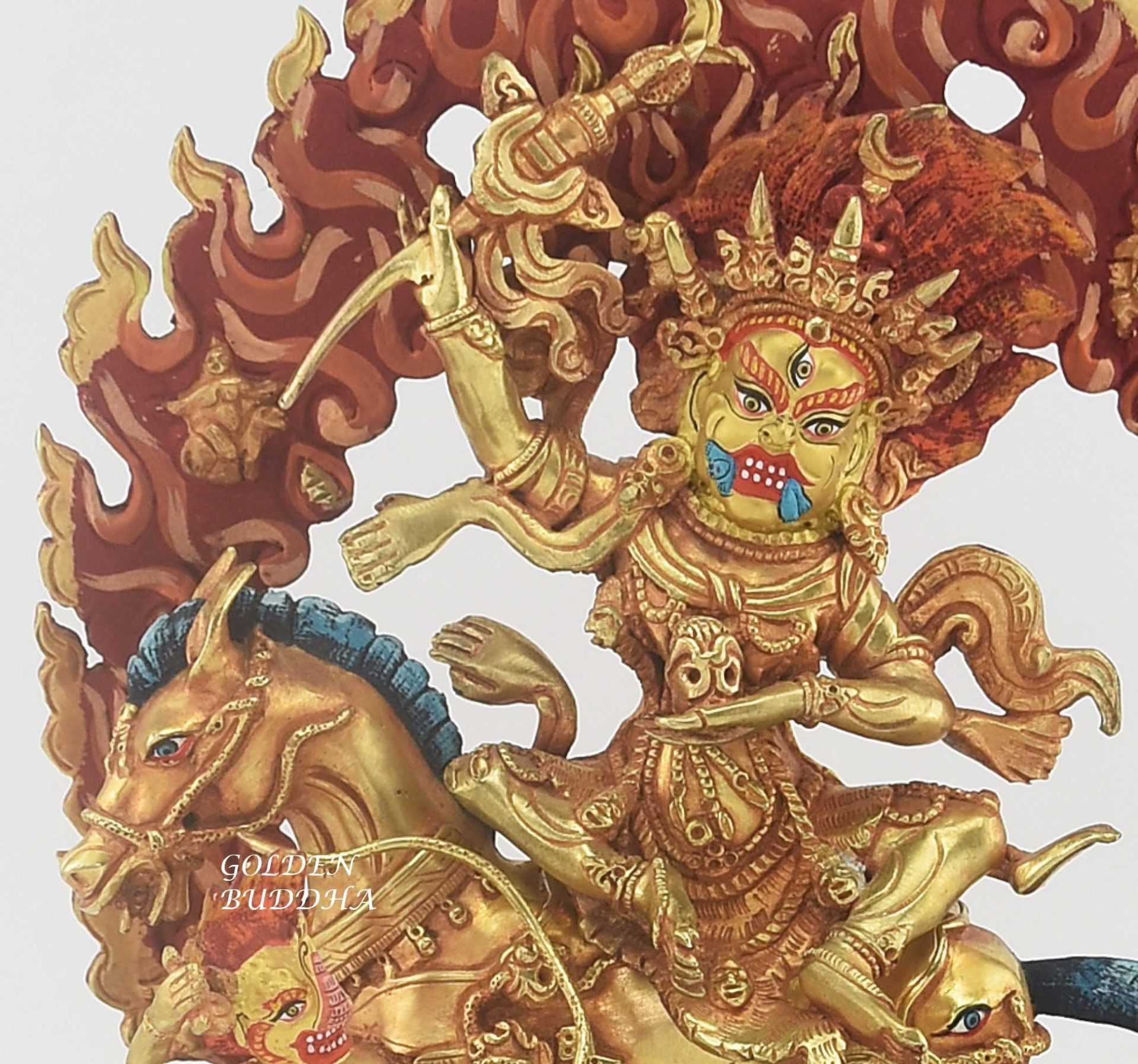
Handcrafted in Patan, Nepal, the complete composition—including Palden Lhamo, her mule, attendants, ritual attributes, the sea-of-blood base, pedestal, structural supports, and removable flame mandorla—is cast from a base of copper alloy using the traditional lost-wax method. The principal figures and selected ornamental details are fire gilded in 24K gold. Carefully applied red, blue, green, and dark pigments create contrast across the mule, turbulent base, facial features, attendants, and wisdom flames. Palden Lhamo’s face is separately hand painted, allowing her three eyes, fierce brows, open mouth, fangs, and wrathful expression to remain clearly defined against the luminous gilded surface.
Palden Lhamo Statue Depicting the Glorious Goddess
Palden Lhamo, whose Tibetan name dPal ldan lha mo means “The Glorious Goddess,” is one of the foremost female Dharma protectors of Tibetan Buddhism. In the Magzor Gyalmo manifestation represented here, she is known as “The Queen Who Repels Armies,” a title expressing her ability to turn back hostile forces, overcome obstacles, and defend the continuity of Buddhist teachings. Her wrathful appearance is not an expression of ordinary hatred. It represents enlightened protective activity operating with complete determination when gentler methods are insufficient.
Palden Lhamo is especially associated with the Gelug tradition and the succession of the Dalai Lamas, while related forms and practices are also known in other Tibetan Buddhist schools. Her connection with the sacred oracle lake of Lhamo Lhatso has made her an enduring symbol of guidance and protection within Tibetan religious history. Readers may explore Palden Lhamo’s role as a protectress of the Dalai Lama lineage in our detailed guide.
Three-Eyed Face, Skull Crown and Wrathful Ornamentation
The face of this Palden Lhamo statue combines ferocity with careful artistic refinement. Three wide-open eyes communicate vigilant awareness, while the sharply arched brows, flared nostrils, open mouth, and visible fangs express the uncompromising force of her protective activity. Her hair rises behind the crown in flame-like locks, reinforcing the upward energy of the surrounding mandorla.
A crown of skulls rises above her forehead, representing the transformation of ordinary mental afflictions into enlightened wisdom. Her body is adorned with necklaces, bracelets, anklets, suspended chains, and other charnel-ground ornaments. These symbols confront attachment to permanence, conventional beauty, and the physical body. Despite their severe meaning, the ornaments are rendered with delicate Newar metalwork and highlighted through 24K fire gilding and selective color.
The crown and jewelry may also be embellished with genuine turquoise and red coral before shipment. These stones would be placed only within appropriate ornamental settings, adding traditional blue-green and red accents while preserving the visual dominance of the gold gilding and the statue’s established iconography.
Ritual Attributes of the Palden Lhamo Statue
In her raised right hand, Palden Lhamo brandishes a sandalwood club (or staff) topped with a half-vajra known as a demon-taming club, an implement representing the forceful subjugation of obstacles and harmful influences. The raised weapon creates a powerful diagonal movement above her head and identifies her as a protector actively engaged in repelling forces hostile to the Dharma. It is not directed against ordinary beings, but against ignorance, destructive activity, and conditions that endanger spiritual practice.
Her left hand holds a kapala, or skull cup, close to her body. In tantric symbolism, the kapala represents the transformation of mortality, desire, and ordinary life-force into wisdom-energy. The demon-taming club and skull cup therefore express two complementary dimensions of wrathful activity: the decisive defeat of obstruction and the transformation of its underlying energy into the path of awakening.
Behind and around the central figure, additional ritual details enrich the iconography. The sculptor has preserved the layered ornaments, flowing garments, reins, animal trappings, attendant figures, and small symbolic components that make Palden Lhamo one of the most technically demanding Dharma protectors to represent in metal sculpture.
Palden Lhamo Riding Her Wild Mule
Palden Lhamo rides sideways upon a wild mule moving forcefully through the composition. The animal’s head turns outward with its mouth open, while the lifted legs and streaming harness ornaments convey motion across the turbulent base. The mule is cast in copper alloy and fire gilded in 24K gold, with dark and colored accents defining the mane, facial details, reins, saddle equipment, and other carefully modeled features.
Traditional accounts describe her saddle covering as connected with the skin of her son, an intentionally severe element of the narrative surrounding her vow to prevent the destruction of the Dharma. This story belongs to the mythic and ritual tradition of Palden Lhamo and should not be interpreted as ordinary conduct. Within the iconography, it expresses the absolute seriousness of her commitment and the complete renunciation of personal attachment when defending the teachings.
The mule’s harness is further associated with serpent reins, here drawn forward by Maharavaktra. These details link the mount, attendant, and central protector into a unified narrative rather than presenting them as unrelated figures. The careful positioning of the legs, reins, saddle, ornaments, and flowing elements produces a convincing sense of movement despite the compact dimensions of the statue.
Simha Mukhi and Maharavaktra in the Protector Retinue
This sculpture is distinguished by the presence of two attendant figures. Behind the mule appears Simha Mukhi, the lion-faced Dakini, whose animal-headed form and raised ritual gesture reinforce the wrathful protective field surrounding Palden Lhamo. Her lion face represents fearless wisdom and the power of enlightened speech, while her placement at the rear creates balance with the forward-moving attendant on the opposite side.
Maharavaktra advances before the mule and controls its serpent reins. His forward position guides the procession through the sea of blood and helps establish the horizontal movement of the complete composition. Both attendants are separately modeled from copper alloy, fire gilded in 24K gold, and finished with individual facial, hair, garment, and ritual details.
The three-figure assembly gives this Palden Lhamo statue exceptional narrative depth. Rather than depicting the Glorious Goddess as an isolated figure, it presents her within an active protector retinue, moving through a charged environment of flames, turbulent waters, ritual implements, and supernatural attendants. This complexity also demonstrates the technical skill required to model, cast, chase, fit, and finish numerous interconnected copper-alloy components.
The Sea of Blood and Removable Flame Mandorla
Beneath the mule is a turbulent sea represented through curling waves, organic forms, and dark red painted recesses. In Palden Lhamo’s traditional narrative, the sea of blood forms part of her fierce journey away from forces opposed to the Dharma. Symbolically, it evokes the violent energies and karmic consequences of samsara brought within the domain of enlightened protective awareness.
A removable copper-alloy mandorla rises around the entire scene. Its curling flames are finished with alternating gold, deep red, and oxidized copper tones, creating a dramatic contrast with the gilded figures at the center. These are the flames of pristine awareness rather than ordinary destructive fire. They represent awakened wisdom consuming ignorance, hostile influences, emotional obscurations, and every condition that threatens the preservation or practice of the Dharma.
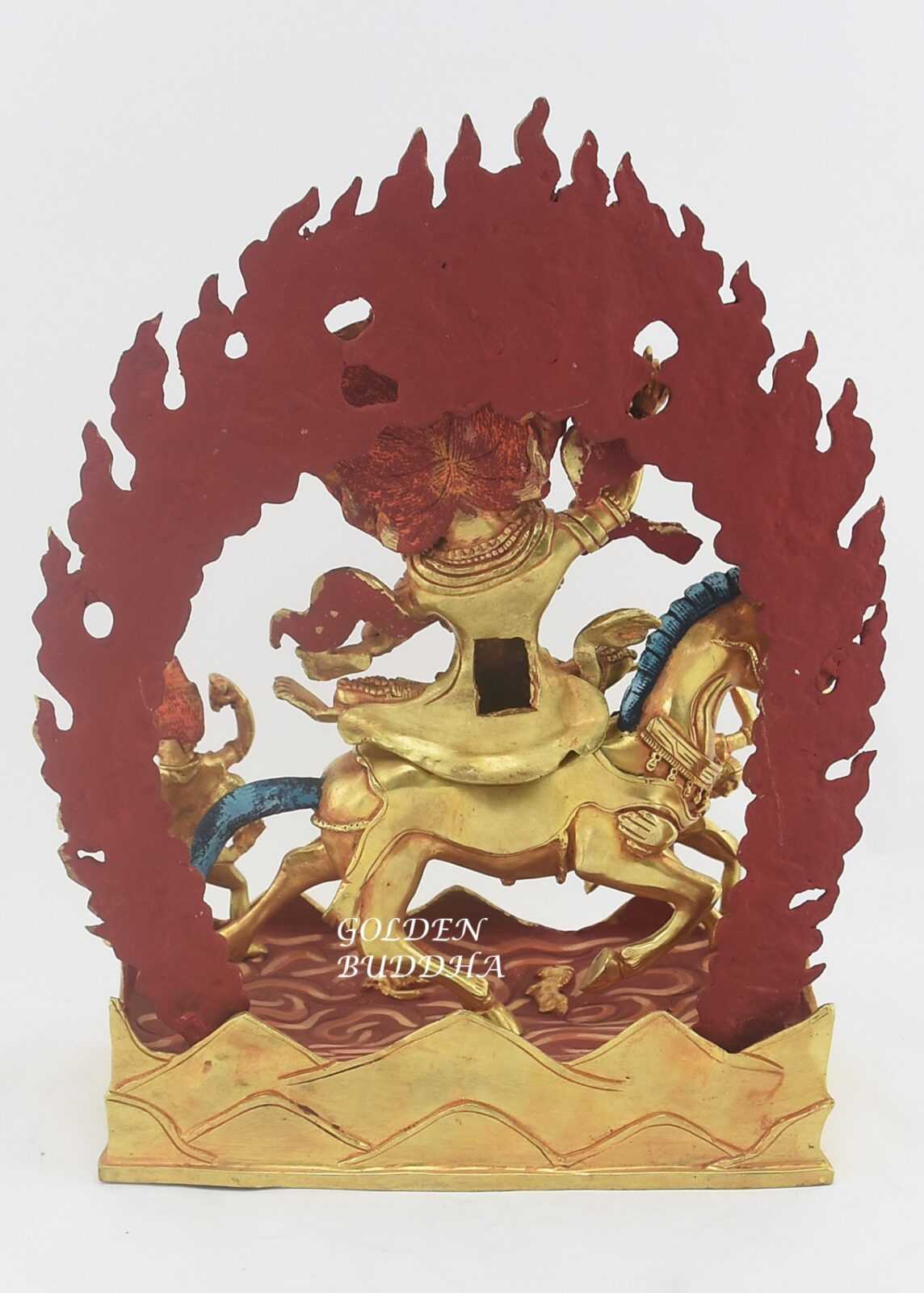
The openwork frame permits light to pass through the composition and prevents the dense field of flames from obscuring Palden Lhamo, her mule, and attendants. Because the mandorla is removable, the statue can be carefully disassembled for secure packing and international transportation or displayed without the frame when a more open altar arrangement is preferred.
Traditional Lost Wax Craftsmanship
This Palden Lhamo statue is handcrafted in the historic city of Patan, Nepal, where Newar artisans have preserved the traditional lost wax casting method for centuries. Every major component—including the central deity, attendants, mule, pedestal, and removable flame mandorla—is individually sculpted in wax before being cast in copper alloy. After casting, each piece is meticulously chased by hand to sharpen the smallest decorative details, including the jewelry, flowing garments, reins, skull ornaments, flames, and ritual implements. The separate components are then carefully assembled, creating a seamless three-dimensional composition that demonstrates the remarkable precision required for complex Himalayan metal sculpture.
Following the metalwork, the exposed surfaces are fire gilded in 24K gold using traditional mercury gilding techniques that have been practiced in the Kathmandu Valley for generations. The remaining decorative work is completed by hand with natural pigments that define the flames, garments, attendants, facial expressions, and symbolic elements throughout the sculpture. The result is a museum-quality representation of one of Tibetan Buddhism’s most intricate Dharma protectors while preserving the authentic craftsmanship for which Nepalese metal artists are internationally respected.
The Meaning of Palden Lhamo in Tibetan Buddhism
Although her appearance is fierce, Palden Lhamo embodies enlightened compassion expressed through unwavering protective activity. Wrathful deities within Vajrayana Buddhism are never understood as manifestations of anger in the ordinary sense. Rather, they symbolize wisdom acting with absolute determination to remove ignorance, eliminate obstacles to spiritual practice, and safeguard authentic Buddhist teachings for future generations.
For practitioners, Palden Lhamo represents fearless commitment, spiritual discipline, and the courage required to overcome both external adversity and internal mental afflictions. Her dramatic iconography reminds practitioners that genuine compassion sometimes requires strength, clarity, and decisive action rather than passive acceptance. This profound union of compassion and wisdom has made Palden Lhamo one of the most revered Dharma Protectors throughout Tibetan Buddhism.
To learn more about the symbolism of Tibetan Buddhist protectors, we also invite you to explore our collections of Mahakala statues and our complete collection of Dharma Protector statues.
Matching Dharma Protector Statue Set
This two armed Palden Lhamo statue pairs exceptionally well with our handcrafted statues of Bernagchen Mahakala and Rahula. Within Tibetan Buddhism, these three enlightened protectors are frequently represented together in Gelugpa oriented temples, monasteries, and private shrine rooms because each embodies a complementary aspect of enlightened protective activity.
Bernagchen Mahakala, the Black Cloaked Mahakala of the Karma Kagyu tradition, is revered for protecting practitioners, preserving authentic transmissions, and removing obstacles that interfere with Dharma practice. His dynamic presence complements Palden Lhamo’s fearless guardianship, creating a balanced representation of enlightened compassionate protection.
Rahula, the powerful multi-eyed Dharma Protector associated with the Nyingma tradition, represents unwavering vigilance and the ability to perceive obscurations that remain hidden from ordinary awareness. His unique iconography symbolizes complete watchfulness over the integrity of the teachings.
Together, these three protector deities create an inspiring shrine arrangement that reflects centuries of Himalayan artistic tradition while honoring the profound symbolism of enlightened protection. Although each protector is associated with particular Tibetan Buddhist lineages, they are widely appreciated for their extraordinary artistic complexity and spiritual significance.
Custom Made Statues
Every statue at Golden Buddha can be custom commissioned by our master artisans in Nepal. If you would like this Palden Lhamo statue produced in a larger size, with additional hand engraving, enhanced repoussé work, or custom gemstone settings using genuine turquoise and red coral, our workshop can create a sculpture specifically for your shrine or collection while preserving the traditional iconography.
Collectors frequently commission complete Dharma Protector shrine sets consisting of Palden Lhamo, Bernagchen Mahakala, Rahula, and other protectors in matching dimensions and artistic style. Each commission is individually handcrafted using traditional lost wax casting in copper alloy before being fire gilded in 24K gold and finished entirely by hand. Because every sculpture is individually produced, subtle variations naturally occur, making every commissioned piece a unique work of authentic Himalayan Buddhist art.
If you are considering a custom commission, our team is happy to discuss dimensions, artistic style, gilding options, gemstone settings, and matching shrine arrangements to create a sculpture that meets your individual requirements while remaining faithful to traditional Himalayan craftsmanship.
Authentic Himalayan Buddhist Art
This remarkable Palden Lhamo statue combines profound religious symbolism with the exceptional craftsmanship of Nepal’s master metal artists. From the expressive facial features and intricate ornaments to the dynamic attendants, sea of blood, and removable flame mandorla, every detail reflects generations of artistic knowledge preserved within the Newar metalworking tradition. Whether displayed as the centerpiece of a Dharma Protector shrine, added to a museum-quality Himalayan art collection, or appreciated as an extraordinary example of traditional Buddhist sculpture, this handcrafted statue stands as an enduring representation of enlightened protection, fearless compassion, and authentic Himalayan craftsmanship.
Authentic, Handmade in Nepal
Every statue is handcrafted in Patan, Nepal, using traditional lost wax casting and comes with a certificate of authenticity issued by Nepal’s Department of Archaeology, verifying its materials, technique, and origin.