
Medicine Buddha statues depict one of the most beloved and universally venerated deities in Mahayana and Vajrayana Buddhism — a fully enlightened being whose singular purpose is the healing of all suffering. Known in Sanskrit as Bhaisajyaguru (“Master of Healing”) and in Tibetan as Sangye Menla (“Healing Buddha”), he is recognized across Buddhist traditions as the supreme source of healing blessings for body, mind, and spirit. The Medicine Buddha has identified ignorance as the root of all sickness — and has prescribed the Dharma itself as the ultimate cure.
Although the origin of Medicine Buddha is in India, his image and teachings underwent a remarkable transformation as the Medicine Buddha Sutra traveled along the ancient Silk Road to China. The story of this journey — from a birch bark manuscript in a Central Asian monastery to the great temples of East Asia, and eventually to Tibet, Nepal, Bhutan, and the world — is one of the most fascinating chapters in Buddhist history.
Today, Medicine Buddha statues and thangka paintings are found in monasteries, temples, homes, and meditation spaces worldwide — from the Himalayas to North America and Europe. Each statue is a complete visual teaching and a powerful support for healing practice. Understanding the meaning behind every element of the statue transforms it from a beautiful object into a living gateway to the Medicine Buddha’s compassionate healing power.
Contents
- Origins of the Medicine Buddha Sutra
- Lapis Lazuli — The Sacred Stone of the Healing Buddha
- The Pure Land of Medicine Buddha — Lapis Lazuli World
- Medicine Buddha Statue Meaning & Iconography
- The 12 Great Vows of Medicine Buddha
- Medicine Buddha Mantra — How to Use It
- 108 Mantra Recitations — Healing Practice
- The Medicine Buddha Trinity
- Frequently Asked Questions About Medicine Buddha
- Buy Authentic Medicine Buddha Statues from Nepal
Origins of the Medicine Buddha Sutra
The earliest physical evidence of the Medicine Buddha Sutra — formally known as the Bhaisajyaguru Vaidurya Prabha Tathagata Sutra — was discovered in birch bark manuscripts at a Mahasamghika Buddhist monastery near Bamiyan, Afghanistan. These texts date to the 7th century CE, placing them squarely in the era of the ancient Silk Road’s greatest cultural exchange.
The Chinese monk Xuanzang — one of the most celebrated pilgrims in Buddhist history — traveled the ancient Silk Road near this very location during his famous 17-year journey to India and back (629–645 CE), translating Buddhist texts into Chinese along the way. Archeologists identified Xuanzang as the source of the Medicine Buddha manuscripts found at the Bamiyan monastery, and his translations became the foundational texts of East Asian Medicine Buddha practice.
The strenuous efforts of Xuanzang resulted in the formal introduction of Medicine Buddha to East Asia, where he was warmly received alongside Shakyamuni Buddha and Amitabha Buddha. The appearance of the distinctive deep blue Medicine Buddha statues and paintings soon followed — establishing the visual iconography that practitioners recognize worldwide today.
Lapis Lazuli — The Sacred Stone of the Healing Buddha
While traveling the Silk Road, the Medicine Buddha image became permanently affiliated with a mysterious deep blue stone called lapis lazuli. This connection is not coincidental — the world’s richest and most historically significant deposits of lapis lazuli are found in the mountains of northern Afghanistan, in the very region surrounding the Bamiyan monastery where the Medicine Buddha Sutra manuscripts were discovered.
Evidence of lapis lazuli mining in this region dates back to the 7th century BCE — over a thousand years before Xuanzang passed through. Lapis lazuli was among the most precious materials in the ancient world, traded across Mesopotamia, Egypt, and the Mediterranean as a stone of divine power. Its deep, luminous blue was associated with the night sky, with wisdom, with truth, and — in Buddhist cosmology — with the transformative, purifying quality of enlightened awareness.
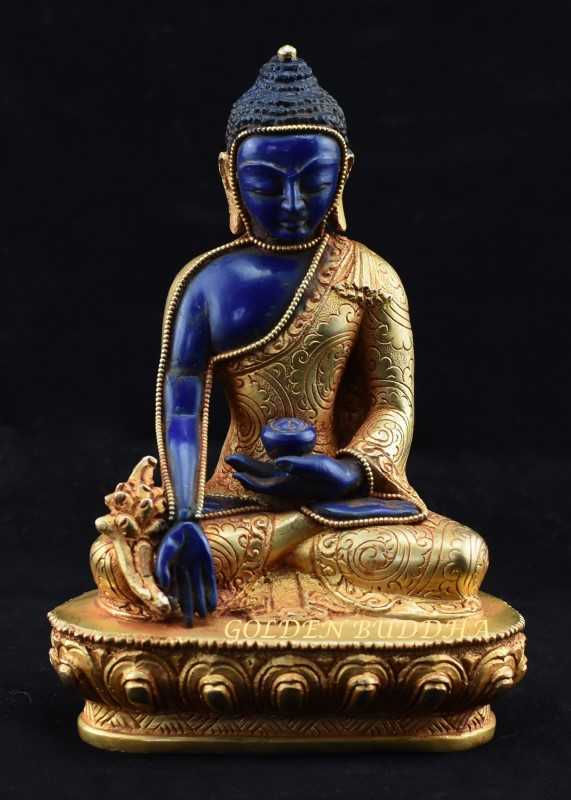
The integration of lapis lazuli into the Medicine Buddha Sutra likely occurred somewhere along the ancient Silk Road near Bamiyan. Perhaps during deep meditation in the mountain caves surrounding the monastery — caves potentially tinged with the deep blue hue of lapis lazuli veins in the rock — meditators experienced visions of a radiant blue healing Buddha. In any case, lapis lazuli became so deeply integrated into the Medicine Buddha’s identity that his body color, his pure land, his medicine bowl, and even the ground of his paradise are all described as the pure lapis lazuli blue.
The Pure Land of Medicine Buddha — Lapis Lazuli World
After achieving Buddhahood, the Medicine Buddha established his own Pure Land — called Vaidūryanirbhāsa in Sanskrit, meaning “Pure Lapis Lazuli” or “Lapis Lazuli World.” It is situated to the east, making Medicine Buddha the protector of the eastern direction — balancing Amitabha Buddha’s western Pure Land of Sukhavati.
In his pure land, the ground itself is composed of pure lapis lazuli stone. Tall buildings, palaces, and pavilions are built from the seven sacred treasures — gold, silver, lapis lazuli, crystal, ruby, emerald, and agate. The deep blue radiance of lapis lazuli permeates the entire realm with healing light.
The Medicine Buddha himself vowed: “My body, inside and out, will radiate far and wide the clarity and flawless purity of lapis lazuli. This body will be adorned with superlative virtues and dwell peacefully in the midst of a web of light more magnificent than the sun or moon. The light will awaken the minds of all beings dwelling in darkness, enabling them to engage in their pursuits according to their wishes.”
Medicine Buddha Statue Meaning & Iconography
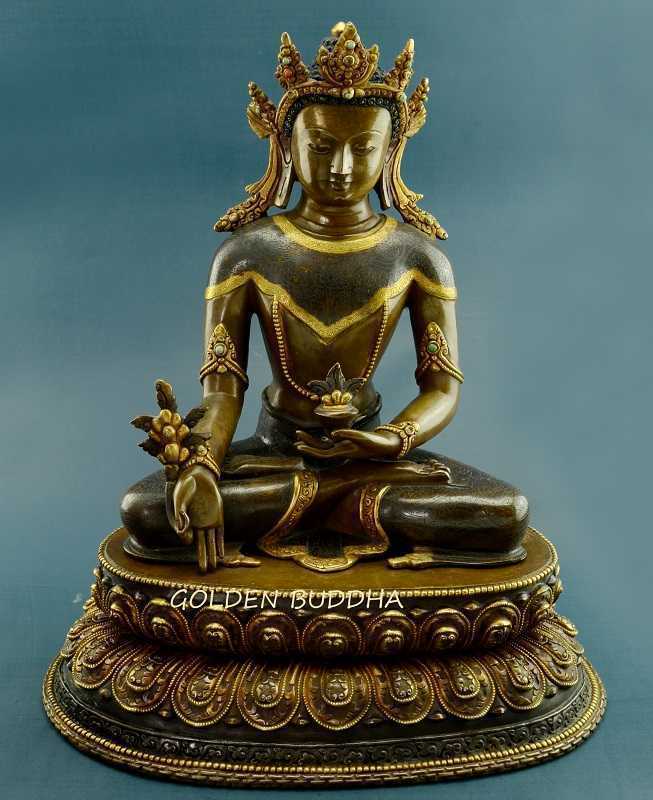
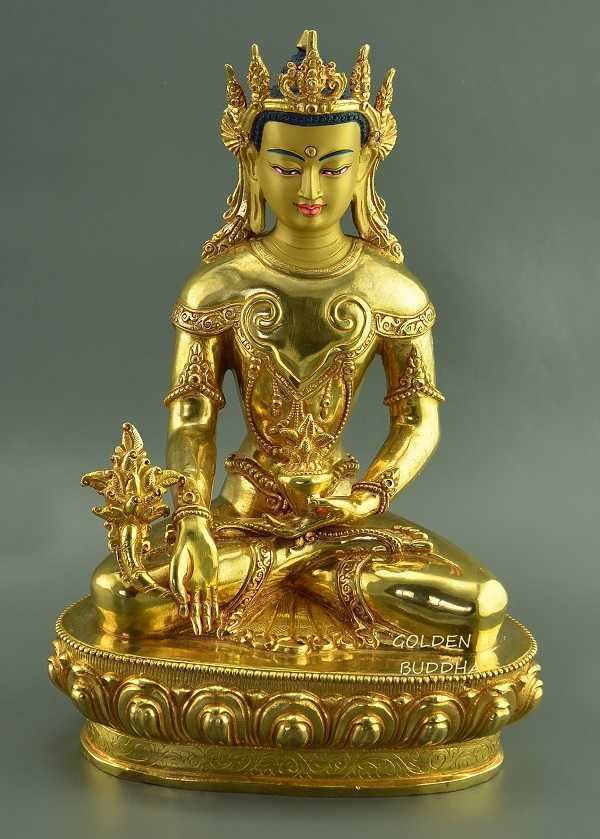
Every element of a traditional Medicine Buddha statue encodes a specific healing teaching. Understanding this iconography is essential for practitioners who use the statue as a focal point for Medicine Buddha practice and visualization:
Deep blue body: The most instantly recognizable feature of Medicine Buddha is his lapis lazuli blue body — a color representing purity, wisdom, and the healing radiance that penetrates and purifies all obscurations. In Tibetan Buddhist visualization practice, practitioners imagine this deep blue healing light flowing into and through their body, dissolving illness and negative karma at their source.
Right hand — Varada Mudra with myrobalan: The primary Medicine Buddha mudra is the Varada mudra (“gift-giving” or “boon-granting”) — the right hand extended over the right knee, palm open and facing outward. This gesture declares that Medicine Buddha freely gives his healing power to all sentient beings. Between his thumb and index finger he holds a sprig of the myrobalan plant (Terminalia chebula — known in Tibetan medicine as arura). Myrobalan is one of the most revered medicinal plants in both Ayurvedic and Tibetan medicine, prescribed for eye disease, infection, skin disease including leprosy, and mental obscurations. It is also known to promote long life.
Left hand — Dhyana Mudra with medicine bowl: The left hand rests in the Dhyana mudra (meditation gesture) in the lap, holding a lapis lazuli medicine bowl filled with the three nectars — amrita (healing nectar), myrobalan medicine, and the nectar of deathlessness. These three nectars are understood to eliminate the three poisons: greed, hatred, and ignorance — the root causes of all physical, mental, and spiritual suffering in Buddhist teaching.
Monastic robes and full lotus pose: Medicine Buddha wears the simple robes of a Buddhist monk and sits in full lotus pose (padmasana) on a lotus pedestal — displaying all the traditional auspicious marks of a Buddha (ushnisha, urna, elongated earlobes) while simultaneously embodying the humble, accessible quality of a healer who has taken vows to serve all beings regardless of their status.
The 12 Great Vows of Medicine Buddha
The Medicine Buddha Sutra narrates the story of Medicine Buddha as a Bodhisattva on the path to enlightenment. As recounted in the Sutra: “Manjushri, when the World-Honored Medicine Buddha was treading the Bodhisattva path, he solemnly made 12 great vows to grant sentient beings whatever they desired.” These 12 vows of Medicine Buddha form the complete covenant of his healing practice and specify exactly what he has committed to provide.
The scope of his vows is extraordinary. Devotees who recite the Medicine Buddha mantra or even simply say his name can receive healing from all forms of physical, mental, and spiritual suffering. His vows extend to promising riches to the destitute, clothing to the cold, food to the hungry, enlightenment to the seeking, and even redemption to those who have used harmful practices — so long as they hear his name and sincerely aspire to be free of suffering.
In Vajrayana Buddhist teaching, illness is understood to arise from three interconnected sources: karmic imbalances accumulated through past actions, emotional afflictions (anger, attachment, jealousy), and fundamental ignorance about the nature of reality. The Medicine Buddha’s 12 vows address all three simultaneously — making his practice one of the most holistic and comprehensive healing systems in any Buddhist tradition. Tibetan healers traditionally offer prayers to Medicine Buddha before treating patients, viewing his blessing as the indispensable foundation of effective medical care.
Medicine Buddha Mantra — How to Use It
The Medicine Buddha mantra is the primary method for invoking his healing power. Two principal versions are used across different Buddhist traditions:
Short form (Sanskrit):
“oṃ bhaiṣajye bhaiṣajye bhaiṣajya-samudgate svāhā”
Long form (Tibetan):
“Tayata Om Bekanze Bekanze Maha Bekanze Radza Samudgate Soha”
The word bhaiṣajye (Tibetan: bekanze) means “eliminating pain and suffering” — and its triple repetition in the mantra is significant: it addresses the elimination of suffering on the physical, mental, and spiritual levels simultaneously. Samudgate means “arisen” or “transcended,” and svāhā is an invocation that seals the mantra with blessing. Together the Medicine Buddha mantra meaning can be rendered as “Om, eliminate pain, eliminate pain, great elimination of pain, arise and be transcended — hail!”
Faithful recitation of the Medicine Buddha mantra invokes his healing power and — according to the Medicine Buddha Sutra — can transfer his karmic merit to the practitioner or a sick person on whose behalf the mantra is recited. The practitioner enters what the Sutra calls a “de facto state of samadhi” (deep concentration) by repeating the mantra with absolute sincerity, faith, and selflessness. The key to Medicine Buddha mantra benefits is complete faith: as the Sutra states, “efficacy lies in the complete absence of doubt on the part of the practitioner.”
108 Mantra Recitations — Medicine Buddha Healing Practice
The Medicine Buddha Sutra provides a precise and detailed method for using the mantra in healing practice. The practitioner recites the mantra over a patient’s food or water 108 times on their behalf. As the Sutra states: “Once they have consumed the food or drink, the illness and suffering will at once disappear.”
The complete method as described in the Sutra and practiced in both Chinese and Tibetan Buddhist traditions:
- Seat yourself before a Medicine Buddha statue or a clear visualization of Medicine Buddha above you, radiating blue healing light.
- Hold a glass of water or food before you. Recite the Medicine Buddha mantra 108 times with absolute sincerity, in complete absence of doubt, with the selfless motivation of relieving the suffering of the patient.
- Upon completing all 108 recitations, gently blow a wisp of breath onto the water or food — transferring the accumulated blessing of the mantra into the offering.
- The patient then drinks the water or consumes the food, receiving the transferred healing karma of Medicine Buddha practice.
The number 108 is highly sacred in Buddhism and Hinduism alike — representing the 108 earthly desires in Buddhist teaching, the 108 beads on a traditional mala (prayer rosary), and the 108 volumes of the Tibetan Buddhist canon. Using 108 recitations thus connects the healing practice to the full scope of Buddhist teaching and spiritual aspiration.
Group recitations are considered especially powerful — when multiple practitioners recite together on behalf of a patient, the karma effects are amplified proportionally. Testimonials of the efficacy of Medicine Buddha healing practice span centuries and cultures. The practice addresses spiritual, mental, and physical ailments simultaneously — reflecting the Sutra’s teaching that all forms of suffering ultimately share the same root: ignorance, craving, and karmic obscuration.
The Medicine Buddha Trinity
In Buddhist temple art and practice, Medicine Buddha is often depicted as part of a trinity of three Buddhas — one of the most meaningful groupings in the entire Buddhist iconographic tradition. Each member of the trinity represents a distinct dimension of the Buddhist path to liberation:
Shakyamuni Buddha (center) represents the “basic Buddha principle” — the historical founder of Buddhism and the Buddha of our time, whose teachings form the indispensable foundation of all Buddhist practice. His presence in the center of the trinity grounds the entire group in the historical reality of the Dharma.
Medicine Buddha (left) is the protector of the eastern direction — the eastern pure land. His role is to guard sentient life in this world: strengthening health, healing illness, removing obstacles to practice, and protecting beings from untimely death. He represents the healing dimension of the Buddha’s compassion as it operates within the earthly realm.
Amitabha Buddha (right) represents his western Pure Land of Sukhavati — the compassionate dimension of the Buddha’s power that operates after death. Amitabha waits in his pure land to receive and protect devotees who aspire to rebirth there, guiding them to liberation even beyond the earthly realm.
Together, the trinity addresses the complete arc of a practitioner’s life and liberation. Medicine Buddha heals and protects while alive; Amitabha receives and guides after death; Shakyamuni provides the Dharma path throughout. The Sutra’s aspiration for this trinity is expressed beautifully: the combination of earthly and heavenly peace ideally results in “ultimate peace, happiness and liberation” — Nirvana.
~Sutra of the Medicine Buddha by Dharma Master Hsuan Jung, Minh Thanh, P.D. Leigh~
Frequently Asked Questions About Medicine Buddha
What does a Medicine Buddha statue represent?
A Medicine Buddha statue represents Bhaisajyaguru — the Buddha of Healing — and his vow to relieve all suffering of body, mind, and spirit. Every iconographic element carries a specific meaning: the deep blue body represents healing wisdom and purity; the right hand in Varada mudra holding myrobalan herb signifies the free gift of healing; the left hand holding a lapis lazuli bowl filled with the three nectars represents the elimination of the three poisons (greed, hatred, ignorance); the monastic robes and lotus throne represent renunciation and purity. Placing a Medicine Buddha statue in a home altar or meditation space supports healing practice and serves as a visual reminder of the compassionate healing power available to all beings.
What is the Medicine Buddha mantra and what does it mean?
The short Medicine Buddha mantra is “Om Bhaisajye Bhaisajye Maha Bhaisajye Bhaisajya-samudgate Svaha” (Sanskrit) or “Tayata Om Bekanze Bekanze Maha Bekanze Radza Samudgate Soha” (Tibetan). The word bhaisajye/bekanze means “eliminating pain and suffering.” Its triple repetition addresses physical, mental, and spiritual suffering simultaneously. Samudgate means “arisen and transcended” and svaha seals the mantra with blessing. Together the mantra is understood to invoke Medicine Buddha’s healing presence and transfer his blessing to the practitioner or a patient on whose behalf it is recited.
Why is the Medicine Buddha blue?
The Medicine Buddha’s deep blue color represents lapis lazuli — the precious gemstone associated with healing, purity, wisdom, and divine power throughout the ancient world. The connection between Medicine Buddha and lapis lazuli developed along the ancient Silk Road near northern Afghanistan, where the world’s richest lapis lazuli deposits are found. In Buddhist iconography, the blue of lapis lazuli represents the transformative, purifying quality of enlightened awareness — specifically the capacity of Medicine Buddha’s healing light to penetrate and dissolve all obscurations of body, mind, and spirit. In Tibetan visualization practice, practitioners meditate on this blue healing light flowing through their body to activate the Medicine Buddha’s blessing.
What are the 12 vows of Medicine Buddha?
The 12 great vows of Medicine Buddha were made while he was still a Bodhisattva, as recorded in the Medicine Buddha Sutra. The vows collectively promise to: illuminate all worlds with his radiance; awaken beings through his teachings; fulfill every wish of devotees; lead all to the Mahayana path; restore moral integrity to those who have broken vows; heal beings with physical disabilities; cure all disease; transform male practitioners who wish for female rebirth; protect beings from false spiritual practices; liberate the oppressed and imprisoned; provide food to the hungry; clothe the destitute; and convey the blessings of the Dharma to all. Any being who hears his name or recites his mantra with sincere faith is promised his protection and assistance.
Where should I place a Medicine Buddha statue at home?
A Medicine Buddha statue should be placed on a clean, elevated surface — never on the floor. A dedicated home altar, high shelf, or meditation room is ideal. Because Medicine Buddha is the protector of the eastern direction, positioning the statue facing east or west (so the practitioner faces east during practice) is considered auspicious. Many practitioners place the statue in a room used for health-related activities — a meditation room, a recovery space, or a yoga room. Keep the area clean and if possible offer light (butter lamp or candle) and fresh water daily. Authentic statues from Patan, Nepal can be formally consecrated (rabne) at a recognized monastery before placement — activating the statue as a genuine object of healing refuge.
What is the difference between Medicine Buddha in Chinese and Tibetan Buddhism?
Both traditions venerate Medicine Buddha (Bhaisajyaguru) equally, but emphasize different aspects of practice. In Chinese Buddhism (Pure Land and Chan traditions), practitioners primarily recite the Medicine Buddha mantra or his name to overcome physical, mental, and spiritual problems — often as a daily devotional practice. In Tibetan Vajrayana Buddhism, Medicine Buddha practice is more elaborate: it includes visualization of the blue healing light emanating from his body and flowing into the practitioner, mantra recitation, prostrations, mandala offerings, and the formal 108-recitation water blessing ritual. Tibetan healers also invoke Medicine Buddha before and during medical treatments, viewing his blessing as foundational to the effectiveness of physical medicine. Both approaches are considered equally valid paths to receiving his healing blessings.
Buy Authentic Medicine Buddha Statues from Nepal
Nepal — and specifically the artisan city of Patan (Lalitpur) in the Kathmandu Valley — has been the world’s foremost center for handcrafted Buddhist statues for over a thousand years. The shakya craftsmen of Patan specialize in the traditional lost-wax casting method (cire perdue), finishing every statue with 24K fire gilding and hand face painting using real gold — the same techniques used to produce statues for the great Tibetan monasteries beginning in the 10th century.
My local partners and I have been working directly with the best Nepali artisans for over three generations. This deep local integration means you receive the highest quality Medicine Buddha statue at the best possible price — crafted by the same masters who produce statues for monasteries. Each statue is a handmade original: unsurpassed in fine detail from the top of the ushnisha to the base of the lotus pedestal, finished in 24K gold, and face painted with real gold to imbue lifelike, luminous qualities that photographs cannot fully capture.
Every statue is certified by the Department of Archaeology in Kathmandu before shipping, and consecration (rabne) at Sangye Choeling Monastery is available upon request — formally activating the statue as a genuine object of healing refuge. Express worldwide shipping is included in the listing price.