

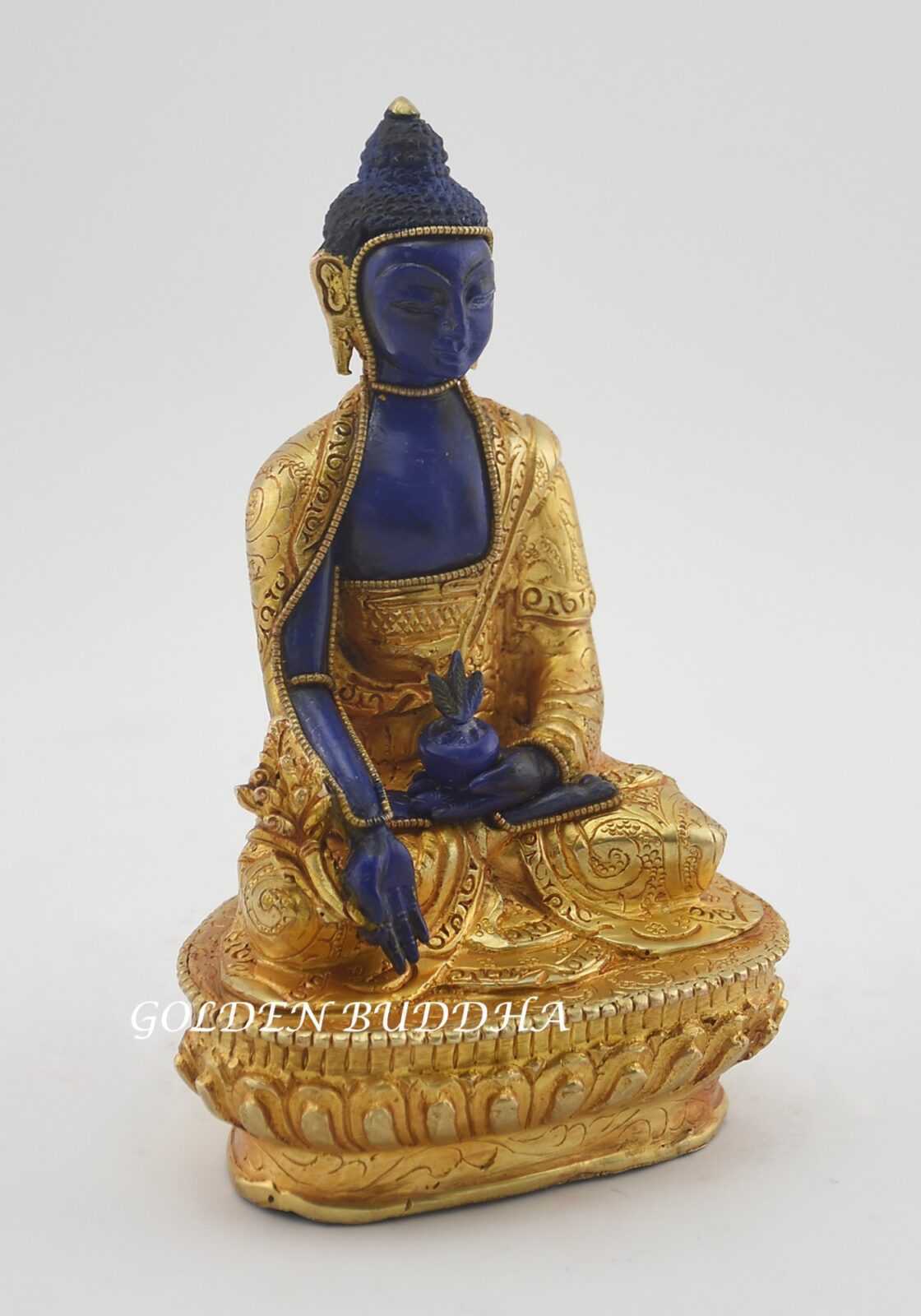
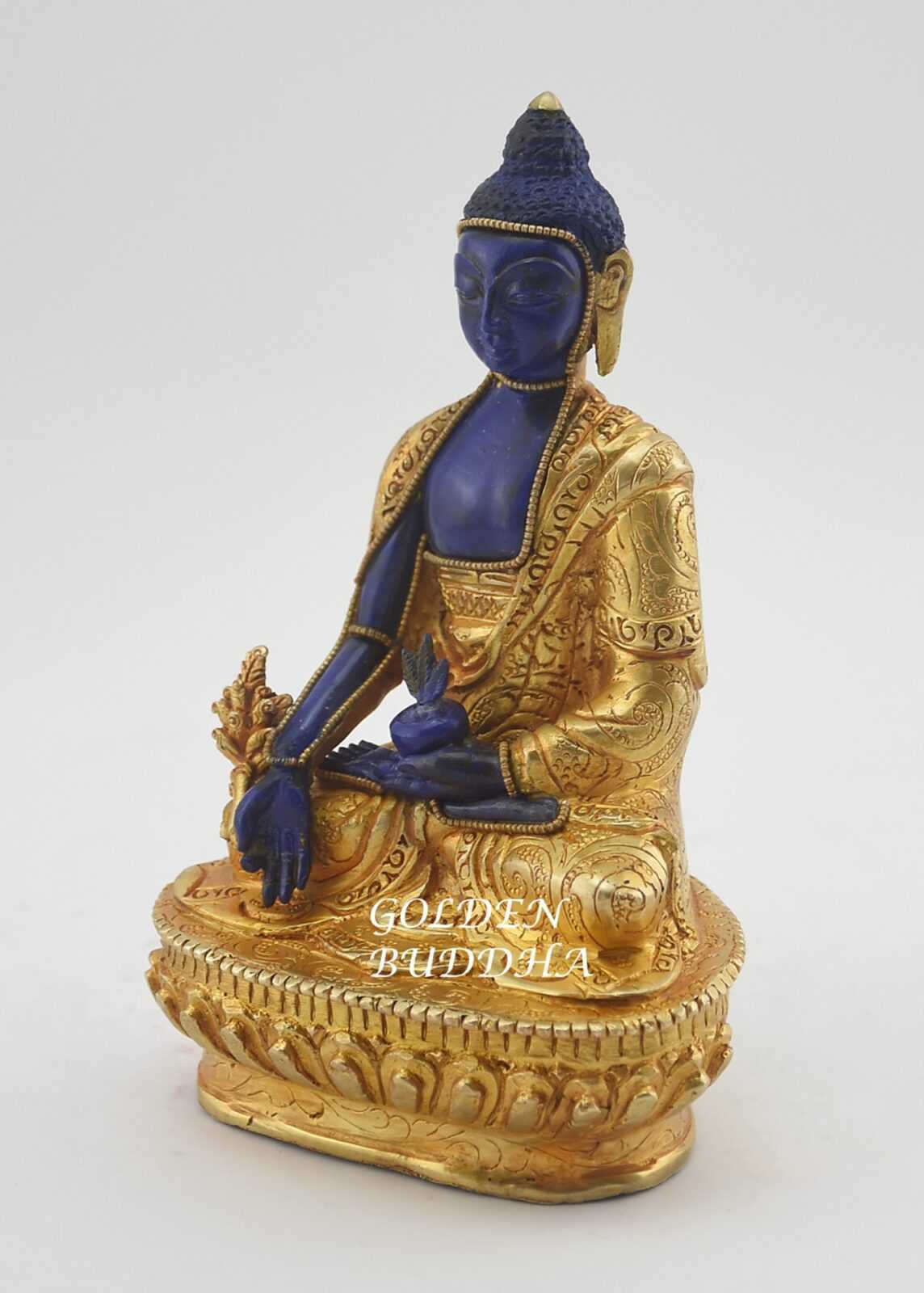

This distinctive Lapis Medicine Buddha Statue portrays Bhaisajyaguru, the Buddha of Healing, with the deep blue body traditionally associated with lapis lazuli in Tibetan Buddhist iconography. Handmade in Patan, Nepal, the 6-inch statue was cast from copper alloy through the traditional lost-wax method. Lapis paste gives the face, torso, hands, medicine bowl and visible portions of the body their saturated blue color, while the monastic robe, sacred ornaments and lotus pedestal are finished with bright 18K gold electroplating.
Medicine Buddha sits in the full lotus posture with his right hand lowered in Varada mudra, the gesture of generosity and the granting of blessings. Between his fingers he holds the stem of the myrobalan plant, the medicinal attribute that identifies his healing activity. His left hand rests in meditation upon his lap and supports a blue medicine bowl crowned by a small leafy form. Together, the herb and bowl represent the healing of physical illness, mental affliction and the deeper spiritual causes of suffering.
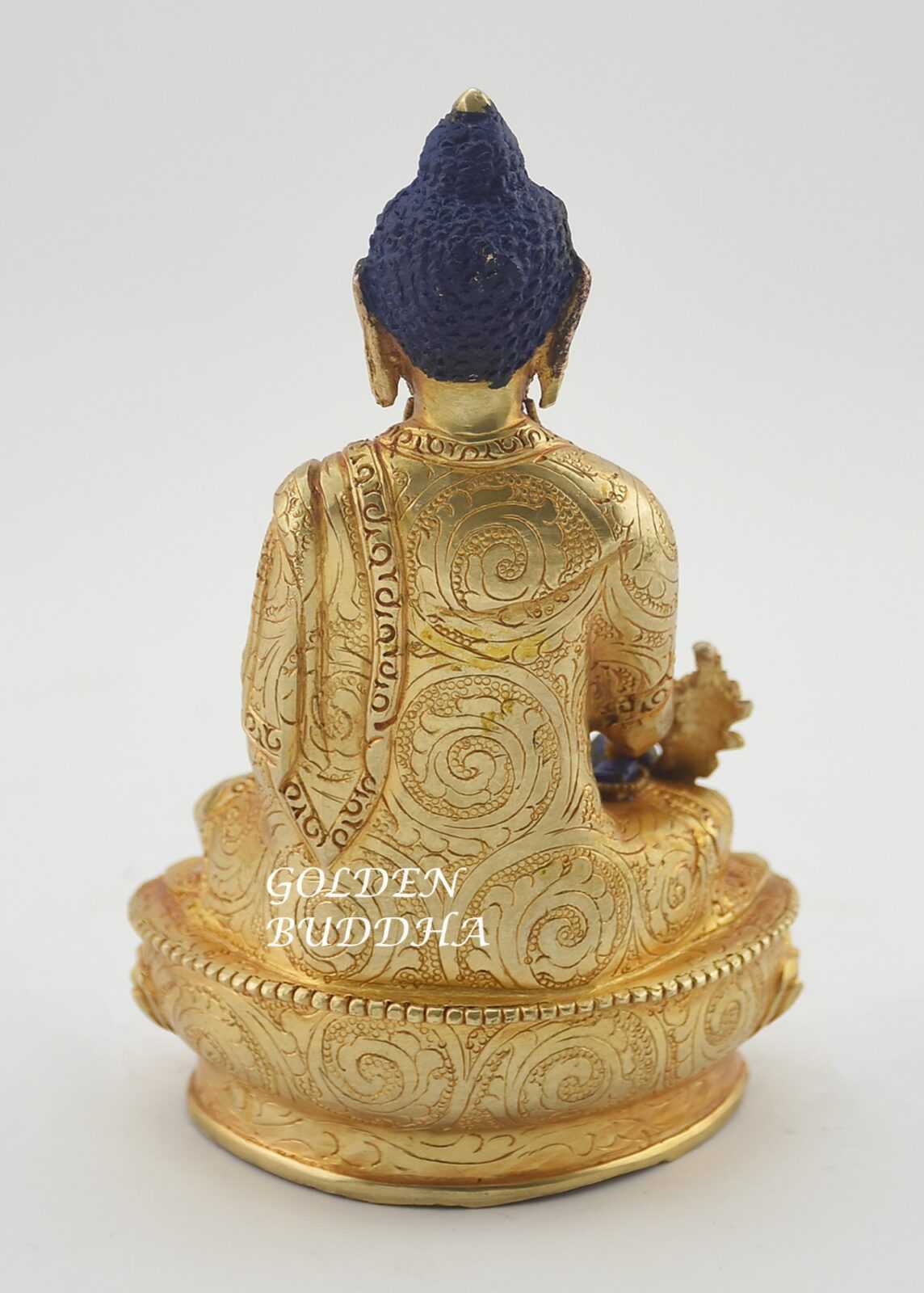
The blue body creates a dramatic contrast with the bright gold robe. Fine hand-carved cloud and foliate engravings cover the garment across the chest, shoulders, sleeves and folded legs, continuing across the reverse in large spiraling patterns. The same scrolling ornament appears around the rear of the lotus pedestal, making the sculpture fully finished from every principal viewing angle.
Measuring approximately 6 inches high, 4 inches wide and 2.5 inches deep, this Lapis Medicine Buddha Statue is ideally proportioned for a personal healing altar, meditation shelf or compact home shrine. Its saturated mineral color, intricate engraving and traditional attributes also make it an unusual example of handmade Himalayan Buddhist art.
Lapis Medicine Buddha Statue of Bhaisajyaguru
Medicine Buddha is known in Sanskrit as Bhaisajyaguru, in Tibetan as Sangye Menla and more fully as the Medicine Master Buddha of Lapis Lazuli Radiance. He embodies the enlightened capacity to recognize suffering, understand its causes and apply the appropriate remedies for its complete removal.
Although Medicine Buddha is closely associated with physical healing, his significance extends beyond the treatment of bodily illness. Buddhist teachings identify ignorance, attachment and aversion as the underlying poisons that perpetuate suffering. Bhaisajyaguru therefore represents healing on several levels: the relief of physical pain, the transformation of destructive mental habits and liberation from the confusion that binds beings to samsara.
The iconography of this Lapis Medicine Buddha Statue brings those teachings together through its blue body, medicine bowl, myrobalan plant, meditative posture and monastic robe. Each attribute contributes to an image of healing guided by wisdom rather than a promise of ordinary or instantaneous cures.
Learn more about Medicine Buddha’s meaning, iconography and meditation practice in our detailed guide to Bhaisajyaguru.
Deep Blue Lapis Body of the Medicine Buddha
The deep blue body is the defining visual feature of this sculpture. Powdered lapis lazuli is incorporated into a mineral paste and applied over selected areas of the copper-alloy surface, producing a rich blue appearance across Medicine Buddha’s face, chest, arms, hands and visible portions of the legs.
His medicine bowl is completed in the same deep blue finish, visually joining the sacred vessel with the healing presence of the Buddha who holds it. The consistency of color across the body and bowl creates a unified iconographic statement rather than treating the blue merely as an ornamental accent.
In the Medicine Buddha tradition, lapis blue is associated with clarity, purity and an awareness capable of perceiving suffering without distortion. The color also carries the cool, tranquil character appropriate to a deity connected with healing, calm and the transformation of anger into mirror-like wisdom.
The contrast between the dark blue body and bright gold robe makes the principal features immediately legible. The face and hands remain visually distinct from the extensively engraved garment, while the blue bowl becomes a clear focal point at the center of the seated composition.
Varada Mudra on the Lapis Medicine Buddha Statue
Medicine Buddha’s right hand extends over his knee in Varada mudra. The open palm faces outward and downward, expressing generosity, compassion and the offering of blessings. This gesture creates a direct visual relationship between Bhaisajyaguru and the practitioner seated before him.
Unlike a hand raised in symbolic protection, the lowered palm reaches toward the world of suffering. It suggests that Medicine Buddha’s healing activity is not distant or abstract but is extended toward sentient beings in a form appropriate to their needs.
The long fingers are individually modeled, and the blue surface remains visible against the gilded cuff and surrounding robe. This contrast gives the hand particular prominence even though the statue is only six inches high.
Varada mudra is also associated with giving the Dharma—the remedy that addresses suffering at its deepest level. Material assistance may relieve immediate difficulty, but wisdom and ethical practice confront the habits that repeatedly produce dissatisfaction and pain.
Myrobalan Plant and the Gift of Healing Wisdom
Medicine Buddha holds the stem of the myrobalan plant between the fingers of his lowered right hand. A leafy branch rises beside the hand and knee, creating a delicate sculptural accent against the larger mass of the robe and lotus pedestal.
Myrobalan has a long association with traditional healing systems in South Asia and Tibet. Within Medicine Buddha iconography, however, its significance is not limited to one physical herb. It represents the appropriate remedy chosen with wisdom after the true character and cause of an illness have been understood.
The attribute therefore reflects the close relationship between compassion and discernment. A healer must care about suffering, but compassion alone is insufficient without the insight needed to select a beneficial treatment. The myrobalan expresses Medicine Buddha’s ability to unite both qualities.
Its position beside the Varada hand also associates the plant with generosity. Bhaisajyaguru does not withhold the remedy; he offers healing knowledge freely to beings who remain afflicted by physical, emotional and spiritual suffering.
Blue Medicine Bowl and Dhyana Mudra
Medicine Buddha’s left hand rests in his lap in Dhyana mudra, the gesture of meditation and inward stability. The open palm supports a rounded medicine bowl finished in the same lapis-blue color as his body.
A small leafy form rises from the vessel, giving the bowl additional height and distinguishing it from a plain monastic alms bowl. The combination of bowl and plant evokes the medicinal nectars traditionally associated with Bhaisajyaguru’s healing activity.
The placement of the vessel upon the meditation hand carries an important meaning. Healing is not presented as separate from mental discipline and wisdom. The medicine bowl rests upon the stable foundation of Dhyana mudra, showing that complete healing arises through a mind capable of sustained awareness.
The bowl may also be understood as containing remedies for the three poisons of attachment, aversion and ignorance. These afflictions are considered the underlying sources of harmful actions and recurring dissatisfaction. Medicine Buddha’s deepest cure is therefore the wisdom that removes them at their root.
Full Lotus Posture and Meditative Stability
Bhaisajyaguru sits in the full lotus posture with both legs folded evenly before him. The broad triangular arrangement of the legs creates a stable foundation beneath the upright torso and balanced hand gestures.
The full lotus pose represents concentration, equanimity and the unshakable quality of awakened awareness. It suggests that Medicine Buddha’s compassionate activity arises from a mind that remains clear and undisturbed even while perceiving the suffering of countless beings.
The posture also creates an effective contrast between the blue body and gold garment. Portions of the blue feet and hands remain visible against the richly engraved robe, allowing the sacred anatomy and textile decoration to be appreciated separately.
For a personal shrine, the symmetrical seated form provides a calm visual support for mantra recitation, meditation and prayers dedicated to healing and the welfare of others.
Hand-Engraved Robe of the Lapis Medicine Buddha Statue
The monastic robe is among the most accomplished decorative features of this Lapis Medicine Buddha Statue. Fine hand-carved foliate scrolls and cloud-like spirals cover the garment across the chest, shoulders, sleeves and folded legs.
Decorative hemlines frame the robe around the open chest and continue vertically along its edges. Beaded trim provides a raised boundary between the blue body and gilded garment, sharpening the transition between the two contrasting finishes.
The front of the robe combines scrolling floral patterns with geometric bands and carefully defined textile borders. These designs follow the contours of the seated body, allowing the engraving to reinforce the sculptural folds rather than appearing as a flat applied pattern.
Medicine Buddha’s left sleeve is especially richly ornamented, with floral forms, curving lines and a prominent circular hemline motif around the upper arm. The lower robe continues across both knees, where large spiraling designs emphasize the rounded volume of the folded legs.
Swirling Cloud Engravings Across the Reverse
The rear photograph reveals the most extensive engraving on the sculpture. Large swirling cloud and foliate motifs cover the back of the robe from the shoulders to the lower hem, creating several interlocking circular fields.
Each principal spiral contains smaller engraved patterns, dotted borders and curling leaf forms. The overlapping design gives the rear garment the appearance of a richly woven ceremonial textile rather than an undecorated monastic robe.
A narrow vertical sash descends from the shoulder and is framed by a continuous scrolling border. Additional foliate engraving fills the sleeves and the robe around the seated legs, maintaining a consistent level of detail across the entire reverse.
This complete treatment makes the statue particularly suitable for freestanding display. Even when viewed from behind, the sculpture presents a carefully resolved arrangement of blue hair, gold robe engraving and ornamental pedestal work.
Single Lotus Pedestal and Engraved Rear Throne
Medicine Buddha sits upon a compact single lotus pedestal formed by a prominent row of sculpted petals. A beaded upper border separates the seating platform from the lotus course, while a broad lower moulding completes the base.
The front petals are modeled individually with raised centers and pointed outer edges. The gold surface catches the light across their rounded forms, while the deeper divisions remain more shadowed and distinct.
The rear of the throne carries extensive hand engraving. Large scrolling motifs continue around the pedestal below the robe, repeating the cloud and foliate language found across Medicine Buddha’s garment. The decoration visually integrates the figure and base rather than treating them as separate elements.
A shallow engraved pattern continues around the lowest plinth, completing the sculpture from the front, sides and reverse. The lotus represents purity arising from samsara and provides the appropriate seat for a Buddha whose healing wisdom remains unstained by the suffering it addresses.
18K Gold-Plated Copper-Alloy Finish
The robe, ears, decorative borders and lotus pedestal are finished with bright 18K gold electroplating. This is a different process from traditional fire gilding and is particularly suited to the sculpture’s combination of mineral-blue body and luminous gold garment.
The gold finish highlights the dense hand engraving, allowing raised hemlines and shallow carved details to remain visible against the reflective surface. The bright robe also creates a strong tonal separation from the comparatively matte lapis paste applied to the body.
Because the blue body and gold garment are treated separately, the statue possesses a distinctive two-color composition. The lapis surface establishes Medicine Buddha’s canonical identity, while the gold robe introduces warmth, visual clarity and the refined ornament associated with Newar sacred metalwork.
The blue-black hair is finished independently from both surfaces, creating a third tonal element that defines the ushnisha and textured curls above the face.
Ushnisha and Blue-Black Hair
Medicine Buddha’s hair is formed from tightly arranged curls that rise into the ushnisha, the cranial protuberance associated with the wisdom and spiritual attainment of a fully awakened Buddha.
The hair carries a dark blue-black finish that complements the lapis body without blending completely into it. Its textured surface contrasts with the comparatively smooth face and chest, helping define the silhouette of the head.
A small gold-colored finial appears at the summit, adding a restrained highlight above the dark curls. The elongated ears and their gilded surfaces frame the blue face, while narrow beaded borders outline the hairline and lower jaw.
The rear view shows the hair worked in complete concentric curls rather than simplified into a smooth surface. This attention to the back reinforces the fully finished character of the statue.
Medicine Buddha Mantra and Healing Practice
Medicine Buddha’s mantra is commonly recited as Tayata Om Bekandze Bekandze Maha Bekandze Radza Samudgate Soha. The repeated term Bekandze is associated with releasing beings from suffering and the causes that produce it.
Practitioners may recite the mantra for themselves, for those experiencing illness or as a dedication for the health and spiritual welfare of all beings. The practice is traditionally combined with visualization, ethical conduct and the development of compassion.
The blue form of this Lapis Medicine Buddha Statue provides a clear visual support for such meditation. The deep blue body, medicine bowl, myrobalan plant and peaceful seated posture bring together the principal elements contemplated during Bhaisajyaguru practice.
The sculpture is not presented as a substitute for appropriate medical diagnosis or treatment. Within Buddhist practice, Medicine Buddha supports a broader understanding of healing that includes physical care, mental discipline, compassionate intention and wisdom.
Traditional Lost-Wax Casting in Patan, Nepal
This Lapis Medicine Buddha Statue was handmade in Patan, Nepal, using the traditional lost-wax casting process. The artisan first prepares a wax model according to established Buddhist iconometric proportions, forming the Buddha’s posture, face, hands, medicine bowl, myrobalan plant, robe and lotus pedestal.
The wax image is enclosed within a heat-resistant mould and fired until the wax melts away, leaving a cavity in its shape. Molten copper alloy is poured into the mould and allowed to cool. After the mould is broken, the raw casting is chased, filed and refined entirely by hand.
The artisan sharpens the fingers, facial contours, bowl, medicinal plant and individual lotus petals before engraving the robe and pedestal. Large swirling cloud patterns are carved across the back, while smaller foliate designs and hemlines are added throughout the front and sleeves.
The body and bowl are then prepared for the lapis-paste finish, while the robe and pedestal receive their 18K gold-plated surface. Because the wax model is destroyed during casting and the engraving and finishing are completed individually, every handmade statue retains subtle variations.
Matching Lapis Medicine Buddha Statue and Red Coral Amitabha Set
This Lapis Medicine Buddha Statue would form a visually distinctive two-piece shrine set with the matching Red Coral Amitabha statue. The two sculptures were created by the same master artisan and share copper-alloy construction, mineral-paste pigmentation, bright 18K gold-plated surfaces and closely coordinated dimensions.
The 6-inch Medicine Buddha and 5.75-inch Amitabha are sufficiently close in height to appear as an intentionally designed pair. Their saturated blue and red bodies create a strong complementary contrast, while the gold robes and lotus pedestals establish a shared visual framework.
Medicine Buddha holds his blue medicine bowl in Dhyana mudra and extends the myrobalan plant from his Varada hand. Amitabha places both hands in Dhyana mudra and supports the alms bowl of a Buddhist monk. These related vessels and meditative gestures connect the two statues while preserving their individual identities.
The pair also forms a meaningful doctrinal arrangement. Medicine Buddha embodies healing, clarity and the removal of physical, mental and spiritual suffering. Amitabha embodies infinite light, meditative awareness and the compassionate vow to guide beings toward rebirth in Sukhavati, the Western Pure Land.
Together, they represent healing within the present life and the creation of favorable conditions for the spiritual path beyond it. Medicine Buddha addresses illness and the causes of suffering, while Amitabha offers a pure environment in which practitioners may continue toward awakening without the same obstacles encountered in ordinary samsara.
Their blue and red forms also express complementary forms of wisdom. Medicine Buddha’s lapis color is associated with mirror-like clarity, while Amitabha’s red color is traditionally associated with discriminating wisdom and the transformation of attachment. The set therefore offers both strong visual contrast and a coherent meditation on healing, clarity and liberation.
Custom-Made Lapis Medicine Buddha Statues
A custom-made Medicine Buddha statue may be commissioned in a preferred size, finish and level of ornamentation. Available options include smaller personal shrine images, larger temple-scale sculptures, antiquated oxidized copper finishes, partial gold decoration and statues fire gilded in 24K gold.
A custom blue Medicine Buddha may be completed with lapis paste, traditional mineral pigment or another iconographically appropriate finish. The medicine bowl may be coordinated with the body, while the robe can receive gold plating, fire gilding or a contrasting oxidized treatment.
Customers may request restrained monastic robes or extensive hand engraving similar to this statue, including decorative hemlines, swirling cloud patterns, foliate scrollwork and coordinated engraving around the rear pedestal. The depth of the lotus petals and proportions of the lower base may also be adapted to the commissioned size.
Traditional attributes—including the full lotus posture, Varada mudra, myrobalan plant, Dhyana mudra, medicine bowl, monastic robe and ushnisha—are preserved throughout the design and production process. Larger custom statues can be created for Dharma centers, Buddhist temples, monasteries and dedicated healing shrines.
A coordinated two-piece set may also be commissioned with Medicine Buddha and the matching Red Coral Amitabha statue. Their heights, mineral colors, gold finishes, robe engravings and lotus pedestals can be planned together so the completed sculptures form a unified altar ensemble.
Such a custom pairing would unite Medicine Buddha’s healing activity with Amitabha’s infinite light and Pure Land aspiration. Medicine Buddha supports the relief and transformation of suffering, while Amitabha represents the compassionate conditions through which beings may continue toward awakening. Together, the statues form a visually balanced and doctrinally meaningful expression of healing, meditation and liberation.
Authentic, Handmade in Nepal
Every statue is handcrafted in Patan, Nepal, using traditional lost wax casting and comes with a certificate of authenticity issued by Nepal’s Department of Archaeology, verifying its materials, technique, and origin.
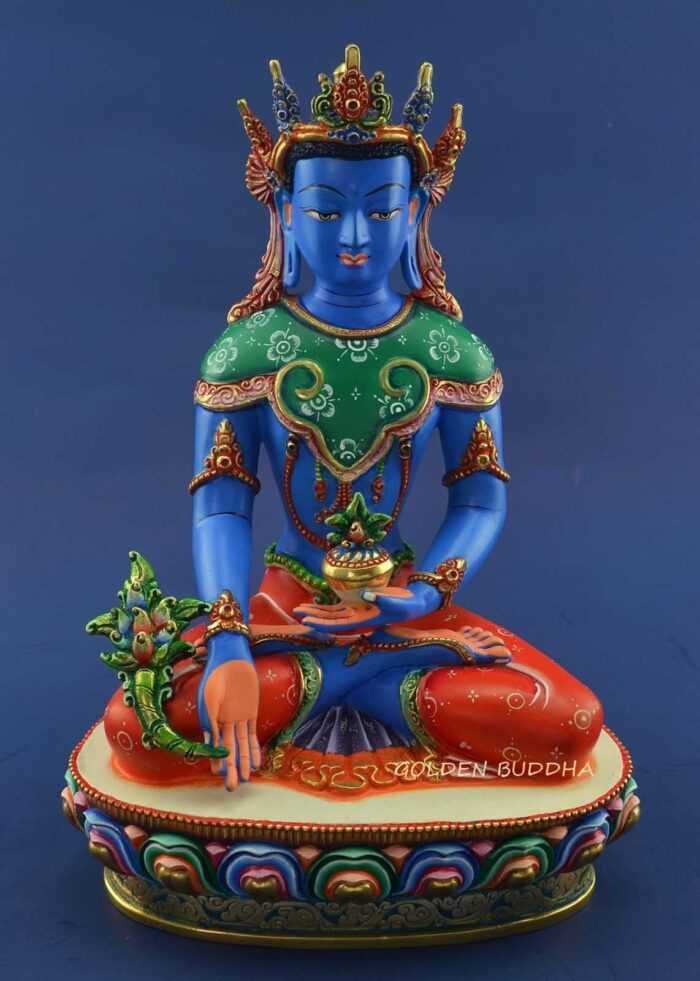
Mannhi Yeung (verified owner) –
An Absolute beautiful Nepali artisan craftsmanship statue