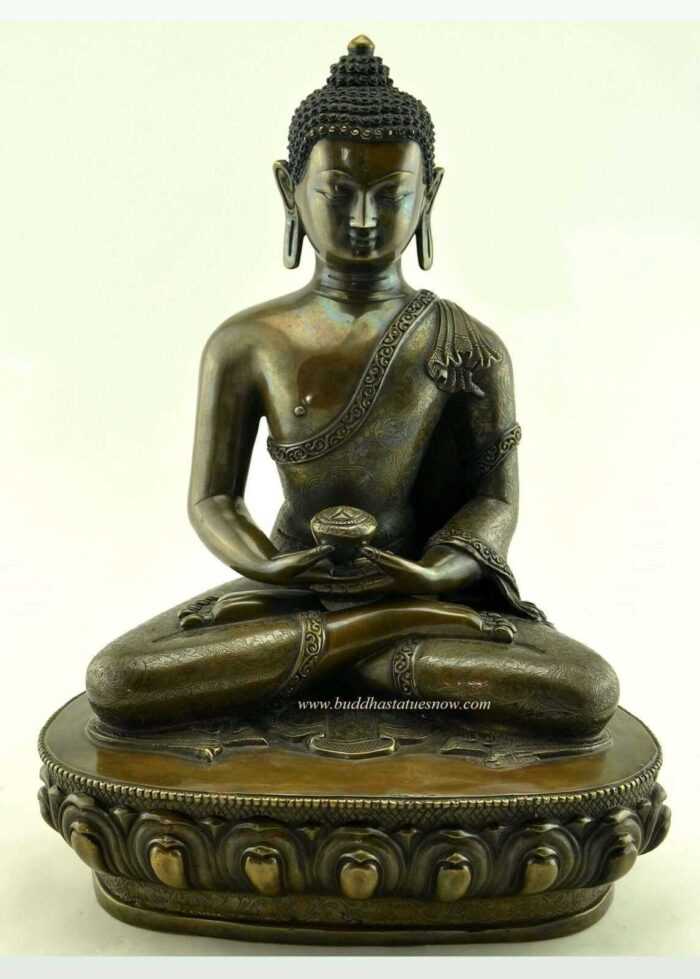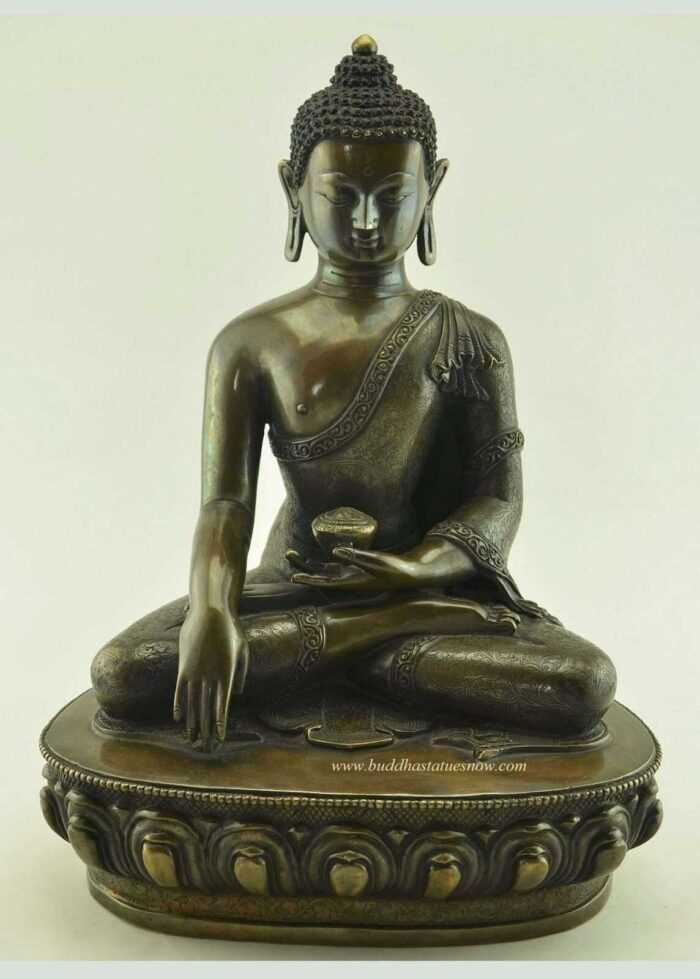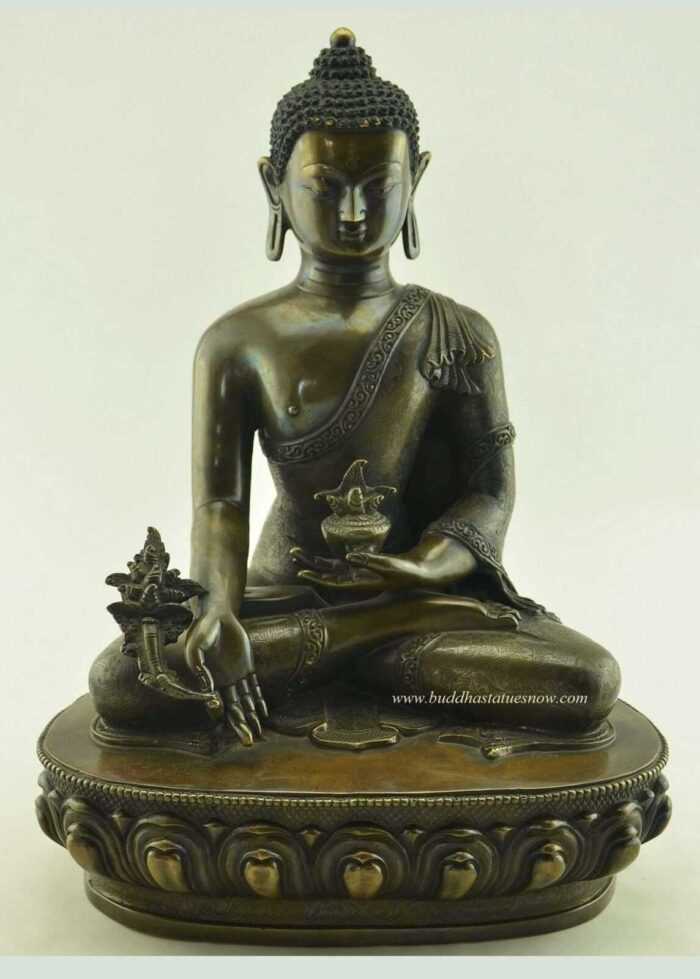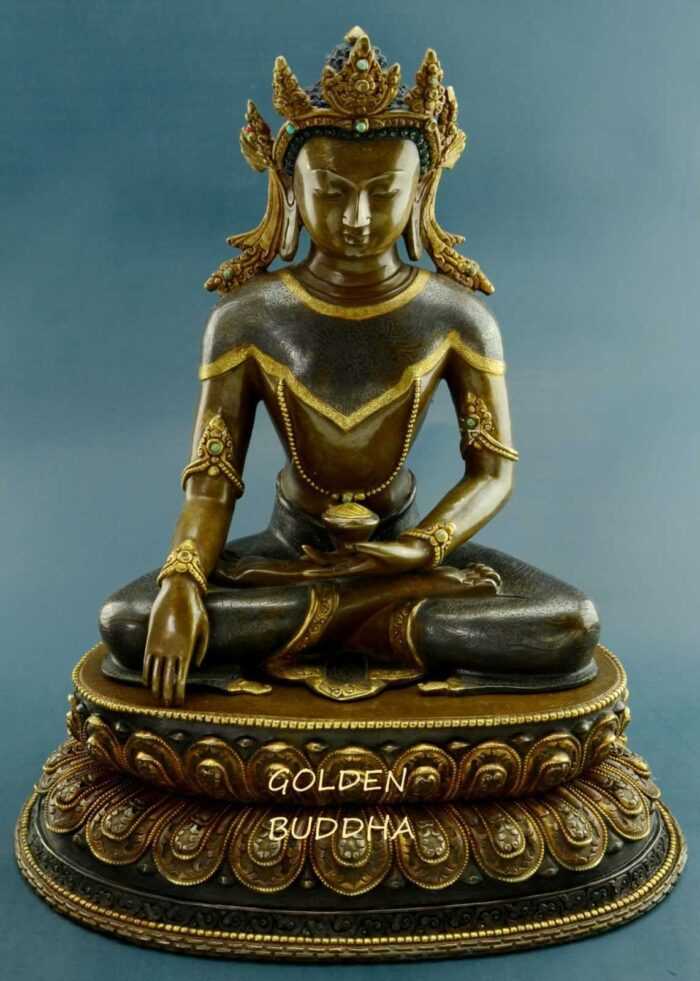
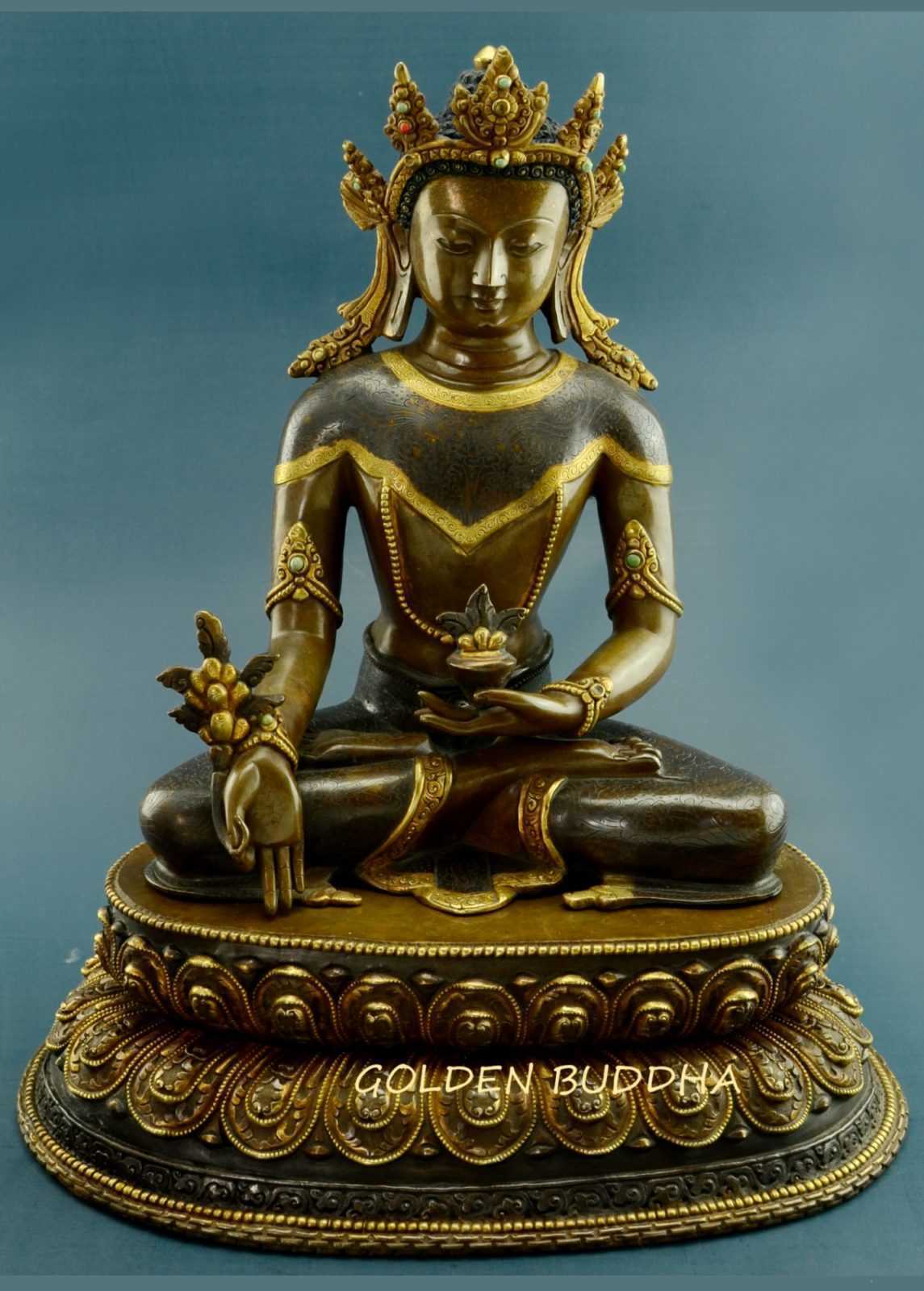


This commanding 13.5″ Oxidized Medicine Buddha statue represents Bhaisajyaguru, known in Tibet as Sangye Menla, the Buddha whose enlightened activity is associated with healing, relief from suffering, and the restoration of balance in body and mind. Handcrafted from copper alloy by a master Newar artisan in Patan, Nepal, the sculpture was created through the traditional lost wax casting method and finished with a rich antiquated surface. Selected details are fire gilded in pure 24K gold, allowing the Bodhisattva crown, jewelry, garment borders, ritual attributes, and lotus throne to emerge vividly against the warm, dark copper finish.
The contrast between oxidized copper and luminous gold gives this sculpture an aged ceremonial character while preserving the clarity of its iconography. Medicine Buddha wears an elaborate five-pointed crown set with genuine turquoise stones, together with long earrings, a chest ornament, armlets, bracelets, and finely finished robe borders. His dark curled hair rises beneath the crown into an ushnisha crowned by a small finial. The restrained gilding directs attention toward the face, healing implements, garments, and intricately worked pedestal without concealing the expressive antiquated surface of the copper alloy casting.
Oxidized Medicine Buddha Statue Healing Attributes
Medicine Buddha is seated in the full lotus posture, expressing meditative stability and complete spiritual composure. His right hand extends over the knee in the Varada mudra, the gesture of generosity, blessings, and compassionate giving. Between the fingers he holds the stem of the myrobalan plant, which rises beside his arm in a carefully modeled cluster of leaves and fruit. Myrobalan has an important place in traditional Tibetan medicine and serves here as the principal botanical emblem of Medicine Buddha’s power to diagnose and treat the causes of suffering.
The myrobalan plant represents more than a physical remedy. It symbolizes the healing wisdom that recognizes the deeper afflictions underlying dissatisfaction, illness, and harmful conduct. Buddhist teachings frequently compare the Buddha to a physician, the Dharma to medicine, suffering to disease, and disciplined practice to the treatment through which freedom becomes possible. Medicine Buddha therefore embodies both compassionate care for physical illness and the wisdom that addresses ignorance, attachment, and aversion at their roots. Learn more about his identity, vows, mantra, and practice in our complete guide to Medicine Buddha statues and healing practice.
Medicine Bowl and the Three Healing Nectars
His left hand rests in the lap in the Dhyana mudra, the gesture of meditation, supporting the traditional medicine bowl. The vessel is understood to contain healing nectar capable of counteracting the three poisons of ignorance, attachment, and hatred. These mental afflictions are regarded as the fundamental causes from which harmful actions and continued suffering arise. The bowl therefore represents a medicine directed not only toward bodily disease but toward the obscurations that prevent beings from recognizing the true nature of experience.
The complementary positions of the two hands unite healing activity with meditative wisdom. The lowered right hand reaches compassionately toward the world, while the left remains centered in contemplation. Together they express the principle that effective healing requires both active care and clear understanding. This balance makes the Oxidized Medicine Buddha statue particularly meaningful for a healing shrine, meditation room, medical practice, Dharma center, or home altar dedicated to the welfare of family members and other sentient beings.
Crowned Medicine Buddha and Turquoise Symbolism
This sculpture presents Medicine Buddha in a crowned sambhogakaya form rather than in plain monastic robes. The elaborate crown and jewelry signify an enlightened manifestation adorned with the qualities accumulated over immeasurable practice. Small turquoise stones are already embedded in the crown and arm ornaments, introducing a vivid blue-green accent against the dark copper and gold. Turquoise has long been valued throughout the Himalayan region for its associations with protection, vitality, healing, and auspicious activity.
The color is especially appropriate for Medicine Buddha because his canonical appearance is lapis blue and his eastern pure land is traditionally associated with lapis lazuli radiance. The blue component recalls the depth and purity of awakened mind, while green suggests living activity, renewal, and a readiness to respond. Against the antiquated finish, the turquoise stones illuminate the crown and jewelry without disturbing the sculpture’s solemn, contemplative character.
Foliate Engraving and Double Lotus Throne
Fine foliate and scrolling engravings extend across the shoulder covering, lower garments, crown, jewelry, and ornamental borders. The subtle patterns remain visible within the oxidized areas, while selected edges are emphasized with gold to reveal the structure of the robes. The craftsmanship continues around the reverse, where engraved designs decorate the shoulder wrap and the lower garment covering the folded legs. This complete finishing makes the statue suitable for an open display where it may be appreciated from several directions.
Medicine Buddha sits upon a substantial double lotus throne with two full registers of petals. The upper petals curve inward beneath the figure, while the larger lower row is ornamented with raised foliate patterns and beaded borders. Around the back of the throne, two gilded deer face a central Dharma wheel, recalling the Buddha’s first teaching at Deer Park. Below them, a raised gilded dragon appears among engraved cloud forms. These carefully worked repoussé-style decorations transform the reverse of the pedestal into one of the statue’s most distinctive artistic features.
A Matching Medicine Buddha and Shakyamuni Statue Set
This Oxidized Medicine Buddha statue forms an exceptional two-piece set with our matching Antiquated Shakyamuni statue. Both figures were created by the same master artisan and share the same 13.5-inch height, closely related proportions, oxidized copper-alloy finish, selective 24K fire gilding, turquoise embellishments, crowned presentation, engraved garments, and double lotus pedestal. Their rear thrones also display complementary raised decorations, including paired deer, Buddhist emblems, gilded mythical creatures, and surrounding cloud motifs.
The two Buddhas also make a strong doctrinal pairing. Shakyamuni is the historical teacher who revealed the Four Noble Truths, the Noble Eightfold Path, and the complete Buddhist path to liberation in our world. Medicine Buddha embodies the healing application of enlightened wisdom, addressing physical illness, mental suffering, and the karmic causes that sustain affliction. Displayed together, Shakyamuni represents the Teacher and the source of the Dharma, while Medicine Buddha presents that Dharma as a healing remedy. The pair therefore unites instruction with restoration, wisdom with compassionate care, and the diagnosis of suffering with the path that brings it to an end.
Filling, Blessing and Consecration
The statue includes a consecration opening so that it may be filled with sacred texts, rolled mantras, incense, medicinal substances, precious materials, and other customary offerings before receiving a blessing according to the buyer’s Buddhist lineage. Filling and consecration prepare the handcrafted image for use as an object of meditation, offering, and veneration. Our guide to Buddha statue filling, blessing, and consecration explains the traditional preparation process and the options available to collectors, practitioners, monasteries, and Dharma centers.
Custom Made Oxidized Medicine Buddha Statues
Collectors, practitioners, monasteries, healing centers, and Dharma organizations may commission a custom made Tibetan Buddhist statue based upon this crowned Medicine Buddha design. A custom Oxidized Medicine Buddha statue can be produced in a different size with an antiquated copper finish, selective 24K gilding, a partly gilded presentation, or a more extensively fire-gilded surface. Available options may include personalized foliate engraving, turquoise or red coral stone settings, facial painting, customized crown details, and additional ornamentation around the lotus throne.
A coordinated Medicine Buddha and Shakyamuni pair may also be commissioned so that both sculptures share the same height, body proportions, oxidized finish, gilding placement, turquoise settings, engraving patterns, and pedestal dimensions. Commissioning the figures together allows the artisan to preserve their visual harmony while expressing their complementary spiritual attributes: Shakyamuni as the historical Buddha who taught the path beyond suffering, and Medicine Buddha as the healing manifestation of awakened wisdom that treats suffering in its physical, emotional, and karmic dimensions. Together they create a balanced altar devoted to learning, practice, healing, and liberation.
Authentic, Handmade in Nepal
Every statue is handcrafted in Patan, Nepal, using traditional lost wax casting and comes with a certificate of authenticity issued by Nepal’s Department of Archaeology, verifying its materials, technique, and origin.