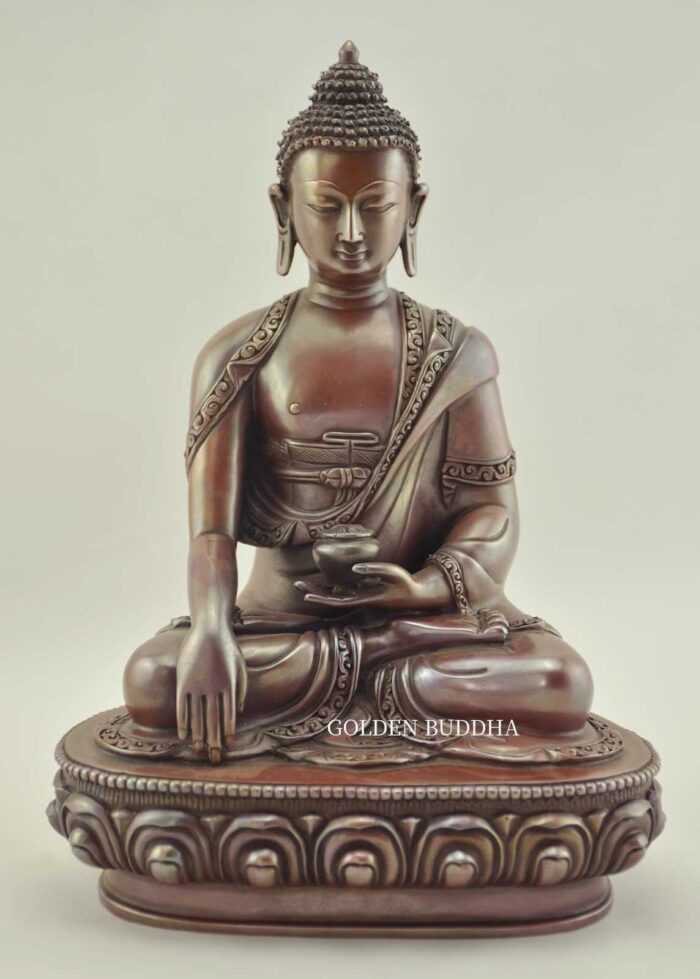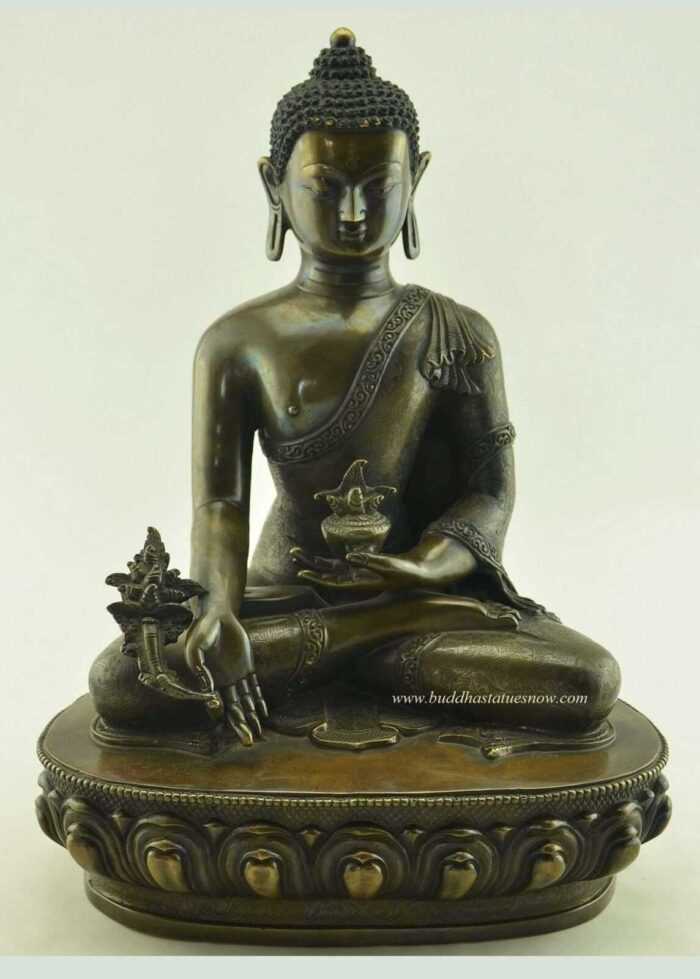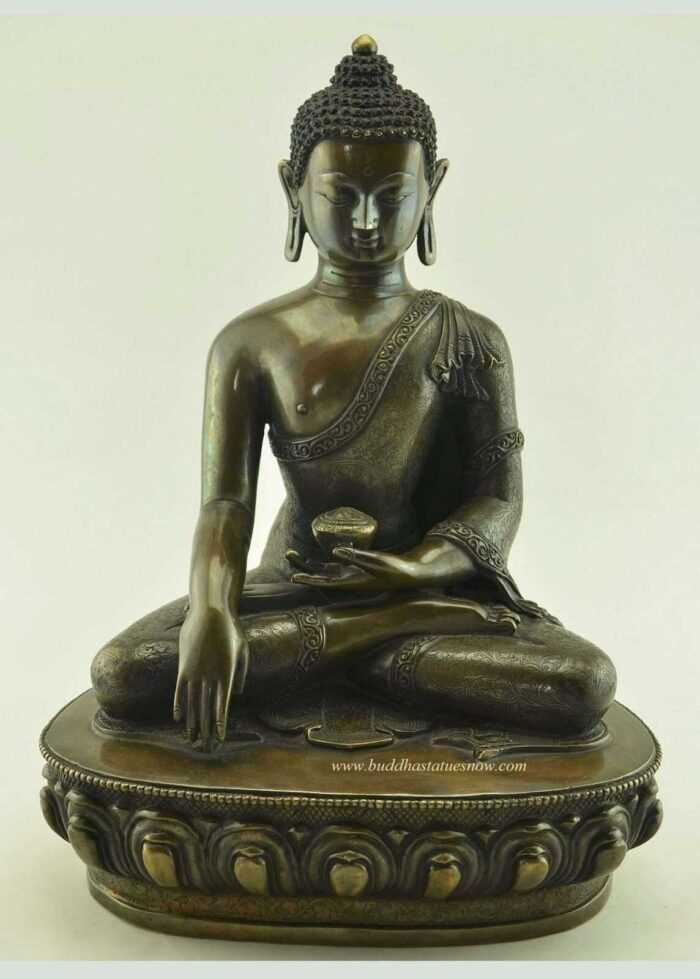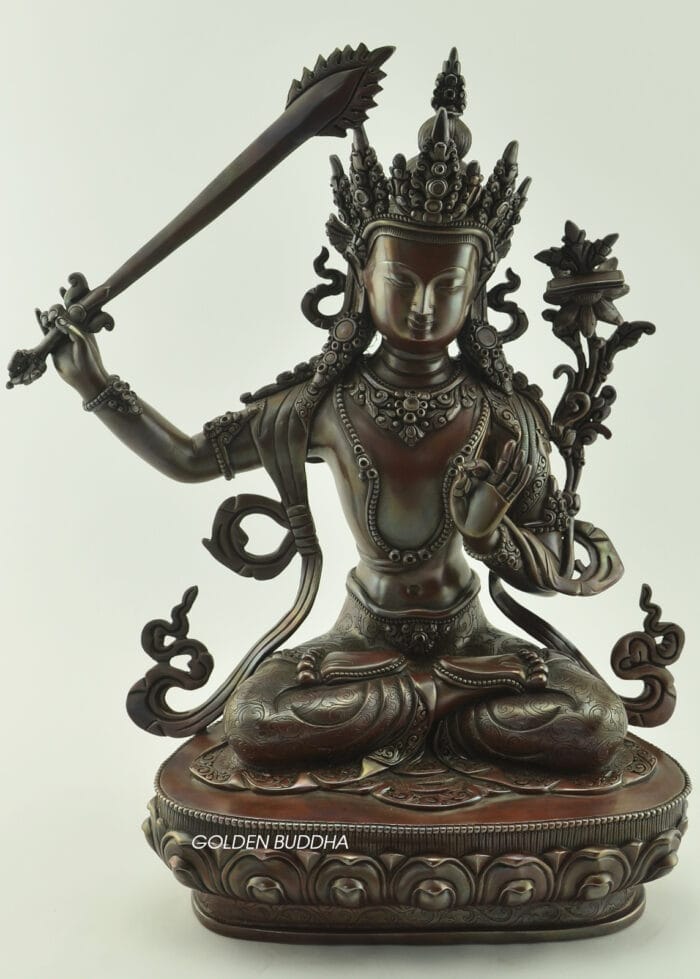

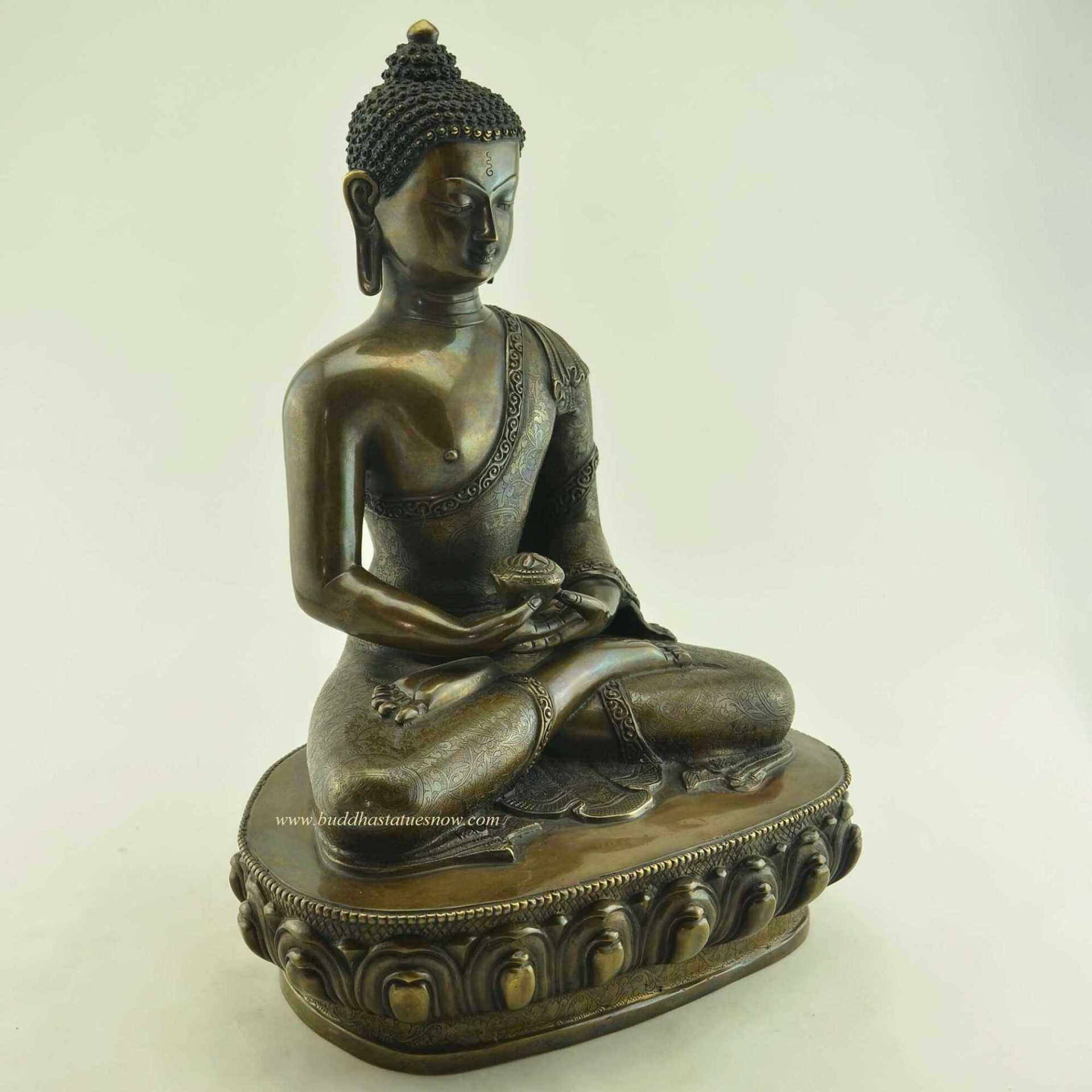
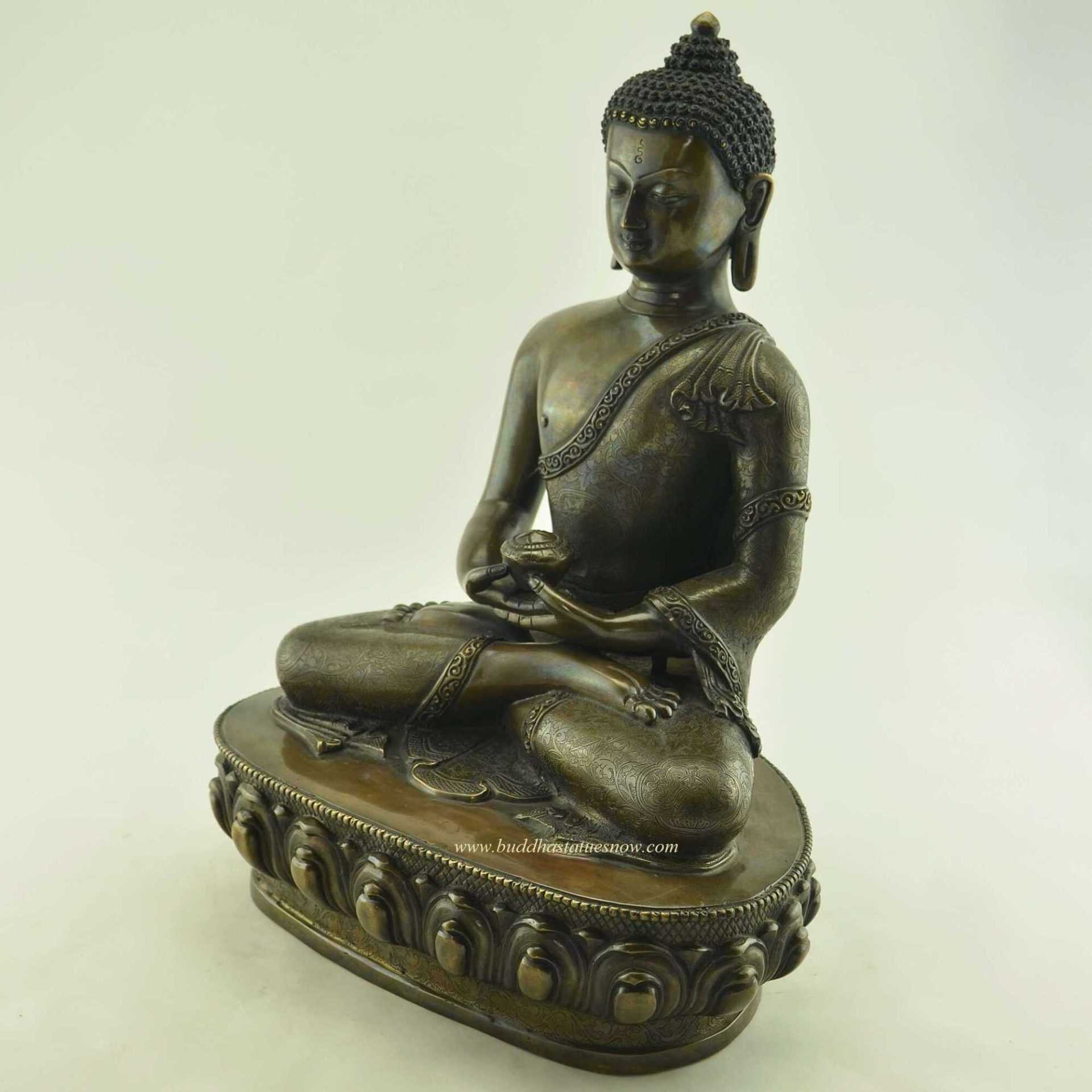
Rich engravings across the monastic robe and pedestal give this 13.5″ Antiquated Amitabha Buddha Statue a remarkably refined appearance while preserving the quiet restraint associated with the Buddha of Infinite Light. Handmade from copper alloy in Patan, Nepal, the sculpture has an oxidized antiquated finish that settles into the carved details and brings out subtle variations of deep brown, bronze, and muted gold. The artisan concentrated the ornamental work on the robe, seated legs, and pedestal while leaving the face, chest, right shoulder, arms, and portions of the back smoothly finished. This balance prevents the decoration from overwhelming Amitabha’s calm meditative presence.
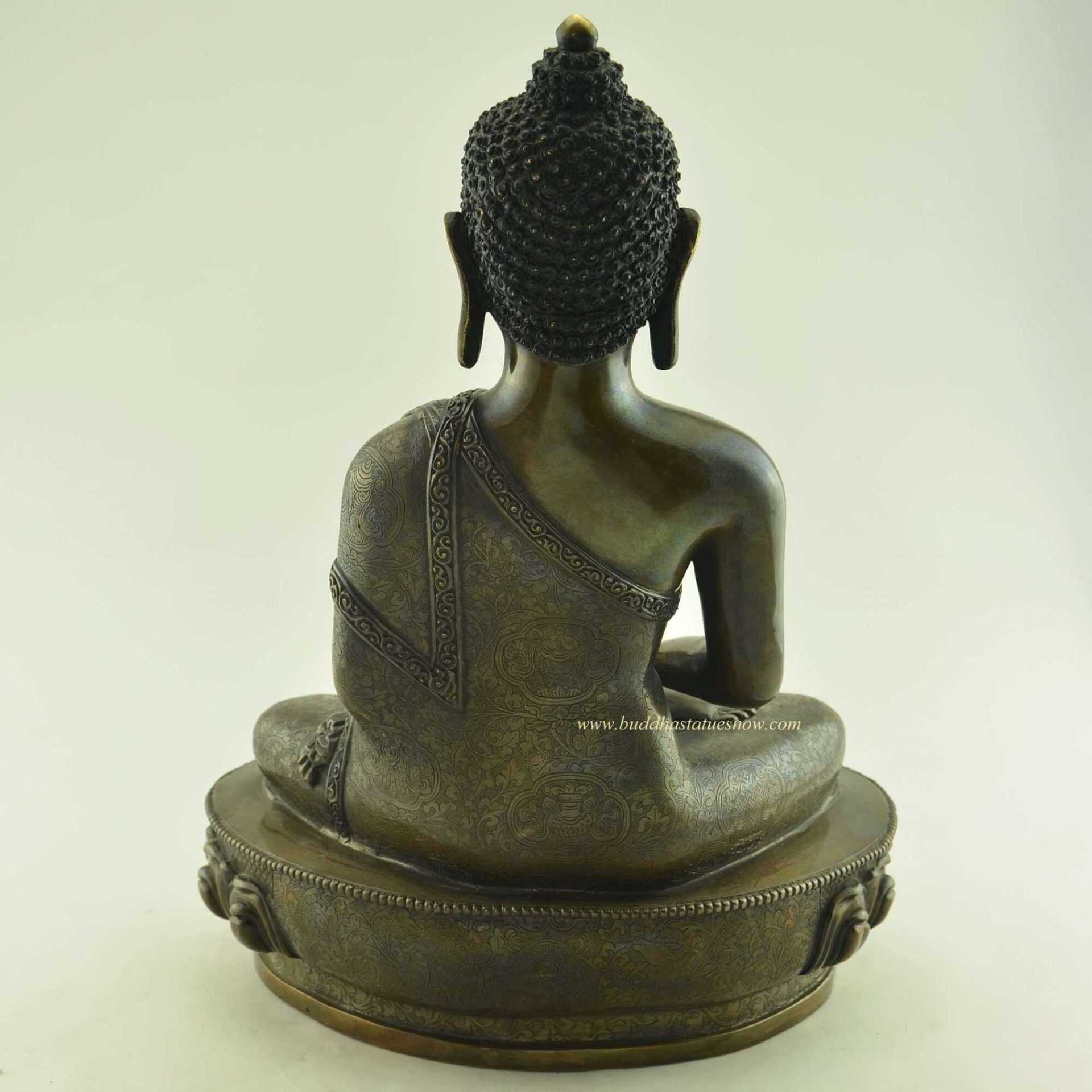
The craftsmanship is especially evident when the Antiquated Amitabha Buddha Statue is viewed from behind. Intricate floral scrolls, auspicious emblems, and rounded medallions cover the robe as it crosses the left shoulder and descends across the back. The engraved borders follow the edges of the garment, making the ornamentation appear woven into a ceremonial textile rather than applied as a separate surface pattern. Similar engraving continues across the lower garment and around the single lotus pedestal, giving the sculpture a finished appearance from every viewing angle.
Before attaining Buddhahood, Amitabha was known as the Bodhisattva Dharmakara. He made a series of profound vows to establish a pure realm where sentient beings could continue progressing toward enlightenment under favorable conditions. After fulfilling those vows and accumulating immeasurable merit, he became Amitabha Buddha and established Sukhavati, the Western Pure Land of Bliss. The complete account is explored in Amitabha’s Long Path to Becoming a Buddha, while the meaning of his realm is explained in The Pure Land of Sukhavati.
Antiquated Amitabha Buddha Statue Features
This Antiquated Amitabha Buddha Statue sits in the full lotus posture upon a single lotus pedestal. His balanced position conveys meditative stability, while both hands rest together in the Dhyana Mudra, the Buddhist hand gesture associated with concentration, inner stillness, and contemplative awareness. A traditional monastic alms bowl is supported above his open palms. The bowl recalls simplicity and renunciation, while also representing the spiritual nourishment of the Dharma offered to beings seeking liberation.
Several traditional marks of Buddhahood are clearly represented. Amitabha has elongated earlobes, three horizontal neck lines, tightly arranged right-turning hair curls, an ushnisha rising above the crown of the head, and an urna between the brows. His lowered eyes and gently composed expression reinforce the inward quality of meditation. The meaning of these physical attributes, together with the posture, bowl, and hand gesture, is discussed in Amitabha Statue Iconography: Mudra, Color & Form.
Within the Five Dhyani Buddha tradition, Amitabha is associated with discriminating wisdom—the awakened capacity to perceive the unique qualities of phenomena without becoming attached to them. His place among the principal figures of Buddhist tradition is described in Amitabha Buddha—Infinite Light and Life. Additional sizes, finishes, and artistic interpretations are available in our complete collection of Amitabha Buddha statues.
Antiquated Amitabha Buddha Statue for a Four Statue Set
This Antiquated Amitabha Buddha Statue can form part of an especially harmonious four statue altar set when paired with the antiquated Shakyamuni sculpture, Manjushri statue and the matching Medicine Buddha statue. All four sculptures were created by the same master artisan and share closely coordinated dimensions, oxidized copper-alloy surfaces, single lotus pedestals, and restrained antiquated finishes. Displayed together, they represent complementary dimensions of Buddhist practice: Shakyamuni as the historical teacher, Manjushri as the embodiment of transcendent wisdom, Medicine Buddha as the embodiment of healing and relief from suffering, and Amitabha as the Buddha of Infinite Light and the guide to Sukhavati.
Custom Made Tibetan Buddha Statues
A custom made Amitabha Buddha statue may be commissioned for a private shrine, Dharma center, monastery, or coordinated Buddhist altar set. The statue can be ordered in a different size, with an oxidized finish similar to this example, more extensive robe engraving, a different pedestal design, or fire gilding in 24K pure gold. Matching Shakyamuni Buddha, Manjushri and Medicine Buddha statues may also be planned as part of the same commission so that the proportions, finish, pedestal style, and artistic character remain consistent across the complete set. Each custom sculpture is cast from copper alloy and individually finished by experienced Nepali artisans using traditional methods.
Authentic, Handmade in Nepal
Every statue is handcrafted in Patan, Nepal, using traditional lost wax casting and comes with a certificate of authenticity issued by Nepal’s Department of Archaeology, verifying its materials, technique, and origin.