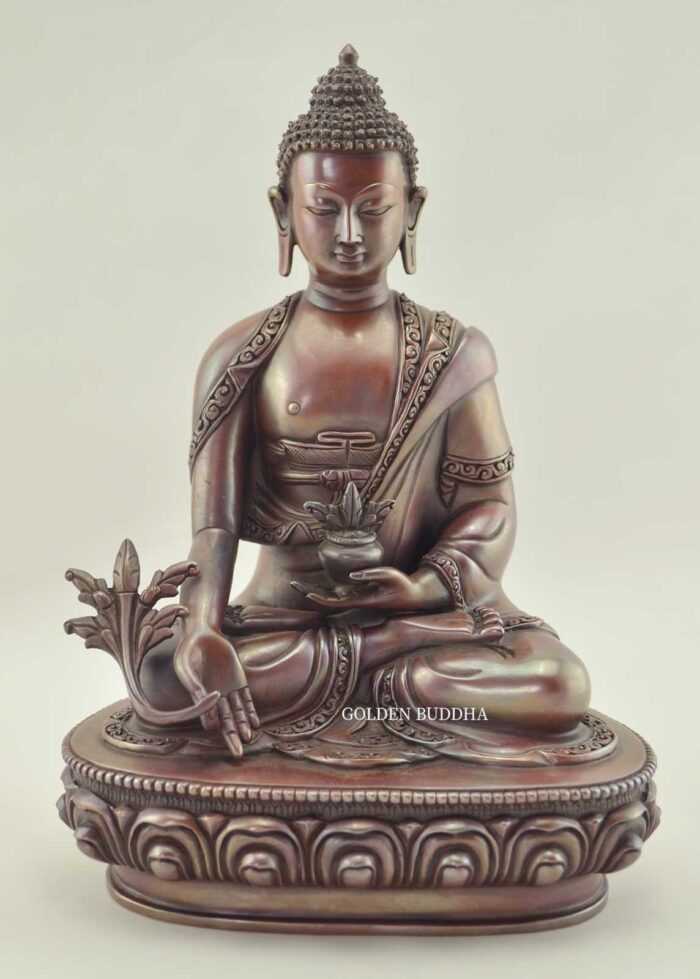
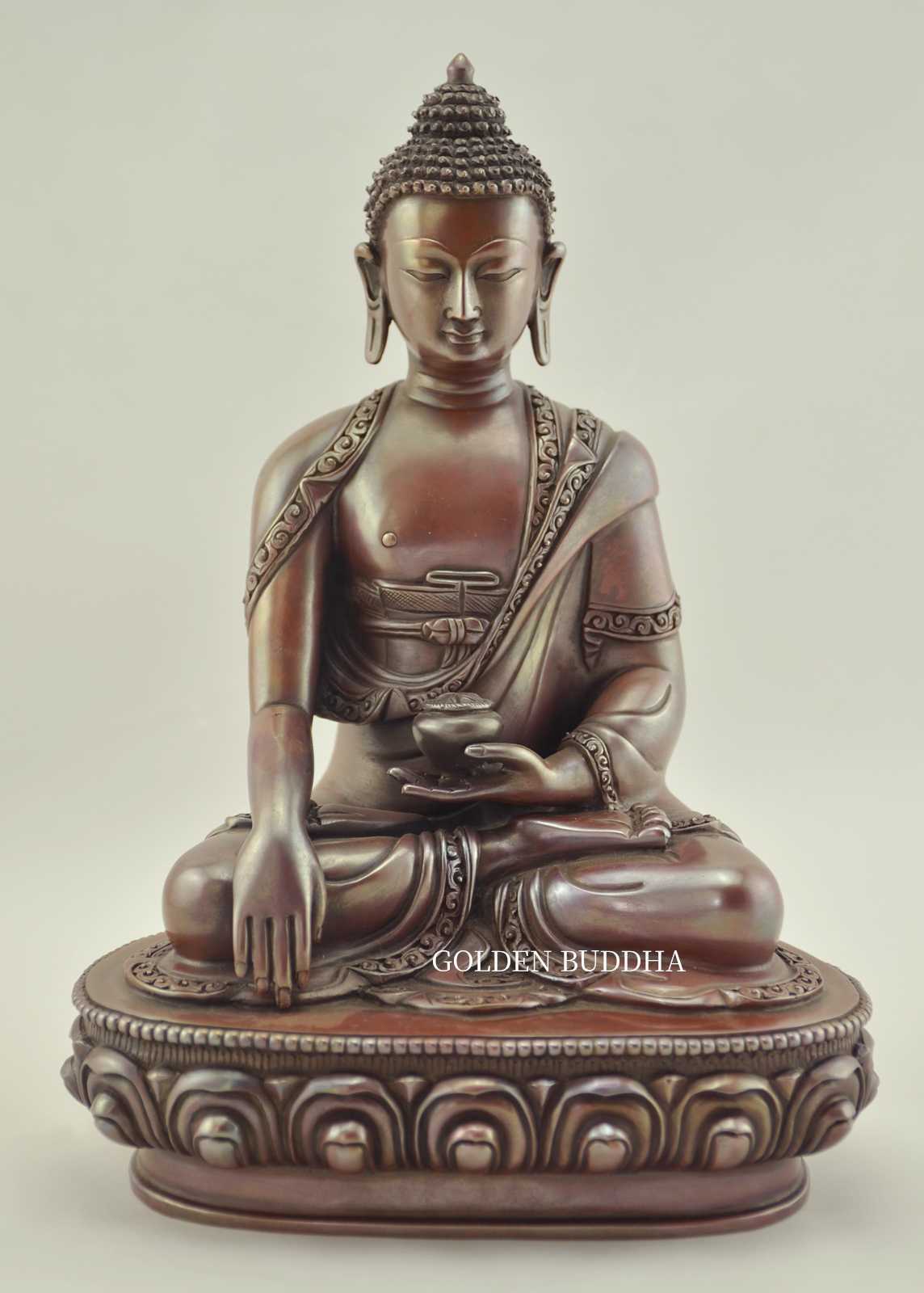
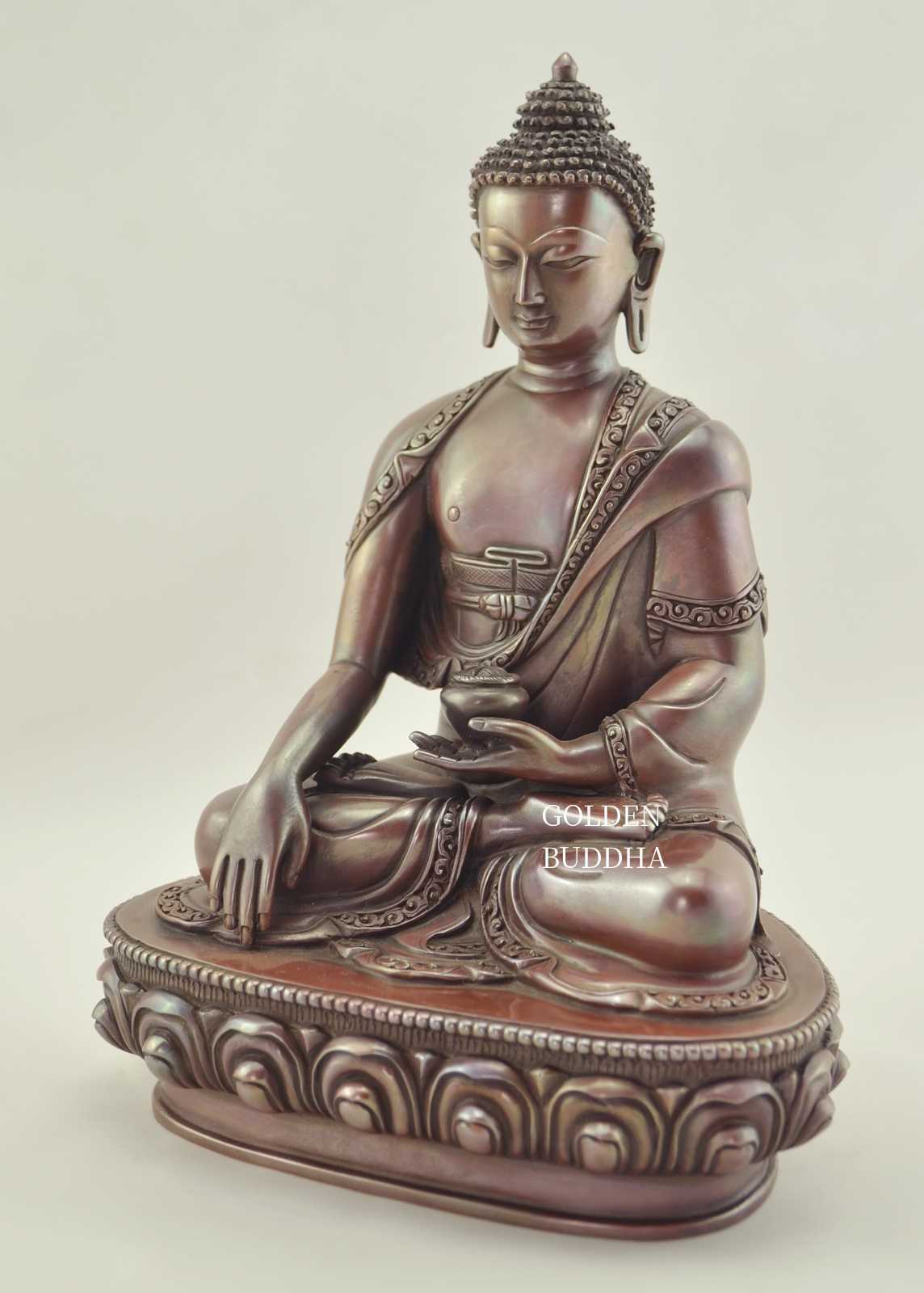
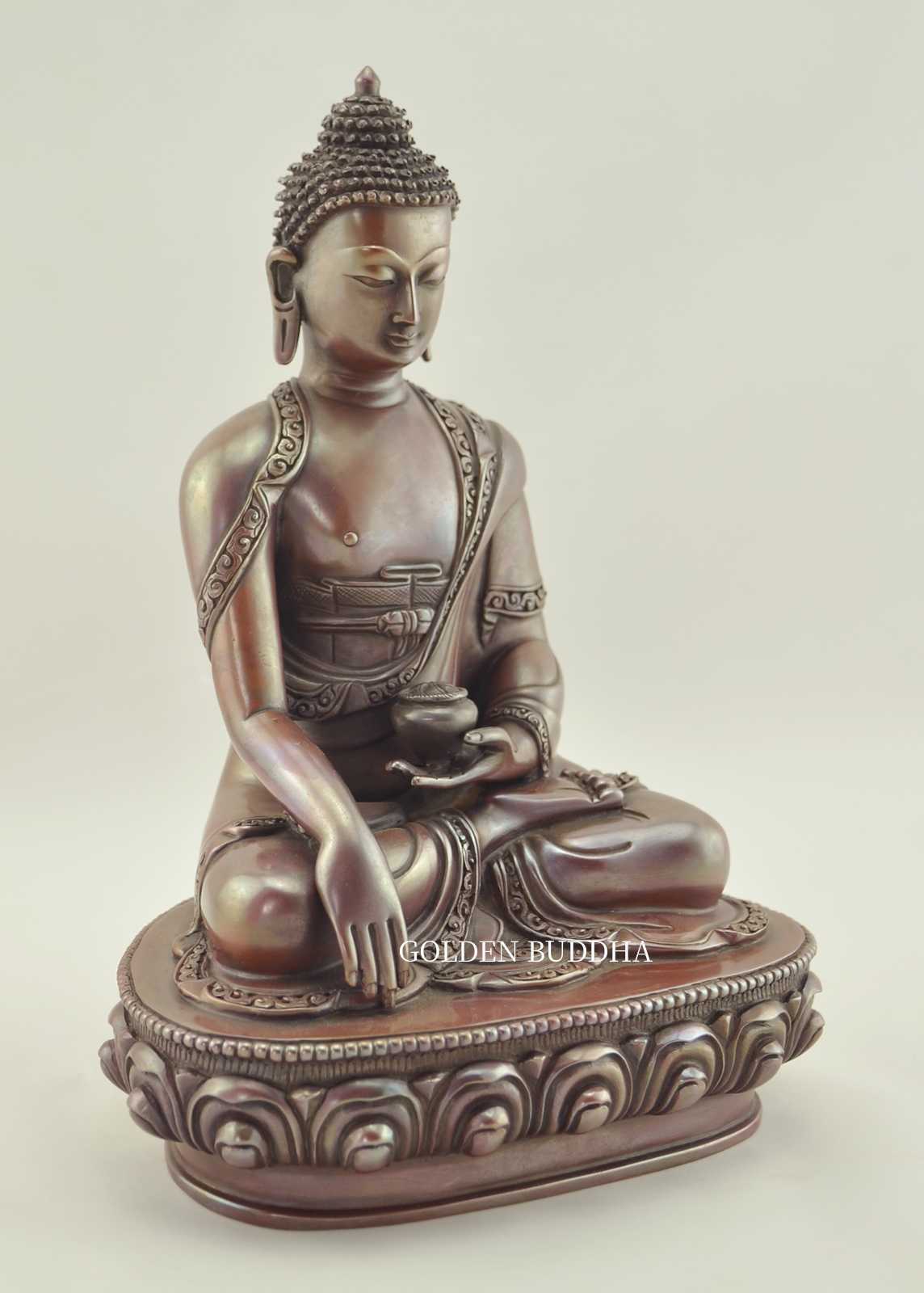
This contemplative 9″ Antiquated Shakyamuni Buddha statue portrays the historical Buddha at the threshold of enlightenment, seated in meditation with his right hand reaching toward the earth. Handcrafted from copper alloy by a master Newar artisan in Patan, Nepal, the sculpture was created through the traditional lost-wax casting method and finished with a deep oxidized copper surface. Warm reddish-brown tones, darker umber recesses, and softly burnished highlights move naturally across the body, robes, and pedestal, giving the newly made statue the dignified presence of an older Himalayan shrine image.
The antiquated finish has been applied without gold gilding or painted facial details, allowing the sculptural form and copper alloy itself to remain the focus. Shakyamuni’s gently lowered eyes, finely modeled lips, urna, elongated earlobes, and three neck lines are all rendered directly in the metal. Darker oxidation settles naturally around the hair curls, engraved robe borders, garment folds, fingers, and lotus petals, while the broader surfaces of the face, chest, arms, and crossed legs retain a soft copper glow. The result is a quiet and grounded presentation especially well suited to meditation rooms, home altars, monasteries, Dharma centers, and collections of traditional Himalayan Buddhist art.
Antiquated Shakyamuni Buddha Statue Meaning
Shakyamuni Buddha was born as Prince Siddhartha Gautama into the Shakya royal family. Although surrounded by privilege, he gradually recognized that wealth and comfort could not protect anyone from aging, illness, separation, and death. At approximately twenty-nine years of age, Siddhartha renounced palace life and began searching for a path that could address suffering at its deepest source. After studying with accomplished meditation teachers and practicing severe asceticism, he understood that neither indulgence nor self-mortification could lead to liberation.
Siddhartha then adopted the Middle Way and sat beneath the Bodhi tree at Bodh Gaya, resolving not to rise until awakening had been attained. His realization revealed the nature of suffering, its causes, its cessation, and the path leading beyond it. Shakyamuni subsequently spent approximately forty-five years teaching the Dharma, beginning with the Four Noble Truths and Noble Eightfold Path at Deer Park in Sarnath. This Antiquated Shakyamuni Buddha statue therefore represents both the historical teacher and the decisive moment from which his teachings became available to the world.
Bhumisparsha Mudra and the Victory over Mara
Shakyamuni’s right hand extends over his knee in the Bhumisparsha mudra, or earth-touching gesture. The palm faces inward and the fingers reach downward toward the ground. According to Buddhist tradition, Mara challenged Siddhartha’s right to occupy the seat of awakening and confronted him with fear, doubt, temptation, and distraction. Siddhartha responded by touching the earth and calling it to witness the merit accumulated through his innumerable previous lives.
The earth bore witness, Mara’s challenge was defeated, and Siddhartha attained complete enlightenment. The Bhumisparsha mudra consequently symbolizes unwavering resolve, victory over delusion, and realization grounded in direct experience rather than belief alone. Explore the meaning of the Bhumisparsha mudra and other Shakyamuni Buddha hand gestures in our complete guide.
Dhyana Mudra and the Monastic Alms Bowl
His left hand rests in the lap in the Dhyana mudra, the gesture of meditation, concentration, and inner equilibrium. Supported within the open palm is the small lidded alms bowl of an ordained Buddhist monk. The bowl recalls Siddhartha’s renunciation of royal privilege and his willingness to live simply, accepting only what was freely offered while dedicating his life to awakening and the welfare of sentient beings.
Within Buddhist iconography, the bowl may also be understood as containing the nectar of the Dharma that counteracts ignorance, attachment, and aversion. Its placement in the still left hand creates a meaningful balance with the active earth-touching gesture of the right. Together, the hands unite profound meditation with decisive realization: the inward discipline through which the mind is understood and the outward declaration that awakening has been attained.
Engraved Monastic Robes and Buddha Attributes
This Antiquated Shakyamuni Buddha statue wears the traditional robes of an ordained monk rather than a Bodhisattva crown or celestial jewelry. Raised scrolling borders frame the robe on both sides of the chest and continue along the shoulder, upper arm, sleeve, lap, and hems surrounding the folded legs. A finely textured sash crosses the waist and gathers into a carefully modeled knot. The ornamentation is concentrated along the garment edges, preserving broad areas of smooth oxidized copper and maintaining the simplicity appropriate to the historical Buddha’s renunciant life.
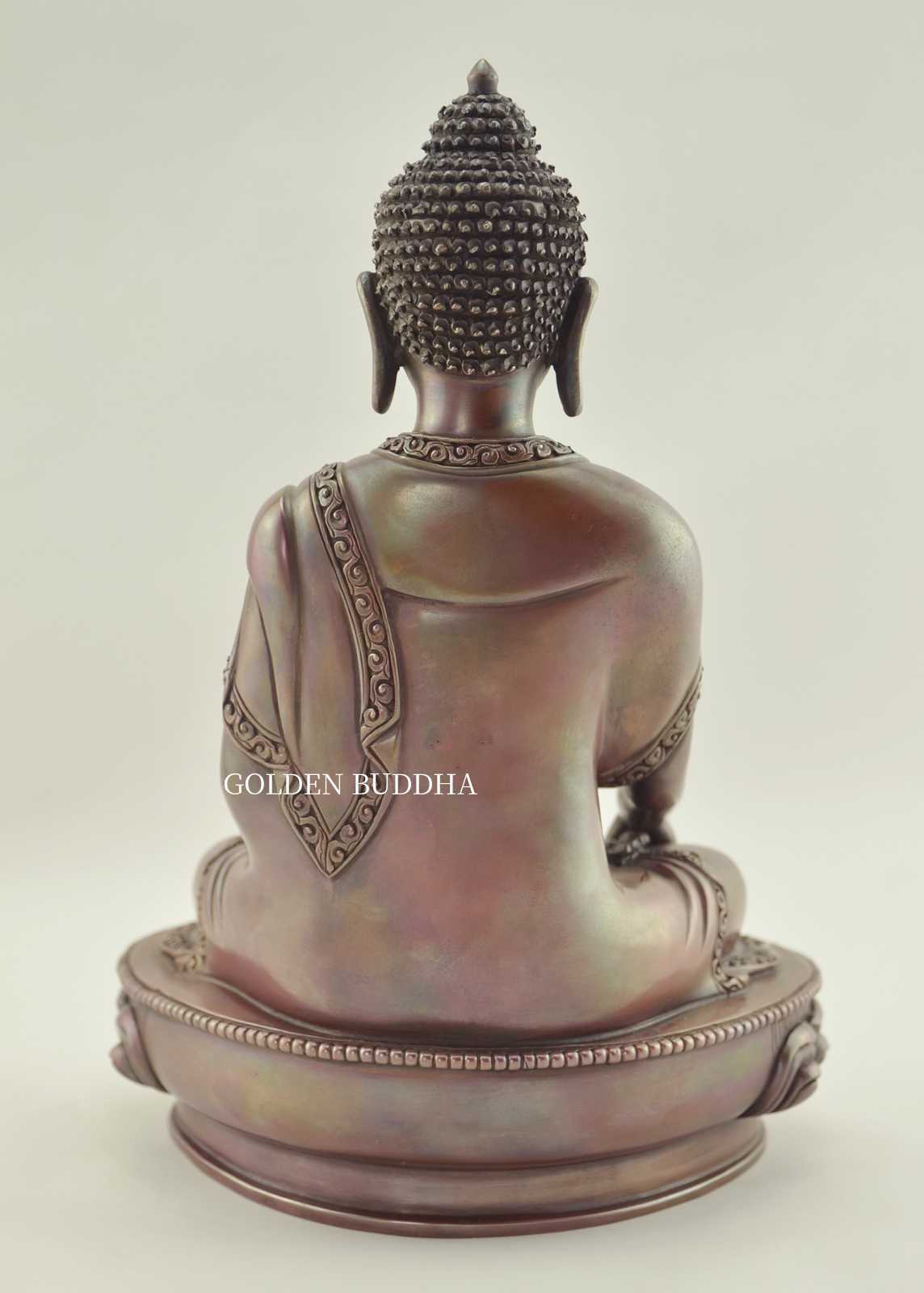
The workmanship continues around the reverse. The robe passes over the shoulder and descends into a pointed panel across the upper back, outlined by a repeating scroll border. Shallow sculpted folds give the garment a convincing sense of weight, while the broad central back remains smooth and softly finished. This restrained approach makes the statue visually complete from several directions without overwhelming its calm monastic character.
Shakyamuni also displays the traditional physical characteristics of a fully awakened Buddha. His tightly arranged, right-turning hair curls rise into the ushnisha, symbolizing extraordinary wisdom. The urna between the brows represents transcendent insight, while the elongated earlobes recall the royal ornaments worn before his renunciation. The three horizontal neck lines are included among the auspicious marks of Buddhahood. Learn more in our guide to the physical characteristics of the Buddha, or browse our collection of Shakyamuni Buddha statues.
Single Lotus Pedestal and Oxidized Copper Finish
Shakyamuni sits in the full lotus posture upon a substantial single lotus pedestal. A continuous register of rounded petals surrounds the oval base beneath a precisely modeled beaded rim. Dark oxidation gathers within the recessed outlines of the petals, making each form clearly visible against the smoother copper surfaces. The pedestal remains comparatively restrained from behind, preserving the uncluttered artistic language shared by the matching Amitabha and Medicine Buddha statues.
The lotus symbolizes purity arising within samsara. Just as the flower grows through muddy water without becoming stained, wisdom and compassion may develop amid the uncertainty and suffering of conditioned existence. The stable pedestal and full lotus posture reinforce the unshakable concentration associated with Shakyamuni’s awakening beneath the Bodhi tree.
A Matching Antiquated Shakyamuni, Amitabha and Medicine Buddha Set
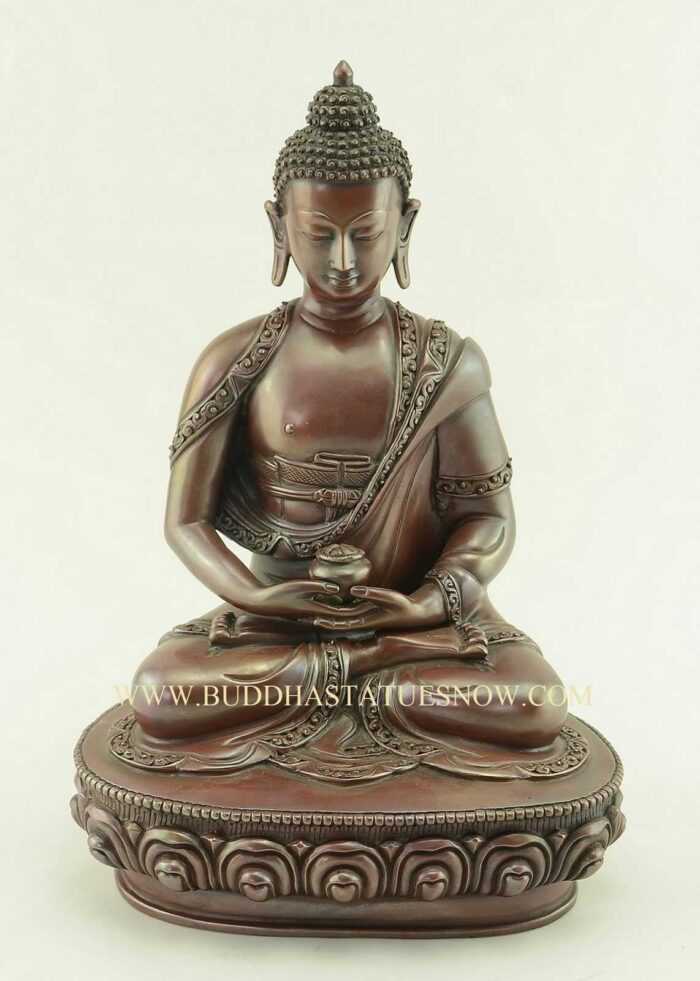
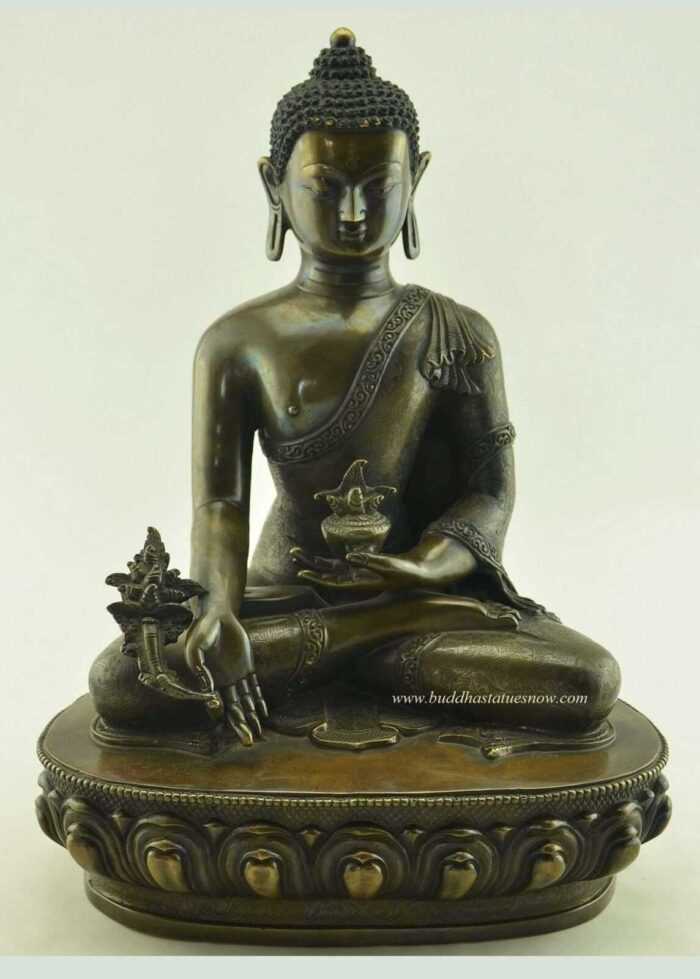
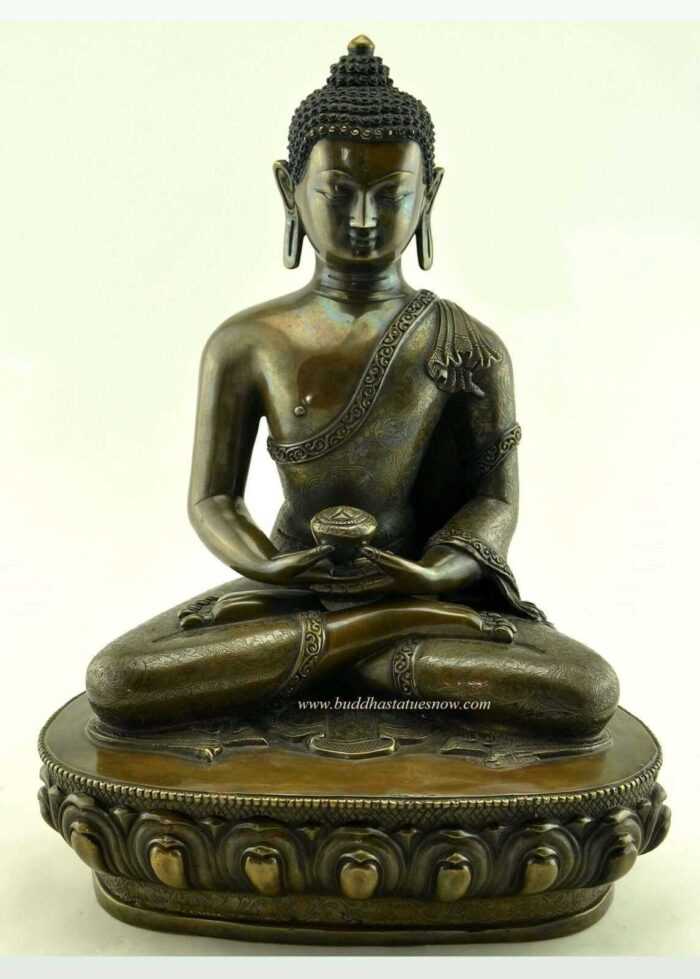
This Antiquated Shakyamuni Buddha statue forms a coordinated three-piece altar arrangement with our Antiquated Amitabha statue and Antiquated Medicine Buddha statue. All three sculptures were created by the same master artisan and share matching 9-inch heights, oxidized copper-alloy construction, traditional lost-wax casting, warm reddish-brown finishes, monastic robes, finely engraved garment borders, balanced proportions, full lotus postures, and corresponding single lotus pedestals. Their common materials and restrained decorative language allow them to stand together as a visually unified shrine while preserving the distinctive mudras and attributes of each Buddha.
The three figures also form a meaningful doctrinal combination. Shakyamuni is the historical teacher who appeared in our world, attained awakening, and revealed the Dharma path beyond suffering. The Antiquated Medicine Buddha statue embodies the healing activity of awakened wisdom and is associated with relief from illness, mental affliction, harmful karma, and the deeper causes of suffering. The Antiquated Amitabha statue represents Infinite Light and the compassionate vows that established Sukhavati as a favorable realm for continued progress toward enlightenment. Displayed together, Shakyamuni provides the teaching, Medicine Buddha supports healing and restoration along the path, and Amitabha represents confidence in favorable future conditions and the ultimate completion of spiritual practice.
Custom Made Antiquated Shakyamuni Buddha Statues
Collectors, practitioners, monasteries, meditation centers, and Dharma organizations may commission a custom made Tibetan Buddhist statue inspired by this design. A custom Antiquated Shakyamuni Buddha statue may be created in a different size with a deep oxidized copper finish, a lighter antiquated bronze-colored finish over the copper-alloy casting, selective 24K gold gilding, or a fully fire-gilded surface. Options may include personalized robe-border engraving, alternative lotus-petal designs, adjusted body proportions, different facial treatments, or more extensively decorated monastic garments.
A coordinated Amitabha, Medicine Buddha, and Shakyamuni set may also be commissioned so that all three sculptures share the same dimensions, finish, monastic robe style, engraved borders, facial character, and lotus-pedestal proportions. Commissioning the figures together allows the artisan to preserve their visual continuity while expressing their complementary spiritual roles: Shakyamuni as the teacher who reveals the path, Medicine Buddha as the healer of suffering and its causes, and Amitabha as the Buddha of Infinite Light whose vows support continued progress toward enlightenment. Every custom statue is individually cast, chased, engraved, and finished by hand in Nepal according to traditional Himalayan iconographic proportions.
Authentic, Handmade in Nepal
Every statue is handcrafted in Patan, Nepal, using traditional lost wax casting and comes with a certificate of authenticity issued by Nepal’s Department of Archaeology, verifying its materials, technique, and origin.