
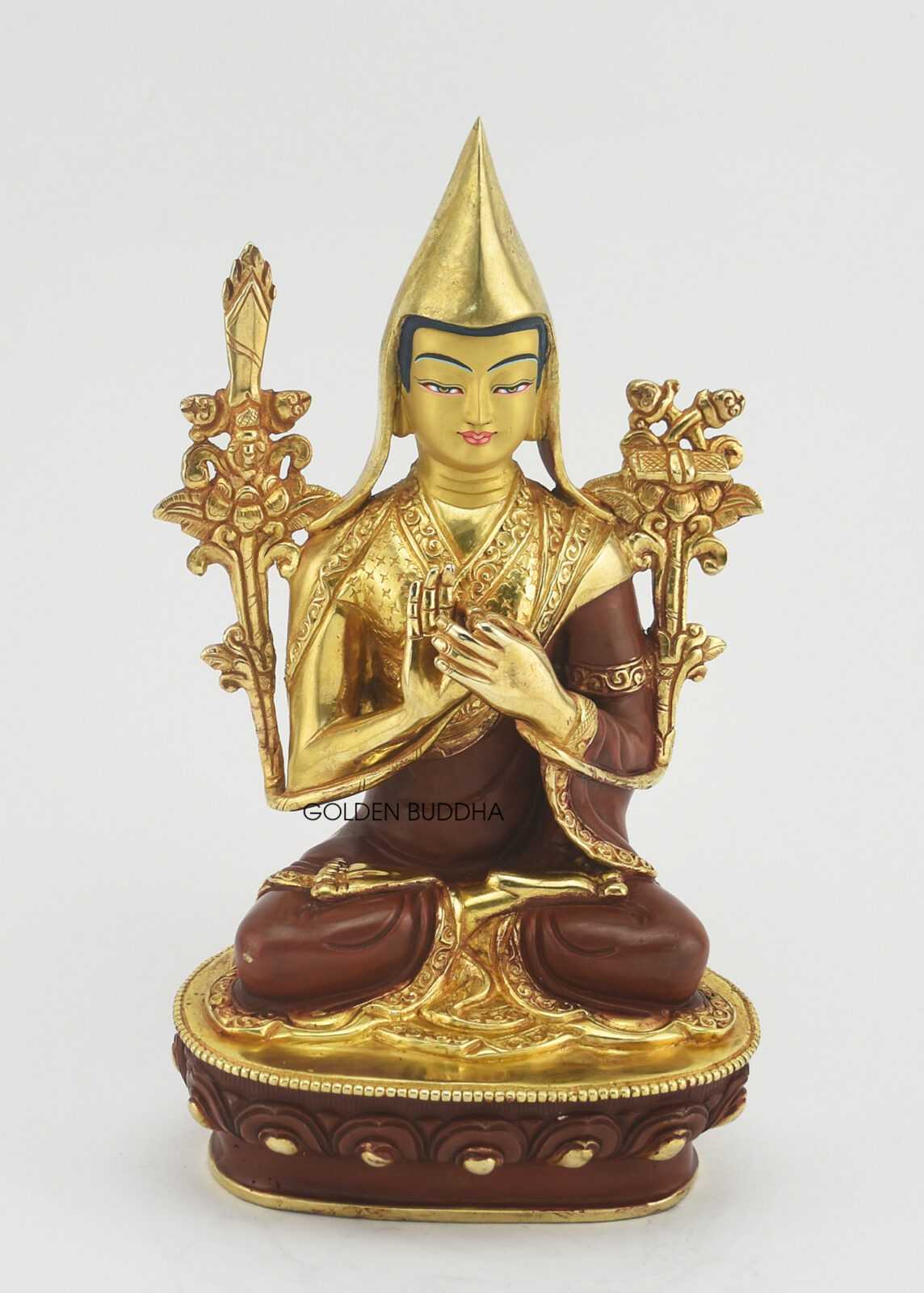
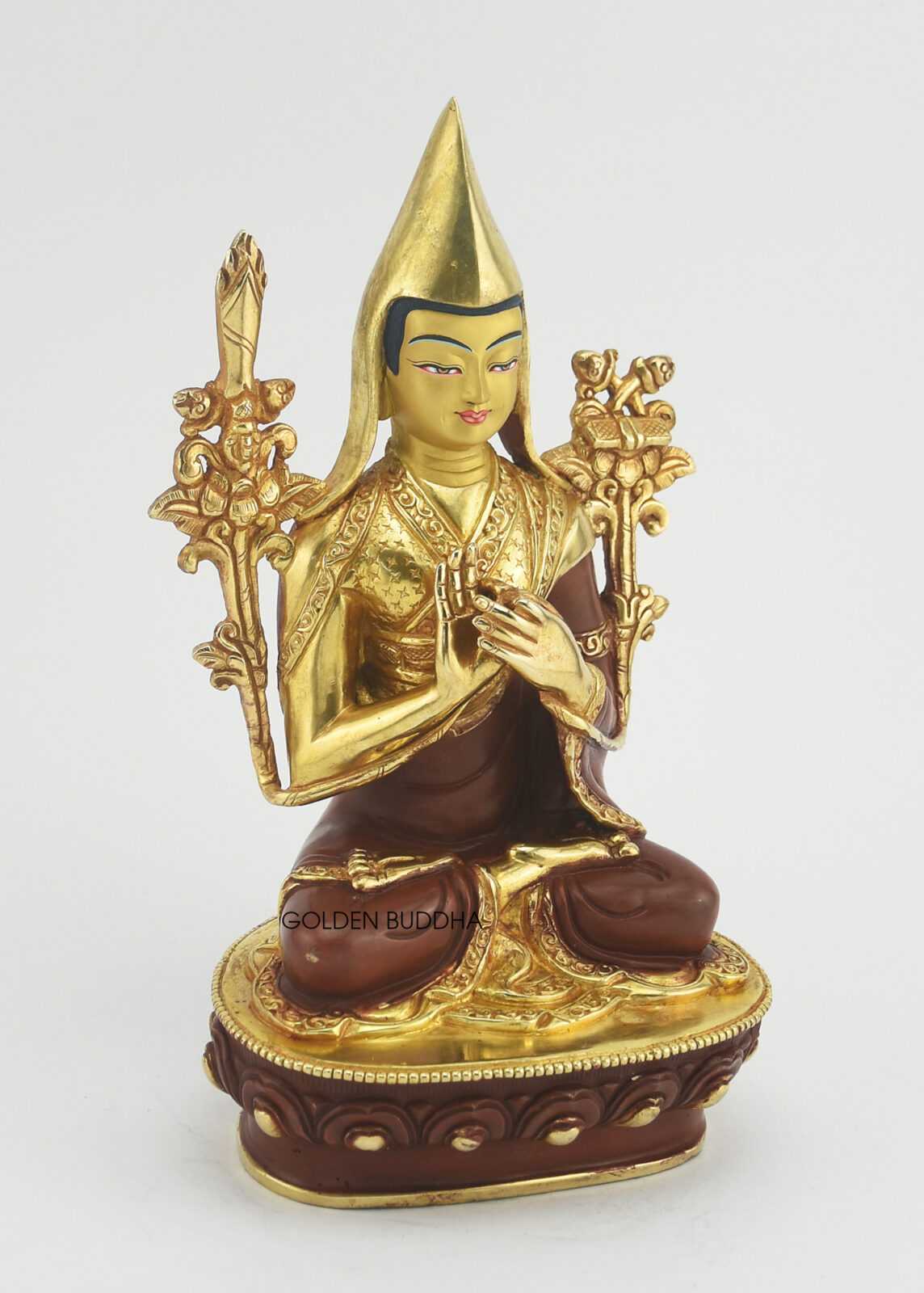
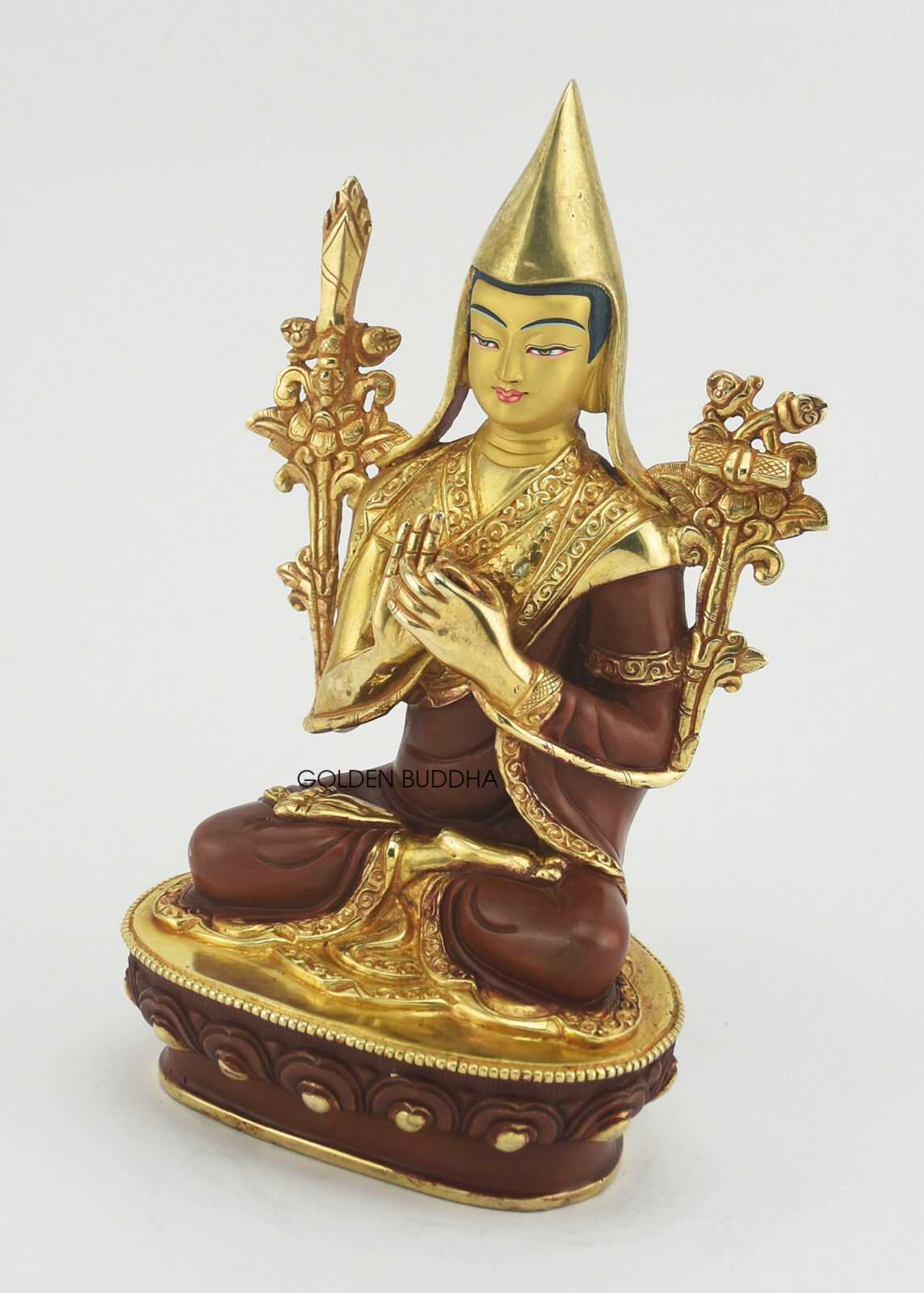
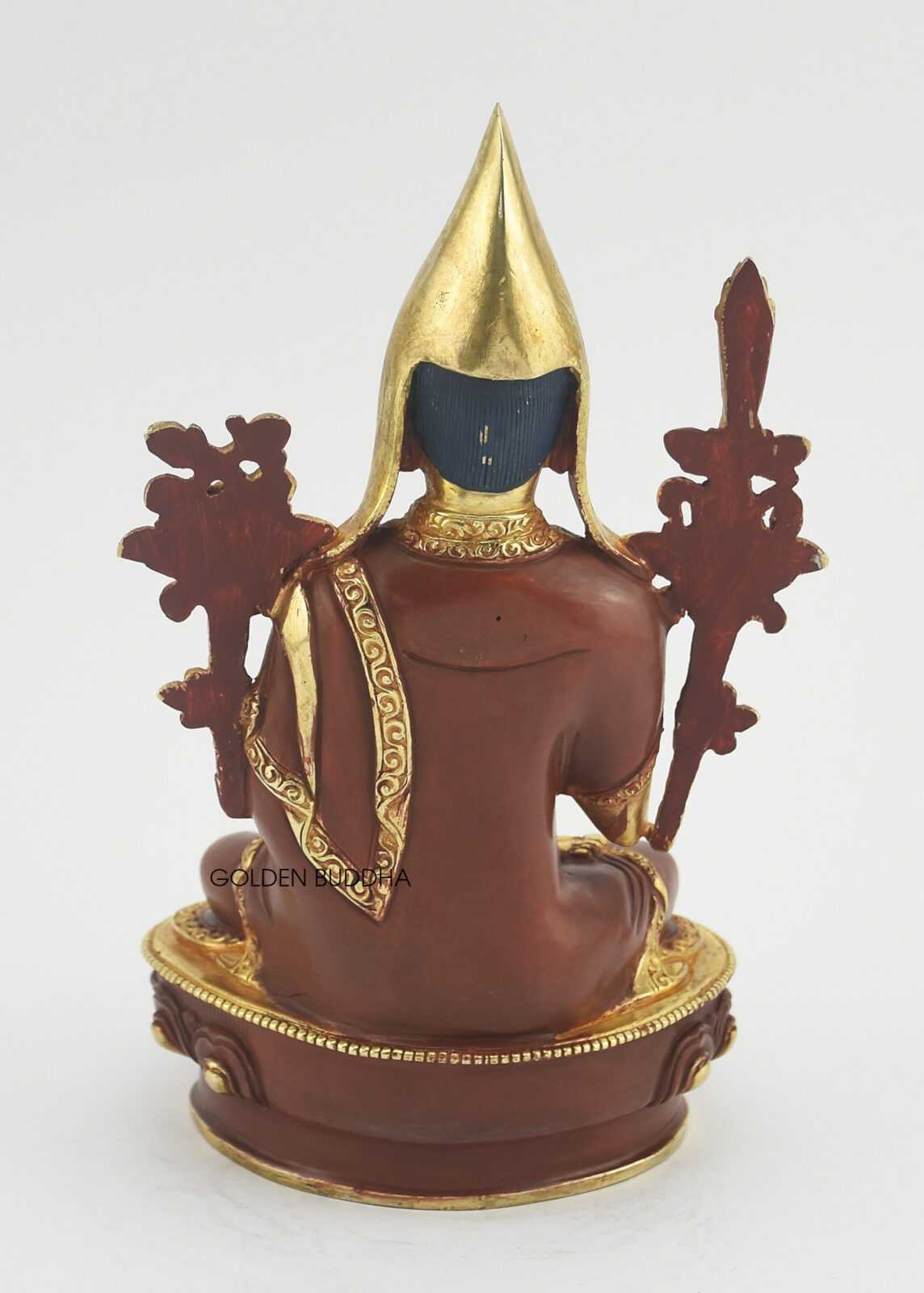
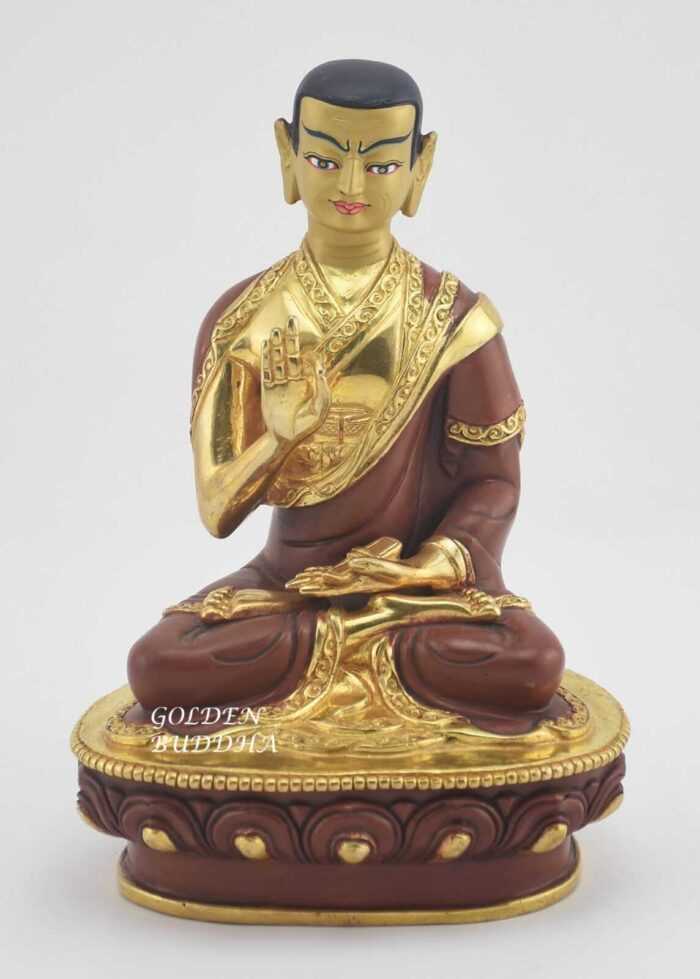
This 9.25-inch Guru Tsongkhapa Statue presents Je Tsongkhapa, also known as Losang Drakpa, in the refined teaching posture associated with the founder of the Gelug school of Tibetan Buddhism. Handmade in Patan, Nepal from copper alloy using the traditional lost-wax casting method, the statue combines selective 24K fire gilding with deep reddish-brown robe sections and a face hand painted in 18K gold and natural pigments. The photographs show a carefully balanced composition: Tsongkhapa sits in a stable cross-legged meditation posture above a broad lotus throne, his tall pointed pandita hat rising prominently above a serene face, while elaborate lotus stems carry his two principal wisdom attributes beside the shoulders.
Guru Tsongkhapa Statue | Gelug Master and Manjushri Emanation
Tsongkhapa (1357–1419) was one of the great scholar-practitioners of Tibetan Buddhism and the founder of the Gelug tradition. Tibetan devotional tradition venerates him as an emanation of Manjushri, the Bodhisattva of transcendent wisdom. This relationship is especially clear in the sculpture’s iconography. Tsongkhapa wears the distinctive pointed yellow pandita hat and monastic robes, identifying him as both an ordained teacher and a master of the scholastic tradition. His hands are held before the heart in the Dharmachakra mudra, the gesture of turning the Wheel of Dharma, emphasizing his role as a teacher who systematized the path of sutra and tantra.
The two lotus blossoms rising beside him provide the clearest connection with Manjushri. Over Tsongkhapa’s right shoulder is the sword of wisdom, whose blade symbolizes discriminating insight cutting through ignorance and mistaken views. Over his left shoulder rests the Prajnaparamita scripture, representing the perfection of wisdom teachings. The photographs clearly show both attributes framed by ornate lotus stems and scrolling foliage, giving the upper composition an unusually architectural quality while preserving the traditional iconographic arrangement.
Handcrafted Detail and Two-Tone Finish
The craftsmanship becomes especially apparent in the contrast between polished gold and the warm reddish-brown robe areas. Fine engraved scrollwork follows the robe borders, neckline, cuffs and layered textile edges, while the central vest is decorated with small repeated motifs. Tsongkhapa’s face is softly modeled with elongated eyes, delicately painted brows and lips, and three clearly defined neck lines. Below, the lotus throne combines a gilded upper platform and beaded rim with darker lotus-petal relief around the base, each petal accented by a bright gold center. These restrained contrasts prevent the gilding from overwhelming the sculptural details and give the statue a mature Himalayan altar aesthetic.
A Wisdom and Mind-Training Three-Statue Arrangement
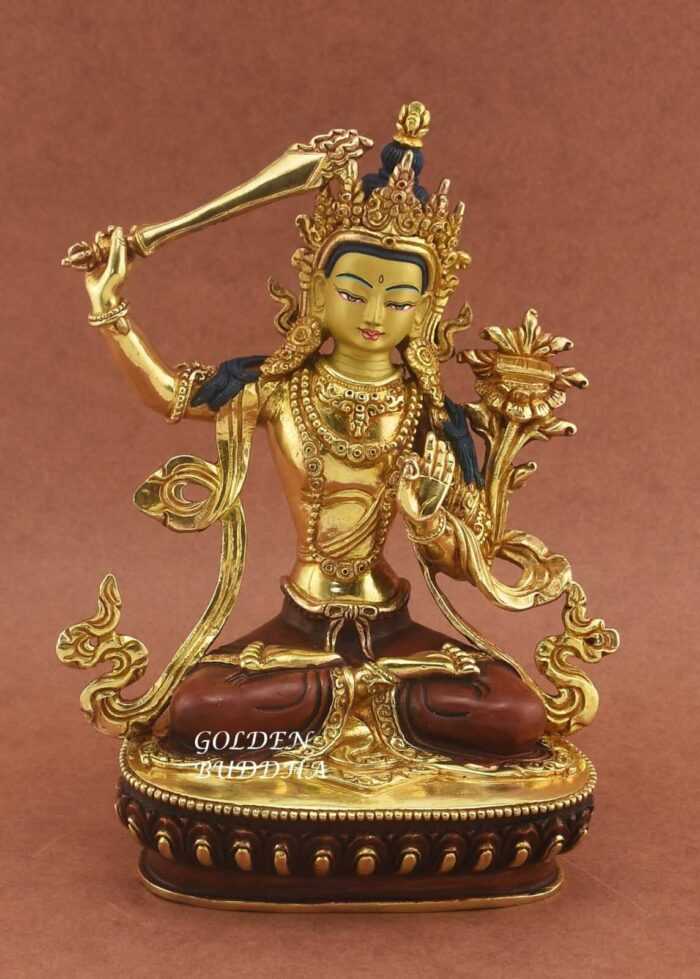
This statue can form a meaningful lineage-inspired grouping with our handmade Manjushri statue and Geshe Langri Tangpa statue. Manjushri represents the archetypal source of wisdom; Tsongkhapa represents that wisdom expressed through a great historical teacher; and the earlier Kadampa master Langri Tangpa represents the disciplined cultivation of bodhicitta and mind training through his celebrated Eight Verses of Thought Transformation. For a visually hierarchical arrangement, Manjushri may be placed in the center or slightly elevated, with Langri Tangpa to the viewer’s left and Tsongkhapa to the viewer’s right. This should be understood as a thoughtful thematic altar grouping rather than a prescribed canonical Gelug trio; the traditional Tsongkhapa trio places him with his principal disciples Gyaltsabje and Khedrubje.
Guru Tsongkhapa Statue | Filling and Consecration in Kathmandu
For practitioners preparing the statue for devotional use, arrangements can be made for traditional statue filling, blessing and consecration in Kathmandu, Nepal. Sacred texts, mantras and appropriate consecration substances can be placed within the hollow interior before the statue is ritually sealed and blessed, transforming the finished sculpture into a formally prepared support for meditation, offerings and lineage practice.
Custom Tibetan Buddhist Statues
Collectors, Dharma centers and practitioners seeking a coordinated Gelug altar may also commission custom Tibetan Buddhist statues handmade in Nepal. Tsongkhapa can be ordered in alternate sizes and traditional finishes, or commissioned together with Manjushri, Geshe Langri Tangpa, Gyaltsabje, Khedrubje or other lineage figures. Matching proportions, gilding, robe treatment and lotus-throne design can be planned with the artisan so that a multi-statue shrine reads as a unified ensemble rather than a collection of unrelated pieces.
Authentic, Handmade in Nepal
Every statue is handcrafted in Patan, Nepal, using traditional lost wax casting and comes with a certificate of authenticity issued by Nepal’s Department of Archaeology, verifying its materials, technique, and origin.
Reviews
There are no reviews yet.