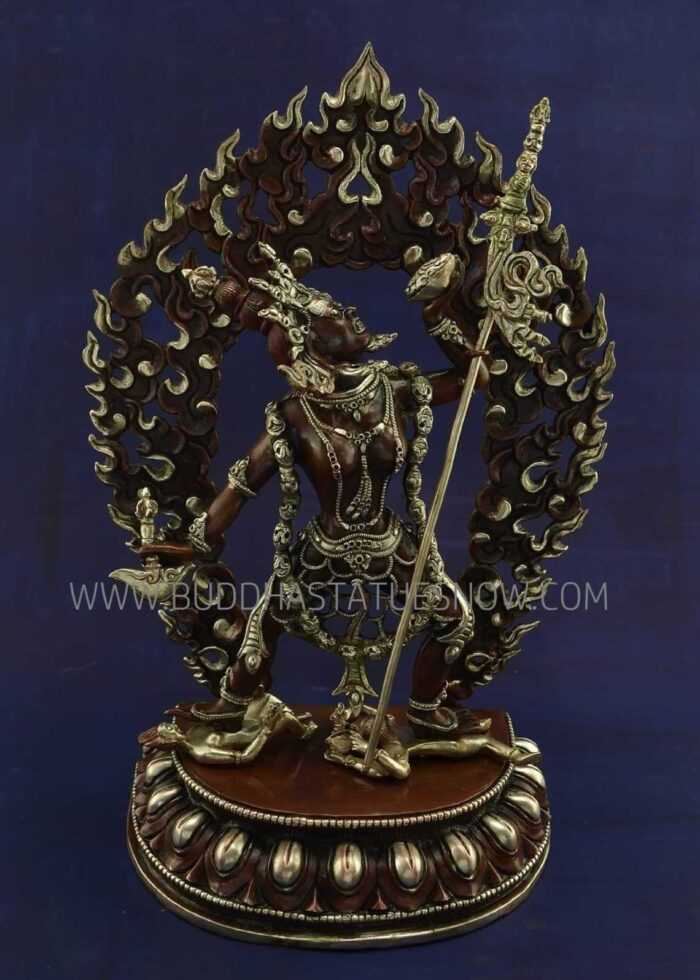

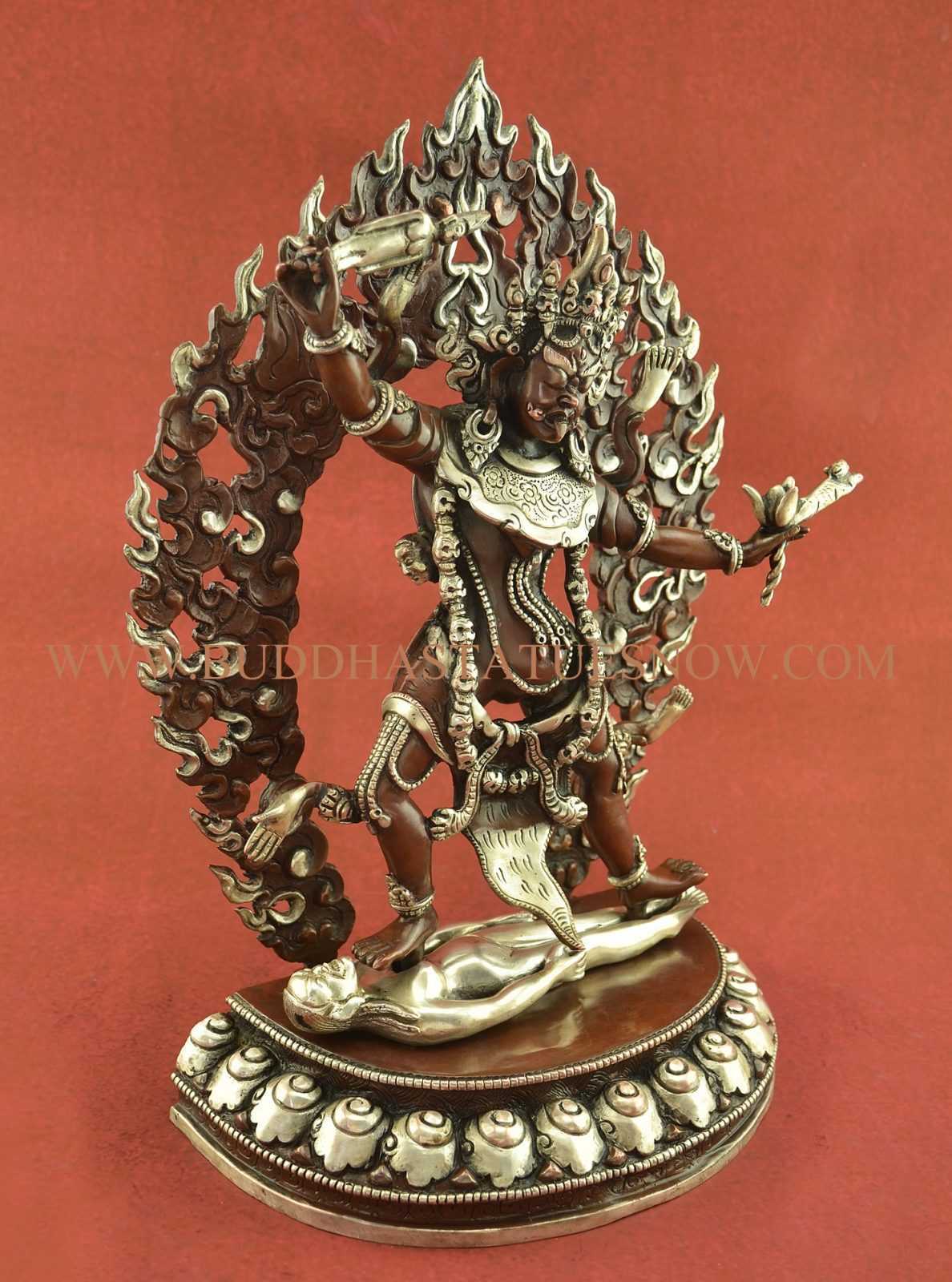
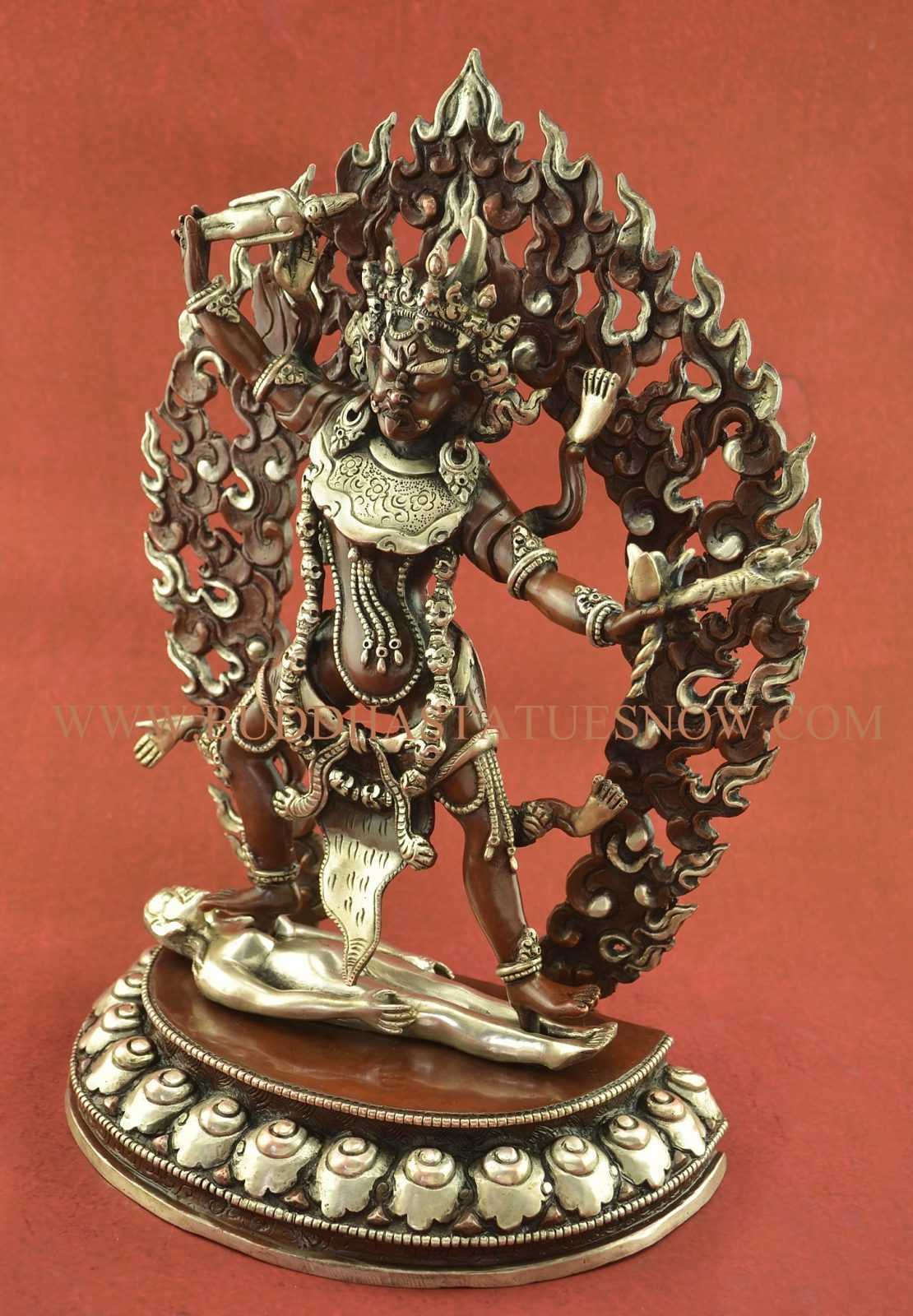
This commanding Ekajati statue depicts Ugra Tara, also known as Blue Tara, in her intensely wrathful role as a guardian of the Dzogchen teachings and revealed treasure traditions of the Nyingma school. Standing within a removable mandorla of blazing awareness, Ekajati displays her unmistakable single eye, single tooth, single breast, skull crown, bone ornaments, tiger-skin garment, and dynamic warrior posture. Her fearsome appearance does not express ordinary anger. It represents enlightened protective activity acting with complete concentration against obstacles, broken commitments, and forces that threaten the authentic transmission of the Dharma.
Handcrafted in Patan, Nepal, this 14-inch Ekajati statue was produced by skilled Newar artisans using the traditional lost-wax casting method. The entire sculpture—including Ekajati, her ritual attributes, the subdued figure, lotus pedestal, structural supports, and removable flame frame—is cast from copper alloy. A rich oxidized copper finish gives the protector a dark, antiquated presence, while real silver plating highlights the crown, jewelry, ritual implements, flame tips, lotus petals, and prostrate figure beneath her feet. The figure measures approximately 12 inches without the frame and 14 inches when fully assembled.
Ekajati Statue Depicting Ugra Tara, Protector of Dzogchen
Ekajati means “she of the single hair knot.” Within important Nyingma traditions, she is revered as a principal guardian of Dzogchen, or the Great Perfection, and of the terma teachings revealed by accomplished treasure discoverers. Her role is not merely to repel worldly harm. She protects the integrity of profound teachings, guards their mantras and transmissions, and prevents sacred instructions from being distorted, misused, or disclosed where the necessary preparation and commitments are absent.
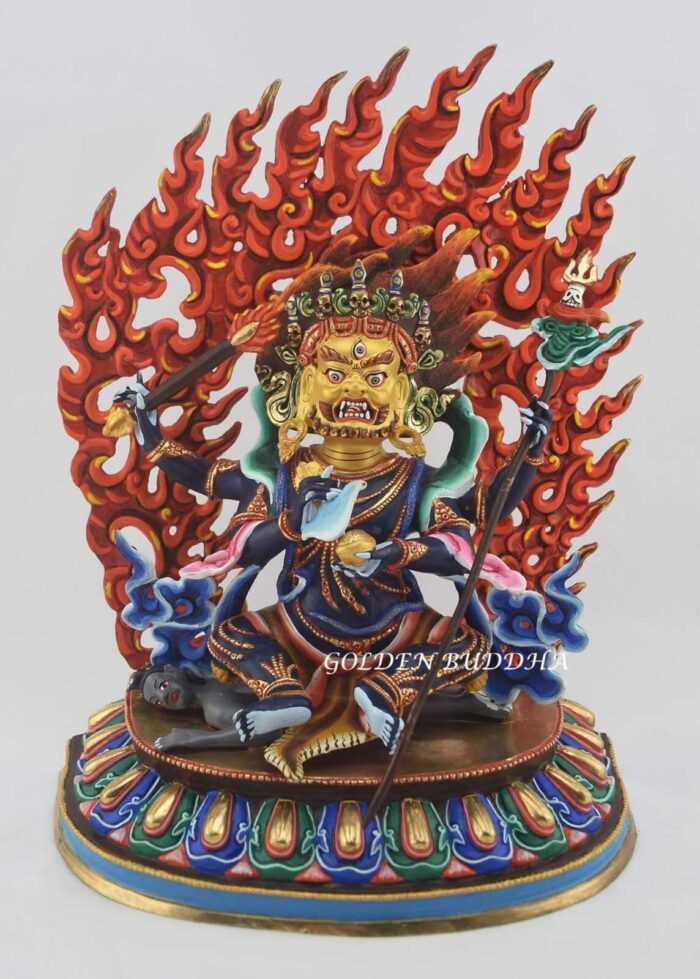
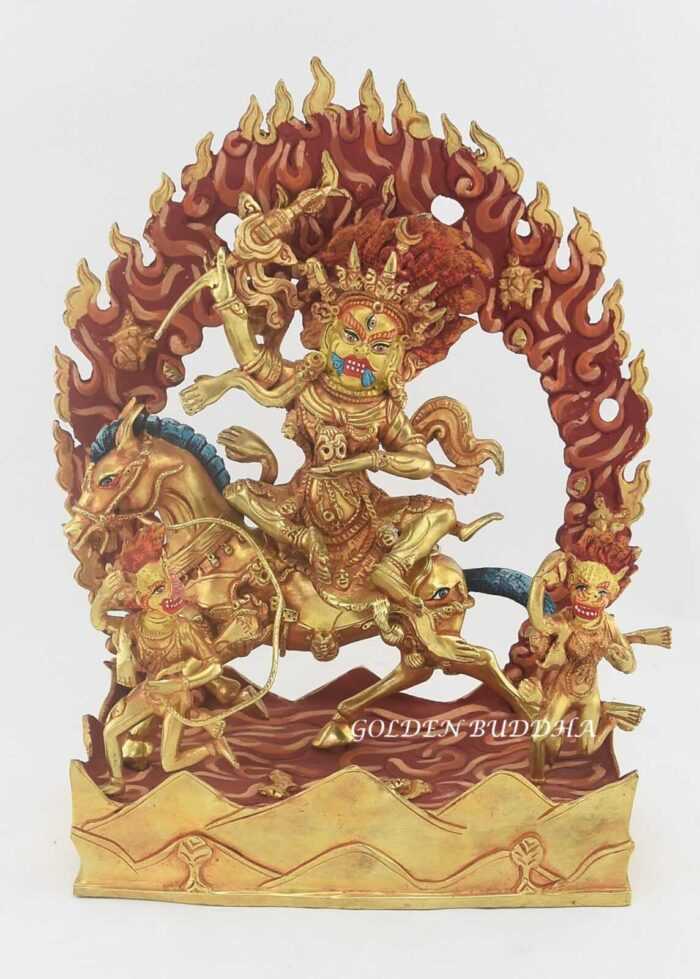
The title Ugra Tara emphasizes her intensely wrathful character, while Blue Tara identifies her within the broader family of forceful Tara manifestations. This Ekajati statue presents that protective energy through an uncompromising stance, a fierce facial expression, a crown of skulls, charnel-ground ornaments, and implements associated with the complete subjugation of hindrances. Related manifestations of enlightened protection may be explored in our guide to Mahakala and other Dharmapala deities.
The Single Eye, Tooth and Breast of the Ekajati Statue
Ekajati’s most distinctive features are her single eye, single tooth, and single breast. These attributes are not presented as physical deficiencies. They express indivisible awareness and unwavering concentration. Her solitary eye looks without distraction, symbolizing direct perception that is not divided between observer and observed. Her single projecting tooth represents decisive power that cuts through obstacles without hesitation, while her single breast signifies undivided nourishment and protection of the teachings entrusted to her care.
The artisan has emphasized these features through the sharply modeled face. One central eye dominates the brow beneath the skull crown, while the open mouth reveals the prominent tooth. Her facial contours, flared nostrils, curling hair, and wrathful expression are enhanced with silver-plated highlights against the dark oxidized copper surface.
Ekajati Statue in the Pratyalidha Warrior Posture
This Ekajati statue stands in the forceful Pratyalidha warrior posture, with her legs spread in active engagement above a prostrate figure. The broad stance creates a stable foundation for the movement of her multiple arms, flying ornaments, and surrounding flames. It conveys a protector who is already acting rather than waiting passively for danger to arise.
The subdued human figure beneath her feet represents conquered obstacles, ego-clinging, and forces hostile to spiritual realization. It is cast in copper alloy and plated in silver, creating a stark visual contrast with Ekajati’s oxidized body. The imagery should be understood symbolically: what is overcome is not an ordinary person, but the ignorance, harmful activity, and broken commitments that obstruct the Dharma.
Wrathful Implements and Messenger of the Ekajati Statue
Among Ekajati’s most formidable attributes is the small impaled body raised above her shoulder. This extreme image expresses her complete mastery over death, obstruction, and destructive forces. It is not an endorsement of worldly violence, but a visual declaration that no condition arising within samsara lies beyond the reach of awakened awareness.
Another hand presents her animal messenger, traditionally identified as a female wolf dispatched against harmful influences. Additional hands extend outward in commanding gestures, reinforcing the impression of simultaneous protective activity in every direction. Silver plating defines the hands, bracelets, implements, and smaller sculptural elements against the deep copper finish.
Skull Crown, Bone Ornaments and Tiger-Skin Garment
Ekajati wears a wrathful skull crown and an elaborate garland of severed heads and bone ornaments. These charnel-ground emblems represent freedom from fear, attachment to the body, and mistaken belief in a permanent self. Silver-plated necklaces, bracelets, anklets, girdles, and chest ornamentation stand out vividly against her antiquated oxidized copper form.
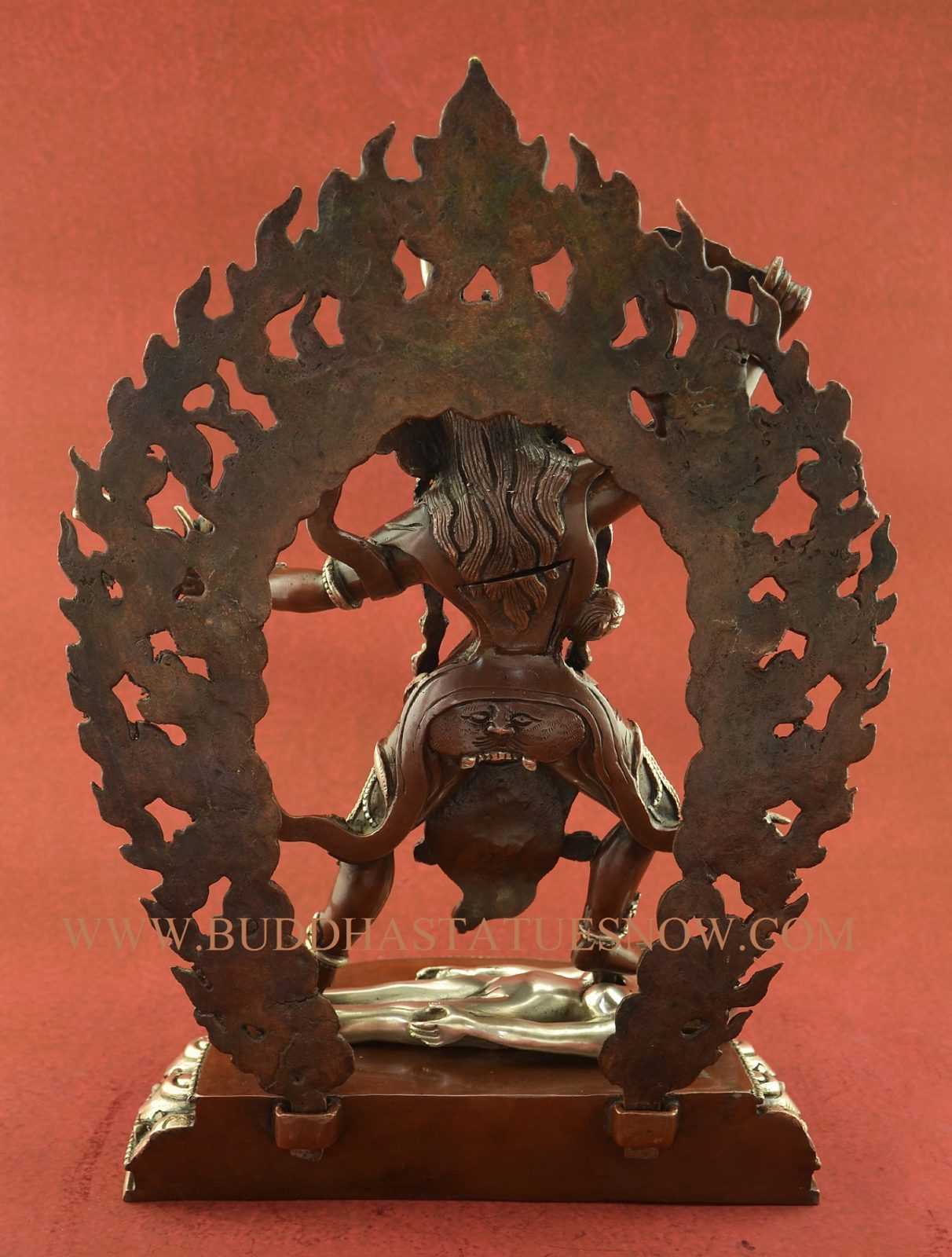
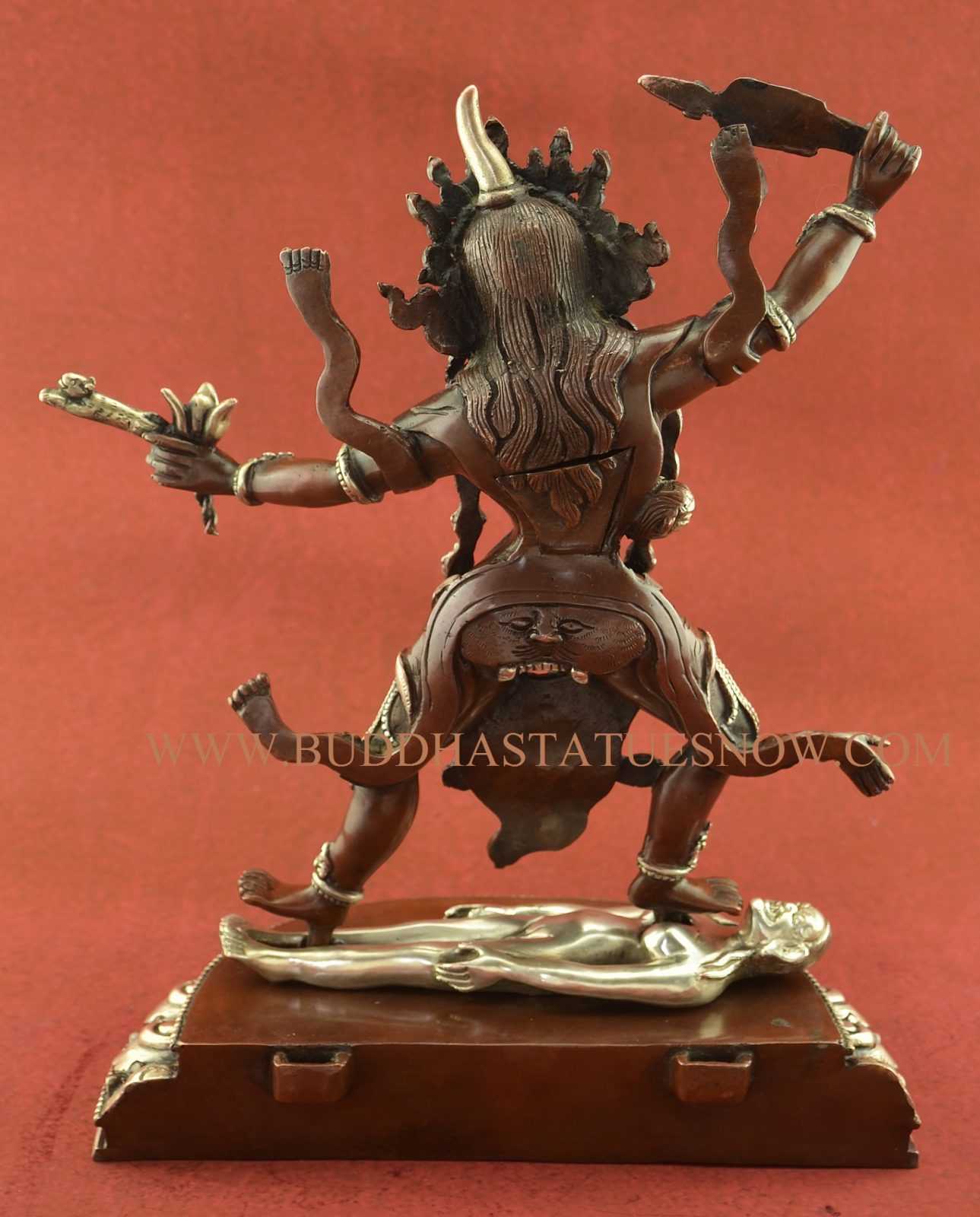
A tiger skin is wrapped around her waist. The rear photographs clearly reveal the tiger’s face centered across the back, with the pelt and limbs extending around her hips. The tiger skin symbolizes mastery over aggression, pride, and untamed instinctive energy. Rather than suppressing this force, Ekajati transforms it into fearless enlightened protection.
Removable Copper-Alloy Flame Frame and Silver Lotus Base
The removable mandorla surrounding the Ekajati statue is cast entirely from copper alloy. Its openwork flames and curling cloud forms receive a dark oxidized finish, while selected flame tips are plated in silver. The contrasting surfaces suggest pristine awareness blazing through darkness and consuming the mental states that obstruct realization.
The frame fits into supports behind the pedestal and may be removed for secure packing or a more open display. Beneath the figure is a broad copper-alloy lotus base with silver-plated petals and beaded borders. The substantial pedestal visually anchors Ekajati’s vigorous posture and balances the height of the surrounding flames.
Pairing the Ekajati Statue with Rahula
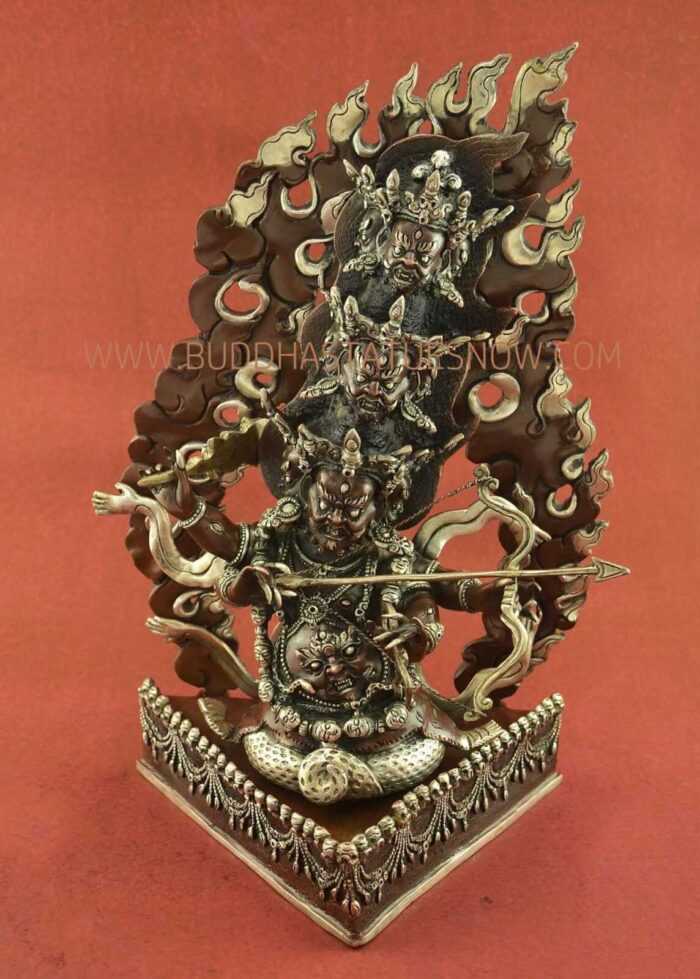
This Ekajati statue would form a powerful two-piece protector arrangement with the silver-plated Rahula Statue. Both are closely associated with the protection of profound Nyingma teachings and the maintenance of tantric commitments. Ekajati guards Dzogchen and treasure teachings through concentrated, undivided awareness, while Rahula is known for enforcing sacred vows and overcoming forces that threaten the integrity of Dharma practice.
Their iconography is complementary. Ekajati’s singular eye expresses uninterrupted awareness, while Rahula’s many eyes represent all-seeing vigilance. Her warrior posture, wolf messenger, skull ornaments, and blazing mandorla correspond naturally with Rahula’s planetary heads, serpent body, bow and arrow, and wrathful protective presence. A gold and silver-plated serkyem set may also accompany such a shrine arrangement for traditional protector offerings performed according to one’s lineage instructions.
Custom-Made Ekajati Statue and Rahula Statue Options
Practitioners, monasteries, Dharma centers, and collectors may commission custom-made Tibetan Buddhist statues handcrafted by experienced Newar artisans in Patan. A custom Ekajati statue may be created in a preferred size or finish while preserving her single eye, tooth and breast, skull crown, tiger skin, ritual implements, wolf messenger, warrior stance, subdued figure, and removable flame mandorla.
A corresponding Rahula statue can be commissioned to create a doctrinally and visually unified protector pair. The sculptures may share coordinated oxidized copper surfaces, silver-plated details, lotus bases, and flame frames while retaining their individual attributes. Their pairing is especially meaningful because Ekajati protects the undivided awareness and secret transmissions of Dzogchen, while Rahula guards vows and confronts forces that endanger the continuity of profound practice.
Every commission is individually modeled and cast in copper alloy through the traditional lost-wax process. Progress photographs may be provided so that iconography, proportions, implements, removable components, and finishes can be reviewed before completion. With its uncompromising symbolism, authentic copper-alloy construction, oxidized finish, real silver-plated details, and refined Newar craftsmanship, this Ekajati statue is a formidable representation of Ugra Tara and the protective power of undivided awakened awareness.
Authentic, Handmade in Nepal
Every statue is handcrafted in Patan, Nepal, using traditional lost wax casting and comes with a certificate of authenticity issued by Nepal’s Department of Archaeology, verifying its materials, technique, and origin.