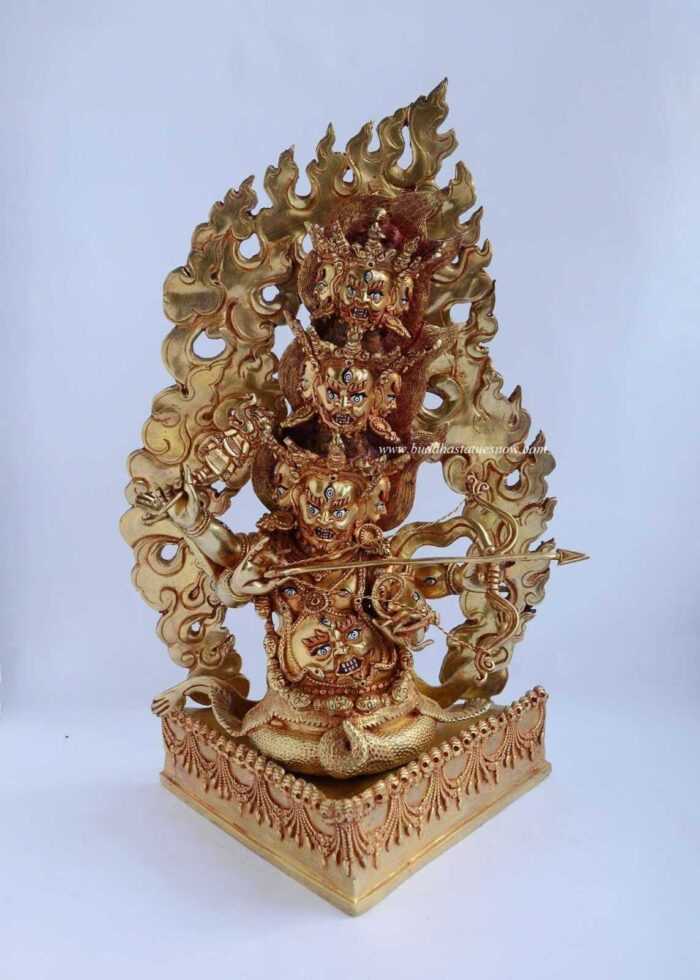

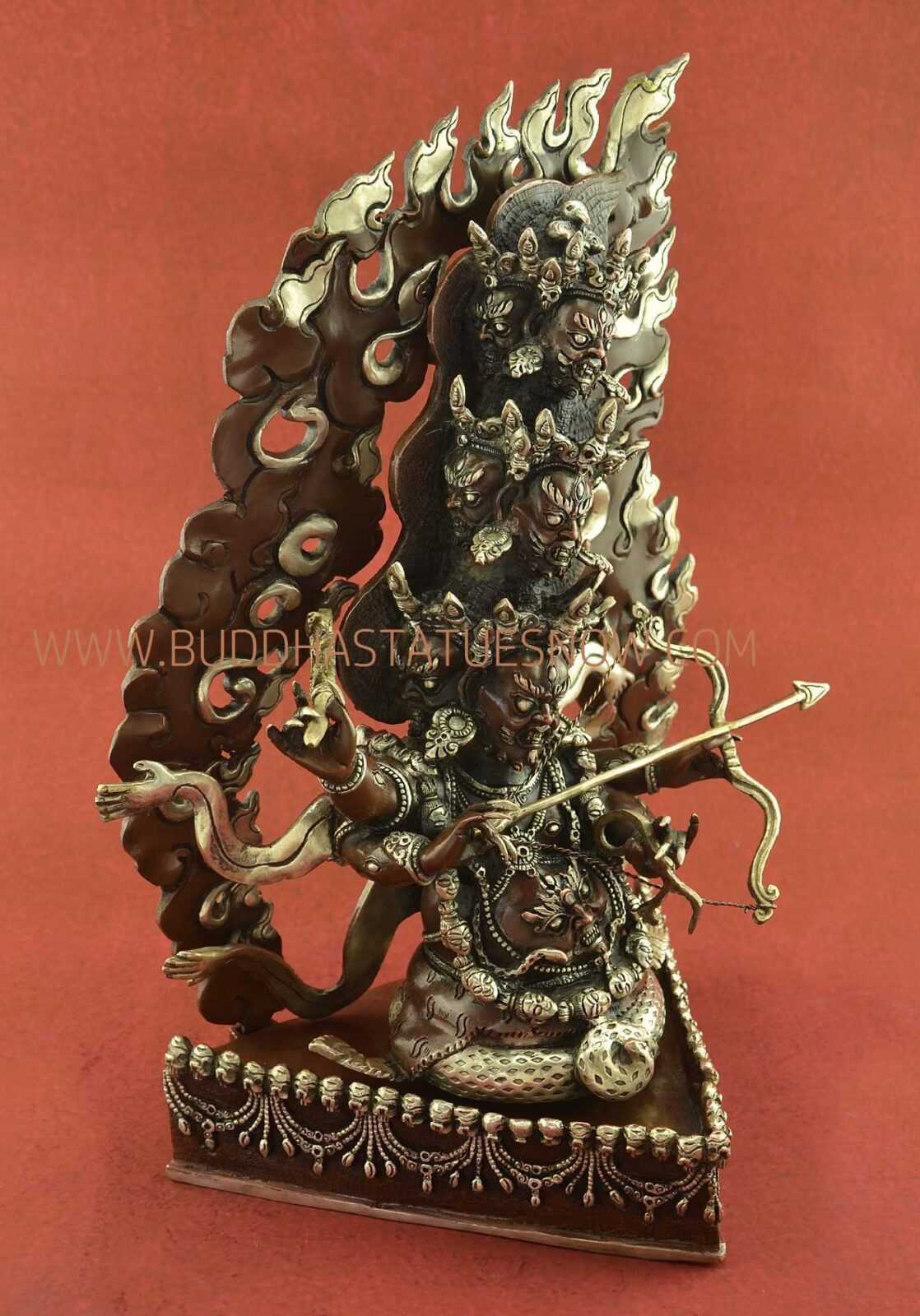
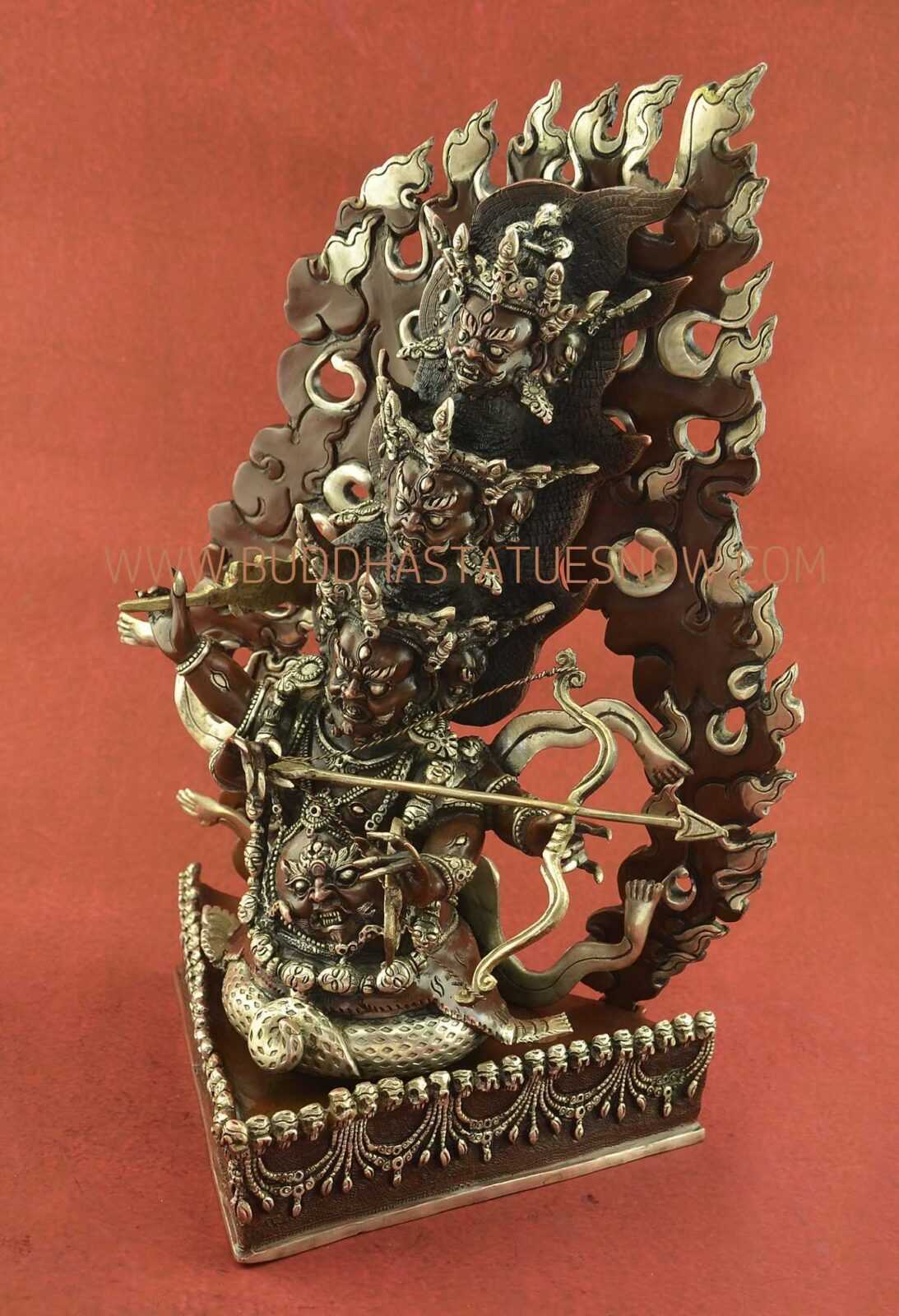
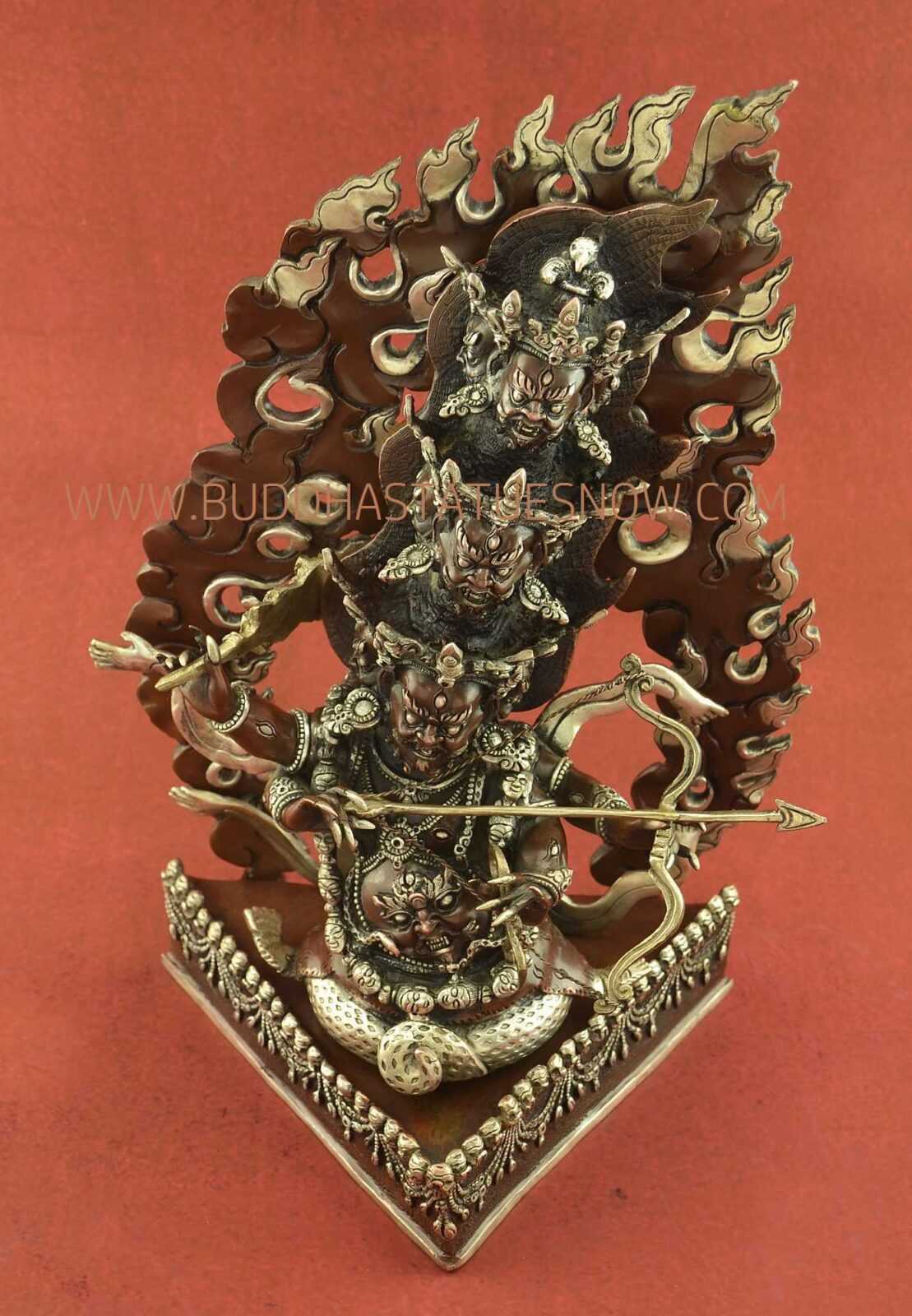
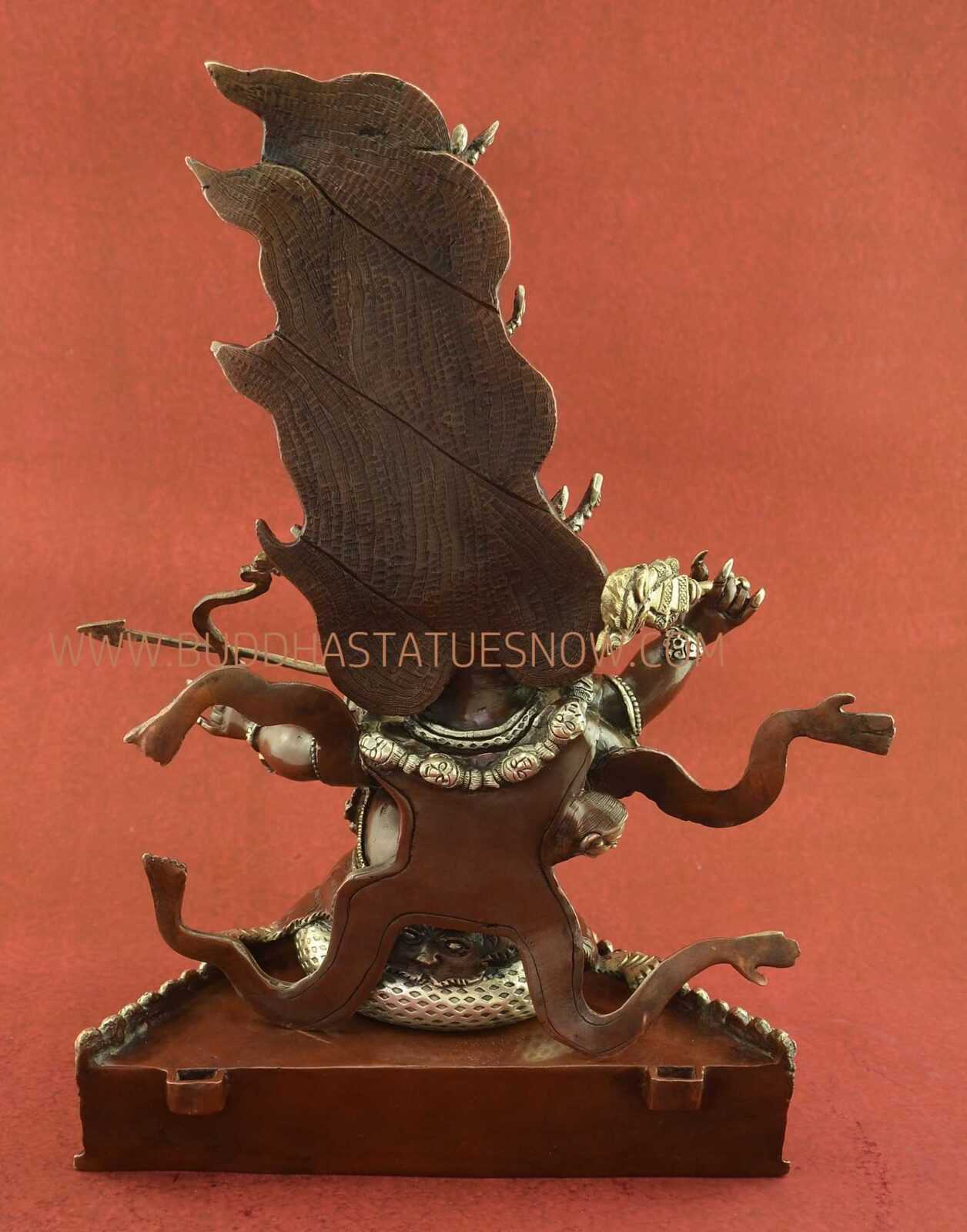
This formidable Rahula statue depicts Sgra gcan ’dzin—pronounced Drachen Dzin—the eclipse deity and one of the most visually complex Dharma protectors in the Nyingma tradition. Rahula appears as a cosmic explosion of stacked wrathful heads, watchful eyes, drawn weapons, blazing flames, and a coiled naga lower body. His terrifying form does not represent uncontrolled aggression. It expresses uncompromising protective activity directed against obstacles, harmful planetary influences, naga disturbances, and violations of the sacred commitments that support Vajrayana practice.
Handcrafted in Patan, Nepal, this 14.5-inch Rahula statue was created by skilled Newar artisans using the traditional lost-wax casting method. The entire composition—including Rahula, his multiple heads and arms, ritual implements, coiled serpent body, triangular pedestal, structural fittings, and removable flame mandorla—is made from a base of copper alloy. The dark oxidized copper finish is enriched with real silver plating across the faces, crowns, jewelry, weapons, naga scales, flame tips, and elaborate borders. The figure measures approximately 13 inches without the frame and 14.5 inches when fully assembled.
Rahula Statue Depicting the Nyingma Eclipse Protector
Rahula is associated with eclipses, planetary forces, astrology, serpent beings, and the protection of tantric vows. His Tibetan name, Sgra gcan ’dzin, is traditionally connected with the power that seizes or eclipses the sun and moon. Tibetan Buddhism transformed this ancient cosmological image into the figure of a vigilant Dharma protector whose awareness extends throughout the heavens, the elemental world, and the hidden domains associated with nagas.
Within important Nyingma traditions, Rahula is invoked to guard practitioners who maintain sacred commitments and to confront disturbances attributed to adverse astrological conditions, elemental imbalance, hostile influences, or weakened samaya. His wrath is compassionate in purpose: he opposes whatever prevents practitioners from honoring their vows and progressing along the Dharma path.
The Many Eyes Covering the Rahula Statue
One of the most extraordinary features of this Rahula statue is the multitude of eyes carved across his upper body. These eyes symbolize uninterrupted vigilance and awareness extending in every direction. Rahula sees the movements of the planets, the configurations of celestial forces, the actions of harmful beings, and the condition of the commitments he is charged to protect.
The dense arrangement of eyes turns his body into an image of cosmic perception. Nothing can approach unnoticed, and no obstacle remains hidden from his protective awareness. The eyes are carefully chased into the copper-alloy surface and accented with silver, allowing them to emerge clearly from the dark antiquated finish.
Nine Stacked Heads and Mastery Over Planetary Forces
Above Rahula’s principal face rises a towering arrangement of wrathful heads associated with the nine planetary forces of Tibetan astrology. Their vertical placement gives the sculpture its explosive upward momentum, as though multiple cosmic powers have been gathered into a single protective form. The silver-highlighted faces bear fierce expressions, bulging eyes, bared teeth, heavy brows, and skull-crown ornamentation.
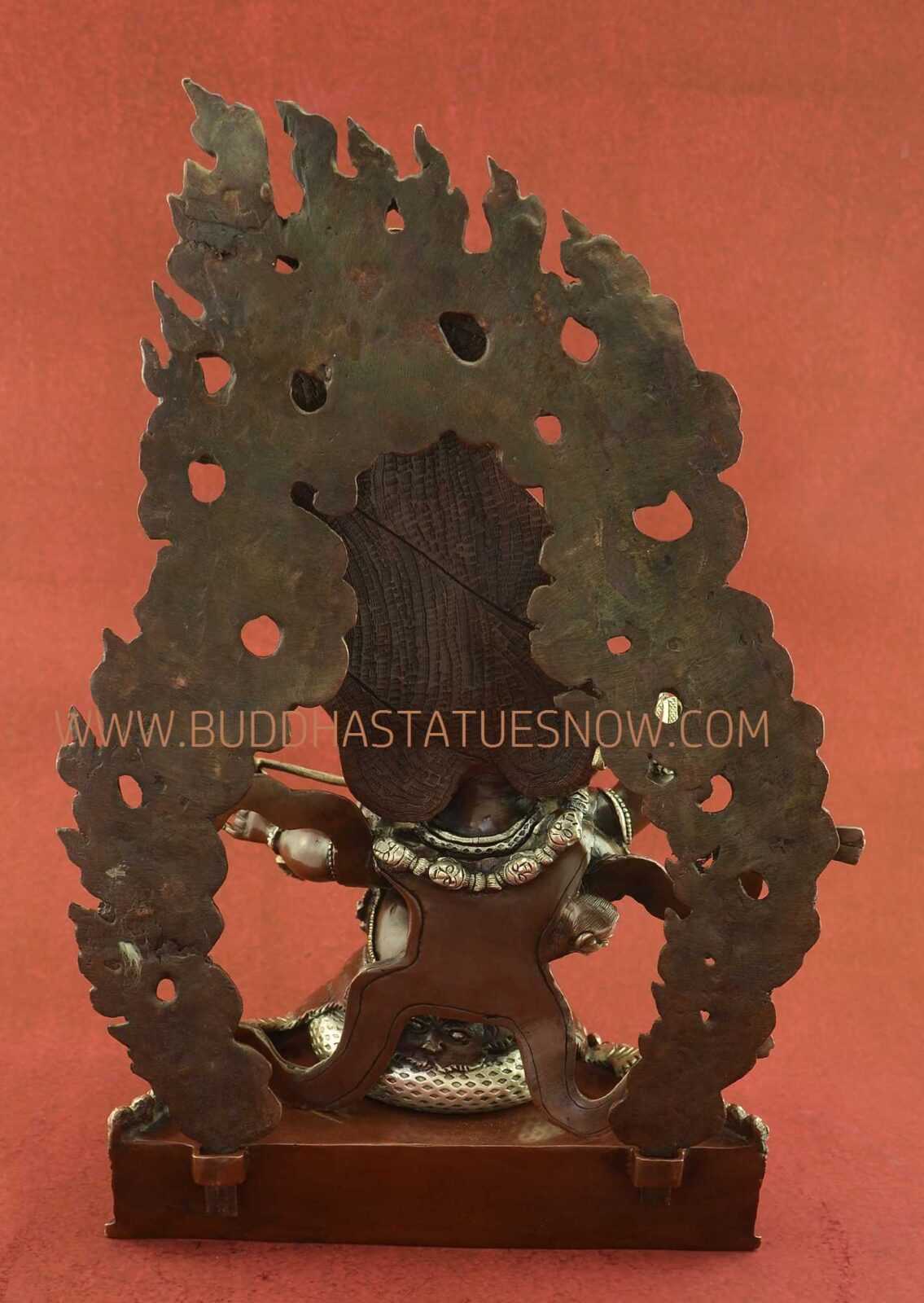
The stacked heads symbolize Rahula’s mastery over the celestial influences traditionally believed to affect health, fortune, environmental conditions, and spiritual practice. Rather than remaining subject to those forces, he absorbs and commands them. The dark hair rising behind the heads is modeled in broad, textured masses, giving the rear of the statue the same imposing sculptural depth as the front.
The Bow and Arrow of the Rahula Statue
Rahula’s principal hands stretch a bow and arrow across the width of the composition. The arrow is drawn horizontally and aimed with controlled precision, while the curving bow creates a strong counterline against the vertical column of heads. This weapon symbolizes focused awareness directed toward the exact source of an obstacle. Like an arrow reaching its target without deviation, enlightened insight penetrates confusion and exposes the causes of harmful actions and broken commitments.
His additional arms extend outward with other attributes and commanding gestures, conveying simultaneous activity in several directions. Silver-plated hands, bracelets, weapons, and ritual ornaments stand out sharply against the oxidized copper arms and torso, making the complex arrangement easier to read without diminishing its wrathful intensity.
Coiled Naga Body and Serpent-Realm Authority
Below the eye-covered torso, Rahula’s form transitions into the body of a coiled naga. The serpent coils rest at the center of the triangular pedestal and are covered with individually modeled scales highlighted in real silver. This composite anatomy links Rahula with the subterranean and aquatic realms traditionally inhabited by nagas, beings associated with water, weather, fertility, hidden treasures, and disturbances arising when the natural environment is harmed.
The naga body signifies Rahula’s authority over these elemental forces. It also reinforces his cosmic nature: his stacked heads reach upward toward the planetary sphere, his many eyes survey every direction, and his serpent coils connect him with forces beneath the visible world.
Silver-Plated Ornaments and Triangular Protector Base
The triangular copper-alloy pedestal is especially appropriate for the forceful character of this Rahula statue. Its dark oxidized surface is edged with silver-plated borders, rows of small skull forms, pendant chains, and finely worked ornaments. The angular base provides a stable visual foundation beneath the dense arrangement of serpent coils, arms, heads, and flames.
Throughout the sculpture, real silver is used selectively rather than uniformly. The bright metal highlights Rahula’s faces, skull crowns, necklaces, naga scales, bow, arrow, hands, flame tips, and pedestal decorations. This contrast reveals the intricate craftsmanship while preserving the antiquated, imposing character of the oxidized copper-alloy body.
Removable Copper-Alloy Flame Mandorla
The removable mandorla is also made entirely from copper alloy. Its openwork flames rise behind the stacked heads and curve around the protector in a dense field of blazing forms. The frame retains a dark oxidized finish, while selected flame tips are plated in silver to produce a flickering contrast around the outer edge.
These flames symbolize pristine awareness consuming obscurations, hostile influences, and every condition that interferes with the Dharma. The frame fits into supports at the rear of the pedestal and can be removed for secure packing, transportation, or display without the mandorla.
Pairing the Rahula Statue with Ekajati
This Rahula statue would form a meaningful two-piece protector arrangement with the oxidized and silver-plated Ekajati Statue. Both figures hold important protective roles within Nyingma traditions and share a powerful visual language of antiquated copper, real silver highlights, charnel-ground imagery, wrathful expressions, and encircling flames.
Their attributes are doctrinally complementary. Rahula’s many eyes signify all-encompassing vigilance, while Ekajati’s single eye represents undivided awareness. Rahula commands planetary and naga-related forces and guards sacred commitments; Ekajati protects Dzogchen and revealed treasure teachings from misuse and corruption. Together they represent expansive cosmic watchfulness and singular concentration applied to the preservation of profound practice. A gold and silver-plated serkyem set may accompany the pair for protector offerings performed according to the instructions of one’s lineage.
Custom-Made Rahula Statue and Ekajati Statue Options
Practitioners, monasteries, Dharma centers, and collectors may commission custom-made Tibetan Buddhist statues handcrafted by experienced Newar artisans in Patan. A custom Rahula statue may be created in a preferred size or finish while preserving the eye-covered torso, stacked planetary heads, wrathful faces, bow and arrow, multiple arms, coiled naga body, triangular base, and removable flame mandorla.
A matching Ekajati may be commissioned so the two protectors share coordinated dimensions, oxidized copper-alloy surfaces, real silver-plated details, flame frames, and pedestal ornamentation. Their individual iconography would remain carefully differentiated: Rahula with many eyes, planetary heads, bow, arrow, and naga body; Ekajati with one eye, one tooth, one breast, warrior stance, tiger skin, and wrathful messenger attributes.
Each commission is individually modeled and cast in copper alloy using the traditional lost-wax method. Progress photographs may be provided so that the heads, eyes, implements, proportions, finishes, and removable components can be reviewed before completion. With its cosmic iconography, intricate stacked construction, antiquated copper finish, genuine silver highlights, and commanding protective presence, this Rahula statue is an exceptional contemporary expression of traditional Nyingma sacred art.
Authentic, Handmade in Nepal
Every statue is handcrafted in Patan, Nepal, using traditional lost wax casting and comes with a certificate of authenticity issued by Nepal’s Department of Archaeology, verifying its materials, technique, and origin.