

Vajrapani statues embody one of the most fundamental principles in all of Buddhist teaching — that spiritual power is not the power to dominate others, but the power to overcome the inner forces that keep beings trapped in suffering. Vajrapani (Sanskrit: “Vajra in Hand”; Tibetan: Chana Dorje — “Holder of the Thunderbolt”) is the Bodhisattva who embodies the complete power of all the Buddhas — their capacity to act decisively, to protect the Dharma, to cut through obstacles, and to ensure that no force of ignorance or demonic interference can impede the path to liberation.
Together with Avalokiteshvara (Compassion) and Manjushri (Wisdom), Vajrapani forms the great triad of Bodhisattvas — the three principal protectors of the Dharma and the three qualities that define the path to Buddhahood: compassion, wisdom, and power. In virtually every major Tibetan Buddhist monastery, these three appear together as a trio — their statues placed side by side to communicate that enlightenment requires all three qualities in equal measure.
Contents
- Origin of Vajrapani — From Yaksha to Bodhisattva
- Vajrapani’s First Appearance — The Ambattha Sutra
- The Great Triad — Vajrapani, Avalokiteshvara & Manjushri
- Peaceful Vajrapani Statues
- Wrathful Vajrapani Statues — Chana Dorje
- Wrathful Vajrapani Statue Iconography Explained
- The Five Skulls — Transformation of the Five Poisons
- Vajrapani as Guhyapati — Lord of Secrets
- Vajrapani Practice & Sadhana
- Vajrapani Mantra — Om Vajrapani Hum
- Frequently Asked Questions About Vajrapani Statues
Origin of Vajrapani — From Yaksha to Bodhisattva
The inspiration behind Vajrapani statues originates in ancient pre-Buddhist Indian religion — specifically the tradition of the yakshas: powerful nature spirits who predated Buddhism by thousands of years. In ancient Indian belief, yakshas were forest deities associated with underground treasure, natural forces, fertility, and the untamed power of the wilderness. They were inherently ambivalent — capable of great generosity to those who respected them and fearsome violence against those who provoked them. Most significantly, they possessed magical powers and the ability to change their physical form at will.
As Buddhism spread across India between the 5th and 2nd centuries BCE, it encountered these powerful indigenous beliefs and responded with characteristic pragmatism: rather than dismissing the yakshas, Buddhism adopted and transformed them. The raw power of the yaksha — unpredictable, elemental, morally neutral — was reoriented toward the protection of the Dharma and the liberation of sentient beings. This transformation is most fully realized in Vajrapani, who evolved from a protective yaksha spirit in the earliest Buddhist texts into one of the most important Bodhisattvas in the entire Mahayana and Vajrayana traditions.
Vajrapani’s First Appearance — The Ambattha Sutra
Vajrapani’s earliest recorded appearance in Buddhist scripture occurs in the Ambattha Sutra (Digha Nikaya 3) — one of the oldest Buddhist texts. Shakyamuni Buddha is in conversation with the young brahmin Ambattha, who has been evasive about his family’s caste origin. The Buddha, known for his gentle persuasion, becomes unusually direct:
“Answer me now, Ambattha, this is not the time for silence. Whoever does not answer a fundamental question put to him by a Tathagata by the third asking has his head split into seven pieces.”
At precisely this moment, “Vajrapani the yaksha” appears in the sky above Ambattha, holding a “huge iron club, flaming, ablaze and glowing.” The terrified Ambattha immediately answers the Buddha’s question truthfully — and Vajrapani vanishes. This brief appearance establishes Vajrapani’s foundational role in Buddhist tradition: he is the enforcer of the Dharma, the power that ensures truth prevails over evasion, and the protector who makes the Buddha’s teaching effective even against the most resistant obstacles.
The Great Triad — Vajrapani, Avalokiteshvara & Manjushri
The relationship between Vajrapani, Avalokiteshvara, and Manjushri is one of the most important structural principles of Tibetan Buddhist iconography. These three Bodhisattvas form the great triad of enlightened qualities — the three characteristics that together define complete Buddhahood:
- Avalokiteshvara — embodies the compassion of all the Buddhas. He perceives the suffering of every being in every realm simultaneously and responds with the most appropriate form of assistance. His mantra Om Mani Padme Hum is the most widely recited mantra in all of Tibetan Buddhism.
- Manjushri — embodies the wisdom of all the Buddhas. He perceives the true nature of reality — emptiness, interdependence, the absence of inherent self — with perfect clarity. His flaming sword cuts through ignorance; his Prajnaparamita Sutra contains the philosophical framework of liberation.
- Vajrapani — embodies the power of all the Buddhas. He is the capacity to act — to translate compassion and wisdom into effective, decisive action that actually benefits beings. Without power, compassion remains sentiment and wisdom remains philosophy.
The theological significance of this triad cannot be overstated. In Tibetan Buddhist teaching, a being who possesses only compassion without wisdom may cause harm through good intentions. A being who possesses only wisdom without compassion may become detached and indifferent. A being who possesses only power without compassion or wisdom becomes a tyrant. Only the inseparable union of all three produces genuine Buddhahood — which is why these three always appear together as a matched set in Tibetan Buddhist monasteries, thangkas, and altar arrangements.
This triad is also mirrored in the Guru Tsongkhapa trio — where Tsongkhapa (Manjushri/Wisdom) is flanked by Gyaltsabje (Avalokiteshvara/Compassion) and Khedrubje (Vajrapani/Power) — a direct visual echo of the Bodhisattva triad applied to the founding masters of the Gelug school.
Peaceful Vajrapani Statues
In the Mahayana Buddhist tradition, Vajrapani statues are depicted in a peaceful, dignified form — serene human features, seated in the lotus posture, holding a vajra scepter as his primary attribute. This peaceful form appears widely in Chinese and Japanese Buddhist art, where Vajrapani is sometimes depicted as a guardian figure at temple gates — a powerful but non-threatening presence whose purpose is protection rather than intimidation.
In the peaceful Mahayana form, Vajrapani is understood as a Bodhisattva — an enlightened being who has chosen to remain active in the world to assist all sentient beings toward liberation. He is the personal protector and attendant of Shakyamuni Buddha, who accompanies the Buddha throughout his life and teachings, guarding against obstacles and ensuring the Dharma reaches those who need it. In this role he appears in countless early Buddhist sculptures — standing beside the Buddha in narrative reliefs depicting scenes from the Buddha’s life.
Wrathful Vajrapani Statues — Chana Dorje
The wrathful Vajrapani statues produced in the Himalayan Buddhist art tradition of Nepal — known as Chana Dorje in Tibetan (“Holder of the Thunderbolt”) — represent the more dynamic, powerful, and visually dramatic form introduced by Vajrayana Buddhism. As Buddhism evolved into the Tantric tradition, Vajrapani’s role expanded dramatically: he became Guhyapati — “The Lord of Secrets” — the guardian of the most profound Tantric teachings, entrusted by Vajradhara Buddha with the preservation of the entire Anuttarayoga Tantra corpus.
This new, expanded role required a correspondingly more powerful form. The gentle Bodhisattva attendant of the Mahayana tradition gave way to a fearsome, dark-bodied protector whose appearance alone was sufficient to subdue the most powerful obstacles to liberation. Wrathful Vajrapani statues embody this transformation — depicting a figure of terrifying power whose every feature communicates the absolute authority of enlightened power over every force that opposes the Dharma.
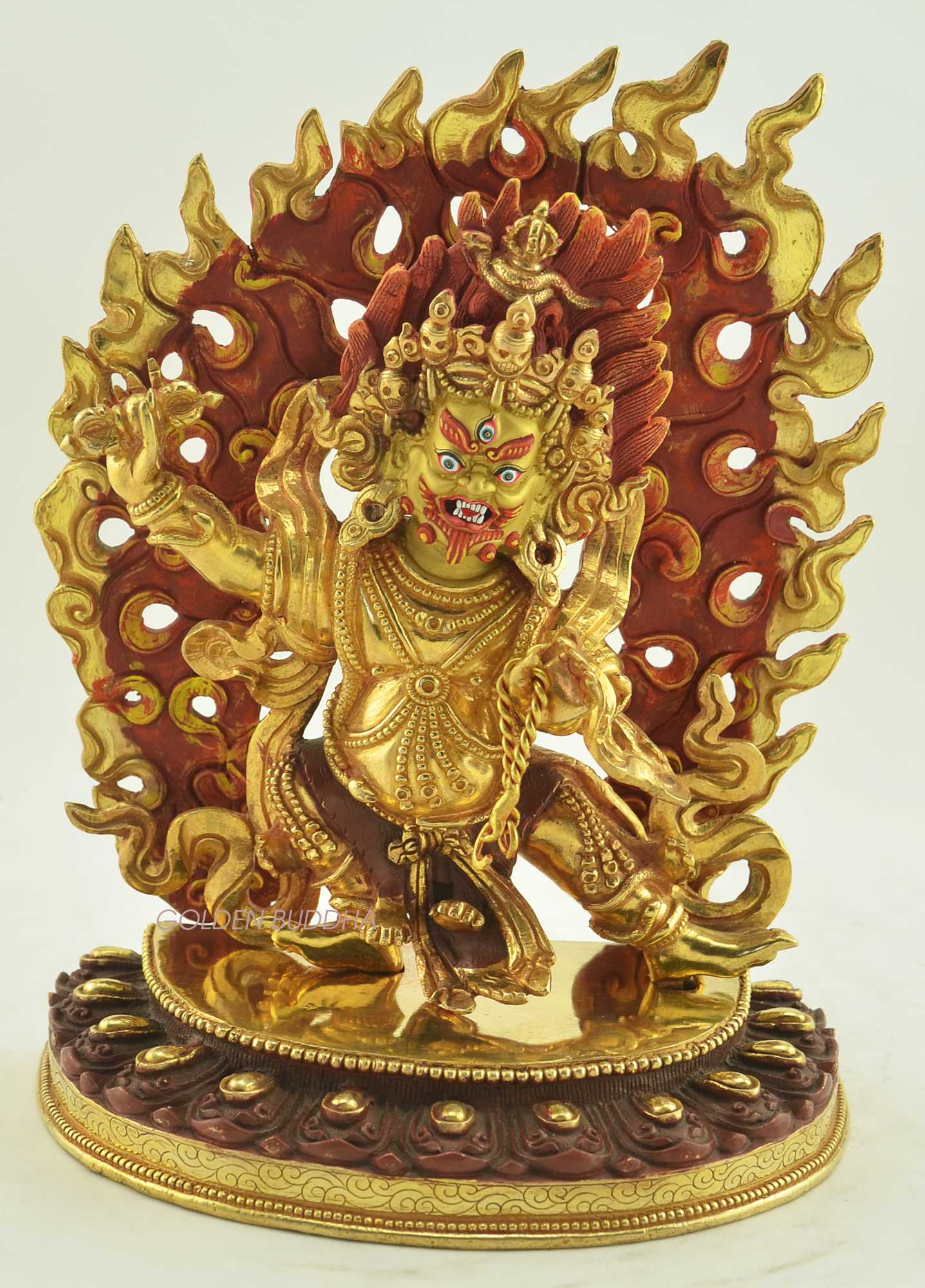
12″ Chana Dorje Vajrapani Statue — Partly Gold Gilded
Wrathful Vajrapani Statue Iconography Explained
Every element of an authentic wrathful Vajrapani statue carries precise symbolic meaning — the fearsome appearance is not gratuitous but a carefully structured visual teaching:
Dark blue body: Vajrapani’s body is depicted in deep navy or midnight blue — the color of the infinite sky and the primordial space of awareness that underlies all phenomena. Blue also represents the transformation of anger into mirror-like wisdom — the most potent of the five wisdom transformations. His dark body communicates that he has absorbed and transformed the most powerful destructive force in human psychology into an equally powerful enlightened quality.
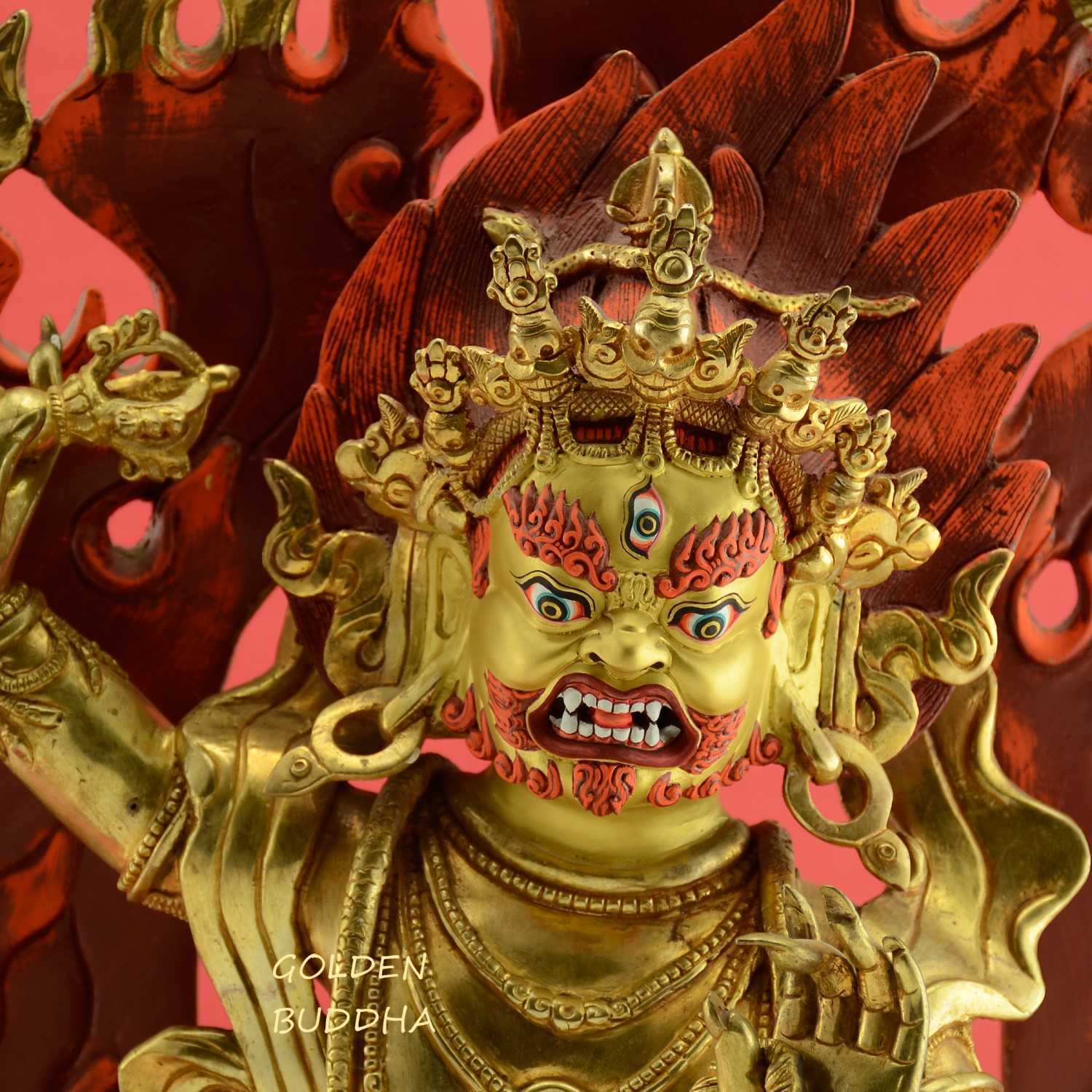
Three glaring eyes: Vajrapani’s three eyes represent his simultaneous perception of the past, present, and future — the omniscience of an enlightened being who sees across all three dimensions of time without limitation. The third eye at the forehead, common to all powerful tantric deities, represents the direct perception of ultimate reality beyond the ordinary duality of subject and object.
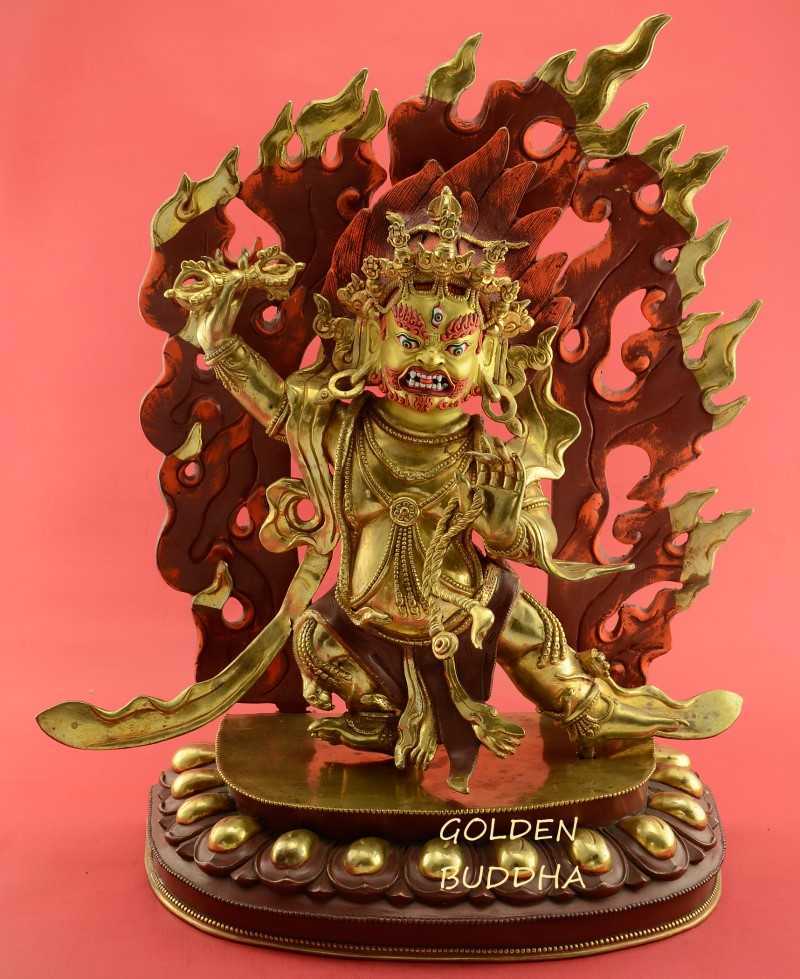
Vajra raised in right hand: The five-pointed vajra scepter — his defining attribute and the source of his name — raised overhead in the right hand in the warrior posture. The vajra (Sanskrit: “diamond” or “thunderbolt”) represents the indestructible, all-penetrating quality of enlightened awareness — as impervious to harm as a diamond, as unstoppable as lightning. In his right hand it is the weapon of liberation: it destroys ignorance as lightning destroys darkness.
Demon lasso in left hand: The pasha (lasso or noose) held in the left hand is the implement of capture — representing Vajrapani’s power to catch and hold whatever obstacles or demonic forces he has conquered, preventing them from regrouping and reforming. Together with the vajra, the lasso communicates a complete methodology: the vajra strikes, the lasso secures.
Serpent ornaments: Vajrapani wears serpents as earrings, bracelets, armlets, and anklets — and a serpent as a sacred thread across his chest. Serpents in Vajrayana iconography represent the transmutation of primal energies — in their ordinary state, serpentine forces in the body and mind generate desire, jealousy, and fear. Worn as ornaments by Vajrapani, they represent these same primal energies transformed and mastered — their power redirected toward enlightened activity.
Warrior pose (alidhasana): Vajrapani stands in the alidhasana posture — the dynamic warrior stance with one leg forward and one leg back, body slightly twisted — ready to strike. This posture communicates active, immediate power: unlike seated Buddha statues that radiate calm stability, Vajrapani is in motion, engaged, confronting obstacles directly.
Ring of flames: Like all powerful wrathful deities, Vajrapani is surrounded by a blazing ring of primordial fire — the jnana (wisdom) fire of awareness that consumes all obscurations. This is not destructive fire but purifying fire — the same symbolism used in the flaming sword of Manjushri and the fire ring of Yamantaka.
19.5″ Wrathful Vajrapani Statue — 24K Gold Gilded
The Five Skulls — Transformation of the Five Poisons
The five skulls crown worn by wrathful Vajrapani statues is one of the most significant iconographic elements in all of Tibetan Buddhist art — appearing on Vajrapani and numerous other wrathful deities including Yamantaka and Mahakala. Each skull represents the death of one of the five mental poisons and its transformation into the corresponding enlightened wisdom:
- Ignorance → Wisdom of Reality (Dharmadhatu wisdom) — the direct perception of the true nature of all phenomena
- Pride → Wisdom of Equality (Samatajnana) — the recognition that all beings share the same fundamental nature
- Attachment/Desire → Wisdom of Discernment (Pratyavekshanajnana) — the capacity to perceive each phenomenon with total clarity without distortion by craving
- Jealousy/Envy → Wisdom of Accomplishment (Krityanusthanajnana) — the ability to accomplish all beneficial activities effortlessly and without competition
- Anger/Hatred → Mirror-like Wisdom (Adarsajnana) — the perfectly clear, undistorted reflection of reality that anger obscures
The five skulls therefore communicate one of the central insights of Vajrayana Buddhist practice: the mental poisons that cause suffering are not simply to be suppressed or eliminated — they are to be transformed. The same energy that drives anger can drive fierce compassion; the same energy that generates jealousy can generate the tireless effort to benefit others. Vajrapani’s five skull crown announces that this transformation has been accomplished completely — every defilement has become wisdom, every obstacle has become a vehicle.
Vajrapani as Guhyapati — Lord of Secrets
In the Vajrayana tradition, Vajrapani’s role expands beyond that of a Bodhisattva attendant to become Guhyapati — “The Lord of Secrets.” This title reflects his position as the guardian and transmitter of the most advanced Tantric teachings. According to Vajrayana tradition, Vajradhara Buddha (the primordial Buddha who embodies the Dharmakaya — the ultimate nature of all reality) transmitted the complete Anuttarayoga Tantra teachings directly to Vajrapani, charging him with their preservation and transmission to qualified practitioners.
This is why Vajrapani is sometimes depicted holding a book of Tantric texts rather than (or in addition to) the vajra — he is the keeper of the most precious and most dangerous knowledge in Buddhist tradition. The Tantric teachings are described as “secret” not because they are hidden arbitrarily, but because they require a specific preparation (proper initiation, qualified teacher, stable ethical foundation) to be practiced safely and effectively. Without this preparation, the most powerful methods for liberation can become the most powerful methods for generating negative karma — hence the need for Guhyapati’s active guardianship.
Vajrapani Practice & Sadhana
Vajrapani practice belongs to the Tantric path — specifically the Anuttarayoga Tantra class in the Gelug and Kagyu traditions, and the Mahayoga class in the Nyingma tradition. The core method is deity yoga: the practitioner progressively dissolves their ordinary self-identification and replaces it with a vivid visualization of themselves as Vajrapani — his body, speech, mantra, and mind becoming their own body, speech, and mind during the meditation session.
Buddhist philosophy identifies the root of all suffering as ignorance — specifically the habitual misidentification of the self as a permanent, independent entity. This misidentification generates attachment, aversion, and the full cycle of samsaric suffering. The Vajrapani sadhana addresses this root cause with characteristic Tantric directness: rather than gradually weakening the ego-grasp through analytical meditation, it abruptly replaces the ordinary self-image with the most powerful possible alternative — the complete, unobstructed power of all the Buddhas in wrathful form.
A Vajrapani statue placed on the meditation altar serves as the primary visual support for this practice — a constant presence that reinforces the practitioner’s identification with Vajrapani’s qualities and provides a tangible focal point for the visualization. The statue’s fierce expression, warrior posture, and blazing ring of fire together communicate the total fearlessness that is the natural state of an enlightened mind — and the goal toward which the practice is directed.
Important note on practice requirements: The Vajrapani sadhana requires formal initiation from a qualified teacher and should be practiced under their ongoing guidance. However, acquiring a Vajrapani statue for veneration, offering, and general protection is open to practitioners at all levels — and is specifically recommended for those facing significant obstacles, interference, or disruptions to their practice.
Vajrapani Mantra — Om Vajrapani Hum
“Om Vajrapani Hum”
The Vajrapani mantra is one of the most concise and powerful in all of Tibetan Buddhism — three syllables that invoke the complete power of all the Buddhas. Om is the universal sacred syllable representing the body, speech, and mind of all enlightened beings. Vajrapani calls directly upon the deity by name — invoking his specific mandate as the embodiment of enlightened power. Hum is the seed syllable of Vajrapani and of the Vajra family — it represents the indestructible, diamond-like quality of enlightened awareness and acts as the mantra’s energetic seal.
The Vajrapani mantra benefits are described in traditional Buddhist texts as particularly powerful for: removing obstacles to practice and daily life; overcoming demonic interference and negative forces; generating the strength and determination needed to maintain ethical commitments; purifying anger and transforming it into clear mirror-like wisdom; and protecting the practitioner against physical danger, illness, and the forces that disrupt spiritual progress. Regular recitation before a Vajrapani statue — 108 times per session — is considered a complete practice in itself accessible to practitioners at any level without special initiation.
Frequently Asked Questions About Vajrapani Statues
Who is Vajrapani in Buddhist tradition?
Vajrapani (Sanskrit: “Vajra in Hand”; Tibetan: Chana Dorje) is one of the most important Bodhisattvas in Tibetan Buddhism — the embodiment of the complete power of all the Buddhas. He forms a great triad with Avalokiteshvara (compassion) and Manjushri (wisdom), representing the third essential quality of Buddhahood: the power to act. He is the personal protector and attendant of Shakyamuni Buddha, appearing in the earliest Buddhist sutras as a yaksha guardian. In Vajrayana Buddhism he became Guhyapati — Lord of Secrets — the guardian of the most advanced Tantric teachings, entrusted with their preservation and transmission by Vajradhara Buddha. He appears in both peaceful form (Mahayana tradition) and wrathful form (Vajrayana tradition), the latter known as Chana Dorje in Tibetan.
What does a Vajrapani statue represent?
A Vajrapani statue represents the complete enlightened power of all the Buddhas — the capacity to overcome every obstacle, subdue every negative force, and protect the Dharma with absolute authority. Every iconographic element carries specific meaning: the dark blue body represents the transformation of anger into mirror-like wisdom; three eyes represent knowledge of past, present, and future; the vajra raised overhead represents indestructible enlightened power; the demon lasso secures conquered obstacles; serpent ornaments represent transformed primal energies; the five-skull crown represents the transformation of the five mental poisons into five wisdoms; and the ring of flames represents all-consuming primordial awareness. Placing a Vajrapani statue on a home altar or meditation space invokes his protective power and supports the development of the fearless, unstoppable quality of enlightened action.
What is the relationship between Vajrapani, Avalokiteshvara and Manjushri?
Vajrapani, Avalokiteshvara, and Manjushri form the great triad of Bodhisattvas — the three qualities that together constitute complete Buddhahood. Avalokiteshvara embodies compassion (the motivation to benefit all beings), Manjushri embodies wisdom (the direct perception of reality), and Vajrapani embodies power (the capacity to translate compassion and wisdom into effective action). None of the three is sufficient alone: compassion without wisdom may cause harm; wisdom without compassion produces detachment; power without compassion or wisdom becomes destructive. Only their inseparable union produces genuine Buddhahood. This is why the three always appear together in Tibetan Buddhist monasteries, thangkas, and altar arrangements — and why the Guru Tsongkhapa trio mirrors this triad exactly, with Tsongkhapa (Manjushri), Gyaltsabje (Avalokiteshvara), and Khedrubje (Vajrapani).
What is the Vajrapani mantra and what does it do?
The Vajrapani mantra “Om Vajrapani Hum” is one of the most concise and powerful mantras in Tibetan Buddhism. Om invokes the body, speech, and mind of all enlightened beings; Vajrapani calls upon the deity directly by name; Hum is his seed syllable representing indestructible awareness. Regular recitation is considered particularly effective for removing obstacles to practice and daily life, overcoming demonic interference and negative forces, generating determination and strength, purifying anger, and protecting against physical and spiritual dangers. Unlike the more advanced Vajrapani sadhana which requires formal initiation, the mantra alone can be recited by any practitioner — 108 times per session before a Vajrapani statue is the traditional practice.
What is the difference between Vajrapani and Chana Dorje?
Vajrapani and Chana Dorje are two names for the same deity — Vajrapani is the Sanskrit name meaning “Vajra in Hand” and Chana Dorje is the Tibetan equivalent meaning “Holder of the Thunderbolt.” Both refer to the same Bodhisattva — the embodiment of enlightened power and guardian of the Tantric teachings. In practice, “Chana Dorje” tends to be used more specifically for the wrathful Vajrayana form of the deity, while “Vajrapani” is used more broadly across both the peaceful Mahayana form and the wrathful Vajrayana form. The name you see on a product listing will depend on the tradition the artisan’s workshop follows and which form of the statue is depicted.
Are Vajrapani statues from Nepal authentic?
The artisan city of Patan (Lalitpur) in Nepal’s Kathmandu Valley has been the world center for handcrafted Himalayan Buddhist statuary for over a thousand years. Authentic Vajrapani statues from the traditional Shakya craftsmen of Patan are created using the lost-wax casting method, finished with 24K fire gilding, and hand face painted using real gold — the same standard used for monastery-quality statues for over a millennium. All statues are certified by the Department of Archaeology in Kathmandu, and consecration (rabne) at a recognized Kathmandu monastery is available upon request. Browse our complete collection of authentic Vajrapani statues from Nepal.