

Tibetan Guru statues depict the remarkable lineage masters who shaped one of the world’s most sophisticated spiritual traditions. Unlike the Buddha statues and Bodhisattva statues that depict enlightened beings of cosmic scale, Tibetan Guru statues portray historical human figures — men who walked the same earth we walk, faced the same obstacles we face, and achieved extraordinary spiritual realization through the very methods they transmitted to us. Their stories are among the most compelling in all of Buddhist history: wandering translators, cave-dwelling yogis, brilliant scholars, and unlikely saints who transformed themselves and transformed a civilization.
The four major schools of Tibetan Buddhism — Nyingma, Kagyu, Sakya, and Gelug — each trace their lineage to a specific founding master whose teachings, personality, and spiritual attainment shaped the entire character of that school. Understanding who these masters were, what they taught, and how their lineages developed over twelve centuries gives the Tibetan Guru statues in your collection their full depth of meaning. This guide covers the complete history of Tibetan Buddhism through the lens of its founding gurus — from the earliest encounters with the Bon Religion through the present dominance of the Gelug school.
Contents
- From Bon Religion to Tibetan Buddhism
- Tibetan Buddhism Schools & Gurus Timeline
- The Four Schools of Tibetan Buddhism
- Nyingma School — The Ancient Ones
- Kagyu School — The Oral Transmission Lineage
- Guru Marpa — The Great Translator
- Guru Milarepa — Tibet’s Greatest Yogi
- Guru Gampopa — Father of the Kagyu Schools
- Sakya School — The Grey Earth Lineage
- Gelug School — The Virtuous Ones
- Guru Tsongkhapa — Founder of the Gelug School
- Guru Tsongkhapa Statues — Meaning & Iconography
- Tsongkhapa’s Two Disciples — The Three Seats of Gelug
- The Dalai Lama & the Gelug Legacy
- Nepali Lost Wax Sculpture — Origin & Artisan Castes
- Fire Gilding — The 24K Gold Standard for Guru Statues
- Frequently Asked Questions About Tibetan Guru Statues
From Bon Religion to Tibetan Buddhism
The story of Tibetan Guru statues begins with a profound religious transformation — one of the most consequential in Asian history. For at least 18,000 years before Buddhism arrived, Tibet was governed spiritually by the Bon Religion, whose founding sage Tongpa Shenrab gave his original teachings in the ancient Zhang Zhung Kingdom of Western Tibet. Bon practice centered on spirit appeasement, shamanistic ritual, divination, and the propitiation of the powerful natural forces inhabiting Tibet’s mountains, lakes, and sky.
Buddhism’s entry into this ancient spiritual landscape was neither smooth nor quick. When Tibetan King Songtsen Gampo married both a Chinese Buddhist princess (Wencheng) and a Nepali Buddhist princess (Bhrikuti) in approximately 625 CE — each bringing a gold Buddha statue as part of her dowry — the seeds of the transition were planted. Both statues remain enshrined in the Jokhang and Ramoche Temples in Lhasa to this day, silent witnesses to the beginning of Tibet’s Buddhist era.
The decisive moment came in 767 CE when King Trisong Detsen — wishing to establish Buddhism as the national religion — invited both the scholar Santaraksita and the Tantric master Guru Rinpoche (Padmasambhava) from India. When Guru Rinpoche’s Tantric methods successfully removed the spirit obstructions preventing the construction of Tibet’s first monastery at Samye, the king made a historic choice: Vajrayana Tantric Buddhism would be the spiritual foundation of Tibet. This single decision launched a 1,200-year tradition whose lineage masters are depicted in the Tibetan Guru statues produced in Nepal today.
Tibetan Buddhism Schools & Gurus Timeline
| Tongpa Shenrab gives Bon teachings — Zhang Zhung Kingdom | c. 16,000 BCE |
| King Songtsen Gampo introduces Buddhism to Tibet | c. 625 CE |
| Guru Rinpoche arrives — Samye Monastery completed — Nyingma school founded | 767 CE |
| King Trisong Detsen chooses Tantric Buddhism — Nyingma establishes dominance | 767 CE |
| Bon revival under King Langdarma — Buddhist persecution — Langdarma assassinated | 836–842 CE |
| Lost wax sculpture emerges in Nepal — Shakya artisans begin supplying Tibet | c. 10th century CE |
| Guru Marpa the Translator — Kagyu school lineage begins | c. 1012–1097 CE |
| Guru Milarepa — Tibet’s greatest yogi — inherits Kagyu lineage | 1052–1135 CE |
| Guru Gampopa — opens Kagyu monastery — teaches first Karmapa | 1079–1153 CE |
| Sakya school founded by Khon Konchog Gyalpo — Pandita converts Mongols | 1073 CE |
| Guru Tsongkhapa — Gelug school founded — two disciples Gyaltsabje & Khedrubje | 1357–1419 CE |
| First Dalai Lama recognized — Gelug becomes Tibet’s dominant school | 15th century CE |
| 14th Dalai Lama flees to Dharamshala — Gelug in exile — Tibetan Buddhism worldwide | 1959 CE – Present |
The Four Schools of Tibetan Buddhism
Following the suppression of Buddhism under King Langdarma (836–842 CE) and the subsequent political fragmentation of Tibet, the 11th century brought a remarkable renaissance. Indian Buddhist masters were once again invited to Tibet, new translations were commissioned, and a diverse flowering of practice lineages gave rise to four major schools — each with its own founding masters, philosophical emphases, and distinctive iconographic traditions in art and Tibetan Guru statues.
The four schools are not competing sects so much as complementary streams within a shared Vajrayana tradition. All four accept the same foundational texts, revere Shakyamuni Buddha as the historical source, and practice the same core meditation and ritual methods. Their differences lie primarily in which lineage of teachings they emphasize, which tantric cycles they practice, and which founding masters they venerate — differences reflected directly in which Tibetan Guru statues are placed on their altars.
Nyingma School — The Ancient Ones
The Nyingma school (Tibetan: “Ancient Ones”) is the oldest of Tibet’s four major Buddhist schools — tracing its founding directly to Guru Rinpoche (Padmasambhava) and the consecration of Samye Monastery in 767 CE. The name “Nyingma” distinguishes this original transmission from the “Sarma” (new) schools that arose during the 11th century renaissance. Its primary characteristic is its preservation of the earliest Tantric teachings transmitted directly by Guru Rinpoche — particularly the Dzogchen (“Great Perfection”) teachings, which represent the highest and most direct path to enlightenment in the Nyingma tradition.
The Nyingma school is also uniquely distinguished by the Terma tradition — the hidden teachings concealed by Guru Rinpoche and his consort Yeshe Tsogyal for discovery by qualified practitioners (tertons) at appropriate future times. This tradition has kept the Nyingma school dynamically alive across centuries of persecution, continuously generating new revelations from Guru Rinpoche’s original transmission. The Nyingma Guru Rinpoche statues — identifiable by the khatvanga staff, lotus hat with vulture feather, vajra, and skull cup — are the primary devotional images of this school.
Kagyu School — The Oral Transmission Lineage
The Kagyu school (Tibetan: “Oral Transmission” or “Whispered Lineage”) traces its origin to the Indian mahasiddha Tilopa (988–1069 CE), who received direct transmission from the primordial Buddha Vajradhara. Tilopa transmitted the lineage to his primary disciple Naropa (1016–1100 CE) — the great scholar-yogi of Nalanda University — whose “Six Yogas of Naropa” became the foundational practice system of the Kagyu tradition. The lineage then passed to the Tibetan translator Marpa, creating the distinctive bridge between Indian Tantric mastery and Tibetan Buddhist practice that defines the Kagyu school.
The Kagyu school places particular emphasis on Mahamudra — the “Great Seal” — a direct pointing-out instruction that reveals the nature of mind as inherently pure, luminous, and beyond concepts. This direct approach to enlightenment, combined with the rigorous physical and meditative practices of the Six Yogas, produced some of the most extraordinary practitioners in Tibetan Buddhist history — including the lineage of Marpa, Milarepa, and Gampopa that forms the backbone of the Kagyu tradition.
Guru Marpa — The Great Translator
Guru Marpa Lotsawa (1012–1097 CE) — “Marpa the Translator” — is the founding father of the Tibetan Kagyu school. Born in Lhodrak in southern Tibet, Marpa displayed an exceptional gift for languages and a fierce determination to obtain the most advanced Buddhist teachings available. He made three separate journeys to India — at great personal expense, hardship, and risk of life — to study under the great Tantric masters Naropa and Maitripa, acquiring the complete transmission of the Chakrasamvara, Hevajra, and Mahamudra lineages.
Marpa’s contribution to Tibetan Buddhism cannot be overstated: his translations of the most advanced Tantric texts — the Chakrasamvara, Hevajra, and Vajravarahi cycles — gave Tibetan Buddhism an entirely new corpus of practice that had not existed before his journeys. He was simultaneously a householder with a wife and children and a fully realized Tantric master — demonstrating that enlightenment was not confined to monastic renunciation. His legacy was transmitted through his most famous disciple: the poet-yogi Milarepa, who became one of the most beloved figures in Tibetan Buddhist history.

Guru Marpa Statue Iconography
Guru Marpa statues depict him seated on an animal skin rug — the traditional posture of all Tibetan masters trained in India, reflecting the Tantric tradition of the mahasiddhas. His expression conveys the forceful, sometimes intimidating presence that characterized his teaching method: ancient sources describe him as having a particularly fierce countenance, sometimes depicted with hair rising straight up from his head — a sign of his intense inner energy and Tantric power. The multicolor finish applied by Patan artisans captures both his human personality and his spiritual authority, while the 24K gold gilding communicates his status as an enlightened Kagyu lineage holder.
Guru Milarepa — Tibet’s Greatest Yogi
Guru Milarepa (1052–1135 CE) is one of the most beloved and extraordinary figures in Tibetan Buddhist history — a man who began his spiritual career practicing black magic at his mother’s request and ended it as the most celebrated yogi Tibet has ever produced. His story is a testament to the transformative power of sincere repentance, fierce determination, and the Kagyu Tantric path. Born in Kya Ngatsa in western Tibet, Milarepa’s early life was marked by tragedy: after his father’s death, his family’s property was seized by a treacherous uncle, and his mother — consumed by grief and rage — sent him to learn black magic as revenge.
The black magic succeeded with devastating effectiveness — Milarepa caused the deaths of many people — but left him overwhelmed by remorse and terror of karmic retribution. He sought out Guru Marpa for teachings, but Marpa — who knew of Milarepa’s karmic burden — subjected him to years of the most grueling trials before transmitting any teachings. The most famous of these trials was the construction of a series of towers, each of which Marpa ordered demolished and rebuilt according to different specifications — a process designed to purify Milarepa’s accumulated negative karma through physical hardship and unconditional obedience.
After finally receiving the complete Kagyu transmission, Milarepa retreated to remote mountain caves — including the famous Milarepa Cave near Manang, Nepal on the Annapurna Circuit — where he practiced the Six Yogas of Naropa with absolute commitment. He sustained himself on nothing but nettles for years, turning his skin green — his body literally thin as a skeleton — until he achieved complete enlightenment. His spontaneous spiritual songs (dohas), known as the Hundred Thousand Songs of Milarepa, are among the greatest literary achievements of Tibetan Buddhist culture and remain widely sung and studied to this day.

Guru Milarepa Statue Iconography
Guru Milarepa statues are among the most immediately recognizable of all Tibetan Guru statues — identifiable by his distinctive posture and attributes: the right hand raised to the ear in the gesture of listening to inner sounds and singing songs of realization — a reference to his famous dohas that emerged spontaneously from his direct experience; a skull cup (kapala) held in the left palm — reflecting the Tantric tradition of the charnel ground practitioners; and a deer skin rug upon which he sits — echoing the ascetic mountain lifestyle that defined his practice. His thin body in some depictions references the years of cave practice sustained on nettles alone, while his serene expression communicates the complete inner peace that emerged from that ordeal.
Guru Gampopa — Father of the Kagyu Schools
Guru Gampopa (1079–1153 CE) — whose name means “Man from Gampo” — is known as the father of all the major Kagyu sub-schools and one of the most influential figures in Tibetan Buddhist institutional history. Unlike Marpa and Milarepa who were primarily wandering yogis and householders, Gampopa was the great systematizer — the master who combined the rigorous Tantric practice of the Kagyu lineage with the disciplined structure of the Kadampa monastic tradition, creating the institutional framework that allowed the Kagyu teachings to be transmitted on a large scale.
Gampopa’s path to Milarepa was unusual: he began his adult life as a physician, married, and had a family — until a terrible epidemic swept through his region, killing his wife and children. As his wife lay dying, she extracted from him a solemn oath to dedicate his life to the Dharma. Honoring that oath, he first studied the Kadampa tradition under monastic teachers before seeking out the legendary Milarepa. When they finally met, Milarepa was immediately impressed by Gampopa’s depth of insight and designated him as the successor to the complete Kagyu lineage.
Gampopa established a monastery from which he attracted many dedicated disciples — four of whom became the founders of the four primary Kagyu branches. Among his most significant disciples was the first Karmapa, Dusum Khyenpa (1110–1193 CE) — founding the Karma Kagyu branch, which established the tulku (reincarnated lama) system that became one of Tibetan Buddhism’s most distinctive and influential institutions. The Karmapa lineage continues to the 17th Karmapa in the present day, making it the oldest continuously recognized incarnation lineage in Tibetan Buddhism.
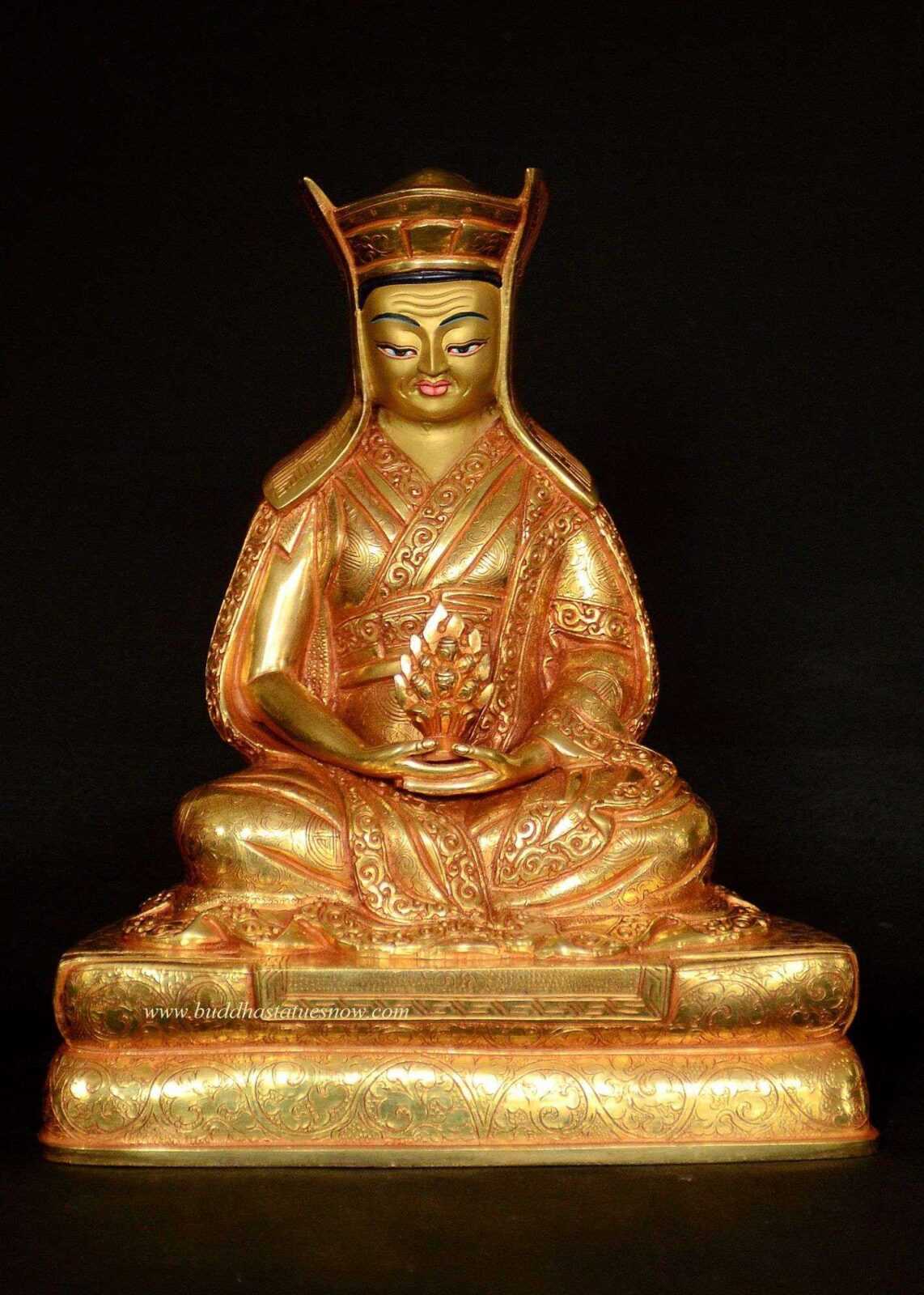
Guru Gampopa Statue Iconography
Guru Gampopa statues depict him in a distinctly monastic style — seated in full vajrasana (lotus posture) with both hands in the Dhyana mudra (meditation gesture) resting in the lap. This posture distinguishes Gampopa statues from those of Marpa and Milarepa, whose more dynamic postures reflect their reputations as wandering Tantric yogis. Gampopa wears the full robes of an ordained Buddhist monk — communicating his role as the great bridge between the wild Tantric energy of the Kagyu mahasiddha lineage and the disciplined institutional structure of the monastic tradition. His serene, scholarly expression reflects the synthesis he achieved: rigorous practice combined with systematic teaching.
Sakya School — The Grey Earth Lineage
The Sakya school (Tibetan: “Grey Earth”) takes its name from the grey soil of the region in central Tibet where its founding monastery was built in 1073 CE by Khon Konchog Gyalpo — a member of the aristocratic Khon family that continues to lead the Sakya school to this day. The Sakya school places particular emphasis on the Lamdre (“Path with Result”) teaching cycle — a profound integrated system of study and practice based on the Hevajra Tantra that presents the entire path to enlightenment as already contained within the nature of the practitioner’s own experience.
The Sakya school achieved its greatest historical prominence in the 13th century under Sakya Pandita Gunga Gyaltsen (1182–1251 CE) — one of the most brilliant scholars in Tibetan Buddhist history, whose logical treatises are still studied across all four schools. His most consequential historical achievement was the conversion of the Mongol prince Godan Khan to Tibetan Buddhism — initiating the “priest-patron” relationship between the Mongols and the Sakya school that eventually gave the Sakya school direct political authority over Tibet under Kublai Khan. This period (1244–1358 CE) represented the only time in history that Tibet was officially governed by a Buddhist lama rather than a secular king.
Gelug School — The Virtuous Ones
The Gelug school (Tibetan: “Virtuous Ones” — also called the Yellow Hat school for its distinctive headwear) is the youngest and most institutionally dominant of Tibet’s four major Buddhist schools. Founded by Guru Tsongkhapa in the late 14th and early 15th centuries, the Gelug school synthesized the best elements of all preceding Tibetan Buddhist traditions into a systematic curriculum that has become the world’s most widely practiced form of Tibetan Buddhism. The school is represented today by the 14th Dalai Lama — its most prominent living figure — whose Dharamshala exile community has brought Gelug teachings to every country on earth.
The Gelug school places its foundational emphasis on Lam Rim (“Graduated Path”) — a systematic presentation of the entire Buddhist path from the most basic ethical principles through the highest Tantric realization. Every practitioner, regardless of their level, can find their appropriate entry point and progress systematically. This structured, accessible approach combined with the Gelug’s uncompromising emphasis on pure monastic discipline and rigorous philosophical study created an institution capable of educating thousands of monks simultaneously — and producing some of the most brilliant Buddhist scholars and practitioners in history.
Guru Tsongkhapa — Founder of the Gelug School
Guru Tsongkhapa Lobsang Drakpa (1357–1419 CE) is considered by Tibetan Buddhists to be one of the greatest Buddhist masters who ever lived — an incarnation of the Bodhisattva Manjushri (the Bodhisattva of Wisdom), whose appearance in Tibet was prophesied by Shakyamuni Buddha himself. The Buddha is said to have predicted that an emanation of Manjushri would appear in the “Land of Snows” to establish a “joyful land” and serve as its protector. The name “Gelug” itself derives from dGe ldan — “Ganden” — the monastery Tsongkhapa founded near Lhasa in 1409, which means “Joyful Land” in Tibetan.
Born in the Amdo region of eastern Tibet, Tsongkhapa was recognized as an extraordinary child and ordained as a monk at age three. He spent the next decades studying under masters of all four Tibetan Buddhist schools — the Nyingma, Kagyu, Sakya, and Kadampa traditions — absorbing the entire breadth of Tibetan Buddhist scholarship and practice before synthesizing what he had learned into a new, integrated approach. His voluminous writings — including the Lam Rim Chenmo (Great Treatise on the Stages of the Path) and the Ngag Rim Chenmo (Great Treatise on the Stages of Tantra) — remain foundational texts of Buddhist philosophy studied worldwide.
What distinguished Tsongkhapa’s approach above all else was his insistence on the inseparability of Sutra and Tantra: the analytical philosophical wisdom of Madhyamaka philosophy (emptiness) and the experiential practices of Vajrayana Tantra were not separate paths for Tsongkhapa — they were two aspects of a single path that must be practiced together. A practitioner who understood emptiness but had not received Tantric initiation, or who had Tantric initiation but had not grounded it in the philosophical understanding of emptiness, was considered to be walking with only one leg. This integration is the defining intellectual contribution of the Gelug school to Tibetan Buddhism.
Guru Tsongkhapa Statues — Meaning & Iconography
Guru Tsongkhapa statues are among the most beautiful and iconographically rich of all Tibetan Guru statues. Every element encodes the specific spiritual qualities and historical significance that make him so revered:
Two Lotus Flowers: The most distinctive feature of every Tsongkhapa statue is the pair of lotus flowers rising over each shoulder. Over his left shoulder, the lotus holds the Prajnaparamita Sutra — the scripture of perfected wisdom, representing the sutra tradition of analytical philosophy. Over his right shoulder, the lotus holds the sword of Manjushri — the flaming sword that cuts through ignorance, representing both the Tantric tradition and Tsongkhapa’s identity as an incarnation of the Bodhisattva of Wisdom. Together, the two lotus flowers with their respective objects communicate the defining achievement of Tsongkhapa’s life: the inseparable union of Sutra and Tantra.
Dharmachakra Mudra: Tsongkhapa statues depict him in the Dharmachakra mudra — both hands at chest level with fingers interlocked, the gesture of “Turning the Wheel of Dharma” associated specifically with the Buddha’s first teaching. This mudra, used for Tsongkhapa rather than the typical Dhyana meditation gesture used for most gurus, signals his status as a second great teacher of Buddhism — one whose synthesis of the path was considered equivalent in scope and importance to the Buddha’s original turning of the wheel.
Pointed Yellow Hat: The iconic pointed yellow hat of the Gelug school — the reason it is sometimes called the “Yellow Hat” school — is worn by Tsongkhapa in all statues. The yellow hat represents the reformed monastic discipline of the Kadampa tradition that Tsongkhapa integrated into his new school, distinguishing it from the red-hat schools (Nyingma, Kagyu, Sakya). The hat’s distinctive pointed peak symbolizes the heights of philosophical and meditative attainment that define the Gelug approach.

Tsongkhapa’s Two Disciples — The Three Seats of Gelug
Guru Tsongkhapa statues are most commonly displayed as a trio — the master flanked by his two primary disciples Gyaltsabje (1364–1432 CE) and Khedrubje (1385–1438 CE). This three-figure arrangement is not merely decorative — it encodes a profound theological statement about the nature of the enlightened qualities required for complete Buddhahood, mirroring the great Bodhisattva triad of Avalokiteshvara, Manjushri, and Vajrapani:
- Guru Tsongkhapa (center, elevated) — considered an incarnation of Manjushri, representing the wisdom of all the Buddhas. He occupies the central, most elevated position in the trio.
- Gyaltsabje (right) — considered an incarnation of Avalokiteshvara, representing the compassion of all the Buddhas. His right hand at heart level exhibits the gesture of expounding the Dharma.
- Khedrubje (left) — considered an incarnation of Vajrapani, representing the power of all the Buddhas. His right hand at heart level mirrors Gyaltsabje’s Dharma-expounding gesture.
Together the three figures embody the complete mandala of enlightened qualities — wisdom, compassion, and power — just as the three principal Bodhisattvas do in the Mahayana tradition. The three statues also represent the three great monasteries (Ganden, Drepung, Sera) that Tsongkhapa and his disciples established near Lhasa — the “Three Seats” of the Gelug school that served as the great universities of Tibetan Buddhism for centuries, educating thousands of monks simultaneously.
The Dalai Lama & the Gelug Legacy
The Gelug school’s institutional dominance was cemented in the 17th century when the 5th Dalai Lama, Lobsang Gyatso (1617–1682 CE), united Tibet under a single government that combined religious and secular authority for the first time. The title “Dalai Lama” (Mongolian: “Ocean of Wisdom”) was first granted by the Mongol ruler Altan Khan to the 3rd Dalai Lama, Sonam Gyatso, in 1578 — and was retroactively applied to his two previous incarnations. The Dalai Lama is understood in Tibetan Buddhist tradition to be a human incarnation of Avalokiteshvara — the Bodhisattva of Compassion.
The 14th Dalai Lama, Tenzin Gyatso (born 1935) — who escaped Chinese occupation of Tibet on March 17, 1959 and established the Tibetan government-in-exile at Dharamshala, India — has become one of the most recognized and influential spiritual leaders in the world. His decades of teaching, writing, and interfaith dialogue have carried the Gelug tradition — and Tibetan Buddhism as a whole — to every country on earth. The Gelug school remains the dominant tradition of Tibetan Buddhism in the modern world, represented by the Dalai Lama’s teachings, the great monastic universities of Sera, Drepung, and Ganden (reestablished in exile in southern India), and the hundreds of Dharma centers founded worldwide since 1959.
Nepali Lost Wax Sculpture — Origin & Artisan Castes
The Tibetan Guru statues that practitioners place on their altars today are the products of a sculptural tradition that emerged in the Kathmandu Valley during the 10th century CE — precisely the period of Tibet’s Buddhist renaissance following the persecutions of King Langdarma. The timing was not coincidental: the revival of Tibetan Buddhism created an enormous demand for high-quality sacred statues, and the master artisans of Patan (Lalitpur) were uniquely positioned to meet it.
The lost wax method (cire perdue) allows the most intricate wax model of a Buddhist guru to be translated into permanent metal form with extraordinary precision. A master sculptor creates a perfect hand-carved wax model of the guru — every detail of the iconography must be iconographically correct: the distinctive hat, the mudra, the throne, the lotus flowers, the held objects. This wax model is coated with a special clay mixture that hardens into a mold. When fired, the wax drains out through a small hole in the base, leaving a perfect impression. Molten copper alloy is poured in, cooled, and the clay mold is carefully broken away to reveal the statue within.
Three master artisan castes dominate this tradition in Patan:
- Shakya caste — Direct descendants of the Buddha’s own Shakya clan (the word Shakya means “the one who is capable”). The Shakya artisans are the most prestigious producers of sacred Buddhist statuary and are the primary creators of Tibetan Guru statues for monastery use.
- Tamrakar caste (Tamra = copper, aakar = shape) — Traditional coppersmiths and metal casters known for hand-worked bronze and brass sculptures requiring extensive manual finishing.
- Swarnakar caste — Hindu goldsmiths who specialize in precious metal work and produce particularly fine gold-finished sacred objects.
Each caste guards its finest techniques as fiercely guarded family secrets transmitted from parent to child across generations — creating a living lineage of both technical mastery and sacred iconographic knowledge that no factory or mass-production facility can replicate. The result is Tibetan Guru statues of unsurpassed quality — each one an unrepeatable original that embodies both the artisan’s skill and the spiritual presence of the guru it depicts.
Fire Gilding — The 24K Gold Standard for Guru Statues
The finest Tibetan Guru statues from Patan are finished using the traditional fire gilding method — the same technique used to produce monastery-quality statues for over a thousand years. A mixture of mercury and 18K gold is evenly spread over the statue’s copper surface by hand. Extreme heat is then applied uniformly — the mercury evaporates completely, leaving a flawless 24K pure gold finish permanently bonded to the metal. The result will never tarnish and retains its brilliant golden luster indefinitely.
The final stage — hand face painting using real gold pigment — brings the guru’s features to vivid life. The eyes, the subtle curve of the lips, the serene but powerful expression — these are applied by brush with extreme care, communicating the inner qualities of the master depicted: Milarepa’s fierce determination and eventual serenity; Gampopa’s scholarly compassion; Tsongkhapa’s luminous wisdom. Every statue is then certified by the Department of Archaeology in Kathmandu before export, and consecration (rabne) at Sangye Choeling Monastery is available upon request.
Frequently Asked Questions About Tibetan Guru Statues
What are Tibetan Guru statues and who do they depict?
Tibetan Guru statues depict the historical lineage masters who founded, transmitted, and preserved the four major schools of Tibetan Buddhism. Unlike Buddha and Bodhisattva statues which represent cosmic enlightened beings, Guru statues portray real historical figures who achieved extraordinary spiritual realization and transmitted specific lineages of teaching. The major Tibetan Guru statues include Guru Rinpoche (Padmasambhava) — founder of the Nyingma school; Guru Marpa, Milarepa, and Gampopa — founders of the Kagyu lineage; Sakya Pandita — the great Sakya master; and Guru Tsongkhapa with his two disciples Gyaltsabje and Khedrubje — founders of the Gelug school. Each statue embodies the specific qualities and teachings of the master depicted.
What are the four schools of Tibetan Buddhism?
The four major schools of Tibetan Buddhism are Nyingma, Kagyu, Sakya, and Gelug. The Nyingma school (“Ancient Ones”) is the oldest, founded by Guru Rinpoche in 767 CE, emphasizing Dzogchen and the Terma tradition. The Kagyu school (“Oral Transmission”) was established through the Marpa-Milarepa-Gampopa lineage in the 11th-12th centuries, emphasizing Mahamudra and the Six Yogas of Naropa. The Sakya school (1073 CE) is known for its Lamdre teaching cycle and the historic priest-patron relationship with the Mongol Empire. The Gelug school (“Virtuous Ones”) was founded by Guru Tsongkhapa in the 14th-15th centuries and remains the most widely practiced today, represented by the Dalai Lama. All four schools share the same Vajrayana foundation and recognize each other as valid paths to enlightenment.
How do I identify a Guru Tsongkhapa statue?
Guru Tsongkhapa statues are identifiable by three distinctive features: the pointed yellow Gelug school hat; two lotus flowers rising over each shoulder (the left holding the Prajnaparamita Sutra, the right holding Manjushri’s flaming sword of wisdom); and the Dharmachakra mudra (both hands at chest level with fingers interlocked — the gesture of Turning the Wheel of Dharma). When depicted in a trio, Tsongkhapa occupies the central, elevated position with his two disciples Gyaltsabje (right) and Khedrubje (left) flanking him. All three wear full monastic robes and their disciples hold their right hands at heart level in the gesture of expounding the Dharma.
Why is Guru Milarepa’s hand raised to his ear?
The gesture of Milarepa’s right hand raised to his ear is one of the most distinctive and immediately recognizable features of Milarepa statues — representing his famous practice of singing spontaneous songs of spiritual realization (dohas). Throughout his years of cave meditation, Milarepa composed and sang hundreds of profound verses communicating his direct experience of enlightenment. These songs — collected in the Hundred Thousand Songs of Milarepa — are among the greatest literary achievements of Tibetan Buddhist culture. The gesture of listening to inner sounds while singing also references his mastery of the Tantric practices of subtle body yoga (tummo, dream yoga, etc.) in which the practitioner works with the internal winds and channels of the subtle body to achieve realization. The skull cup (kapala) in his left hand represents the Tantric Kagyu tradition of the charnel ground practitioners.
Which Tibetan Guru statue is best for a home altar?
The best Tibetan Guru statue for a home altar depends on your practice lineage and spiritual inclination. Gelug practitioners typically display a Guru Tsongkhapa trio (with Gyaltsabje and Khedrubje) as their primary guru statue. Kagyu practitioners favor Guru Milarepa or Guru Gampopa statues. Nyingma practitioners place a Guru Rinpoche (Padmasambhava) statue as the centerpiece of their altar. Non-denominational practitioners who feel drawn to Tibetan Buddhism’s history can choose any of these masters — the key is to choose a guru whose story, teaching, and personal qualities resonate with your own spiritual aspiration. All authentic Patan-made statues carry the same traditional quality regardless of the school they represent.
Are Tibetan Guru statues from Nepal authentic?
Patan (Lalitpur) in Nepal’s Kathmandu Valley has been the world center for handcrafted Himalayan Buddhist statuary for over a thousand years — and Tibetan Guru statues from the traditional Shakya craftsmen of Patan are among the finest sacred art objects available anywhere. Each statue is created using the lost-wax casting method, finished with 24K fire gilding, and hand face painted using real gold — the same standard used for monastery-quality statues since the 10th century CE. All statues are certified by the Department of Archaeology in Kathmandu, and consecration (rabne) at a recognized Kathmandu monastery is available upon request. Browse the complete collection of authentic Tibetan Guru statues from Nepal.