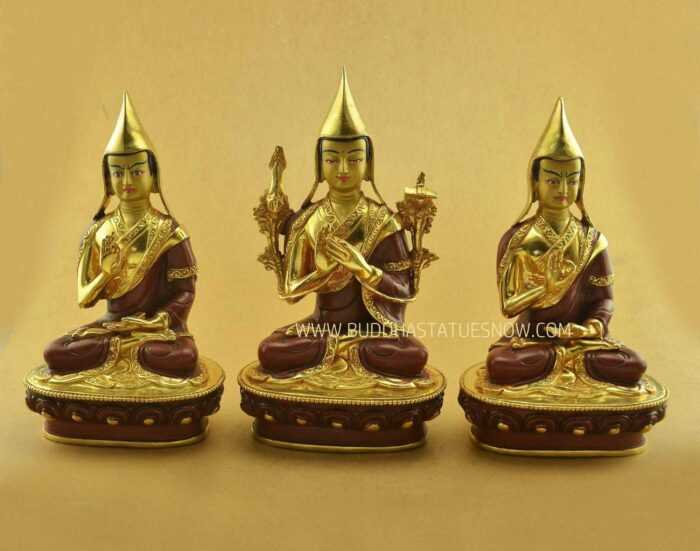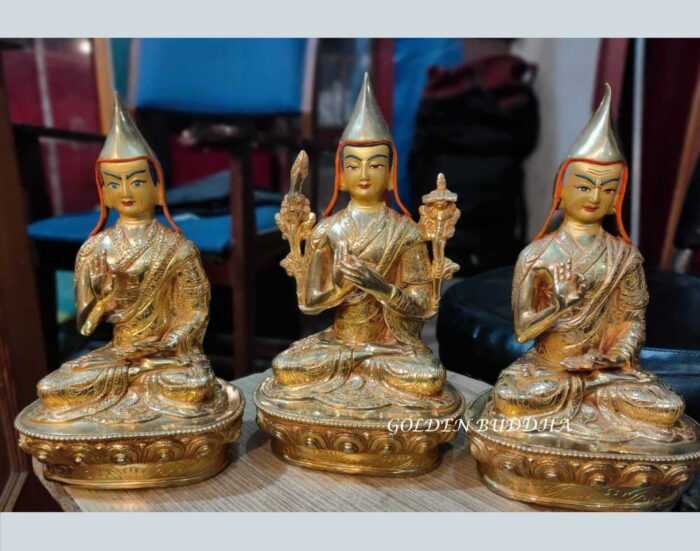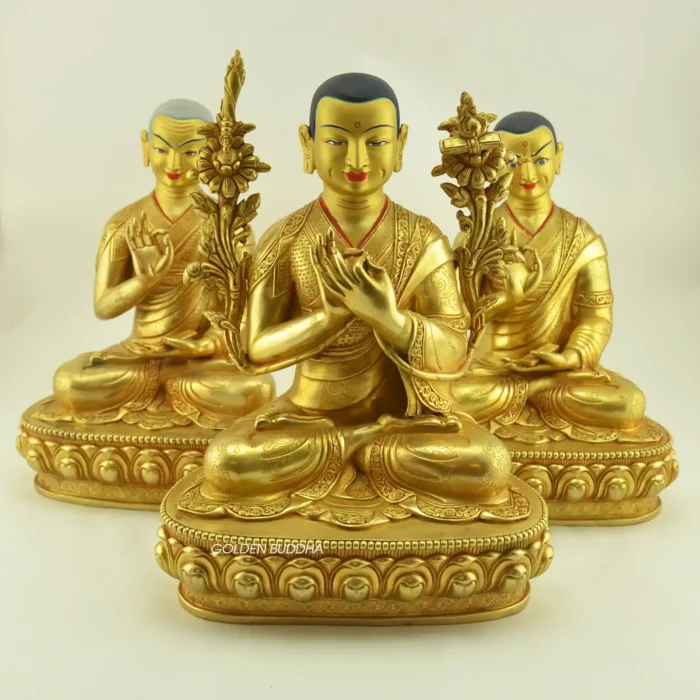
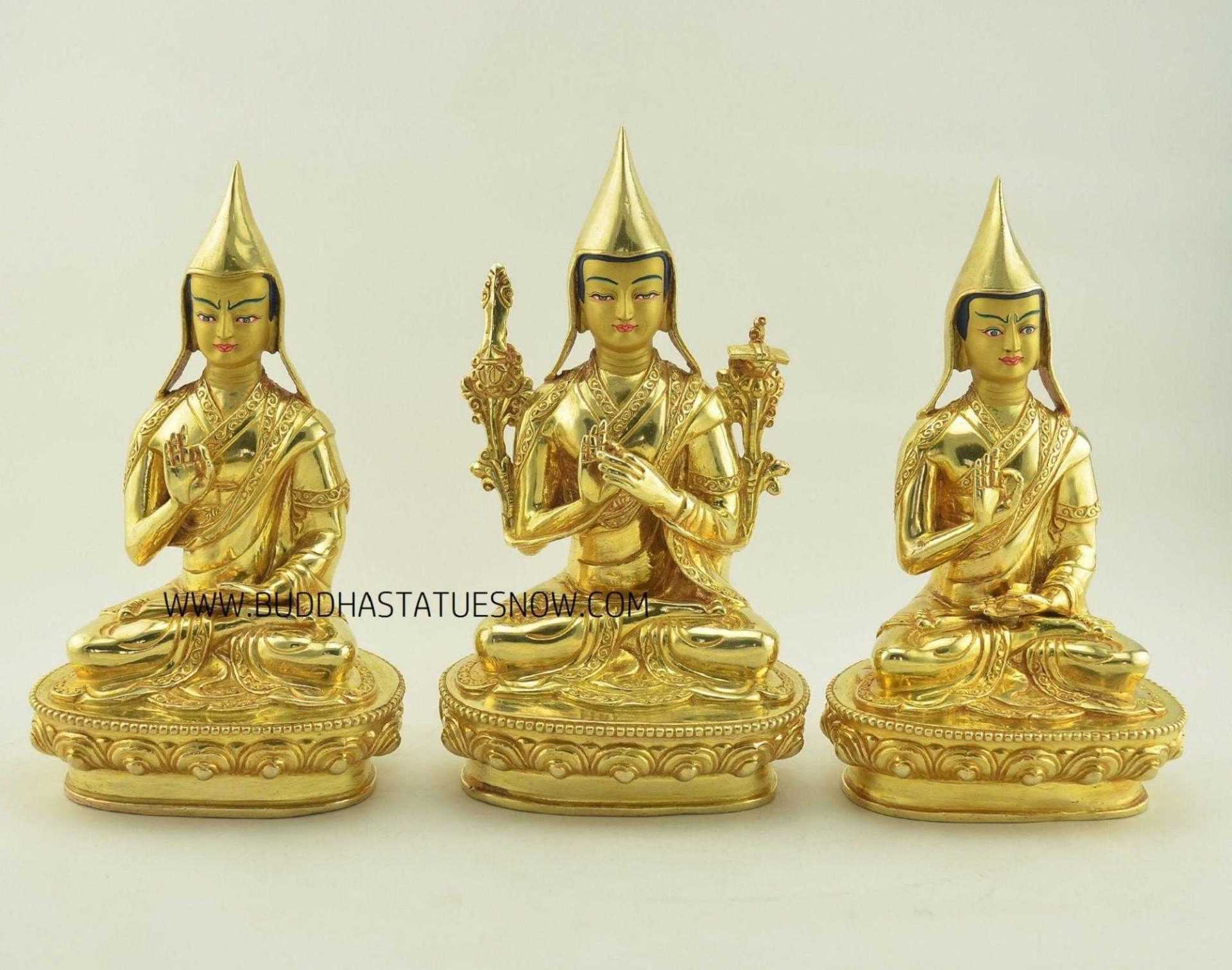
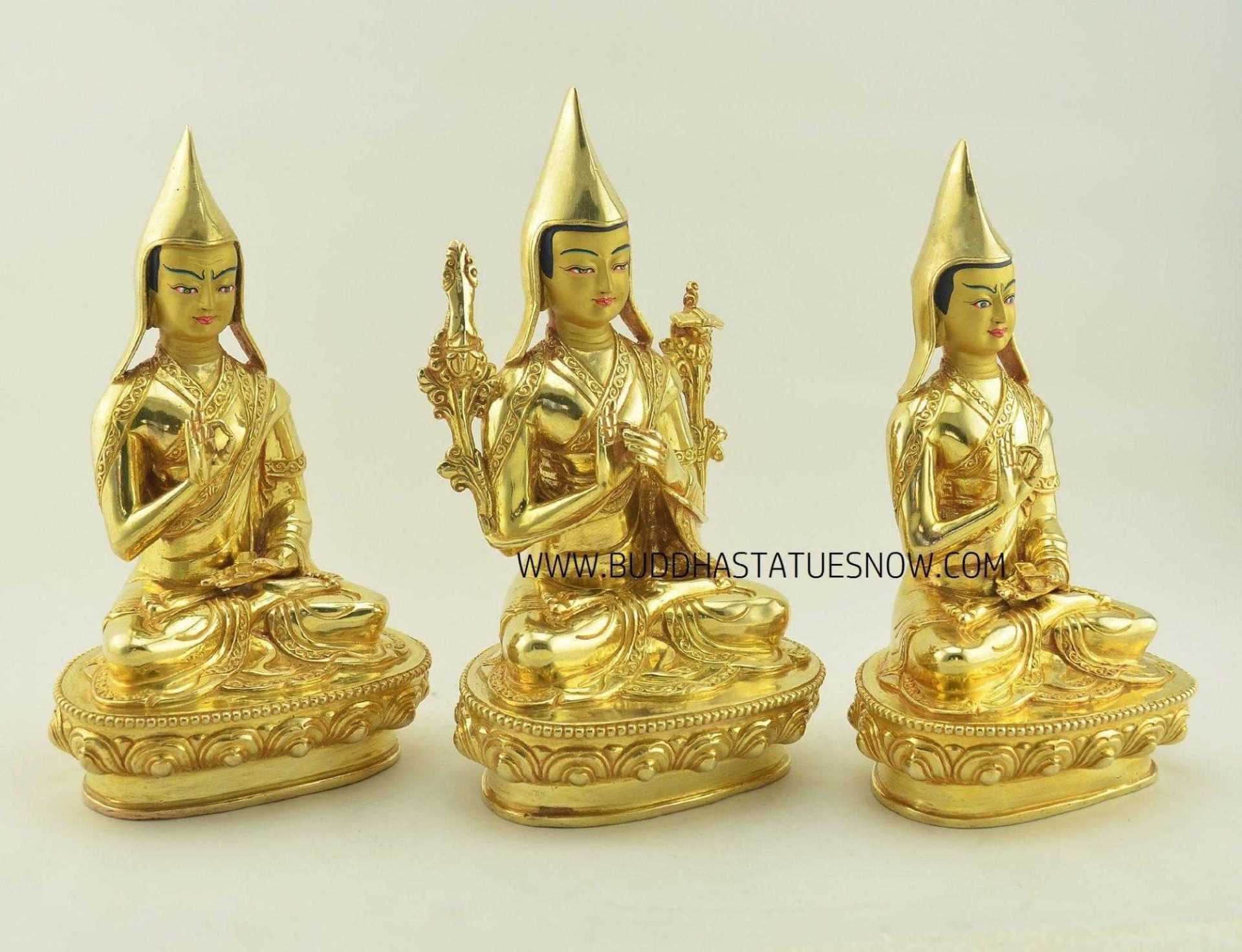
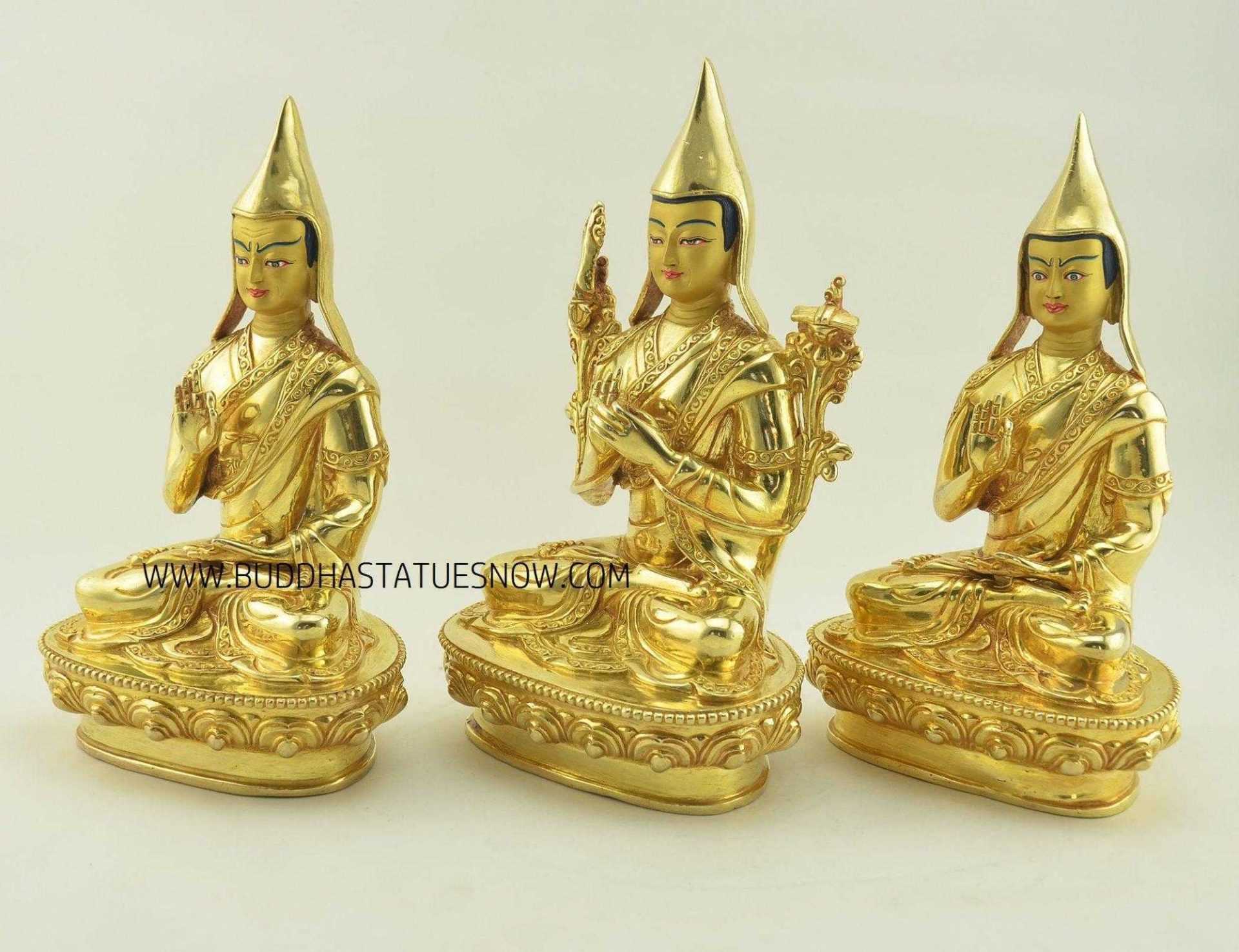
Created as a unified Gelug lineage ensemble, this 9.25-inch Guru Tsongkhapa Sculptures Set brings Je Tsongkhapa together with his principal disciples Gyaltsab Je and Khedrub Je in a richly gilded three-statue arrangement. The central master is immediately distinguished by the twin flowering lotuses carrying Manjushri’s sword of wisdom and the Prajnaparamita scripture, while the flanking disciples mirror one another through Vitarka mudra and scriptures held in their open left palms. Tall Gelug pandita hats, full lotus postures and coordinated lotus thrones give the trio a strong visual unity. Each statue is handmade in Patan, Nepal from copper alloy using the traditional lost-wax casting method, fire gilded in 24K gold and finished with a face hand painted in 18K gold and natural pigments.
Guru Tsongkhapa Sculptures Set | Gelug Lineage Trio
Je Tsongkhapa, also known as Je Rinpoche, was the Tibetan scholar-practitioner whose teachings became the foundation of the Gelug tradition. He is revered in Tibetan Buddhist tradition as an emanation of Manjushri, the Bodhisattva of Wisdom. His two principal disciples continued the lineage after him: Gyaltsab Je became his immediate successor in the Ganden lineage, followed by Khedrub Je. In the traditional trio, Gyaltsab Je appears on Tsongkhapa’s right, the viewer’s left, while Khedrub Je appears on Tsongkhapa’s left, the viewer’s right. Together the three masters form one of the most recognizable teacher groupings in Gelug Buddhist art. Learn more about Je Tsongkhapa and the Gelug tradition.
Je Tsongkhapa and His Two Principal Disciples
This grouping is more than a symmetrical arrangement of three historical teachers. Tsongkhapa’s writings and teaching system emphasized disciplined monastic conduct, rigorous philosophical study and the integration of sutra and tantra. Gyaltsab Je and Khedrub Je preserved and developed this inheritance through scholarship, teaching and institutional leadership. Their inclusion therefore transforms the central Tsongkhapa figure into a complete lineage presentation, linking the founding master directly with the two spiritual sons who carried his teachings into the next generation. Additional background can be found in our guide to Tsongkhapa’s principal disciples.
Guru Tsongkhapa Sculptures Set | Dharmachakra and Vitarka Mudras
Tsongkhapa sits in full lotus posture with both hands held before his heart in Dharmachakra mudra, symbolizing the turning of the Wheel of Dharma. Two flowering lotus stems rise beside his shoulders. The lotus over his right shoulder supports Manjushri’s sword of wisdom, while the lotus over his left supports the Prajnaparamita scripture of perfected wisdom. Both attributes are clearly visible in the photographs and reinforce Tsongkhapa’s association with Manjushri and the perfection of wisdom teachings.
Gyaltsab Je and Khedrub Je also sit in full lotus posture. Each displays Vitarka mudra with the raised right hand and supports a small scripture in the open left palm. Their corresponding mudras and books create visual balance around the central teacher, while different facial expressions distinguish the two disciples. All three wear tall pointed Gelug pandita hats and the robes of ordained Buddhist monks.
24K Gold Fire Gilding and Monastic Detail
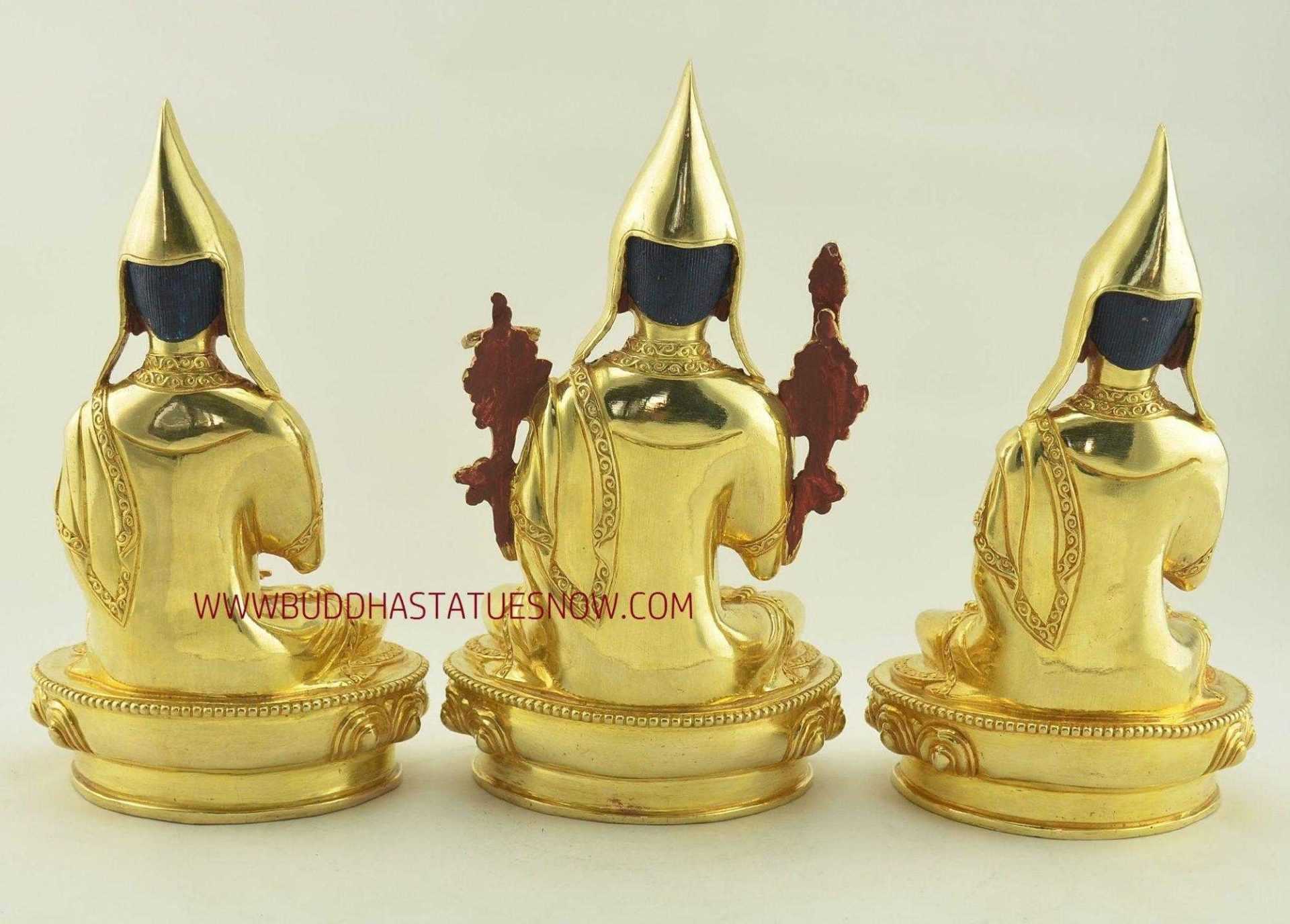
The workmanship is especially visible in the fully gilded finish. The bodies, hands, robes, pandita hats, attributes and lotus thrones are fire gilded in 24K gold. Decorative scrolling borders follow the collars, robe edges and sleeve bands, while additional fine detailing appears across the folded garments around the legs. The rear photographs show broad polished gold surfaces framed by ornamental robe borders rather than dense engraving over the entire back. Each throne has a beaded upper rim, raised lotus-petal carvings around the front and sides and a simple lower foot, giving all three statues a consistent visual foundation.
Guru Tsongkhapa Sculptures Set | Filling and Consecration
For practitioners preparing this set for devotional use, traditional statue filling, blessing and consecration in Kathmandu, Nepal can be arranged before shipment. Appropriate sacred materials may be placed within the hollow copper-alloy statues before their bases are resealed and the figures are ritually blessed. Preparing all three statues together preserves their devotional unity as a complete Gelug lineage group for offerings, meditation and guru-yoga practice.
Custom Tibetan Buddhist Statues
Collectors, monasteries and Dharma centers seeking a different scale or finish may also commission custom Tibetan Buddhist statues handmade in Nepal. A custom Tsongkhapa trio can be planned as a coordinated set so Je Tsongkhapa, Gyaltsab Je and Khedrub Je share proportional dimensions, matching pandita hats, compatible robe treatment and consistent lotus-throne designs. Options can include alternate sizes, full or partial 24K gold fire gilding and other traditional surface treatments while preserving the established iconography, mudras and attributes of the three Gelug masters.
Authentic, Handmade in Nepal
Every statue is handcrafted in Patan, Nepal, using traditional lost wax casting and comes with a certificate of authenticity issued by Nepal’s Department of Archaeology, verifying its materials, technique, and origin.