

Tara statues portray one of the most beloved and universally venerated female deities in all of Buddhism — a Bodhisattva whose compassion is so swift, so all-encompassing, and so fiercely protective that she is known throughout the Buddhist world as the Mother of Liberation. Tara appears in 21 distinct forms — peaceful, semi-wrathful, and wrathful — each representing a different dimension of her enlightened activity. The three most widely venerated are Green Tara (swift protection), White Tara (longevity and healing), and Red Tara Kurukulla (enchantment and magnetizing power).
The divine inspiration behind Tara statues first appeared in the Prajnaparamita Sutra — the great scripture of perfected wisdom — where the essence of Tara coincided with the rapidly evolving Mahayana Buddhist tradition. Five centuries later, through the rise of the Pala Empire in 8th century India and the subsequent flowering of Tibetan Buddhism, the Tara statue meaning evolved into the rich, elaborately defined iconography we recognize today: the expression of the compassion of perfected wisdom in feminine form.
This complete guide covers the origin, meaning, iconography, and mantra of every major form of Tara — with everything you need to understand, identify, and choose the right Tara statue for your altar or meditation practice.
Contents
- Origin & Evolution of Tara Statues
- Tara’s Birth & Feminist Vow
- The 21 Forms of Tara
- The Eight Fears — What Tara Protects Against
- Green Tara Statue — Meaning & Symbolism
- Green Tara Iconography: Posture, Mudras & Attributes
- Green Tara Mantra: Om Tare Tuttare Ture Svaha
- White Tara Statue — Meaning & Symbolism
- White Tara’s Seven Eyes — Meaning Explained
- White Tara Mantra & Longevity Practice
- Red Tara Statue (Kurukulla) — Meaning & Symbolism
- Kurukulla Mantra & Magnetizing Practice
- Frequently Asked Questions About Tara Statues
Origin & Evolution of Tara Statues
The worship of Tara spread rapidly with the rise of the Pala Empire in 8th century India — the last great Buddhist dynasty of the subcontinent, whose rulers commissioned magnificent Tara statues for temples and monasteries across Bengal and Bihar. As a result, Tara’s worship took deep root in both Mahayana and Vajrayana Buddhism. It was in Tibetan Buddhism particularly that the character and physical appearances of Tara gained in complexity — evolving from a single female Bodhisattva into an entire mandala of 21 distinct emanations, each with her own color, posture, attributes, and mantra.
The cult of Tara then traveled with Tibetan Buddhism to Nepal, Bhutan, Mongolia, and eventually the entire world. Scholars believe that Tara’s Hindu origins — she appears as a goddess in the Hindu Shakta tradition before her adoption into Buddhism — facilitated her acceptance across both traditions. In Buddhist teaching, she is understood as a fully enlightened being who manifests in feminine form to make her compassionate assistance maximally accessible — particularly to those who cannot easily relate to male Buddhas and Bodhisattvas.
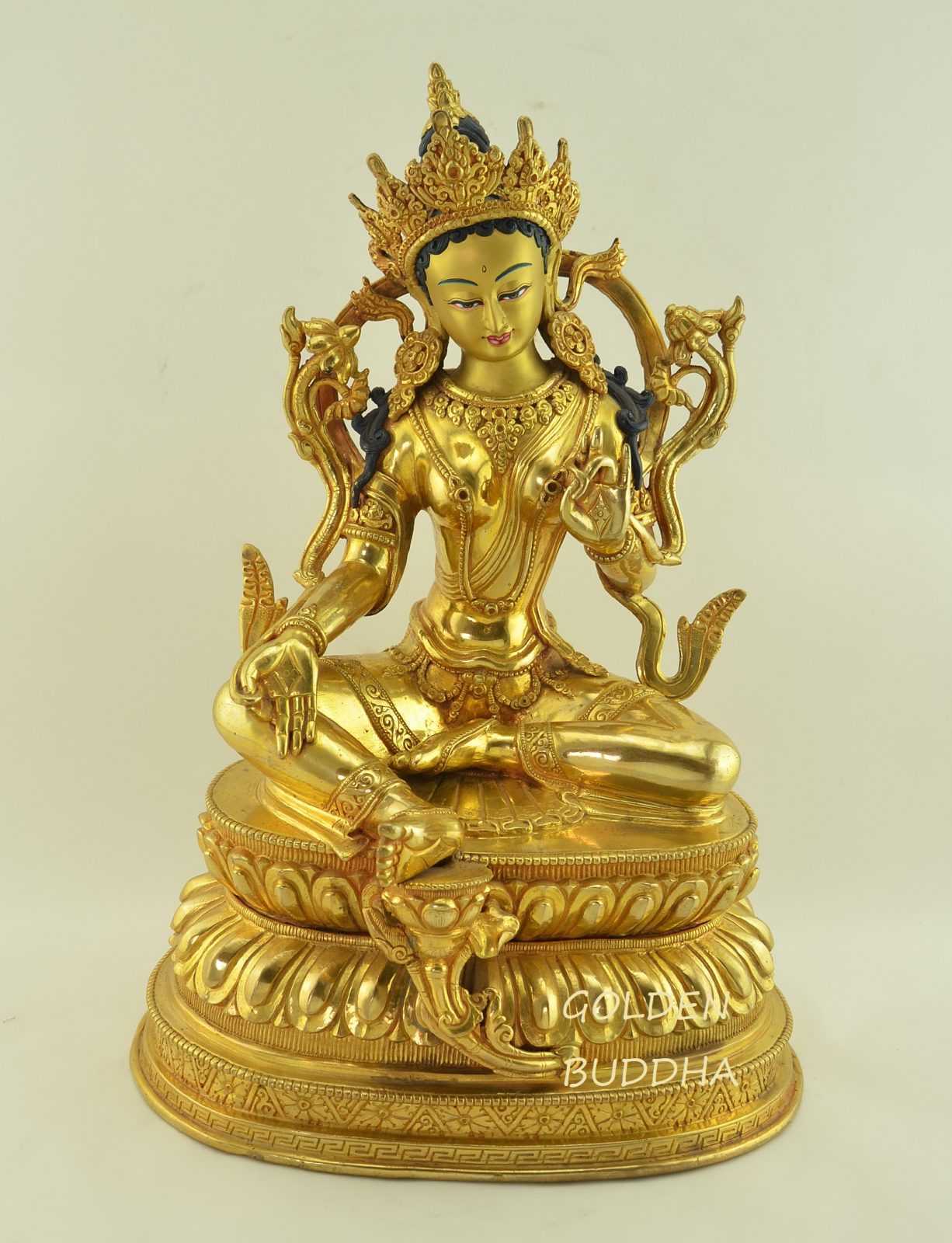
Gold Gilded Green Tara Statue
Tara’s Birth & Feminist Vow
In Tibetan Buddhist tradition, Tara was born from a teardrop that fell from the eye of Avalokiteshvara — the great Bodhisattva of Compassion — as he contemplated the immensity of all sentient suffering. The tear fell into a lake already filled with his tears of compassion, where it formed a lotus on the surface. From this lotus, Tara emerged — born from the purest compassion, the daughter of the most compassionate being in the Buddhist pantheon. This origin story establishes the Tara Bodhisattva meaning at its most fundamental: she is compassion itself, given feminine form.
Tara is also widely regarded as the world’s first Buddhist feminist. When monks in her presence urged her to pray for rebirth as a male — as was customary — she refused with a declaration that remains remarkable across 2,500 years of Buddhist history. She vowed to refuse rebirth as a male until there were more female Buddhas recognized in Buddhist tradition. She has maintained this vow across countless lifetimes, always returning in female form out of both conviction and compassion for those who need a female spiritual guide. For this reason, Tibetan Buddhists consider Tara already a fully enlightened female Buddha, while Mahayana traditions classify her as a Bodhisattva.
The 21 Forms of Tara
Tara’s complexity evolved into 21 distinct forms — based on the 21 verses of the celebrated Praises of the 21 Taras, one of the most beloved liturgical texts in Tibetan Buddhism. Each of the 21 Taras embodies a specific quality of Tara’s enlightened compassionate activity, from swift protection and fearlessness to longevity, wealth, healing, and the defeat of demonic forces. The 21 Taras together protect devotees from the eight great fears and the sixteen secondary fears — addressing every form of obstacle, physical danger, and mental defilement a practitioner might face on the path.
Some disagreement exists between Tibetan Buddhist schools about which specific praise corresponds to which Tara form — but the essential qualities and protective functions attributed to the 21 Taras are generally consistent across all traditions. An authentic 21 Tara statue set allows devotees to work with the complete mandala of Tara’s compassionate activity. The 21 Taras are displayed in various iconographic styles: peaceful, semi-wrathful, and fully wrathful — reflecting Tara’s capacity to express compassion through whatever means are most effective for each situation.
The Eight Fears — What Tara Protects Against
One of the most important teachings associated with Tara statues is her protection against the eight great fears — both their literal outer manifestations and the inner mental defilements they represent. Understanding these eight fears reveals why Tara’s protection is considered so comprehensive and why her practice is relevant to every practitioner regardless of their circumstances:
- Lions (outer) / Pride (inner)
- Elephants (outer) / Ignorance and delusion (inner)
- Fire (outer) / Hatred and anger (inner)
- Snakes (outer) / Jealousy and envy (inner)
- Thieves and bandits (outer) / Wrong views and wrong conduct (inner)
- Water and floods (outer) / Desire and attachment (inner)
- False imprisonment (outer) / Avarice and miserliness (inner)
- Demons and evil spirits (outer) / Deluded doubts and confusion (inner)
The dual nature of each fear — outer and inner — reflects a fundamental principle of Tibetan Buddhist teaching: external dangers and internal mental defilements arise from the same root. Tara’s protection operates simultaneously on both levels, shielding practitioners from physical harm while purifying the mental obscurations that generate those dangers in the first place.
Green Tara Statue — Meaning & Symbolism
Green Tara (Sanskrit: Shyamatara; Tibetan: Sgrol ljang; devotional title: Jetsun Dolma — “Venerable Liberatrix”) is the most widely venerated and beloved of all 21 Taras — the archetype of Tara herself. Jetsun Dolma is the name Tibetan practitioners use in everyday prayer and devotional practice: Jetsun meaning venerable or noble, Dolma meaning she who liberates — a title that captures both the reverence in which she is held and the core function she embodies. The Green Tara statue meaning is swift, active compassion: she is always ready to spring to the aid of devotees the moment her name is called, making her the most accessible of all Buddhist protectors. In Tibetan Buddhism, Green Tara is already considered a fully enlightened female Buddha — not merely a Bodhisattva aspiring to Buddhahood.
Her specific form within the 21 Taras is known as Khadiravani Tara — “Tara of the Acacia Forest” — reflecting her role as a forest goddess who resides in her pure land called Mt Potala. Mt Potala is described as a lush evergreen paradise of waterfalls, birds, flowers, and trees — a realm of natural abundance reflecting her connection to the fertility and vitality of the earth. The color green itself carries this symbolism: renewal, growth, healing, protection, and the active energy that makes things happen.
Green Tara Iconography: Posture, Mudras & Attributes
Every detail of an authentic Green Tara statue communicates her nature and function:
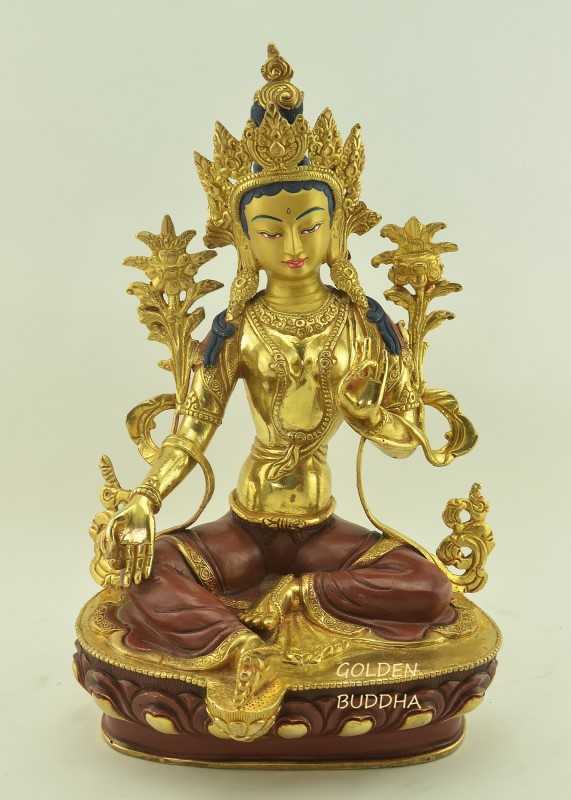
The Royal Ease Posture (Lalitasana): Unlike most seated Buddhas and Bodhisattvas who sit in full lotus with both legs drawn in, Green Tara is depicted with her right leg extended forward off the lotus throne and her left leg pulled in toward the body. This distinctive posture — called lalitasana or “royal ease” — is unique to Tara and communicates her essential quality: she is not locked in deep meditation, absorbed in her own realization. She sits ready, one foot already on the ground, prepared to rise and assist at any moment. The left leg drawn in represents meditative contemplation; the right extended outward represents immediate, active compassion.
Left Hand — Abhaya Mudra Variation with Lotus: Green Tara’s left hand performs a distinctive variation of the Abhaya mudra (protection gesture) — holding the stem of a closed blue utpala lotus between index finger and thumb, with the palm opening toward the viewer in a gesture of fearlessness and protection. This is unusual: most Buddhist deities perform Abhaya with the right hand. Tara’s left-hand Abhaya is her signature, and the lotus simultaneously represents purity and the enlightened wisdom that guides her protective action.
Right Hand — Varada Mudra (Gift-Giving): Her right hand rests over her right knee in the Varada mudra — palm open and facing outward, fingers pointing toward the earth — the gesture of unconditional generosity. This posture communicates that Green Tara freely offers her protection, blessings, and assistance to all who call upon her, without conditions or prerequisites.
Khadiravani Green Tara Statue
Green Tara Mantra: Om Tare Tuttare Ture Svaha
The Green Tara mantra is one of the most widely recited mantras in all of Tibetan Buddhism — second only to Avalokiteshvara’s Om Mani Padme Hum:
“oṃ tāre tuttāre ture svāhā”
Each syllable of the Green Tara mantra meaning carries precise significance: Om is the universal sacred syllable. Tare means liberation from mundane suffering — the ordinary troubles and obstacles of daily life. Tuttare invokes liberation specifically from the eight great fears and their corresponding inner defilements. Ture addresses liberation from spiritual ignorance — the root cause of all suffering in Buddhist teaching. Svaha (or Soha in Tibetan) seals the mantra with blessing, establishing its power in the heart of the practitioner.
Regular Green Tara mantra practice protects devotees from all eight fears and their internal counterparts — pride, delusion, hatred, jealousy, wrong views, avarice, desire, and deluded doubts. Practitioners report that sustained mantra recitation brings a growing sense of fearlessness, clarity, and the capacity to actively help others — qualities that directly reflect Green Tara’s own enlightened nature. The standard practice is 108 recitations per session using a mala, ideally while seated before a Green Tara statue as the focal point.
White Tara Statue — Meaning & Symbolism
White Tara (Sanskrit: Sitatara; Tibetan: Sgrol dkar) is the emanation of Tara associated with longevity, healing, compassion, and the wish-fulfilling qualities of an enlightened mind. The White Tara statue meaning is profound: devotees believe she glows with the radiance of a thousand full moons — a luminosity so pure and all-pervasive that her compassion for sentient beings exceeds even the love of a mother for her child. She is one of the three long life deities in Tibetan Buddhism, alongside Amitabha Buddha (in his Amitayus form) and Namgyalma.
In Tibetan Buddhist teaching, White Tara is known as the Cintachakra — the “Wish-Fulfilling Wheel” — reflecting her capacity to grant the sincere wishes of faithful devotees. Like Green Tara, she is regarded as a fully enlightened Buddha in female form in Tibetan Buddhism, and as a Bodhisattva in Mahayana Buddhist traditions. White Tara statues sit in full lotus pose (vajrasana) — distinguishing them at a glance from Green Tara statues, which always show the right leg extended.
White Tara Statue

White Tara’s Seven Eyes — Meaning Explained
The most distinctive and immediately recognizable feature of every White Tara statue is her seven eyes. No other Buddhist deity is depicted with this specific iconographic attribute, making White Tara instantly identifiable even to first-time viewers:
- Two eyes on her face — perceiving the suffering of all beings in the ordinary human world
- One eye on her forehead — the urna (third eye of wisdom), perceiving reality beyond the ordinary six senses
- One eye on each palm — perceiving suffering in all directions simultaneously as she reaches out to assist
- One eye on each sole of her feet — perceiving suffering even in the lower realms as she walks the path of compassion
Together, the seven eyes meaning communicates that White Tara’s compassionate awareness is omnidirectional and all-pervasive — she simultaneously perceives every form of suffering in every realm, at every level of reality. Her actions are therefore described as “imbued with the compassion and wisdom of all the Buddhas” — because she sees everything they see and responds with the same boundless care. This is why White Tara practice is considered especially powerful for healing, longevity, and the removal of obstacles to wellbeing.
White Tara Mantra & Longevity Practice
The White Tara mantra is the primary method for invoking her longevity blessings and healing power:
“Om Tare Tuttare Ture Mama Ayuh Punya Jñana Pustim Kuru Svaha”
The White Tara mantra meaning: Mama Ayuh Punya Jñana Pustim Kuru translates as “Please increase my lifespan, merit, and wisdom” — making the specific purpose of the White Tara mantra explicit within the words themselves. This is the mantra recited in Tibetan longevity rituals (tse drub), often in combination with Amitayus and Namgyalma practices, when practitioners wish to extend their lifespan, recover from illness, or remove obstacles to a long and fruitful life of Dharma practice.
The White Tara mantra benefits are most accessible when recited regularly before a White Tara statue with sincere aspiration for long life — not for its own sake, but as an opportunity to continue accumulating merit and progressing on the path to enlightenment. White Tara practice is also traditionally performed on behalf of sick or elderly loved ones, making it one of the most compassionate and practically applied devotional practices in Tibetan Buddhism.
Red Tara Statue (Kurukulla) — Meaning & Symbolism
Red Tara — known by her tantric name Kurukulla — is the most wrathful and visually dramatic of the three principal Tara forms. She is the Tara of enchantment and magnetizing power — a deity whose practice enables devotees to influence others, attract favorable circumstances, and exert a kind of inspired spiritual persuasion on those around them. The color red represents the magnetizing activities of an enlightened mind: the capacity to draw beings toward the Dharma and away from suffering.
The Kurukulla statue depicts her in what is known as the Dakini pose — standing dynamically on her right leg, with her left leg raised and extended to the side, dancing in an attitude of fierce spiritual energy. Beneath her feet she stands upon a human corpse — a vivid symbol of the death of negativity, ego-clinging, and all obstacles to liberation. She is surrounded by a ring of flames representing pristine awareness — the wisdom fire that burns away all obscurations.
Kurukulla has four arms, each holding a flower implement that carries specific symbolic meaning: a flower bow and flower arrow in her right hands — drawn back and aimed, ready to release — and a flower noose and flower goad in her left hands. All four implements are made of flowers rather than metal weapons, communicating that her power is the power of attraction, beauty, and loving persuasion — not force. The flower bow and arrow enchant and magnetize; the noose captures and holds what has been attracted; the goad guides and disciplines toward the Dharma.
Dancing Red Tara Statue (Kurukulla)

Kurukulla Mantra & Magnetizing Practice
The Kurukulla mantra is among the most powerful magnetizing mantras in the Vajrayana Buddhist tradition:
“Om Kurukulle Hrih Svaha”
The Kurukulla mantra benefits are described in Tibetan Buddhist texts with remarkable specificity: 10,000 recitations will fulfill the sincere desires of a devoted practitioner; 30,000 recitations can influence a government minister; and 100,000 recitations can subdue even a king. However, a critical condition governs the mantra’s effectiveness — the intentions of the practitioner must be entirely virtuous and beneficial. Any attempt to use the Kurukulla mantra for selfish, harmful, or manipulative ends will not only fail but may generate negative karma for the practitioner.
In practice, the Red Tara practice is used by Buddhist practitioners primarily to: attract favorable conditions for Dharma study and practice; draw the right teacher, community, or support into their lives; inspire positive change in people they care about; and develop the inner magnetism and eloquence that makes teaching and sharing the Dharma more effective. The flower arrow of Kurukulla does not compel — it enchants through genuine spiritual beauty, the most irresistible force in the universe.
Frequently Asked Questions About Tara Statues
What does a Tara statue represent?
A Tara statue represents the female Bodhisattva of compassion — known as the Mother of Liberation — in one of her 21 distinct forms. Each form embodies a specific quality of enlightened compassionate activity: Green Tara represents swift protection and the removal of obstacles; White Tara represents longevity, healing, and wish-fulfillment; Red Tara (Kurukulla) represents enchantment and magnetizing power. Every element of the statue’s iconography — posture, color, hand gesture, and held objects — communicates the specific teaching and function of that Tara form. Placing a Tara statue on a home altar or meditation space supports mantra practice and serves as a visual reminder to cultivate compassionate action in daily life.
What is the difference between Green Tara and White Tara?
Green Tara and White Tara are both emanations of the Bodhisattva Tara but emphasize different qualities. Green Tara embodies swift, active compassion — she specializes in the immediate removal of obstacles, protection from the eight great fears, and rapid response to practitioners in distress. White Tara emphasizes longevity, healing, and the wish-fulfilling dimension of compassion — she is one of the three long life deities and is invoked specifically for health, long life, and the removal of obstacles to wellbeing. Iconographically, Green Tara sits with her right leg extended (ready to spring to action); White Tara sits in full lotus (radiating stable, all-pervasive compassion). White Tara’s most distinctive feature is her seven eyes; Green Tara’s is her lalitasana posture and blue lotus.
What does the Green Tara mantra mean?
The Green Tara mantra “Om Tare Tuttare Ture Svaha” encodes three levels of liberation: Tare = liberation from mundane suffering and everyday obstacles; Tuttare = liberation from the eight great fears and their corresponding inner defilements (pride, delusion, hatred, jealousy, wrong views, avarice, desire, deluded doubts); Ture = liberation from spiritual ignorance — the root cause of all suffering. Om is the universal sacred syllable, and Svaha seals the mantra with blessing. Together the mantra invokes Tara’s compassionate activity on all three levels simultaneously, making it one of the most comprehensive protection mantras in Tibetan Buddhism.
Why does White Tara have seven eyes?
White Tara’s seven eyes represent her omnidirectional compassionate awareness — the capacity to perceive every form of suffering in every realm simultaneously. The seven eyes are: two on her face (perceiving ordinary human suffering), one on her forehead (the third eye of wisdom perceiving beyond ordinary senses), one on each palm (perceiving suffering in all directions as she reaches out), and one on each sole (perceiving suffering even in lower realms as she walks the path of compassion). Together they communicate that White Tara’s healing and protective awareness has no blind spots, no directions left unobserved, and no form of suffering beyond her compassionate reach.
Who is Kurukulla and why is she red?
Kurukulla is the wrathful-emanation form of Tara associated with enchantment, attraction, and magnetizing power — the capacity to draw favorable conditions, people, and circumstances toward the practitioner and toward the Dharma. Her red color represents the magnetizing activities of an enlightened mind: the warmth, passion, and irresistible spiritual beauty that draws beings toward liberation rather than repelling them with severity. Red is also the color of the karma Buddha family (Amoghasiddhi), which governs all-accomplishing activity — the quality of acting precisely and effectively in the world. Her flower bow, arrow, noose, and goad all operate through attraction, not force — she enchants rather than compels.
Are Tara statues from Nepal authentic?
The artisan city of Patan (Lalitpur) in the Kathmandu Valley has been the world center for handcrafted Himalayan Buddhist statues for over a thousand years — and Tara statues from Nepal produced by the traditional shakya craftsmen of Patan are among the finest Buddhist art objects available. Each statue is created using the lost-wax casting (cire perdue) method, finished with 24K fire gilding and hand face painting using real gold. All statues are certified by the Department of Archaeology in Kathmandu, and consecration (rabne) at a recognized Kathmandu monastery is available upon request — activating the statue as a genuine object of devotional practice. Browse our complete collection of Green Tara statues, White Tara statues, and Red Tara statues from Nepal.