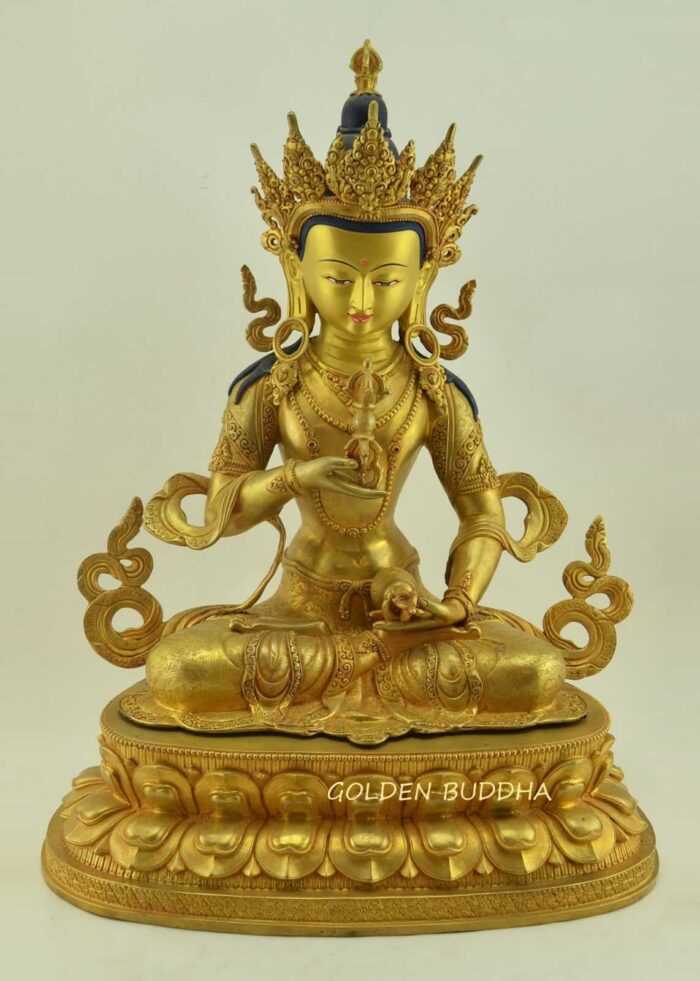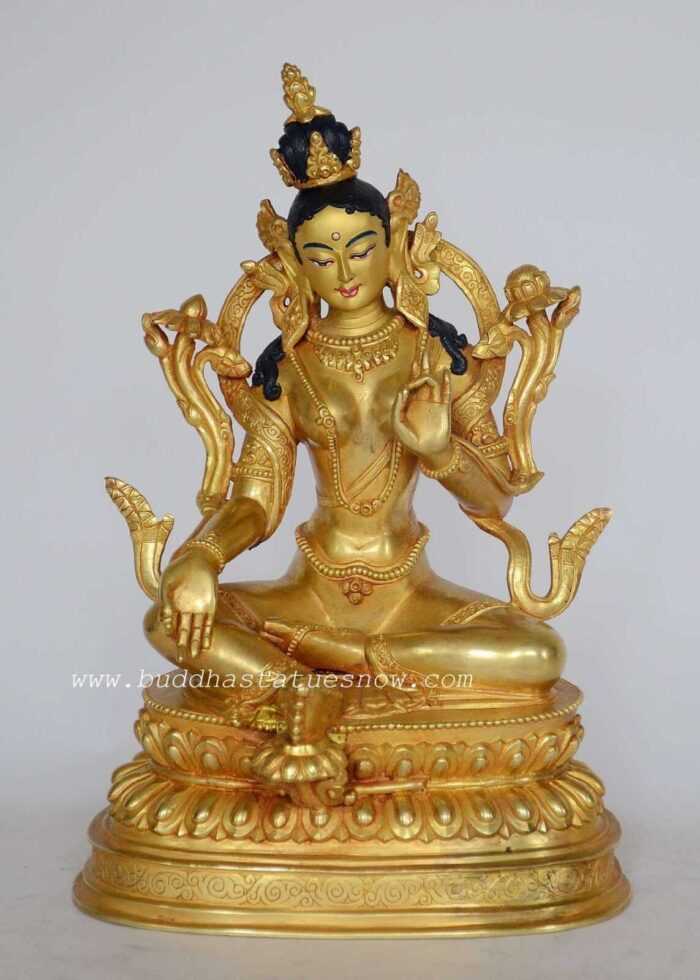

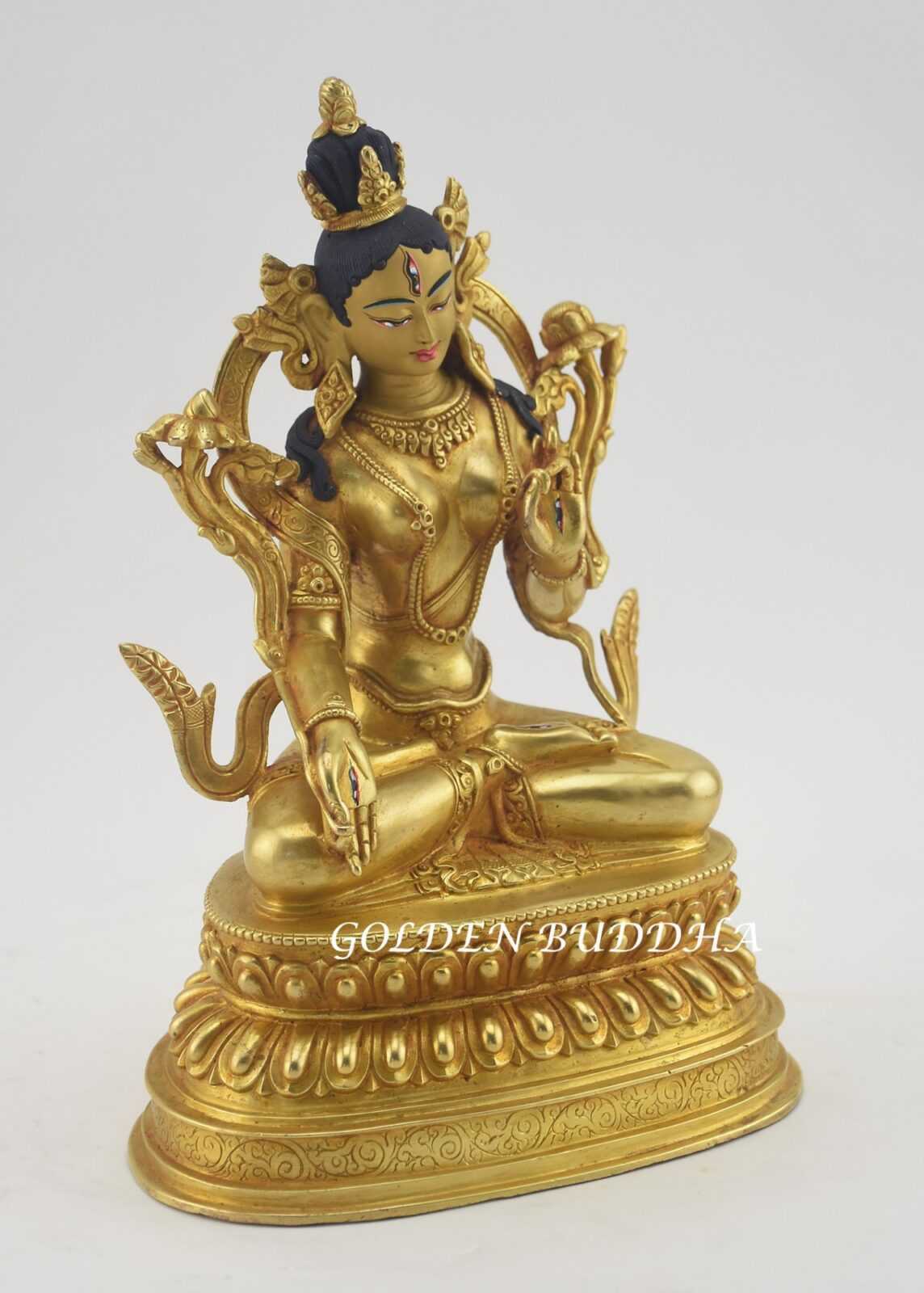
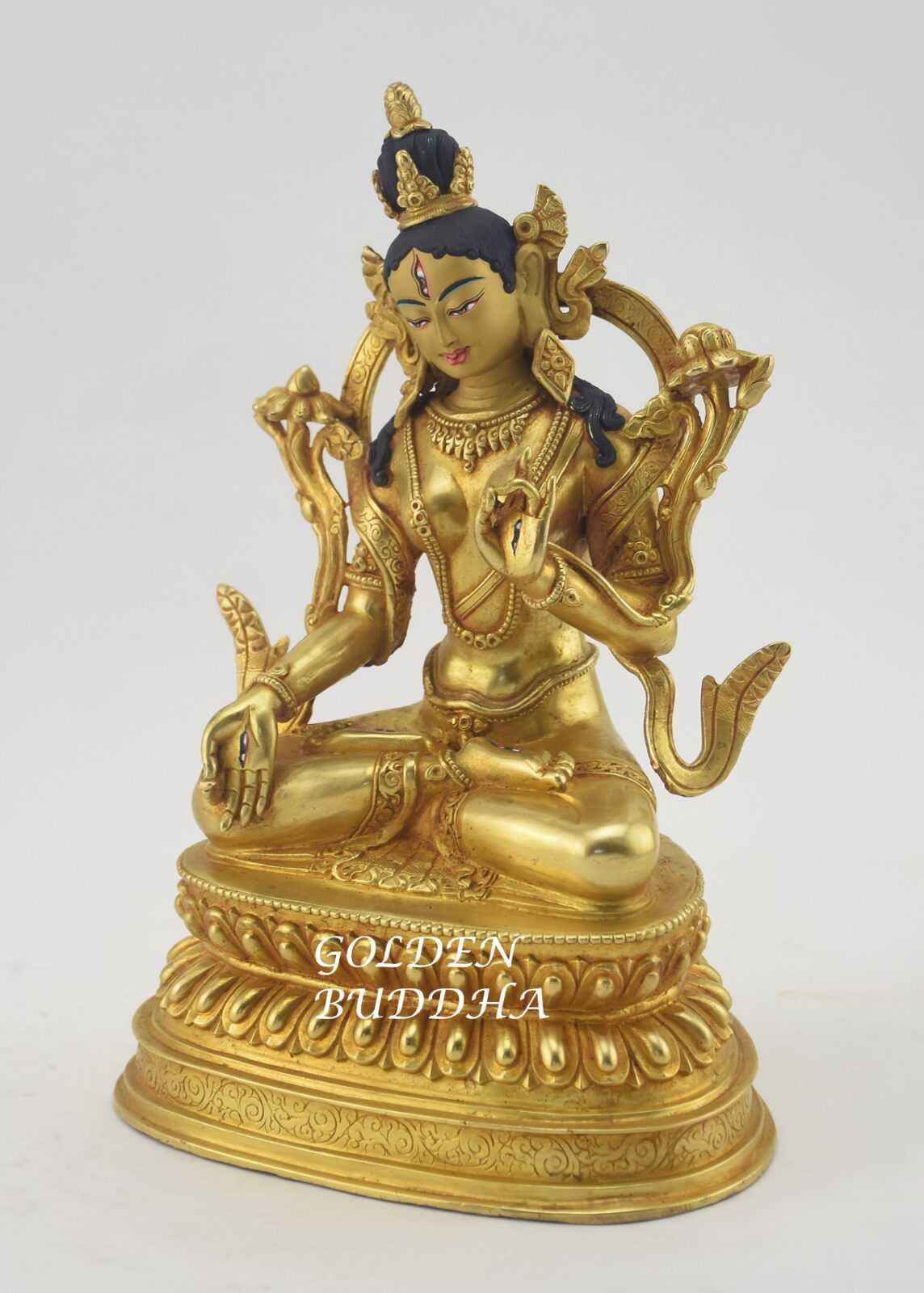
This elegant Nepali White Tara statue portrays seven-eyed White Tara, known in Tibetan Buddhism as Dolkar and in Sanskrit as Sita Tara. Handmade in Patan, Nepal, the 9.5-inch image was cast from copper alloy through the traditional lost-wax method and fire gilded in 24K gold. Its rich, low-luster finish gives the statue a warm devotional presence while preserving the clarity of Tara’s graceful posture, seven sacred eyes, ornamental topknot, celestial jewelry, utpala lotuses and double lotus pedestal.
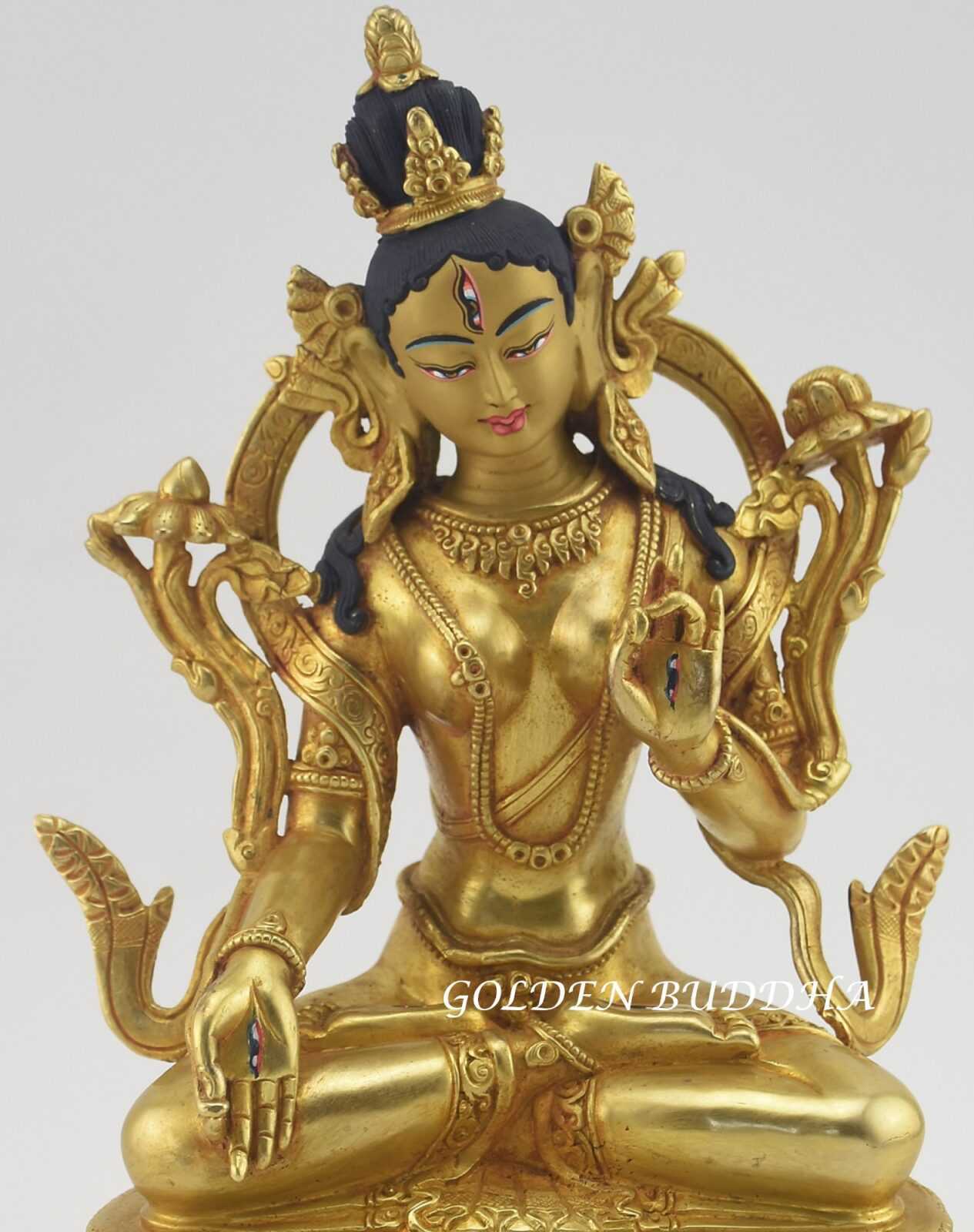
White Tara sits in the full lotus posture with both legs folded evenly before her, expressing meditative stability, healing and the patient preservation of life. Her lowered right hand rests open above the knee in Varada mudra, the gesture of generosity and the granting of blessings. Her raised left hand is held near the heart in a gesture of reassurance while supporting the stem of an utpala lotus. Painted wisdom eyes appear in both palms, complementing the two natural eyes of her face and the upright third eye upon her forehead.
Two lotus stems rise beside Tara’s shoulders, while long celestial ribbons curve outward from the upper body and flare beside her folded legs. Her black-painted hair is gathered into a tall topknot decorated with finely modeled gilded ornaments, with dark strands descending over both shoulders. Layered necklaces, armlets, bracelets, anklets and waist ornaments complete her celestial adornment and provide refined detail against the broad, smoothly gilded surfaces of the torso and robes.
Measuring approximately 9.5 inches high, 6.5 inches wide and 4.5 inches deep, this shrine-quality image is well suited to a home altar, meditation room or collection of authentic Himalayan Buddhist art. The statue was created by the same master artisan as the matching Gold Gilded Green Tara statue, allowing the two closely proportioned sculptures to form a visually unified and doctrinally complementary Tara set.
Nepali White Tara Statue of Seven-Eyed Dolkar
White Tara is one of the most revered female Buddhas in Tibetan Buddhism. Known in Tibetan as Dolkar, she embodies healing, longevity, serenity and compassionate protection. Her practice is traditionally associated with removing obstacles to life and strengthening the favorable conditions needed for meditation, study and service to others.
This Nepali White Tara statue presents those qualities through a balanced full-lotus posture, gently lowered gaze and harmonious arrangement of hands, flowers and ornaments. Tara remains upright yet relaxed, communicating contemplative stability without rigidity. Her stillness expresses the sustaining dimension of compassion: the capacity to heal, restore and nurture beings over time.
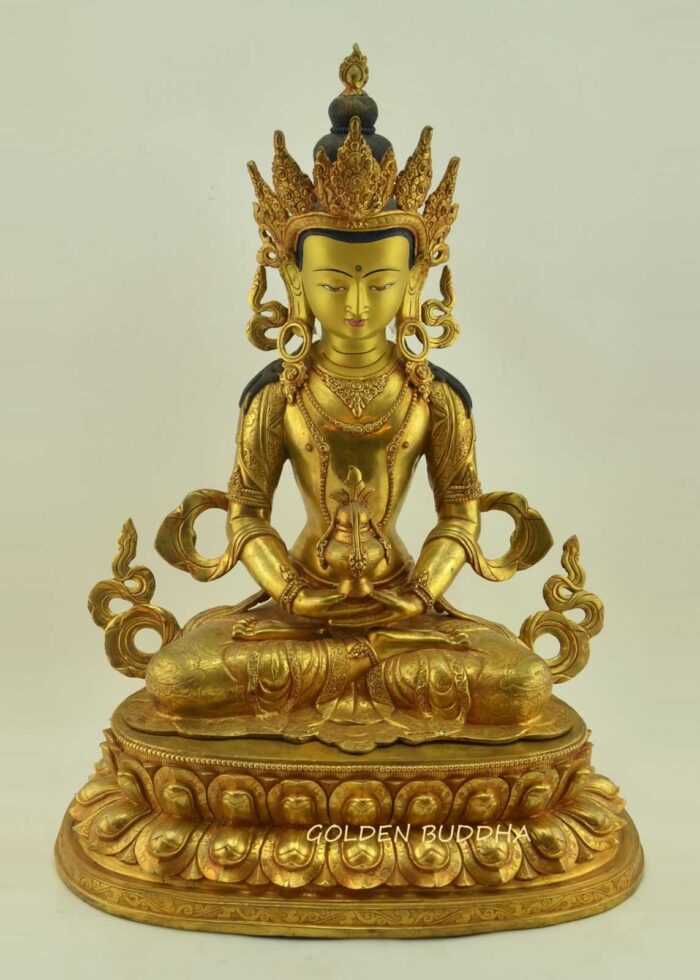
White Tara is traditionally counted among the three principal long-life deities of Tibetan Buddhism, together with Amitayus and Ushnishavijaya. Longevity in this context is not pursued merely for worldly enjoyment. A longer and healthier life provides additional opportunity to practice the Dharma, accumulate merit, cultivate wisdom and benefit sentient beings.
Learn more about White Tara’s meaning and symbolism, or browse our complete collection of White Tara statues in a range of sizes, finishes and artisan styles.
The Seven Eyes of the Nepali White Tara Statue
The seven eyes are the defining iconographic feature of White Tara. In addition to the two natural eyes of her face, a third eye appears vertically upon her forehead. Further eyes are traditionally represented in the palms of both hands and the soles of both feet. On this sculpture, the delicately painted eyes in the open palms are especially visible.
The forehead eye represents transcendent wisdom and the ability to perceive reality beyond ordinary appearances. The palm eyes unite insight with compassionate action, showing that Tara does not respond blindly or impulsively. Her assistance is guided by a complete understanding of suffering, its causes and the methods appropriate for relieving it.
The eyes associated with the feet symbolize awareness extending into every direction and every realm. Together, the seven eyes communicate compassion that is gentle yet vigilant. White Tara perceives physical illness, emotional distress and spiritual obstacles while remaining established in the calm clarity of awakened wisdom.
Her peaceful gaze is therefore more than an aesthetic detail. It expresses the union of wisdom and compassion at the heart of White Tara practice. The seven eyes remind practitioners to cultivate awareness in thought, speech and action so that compassion remains discerning and effective.
Full Lotus Posture and Meditative Stability
White Tara sits with both legs folded in the full lotus posture. This symmetrical position distinguishes her visually from Green Tara, who is commonly depicted with one leg extended in readiness to rise. White Tara’s closed lotus pose emphasizes stability, contemplation, healing and the patient continuation of compassionate activity.
The broad arrangement of the folded legs creates a stable triangular composition beneath the slender waist and upright torso. Smooth gilded surfaces across the knees reflect light softly, while narrow decorative borders define the edges of the garments without covering them in dense engraving.
Her posture conveys a form of compassion that restores and sustains. White Tara does not symbolize inactivity; instead, she represents the steady preservation of health, clarity and favorable circumstances. Her image can remind practitioners that lasting spiritual development depends upon patience, balance and continuity.
Mudras of the Nepali White Tara Statue
White Tara’s right hand extends over her knee with the palm open in Varada mudra. This gesture represents generosity, compassion and the granting of blessings and spiritual attainments. Its downward orientation creates a direct visual connection between the enlightened deity and the devotee, expressing Tara’s willingness to offer healing, merit and protection.
Her raised left hand is held close to the heart, with the thumb and forefinger delicately supporting an utpala stem. The gesture conveys reassurance, refuge and teaching. Its position near the heart indicates that Tara’s enlightened activity arises from wisdom and immeasurable compassion rather than ordinary emotion.
The painted eyes within both palms reinforce the meaning of the gestures. The hands represent compassionate method, while the eyes signify insight. Together they teach that beneficial action should always be guided by wisdom and a clear understanding of the needs of others.
Utpala Lotuses and Celestial Ribbons
Two utpala lotus stems rise beside Tara’s body and blossom near her shoulders. Their openwork stems curve through the composition rather than appearing as simple vertical supports, adding depth and movement around the upper body. One flower appears more open and developed, while the other remains more compact.
The complementary blossoms may be understood as different stages in the unfolding of wisdom. The more developed flower represents realization approaching complete expression, while the less-open blossom symbolizes the awakened potential present within every sentient being.
The lotus is especially meaningful in Buddhist art because it grows from muddy water yet opens above the surface without becoming stained. It represents wisdom and compassion arising within samsara while remaining free from ignorance, attachment and fear. White Tara enters the conditions of suffering without becoming bound by them.
Long celestial ribbons sweep outward beside the lower body, introducing graceful movement into the stable seated composition. A broad curved scarf passes behind the upper body and visually connects the lotus stems. The darker reddish finish visible on portions of these ribbons creates subtle contrast against the gold body, black hair and gilded blossoms.
Ornamental Topknot and Celestial Jewelry
White Tara’s black-painted hair is gathered into a tall, rounded topknot decorated with finely modeled gilded ornaments. Small decorative fittings encircle the upper hair arrangement, and a larger ornamental finial rises at the summit. Dark strands descend over both shoulders and frame the hand-painted face.
The contrast between the black hair and low-luster gold finish gives strong definition to Tara’s head and upper body. The gilded ornaments catch the light while the dark hair emphasizes the gentle contours of the face, neck and shoulders.
Layered necklaces decorate the chest, with additional jewelry at the upper arms, wrists, ankles and waist. Beaded details and pendant forms introduce texture without overwhelming the sculpture’s smooth body and robes. These celestial ornaments symbolize the abundance of enlightened qualities cultivated for the welfare of sentient beings.
At the buyer’s request, the hair ornaments and jewelry may be embellished with genuine turquoise and red coral before shipping. Turquoise introduces a vivid blue-green accent against the gold, while red coral adds a warmer contrast. The stones may be placed selectively to preserve the statue’s restrained and traditional Himalayan appearance.
Hand-Painted Face and Peaceful Expression
The face of this Nepali White Tara statue is separately hand painted with 18K gold and natural pigments. Fine painted lines define the eyebrows, lowered eyes, forehead eye and lips, while the black hair creates a strong frame around Tara’s serene expression.
Her gaze is peaceful without appearing distant. The gently lowered eyes suggest compassionate attention directed toward practitioners while remaining grounded in meditative awareness. The subtly painted lips and carefully outlined eyes add warmth and vitality to the face.
The face-painting process is distinct from the traditional fire gilding applied to the body. The copper-alloy sculpture is fire gilded in 24K gold, while the face receives a separate finish using 18K gold and natural pigments. This method is characteristic of refined Himalayan Buddhist sculpture and gives the facial features greater clarity and devotional presence.
Smooth Robes and Refined Surface Treatment
This sculpture emphasizes broad, smooth gilded surfaces across Tara’s torso, folded legs and garments. The restrained treatment allows the quality of the 24K fire-gilded finish and the graceful modeling of the body to remain prominent.
Narrow borders define portions of the dhoti and sash, while selected folds and hemline details give structure to the fabric without covering the robes in extensive engraving. The simplicity of the garments allows the lotus stems, jewelry, hair ornaments and pedestal to provide the principal decorative detail.
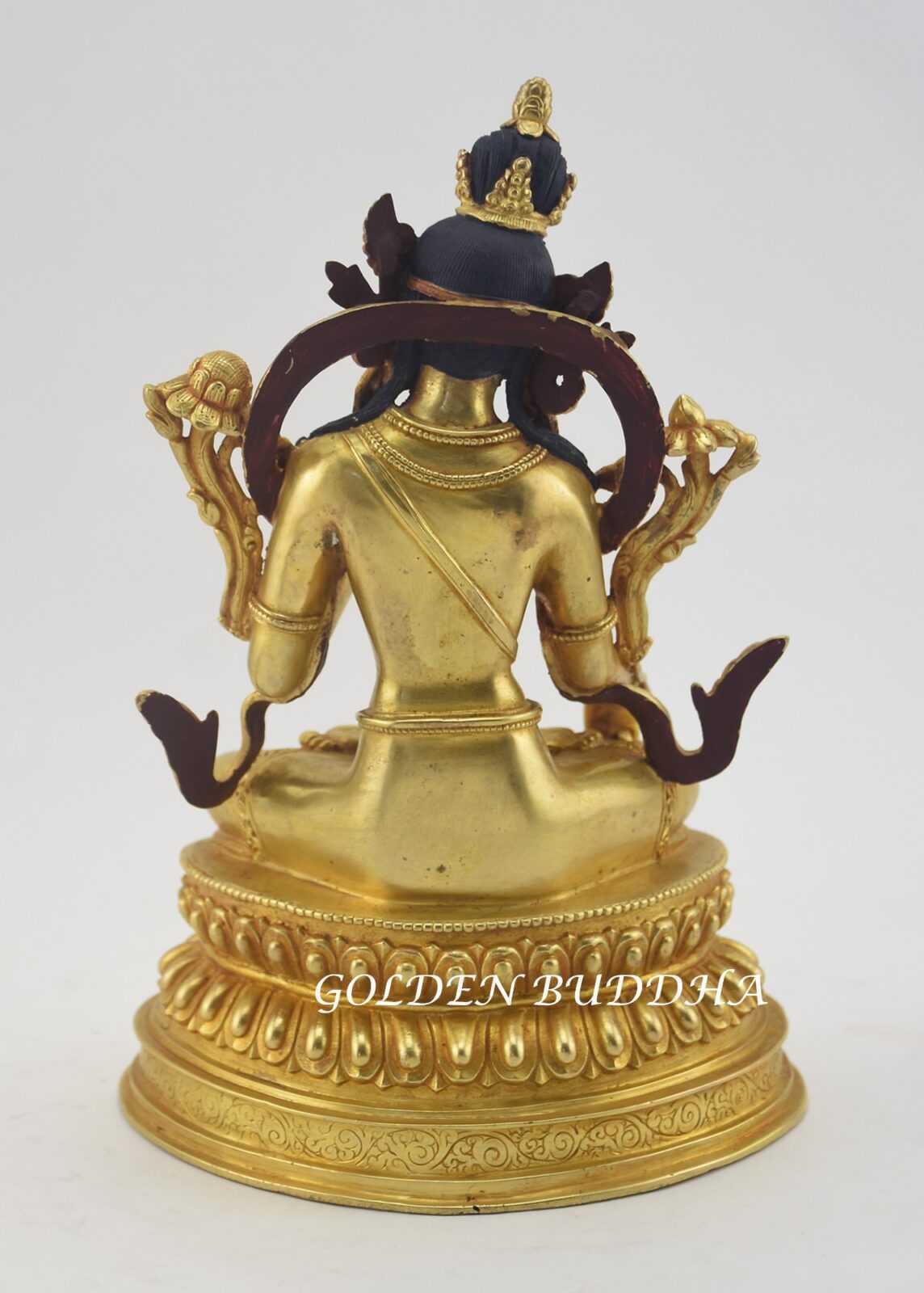
The reverse is similarly smooth, with a diagonal sash crossing Tara’s back and fine beaded jewelry continuing around the neck, upper arms and waist. The uncluttered treatment reveals the natural transition between the shoulders, narrow waist and seated posture while displaying the low-luster gilding across broad uninterrupted surfaces.
Double Lotus Pedestal of the Nepali White Tara Statue
The substantial double lotus pedestal is one of the most visually prominent craftsmanship features of this statue. Two distinct rows of individually modeled petals surround the throne, creating a layered and stable foundation beneath Tara’s full lotus posture.
The upper row consists of smaller rounded petals arranged beneath the smooth seating platform. Their repeated forms establish an even rhythm across the front, sides and reverse. Below them, a broader row of elongated downward-facing petals projects outward and gives the base greater visual depth.
Beaded borders separate the lotus courses from the upper seating surface and lower architectural pedestal. The raised centers of the petals reflect light more strongly, while their recessed outlines remain in deeper shadow. This contrast helps distinguish the individual petals within the uniform gilded finish.
The lotus represents purity and awakening. Although it develops from muddy water, its blossom opens unstained above the surface. White Tara’s placement upon two complete rows of lotus petals symbolizes enlightened wisdom and compassion arising beyond the obscurations of cyclic existence.
Engraved Architectural Base
Beneath the double lotus throne is a broad stepped pedestal that gives the compact statue a substantial shrine presence. Smooth rounded mouldings frame a finely engraved lower band decorated with scrolling foliate motifs.
The shallow engraving catches reflected light without competing with the larger sculpted lotus petals above. It creates a refined finishing course around the base and visually anchors the seated deity.
The rear photograph confirms that the petal rows, beaded borders and engraved lower band continue around the full circumference. This complete treatment allows the statue to be placed on a freestanding altar and appreciated from several viewing angles.
Low-Luster 24K Fire-Gilded Finish
The copper-alloy body, ornaments and pedestal are fire gilded in 24K gold using traditional Himalayan techniques. Rather than presenting a highly polished surface, the statue retains a rich low-luster finish that softens reflected light and gives the image the dignified appearance of a devotional sculpture intended for shrine use.
Subtle variations across the gold surface reveal the handmade process. Raised areas such as the hair ornaments, jewelry, lotus petals and facial contours catch light more clearly, while recessed spaces around the flowers and ribbons appear deeper in tone.
The broad smooth surfaces of Tara’s body and robes allow the warmth of the gold to remain especially visible. Small variations in tone and texture are characteristic of traditional hand finishing and distinguish the statue from mechanically plated reproductions.
Finished from the Front and Reverse
The rear view reveals the complete three-dimensional construction of the sculpture. Tara’s shoulders, back and waist are smoothly modeled, with a diagonal sash crossing the upper body and beaded necklaces continuing behind the neck.
The black-painted hair remains carefully defined from behind, including the rounded topknot, small gilded fittings and ornamental finial. The lotus blossoms, curved stems and celestial ribbons retain their depth and sculptural form when viewed from the reverse.
The folded legs are smoothly finished across the back, while the double lotus pedestal carries its complete rows of petals and engraved lower border around the full base. This attention to the reverse makes the sculpture suitable for freestanding shrine placement and reflects the high standard of traditional Newar metalwork.
Traditional Lost-Wax Casting in Patan, Nepal
This Nepali White Tara statue was handmade in Patan, Nepal, through the traditional lost-wax casting process. The work begins with a detailed wax model prepared according to established Buddhist iconometric proportions. The artisan forms Tara’s face, posture, hands, seven-eyed iconography, lotus flowers, ribbons, hair ornaments, jewelry and double lotus pedestal before the image is prepared for casting.
The wax model is enclosed within a heat-resistant mould and fired so that the wax melts away, leaving a cavity in its form. Molten copper alloy is poured into the mould and allowed to cool. Once the mould is removed, the raw casting is chased, filed and refined by hand.
The artisan sharpens the fingers, facial features, ornaments and openwork flower stems before refining the individually modeled lotus petals and engraved lower border. The completed copper-alloy statue is then prepared for 24K fire gilding. Traditional black pigment is applied to the hair, and the face is separately hand painted with 18K gold and natural pigments.
Because the original wax model is destroyed during casting and the chasing, assembly and finishing are completed individually, every statue retains subtle handmade variations. These qualities distinguish authentic Newar metalwork from mass-produced religious objects.
White Tara’s Healing and Long-Life Practice
White Tara practice is traditionally associated with healing illness, overcoming obstacles to life and strengthening the circumstances required for continued spiritual development. Her activity is gentle, restorative and sustaining.
Her mantra is commonly recited as Om Tare Tuttare Ture Mama Ayuh Punya Jnana Pushtim Kuru Svaha. The practice invokes the increase of life, merit and wisdom. Life provides the opportunity to practice, merit creates favorable conditions, and wisdom directs those conditions toward liberation.
Placed upon an altar, this Nepali White Tara statue can serve as a visual support for meditation, mantra recitation and long-life prayers. The seven eyes remind practitioners that healing compassion must be guided by insight, while the stable lotus posture encourages patience and continuity.
Learn more about the traditional practice in our guide to the White Tara mantra, or read the White Tara statues FAQ.
Matching Nepali White Tara Statue and Green Tara Set
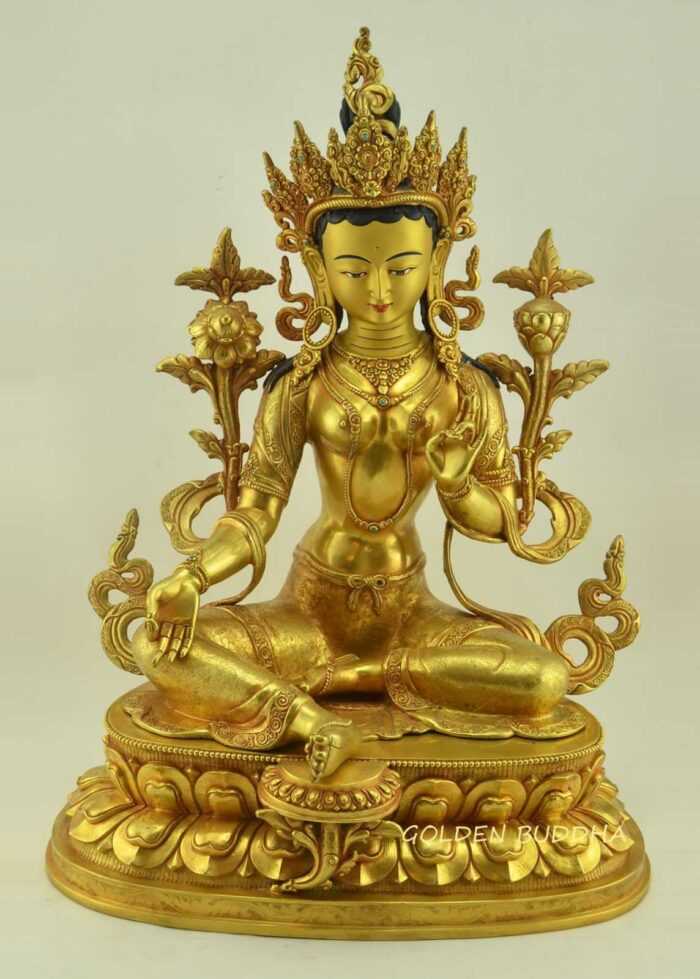
This Nepali White Tara statue would form a harmonious two-piece shrine set with the matching Gold Gilded Green Tara statue. Both sculptures were created by the same master artisan and share closely coordinated proportions, copper-alloy construction and rich low-luster 24K fire-gilded finishes.
The 9.5-inch White Tara and 9.25-inch Green Tara are sufficiently close in height to appear as an intentionally planned pair. Both feature double lotus thrones with two rows of modeled petals, tall black-painted topknots with gilded hair ornaments, openwork lotus stems, celestial ribbons, smooth garments and engraved lower pedestal bands.
Their shared workmanship creates visual unity, while their contrasting postures express complementary forms of enlightened compassion. Green Tara sits in lalitasana with one leg extended, showing her readiness to rise immediately when beings encounter danger or obstacles. White Tara rests in full lotus posture, representing healing, longevity and meditative stability.
Green Tara embodies swift compassionate action. She responds to fear, danger and spiritual obstacles without delay. White Tara embodies compassion that heals, restores and sustains beings over time, preserving the health and favorable circumstances needed for continued Dharma practice.
Together, the pair represents compassion in both immediate and enduring forms. Green Tara removes urgent difficulties, while White Tara nurtures life and supports practitioners after those difficulties have been overcome. Their complementary iconography makes the statues an especially meaningful pairing for a home shrine, meditation room or Dharma center.
Custom-Made Nepali White Tara Statues
A custom-made White Tara statue may be commissioned in a preferred height, finish and level of ornamentation. Available options include smaller personal shrine images, larger temple-scale statues, antiquated oxidized copper finishes, silver-highlighted surfaces and sculptures fire gilded in 24K gold.
For a gilded commission, the face may be separately hand painted with 18K gold and natural pigments, while the hair can be completed with traditional black pigment. The ornamental topknot fittings, necklaces, armlets, bracelets and waist jewelry may also be embellished with genuine turquoise and red coral.
The double lotus pedestal may be adapted with larger petals, deeper carving, engraved foliate borders or different architectural proportions. Customers may request smooth robes similar to this image or more extensive hand engraving across the garments and pedestal.
Custom seven-eyed Tara statues can be created for private collectors, home shrines, Dharma centers and monasteries. Traditional features—including the seven eyes, full lotus posture, Varada mudra, raised protective hand, paired utpala lotuses and ornamental topknot—are preserved throughout the design and production process.
A coordinated two-piece Tara set may also be commissioned with White Tara and the matching Gold Gilded Green Tara statue. Their heights, gilded finishes, topknot ornaments, lotus stems, celestial ribbons and double lotus pedestals can be planned together so the finished sculptures form a unified shrine ensemble.
Such a pairing unites Green Tara’s swift response to danger with White Tara’s healing and life-sustaining activity. Green Tara represents compassion acting immediately when suffering arises, while White Tara preserves the life, merit and wisdom needed for continued spiritual practice. Together, they form a visually balanced and doctrinally meaningful expression of Tara’s enlightened activity.
Authentic, Handmade in Nepal
Every statue is handcrafted in Patan, Nepal, using traditional lost wax casting and comes with a certificate of authenticity issued by Nepal’s Department of Archaeology, verifying its materials, technique, and origin.