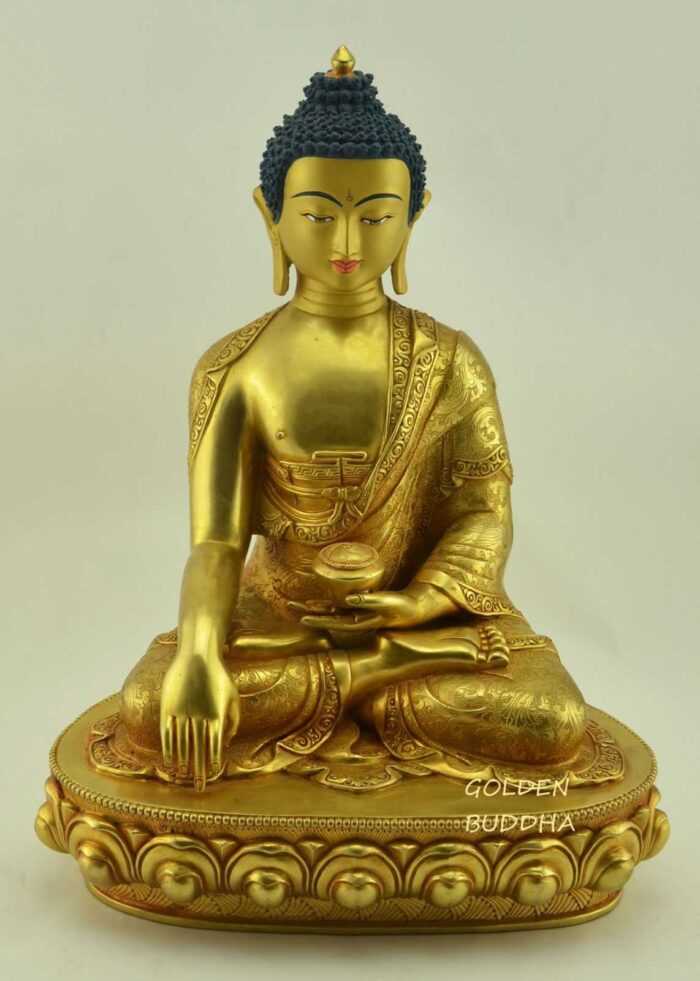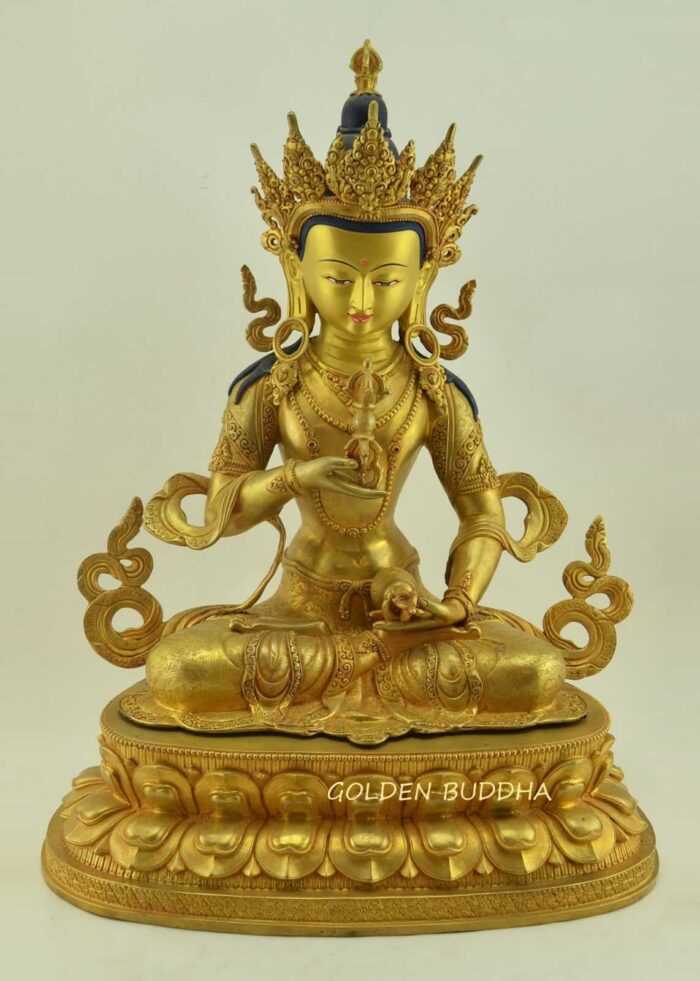

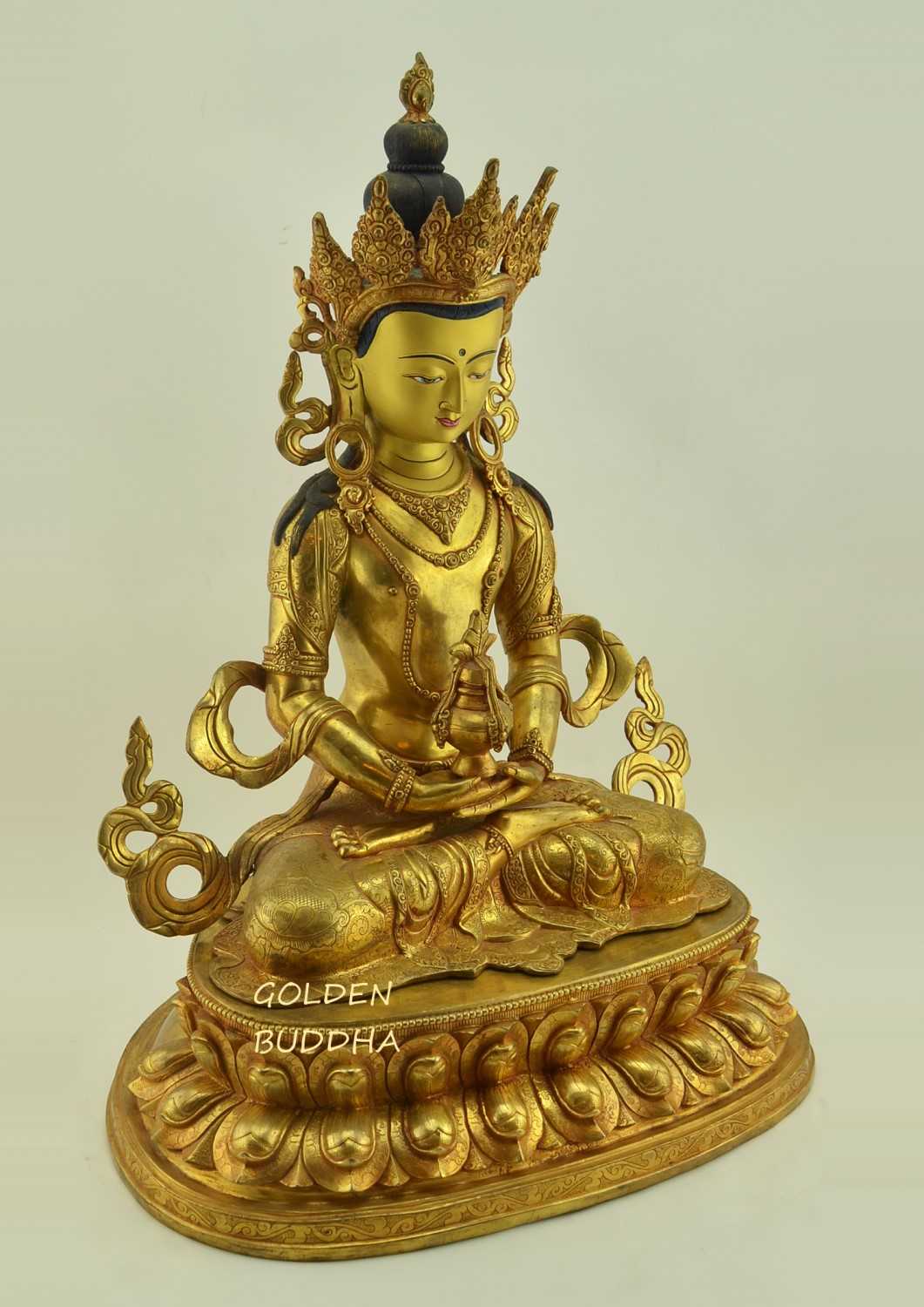


This magnificent 19″ Amitayus Buddha statue represents the Buddha of Infinite Life, a revered figure associated with longevity, vitality, merit, and the favorable conditions needed for sustained Dharma practice. Handcrafted from copper alloy by a master Newar artisan in Patan, Nepal, the sculpture was created through the traditional lost wax casting method and fire gilded in pure 24K gold. The radiant gilded surface is complemented by a delicately hand-painted face, deep blue-black hair, and an extraordinary amount of finely chased ornamentation across the garments, jewelry, lotus pedestal, and reverse of the sculpture.
Amitayus sits in the full lotus posture upon a substantial double lotus pedestal composed of two complete registers of overlapping petals. His balanced proportions, upright posture, and peaceful expression give the figure a commanding yet contemplative presence suitable for a home altar, meditation room, monastery, or Dharma center. The artisan has carefully finished the statue from every direction, including the back of the garments and throne, so it may be displayed in an open shrine where the refinement of the entire sculpture can be appreciated.
Amitayus Buddha Statue Crown and Bodhisattva Ornaments
The elaborate appearance of this Amitayus Buddha statue reflects his sambhogakaya form. Rather than wearing the simple monastic robes associated with a historical Buddha, Amitayus is adorned with the crown, jewels, silks, and celestial ornaments of an enlightened Bodhisattva. A tall five-pointed crown rises above his carefully painted face, framing the forehead beneath a gathered topknot of dark blue hair. The topknot is capped by a curling gold finial, while ornamental ribbons extend outward beside the head and accentuate the statue’s graceful silhouette.
Large open hoop earrings are among the most distinctive features of this sculpture. They are accompanied by layered necklaces, armlets, bracelets, and additional beaded ornaments that enrich the upper body without overwhelming the calm symmetry of the figure. Flowing celestial scarves pass around the shoulders and elbows before curling outward beside the knees in broad, cloud-like forms. These ribbons create movement around the seated Buddha while preserving the stillness of his meditative posture.
His face has been painted with delicately arched brows, softly outlined eyes, a clearly defined urna between the eyebrows, and warm red lips. The half-closed gaze suggests a state of inward meditation combined with compassionate awareness of the world. Three horizontal lines at the neck are included among the traditional auspicious marks of an enlightened being. The contrast between the painted facial details, dark hair, and luminous gold surface gives this Amitayus figure an especially refined and dignified character.
Amitayus Buddha Statue Longevity Vase and Meditation Mudra
Amitayus rests both hands in his lap in the Dhyana mudra, the gesture of meditation and inner equipoise. Supported within his palms is the sacred long-life vase containing amrita, the nectar of immortality. The vessel is one of the principal attributes used to identify Amitayus in Tibetan Buddhist art. Its decorative lid rises into an ornate, sprouting finial, giving the central attribute both symbolic importance and visual prominence.
The nectar does not merely signify the desire to prolong ordinary life. Within Buddhist practice, longevity is valued because a precious human life provides the opportunity to study the Dharma, accumulate merit, cultivate wisdom, and benefit sentient beings. The vase therefore represents the preservation and renewal of life energy so that meaningful spiritual activity may continue. Amitayus practices may be undertaken for oneself, for teachers whose long lives benefit their students, or for others facing illness and obstacles to longevity.
The full lotus posture reinforces the qualities of stability, meditation, and complete spiritual composure. The double lotus pedestal beneath him symbolizes purity arising from the conditions of cyclic existence, just as a lotus grows through muddy water without being stained by it. The two rows of carefully modeled petals also provide a substantial architectural foundation for the richly ornamented figure above.
Hand Engraving and Repoussé Lotus Throne
Exceptional surface decoration distinguishes this Amitayus Buddha statue from more simply finished examples. Fine floral and scrolling patterns have been engraved by hand across the dhoti and shoulder wrap, with additional detail appearing on the jewelry, crown, scarves, and pedestal. The fitted garment covering the legs is filled with closely worked motifs that catch the light differently as the statue is viewed from changing angles. These carved patterns add depth and texture to the brilliant 24K gold surface without obscuring the natural contours of the body.
The craftsmanship continues around the back, where the shoulder covering and lower garments display further hand-carved decoration. Raised ornamental metalwork is incorporated around the reverse of the double lotus throne, creating a repoussé-style decorative treatment that complements the engraving across the robes. This attention to the rear confirms that the sculpture was conceived as a fully finished sacred artwork rather than as a figure intended to be viewed only from the front.
Traditional lost wax casting allows the artisan to preserve complex sculptural details in the crown, earrings, jewelry, fingers, longevity vase, and layered lotus petals. After casting, the surfaces are refined, engraved, gilded, and painted through a sequence of specialized processes. The result combines precise iconographic proportions with the distinctive hand-finished character for which the Buddhist metalworkers of Patan have been renowned for generations.
Amitayus as the Longevity Form of Amitabha Buddha
Amitayus has a particularly close relationship with Amitabha Buddha. Amitabha is the Buddha of Infinite Light and presides over the western Pure Land of Sukhavati, while Amitayus is understood as the sambhogakaya manifestation of Amitabha’s infinite-life or longevity attribute. Through this richly ornamented form, the enlightened qualities of Amitabha appear specifically in connection with long life, merit, wisdom, and the removal of obstacles that shorten the opportunity for practice. Read more about this relationship in our discussion of Amitayus, the longevity form of Amitabha Buddha.
Amitayus rituals are widely practiced within Tibetan Buddhism. Long-life ceremonies may include mantra recitation, visualization, offerings, and the blessing of substances connected with longevity. In some traditions, a ritual vessel is filled with consecrated liquid and a small portion is distributed to participants as part of the long-life blessing. The purpose is not simply to seek additional years, but to cultivate the conditions through which life may be used wisely and compassionately. Learn more in our complete guide to Amitayus long-life practice and meaning, or browse our collection of Amitayus Buddha statues to compare different sizes, finishes, and artistic interpretations.
A Matching Amitayus, Vajrasattva and Green Tara Statue Set
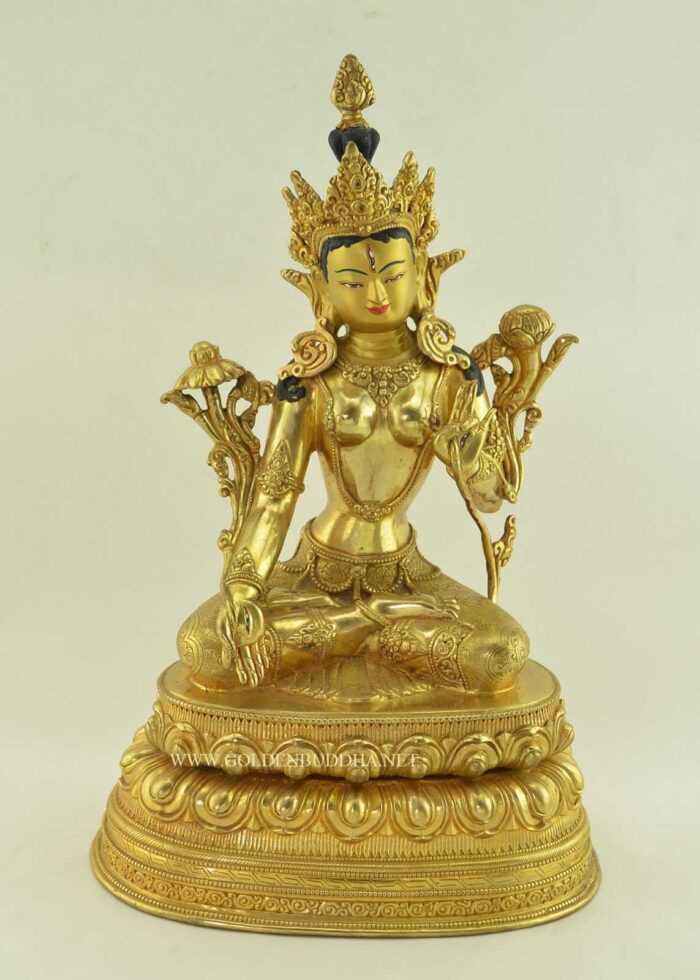
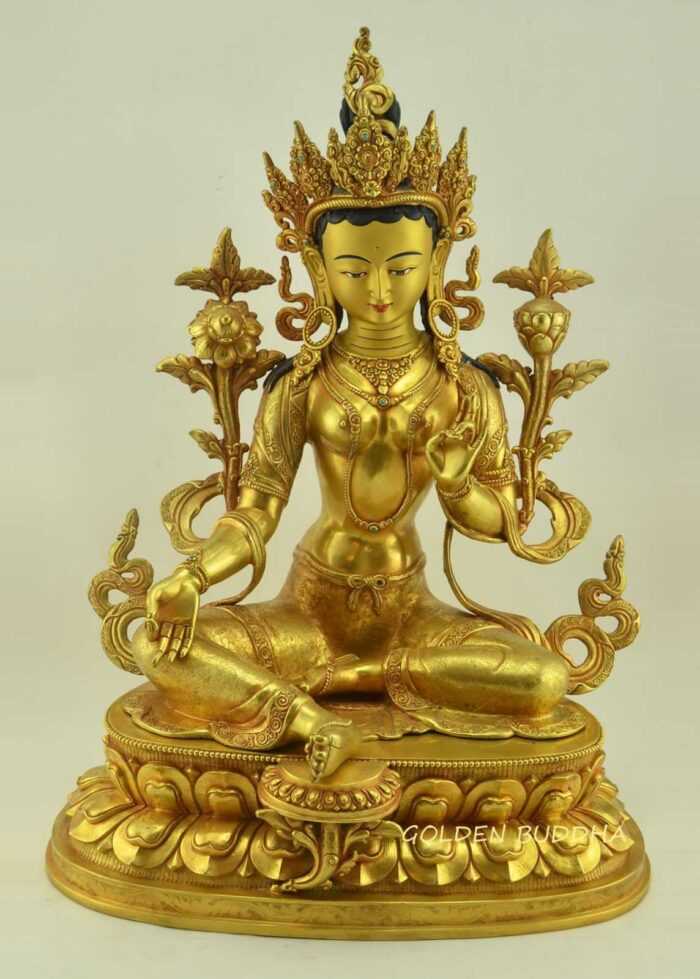
This Amitayus Buddha statue would form an especially harmonious three-piece shrine set with our gilded Vajrasattva statue and gold-gilded Green Tara statue. The three sculptures were created by the same master artisan and share a closely related decorative language. Each features radiant 24K gold gilding, finely painted facial details, elaborate Bodhisattva ornaments, hand-carved engraving across the dhoti and shoulder garments, and richly finished lotus pedestals. Decorative metalwork and engraving also continue around the backs of the figures, allowing the set to be appreciated as a unified group from several directions.
The three deities also complement one another doctrinally. Amitayus represents long life, vitality, accumulated merit, and the preservation of favorable conditions for Dharma practice. Vajrasattva embodies purification and is approached for the cleansing of negative karma, obscurations, damaged commitments, and habitual patterns that obstruct spiritual progress. Green Tara expresses swift compassionate activity, protection from fear, and immediate assistance in overcoming outer and inner obstacles. Displayed together, Vajrasattva purifies the path, Green Tara protects and supports compassionate activity, and Amitayus sustains the life and merit needed to continue that path. Their combination therefore brings together purification, active compassion, protection, and longevity in a balanced shrine arrangement.
Filling, Blessing and Consecration
The statue includes a consecration opening so that it may be filled with sacred texts, printed mantras, incense, precious substances, and other traditional materials before being blessed according to the buyer’s Buddhist lineage. Filling and consecration prepare the handcrafted image for use as an object of meditation, offering, and veneration. Our guide to Buddha statue filling, blessing, and consecration explains the customary preparation and available options for practitioners, collectors, monasteries, and Dharma centers.
Custom Made Amitayus Buddha Statues
Collectors, practitioners, monasteries, and Dharma centers may commission a custom made Tibetan Buddhist statue based upon this Amitayus design. A custom Amitayus Buddha statue may be produced in a different size with an oxidized, partly gilded, or fully 24K fire-gilded finish. Available options may include personalized garment engraving, additional pedestal ornamentation, facial painting, and suitable turquoise or red coral stone embellishment in the crown and jewelry. Each commission is individually handcrafted in Nepal according to traditional Himalayan iconographic proportions.
A coordinated Amitayus, Vajrasattva, and Green Tara set may also be commissioned so that all three statues share the same height, gilding, pedestal proportions, engraved motifs, and overall altar presence. Creating the figures together allows the master artisan to maintain visual continuity across the crowns, garments, jewelry, lotus bases, and painted facial details. Such a set would unite Amitayus’s blessings of longevity, Vajrasattva’s power of purification, and Green Tara’s swift compassionate protection in a doctrinally meaningful and artistically unified shrine ensemble.
Authentic, Handmade in Nepal
Every statue is handcrafted in Patan, Nepal, using traditional lost wax casting and comes with a certificate of authenticity issued by Nepal’s Department of Archaeology, verifying its materials, technique, and origin.