

Yamantaka statues represent the most awe-inspiring expression of wisdom in all of Tibetan Buddhist art — the fearsome, multi-armed, buffalo-headed deity who has defeated Yama, the Lord of Death himself, and emerged victorious into the ultimate bliss of supreme enlightenment. No other figure in the Tibetan Buddhist pantheon communicates the transformative power of wisdom so dramatically: nine heads, thirty-four arms, sixteen legs, surrounded by the flames of primordial awareness — a terrifying spectacle that is simultaneously a complete visual teaching on the path to liberation.
Yamantaka — also known as Vajrabhairava (“Diamond Terror”) and Megh Samvara — is the most powerful wrathful deity in the Gelug school of Tibetan Buddhism, and the wrathful emanation of Manjushri, the Bodhisattva of Wisdom. To those unfamiliar with Mahayana Buddhist iconography, a Yamantaka statue may appear purely terrifying. To practitioners, it is one of the most profound and effective supports for Tantric meditation available — a deity whose practice has been described by Gelug masters as sufficient to achieve enlightenment in a single lifetime.
Contents
- Yamantaka Statue Meaning — Conqueror of Death
- Yamantaka, Vajrabhairava & Megh Samvara — Names Explained
- Yamantaka — Wrathful Embodiment of Manjushri
- Peaceful vs Wrathful Wisdom — Two Faces of Manjushri
- Yamantaka Statue Iconography — The Nine Heads, 34 Arms & 16 Legs
- Yamantaka in Yab Yum — Union with Vetali
- The Tibetan Legend of Yamantaka
- Yamantaka Sadhana — Tantric Practice
- Yamantaka Mantra
- Yamantaka in the Gelug School
- Frequently Asked Questions About Yamantaka
Yamantaka Statue Meaning — Conqueror of Death
The name Yamantaka is a Sanskrit compound: Yama — “the Lord of Death” — combined with antaka — “destroyer” or “ender.” Together: “The Destroyer of Death” or more poetically, “The Conqueror of Death.” In Tibetan Buddhist teaching, Yama is the fearsome deity who presides over the judgment of the dead in the bardo (intermediate state between death and rebirth) — weighing the accumulated karma of each being and assigning them to their next rebirth accordingly. To defeat Yama is to break free from the endless cycle of death and rebirth known as samsara.
It is important to understand precisely what Yamantaka’s victory over death represents in Buddhist philosophy. It does not represent the attainment of physical immortality — the endless continuation of the physical body. Rather, it represents the achievement of complete enlightenment — the permanent liberation from the ignorance that causes beings to take rebirth involuntarily. Practitioners who successfully complete Yamantaka practice are not seeking to live forever in their current form. They are seeking to break the karmic cycle entirely — to achieve the state of a fully enlightened Buddha who passes beyond the power of death to impose further involuntary rebirths.
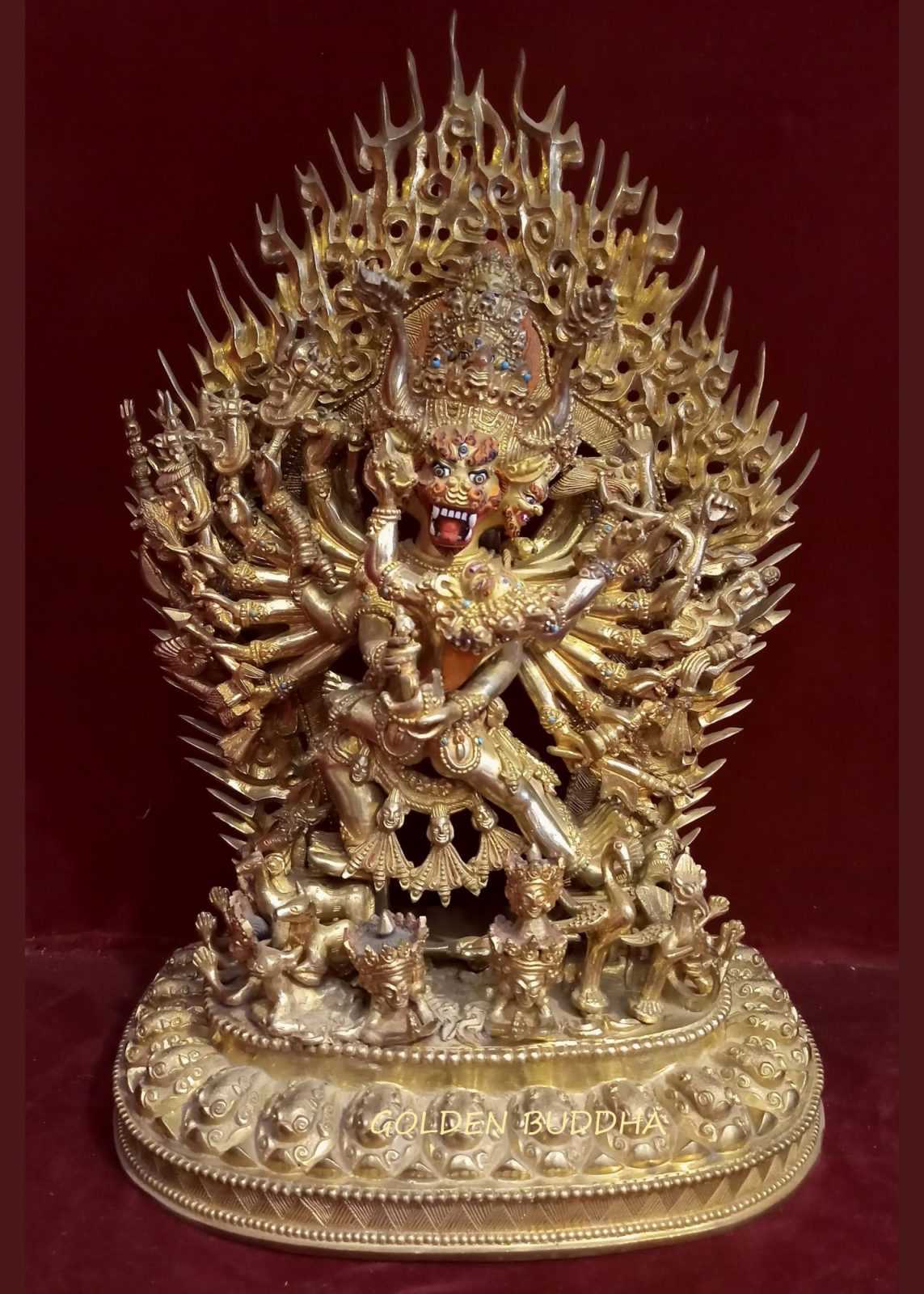
14.5″ Megh Samvara Yamantaka Statue
Yamantaka, Vajrabhairava & Megh Samvara — Names Explained
Yamantaka statues are known by several interchangeable names, each emphasizing a different aspect of this deity’s nature and function:
- Yamantaka — “Destroyer/Conqueror of Death” (Sanskrit) — the most common name in Tibetan Buddhist scholarship and Western Buddhist literature. Emphasizes his victory over Yama, the Lord of Death.
- Vajrabhairava — “Diamond/Thunderbolt Terrifier” (Sanskrit) — vajra meaning diamond or indestructible, bhairava meaning terrifying. Emphasizes the indestructible quality of his wisdom and the fear he instills in the forces of ignorance and death. This is the name most commonly used in the Gelug school tantric texts.
- Megh Samvara — an alternate tantric name used in specific Yamantaka practice lineages, referring to the deity in his function as the great purifier of karmic obscurations. The name appears in certain Nepali Buddhist traditions and is the designation used for the 14.5″ statue in Golden Buddha’s collection.
All three names refer to the same deity — the wrathful emanation of Manjushri in his role as the supreme conqueror of death and the chief Anuttarayoga Tantra deity of the Gelug school. In Tibetan, Yamantaka is known as Gshin rje gshed — “Slayer of Yama.”
Yamantaka — Wrathful Embodiment of Manjushri
Yamantaka is the wrathful emanation of Manjushri — the Bodhisattva of Wisdom and one of the most beloved deities in all of Mahayana and Vajrayana Buddhism. The relationship between peaceful Manjushri and wrathful Yamantaka is one of the most profound teachings in Tibetan Buddhist iconography: they are the same wisdom expressed through two radically different forms, each suited to different circumstances.
This relationship may seem paradoxical to those approaching Buddhist iconography for the first time. How can the serene, golden, sword-bearing Manjushri and the terrifying buffalo-headed Yamantaka be the same being? The answer lies in a fundamental principle of Mahayana Buddhism: accomplished Bodhisattvas can take any form necessary to relieve the suffering of sentient beings. A Bodhisattva of Manjushri’s stature — one who has perfected wisdom across countless lifetimes — is not limited to a single appearance or approach. When gentle methods are sufficient, he appears as the peaceful Manjushri. When the most powerful obstacles require the most powerful methods, he appears as Yamantaka.
Peaceful Manjushri Statue — Wrathful Wisdom vs Peaceful Wisdom

Peaceful vs Wrathful Wisdom — Two Faces of Manjushri
Both peaceful Manjushri statues and wrathful Yamantaka statues use the same symbolic language to communicate their essential nature — fire. In Buddhist iconography, fire consistently represents wisdom: the burning away of ignorance, the illumination of darkness, and the purifying transformation of defilement into clarity.
In peaceful Manjushri statues, this fire appears as the flaming sword of wisdom (khadga) — rising from the right hand and cutting through the darkness of ignorance with elegant precision. The sword’s flame is contained, directed, surgical. It communicates wisdom as a gentle but unstoppable force — the kind that dissolves confusion through understanding rather than force. The Prajnaparamita Sutra held in the left hand represents the complete philosophical framework of emptiness that Manjushri embodies.
In Yamantaka statues, fire appears as a roaring ring of flames surrounding the entire deity — the halo of primordial awareness (Sanskrit: jnana) that consumes all obscurations without exception. This is wisdom not as a surgical instrument but as a conflagration — total, all-consuming, leaving nothing of ignorance untouched. The head of Manjushri, visible above Yamantaka’s buffalo head in authentic statues, explicitly communicates the identity of the two: this terrifying figure is wisdom itself, wearing death as a crown.
Yamantaka Statue Iconography — The Nine Heads, 34 Arms & 16 Legs
Every element of an authentic Yamantaka statue encodes precise tantric meaning. The sheer complexity of the iconography — nine faces, thirty-four arms, sixteen legs — is not decorative excess but a complete visual mandala of his enlightened activity:
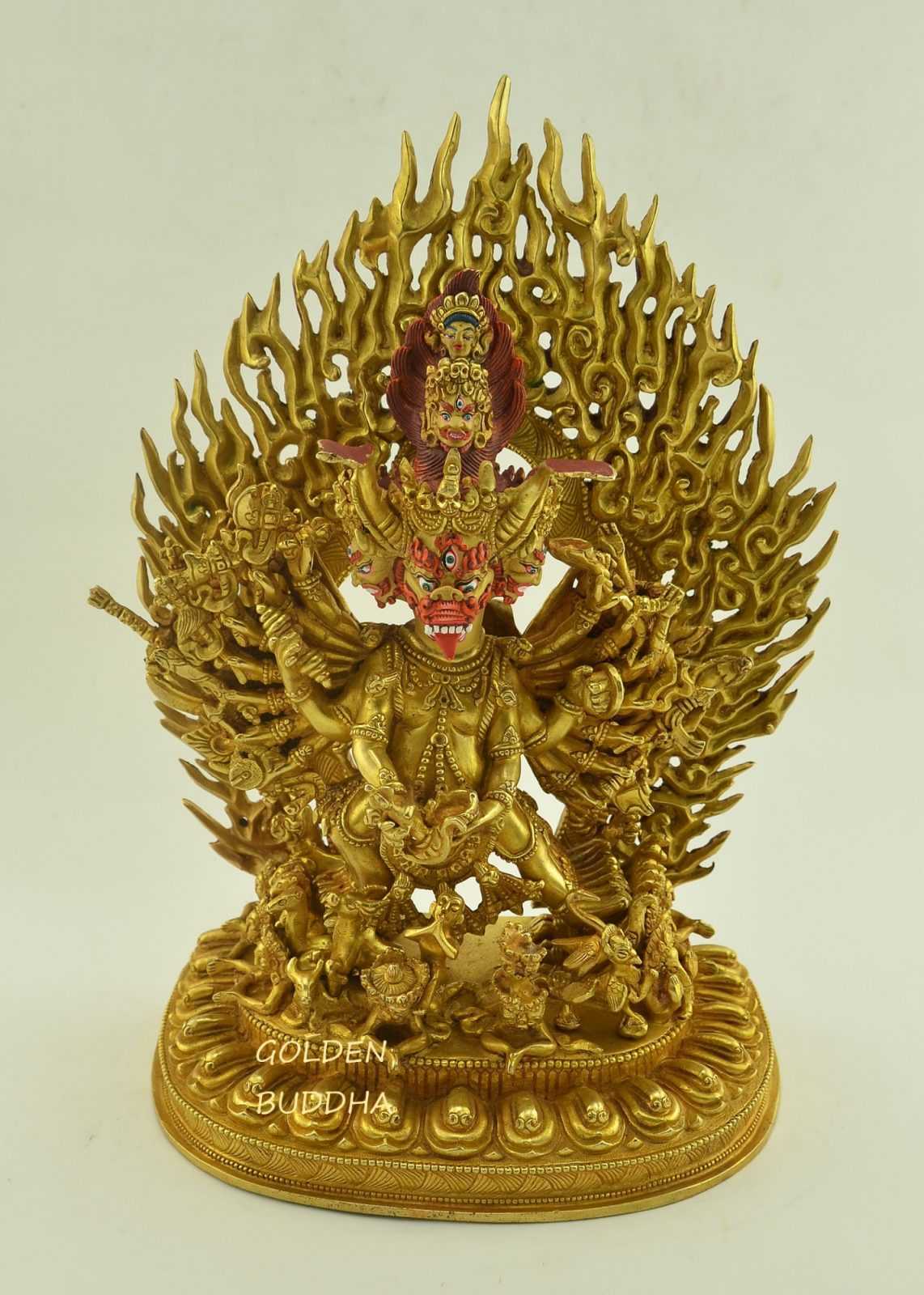
Nine Heads: The primary face is that of a buffalo — dark blue, with enormous curving horns, three eyes, and an expression of supreme fury. This is the face of Yama the Lord of Death, now worn by Yamantaka as a trophy of his conquest. Above the buffalo head rise eight additional faces in ascending tiers — alternating between wrathful and semi-wrathful expressions, representing Yamantaka’s mastery of the nine realms of existence. The topmost face, wreathed in flame, is the serene golden face of Manjushri himself — the true nature of the deity revealed at the crown.
Thirty-Four Arms: Each arm holds a specific implement or makes a specific gesture — ritual weapons, skulls, severed heads, a flaying knife, an elephant hide, an ax, a noose, a hook, a sword, arrows, a bow, a vajra, a skull cup. Together these thirty-four implements represent Yamantaka’s complete arsenal against all forms of ignorance, delusion, and the forces that bind beings to the wheel of samsara. The principal pair of hands holds a skull cup (kapala) and a chopper (kartrika) against the chest.
Sixteen Legs: Yamantaka stands with sixteen legs spread wide, each leg trampling a specific being or force beneath its feet. Eight right legs trample eight birds — the crow, the owl, the raven, the parrot, the hawk, the vulture, the garuda, and the peacock — representing the eight classes of worldly demons. Eight left legs trample eight animals — the ox, the buffalo, the elephant, the horse, the camel, the ass, the dog, and the sheep — representing eight forms of ignorance and negativity. Yamantaka stands upon all of them, crushing every obstacle to liberation simultaneously.
11.5″ Yamantaka Statue — Fire Gilded 24K Gold
Yamantaka in Yab Yum — Union with Vetali
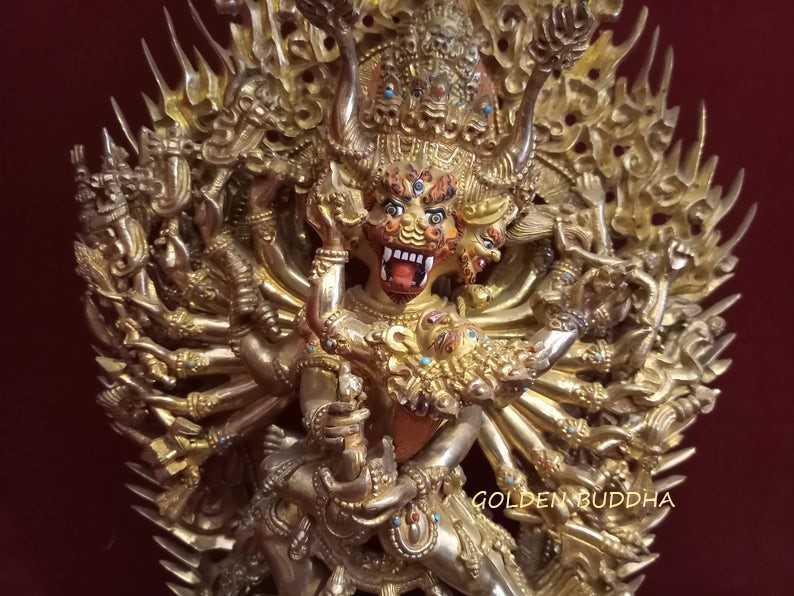
The most elaborate and iconographically complete Yamantaka statues depict him in Yab Yum — the Tibetan term for the sacred union of a male deity with his wisdom consort. Yamantaka’s consort is Vetali (also spelled Vetali or Damtsig Drolma) — a dark blue wrathful female deity who wraps her legs around him in the union posture. She holds a skull cup filled with blood in her left hand and raises a chopper in her right.
The Yab Yum iconography represents the inseparable union of compassionate method (the male principle, Yamantaka) and wisdom (the female principle, Vetali) — the two essential qualities that must be unified to achieve Buddhahood. This is the same principle expressed in the peaceful union statues throughout the Tibetan Buddhist tradition, but rendered in the most powerful and dramatic form available: the union of death’s conqueror with the wisdom that makes conquest possible. The Yab Yum Yamantaka statue is the most sought-after form for serious Anuttarayoga Tantra practitioners.
The Tibetan Legend of Yamantaka
A celebrated Tibetan legend explains the origin of Yamantaka’s buffalo-headed appearance — a story that captures the precarious relationship between advanced spiritual power and the emotions that even high-level practitioners must master.
In ancient Tibet, a hermit monk had been practicing intensive meditation in a remote mountain cave for the final years of his life. He was very close to achieving complete enlightenment — having meditated for 50 years in solitary retreat, he was approaching the culmination of decades of practice. One dark and stormy night, two thieves burst into his cave, dragging a stolen water buffalo behind them. The monk politely asked them to leave — he was at a crucial stage of meditation that could not be interrupted. The thieves, fearing capture if they went back outside, refused.
Moments later the monk heard the buffalo being slaughtered. He pleaded again for them to stop — and was himself beheaded by the terrified thieves who feared he would report them. But the monk was a high-level practitioner with extraordinary siddhis (spiritual powers). His practice had brought him to the threshold of enlightenment — but his life was cut short one crucial moment before completion, and his rage at the interruption was monumental. He seized the severed head of the water buffalo and placed it on his own decapitated body. Then he killed the two thieves — and went on a murderous rampage throughout Tibet, killing indiscriminately, until the people knew him simply as Yama, the Lord of Death.
The people of Tibet prayed desperately to Manjushri for deliverance. Manjushri heard their prayers and responded — but he recognized that no peaceful form could overcome such a powerful force of rage and death. He manifested in the most terrifying form possible: Yamantaka — with nine heads, thirty-four arms, sixteen legs, buffalo horns larger and more fearsome than Yama’s own, and an aura of primordial wisdom so overwhelming that even death itself could not withstand it. He confronted Yama and defeated him utterly — not through greater violence but through the indestructible power of wisdom. The anger and hatred that had consumed the monk were dissolved by the light of Manjushri’s realization. In the end, wisdom conquers death.
Yamantaka Sadhana — Tantric Practice
The Yamantaka sadhana (Sanskrit: “means of accomplishment” — a structured Tantric meditation practice) is among the most advanced and potent in all of Tibetan Buddhism. It belongs to the Anuttarayoga Tantra class — the highest class of Tantric practice — and is one of the Three Principal Deities of the Gelug school, alongside Guhyasamaja and Chakrasamvara.
In Buddhist teaching, the root of all suffering is ignorance — specifically the mistaken belief in a permanent, independent self. This ignorance generates attachment, aversion, and confusion, which in turn generate the karma that perpetuates the cycle of death and rebirth. The Yamantaka sadhana addresses this root cause with the most powerful method available: by repeatedly visualizing oneself as Yamantaka — fully identifying with the deity’s complete defeat of death and ignorance — the practitioner gradually dismantles the illusion of the self that ignorance depends upon.
The fierce visualization of Yamantaka serves a specific psychological function: it provides what Tibetan masters sometimes call “shock therapy” for the mind. The ordinary, habitual mind — comfortable in its familiar patterns of thought and self-identification — is violently disrupted by the sustained contemplation of this terrifying form. The disruption creates space for a direct recognition of the mind’s true nature: vast, luminous, beyond birth and death, never having been subject to the power of Yama at all. A Yamantaka statue on the altar serves as the visual support for this practice — a constant reminder of the practitioner’s own capacity to defeat death through wisdom.
Important note on practice requirements: The Yamantaka sadhana requires formal initiation (wang) from a qualified Gelug lama and must be conducted under their ongoing guidance. Attempting the practice without proper initiation and instruction is considered counterproductive and potentially harmful in the Tibetan Buddhist tradition. The practice is available through recognized Gelug monasteries and Dharma centers worldwide — the Ganden, Sera, and Drepung monasteries regularly confer Yamantaka initiations to qualified practitioners.
Yamantaka Mantra
“Om Yamaraja Saparivara Argham Pratitsa Svaha”
The Yamantaka mantra invokes the full assembly of Yamantaka’s mandala — saparivara meaning “together with his retinue.” The mantra is recited during the formal sadhana practice and during the offering ceremony to Yamantaka. For practitioners who have received the formal Yamantaka initiation, the mantra recitation — combined with vivid visualization of the deity — is the primary method for connecting with Yamantaka’s blessing energy and accumulating the merit necessary to achieve liberation.
The longer Vajrabhairava root mantra — “Om Hrih Strih Vikritanana Hum Phat” — is the seed syllable mantra of the deity in his Vajrabhairava aspect, used specifically in the more advanced stages of the sadhana. Both mantras should only be recited by practitioners who have received the appropriate initiation from a qualified lama.
Yamantaka in the Gelug School
Yamantaka (Vajrabhairava) holds a uniquely important position in the Gelug school of Tibetan Buddhism — founded by Guru Tsongkhapa in the 14th-15th centuries. Tsongkhapa himself practiced the Yamantaka sadhana intensively and is credited with receiving direct visions of Manjushri — which in the Gelug tradition is understood as a direct encounter with Yamantaka’s peaceful aspect. The Yamantaka practice was among the highest teachings Tsongkhapa received and transmitted to his disciples.
In the Gelug school, Yamantaka is one of the Three Principal Deities (Gyalwa Lha Sum) — the three Anuttarayoga Tantra deities that form the foundation of advanced Gelug Tantric practice: Yamantaka (for subduing obstacles and achieving wisdom), Guhyasamaja (for the completion stage practices of the subtle body), and Chakrasamvara (for the bliss-emptiness practices). Every Gelug monastery maintains a Yamantaka chapel, and the great Ganden monastery near Lhasa was particularly associated with the transmission of Yamantaka practice through Tsongkhapa’s direct lineage.
Frequently Asked Questions About Yamantaka
Who is Yamantaka in Tibetan Buddhism?
Yamantaka is the wrathful emanation of Manjushri — the Bodhisattva of Wisdom — and the most powerful Anuttarayoga Tantra deity of the Gelug school of Tibetan Buddhism. His name means “Destroyer/Conqueror of Death” — he defeated Yama, the Lord of Death, through the power of primordial wisdom. He is depicted with nine heads (the primary being a buffalo head), thirty-four arms, and sixteen legs, surrounded by a ring of flames representing his all-consuming wisdom. He is also known as Vajrabhairava (“Diamond Terrifier”) and Megh Samvara. His practice is considered one of the most effective methods for achieving enlightenment in a single lifetime and is a cornerstone of Gelug Tantric practice alongside Guhyasamaja and Chakrasamvara.
What is the difference between Yamantaka and Vajrabhairava?
Yamantaka and Vajrabhairava are two names for the same deity, each emphasizing a different aspect of his nature. Yamantaka (“Conqueror of Death”) emphasizes his function — the defeat of Yama, the Lord of Death, and liberation from the cycle of rebirth. Vajrabhairava (“Diamond Terrifier”) emphasizes his appearance and the indestructible quality of his wisdom — vajra meaning diamond/indestructible and bhairava meaning terrifying. In Gelug school tantric texts, Vajrabhairava is the more commonly used technical name, while Yamantaka is more widely used in general Buddhist literature and Western scholarship. Both names refer to the same wrathful emanation of Manjushri.
Why does Yamantaka have a buffalo head?
According to Tibetan legend, the buffalo head originated when a meditating hermit monk — close to achieving enlightenment after 50 years of retreat — was killed by two thieves who also killed a water buffalo in his cave. The monk, enraged at having his practice interrupted at a crucial moment, placed the buffalo’s severed head on his own decapitated body and went on a murderous rampage across Tibet, becoming Yama the Lord of Death. Manjushri manifested as Yamantaka with an even larger and more fearsome buffalo head to defeat this Yama — and has worn the buffalo head ever since as a symbol of his complete mastery over death. Iconographically, the buffalo head also represents the transformation of animal consciousness (the most extreme form of ignorance) into the vehicle of liberation.
What does a Yamantaka statue represent?
A Yamantaka statue represents the complete victory of wisdom over ignorance, death, and the cycle of involuntary rebirth. Every iconographic element carries specific meaning: the nine heads represent mastery of nine realms, with Manjushri’s face at the crown revealing the deity’s true nature; the thirty-four arms hold implements representing tools against all forms of ignorance; the sixteen legs trample eight birds and eight animals representing eight classes of demons and eight forms of ignorance; the ring of flames represents primordial all-consuming wisdom; and the consort Vetali (in Yab Yum statues) represents the inseparable union of method and wisdom. Placing a Yamantaka statue on a meditation altar supports advanced Anuttarayoga Tantra practice and serves as a visual teaching on the inseparability of wisdom and the conquest of death.
Can anyone practice with a Yamantaka statue?
The formal Yamantaka sadhana requires initiation (wang) from a qualified Gelug lama and should only be practiced under their guidance. However, acquiring a Yamantaka statue and placing it on an altar as an object of veneration and inspiration is open to any Buddhist practitioner or collector of Himalayan Buddhist art. The statue serves as a powerful reminder of the capacity of wisdom to overcome the deepest obstacles — a teaching that is universally relevant regardless of whether one practices the formal sadhana. For practitioners who have received the initiation, the statue becomes an essential support for the complete visualization practice. Browse our collection of authentic Yamantaka statues from Nepal.
How does Yamantaka relate to Manjushri?
Yamantaka is the wrathful emanation of Manjushri — the same wisdom expressed through two radically different forms suited to different circumstances. Peaceful Manjushri represents wisdom as elegant precision — the flaming sword that cuts through ignorance with surgical clarity, the Prajnaparamita Sutra held in philosophical contemplation. Yamantaka represents wisdom as total conflagration — the all-consuming ring of flames that leaves nothing of ignorance standing. Both are expressions of the same primordial awareness; the choice of form depends on the nature and severity of the obstacles being addressed. In Yamantaka statues, Manjushri’s face is visible at the crown above the buffalo head — the peaceful wisdom looking down on the wrathful activity below, confirming their identity. You can learn more about the peaceful form in our complete Manjushri statue guide.