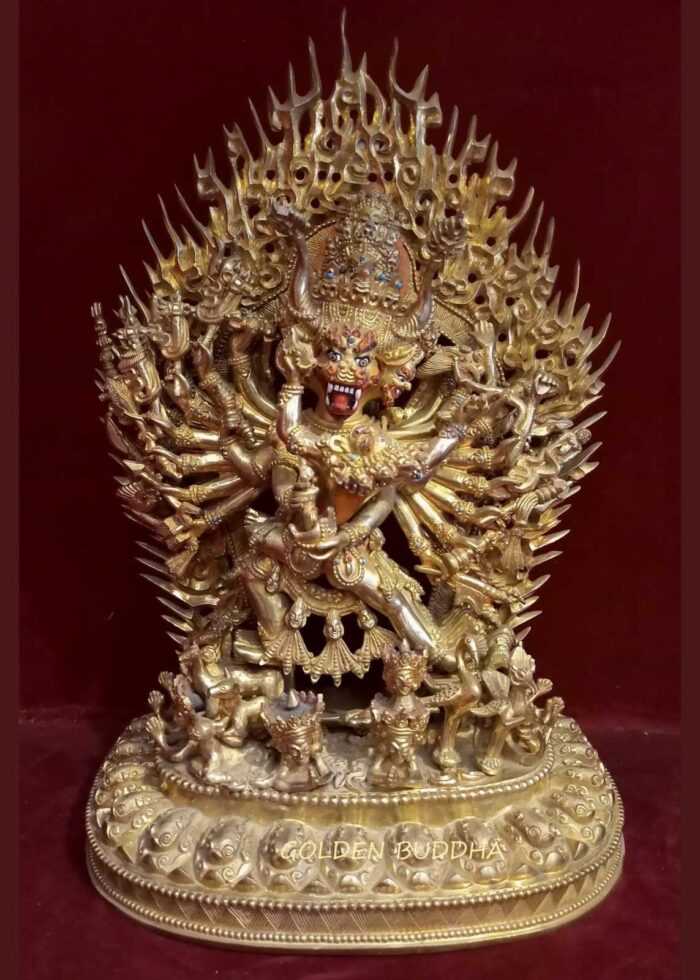
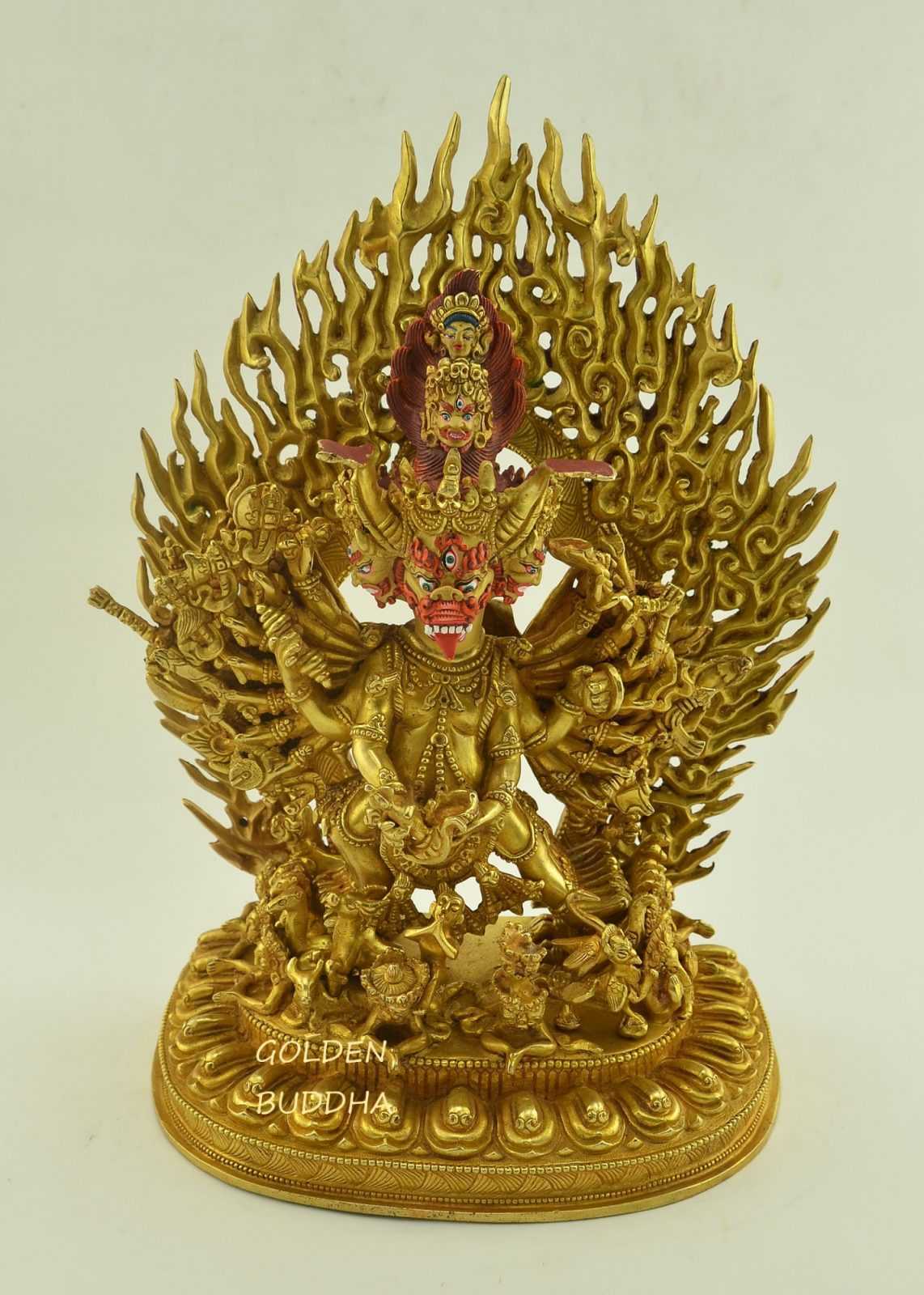
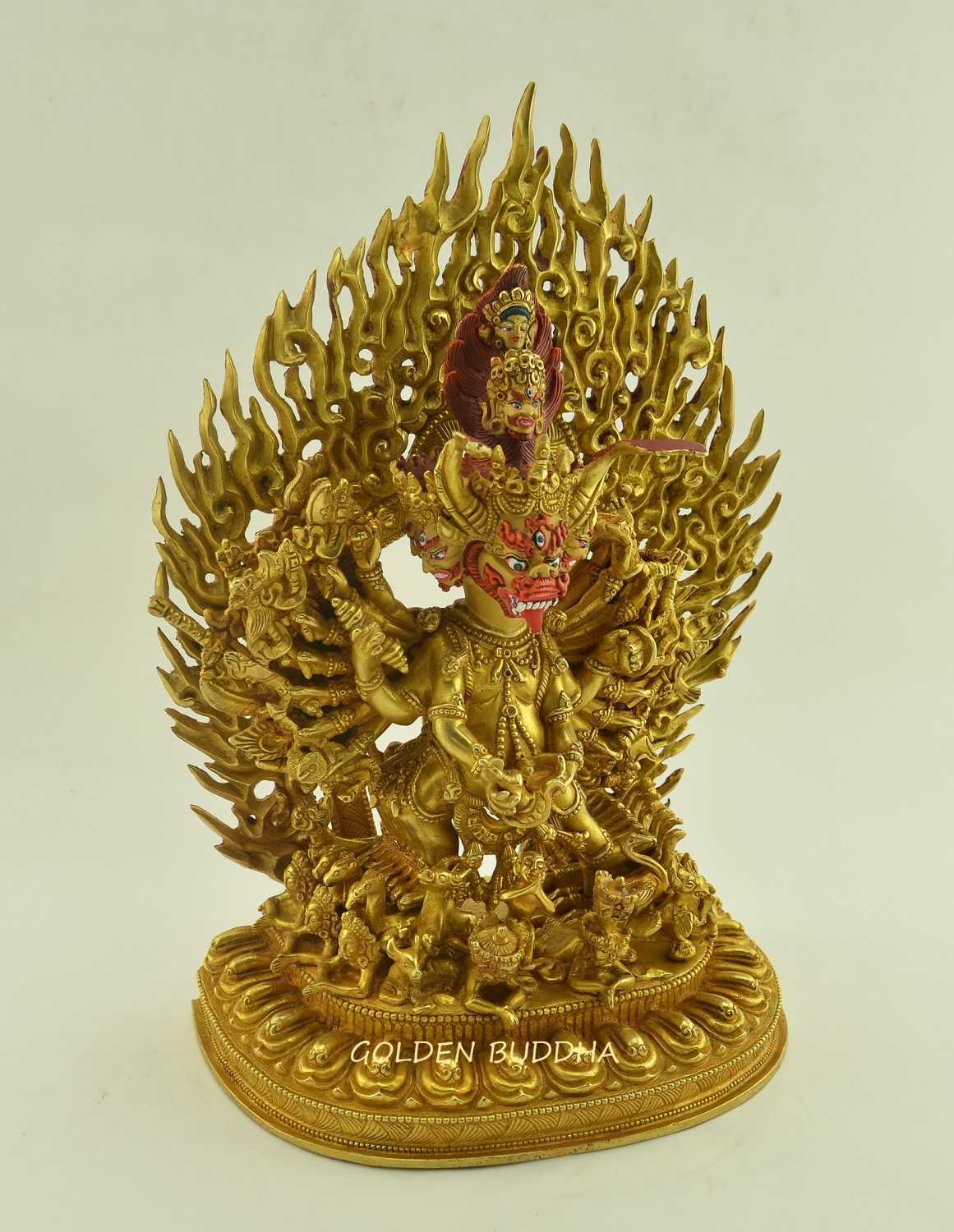
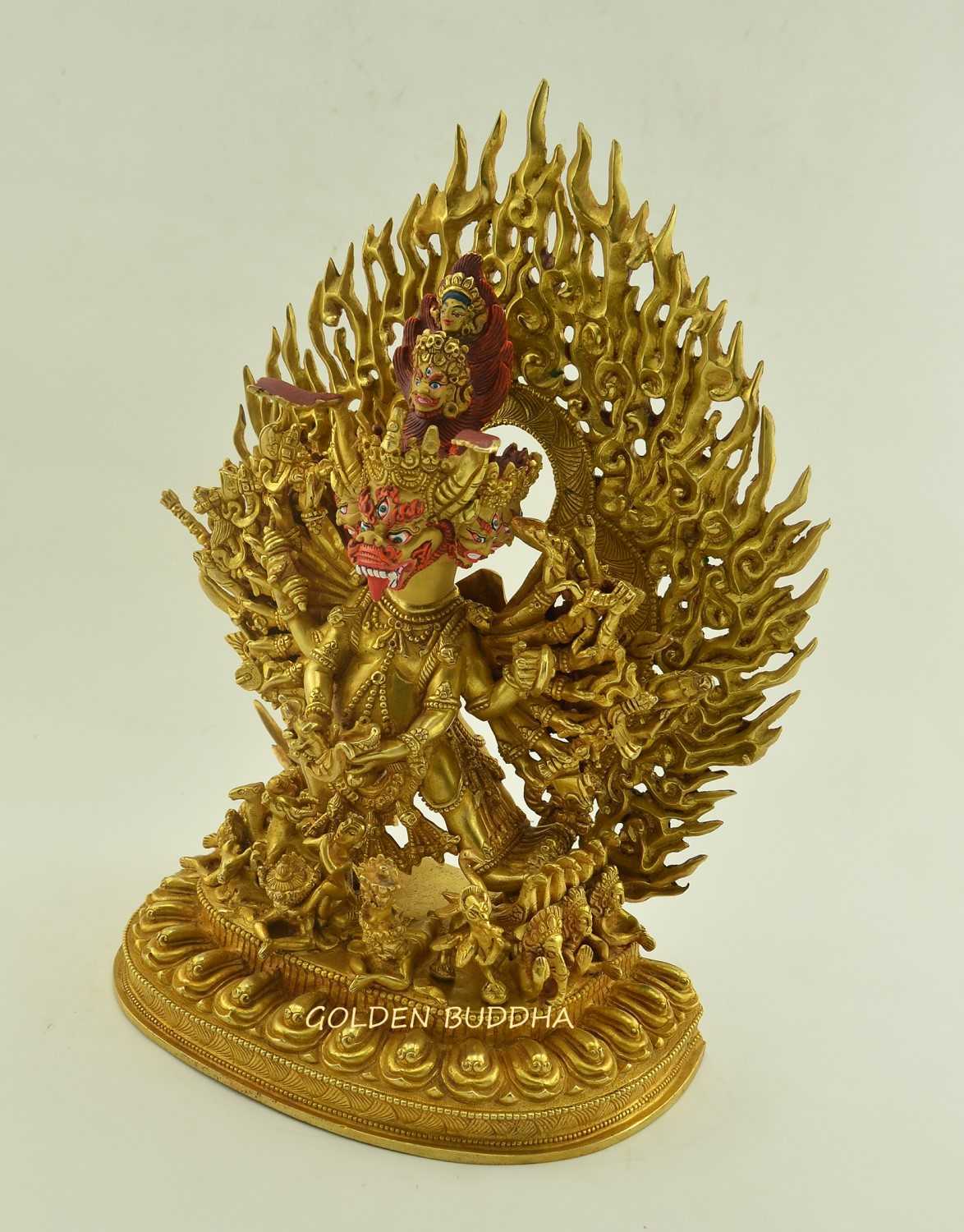
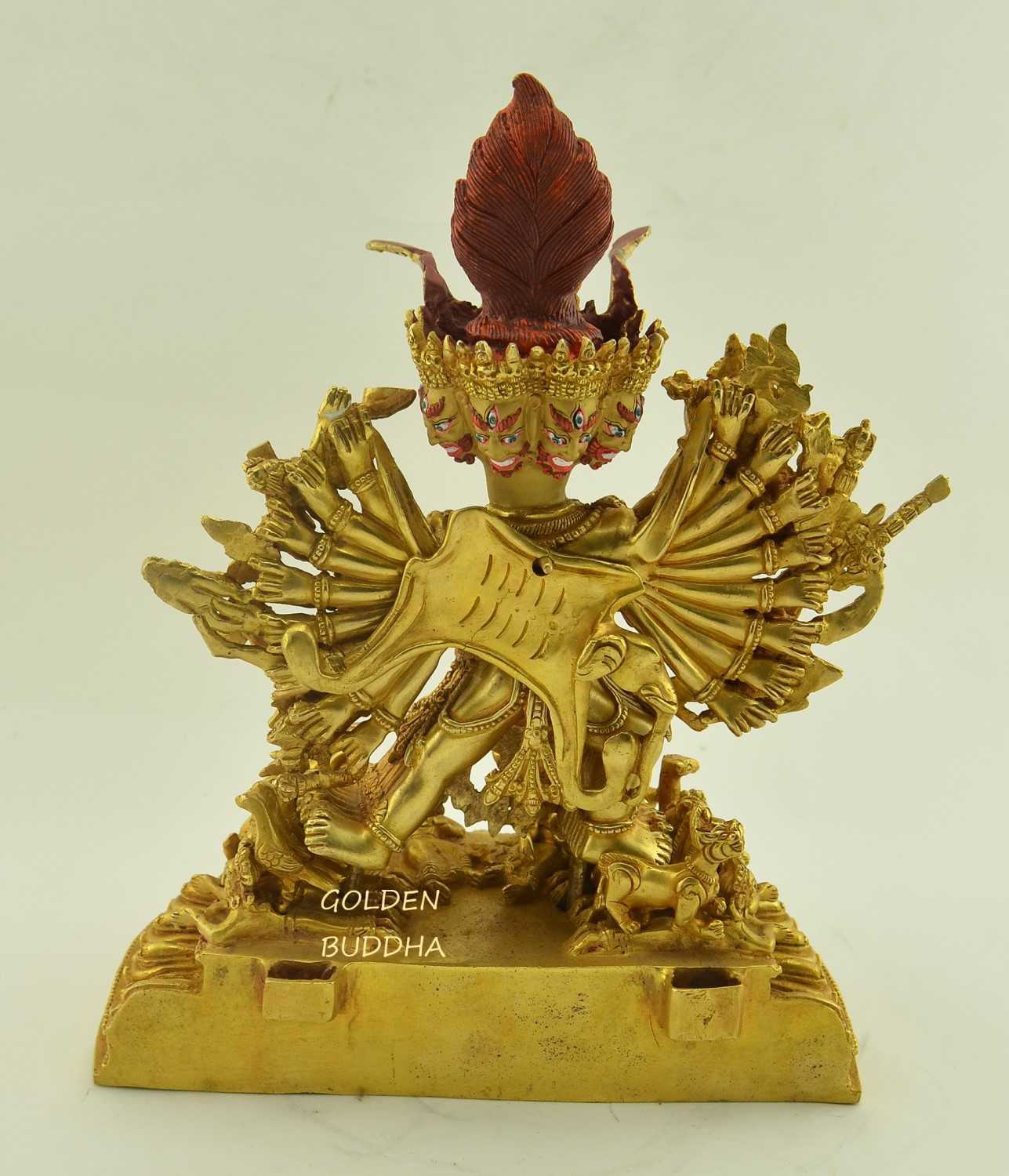
This formidable Yamantaka statue portrays Vajrabhairava, also known as Megh Sambara, in his complete nine-faced, thirty-four-armed and sixteen-legged manifestation. Rising within an immense removable mandorla of wisdom flames, Yamantaka stands in a dynamic posture above a complex assembly of subdued beings and animals. His principal buffalo head, multiple wrathful faces, numerous ritual implements and expansive golden silhouette present the “Destroyer of Death” with the uncompromising power required by this advanced Vajrayana iconography.
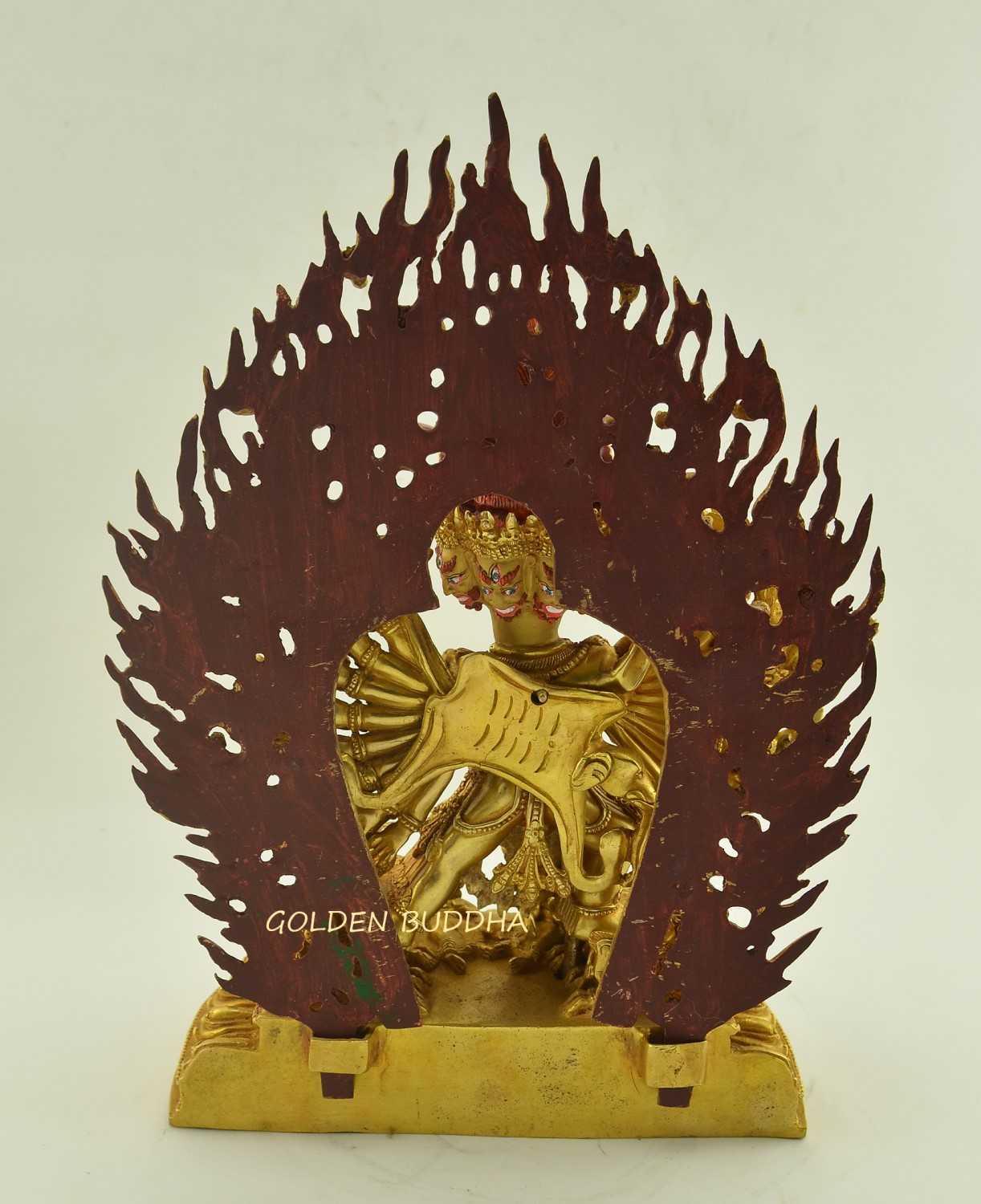
Handcrafted in Patan, Nepal, the entire composition—including Yamantaka, every arm and attribute, the subdued figures, oval lotus pedestal and removable flame frame—is cast from a base of copper alloy through the traditional lost-wax method. The sculpture is fire gilded in 24K gold, while the face is hand painted with real gold, natural pigments define the fierce eyes, mouths, brows, hair and facial details. The reverse of the removable frame carries a dark reddish finish, contrasting with the brilliant gold flames visible from the front. The statue measures approximately 11.5 inches high with the frame and 9.5 inches without it.
Yamantaka Statue of Vajrabhairava
Yamantaka is the wrathful manifestation of Manjushri, the Bodhisattva of Transcendent Wisdom. His name is commonly translated as the “Destroyer of Death” or “Conqueror of Death.” Rather than representing anger or violence in an ordinary sense, his fearsome appearance expresses enlightened wisdom assuming a form powerful enough to overcome ignorance, attachment, karmic obstruction and the fear of death itself.
The great buffalo head identifies his relationship with Yama, the Lord of Death. According to the traditional symbolism, Manjushri manifests as an even more overwhelming buffalo-headed deity to conquer death on its own ground. Above the wrathful faces appears the peaceful head of Manjushri, reminding practitioners that the entire terrifying display arises from wisdom and compassionate intent rather than hatred. Learn more in our guide to Yamantaka, the Conqueror of Death.
Nine Faces, Thirty-Four Arms and Sixteen Legs
The visual complexity of this Yamantaka statue reflects the all-encompassing scope of Vajrabhairava’s enlightened activity. His nine faces look in multiple directions, symbolizing awareness that cannot be limited to a single viewpoint. Fierce eyes, exposed fangs, curling brows and flame-like hair communicate complete mastery over the forces that bind beings to cyclic existence.
His thirty-four arms radiate around the body in a dense circular formation. Each hand carries a weapon, ritual implement, symbolic object or subdued being associated with the destruction of a particular obstacle. The sixteen legs extend across the lower composition and trample a varied assembly of animals and figures, representing the complete subjugation and transformation of harmful forces, mistaken perceptions and obstructive energies.
Removable Flame Mandorla
A towering removable frame of curling flames surrounds the deity. The openwork design creates a broad aureole around the many arms without concealing the ritual implements or secondary figures. These flames represent pristine awareness consuming ignorance and mental obscuration. The copper-alloy frame is fire gilded in 24K gold across its visible front, while the reverse is finished in a deep reddish tone that preserves the dramatic contrast of the composition.
The detachable construction also allows the sculpture to be packed more securely for international transportation and permits the extraordinary workmanship behind the central deity to be examined more closely.
Traditional Newar Metalwork
Creating a figure of this complexity requires exceptional skill. Each face, arm, leg, weapon, ornament, subordinate figure and flame must be modeled according to the established proportions of Yamantaka practice before casting. After the copper alloy has cooled, Newar artisans chase and refine the dense arrangement by hand, sharpening the facial features, jewelry, ritual implements and small figures throughout the base.
The finished sculpture is fire gilded in 24K gold and its faces are individually painted to preserve their distinct expressions. Genuine turquoise and red coral may be added selectively to suitable crown and jewelry settings before shipment upon request.
Manjushri, Yamantaka and Yama Statue Set
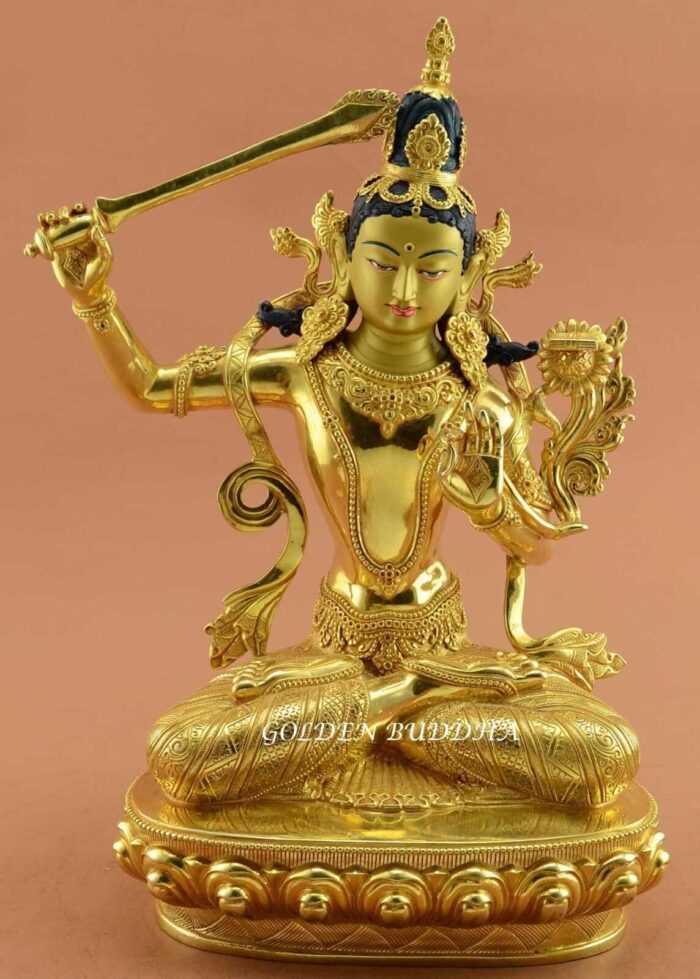
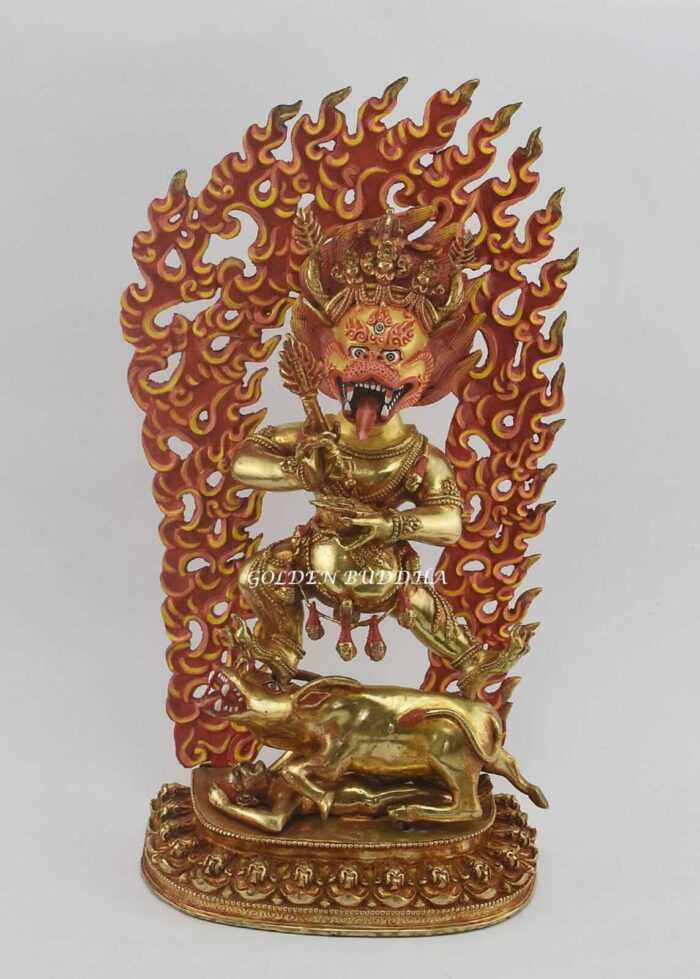
This sculpture forms a doctrinally meaningful three-piece arrangement with the Nepali Manjushri statue and the handmade Yama statue. Manjushri may be placed at the center or highest point as the peaceful Bodhisattva of Wisdom. Yamantaka can be positioned nearby as Manjushri’s wrathful emanation, while Yama may occupy an outer or subordinate position as the Lord of Death brought within the protecting activity of enlightened wisdom.
Their attributes explain why the grouping is so effective. Manjushri raises the sword that cuts through ignorance and displays the Prajnaparamita scripture of perfected wisdom. Yamantaka expands that same wisdom into a ferocious multi-faced and multi-armed form capable of overcoming death and profound obstruction. Yama, with his buffalo head and wrathful protector imagery, represents mortality, karmic consequence and the inevitability of death. Together they illustrate wisdom in its peaceful form, wisdom transformed into overwhelming tantric activity and the force of death ultimately subdued by realization.
Custom Made Yamantaka Statues
Golden Buddha can arrange a custom-made Yamantaka statue in a preferred size, finish and degree of ornamental detail. Because Vajrabhairava has one of the most demanding iconographic forms in Tibetan Buddhism, each commission must carefully preserve the nine faces, thirty-four arms, sixteen legs, ritual attributes, subdued figures and removable copper-alloy flame frame. Available finishes include complete 24K fire gilding, selective oxidized contrast and individually painted wrathful faces.
Manjushri, Yamantaka and Yama may also be commissioned as a coordinated shrine set with complementary dimensions, gilding tones, pedestal designs and painted details. The unified craftsmanship creates visual continuity, while their distinct attributes preserve the hierarchy of Manjushri as the source of wisdom, Yamantaka as its wrathful expression and Yama as the force of death subdued and placed within the outer protective field.
Authentic, Handmade in Nepal
Every statue is handcrafted in Patan, Nepal, using traditional lost wax casting and comes with a certificate of authenticity issued by Nepal’s Department of Archaeology, verifying its materials, technique, and origin.