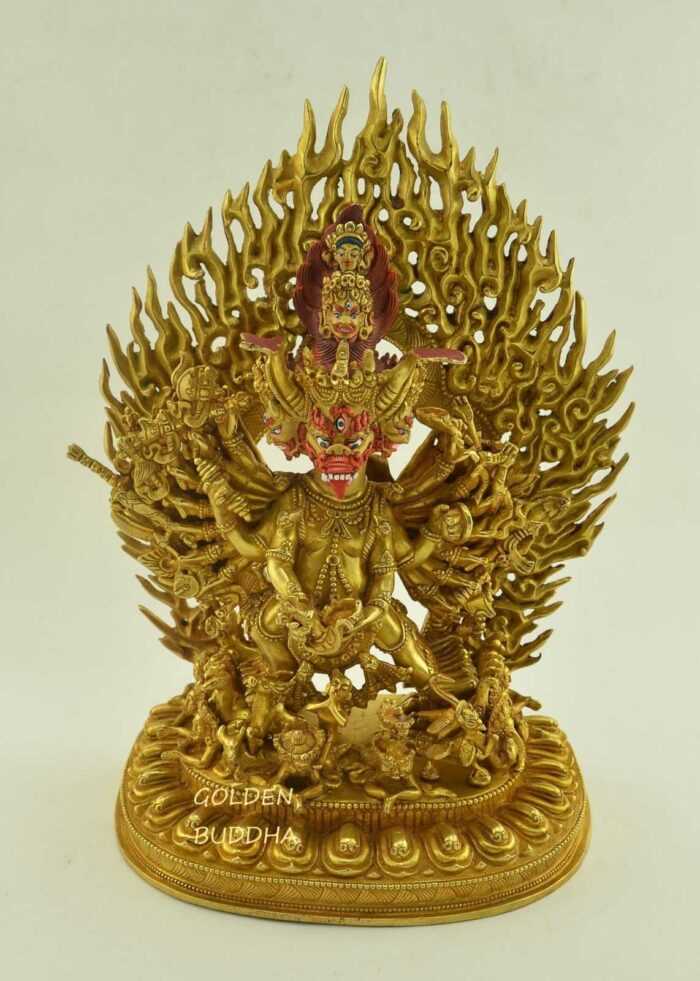
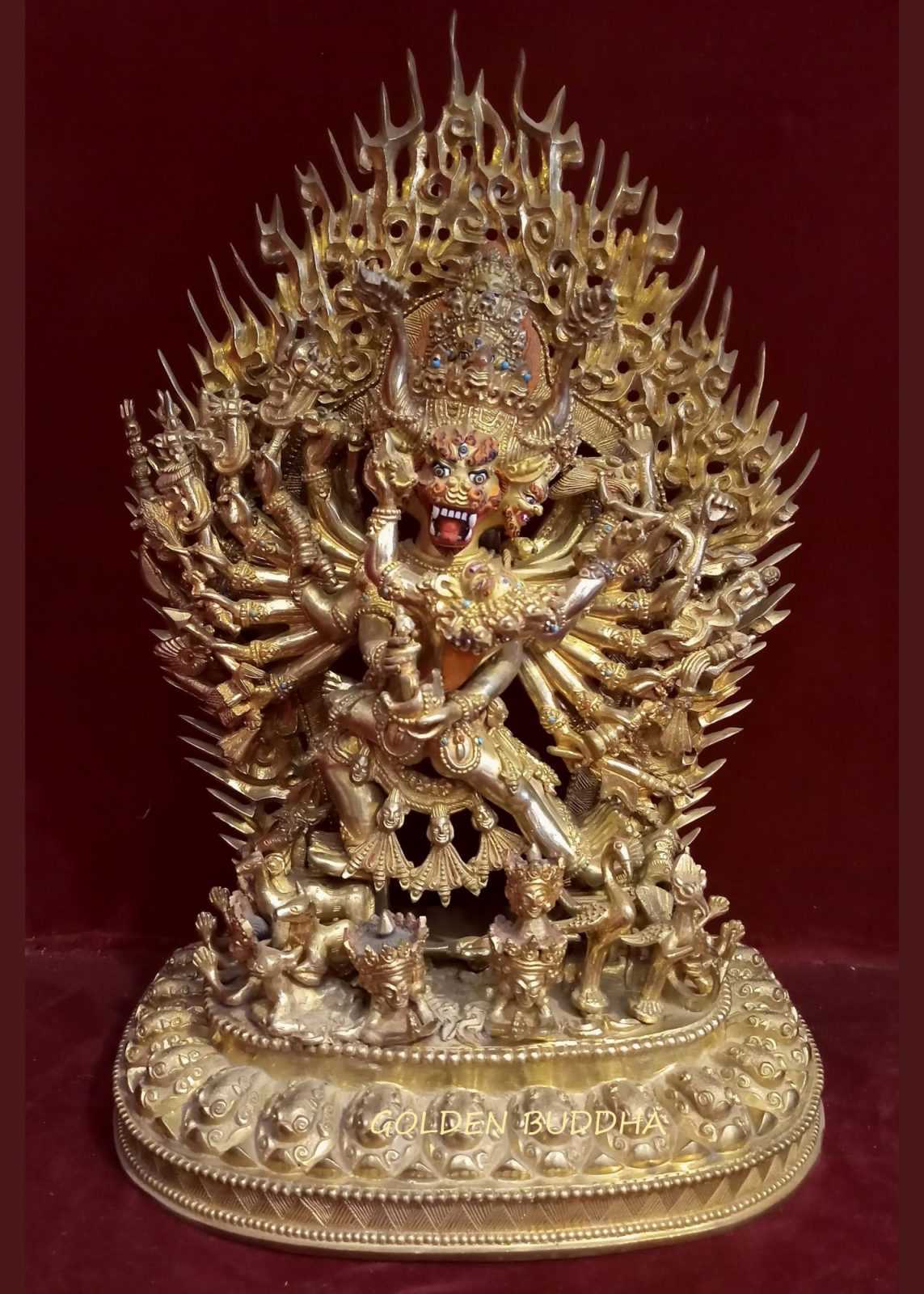
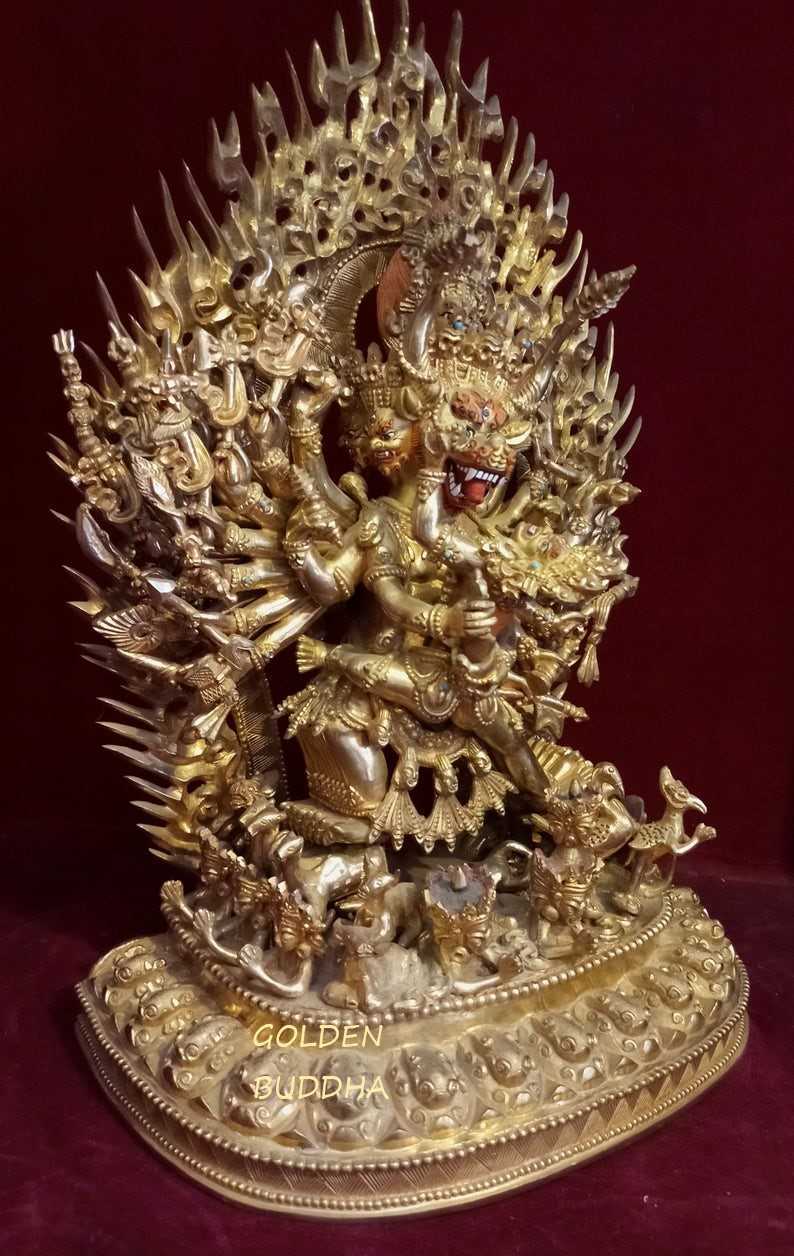
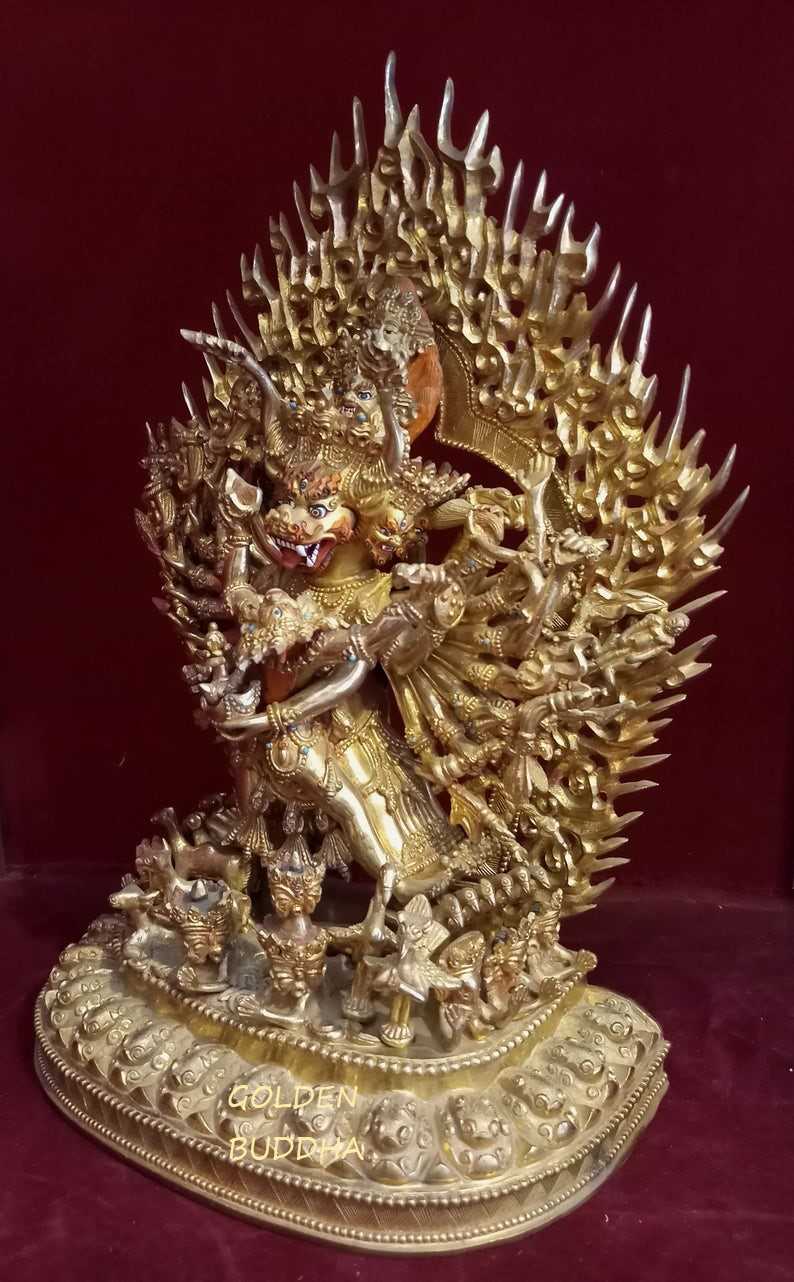
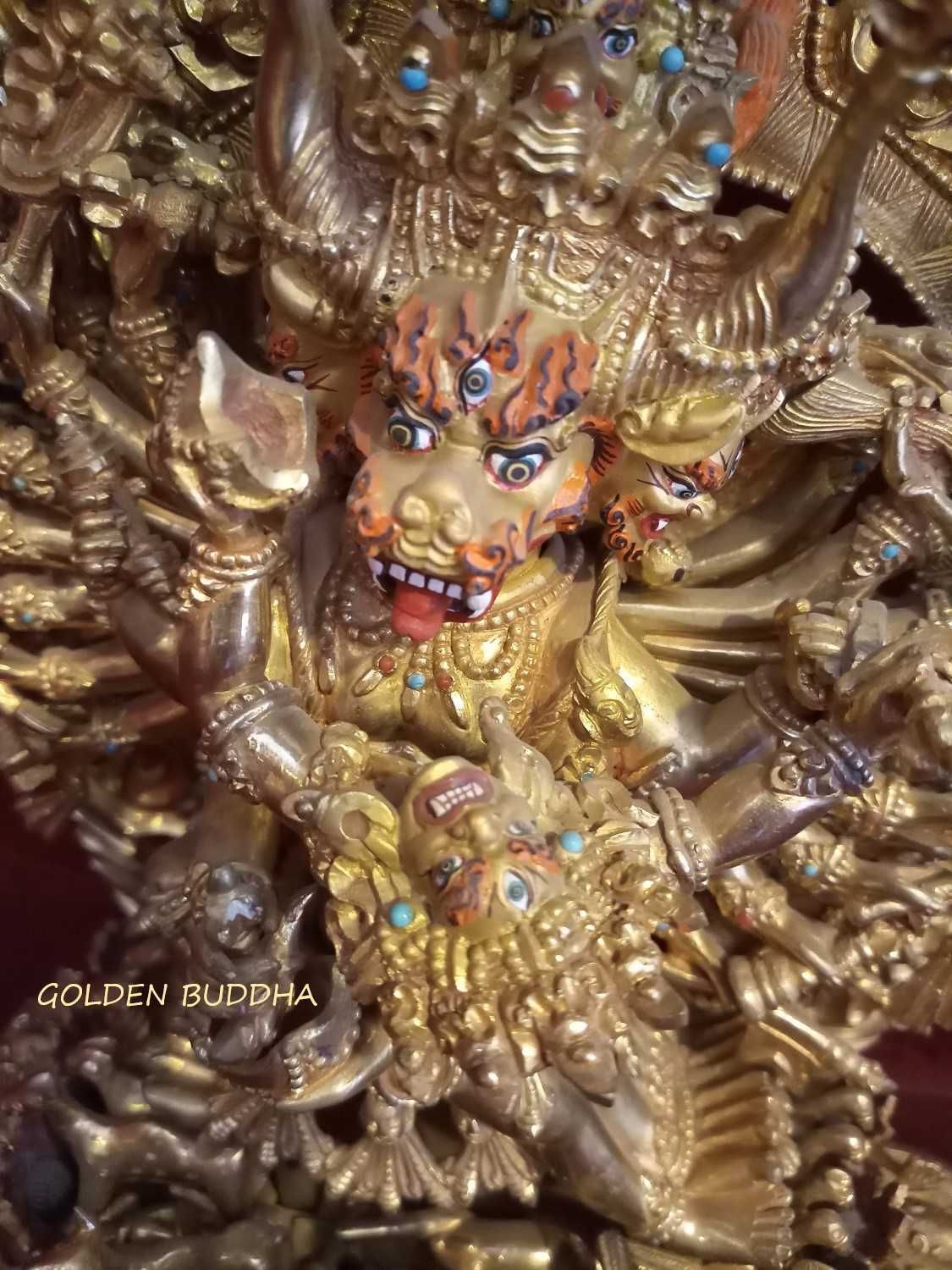
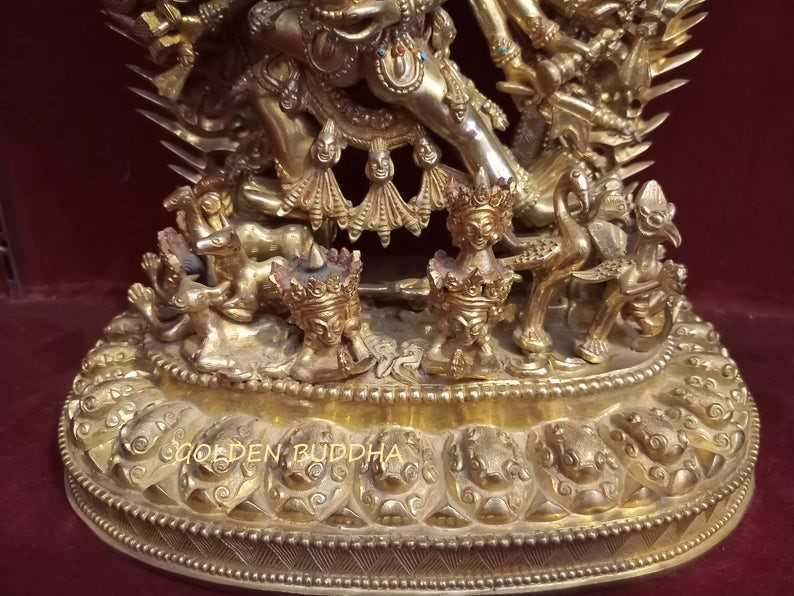
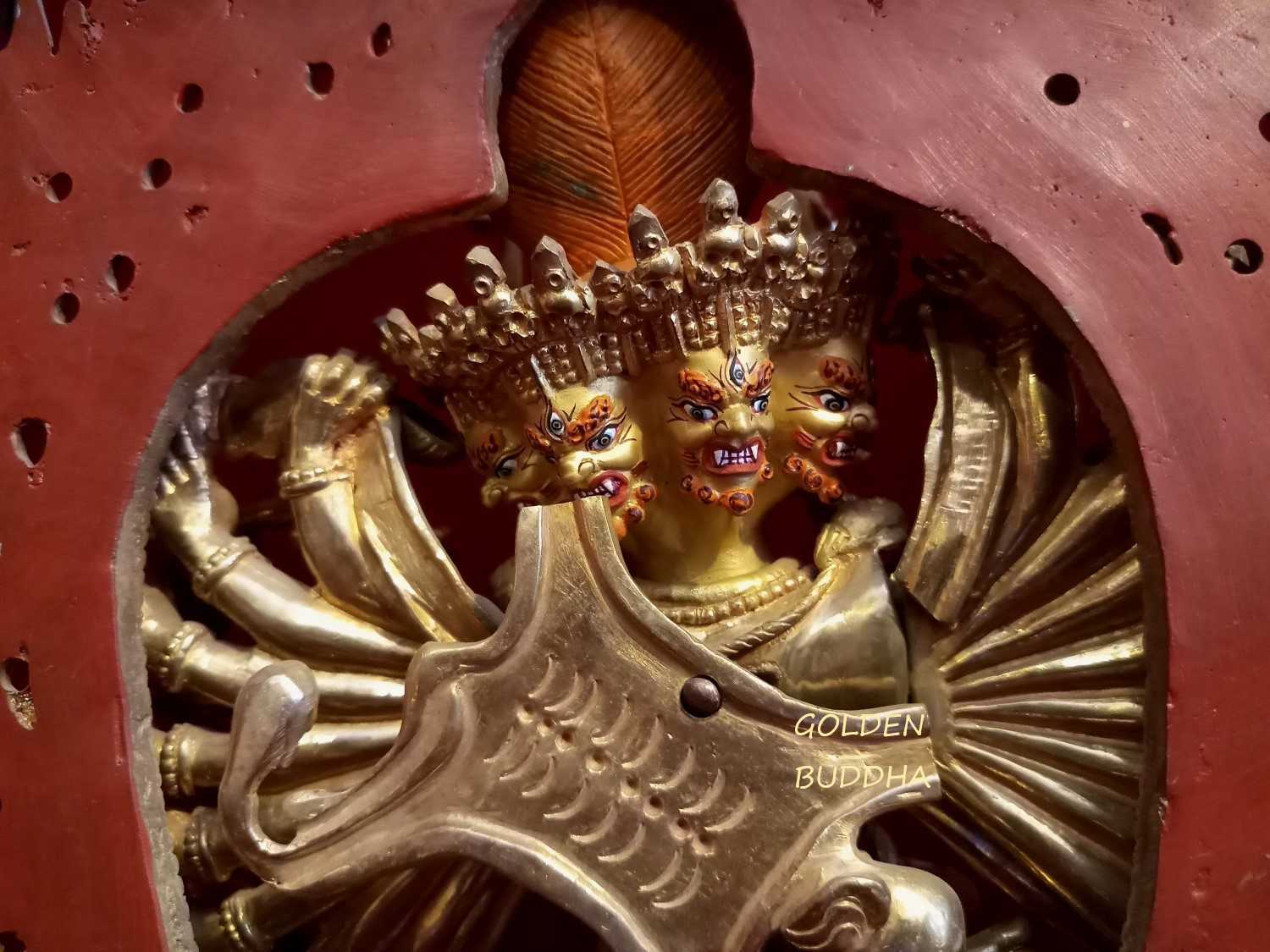
This monumental Megh Sambara statue portrays Yamantaka, also known as Vajrabhairava, united in Yab Yum with his wisdom consort Vetali. Measuring approximately 14.5 inches high, the sculpture presents one of the most complex wrathful forms in Vajrayana Buddhism: nine faces, thirty-four arms bearing ritual implements, sixteen legs, subdued figures and animals, and an expansive removable mandorla of pristine-awareness flames. The dense composition expresses enlightened wisdom confronting death, delusion and karmic obstruction without compromise.
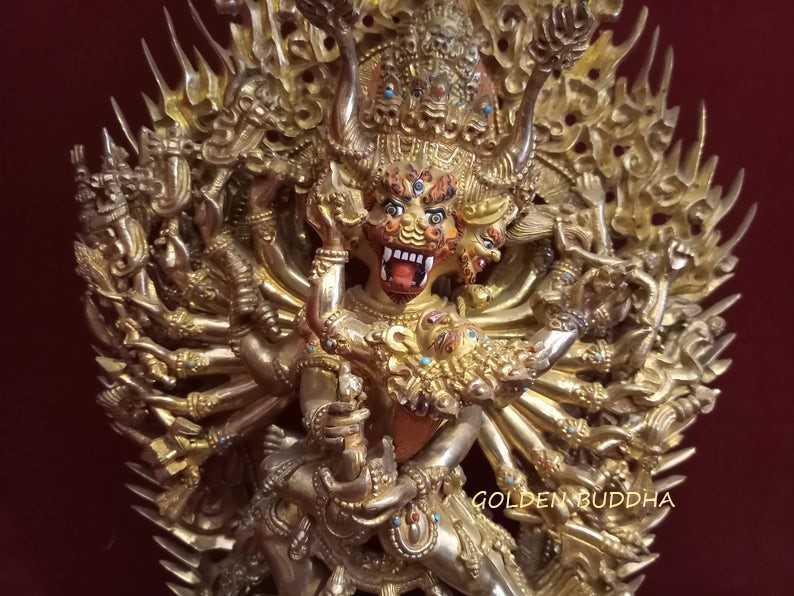
Handcrafted in Patan, Nepal, the entire assembly—including Megh Sambara, Vetali, every arm and attribute, the subdued figures, oval pedestal and removable flame frame—is cast from a base of copper alloy using the traditional lost-wax method. The sculpture is fire gilded in 24K gold, while the faces are individually hand painted to distinguish their wrathful expressions. Genuine turquoise and red coral are already embedded throughout selected crown and jewelry settings, giving the completed image the richly adorned ceremonial appearance associated with refined Newar sacred metalwork.
Megh Sambara Statue of Yamantaka Vajrabhairava
Megh Sambara is a form of Yamantaka, the wrathful manifestation of Manjushri, Bodhisattva of Transcendent Wisdom. Yamantaka means the “Destroyer of Death,” while Vajrabhairava conveys an indestructibly terrifying form capable of subduing the forces that bind beings to cyclic existence. His frightening appearance does not represent ordinary anger. It is wisdom assuming an overwhelming form to defeat ignorance, attachment, fear and the mistaken belief that death possesses ultimate power.
The central buffalo head establishes his relationship with Yama, the Lord of Death. Above and around it appear additional wrathful faces looking in several directions, while the peaceful face of Manjushri at the crown reveals the true source of the entire manifestation. Beneath the terrifying exterior remains awakened wisdom acting for the liberation of beings. Learn more in our detailed guide to Yamantaka iconography and the meaning of the Conqueror of Death.
Yab Yum Union with Vetali
Vetali embraces Megh Sambara at the center of the composition. In highest yoga tantra, Yab Yum imagery represents the inseparability of compassionate method and the wisdom directly realizing emptiness. The male deity embodies enlightened activity and method, while the female consort embodies wisdom. Their union communicates non-dual awareness rather than ordinary passion.
Vetali’s association with charnel-ground symbolism reinforces the practice’s direct confrontation with impermanence and death. Together, Megh Sambara and Vetali express awareness that is neither created by life nor destroyed by death. Their embrace occupies the still center of the otherwise explosive arrangement of faces, arms, weapons, ornaments and flames.
Nine Faces, Thirty-Four Arms and Sixteen Legs
The nine faces of this Megh Sambara statue embody awareness extending beyond a single viewpoint. Their painted eyes, curling brows, bared teeth and flame-like markings give each head an individually defined wrathful character. Manjushri’s peaceful face at the summit establishes a clear hierarchy: wisdom remains the source and governing principle of every fierce expression below.
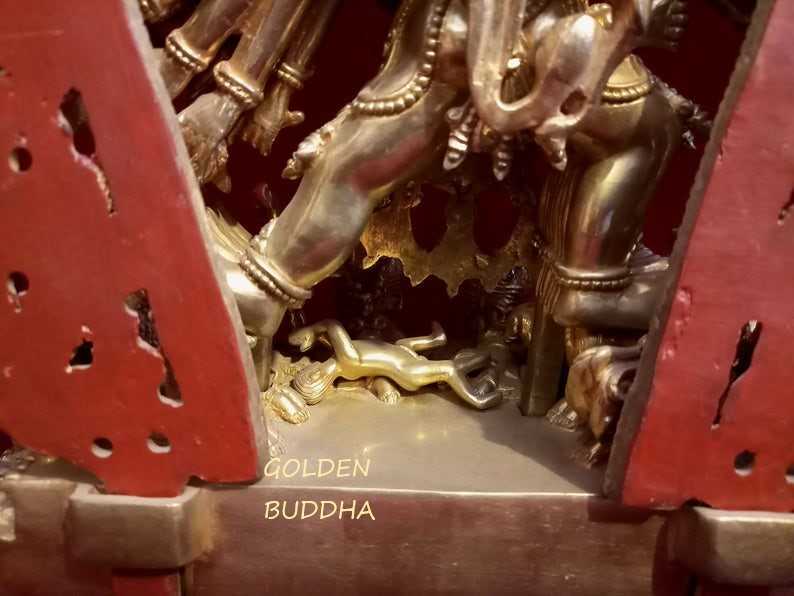
Numerous arms radiate around the central body, carrying an extensive array of weapons, ritual implements and symbolic objects. These do not advocate physical violence; they represent the many enlightened methods required to cut through different forms of ignorance and obstruction. The sixteen legs extend across a crowded field of subdued beings and animals, symbolizing the transformation of harmful forces and distorted energies that obstruct realization.
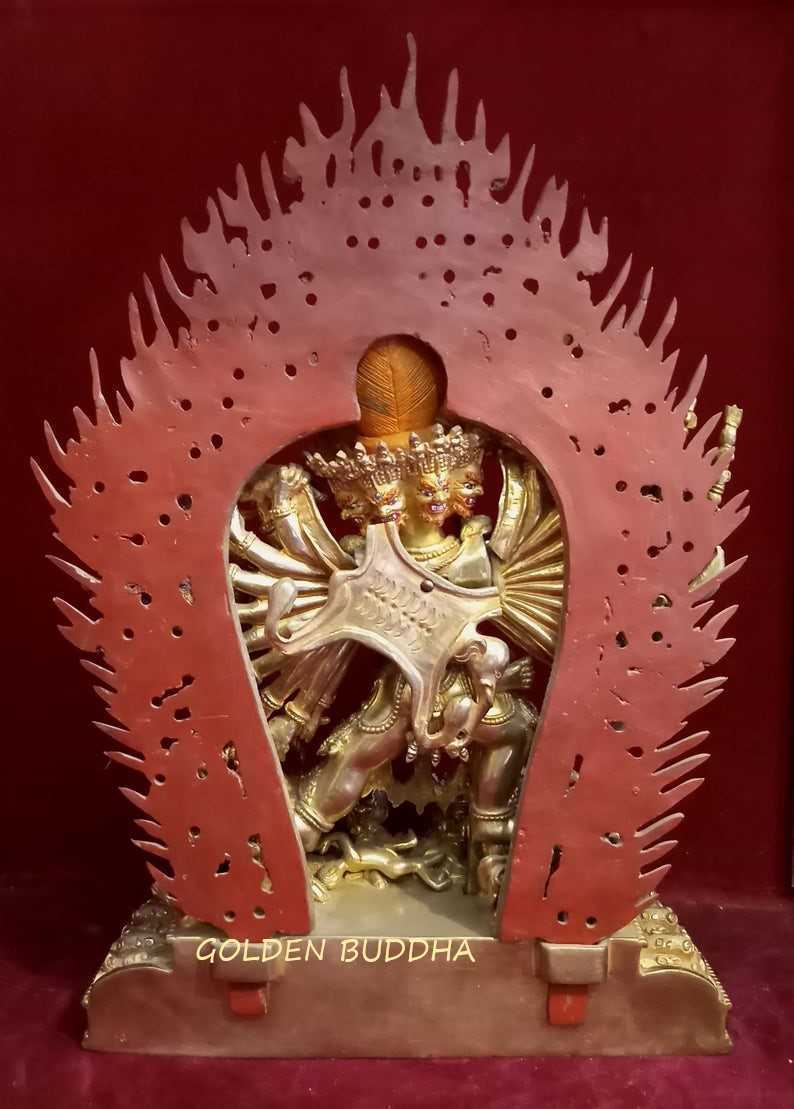
Removable Copper-Alloy Flame Mandorla
A large removable mandorla surrounds the complete deity assembly with layered openwork flames. The front is fire gilded in 24K gold, while the reverse displays a reddish finish that contrasts with the central gilded figure. These are flames of pristine awareness, symbolizing wisdom consuming ignorance and obscuration rather than ordinary destructive fire.
The frame is made from the same copper-alloy base as the figures and pedestal. Its removable construction allows the dense reverse workmanship to be examined and permits safer packing for international transportation without diminishing the integrity of the assembled composition.
Manjushri, Megh Sambara and Yama Statue Set
This sculpture forms a doctrinally meaningful three-piece arrangement with the Nepali Manjushri statue and the handcrafted Yama statue. Manjushri may be placed at the center or highest point as the peaceful source of transcendent wisdom. Megh Sambara can stand nearby as that wisdom transformed into overwhelming wrathful activity, while Yama may be positioned respectfully toward the outer part of the shrine as the Lord of Death subdued within the protective field.
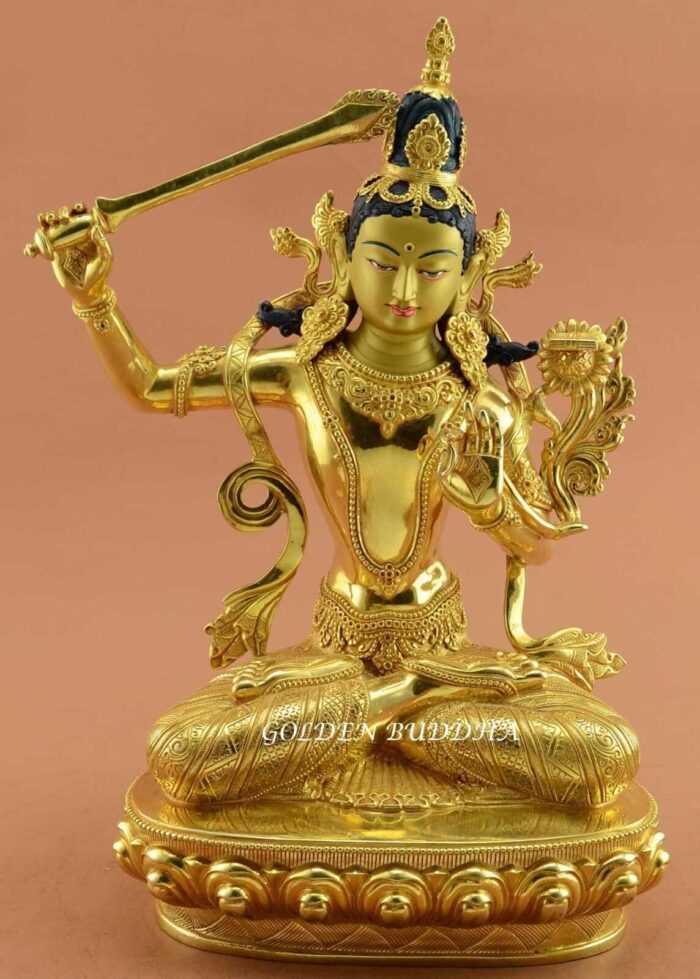
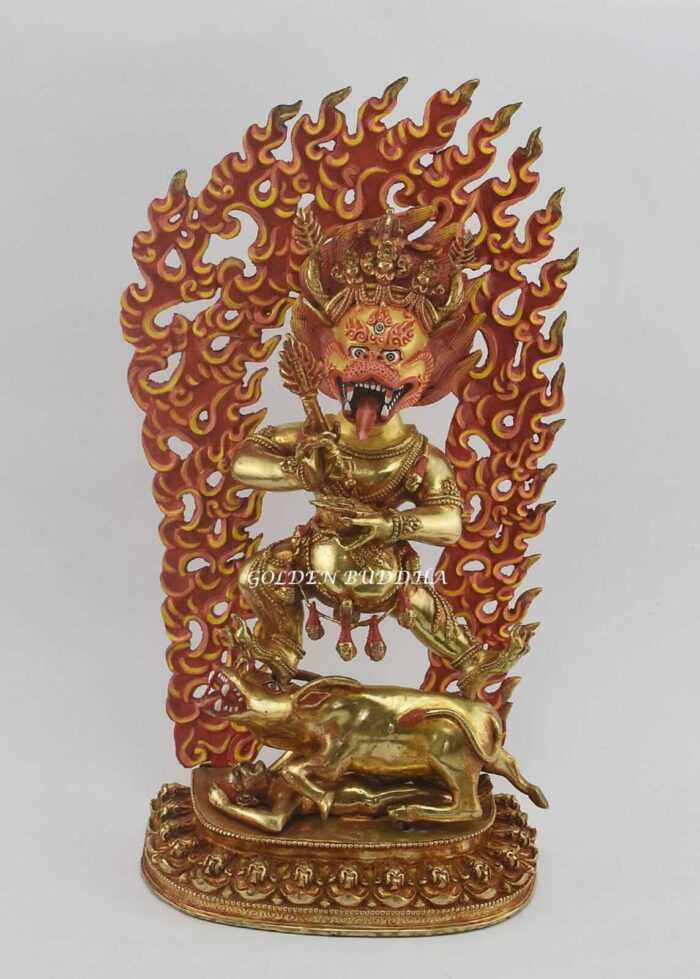
Manjushri raises the sword that cuts through ignorance and displays the Prajnaparamita scripture of perfected wisdom. Megh Sambara deploys multiple faces, arms, implements and legs against death and delusion. Yama represents mortality, karmic consequence and the unavoidable limits of conditioned existence. Together they illustrate wisdom in peaceful form, wisdom manifesting as wrathful tantric power, and death brought beneath the authority of awakened realization.
Custom Made Megh Sambara Statues
Golden Buddha can arrange a custom-made Megh Sambara statue in a preferred size, gilding treatment and degree of ornamental detail. Because this is among the most demanding forms in Himalayan sculpture, each commission must preserve the established faces, arms, sixteen legs, Vetali consort, ritual implements, subdued beings and removable copper-alloy flame frame. Options may include complete 24K fire gilding, selected oxidized contrast, individually painted faces, extensive hand chasing and traditional turquoise and red coral settings.
Manjushri, Megh Sambara and Yama may also be commissioned as a coordinated three-statue set with complementary dimensions, gold tones, pedestal designs and painted details. Consistent Newar craftsmanship creates visual unity, while each figure retains its correct hierarchy and attributes: Manjushri as the peaceful source of wisdom, Megh Sambara as his wrathful manifestation, and Yama as the power of death subordinated to enlightened awareness.
Authentic, Handmade in Nepal
Every statue is handcrafted in Patan, Nepal, using traditional lost wax casting and comes with a certificate of authenticity issued by Nepal’s Department of Archaeology, verifying its materials, technique, and origin.