
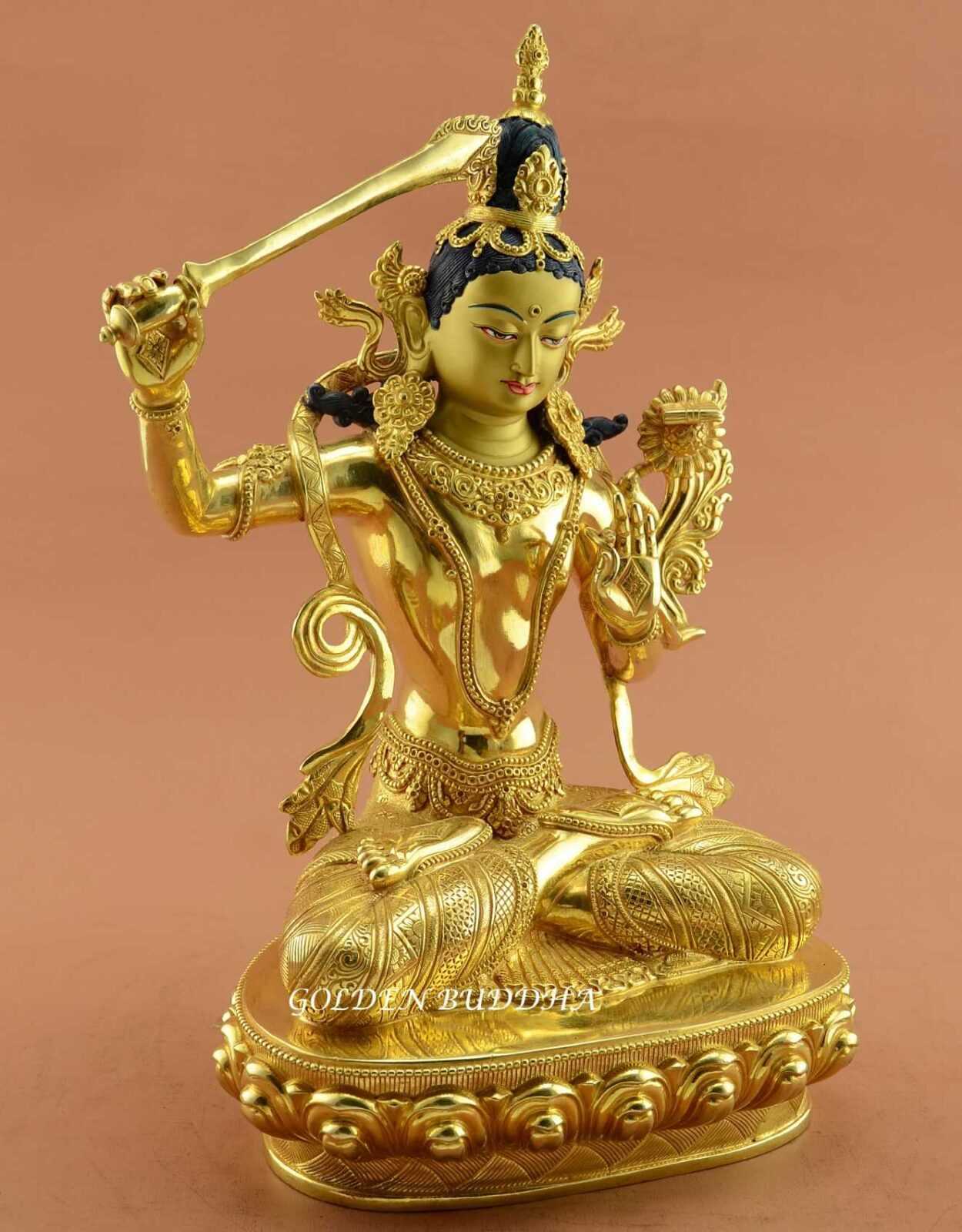


This exceptional Nepali Manjushri Sculpture portrays Jampelyang, the Bodhisattva of Transcendent Wisdom, raising his flaming sword above his right shoulder while displaying the Prajnaparamita scripture upon a lotus beside his left. Handmade in Patan, Nepal, the 14-inch statue was cast from copper alloy through the traditional lost-wax method and fire gilded in 24K gold. The rich gold surface is complemented by a face hand painted with 18K gold and natural pigments, black-painted hair, gilded topknot ornaments, elaborate celestial jewelry and richly engraved garments.
Manjushri sits in the full lotus posture with the sword of wisdom extended dramatically above his head. His raised right arm gives the sculpture an expansive silhouette and communicates the active force of insight cutting through ignorance. His left hand is held before the chest in a teaching gesture, with a vajra motif visible in the open palm. Beside that hand, an open lotus supports the Prajnaparamita scripture, the sacred teaching of perfected wisdom.
The statue is distinguished by its tall black-painted hair arrangement, which is decorated with gilded floral ornaments, jeweled bands and an elaborate finial rather than a Bodhisattva crown. Dark locks extend toward both shoulders and create a striking contrast with the smooth fire-gilded face, torso and arms. Long celestial ribbons sweep around the body, while necklaces, earrings, armlets, bracelets and waist ornaments enrich the composition without obscuring the deity’s elegant proportions.
Extensive hand engraving covers Manjushri’s dhoti across both folded legs. Angular textile panels, floral scrollwork, dotted fields and geometric borders follow the contours of the fabric, giving each section a distinct woven appearance. The engraving continues around the reverse of the robe and across the back of the lotus pedestal, where floral motifs are paired with a lower overlapping-leaf pattern. Measuring approximately 14 inches high, 9 inches wide and 6 inches deep, this Nepali Manjushri Sculpture has the visual presence required for a principal shrine image, meditation room, Dharma center or collection of Himalayan Buddhist art.
Nepali Manjushri Sculpture of Jampelyang
Manjushri is known in Tibetan as Jampelyang and is revered as the embodiment of the transcendent wisdom of all the Buddhas. He represents the clear insight that recognizes the nature of reality and dispels the ignorance responsible for suffering. In Mahayana Buddhism, wisdom is not simply knowledge, memory or intellectual ability. It is the direct understanding of emptiness, dependent origination and the absence of a permanent independent self.
This Nepali Manjushri Sculpture presents wisdom as both peaceful and active. Manjushri’s serene face remains composed, while the raised sword demonstrates that awakened insight acts decisively against confusion. His posture teaches that clarity does not require aggression. The deepest obstacles are overcome by seeing them accurately rather than by applying ordinary force.
Manjushri is especially important to practitioners engaged in Buddhist study, philosophical analysis, debate, teaching and meditation. His practice is traditionally used to strengthen comprehension, memory, eloquence and the capacity to distinguish valid understanding from mistaken views. Learn more in our detailed guide to the meaning of Manjushri statues and Buddhist wisdom.
Sword of Wisdom on the Nepali Manjushri Sculpture
Manjushri raises the sword of perfected wisdom in his right hand. The long blade extends above and behind the ornamental topknot, creating a strong diagonal line across the upper composition. This dramatic gesture distinguishes the deity immediately and gives the statue a sense of enlightened energy despite the stability of its seated posture.
The sword does not symbolize physical violence or the destruction of living beings. Its purpose is to cut through ignorance, distorted perception and attachment to mistaken concepts. Ignorance is considered the fundamental cause of cyclic existence because it prevents beings from understanding themselves and the world correctly.
The blade therefore represents discerning awareness. It separates beneficial understanding from confusion, valid reasoning from false assumptions and reality from the mental projections imposed upon it. The sword’s action is precise rather than indiscriminate, reflecting wisdom that identifies the actual source of suffering.
The flame-like ornament near the upper end of the blade signifies the radiance of awakened insight. Just as light dispels darkness without physically struggling against it, wisdom eliminates ignorance through direct recognition. Manjushri’s peaceful expression confirms that this victory is achieved through clarity rather than anger.
Prajnaparamita Scripture and the Lotus of Wisdom
A large open lotus rises beside Manjushri’s left shoulder and supports the Prajnaparamita scripture. The Prajnaparamita, or Perfection of Wisdom, teachings are central to Mahayana Buddhism and explain the emptiness of all phenomena. They reveal that things arise through causes, conditions and relationships rather than possessing fixed, independent existence.
The scripture balances the sword both visually and doctrinally. The sword represents wisdom actively cutting through confusion, while the sacred book represents the teachings that explain and cultivate that wisdom. Together they unite realization with the study and contemplation required to reach it.
The lotus supporting the scripture represents purity arising within samsara. Although a lotus grows from mud, its blossom opens above the water without becoming stained. In the same way, wisdom may develop within ordinary life and transform the very conditions that once supported ignorance.
The flower and manuscript are fully sculpted with curling leaves, an open blossom and layered book forms. Their complex openwork construction adds depth beside the raised left arm and balances the broad sweep of the sword on the opposite side. For further explanation of these attributes, visit our Manjushri statue meaning and symbolism FAQ.
Teaching Gesture and Vajra-Engraved Palm
Manjushri’s left hand is raised near the chest with the palm turned outward. The fingers form a refined teaching gesture associated with explanation, discussion and the transmission of wisdom. Its position close to the Prajnaparamita scripture connects the spoken communication of the Dharma with the profound teachings represented by the sacred book.
A vajra motif appears within the open palm. The vajra symbolizes indestructibility, stability and the unchanging nature of awakened realization. Placed within the hand of teaching, it indicates that Manjushri’s wisdom is not uncertain or provisional. It arises from direct insight into the nature of reality.
The raised palm also faces the devotee, making wisdom appear accessible rather than remote. Manjushri does not conceal the Dharma; he offers it to those willing to study, reflect and meditate. The gesture encourages the practitioner to unite intellectual learning with personal realization.
Explore the symbolism of teaching gestures and other sacred hand positions in our guide to Buddhist statue mudras and their meanings.
Ornamental Topknot and Gilded Hair Decorations
The elaborate hair arrangement is one of the most distinctive visual features of this Nepali Manjushri Sculpture. Manjushri’s black-painted hair rises into a tall, ribbed topknot decorated with gilded floral rosettes, ornamental bands and a sculpted finial. The dark hair remains clearly visible between the gold fittings, producing a strong contrast that emphasizes the height and structure of the coiffure.
A prominent gilded floral ornament decorates the front of the upper topknot, while smaller fittings appear at the sides and reverse. Looping jeweled bands follow the lower edge of the hair arrangement above the forehead, creating an ornamental fringe without concealing the black-painted strands.
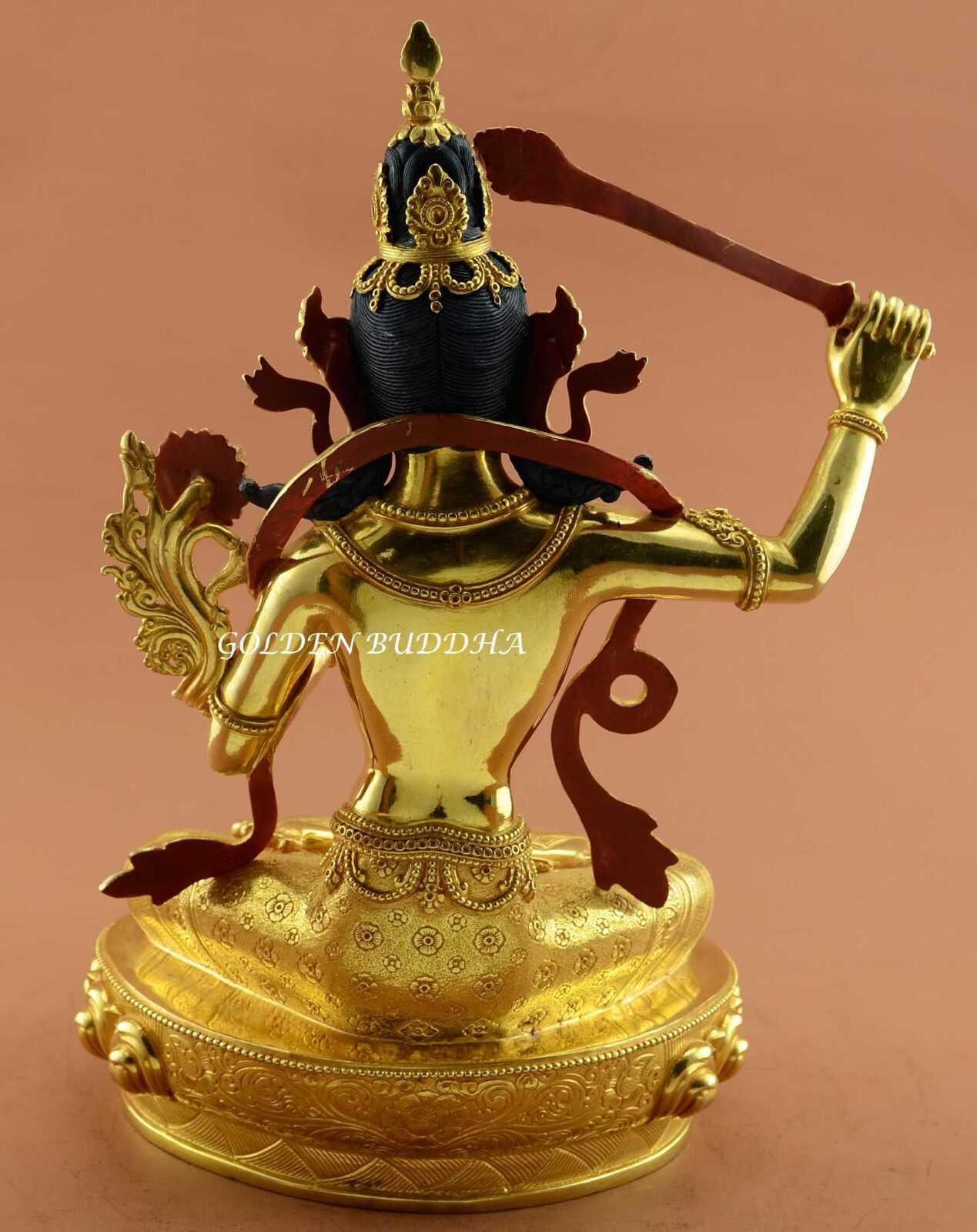
Dark locks descend toward both shoulders and are joined by large gilded floral ornaments near the ears. The reverse photograph shows the topknot completed on all sides, including a central back rosette, side decorations and the tall upper finial. This complete treatment gives the hair arrangement a fully three-dimensional form.
At the buyer’s request, the hair ornaments and celestial jewelry may be embellished with genuine turquoise and red coral before shipping. The stones can be placed selectively within the topknot fittings, earrings, necklaces, armlets, bracelets and waist ornaments while preserving the sculpture’s balanced traditional appearance.
Celestial Jewelry and Flowing Ribbons
Manjushri wears lavish celestial jewelry symbolizing the perfected qualities of an enlightened Bodhisattva. An elaborate necklace with floral scrollwork covers the upper chest, accompanied by longer beaded strands descending toward the waist. Large earrings frame the face, while additional ornaments appear at the upper arms, wrists and waist.
The armlets display finely engraved leaf and geometric patterns. Small raised beads outline their edges, and jeweled fittings provide additional detail at the elbows and wrists. The waist is encircled by a broad ornamental belt with hanging chains, loops and pendants above the engraved dhoti.
Long celestial ribbons flow from the shoulders and curve around the seated body. One ribbon forms a large spiral beside the right side of the torso, while others extend outward near the folded legs. Their sweeping forms add movement to the otherwise stable full-lotus posture.
From behind, portions of the ribbons reveal a dark reddish backing that contrasts with the gold body and black hair. The ribbons remain fully modeled rather than appearing as flat frontal attachments, contributing to the statue’s substantial depth and sculptural presence.
Hand-Painted Face of the Nepali Manjushri Sculpture
Manjushri’s face is hand painted with 18K gold and natural pigments, separately from the 24K fire gilding applied to the copper-alloy body. Fine painted lines define the eyebrows, lowered eyes and lips, while a small urna appears between the brows.
The expression is youthful, peaceful and attentive. Manjushri’s lowered gaze suggests inward clarity while remaining directed toward practitioners. The calm face creates an important contrast with the dynamic sword raised overhead, teaching that decisive wisdom arises from meditative composure rather than emotional agitation.
Black-painted hair frames the warm gold face, while the gilded earrings and hair ornaments provide bright points of detail around the cheeks and temples. This traditional combination of gold, black and natural pigments gives the image the devotional character associated with refined Newar sacred sculpture.
Full Lotus Posture and Meditative Stability
Manjushri sits in the full lotus posture with both legs folded evenly before him. This symmetrical position establishes a stable foundation beneath the raised sword, teaching hand and elaborate upper ornaments.
The full lotus pose represents concentration, equilibrium and the stability of awakened realization. Although wisdom cuts forcefully through ignorance, it is grounded in a mind that is calm, disciplined and free from distraction.
The broad folded legs create a triangular composition beneath the slender torso. Their weight visually anchors the extended right arm and long sword, preventing the upper portion of the statue from appearing unbalanced. The contrast between the steady posture and active attributes communicates wisdom that is both contemplative and effective.
Hand-Engraved Dhoti of the Nepali Manjushri Sculpture
The hand-engraved dhoti is among the most accomplished craftsmanship features of this statue. Separate textile panels cover both folded legs, combining angular divisions, floral scrollwork, geometric fields and finely dotted textures. Each pattern follows the rounded contours of the fabric rather than appearing as a flat decorative overlay.
The front of the garment includes diagonal bands, repeating geometric motifs and narrow beaded borders. Some panels contain curling foliate patterns, while others resemble intricately woven Himalayan textiles. The variety of decoration creates visual richness without sacrificing the clarity of Manjushri’s seated posture.
The engraving continues around the sides and reverse. From behind, smaller floral medallions and scrolling patterns decorate the robe across both folded legs. The rear waist ornaments descend above this engraved field in symmetrical loops and pendants.
The richly patterned dhoti contrasts with the smooth fire-gilded back, chest and arms. This balance allows the sculpture to display both the artisan’s engraving skill and the broad reflective qualities of the 24K gold finish.
Lotus Pedestal and Engraved Rear Throne
Manjushri is seated upon a broad lotus pedestal with a smooth upper platform and a projecting row of large rounded lotus petals. Their deeply modeled centers catch the light, while the recessed outlines produce stronger shadows and give the throne substantial visual weight.
A beaded border follows the upper edge of the lotus course, separating the seating platform from the sculpted petals. Beneath them, a lower band displays a repeating overlapping-leaf or woven pattern that encircles the base.
The rear pedestal receives extensive hand engraving. Floral scrollwork fills the broad rounded band beneath the seating platform, while the lower leaf pattern continues uninterrupted around the back. This complete decoration allows the statue to be displayed away from a wall and appreciated from several directions.
The lotus symbolizes purity and awakening because it rises from muddy water without becoming stained. As Manjushri’s throne, it expresses wisdom that develops within samsara yet remains free from the ignorance and attachment it eliminates.
24K Fire-Gilded Copper-Alloy Finish
The copper-alloy body, sacred attributes, jewelry and pedestal are fire gilded in 24K gold through traditional Himalayan techniques. The gold finish gives this Nepali Manjushri Sculpture a luminous shrine presence while allowing the engraved patterns and sculptural contours to remain clearly visible.
Raised areas across the jewelry, hands, sword and lotus petals reflect light strongly, while the recessed engraving appears deeper in tone. This natural contrast gives definition to the dense ornamental work without requiring painted decoration across the body.
Broad smooth surfaces across the torso, arms and back reveal the quality of the hand-finished gilding. Subtle tonal variations are characteristic of traditional fire gilding and distinguish handmade Newar metalwork from mechanically plated reproductions. Learn more about traditional 24K fire gilding in our buyer’s guide.
Finished from the Front and Reverse
The reverse photograph demonstrates the complete three-dimensional workmanship of the statue. Manjushri’s shoulders, back and waist are smoothly modeled, while necklaces, armlets and garment borders continue behind the figure.
The sword, raised hand, lotus flower, scripture and openwork stem remain fully developed from behind. The tall topknot is especially detailed, with black-painted ribbed hair, gilded rosettes, ornamental bands and a finial visible from the reverse.
The celestial ribbons reveal their contrasting reddish backing and continue around the shoulders and sides. Floral engraving covers the rear dhoti and lotus pedestal, while the lower overlapping-leaf border completes the base.
This attention to the reverse makes the statue suitable for freestanding shrine placement and demonstrates that the artisan treated it as a complete sacred object rather than a front-facing decorative image.
Traditional Lost-Wax Casting in Patan, Nepal
This Nepali Manjushri Sculpture was handmade by Newar artisans in Patan, Nepal, using the traditional lost-wax casting method. The process begins with a detailed wax model prepared according to established Buddhist iconometric proportions. The artisan forms Manjushri’s posture, face, sword, teaching hand, lotus, scripture, hair ornaments, jewelry and pedestal before preparing the image for casting.
The wax model is enclosed within a heat-resistant mould and fired so that the wax melts away, leaving a cavity in its shape. Molten copper alloy is poured into the mould and allowed to cool. Once the outer mould is removed, the raw casting is chased, filed and refined by hand.
The artisan sharpens the facial features, fingers, sword, scripture, lotus petals, hair ornaments and jewelry before engraving the complex textile patterns across the dhoti and pedestal. The completed copper-alloy sculpture is then prepared for traditional 24K fire gilding.
Black pigment is applied to the hair, selected ribbon surfaces receive a reddish finish, and the face is separately hand painted with 18K gold and natural pigments. Since the original wax model is destroyed during casting and the engraving and finishing are performed individually, each statue retains subtle handmade variations.
Learn more about the Shakya artisans and traditional lost-wax casting practiced in the historic metalworking communities of Patan.
Matching Manjushri and Chenrezig Shrine Set
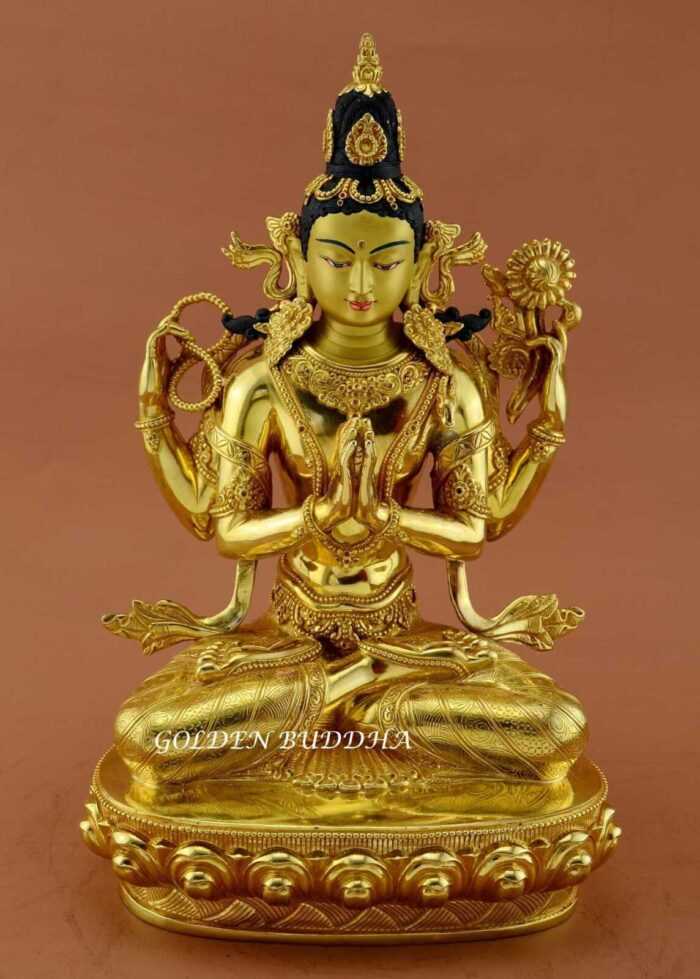
This Nepali Manjushri Sculpture would form a harmonious two-piece shrine set with the matching Handmade Chenrezig Sculpture. Both 14-inch statues were created by the same master artisan and share copper-alloy construction, 24K fire-gilded finishes, hand-painted faces and nearly identical dimensions.
Their closely related craftsmanship creates strong visual continuity. Both sculptures feature tall black-painted topknots decorated with gilded ornaments, lavish celestial jewelry, flowing ribbons, richly hand-engraved dhotis and fully finished lotus pedestals. Smooth gold torsos contrast with the dense textile engraving across the folded legs, giving the pair a consistent artistic character.
Their sacred attributes create visual balance without making the images identical. Manjushri raises the long sword of wisdom and displays the Prajnaparamita scripture upon a lotus. Chenrezig joins his principal hands at the heart, holds a mala and supports an open lotus. The contrasting gestures express distinct enlightened qualities while their seated postures and artisan finishes unify the pair.
The two deities also form a foundational doctrinal match. Manjushri embodies transcendent wisdom, cutting through ignorance and revealing the empty, interdependent nature of reality. Chenrezig embodies universal compassion, perceiving the suffering of all beings and generating the aspiration to lead them toward liberation.
Wisdom prevents compassion from becoming confused or poorly directed, while compassion ensures that wisdom remains dedicated to the welfare of living beings. Together they represent the inseparable union of insight and compassionate method at the heart of the Mahayana path.
Placed together upon an altar, Manjushri reminds practitioners how the causes of suffering are eliminated through wisdom, while Chenrezig reminds them why awakening is pursued—for the benefit of every sentient being. Their equal height and matching craftsmanship make the pair visually balanced as well as doctrinally complete.
Custom-Made Nepali Manjushri Sculptures
A custom-made Manjushri statue may be commissioned in a preferred size, finish and degree of ornamentation. Available options include smaller personal shrine images, larger temple-scale sculptures, rich antiquated oxidized copper finishes, silver-highlighted surfaces and statues fire gilded in 24K gold.
For a gilded commission, the face may be separately hand painted with 18K gold and natural pigments, while the hair can be completed in traditional black pigment. The topknot ornaments, earrings, necklaces, armlets, bracelets and waist jewelry may be embellished with genuine turquoise and red coral.
Customers may request smooth robes, elaborate textile engraving similar to this sculpture, alternative lotus-petal designs or expanded floral decoration around the pedestal. The sword, lotus and Prajnaparamita manuscript may be adjusted proportionally for larger temple commissions while preserving Manjushri’s established iconography.
Custom Jampelyang statues can be created for private collectors, home shrines, Buddhist temples, Dharma centers and monasteries. Traditional attributes—including the flaming sword of wisdom, Prajnaparamita scripture, teaching hand, lotus support and full lotus posture—are maintained throughout the design and production process.
A coordinated two-piece set may also be commissioned with Manjushri and the matching Handmade Chenrezig Sculpture. Their heights, gilded finishes, hair ornaments, celestial jewelry, engraved garments, ribbons and lotus pedestals can be planned together so the completed statues form a unified shrine ensemble.
Such a pairing unites Manjushri’s penetrating wisdom with Chenrezig’s limitless compassion. Manjushri provides the insight required to understand and eliminate the deepest causes of suffering, while Chenrezig generates the altruistic intention to apply that understanding for the welfare of all beings. Together, the two deities form a visually balanced and doctrinally meaningful expression of the Mahayana path.
Authentic, Handmade in Nepal
Every statue is handcrafted in Patan, Nepal, using traditional lost wax casting and comes with a certificate of authenticity issued by Nepal’s Department of Archaeology, verifying its materials, technique, and origin.