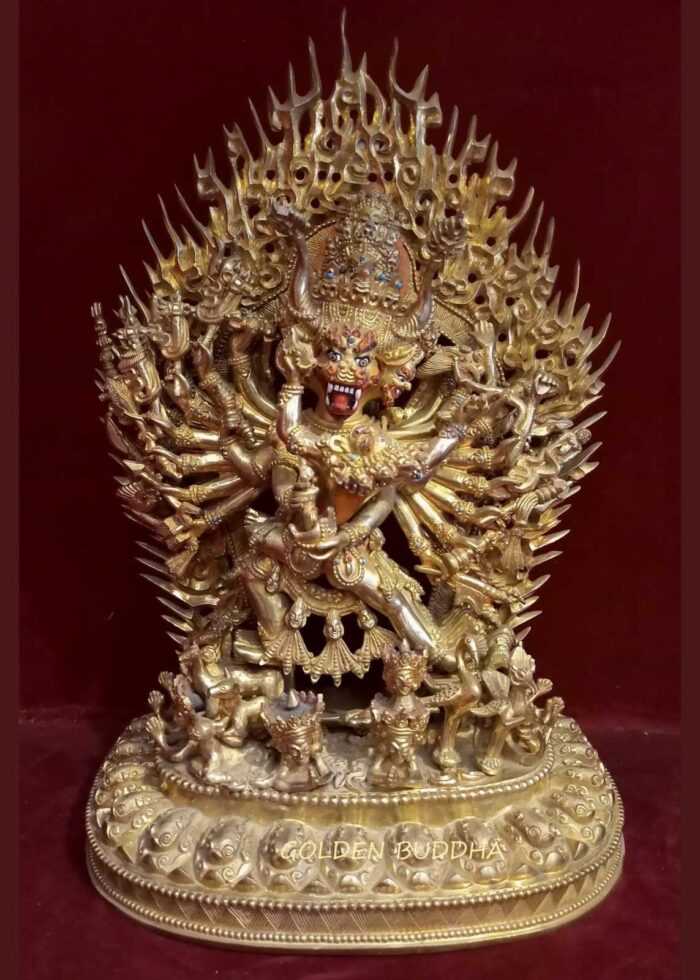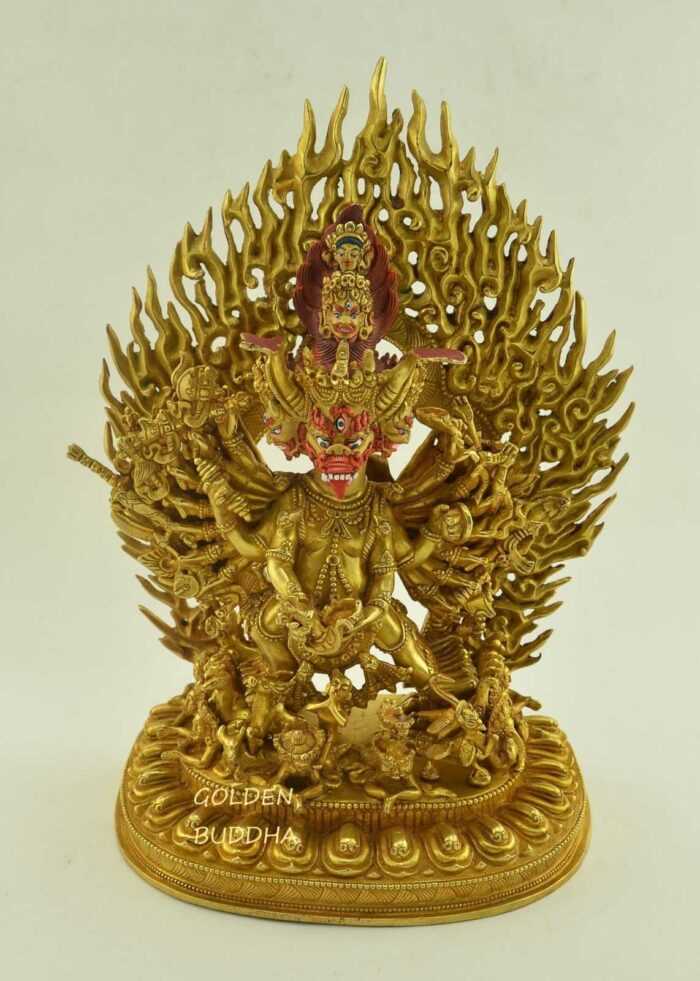
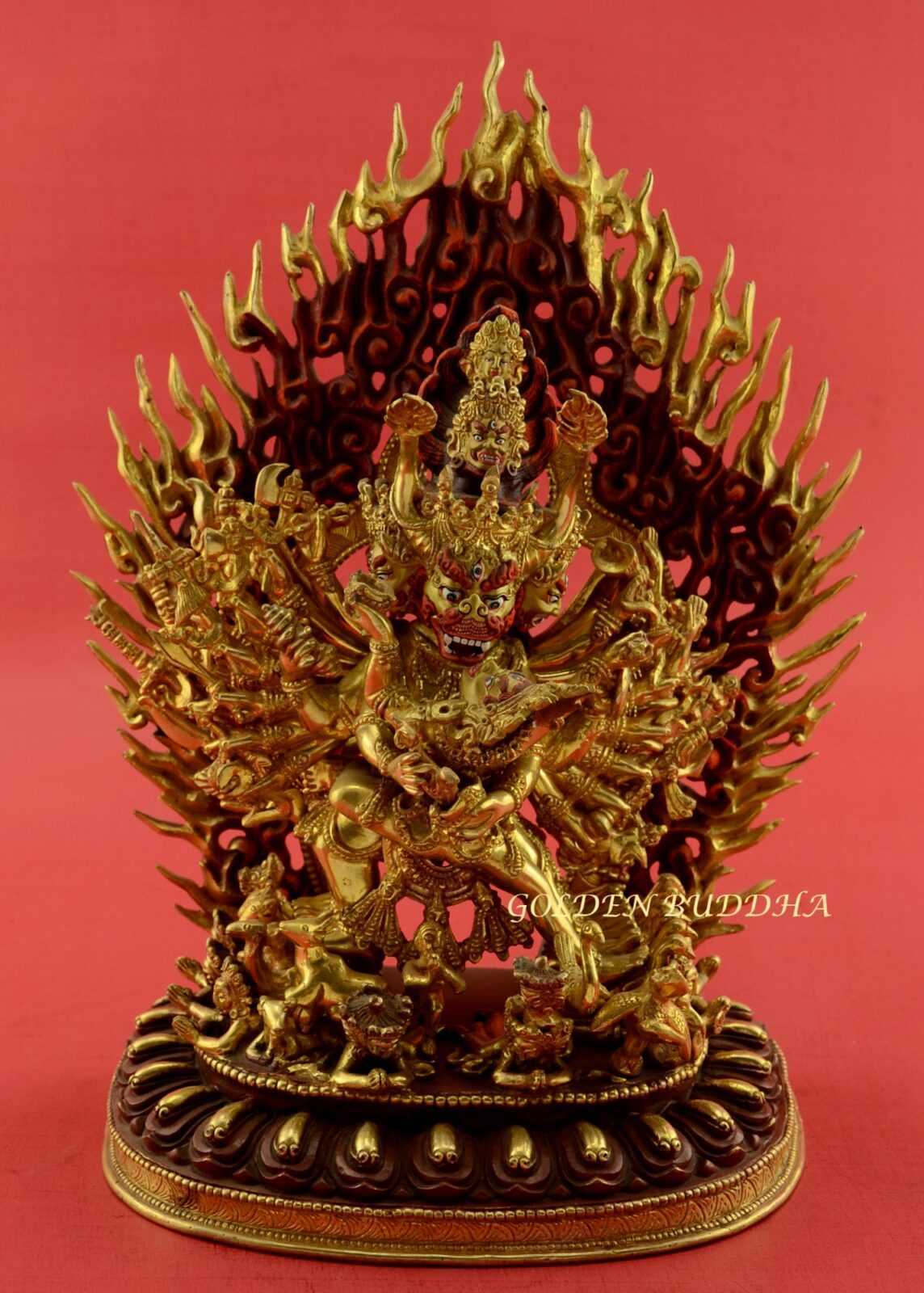
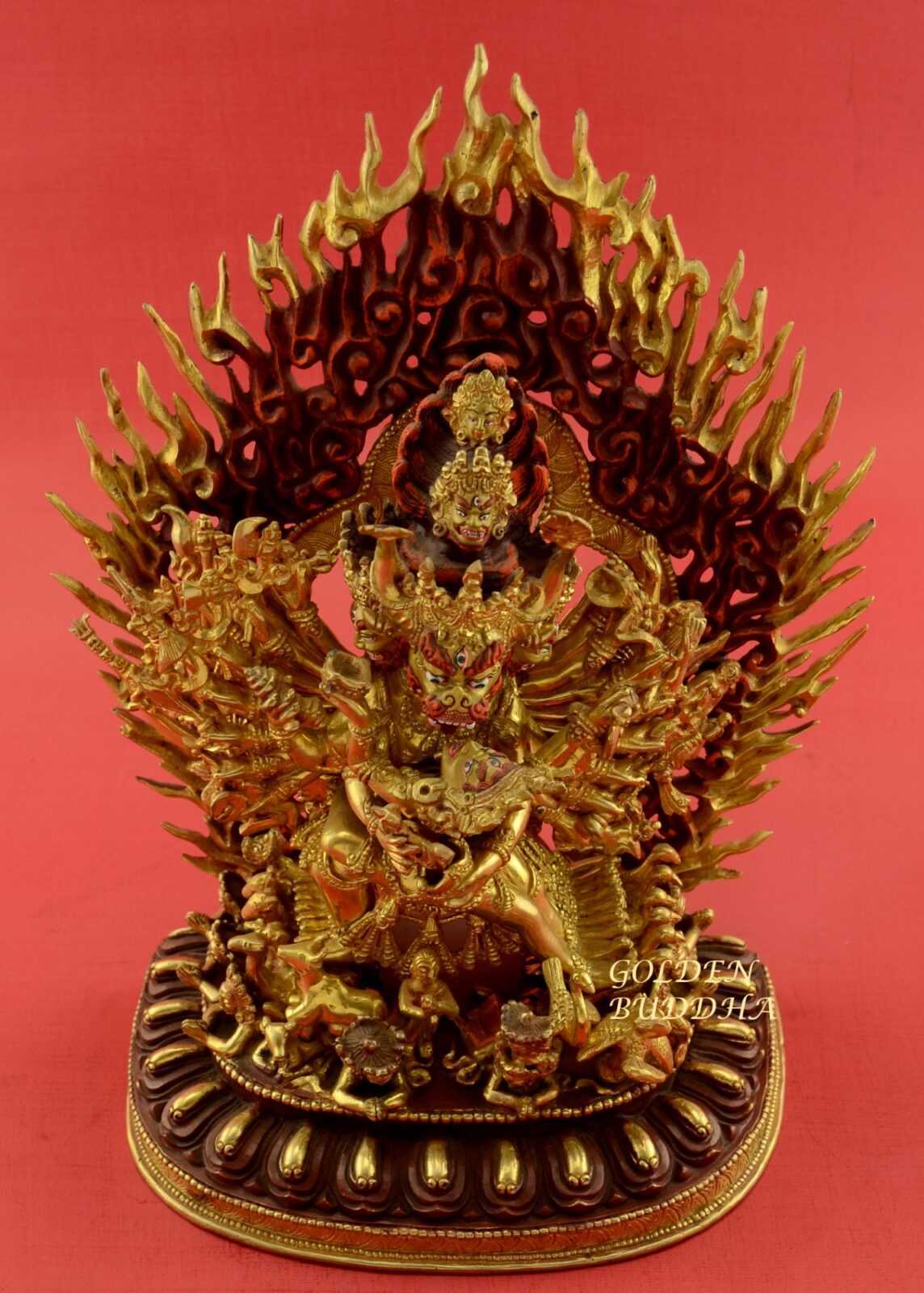
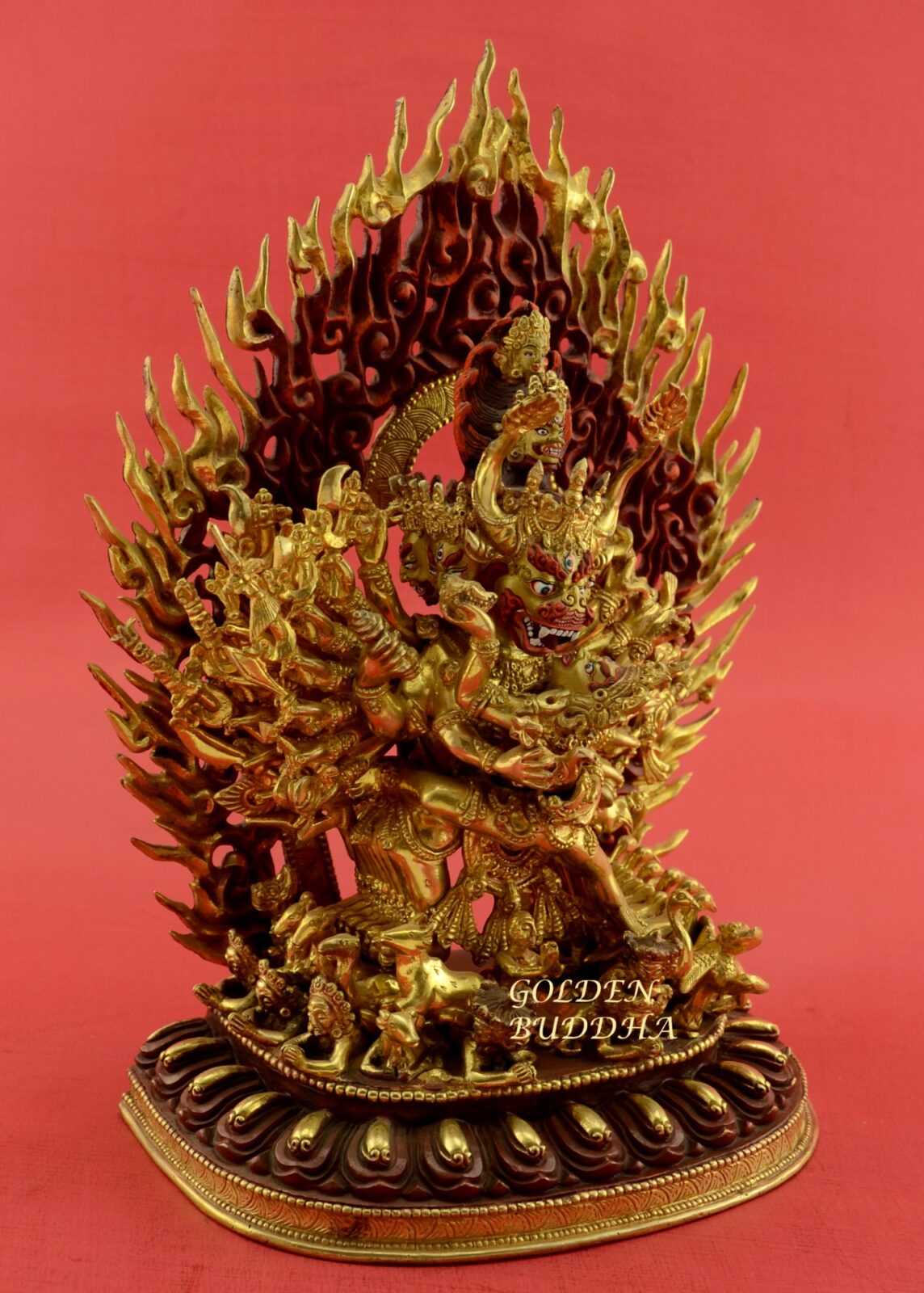
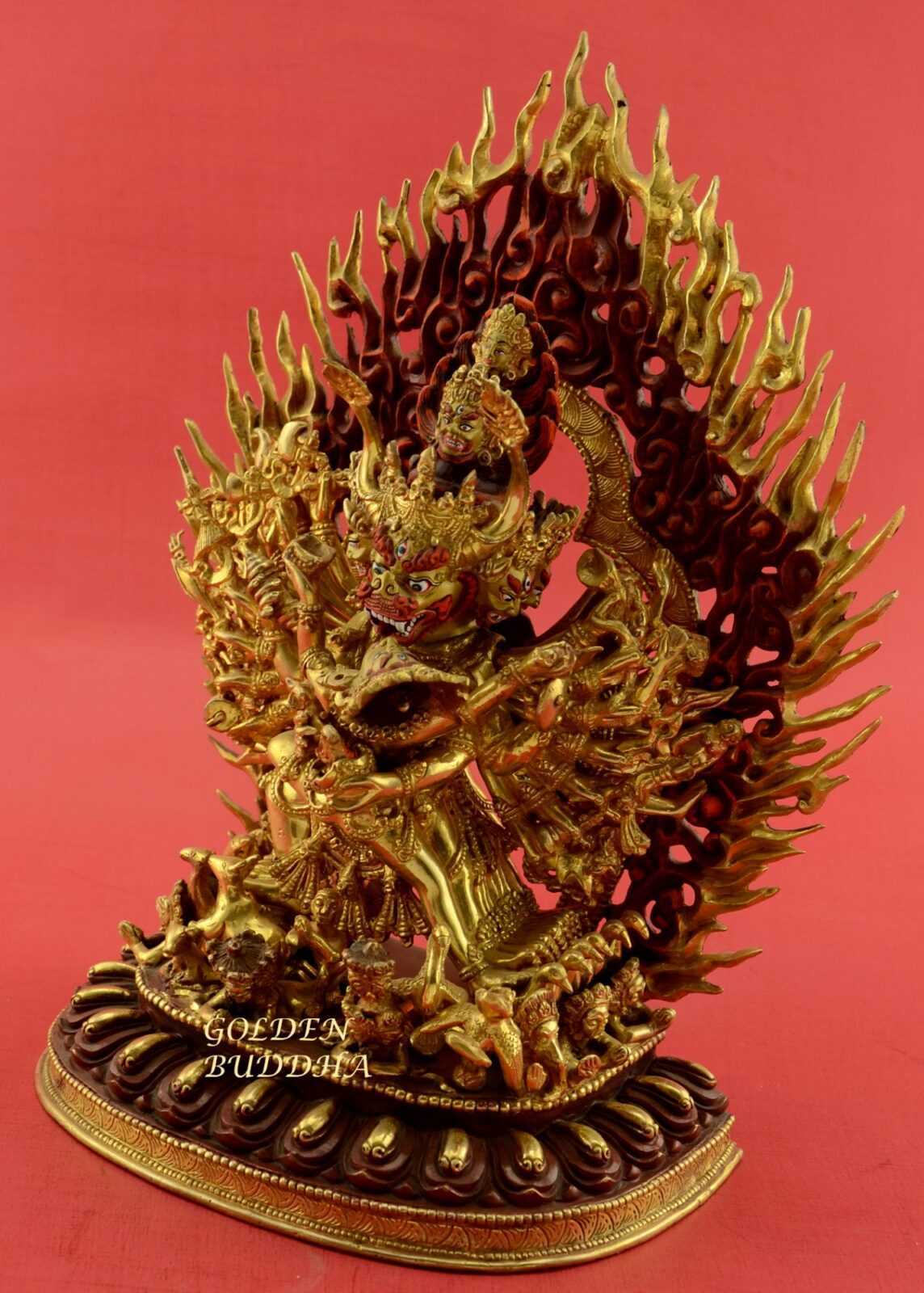
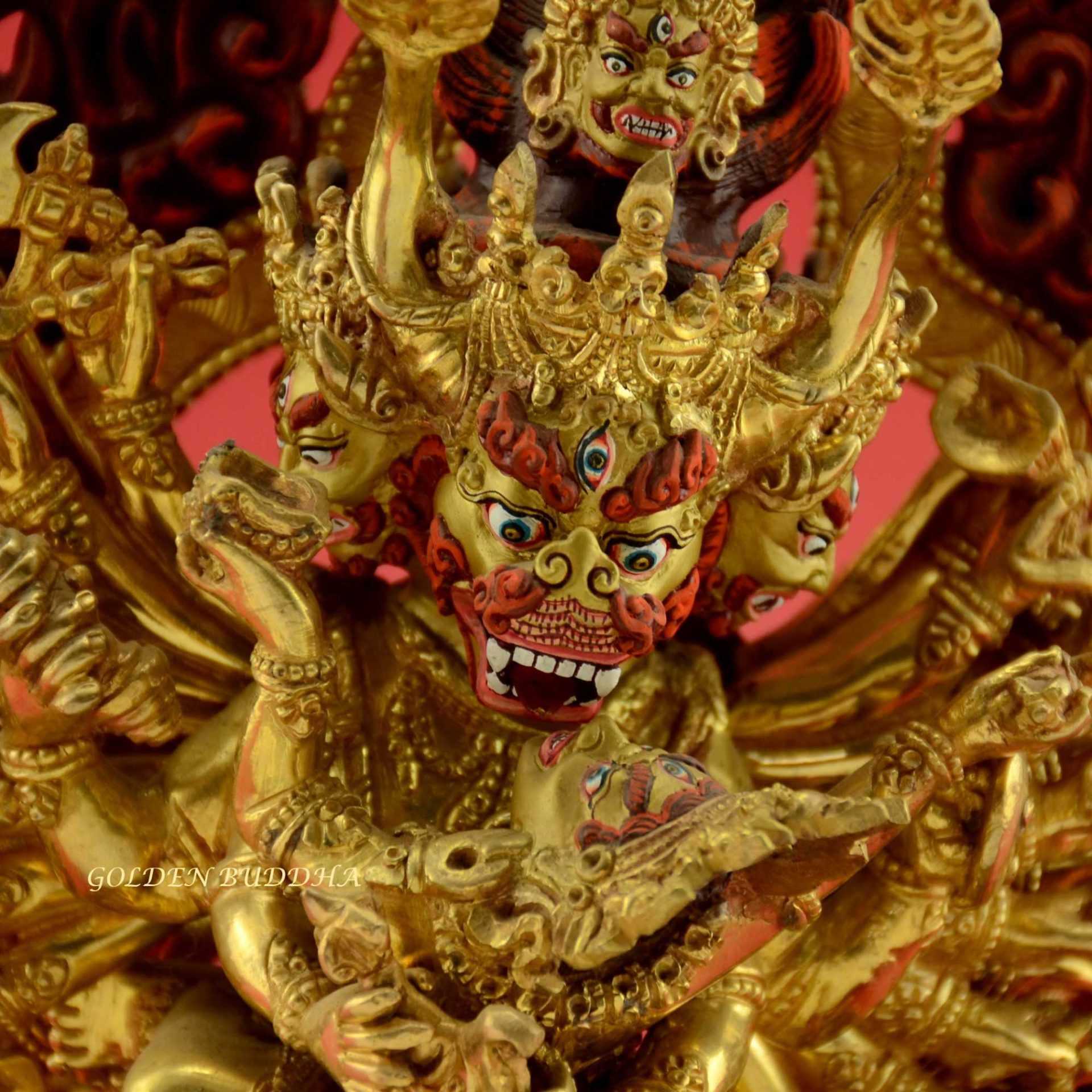
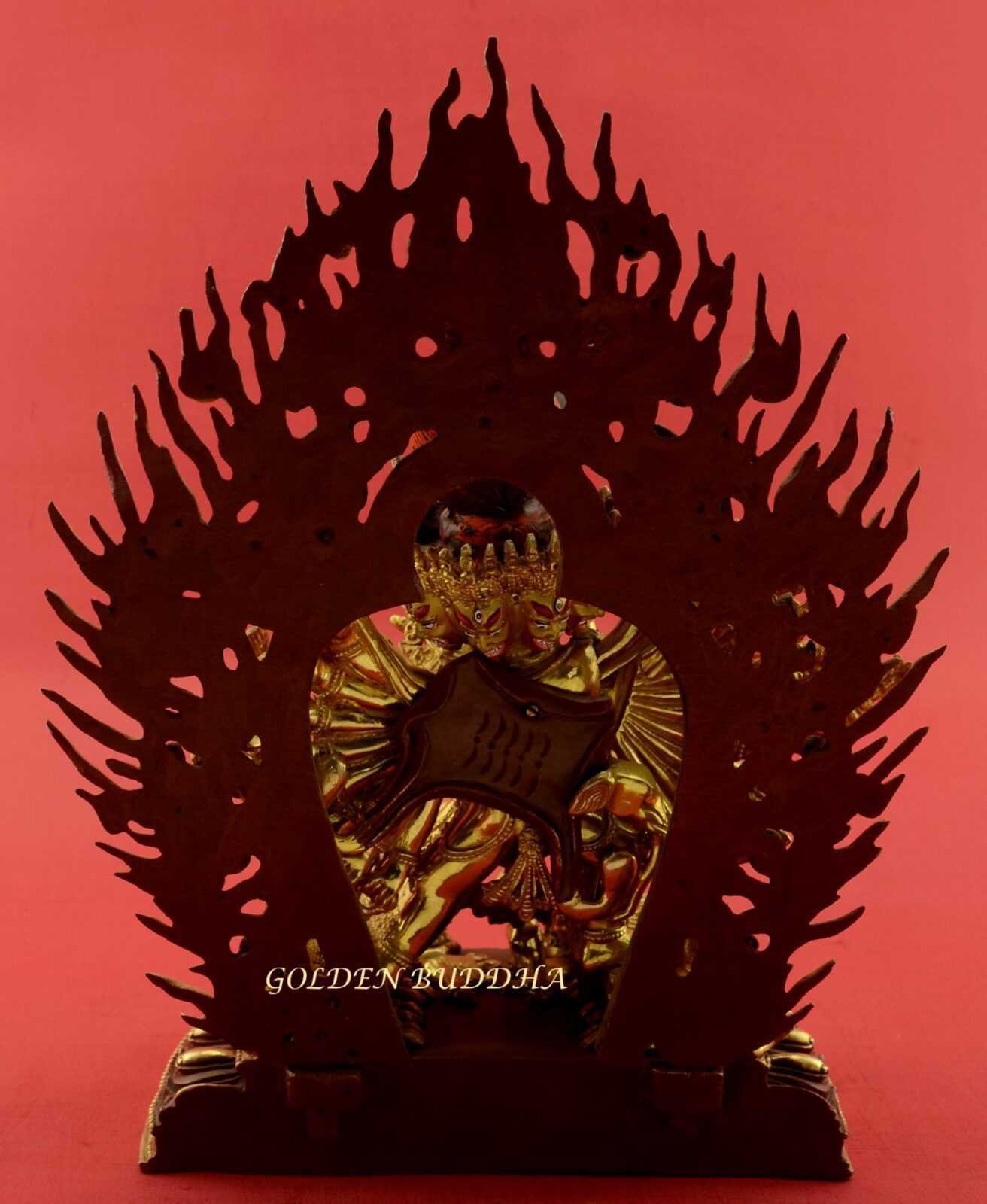
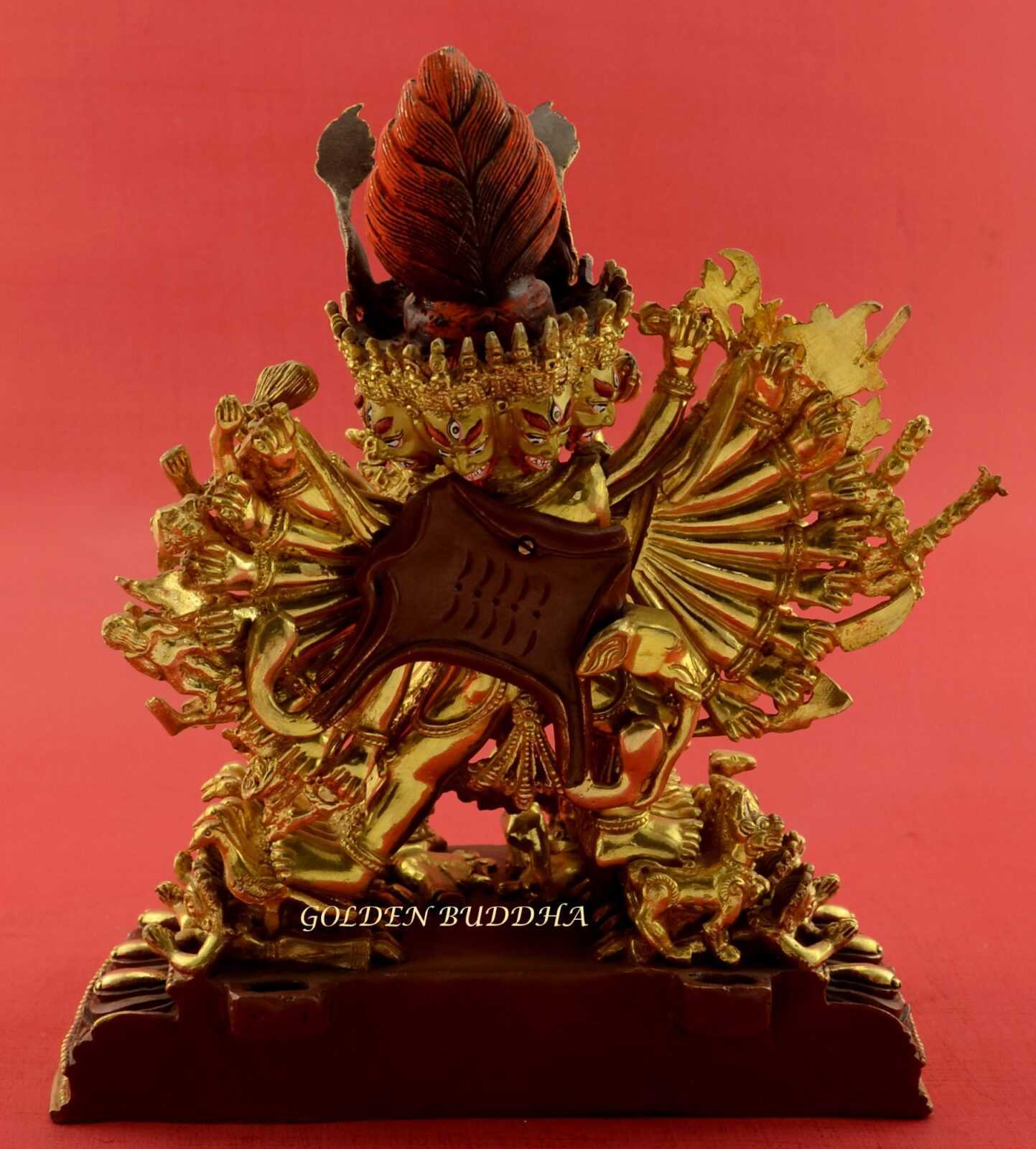
This intricate Yamantaka sculpture portrays Vajrabhairava, also known as Megh Sambara, in his complete nine-faced, 34-armed and 16-legged manifestation. Surrounded by a removable mandorla of pristine-awareness flames, the wrathful deity stands in sacred union with his wisdom consort Vetali above a dense assembly of subdued figures and animals. The extraordinarily complex iconography represents Manjushri’s transcendent wisdom arising in a form powerful enough to overcome death, delusion and the deepest obstacles to awakening.
Measuring approximately 11.5 inches with the frame and 9.25 inches without it, the entire composition—including Yamantaka, Vetali, the 34 arms and ritual implements, sixteen legs, subordinate figures, lotus throne and removable flame mandorla—is cast from a base of copper alloy. Master Newar artisans in Patan, Nepal created the sculpture through traditional lost-wax casting before fire gilding the figures and principal details in 24K gold. Deep red oxidized and painted surfaces across the inner mandorla and pedestal create a dramatic contrast with the luminous central figures, while the wrathful faces are individually hand painted with precise eyes, fangs, brows and flame-like markings.
Yamantaka Sculpture of Vajrabhairava
Yamantaka is the wrathful manifestation of Manjushri, the Bodhisattva of Transcendent Wisdom. His name is commonly translated as the “Conqueror of Death” or “Destroyer of Death.” Although his appearance is terrifying, it does not represent ordinary anger. Every fierce feature expresses enlightened wisdom acting decisively against ignorance, attachment, karmic obstruction and fear of mortality.
The principal buffalo head establishes Yamantaka’s relationship with Yama, the Lord of Death. Eight additional faces extend his awareness in every direction, while the peaceful golden face of Manjushri appears at the summit. This uppermost face reveals that the entire wrathful manifestation originates in wisdom and compassionate intent. Learn more in our guide to Yamantaka, the Conqueror of Death.
Nine Faces, 34 Arms and Sixteen Legs
The complete Vajrabhairava form has nine faces, 34 arms and sixteen legs. His principal pair of hands holds the curved flaying knife and skull cup close to the heart while embracing Vetali. The remaining 32 hands radiate around the body and carry distinct weapons, ritual implements and symbolic objects. This arrangement is sometimes mistakenly described as 32 arms because the outer 32 implements are counted without including the central pair.
The implements represent the many enlightened methods used to cut through different forms of delusion and obstruction. His sixteen legs extend across a crowded field of animals, deities and subdued beings, symbolizing mastery over harmful forces, conditioned existence and the obstacles that bind beings to cyclic rebirth.
Sacred Union with Vetali
Vetali embraces Yamantaka at the still center of the otherwise explosive composition. In highest yoga tantra, this Yab Yum form symbolizes the inseparability of compassionate method and the wisdom directly realizing emptiness. The imagery therefore communicates non-dual awakened awareness rather than worldly passion.
Vetali’s association with charnel-ground symbolism reinforces Vajrabhairava’s confrontation with death and impermanence. Their union expresses awareness that is neither created by life nor extinguished by death, while the surrounding attributes reveal its dynamic power to transform obscuration.
Removable Copper-Alloy Flame Mandorla
A removable copper-alloy mandorla encloses the deity within layered flames of pristine awareness. Gold highlights along the outer flame tips contrast with the dark red inner surface, helping the gilded figures and numerous ritual implements remain visually distinct. These flames symbolize awakened wisdom consuming ignorance and neurotic mental states without remainder.
The detachable frame reveals the extensive workmanship across the sculpture’s reverse and allows the statue to be packed more securely for international transportation. The rear view shows the multiple faces, radiating arms, fitted attributes, flowing garments and animal-hide covering modeled as a complete three-dimensional composition.
Manjushri, Yama and Yamantaka Sculpture Set
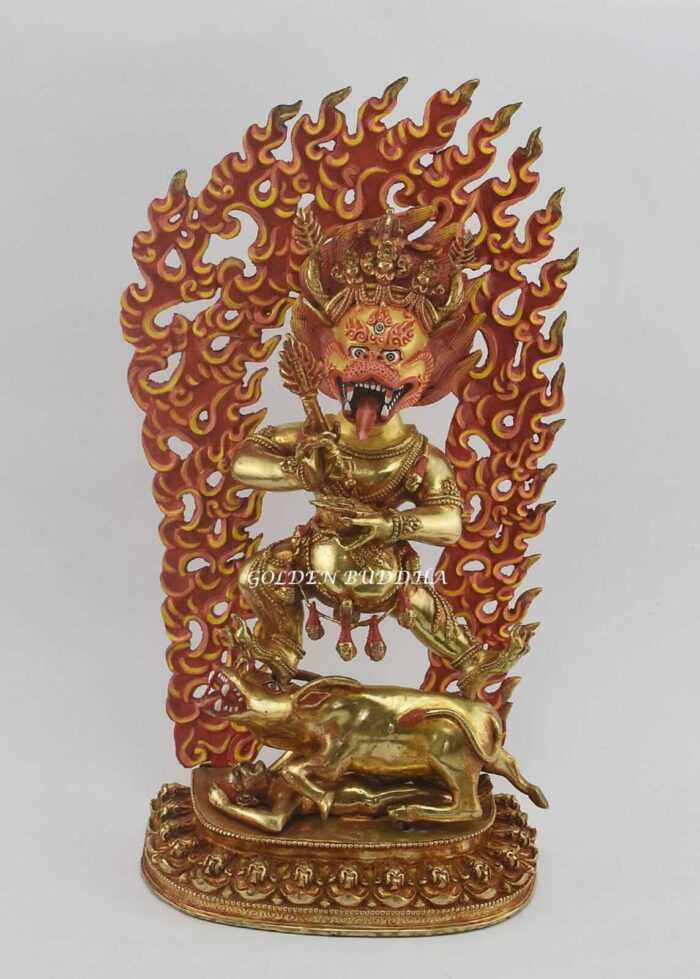
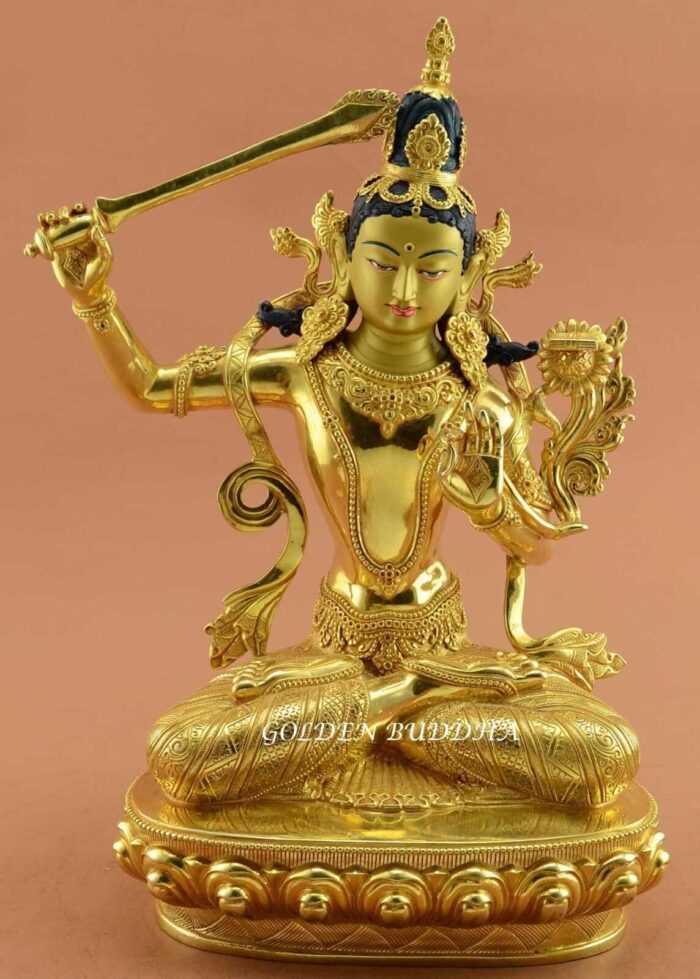
This Yamantaka sculpture forms a meaningful three-piece shrine arrangement with the Nepali Manjushri statue and the handcrafted Yama statue. Manjushri may be placed at the center or highest point as the peaceful source of transcendent wisdom. Yamantaka may be positioned nearby as Manjushri’s wrathful manifestation, with Yama placed respectfully toward the outer shrine as the Lord of Death subdued beneath enlightened awareness.
Manjushri raises the wisdom sword that cuts through ignorance and is associated with the Prajnaparamita teachings. Yamantaka transforms that same wisdom into a nine-faced, 34-armed and sixteen-legged form capable of confronting death and profound obstruction. Yama represents mortality, karmic consequence and the limits of conditioned existence. Together, the three figures illustrate peaceful wisdom, its forceful tantric expression and the power of death ultimately brought beneath realization.
Custom Made Yamantaka Sculptures
Golden Buddha can arrange a custom-made Yamantaka sculpture in a preferred size, finish and degree of ornamental detail. Every commission must preserve the established nine faces, 34 arms, sixteen legs, Vetali consort, ritual implements, subordinate figures and removable copper-alloy flame mandorla. Available options may include complete or selective 24K fire gilding, oxidized contrast, individually painted wrathful faces, additional hand chasing and traditional turquoise or red coral settings.
Manjushri, Yamantaka and Yama may also be commissioned as a coordinated three-statue set with complementary dimensions, gilding tones, pedestal designs and painted details. Matching craftsmanship creates visual harmony while preserving their correct hierarchy: Manjushri as the peaceful source of wisdom, Yamantaka as its wrathful death-conquering manifestation and Yama as mortality subordinated within the outer protective field.
Authentic, Handmade in Nepal
Every statue is handcrafted in Patan, Nepal, using traditional lost wax casting and comes with a certificate of authenticity issued by Nepal’s Department of Archaeology, verifying its materials, technique, and origin.