
Avalokiteshvara (Chenrezig) Thangka Paintings
Avalokiteshvara is the Bodhisattva of Compassion, known in Tibetan as Chenrezig and in his earliest form as Padmapani, the lotus bearer. He is the patron deity of Tibet and the source of Om Mani Padme Hum, the mantra recited more than any other in the Buddhist world – and compassion, in his case, means not sentiment but the active resolve to relieve the suffering of every being without exception. Read more about his place in Tibetan life and practice in our guide to the cultural significance of Chenrezig. As Buddhism travelled east he was gradually reimagined in female form, becoming Guanyin in China and Kannon in Japan, so that a single Bodhisattva is understood through both genders across the Buddhist world. The paintings in this category follow the Tibetan and Nepali tradition, in which he is depicted as male.
Three of his forms appear in this collection, and together they trace how the Bodhisattva of Compassion has been visualized over more than a thousand years. Padmapani is the oldest: the two-armed Mahayana Avalokiteshvara of pre-Tantric India, holding the stem of an utpala lotus in his right hand, serene and unelaborated. Vajrayana practice later developed him into the four-armed Chenrezig, or Shadakshari, painted white and seated in full lotus, his first two hands joined at the heart around a wish-fulfilling jewel while the others hold a crystal mala and a white lotus – the form used in daily practice and mantra recitation. The thousand-armed Avalokiteshvara, or Sahasrabhuja, is the most elaborate of all: heads rising in tiers above a vast aureole of arms, each palm bearing an eye. That form comes from the tradition that Avalokiteshvara, overwhelmed by the endless suffering he had vowed to end, shattered into pieces, and was reassembled by Amitabha Buddha with a thousand arms to reach further and a thousand eyes to see more.
Amitabha still appears at the crown of his head in most paintings, marking Avalokiteshvara as a member of the Amitabha lotus family, and tradition holds that Green and White Tara were born from his tears as he wept over the suffering of beings – see our guide to Tara’s origins. Also in this category is the 108 Chenrezig thangka, which repeats the central figure one hundred and eight times across the canvas, 108 being the number of beads on a mala and traditionally the number of afflictions to be purified.
Every painting here is hand painted in Nepal by Himalayan artists trained in the traditional schools, working to the iconometric grids that govern each form’s proportions and attributes, and finished with genuine 24K gold detailing applied by hand. Sizes run from compact paintings of around 15 inches, suited to a personal altar or meditation room, up to major works of 44 inches intended as the central image of a shrine room or Dharma center. For common questions about his forms, mantra, and practice, see our Avalokiteshvara FAQ. Browse the full range of Tibetan thangka paintings, or see Chenrezig rendered in copper alloy among our Avalokiteshvara statues.
Showing all 6 resultsSorted by popularity
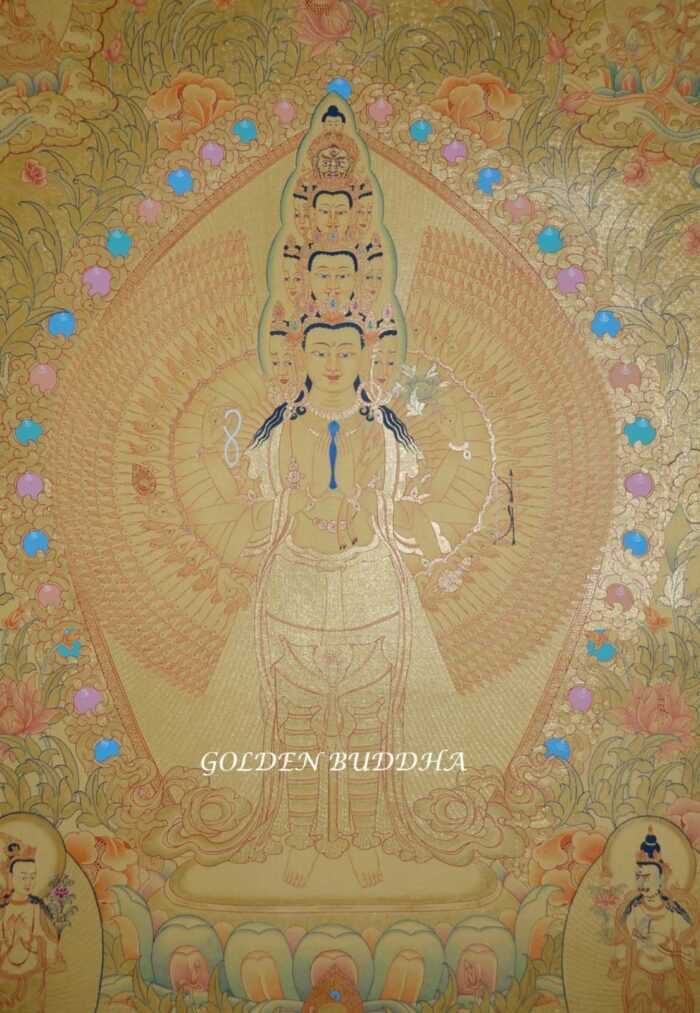
1000 Armed Avalokiteshvara Thangka 33.5″ x 25.5″, Hand Painted, 24K Gold Detail
Original price was: $999.00.$769.00Current price is: $769.00.Add to Cart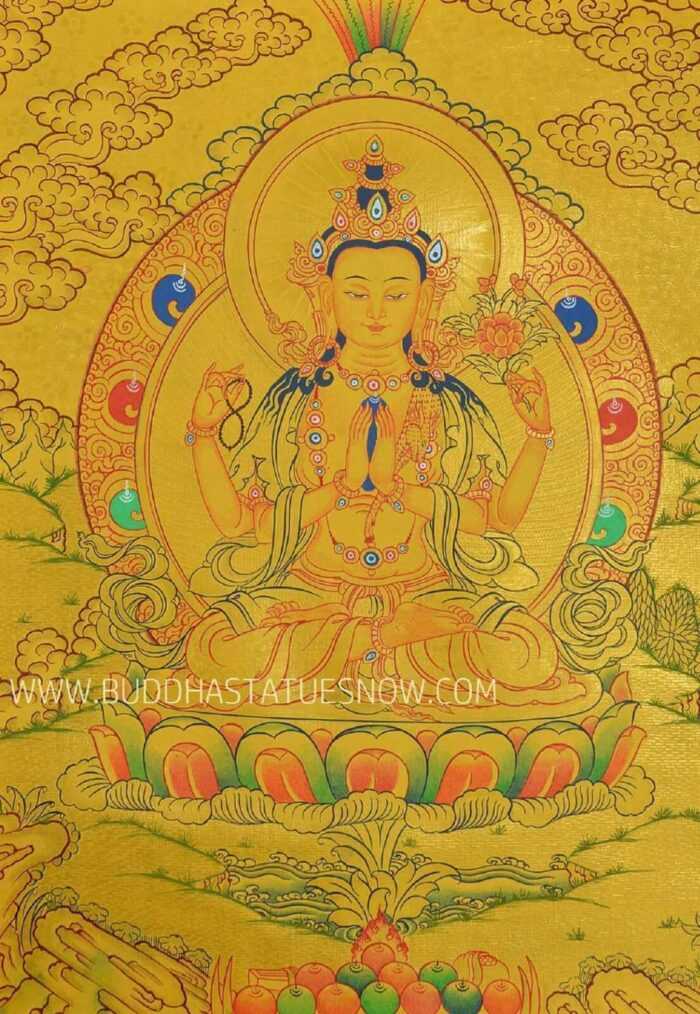
Chenrezig Thangka Painting, 24K Gold Detailing, 15.5″ x 9.75″
Original price was: $269.00.$179.00Current price is: $179.00.Add to Cart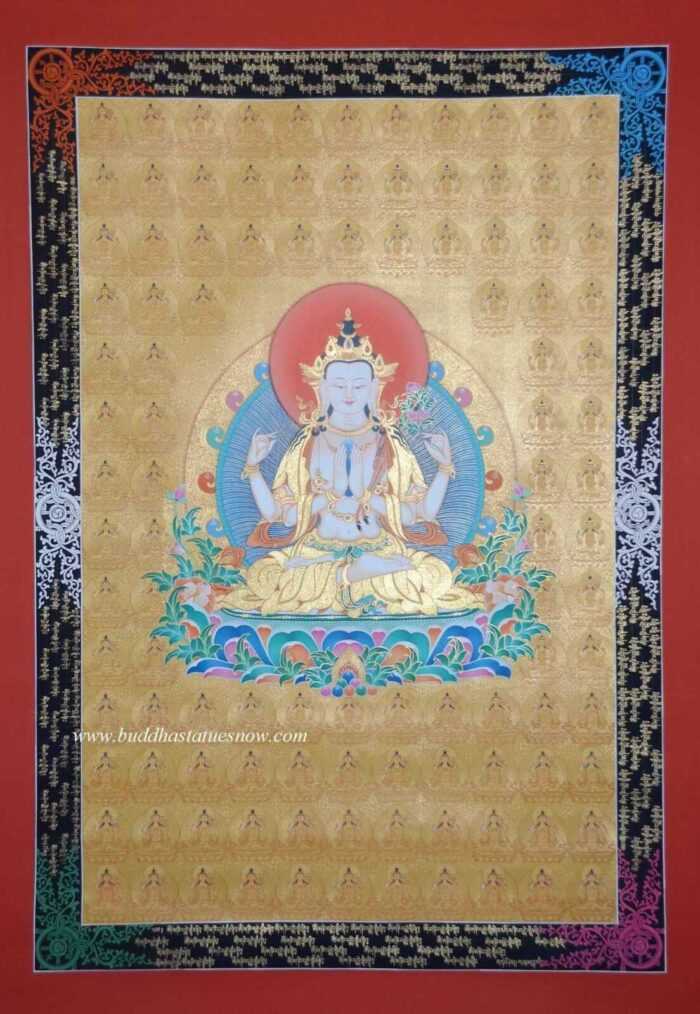
108 Chenrezig Tibetan Thangka Painting 44″ x 31.75″ (24k Gold Detailing)
Original price was: $1,689.00.$1,199.00Current price is: $1,199.00.Add to Cart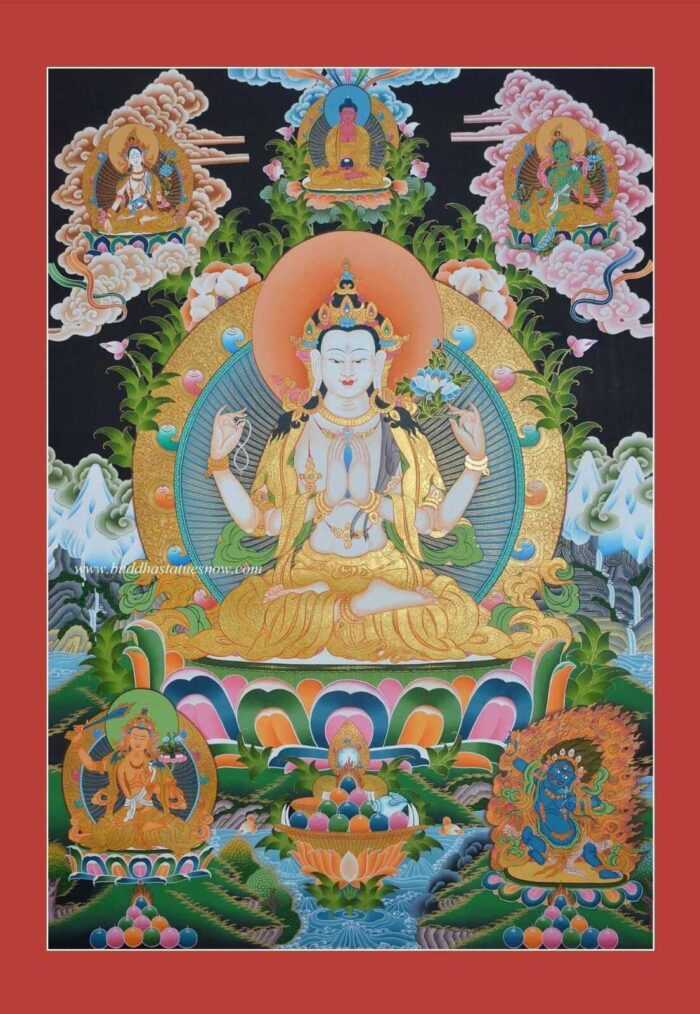
Tibetan Avalokiteshvara Thangka, 24K Gold Detailing, 33.5″ x 24.25″
Original price was: $1,299.00.$879.00Current price is: $879.00.Add to Cart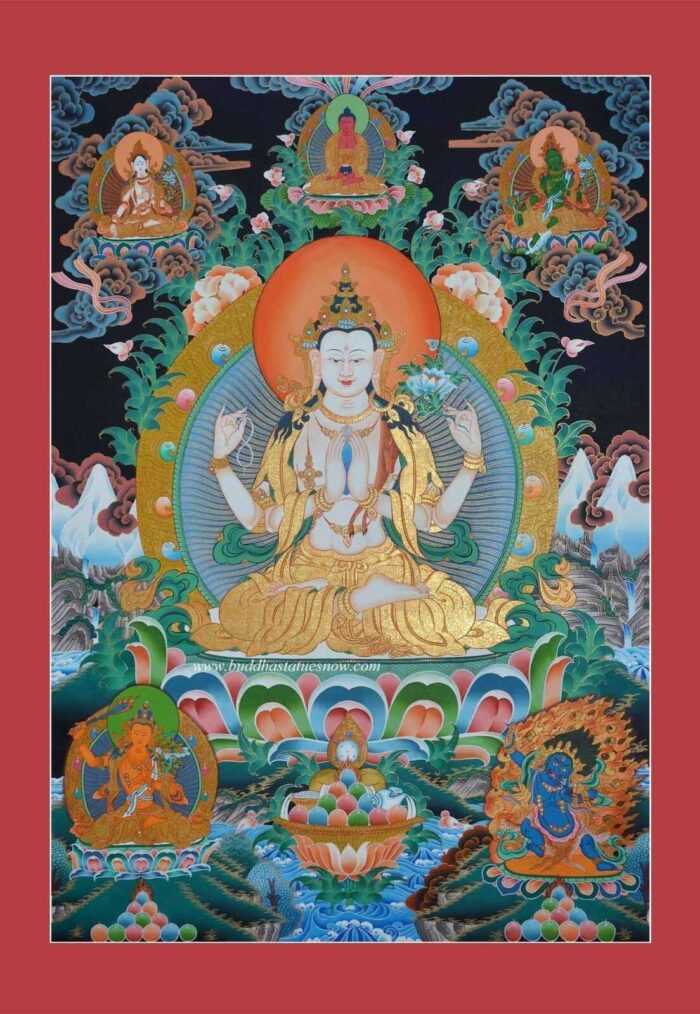
Padmapani Tibetan Thangka, 24k Gold Detailing, 33.25″ x 23.75″
Original price was: $1,299.00.$869.00Current price is: $869.00.Add to Cart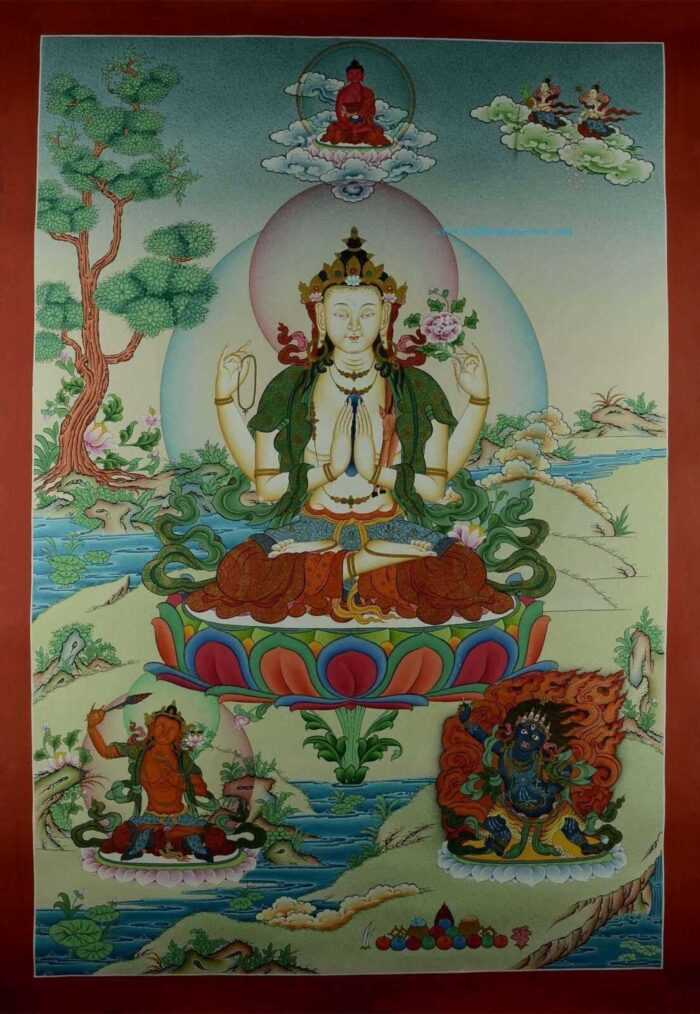
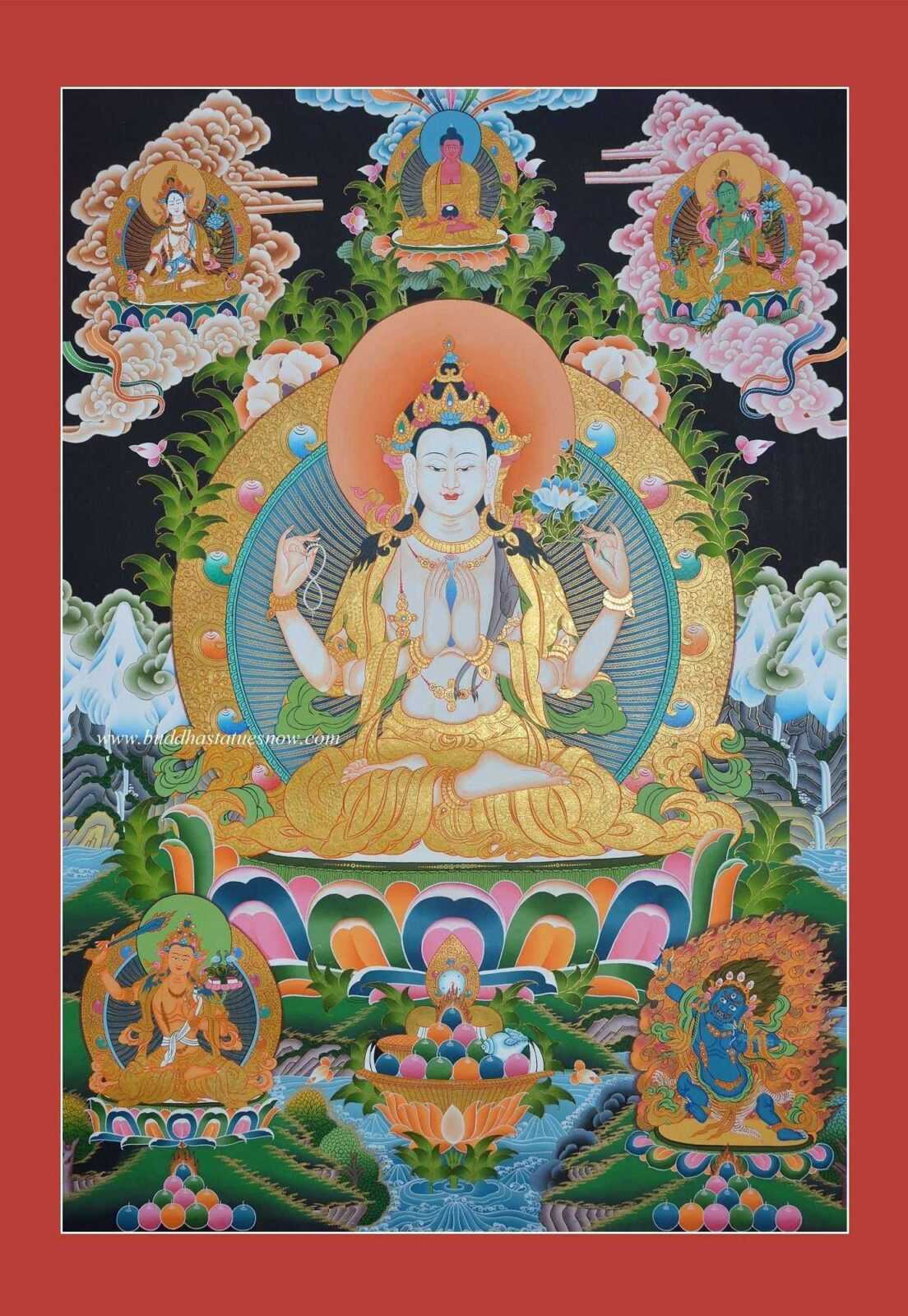
Chenrezig Tibetan Thangka, Hand Painted with 24k Gold Detailing, 33″ x 22.5″
Original price was: $799.00.$599.00Current price is: $599.00.Add to Cart




The Forms of Avalokiteshvara in Thangka Painting
Thangka painters work to strict iconometric grids, and each form of Avalokiteshvara carries its own set of attributes that identify it at a glance. The four-armed Chenrezig is painted white, seated in full lotus on a moon disc above a lotus throne, his first two hands pressed together at the heart around a wish-fulfilling jewel while the upper right holds a crystal mala and the upper left a white lotus. A deerskin is draped over his left shoulder, a reminder of gentleness, and Amitabha Buddha appears in miniature at the crown of his head.
Padmapani, the lotus bearer, is the older and simpler figure - two-armed, holding the stem of an utpala lotus in his right hand, standing or seated in a posture of relaxed grace. The thousand-armed Sahasrabhuja is the most elaborate composition in this category, its heads rising in tiers and its arms spread in a great aureole with an eye in every palm, so that he may see all suffering and reach it. For a broader introduction to these symbols, see our guides to Buddha statue meaning and the Buddhist pantheon.
Om Mani Padme Hum and Chenrezig Practice
No mantra is recited more widely in the Buddhist world than Om Mani Padme Hum, and no deity is more closely bound to a mantra than Chenrezig is to his. Practitioners recite it counted on a mala, carve it into stone at mountain passes, and turn it in prayer wheels by the thousand. Each of the six syllables is traditionally understood to purify one of the six realms of existence and its corresponding affliction, so the mantra is regarded as holding the whole path in condensed form. A Chenrezig thangka gives that recitation a focus - which is why it is among the first images most Tibetan practitioners place on a shrine.
Because Avalokiteshvara is the patron deity of Tibet, his image also carries a cultural weight that goes beyond individual practice, and the Dalai Lamas are traditionally regarded as his emanations. Our guide to the cultural significance of Chenrezig covers that history. Every painting here is hand painted in Nepal by Himalayan artists trained in the traditional schools and finished with genuine 24K gold detailing applied by hand, in sizes from around 15 inches for a personal altar up to 44 inches for a shrine room. You can also see Chenrezig rendered in copper alloy among our Avalokiteshvara statues.
Frequently Asked Questions
What does an Avalokiteshvara thangka represent?
An Avalokiteshvara thangka depicts the Bodhisattva of Compassion, known in Tibetan as Chenrezig. He embodies compassion not as sentiment but as active resolve - the vow to relieve the suffering of every being without exception, and to postpone his own final liberation until that work is finished. The painting serves as a support for practice: a focus for visualization, for recitation of Om Mani Padme Hum, and for cultivating the same intention in oneself.
What is the difference between Padmapani, Chenrezig, and the thousand-armed Avalokiteshvara?
They are three forms of the same Bodhisattva, representing successive stages in how he has been visualized. Padmapani is the oldest: the two-armed Mahayana Avalokiteshvara of pre-Tantric India, holding the stem of an utpala lotus in his right hand. Vajrayana practice later developed him into the four-armed Chenrezig, or Shadakshari, with hands joined at the heart around a wish-fulfilling jewel. The thousand-armed Sahasrabhuja is the most elaborate, with heads rising in tiers above an aureole of arms, each palm bearing an eye. Our guide to Avalokiteshvara and Chenrezig covers each form in detail.
What does the mantra Om Mani Padme Hum mean?
It is the mantra of Avalokiteshvara, the most widely recited mantra in the Buddhist world, and is often rendered as "the jewel in the lotus." Tibetan teachers generally caution against reducing it to a translation: each of the six syllables is traditionally understood to purify one of the six realms of existence and its corresponding affliction, so the mantra is regarded as containing the whole of the path in condensed form. It is recited aloud or silently, counted on a mala, carved into stone, and turned in prayer wheels.
Is Avalokiteshvara the same as Guanyin or Kuan Yin?
Yes. As Buddhism travelled east from India, Avalokiteshvara was gradually depicted in female form, becoming Guanyin in China, Kannon in Japan, and Gwaneum in Korea. It is the same Bodhisattva of Compassion understood through a different cultural lens. Tibetan and Nepali tradition retains the male depiction, so the thangkas in this category show Chenrezig as male - read more about the masculine and feminine forms of Avalokiteshvara.
Why is Amitabha Buddha shown above Avalokiteshvara's head?
Avalokiteshvara belongs to the lotus family of Amitabha Buddha, who is regarded as his spiritual father, and thangka painters mark that relationship by placing a small figure of Amitabha at the crown of his head. In the thousand-armed form, Amitabha sits above the tiered heads. The detail is diagnostic as well as devotional: it is one of the surest ways to identify a painting as Avalokiteshvara rather than another white Bodhisattva.
Which form should I choose for my shrine?
For daily practice and mantra recitation, the four-armed Chenrezig is the most widely used form and the most straightforward image to sit with. Padmapani suits those drawn to the earlier, simpler Mahayana iconography, and works well in smaller sizes. The thousand-armed Avalokiteshvara is the most visually commanding and is usually chosen as the principal image of a shrine room or Dharma center rather than for a personal altar, both because of its scale and because of the density of detail it invites you to explore.