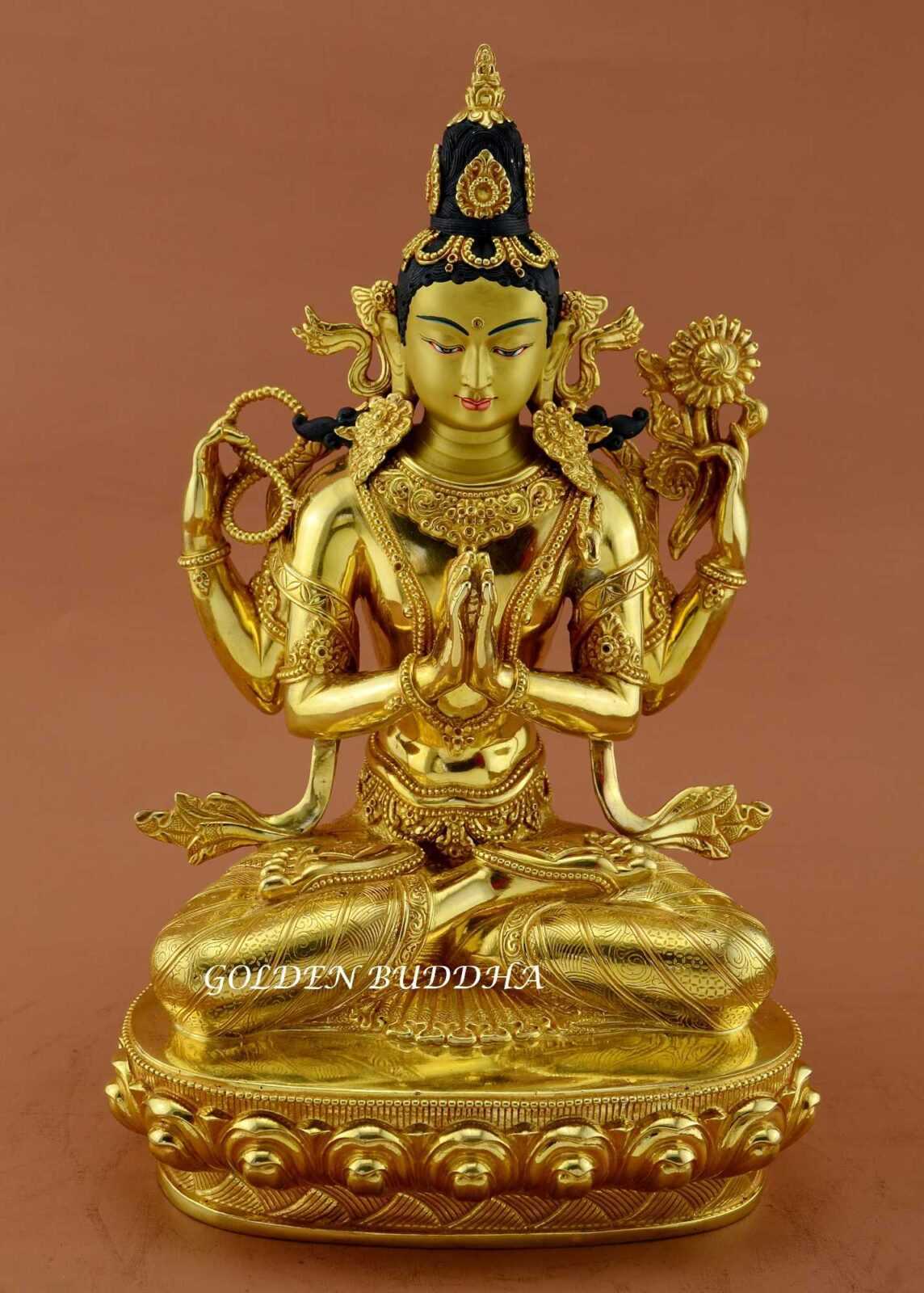
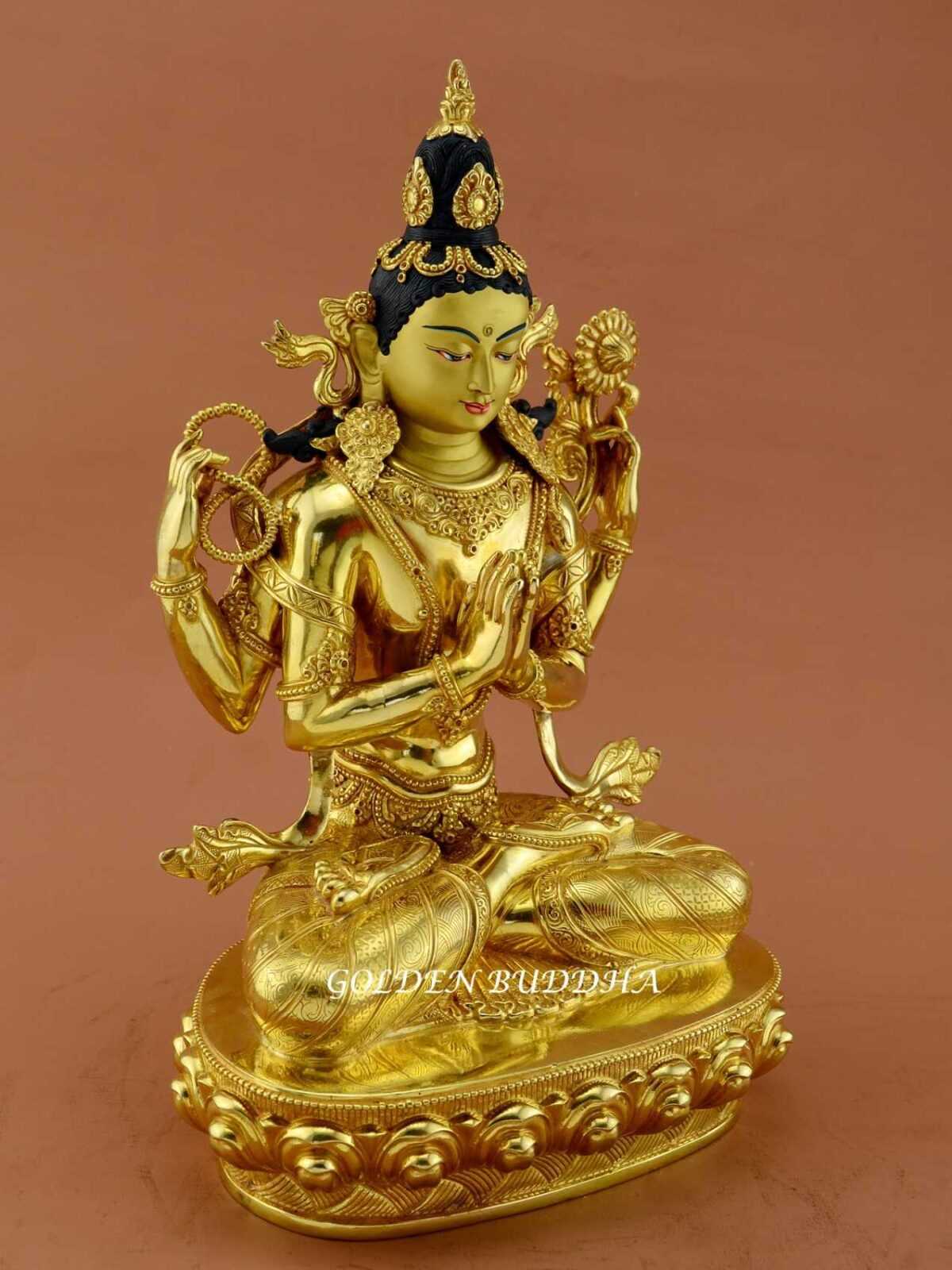

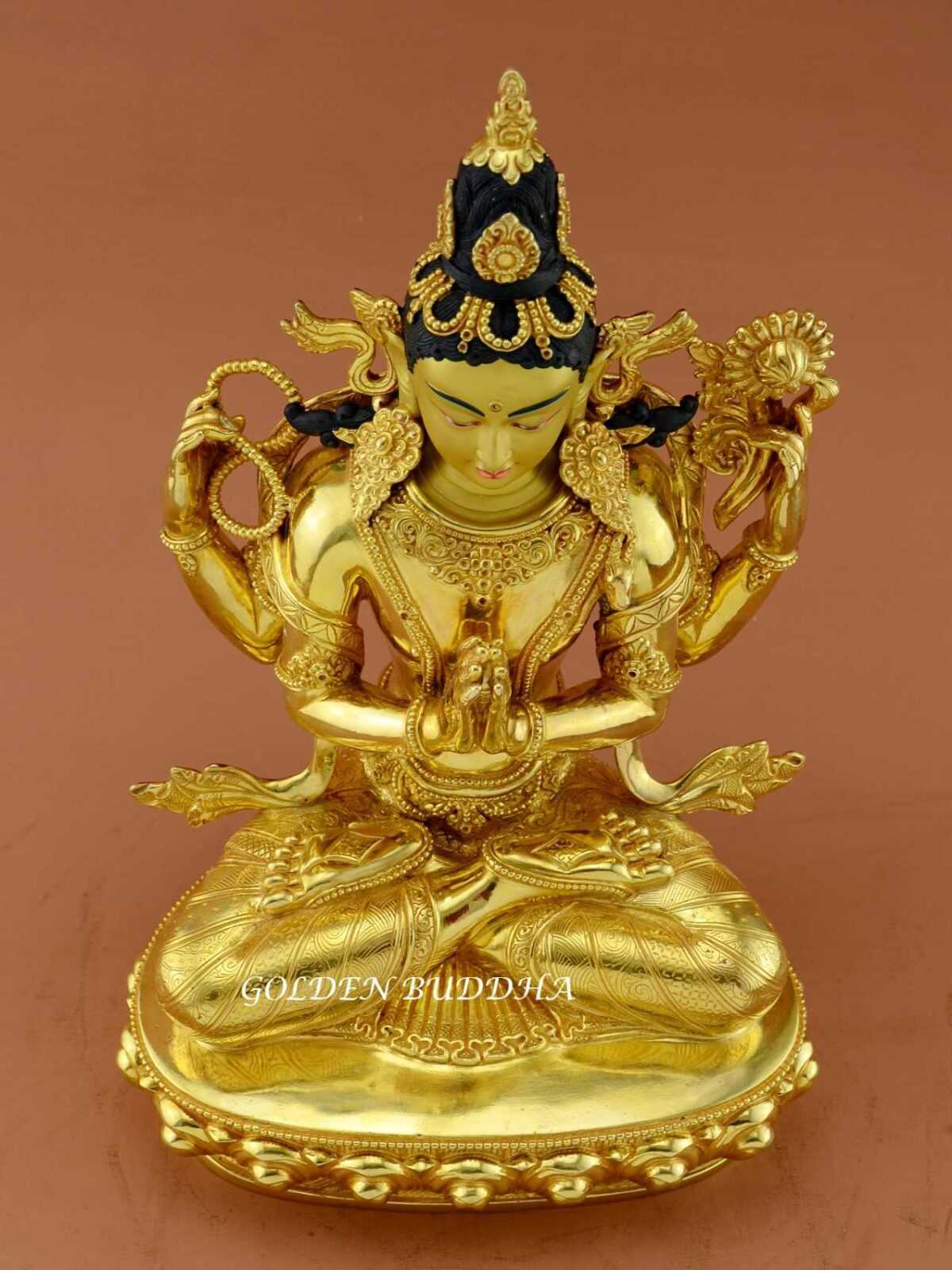
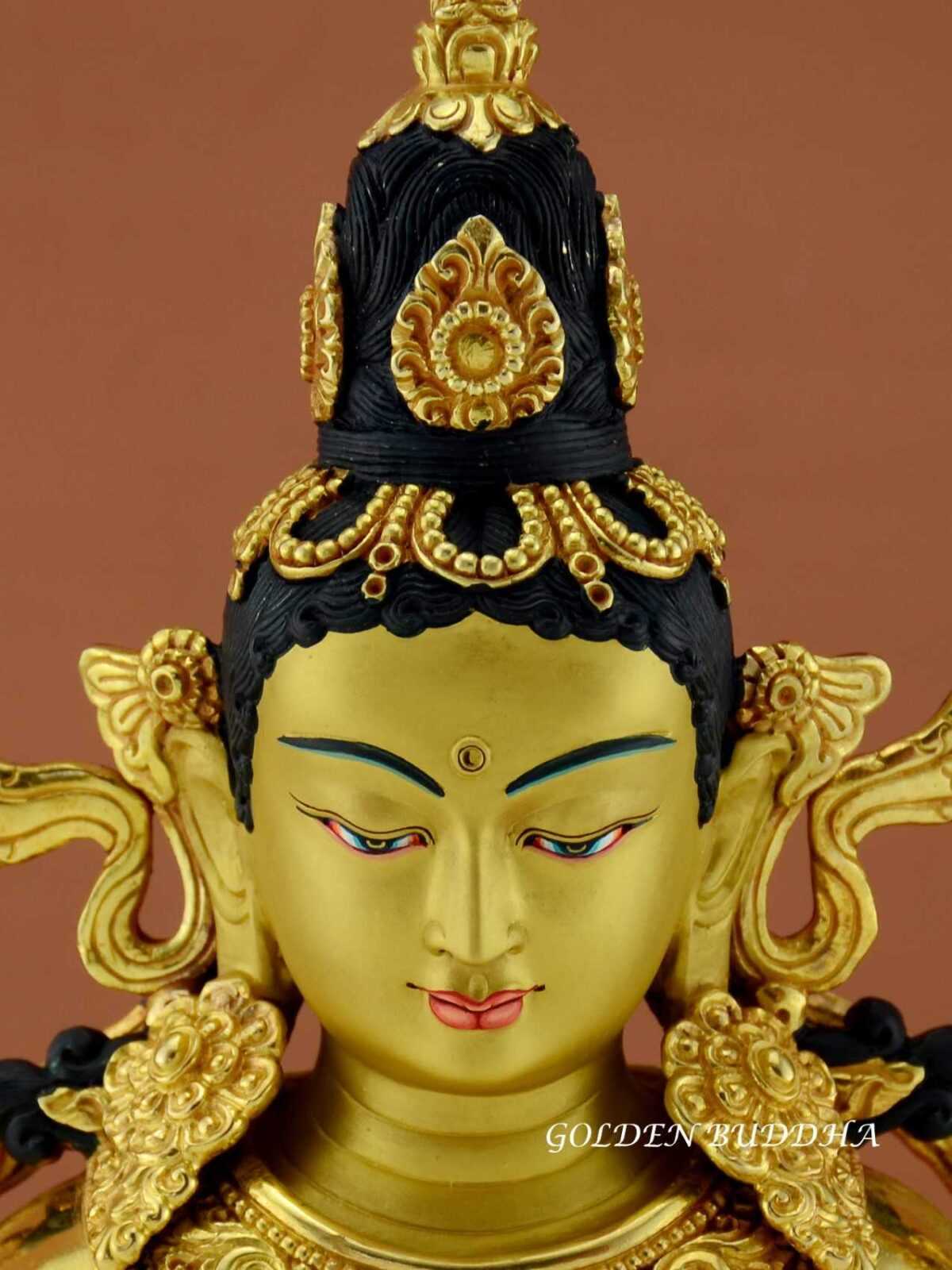
This exceptional Handmade Chenrezig Sculpture portrays four-armed Chenrezig, the Tibetan manifestation of Avalokiteshvara and the Bodhisattva of Compassion. Handmade in Patan, Nepal, the 14-inch statue was cast from copper alloy through the traditional lost-wax method and fire gilded in 24K gold. Its luminous finish is complemented by a face hand painted with 18K gold and natural pigments, finely engraved garments, elaborate celestial jewelry and carefully modeled sacred attributes.
Chenrezig sits in the full lotus posture with his two principal hands joined before his heart around the cintamani, or wish-fulfilling jewel. His upper right hand holds a mala used for continuous mantra recitation, while his upper left hand supports a fully opened lotus flower. Together, the four hands express the union of prayer, compassionate activity, purity and the tireless aspiration to liberate sentient beings from suffering.
The statue is distinguished by its elaborate black-painted hair arrangement rather than a Bodhisattva crown. Chenrezig’s hair rises into a tall topknot decorated with gilded rosettes, ornamental bands, jeweled fittings and a sculpted finial. Dark locks descend across the shoulders, while gilded temple ornaments, necklaces, armlets, bracelets and waist jewelry create a rich contrast against the smooth 24K fire-gilded torso.
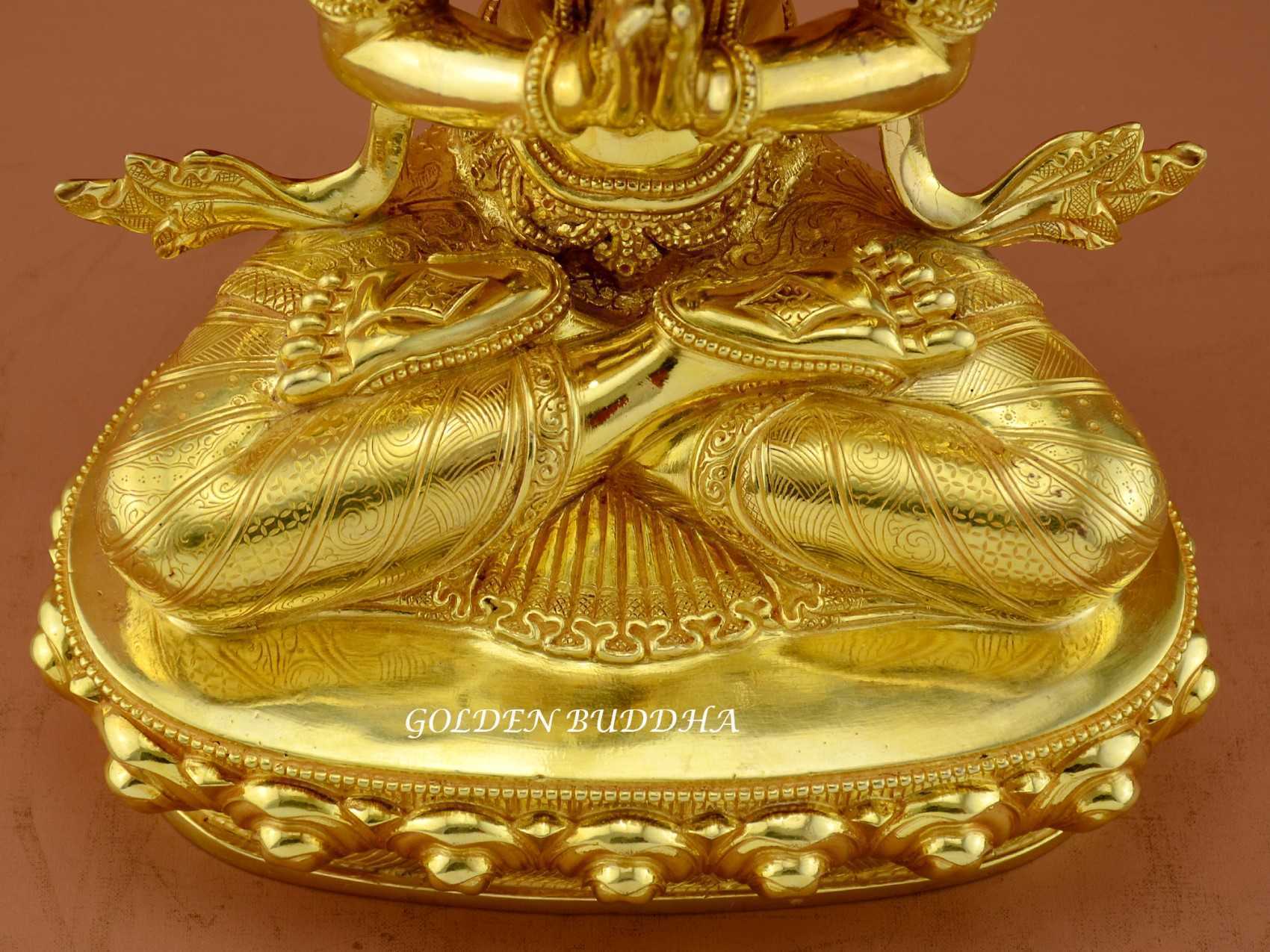
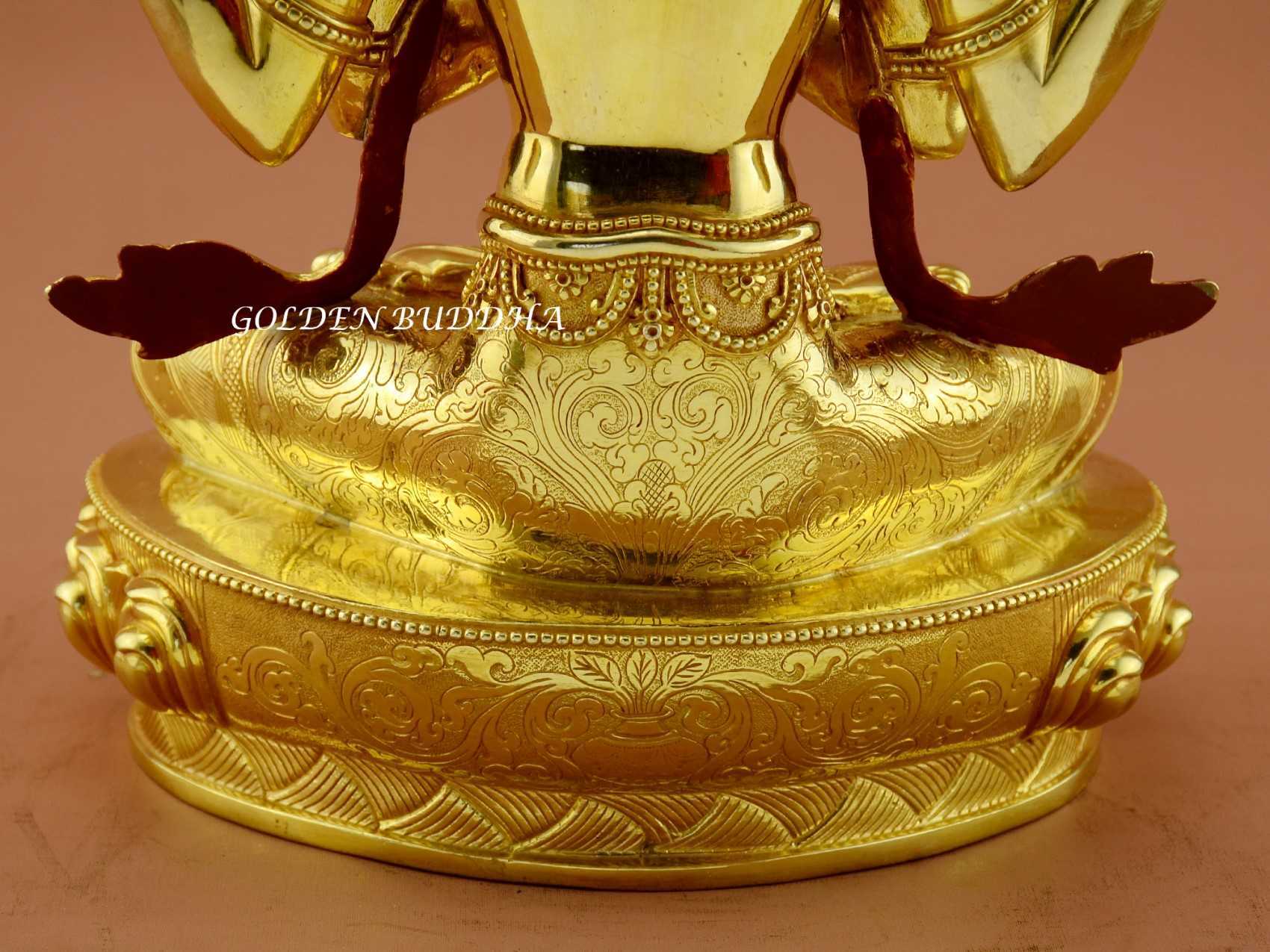
Extensive hand-carved foliate and textile patterns cover the dhoti across both folded legs and continue around the reverse. The pedestal is equally refined, with sculpted lotus forms, beaded borders, engraved floral designs and a woven geometric pattern along the lower course. Measuring approximately 14 inches high, 9 inches wide and 6 inches deep, this Handmade Chenrezig Sculpture has the scale and presence required for a principal home shrine, meditation room, Dharma center or collection of Himalayan Buddhist art.
Handmade Chenrezig Sculpture of the Bodhisattva of Compassion
Chenrezig is the Tibetan name for Avalokiteshvara, the great Bodhisattva who embodies the compassion of all the Buddhas. His name is often interpreted as “the one who looks upon beings with compassionate eyes.” He perceives the suffering of sentient beings without becoming overwhelmed by it and responds through methods appropriate to their individual circumstances.
In Tibetan Buddhism, Chenrezig is among the most widely practiced and beloved Bodhisattvas. His peaceful form teaches that compassion is not merely an emotion or sympathetic response. Enlightened compassion is joined with wisdom, sustained by discipline and expressed through effective action.
According to Buddhist tradition, Avalokiteshvara vowed not to rest until every sentient being had been freed from samsara. His continuing commitment to that vow is represented by his multiple arms, sacred implements and uninterrupted mantra practice. This Handmade Chenrezig Sculpture gives visual form to that limitless aspiration.
Chenrezig is also closely connected with Amitabha Buddha, the Buddha of Infinite Light and head of the lotus family. Amitabha represents the enlightened source from which Avalokiteshvara’s compassionate activity arises.
Four Arms of the Handmade Chenrezig Sculpture
The four arms of Chenrezig symbolize four immeasurable qualities cultivated for the welfare of all beings: loving-kindness, compassion, sympathetic joy and equanimity. These qualities are not separate from one another. Together they form a complete and balanced approach to compassionate Buddhist practice.
The two principal hands meet before Chenrezig’s heart in a devotional gesture. Their central position shows that his actions arise from a compassionate intention directed toward every sentient being. The hands enclose the cintamani jewel, traditionally associated with the fulfillment of the deepest spiritual aspiration: freedom from ignorance and suffering.
His upper right hand holds a circular mala. Its continuous strand represents ceaseless mantra recitation and uninterrupted compassionate activity. The beads also remind practitioners that transformation develops through repeated practice rather than a single moment of inspiration.
The upper left hand supports a fully opened lotus flower. The blossom represents purity, wisdom and awakening within the difficult conditions of samsara. Although the lotus grows from muddy water, its petals emerge unstained, illustrating Chenrezig’s ability to enter the suffering of the world without becoming bound by confusion or attachment.
Cintamani Jewel and the Joined Hands
Chenrezig’s principal hands are pressed together near the center of his chest, forming one of the most recognizable features of four-armed Avalokiteshvara iconography. The hands are traditionally understood to hold the cintamani, the wish-fulfilling jewel of awakened compassion.
The jewel does not symbolize the fulfillment of ordinary desire. It represents the enlightened qualities capable of satisfying the deepest wish of sentient beings: liberation from suffering and the realization of wisdom. Its position at the heart indicates that compassionate action begins with pure motivation.
The symmetrical arrangement of the principal arms gives the central body a stable devotional axis. This balance is complemented by the outer arms, which rise toward the mala and lotus flower and expand the visual composition beyond the peaceful torso.
Mala Beads and the Chenrezig Mantra
The mala held in Chenrezig’s upper right hand is traditionally composed of 108 beads. The number 108 appears frequently in Buddhist practice and is associated with the purification of mental afflictions and the completion of cycles of mantra recitation.
Chenrezig’s mantra, Om Mani Padme Hum, is among the most widely recited mantras in Tibetan Buddhism. Each repetition is used to cultivate compassion, purify obscurations and align the practitioner’s mind with Chenrezig’s enlightened intention.
The circular form of the mala has no obvious beginning or end, reflecting the continuity of compassionate activity. Chenrezig does not assist beings only under ideal conditions; his vow extends throughout every realm and every stage of existence. Explore the meaning of Om Mani Padme Hum syllable by syllable in our guide to Avalokiteshvara practice.
Open Lotus and the Purity of Compassion
A large open lotus rises above Chenrezig’s left shoulder. Its radiating petals and curving stem add height and movement to the upper portion of the sculpture while balancing the circular mala held on the opposite side.
The open blossom represents wisdom brought to maturity. It also expresses the possibility of awakening within samsara, showing that enlightened qualities can emerge without being contaminated by the suffering and confusion surrounding them.
The lotus belongs to the same enlightened family as Amitabha Buddha and reinforces Chenrezig’s relationship with the Buddha of Infinite Light. Its placement close to the upper hand suggests compassion guided by wisdom rather than sentiment alone.
Ornamental Topknot and Gilded Hair Decorations
The elaborate hair treatment is one of the defining visual features of this Handmade Chenrezig Sculpture. Chenrezig’s black-painted hair rises into a tall topknot ornamented with gilded rosettes, beaded bands and a decorative finial. A large central floral ornament appears on the front of the upper hair arrangement, with complementary gilded details visible from the sides and reverse.
A jeweled fringe follows the lower edge of the hair above the forehead, while dark locks extend across both shoulders. The contrast between the black hair and bright gold ornaments gives the head a strong vertical presence and directs attention toward the peaceful hand-painted face.
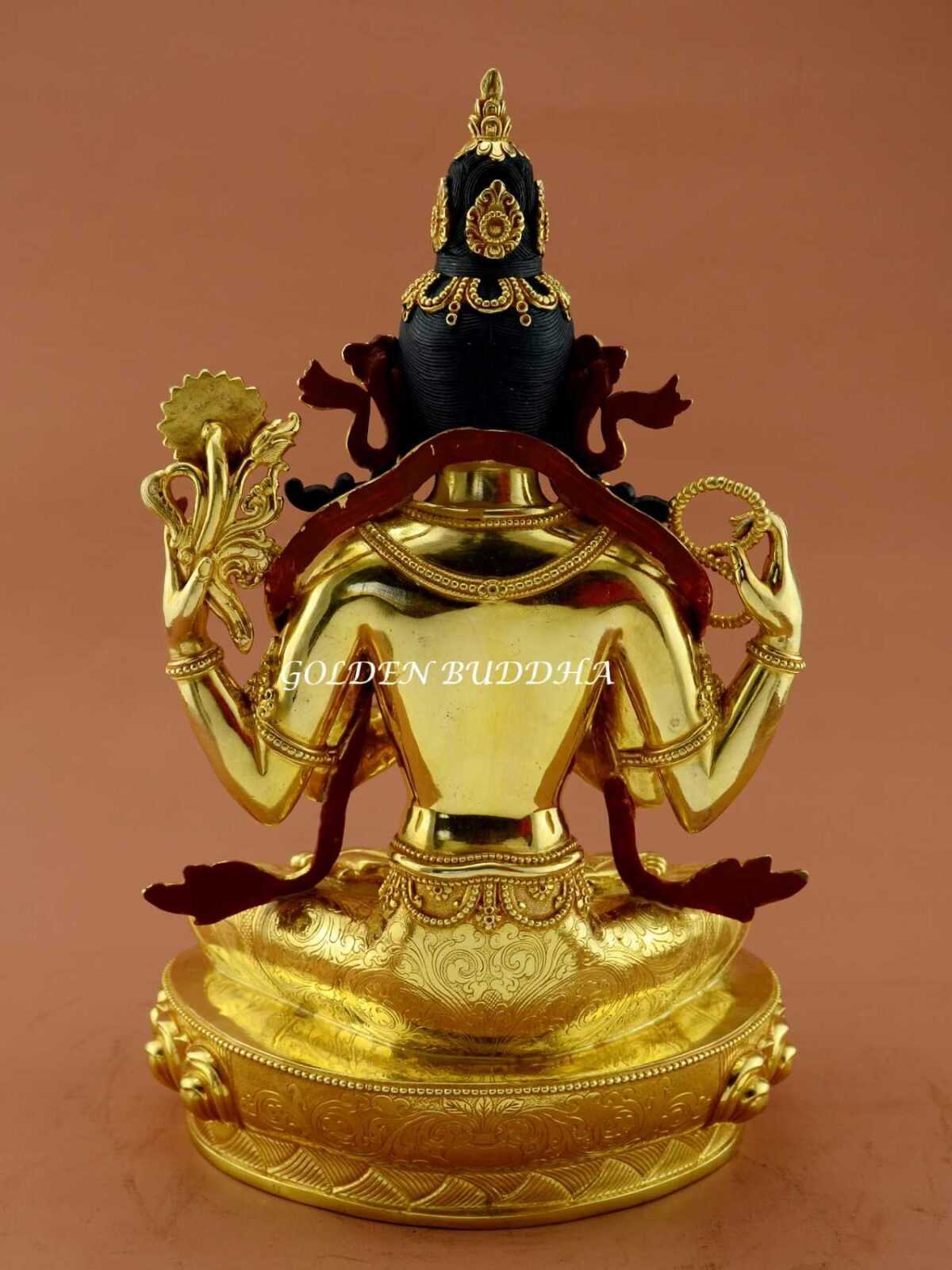
The rear view reveals further ornamentation across the topknot, including a prominent central rosette and looping gilded bands. This complete treatment demonstrates that the artisan developed the hair arrangement as a fully three-dimensional feature rather than a frontal decoration.
Celestial Jewelry and Flowing Ribbons
Chenrezig wears lavish celestial jewelry symbolizing the perfected qualities of an enlightened Bodhisattva. A broad ornamental necklace covers the upper chest, accompanied by longer beaded strands and pendant forms extending toward the waist.
Additional ornaments decorate the upper arms, wrists and waist. The armlets combine engraved floral designs with raised beaded borders, while the bracelets and jeweled bands introduce smaller points of detail along the four arms.
Long celestial ribbons descend from the shoulders and curve outward beside the seated body. Their sweeping ends rest near the knees and give the otherwise symmetrical full-lotus posture a sense of movement. The reverse shows reddish backing across portions of the ribbons, creating a restrained contrast with the gilded body and black hair.
At the buyer’s request, the hair ornaments and jewelry may be embellished with genuine turquoise and red coral before shipping. Turquoise provides a blue-green contrast against the gold finish, while red coral complements Chenrezig’s relationship with Amitabha and the lotus family.
Hand-Painted Face of the Handmade Chenrezig Sculpture
Chenrezig’s face is separately hand painted with 18K gold and natural pigments. Fine lines define the eyebrows, lowered eyes and lips, creating a peaceful expression that is attentive without appearing severe.
The gently lowered gaze communicates compassionate awareness directed toward practitioners. His expression remains calm because enlightened compassion perceives suffering clearly without becoming confused or overwhelmed by it.
The face painting is distinct from the 24K fire gilding applied to the copper-alloy body. Traditional pigment work gives the facial features additional clarity, while the surrounding black hair and gilded ornaments form an elegant frame around the serene countenance.
Full Lotus Posture and Vajra Stability
Chenrezig sits in the full lotus posture with both legs folded evenly before him. This symmetrical meditative position is also known as the vajra posture because it represents unshakable stability and the indestructible nature of awakened realization.
The broad folded legs create a strong triangular foundation beneath the upright torso and four arms. Vajra symbols are represented upon the upturned soles, reinforcing the relationship between the seated posture and unwavering spiritual resolve.
Although the central body remains still, the raised arms, circular mala, open lotus and flowing ribbons introduce movement around it. The overall composition therefore joins meditative stability with continuous compassionate activity.
Hand-Engraved Dhoti and Textile Patterns
The richly engraved dhoti is among the finest craftsmanship features of this statue. Dense floral scrollwork, feather-like patterns and repeating textile designs cover both folded legs. The decoration follows the contours of the fabric, strengthening the three-dimensional form rather than appearing as a flat surface pattern.
Different engraving styles are used across separate sections of the garment. Fine linear patterns appear beside broader foliate motifs, while dotted textures and narrow borders distinguish individual panels and hemlines.
The engraving continues around the reverse of the legs, where scrolling floral patterns remain clearly visible beneath the jeweled waist ornaments. This complete treatment allows the statue to be viewed from the sides and back without revealing an unfinished garment surface.
The heavily patterned dhoti contrasts with the smooth back and upper torso. This balance prevents the sculpture from becoming visually overcrowded and allows the bright 24K fire-gilded finish to remain visible across broad areas of the body.
Lotus Pedestal and Engraved Rear Base
Chenrezig is seated upon a broad lotus pedestal with a smooth upper platform, a projecting row of rounded lotus forms and a lower woven-leaf border. Beaded edging separates the principal sections and gives the base a measured architectural rhythm.
The front petals are deeply modeled, creating bright highlights across their rounded centers and deeper shadows in the recessed divisions. Their substantial form provides the visual weight required to support the four-armed deity and elaborate upper ornamentation.
The rear pedestal carries extensive hand engraving rather than being left plain. Floral scrollwork fills the broad rounded band, while the lower section displays a repeating woven or overlapping leaf pattern. The decoration continues around both sides, giving the base a fully finished appearance from every viewing angle.
24K Fire-Gilded Copper-Alloy Finish
The copper-alloy body, sacred attributes, jewelry and pedestal are fire gilded in 24K gold using traditional Himalayan techniques. The gold surface creates a rich devotional presence while allowing the engraving, beaded borders and sculptural contours to remain clearly visible.
Raised areas across the jewelry, hands and lotus forms reflect light strongly, while the recessed engravings appear deeper in tone. This contrast gives definition to the complex decorative work without requiring additional painted color across the body.
The broad smooth areas across Chenrezig’s back, shoulders and torso reveal the quality of the hand-finished gilding. Subtle tonal variations are characteristic of traditional fire gilding and distinguish handmade Himalayan metalwork from mechanically plated reproductions.
Finished from the Front and Reverse
The reverse photograph demonstrates the complete three-dimensional craftsmanship of the statue. Chenrezig’s shoulders, back and waist are smoothly modeled, while fine necklaces and garment borders continue behind the neck and across the upper body.
The upper hands, mala, lotus stem and flower remain fully developed from behind. The hair arrangement is particularly detailed, with black-painted strands, gilded rosettes, ornamental bands and the tall upper finial all visible from the reverse.
The hand-carved engraving continues across the rear dhoti and pedestal, while the ribbons reveal their contrasting reddish backing. This complete finish makes the statue appropriate for freestanding shrine placement and reflects the high standard of traditional Newar metalwork.
Traditional Lost-Wax Casting in Patan, Nepal
This Handmade Chenrezig Sculpture was created in Patan, Nepal, using the traditional lost-wax casting process. The artisan first prepares a detailed wax model according to established Buddhist iconometric proportions, forming the four arms, hands, sacred attributes, meditative posture, hair ornaments, jewelry and pedestal.
The wax model is enclosed within a heat-resistant mould and fired so that the wax melts away, leaving a cavity in its shape. Molten copper alloy is poured into the mould and allowed to cool. Once the mould is removed, the raw casting is chased, filed and refined by hand.
The artisan sharpens the fingers, facial features, mala beads, lotus petals, jewelry and hair decorations before engraving the elaborate patterns across the dhoti and pedestal. The completed copper-alloy sculpture is then prepared for 24K fire gilding.
Black pigment is applied to the hair, restrained red pigment is used behind selected ribbons, and the face is separately hand painted with 18K gold and natural pigments. Since the original wax model is destroyed during casting and the engraving and finishing are completed individually, each statue retains subtle handmade variations.
Matching Handmade Chenrezig and Manjushri Sculpture Set
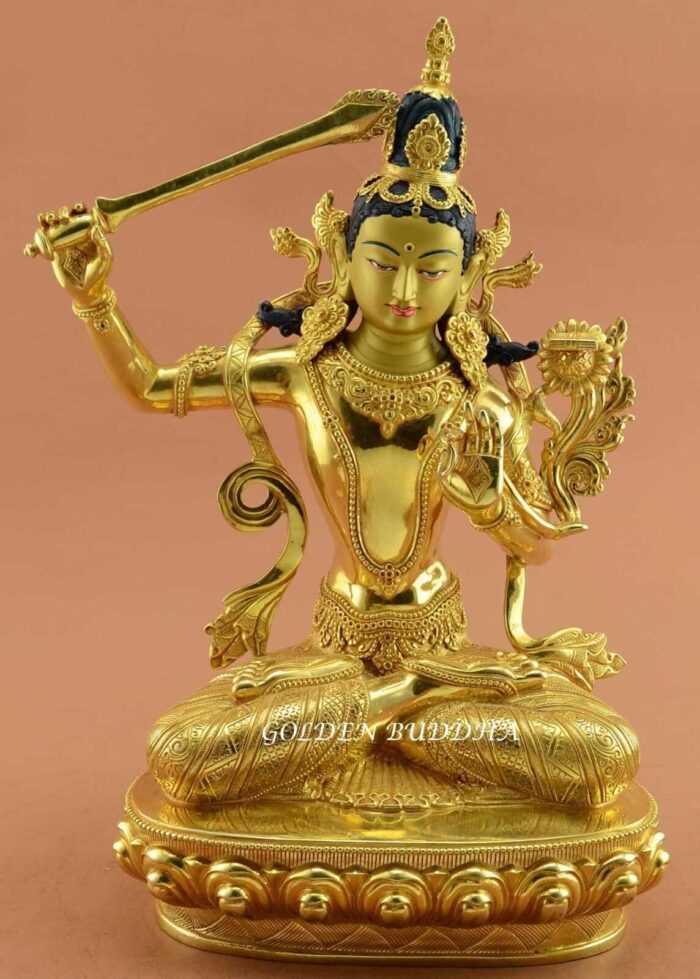
This Handmade Chenrezig Sculpture would form a harmonious two-piece shrine set with the matching Nepali Manjushri sculpture. Both 14-inch statues were created by the same master artisan and share copper-alloy construction, 24K fire-gilded finishes, finely hand-painted faces and closely coordinated proportions.
Their related workmanship creates strong visual continuity. Both figures feature tall black-painted hair arrangements with gilded ornaments, lavish celestial jewelry, flowing ribbons, richly hand-engraved dhotis and carefully finished lotus pedestals. Smooth upper torsos contrast with the dense textile patterns covering the folded legs, giving the pair a consistent artistic character.
The statues also form a foundational doctrinal pairing. Chenrezig embodies universal compassion—the aspiration to perceive suffering and act for the liberation of every sentient being. Manjushri embodies transcendent wisdom, cutting through ignorance and revealing the true nature of reality.
Compassion without wisdom may be sincere but poorly directed, while wisdom without compassion can remain detached from the needs of living beings. Together, Chenrezig and Manjushri represent the inseparable union of method and insight that lies at the heart of the Mahayana path.
Placed together upon an altar, Chenrezig reminds practitioners why awakening is pursued—for the welfare of all beings—while Manjushri clarifies how liberation is attained through wisdom that recognizes emptiness. Their equal height and closely matched craftsmanship make the statues both visually balanced and doctrinally complete.
Custom-Made Handmade Chenrezig Sculptures
A custom-made Chenrezig statue may be commissioned in a preferred size, finish and degree of ornamentation. Available options include smaller personal shrine images, larger temple-scale statues, antiquated oxidized copper finishes, silver-highlighted surfaces and statues fire gilded in 24K gold.
For a gilded commission, the face may be separately hand painted with 18K gold and natural pigments, while the hair can be completed in traditional black pigment. Hair ornaments, necklaces, armlets, bracelets and waist jewelry may be embellished with genuine turquoise and red coral.
Customers may request smooth robes, elaborate textile engraving similar to this sculpture, alternative lotus-petal designs or more extensive floral decoration around the pedestal. The height and proportions of the base may also be adapted for a private shrine, Buddhist temple, Dharma center or monastery.
Traditional four-armed Chenrezig features—including the joined principal hands, cintamani jewel, mala, lotus flower and full lotus posture—are preserved throughout the design process. Other forms of Avalokiteshvara may also be commissioned, including standing Padmapani and multi-armed manifestations.
A coordinated two-piece set may be custom ordered with Chenrezig and the matching Nepali Manjushri sculpture. Their heights, gilding, hair ornaments, celestial jewelry, engraved garments, ribbons and lotus pedestals can be planned together so that the finished statues form a unified shrine ensemble.
Such a pairing unites Chenrezig’s limitless compassion with Manjushri’s penetrating wisdom. Chenrezig generates the altruistic intention to free all beings from suffering, while Manjushri provides the insight required to understand and eliminate its deepest causes. Together, the deities create a balanced visual and doctrinal expression of the Mahayana path.
Authentic, Handmade in Nepal
Every statue is handcrafted in Patan, Nepal, using traditional lost wax casting and comes with a certificate of authenticity issued by Nepal’s Department of Archaeology, verifying its materials, technique, and origin.