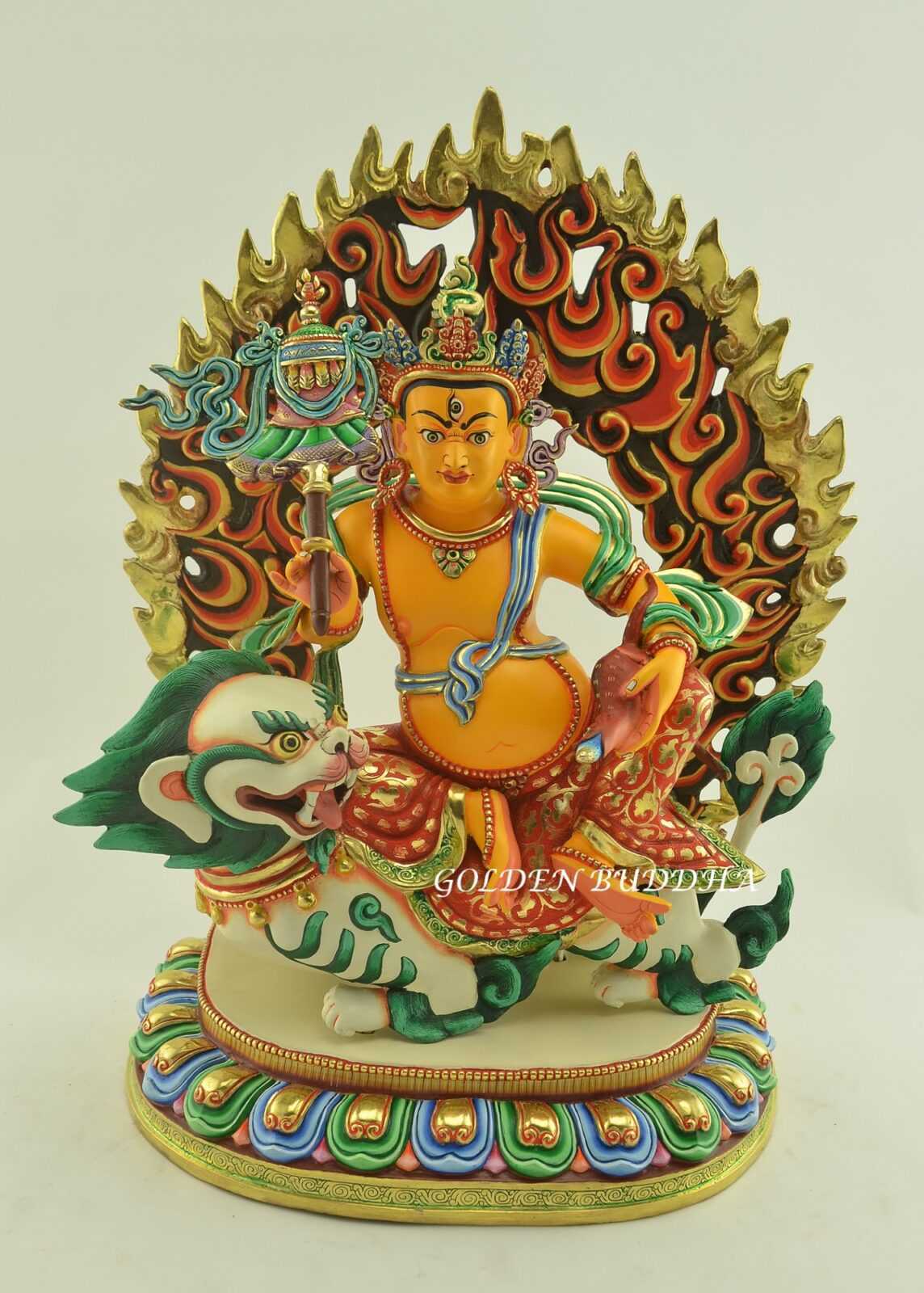
Vaishravana Statues | Namtöse | Buddhist Guardian King
Vaishravana statues portray one of the Four Great Kings of Buddhist tradition and an important protector associated with the northern direction, the safeguarding of the Dharma, and the stewardship of prosperity. Known in Sanskrit as Vaiśravaṇa and in Tibetan as Namtöse (rNam thos sras), he appears in Tibetan Buddhist art as a commanding, richly adorned guardian whose authority combines protective and wealth-related functions. Although his imagery overlaps in important ways with Jambhala and the earlier Indian figure Kubera, Vaishravana has his own distinct identity as a Guardian King and should not simply be classified as Yellow Jambhala.
Traditional Tibetan Vaishravana statues frequently depict him riding a powerful snow lion and carrying a victory banner, an emblem of the triumph of the Dharma over obstructive forces. A jewel-producing mongoose may also appear in his hand, connecting his protective role with abundance and generosity. Elaborate armor, royal ornaments and a commanding posture distinguish his iconography from the more relaxed seated appearance normally associated with Yellow Jambhala. Our collection includes an antiquated copper Vaishravana statue, whose dark oxidized finish emphasizes the martial character of the Guardian King, as well as a highly detailed multicolored Vaishravana statue with vivid robes, snow lion mount and removable flaming aureole.
Vaishravana also lends himself to carefully chosen protector pairings. The multicolored form creates an especially strong aesthetic and doctrinal arrangement with our multicolored Chaturbhuja Mahakala statue. Both figures belong to the broader world of Buddhist protective imagery, while their vivid polychrome finishes, elaborate ornaments and dynamic presence give a shrine display visual balance without suggesting that they form a consort pair or a single practice cycle.
Another meaningful companion is Black Jambhala. Vaishravana and Jambhala are distinct deities and should not be treated as interchangeable, yet both bring together themes of protection, prosperity and the removal of material obstacles. Displaying them together can therefore create a coherent wealth-and-protection grouping while preserving their separate iconographic identities. These handmade Vaishravana statues are cast in copper alloy by Himalayan artisans in Nepal using the traditional lost-wax casting method.
Showing all 2 resultsSorted by popularity