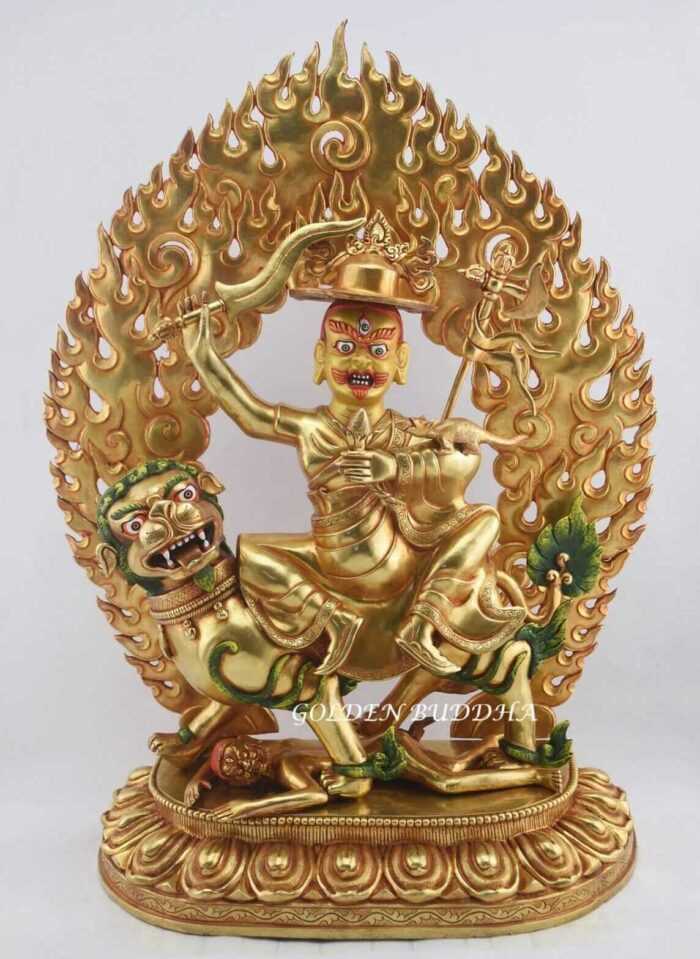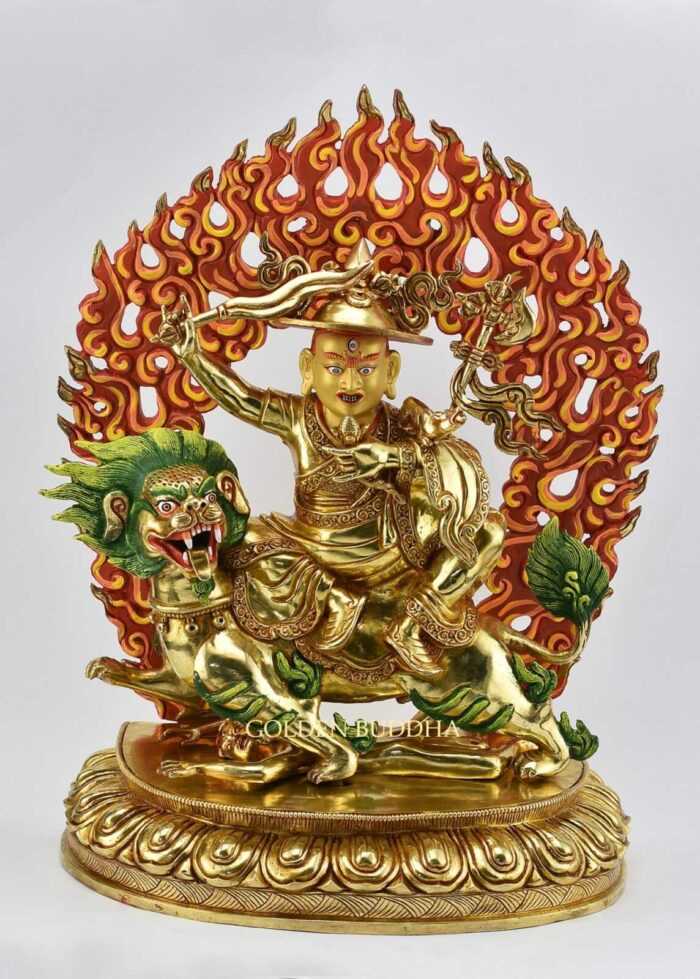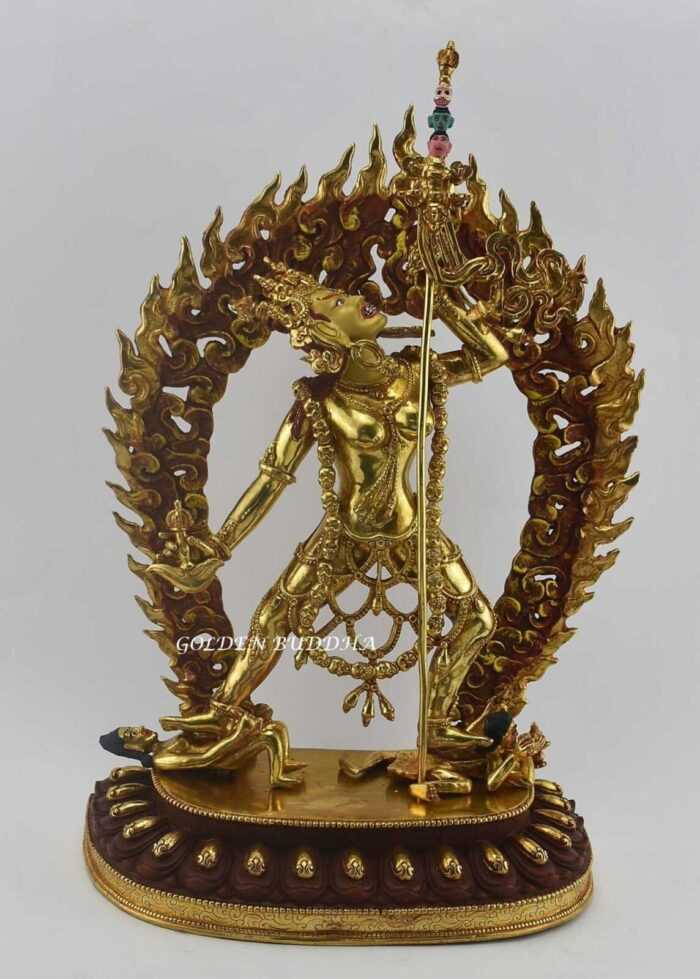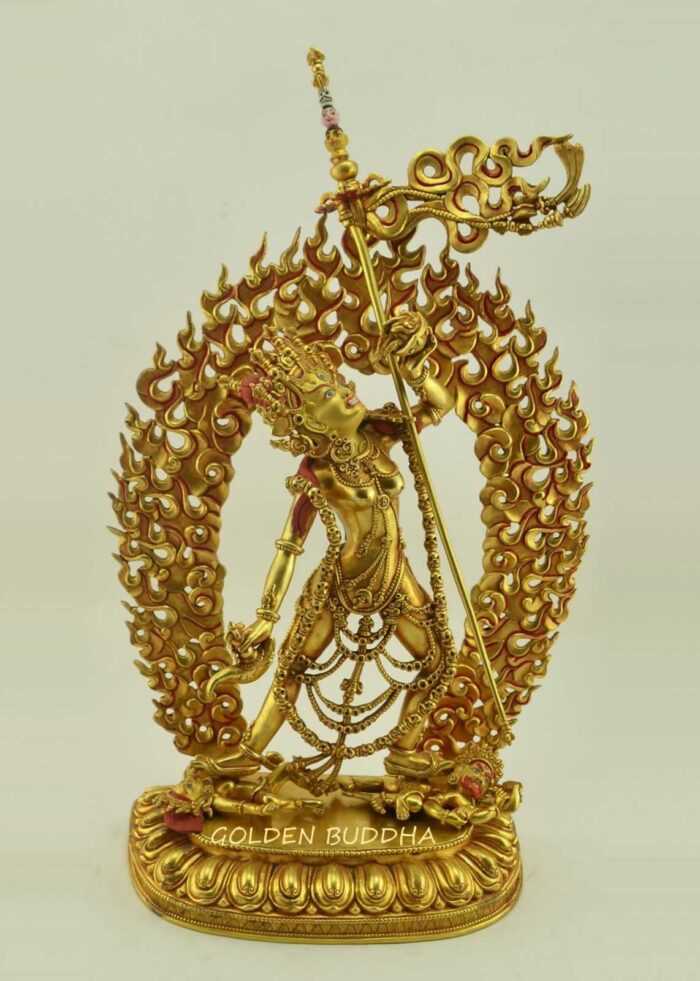
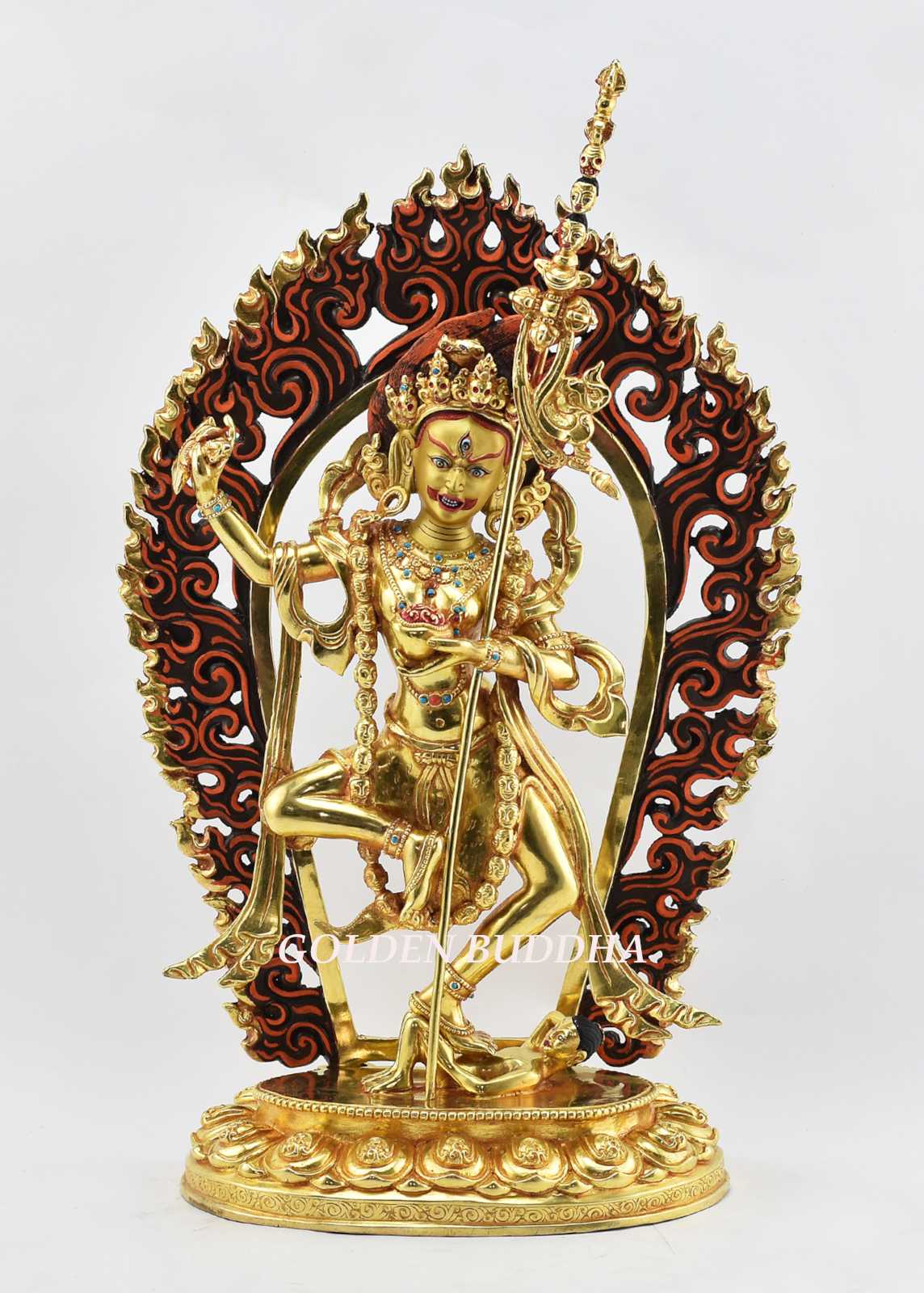
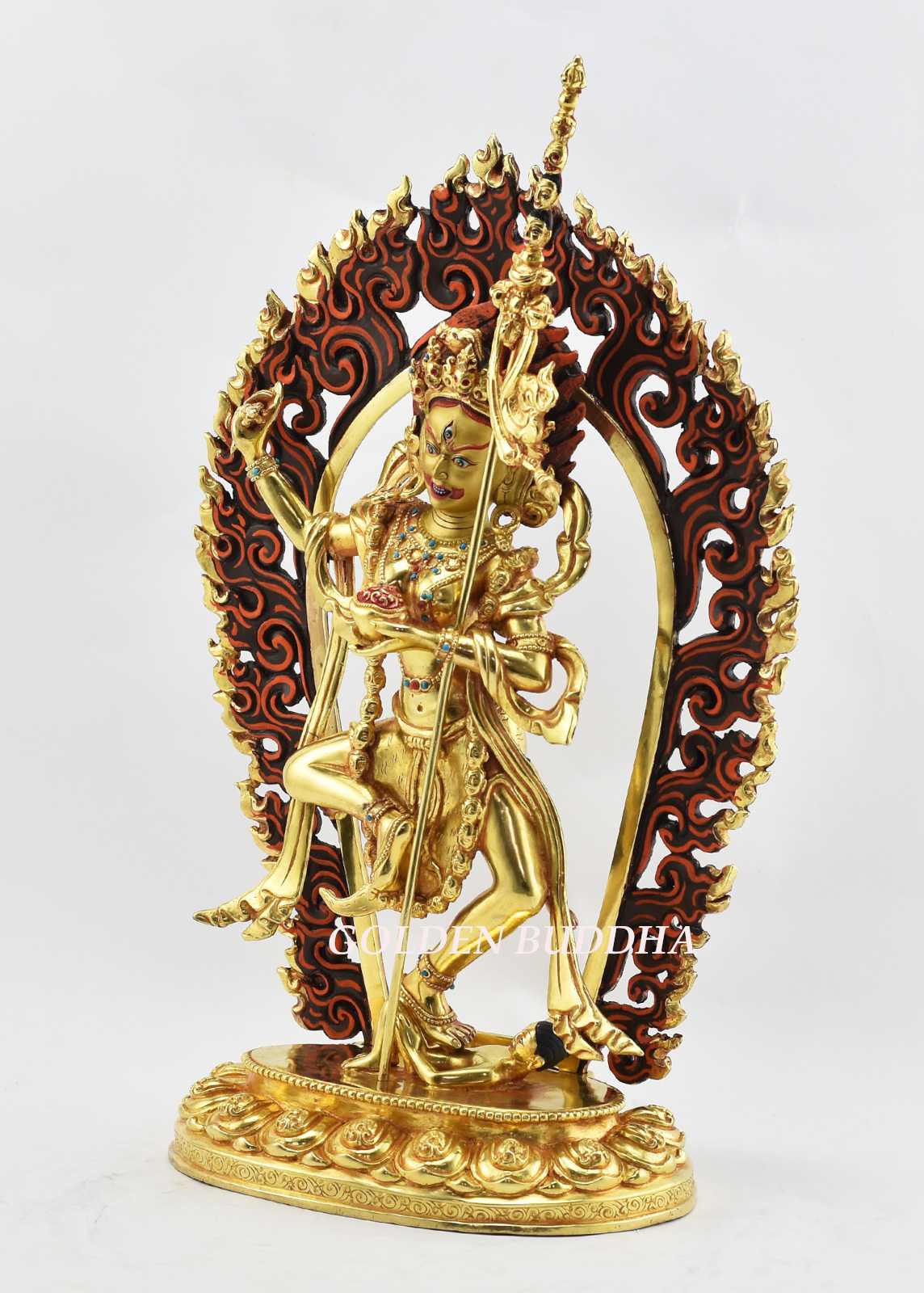
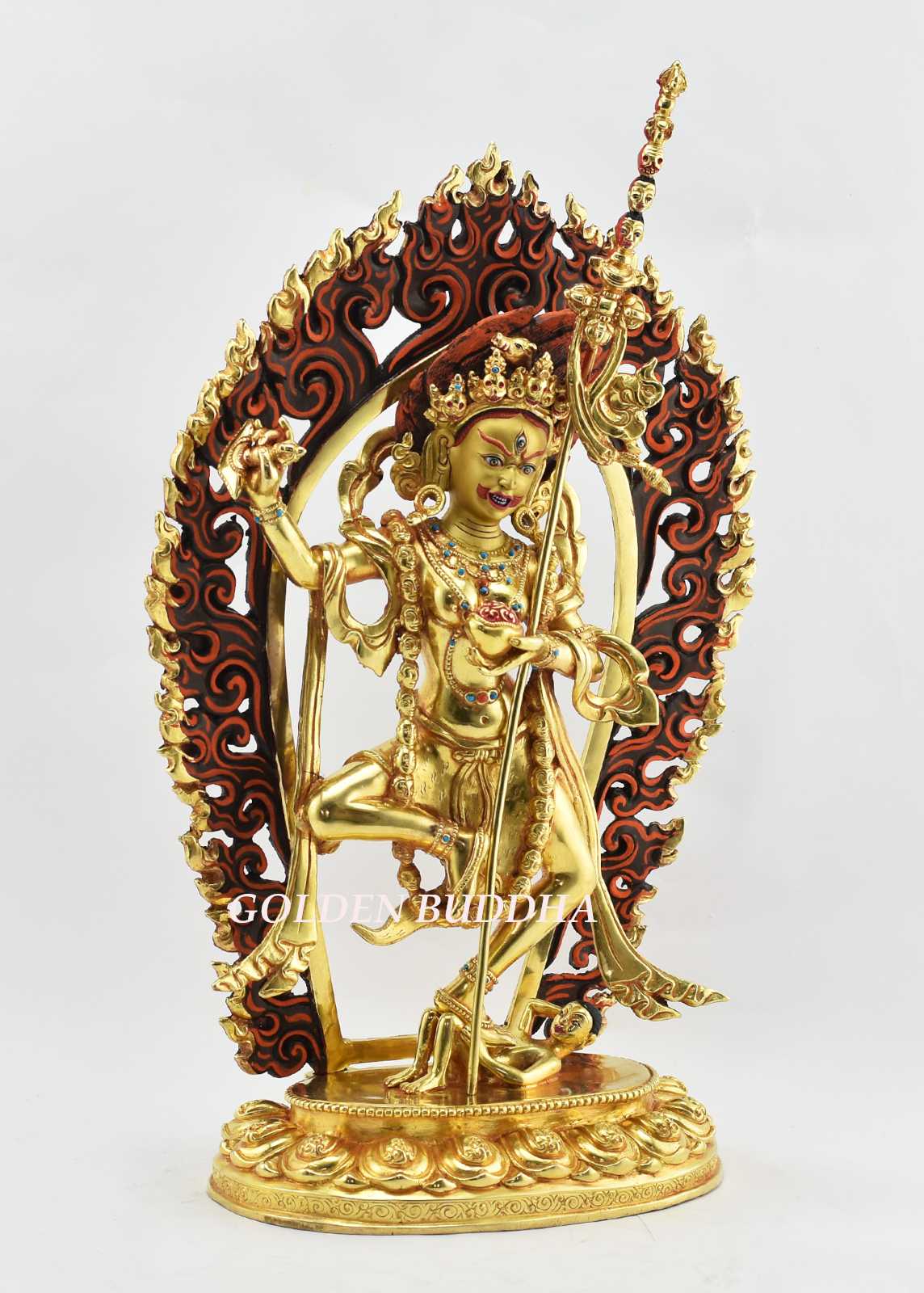
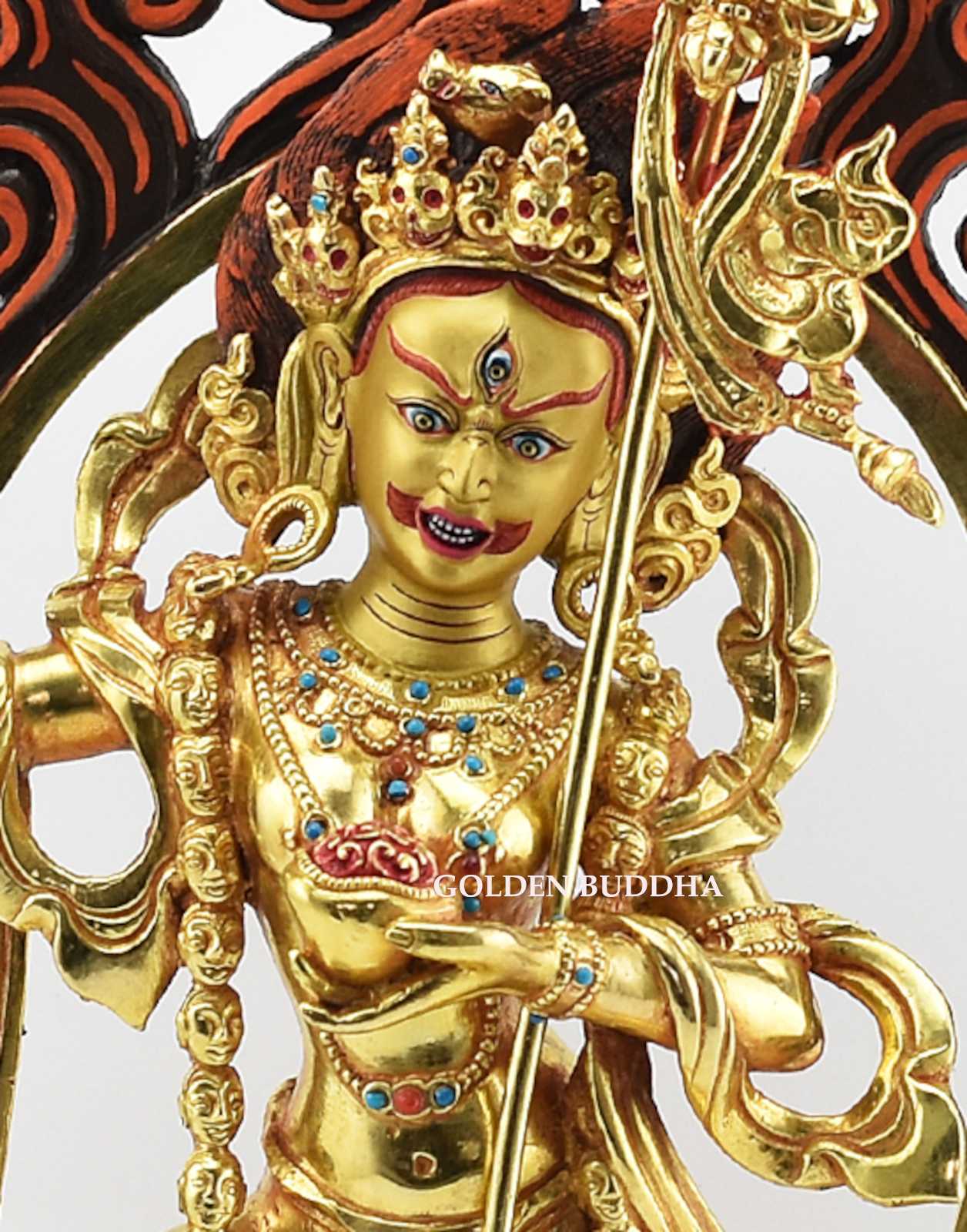
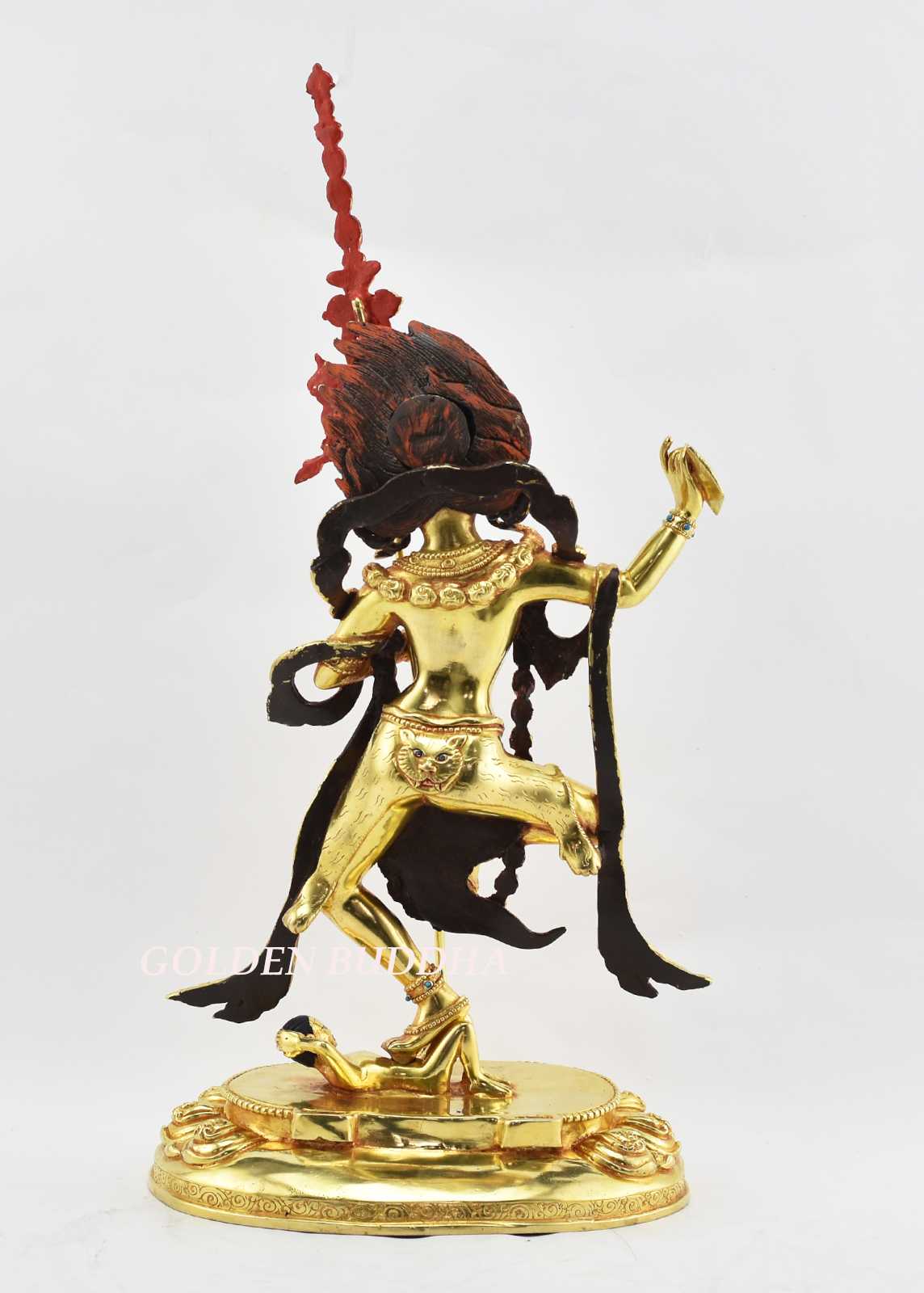
This exceptional Masterpiece Vajravarahi Statue portrays Dorje Pakmo, the wrathful form of Vajrayogini, dancing within a dramatic mandorla of blazing wisdom flames. Her radiant golden body, fierce three-eyed expression, crown of five skulls, raised kartika, skull cup, tiger-skin garment, khatvanga staff, flowing red hair, and unmistakable sow’s head combine beauty with the uncompromising symbolism of highest yoga tantra. Handcrafted in Patan, Nepal, by accomplished Newar artisans, the entire composition—including Vajravarahi, her ritual attributes, the subdued figure, lotus pedestal, supports, and removable flame frame—is cast from a base of copper alloy using the traditional lost-wax method.
The central figure is fire gilded in 24K gold, while the surrounding copper-alloy mandorla has a deep oxidized finish enriched with red-painted scrolling details and selectively gilded flame tips. Genuine turquoise and red coral are embedded throughout Vajravarahi’s crown, necklaces, bracelets, girdle, and other ornamental settings, introducing carefully controlled color against the luminous gold surface. The contrast between the brilliant deity and the dark ring of fire creates the impression of awakened wisdom emerging from an intensely charged field of transformative energy.
The complete sculpture measures approximately 15.5 inches in height when displayed with the elevated khatvanga, approximately 14 inches with the removable flame frame, and approximately 12 inches for the central figure without the frame. Measuring about 9 inches wide and 5 inches deep, it has a tall yet balanced altar presence suitable for a private shrine, Dharma center, monastery, or distinguished collection of Himalayan Buddhist art.
Masterpiece Vajravarahi Statue – Dorje Pakmo, the Wrathful Vajrayogini
Vajravarahi, known in Tibetan as Dorje Pakmo, is one of the most important enlightened Dakinis of Tibetan Vajrayana. Closely related to Vajrayogini and the Chakrasamvara cycle, she embodies the inseparability of great bliss and emptiness in an especially forceful form. Her wrathful appearance does not represent ordinary anger. It expresses awakened wisdom acting without hesitation to sever ignorance, ego-clinging, attachment, and the deeply rooted habits that keep beings bound within samsara.
The sculpture captures this enlightened intensity through a dynamic dancing posture. Vajravarahi’s left leg remains extended and firmly planted upon the subdued figure beneath her, while the right leg is drawn upward in a vigorous Dakini stance. Her hips turn, her torso rises, and her arms extend in opposing directions, creating a spiraling movement that continues into the flying scarves, red hair, tall khatvanga, and encircling flames. Although the figure is densely ornamented, the open spaces between her limbs, attributes, and mandorla preserve the clarity of the composition.
Learn more about Vajravarahi’s meaning and iconography in our detailed guide to Vajrayogini and her principal forms.
The Sow’s Head Rising Above Her Right Ear
The defining attribute of this Masterpiece Vajravarahi Statue is the small sow’s head rising from the right side of her hair. The Sanskrit name Vajravarahi combines vajra, representing indestructible awakened awareness, with varahi, meaning sow or female boar. In Tibetan she is called Dorje Pakmo, carrying the same essential meaning.
Within Buddhist symbolism, the pig traditionally represents ignorance—the fundamental misapprehension of reality from which attachment, aversion, and the other afflictions arise. The sow’s head emerging above Vajravarahi’s ear does not indicate that she is controlled by ignorance. Instead, it proclaims that she has recognized, mastered, and transformed ignorance at its root. What ordinarily sustains samsara is revealed within her enlightened form as wisdom itself.
The artisan has integrated the small animal head into the crown and streaming hair rather than treating it as a detached accessory. Its snout and facial profile remain clearly distinguishable beside the elaborate five-skull crown, allowing knowledgeable practitioners to identify Vajravarahi immediately among other forms of Vajrayogini.
The Raised Kartika in Vajravarahi’s Right Hand
In her raised right hand, Vajravarahi holds a kartika, the curved ritual flaying knife associated with Dakinis and wrathful tantric deities. The crescent-shaped blade is displayed prominently above her shoulder, where its hooked outline remains visible against the dark mandorla. Its ornamented handle and gilded blade demonstrate the careful finishing applied even to the smaller ritual attributes of the sculpture.
The kartika symbolizes the sharp, immediate action of wisdom severing ego-clinging and conceptual obscuration. Its flaying form suggests the removal of the superficial “skin” of appearances—the mistaken belief that the self and phenomena exist independently and permanently. Vajravarahi does not gradually negotiate with delusion; her blade represents the decisive realization that cuts through it at the root.
Masterpiece Vajravarahi Statue ‒ Kapala Skull Cup Held in Her Left Hand
Her left hand extends across the front of her body holding a kapala, or skull cup. Traditionally described as containing blood or transformative nectar, the kapala represents the conversion of ordinary desire, sensory experience, and life-force into the nectar of blissful wisdom. The symbolism does not celebrate death or violence. It confronts impermanence directly and demonstrates that experiences ordinarily regarded as frightening or impure may become supports for realization when their empty nature is understood.
The kartika and kapala function as a coordinated pair. The curved knife cuts through ignorance and grasping, while the skull cup receives and transforms what has been severed into awakened experience. Together they express the inseparability of penetrating wisdom and tantric transformation.
Khatvanga Staff and Inseparable Union with Heruka
A tall khatvanga rises beside Vajravarahi and rests against her left shoulder. Its long shaft extends from the pedestal to a complex upper finial that rises beyond the flame mandorla. The staff incorporates three stacked heads in successive states, crowned by a vajra finial and enriched with flowing ornamental elements. These features evoke impermanence and the transformation of the three realms of desire, form, and formlessness.
In a solitary representation of Vajravarahi, the khatvanga signifies her inseparability from Heruka Chakrasamvara. Although the consort is not shown as a separate figure, the staff indicates that method and wisdom, compassion and emptiness, and bliss and awareness remain united within her realization. The vertical khatvanga also provides an elegant compositional counterpoint to the lifted kartika and the circular flame frame.
Masterpiece Vajravarahi Statue ‒ Five-Skull Crown, Three Eyes and Fierce Expression
Vajravarahi wears a prominent crown of five skulls, carefully modeled and set with small turquoise and red coral accents. This is a tantric skull crown rather than the jeweled crown of a peaceful Bodhisattva. The five skulls represent the transformation of the five principal afflictions—ignorance, anger, pride, attachment, and jealousy—into the five forms of awakened wisdom. They also signify freedom from grasping at the five aggregates as a fixed and permanent self.
A vertical third eye of wisdom appears in the center of her forehead. Together, her three eyes symbolize unimpeded awareness extending beyond ordinary perception. Her arched brows, wide eyes, open mouth, small fangs, and red facial detailing communicate fierce awakened energy rather than uncontrolled anger. The face is hand painted with gold and natural pigments, giving clarity to the eyes, brows, lips, teeth, and wrathful expression while preserving the sculptural modeling beneath.
Flowing Red Hair and Charnel-Ground Ornamentation
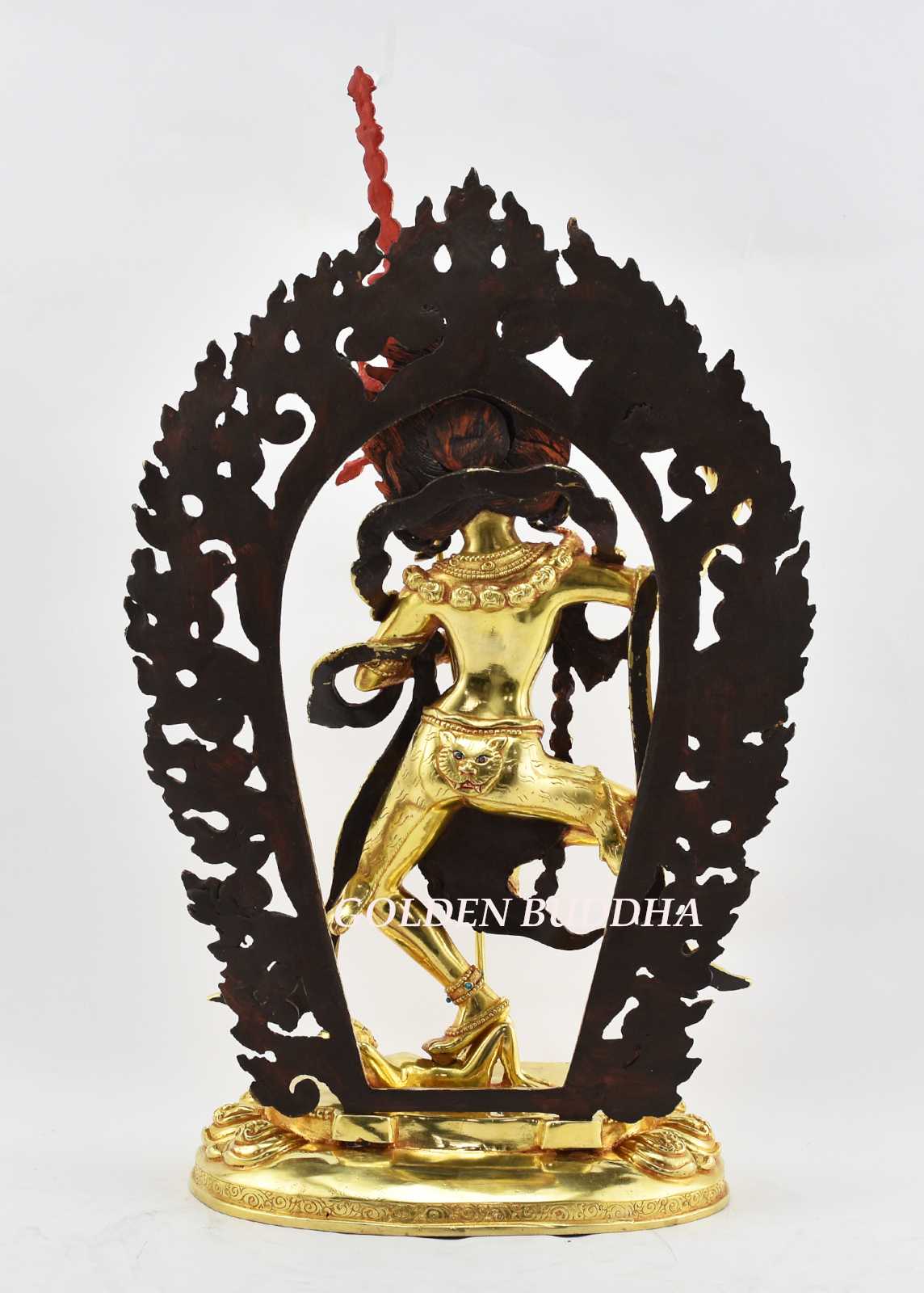
Vajravarahi’s long hair streams upward and backward in a mass of deeply modeled strands finished in vivid red and dark oxidized tones. The rear view reveals the exceptional depth of this feature, with the hair radiating outward behind the crown and partially surrounding the sow’s head. Its uncontrolled movement expresses freedom from social convention, conceptual limitation, and attachment to ordinary identity.
Her youthful gilded body is adorned with necklaces, bracelets, anklets, earrings, a girdle, suspended chains, and a garland of sculpted heads. These ornaments refer to the charnel-ground tradition of tantric practice, where accomplished yogis and yoginis confronted impermanence, fear, and attachment to the physical body. Their severe symbolism is rendered through remarkably refined Newar craftsmanship, creating a deliberate tension between beauty and mortality.
Turquoise and red coral are embedded selectively across the crown, necklaces, chest ornaments, wrist jewelry, waist, and anklets. The stones are used as controlled accents rather than overwhelming the gilded surface. Their blue-green and red tones enliven the intricate jewelry and help distinguish individual ornamental settings across the figure.
The Tiger Skin Wrapped Around Her Waist
Around her waist Vajravarahi wears a carefully modeled tiger skin. The rear view provides the clearest identification: a tiger’s face is positioned at the lower back, while the animal’s legs and pelt extend around her hips. Fine engraved markings across the gilded surface suggest the texture and pattern of the hide.
The tiger skin traditionally represents mastery over anger, pride, and untamed instinctive energy. Vajravarahi does not destroy that power but wears it, demonstrating its transformation into fearless enlightened activity. The pelt also creates a strong sculptural transition between the unclothed upper body and the dancing legs, while the tiger mask adds an impressive detail to the otherwise open rear composition.
Dancing Above the Subdued Human Figure
Vajravarahi dances above a prone human figure stretched across the upper platform of the lotus pedestal. Her extended foot presses firmly upon the figure while the opposite leg rises in a vigorous Dakini posture. The subdued body represents ordinary ego-consciousness, obstructive forces, and the mistaken view of an independently existing self brought under the mastery of awakened wisdom.
This imagery should not be interpreted as personal hostility toward an individual being. The figure beneath Vajravarahi represents the inner patterns that dominate unenlightened experience. Her dance shows that ignorance and attachment lose their authority when their empty nature is recognized directly. The subdued figure is cast in copper alloy and fire gilded in 24K gold, with selectively painted hair and facial details visible beneath the deity’s feet.
Removable Copper-Alloy Mandorla of Wisdom Flames
The removable mandorla surrounding Vajravarahi is made entirely from a base of copper alloy. Its openwork oval is filled with densely curling flames, each shaped to create a continuous field of movement around the central deity. The front has a deep oxidized copper finish with red-painted inner scrolls and selectively fire-gilded flame tips, while the reverse retains a dark oxidized appearance that reveals the silhouette and construction of the frame.
The flames do not represent ordinary destructive fire. They symbolize pristine awareness consuming ignorance, attachment, aversion, and every obscuration that obstructs realization. The dark copper and red interior of the mandorla create a powerful visual contrast with Vajravarahi’s luminous 24K gold body, making the deity appear to emerge from the very fire of awakened wisdom.
The frame fits securely into supports on the rear of the pedestal and may be removed for careful packing, transportation, or a more open presentation of the central figure. Its open spaces permit light to pass through the composition and keep the elaborate flames from obscuring Vajravarahi’s posture, ritual implements, and streaming scarves.
Copper-Alloy Casting, 24K Fire Gilding and Traditional Newar Craftsmanship
Every component of this Masterpiece Vajravarahi Statue is made from copper alloy through the traditional lost-wax casting process. Separate wax models are prepared for Vajravarahi, the hands and ritual implements, khatvanga, subdued figure, pedestal, mandorla, and structural supports. After the wax is enclosed within a heat-resistant mould and melted away, molten copper alloy is poured into the resulting cavities.
Once the castings have cooled, the moulds are broken and each component is refined individually. Newar artisans chase the three eyes, sow’s head, fangs, skull crown, jewelry, tiger skin, garland, kartika, kapala, khatvanga, flame tips, and lotus details by hand. The many openwork elements require particular care because they must appear delicate and energetic while remaining structurally secure.
The central deity and selected details are then prepared for traditional 24K fire gilding. The mandorla receives its darker oxidized finish, painted red scrollwork, and gilded highlights, while turquoise and red coral are fitted into the appropriate ornamental settings. This combination of luminous gold, dark oxidized copper, saturated pigments, and natural stones gives the statue remarkable visual depth from every viewing angle.
Masterpiece Vajravarahi and Vajrayogini as a Two-Statue Pair
This Masterpiece Vajravarahi Statue would form a meaningful two-piece arrangement with the Gold Gilded Vajrayogini Sculpture in the Naro Kacho form. Vajrayogini and Vajravarahi are closely related enlightened Dakinis associated with the Chakrasamvara tantric cycle. They should not be understood as unrelated deities selected merely because their statues share similar visual qualities. Their pairing reflects two intimately connected expressions of transformative Dakini wisdom.
Naro Kacho Vajrayogini is identified by her upward gaze, lowered right-hand kartika, raised left-hand kapala, khatvanga at the left shoulder, five-skull crown, and stance upon Kalarati and Bhairava. Her iconography emphasizes the rising movement toward the Pure Land of the Dakinis and the transformation of ordinary experience into the union of great bliss and emptiness. Vajravarahi presents the same enlightened Dakini principle in a more forcefully wrathful manifestation, distinguished by the sow’s head, raised kartika, kapala held near the body, tiger skin, vigorous Ardhaparyanka posture, and subdued figure beneath her foot.
Displayed together, the two statues illustrate both continuity and distinction within the Vajrayogini traditions. Their shared kartika, kapala, skull crown, khatvanga, bone ornaments, and wisdom flames express the same essential tantric transformation of ignorance and attachment. Their different gestures and postures reveal distinct ways in which that awakened activity is manifested. Such a pairing is especially appropriate for knowledgeable collectors and practitioners who appreciate the relationship between these forms and who arrange sacred images according to the guidance and commitments of their lineage.
Custom-Made Vajravarahi and Vajrayogini Statues
Practitioners, monasteries, Dharma centers, and collectors may commission custom-made Tibetan Buddhist statues handcrafted by experienced Newar artisans in Patan, Nepal. A custom Vajravarahi may be created in a preferred height, finish, pedestal style, or level of ornamentation while preserving the defining iconographic features of Dorje Pakmo. Particular attention can be given to the sow’s head above the right ear, three eyes, five-skull crown, raised right-hand kartika, left-hand kapala, khatvanga, tiger skin, bone ornaments, dancing posture, subdued figure, and removable flame mandorla.
Available finishes may include extensive 24K fire gilding, antiquated oxidized copper, selective gilding, or a two-tone composition combining a luminous central deity with a darker mandorla. Genuine turquoise and red coral may be embedded in appropriate ornamental settings. The entire commissioned sculpture—including the figure, implements, base, frame, and supports—can be cast from copper alloy through the traditional lost-wax method.
A coordinated Vajrayogini statue may also be commissioned to create a doctrinally and visually harmonious pair. Their heights, lotus pedestals, gilded surfaces, oxidized flame frames, stone settings, and overall proportions can be planned together, while the unique attributes of each form remain precisely differentiated. Vajrayogini’s upward gaze, raised kapala, lowered kartika, and Naro Kacho stance would remain distinct from Vajravarahi’s sow’s head, raised kartika, tiger skin, and forceful Dakini dance.
Progress photographs may be provided during a custom commission so that the identity, proportions, ritual implements, hand positions, facial expression, ornamentation, and finish can be reviewed before completion. This collaborative process is particularly valuable for complex tantric deities, whose authenticity depends upon preserving the precise relationship between every symbolic attribute.
With its commanding Dakini posture, clearly modeled sow’s head, raised kartika, skull cup, towering khatvanga, tiger skin, natural turquoise and red coral accents, and dramatic removable copper-alloy mandorla, this Masterpiece Vajravarahi Statue is an outstanding contemporary expression of traditional Newar sacred metalwork. Its union of precise iconography, 24K fire gilding, oxidized copper contrast, hand-painted details, and intricate lost-wax casting makes it a powerful devotional image and an exceptional work of Himalayan Buddhist art.
Authentic, Handmade in Nepal
Every statue is handcrafted in Patan, Nepal, using traditional lost wax casting and comes with a certificate of authenticity issued by Nepal’s Department of Archaeology, verifying its materials, technique, and origin.