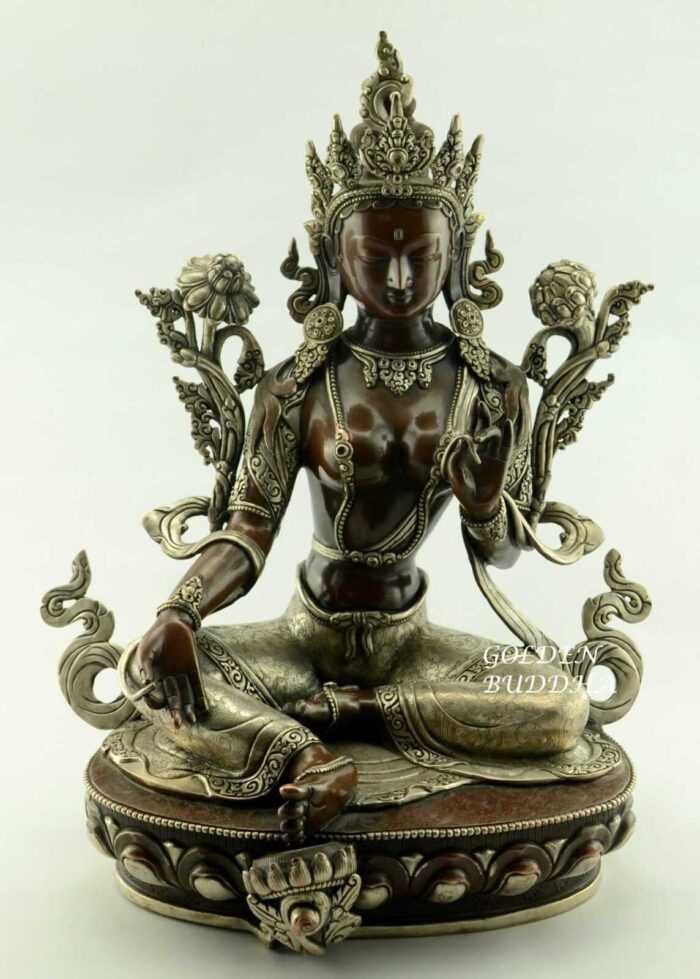
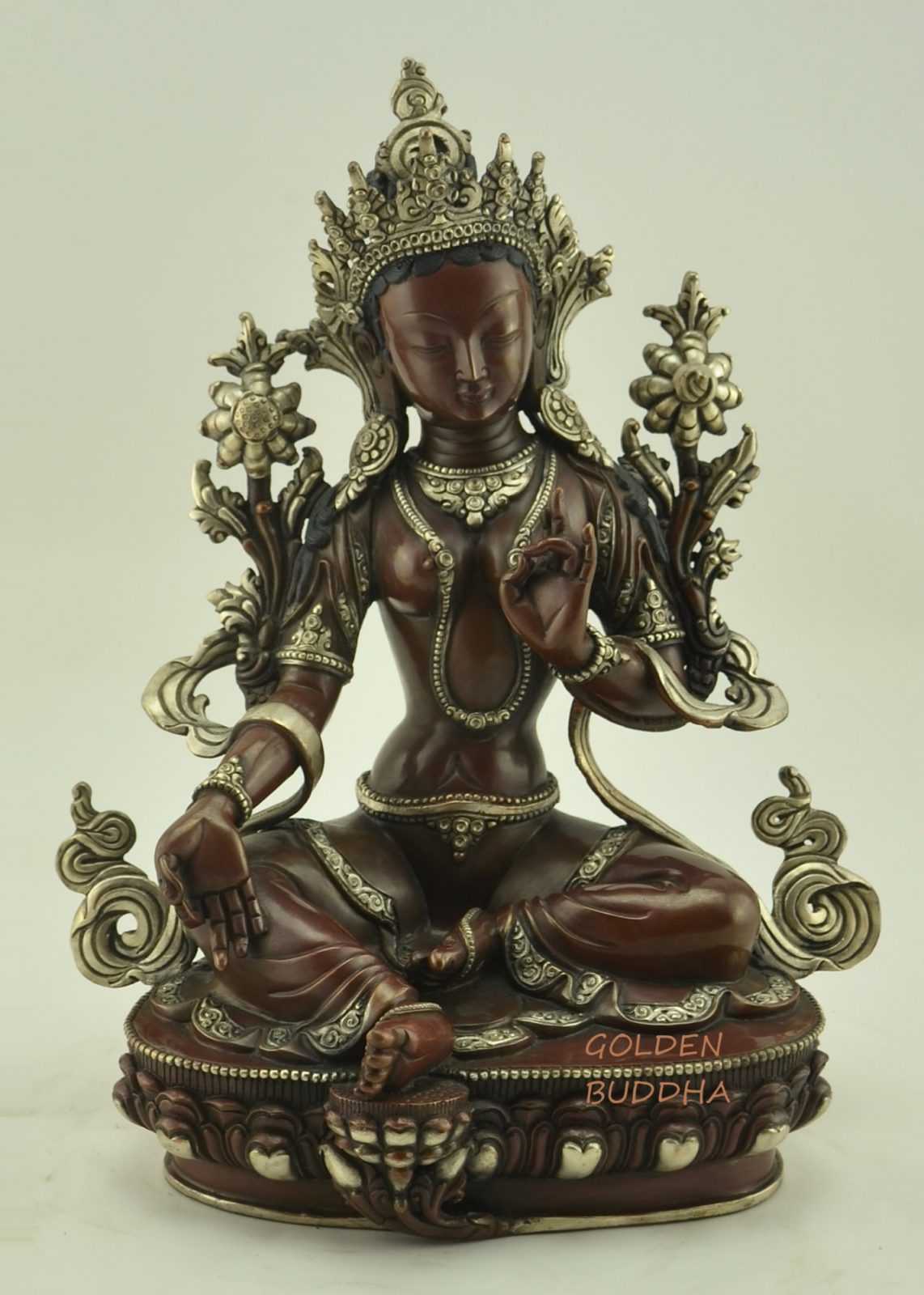
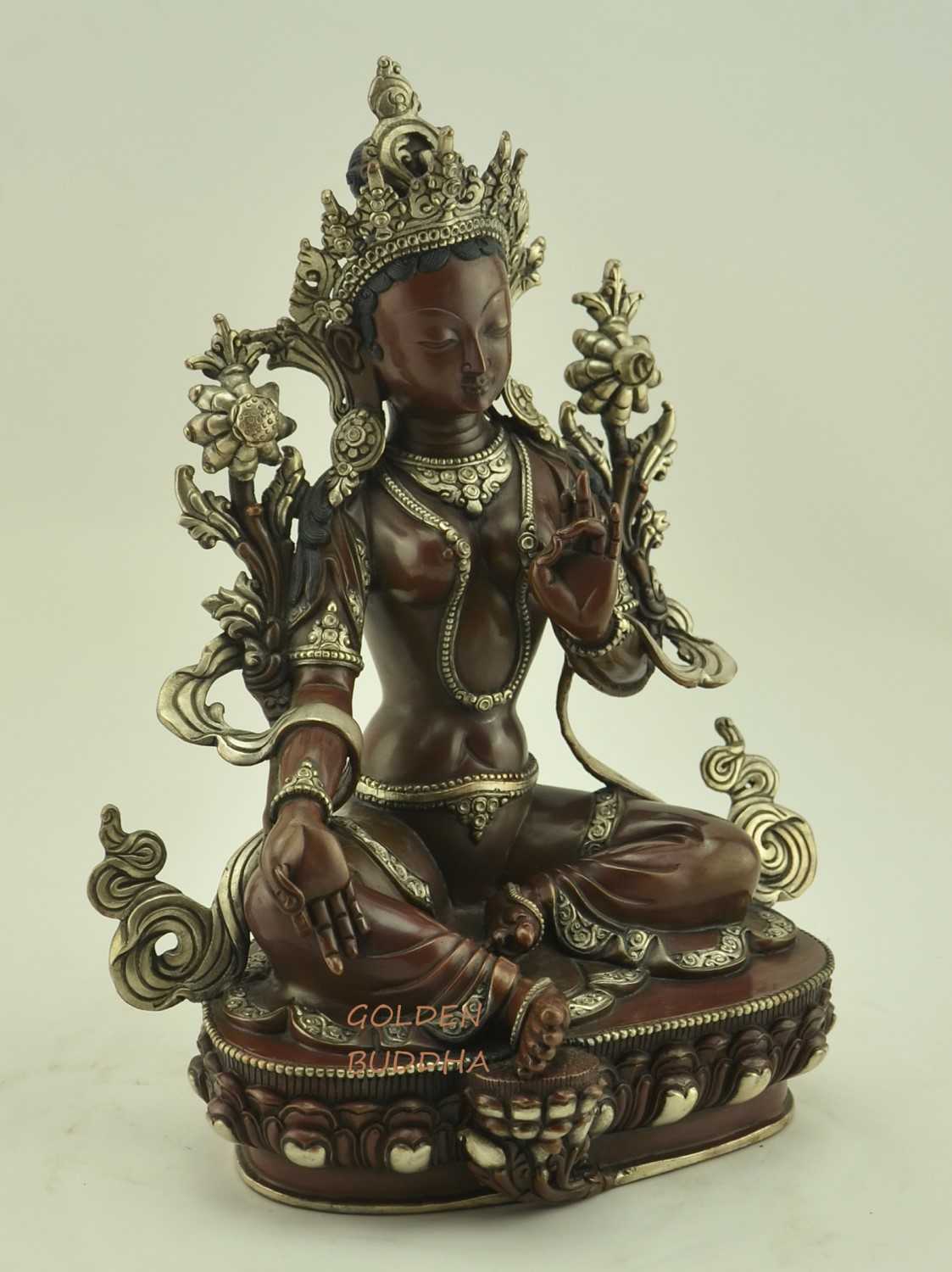
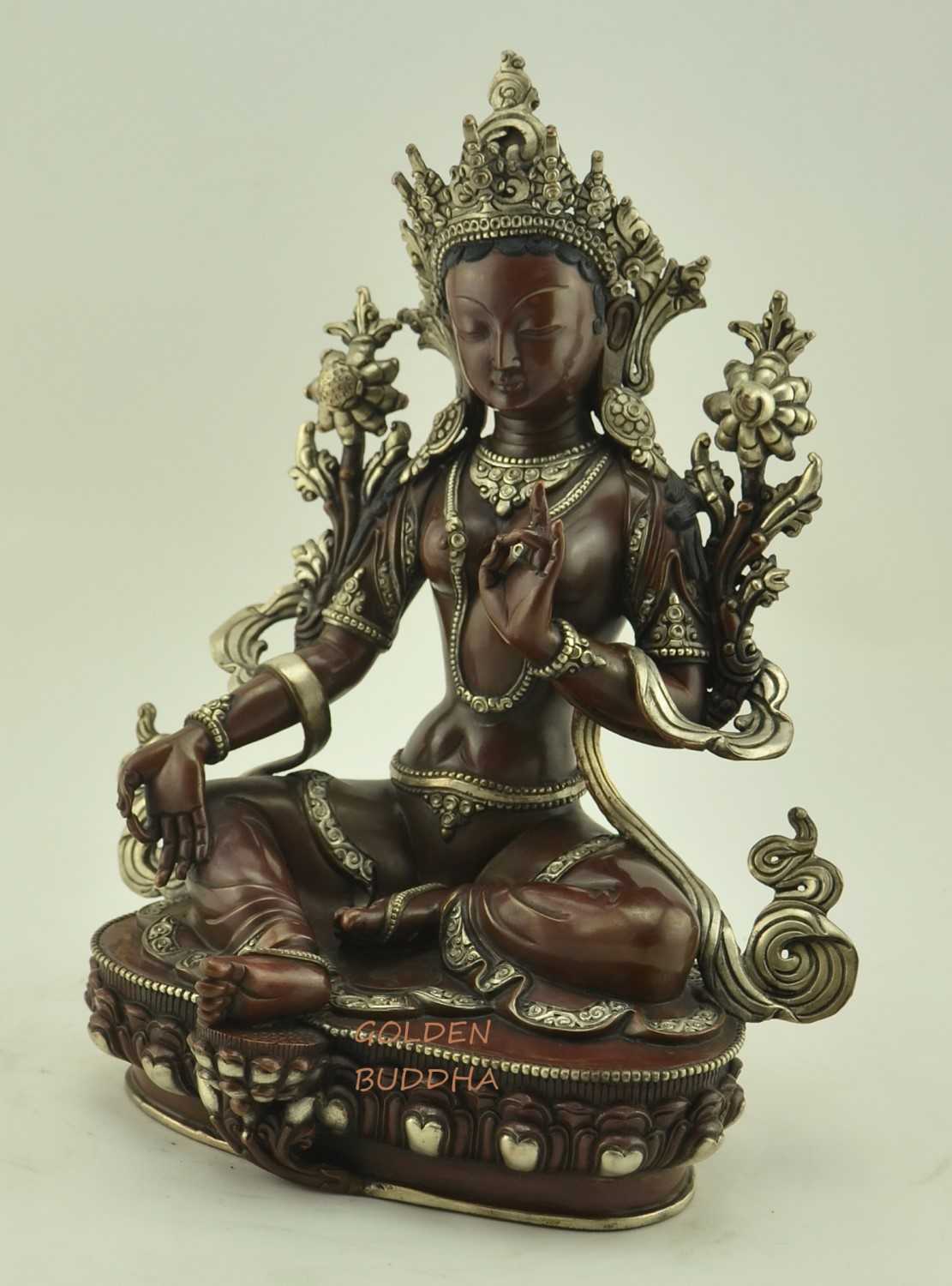
This 9.75″ Silver Green Tara statue presents Jetsun Dolma in an elegant two-tone combination of warm oxidized copper alloy and carefully applied silver detailing. Handcrafted in Patan, Nepal by a master Newar artisan, the sculpture was created through the traditional lost wax casting method and individually refined by hand. The rich, antiquated copper finish gives Tara’s body and garments a softly aged appearance, while the silver-plated Bodhisattva crown, jewelry, garment borders, flowing ribbons, utpala blossoms, throne rim and selected lotus petals illuminate the most intricate sculptural details.
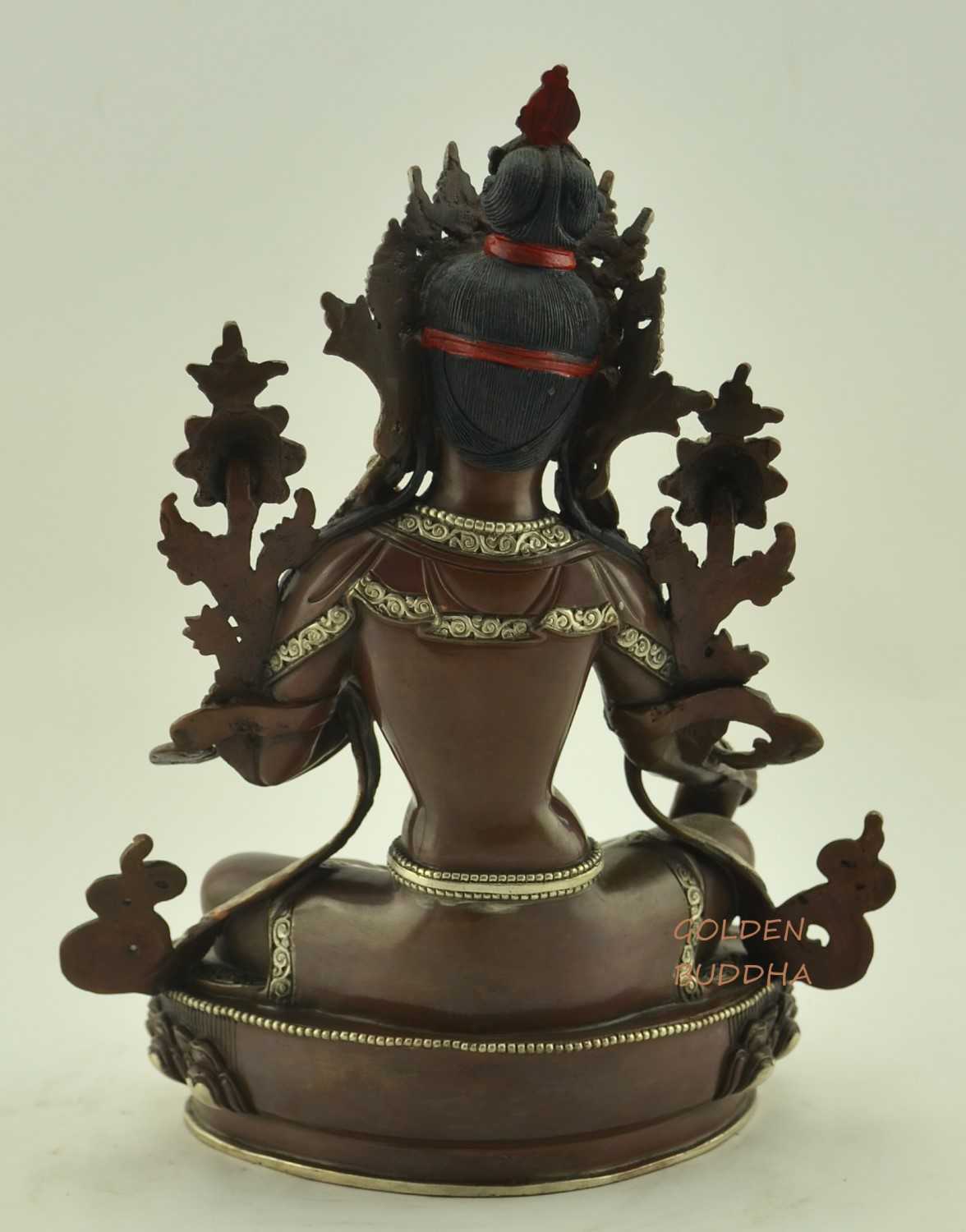
The contrast is especially effective across the front of the sculpture. Bright silver highlights frame Tara’s serene face, encircle her neck and arms, follow the engraved hemlines of her garments and continue around the single lotus throne. A finely sculpted elephant head projects from the center of the pedestal beneath her extended foot, creating a distinctive focal point and adding further depth to the composition. From the back, silver scrollwork follows the shoulder covering, waist ornament and throne rim, while the antiquated copper surface remains visible across the gracefully modeled torso and seated posture.
Green Tara is known in Tibetan as Jetsun Dolma, “the Venerable Liberator.” She embodies compassion expressed through immediate enlightened activity and is invoked for protection, courage and the removal of obstacles that interfere with spiritual practice. Rather than remaining withdrawn in meditation, Tara is portrayed poised to respond whenever sentient beings call upon her. Learn more about Green Tara in the Buddhist pantheon and the meaning of her compassionate activity.
Silver Green Tara Statue Features
This Silver Green Tara statue depicts the Bodhisattva seated in lalitasana, the posture of royal ease. Her left leg remains folded in meditative stability while her right leg extends downward and rests upon a small lotus support at the front of the throne. This open posture is one of Green Tara’s defining iconographic features. It signifies that although she possesses the serenity of meditation, she remains ready to rise immediately and assist beings endangered by fear, confusion or adverse circumstances.
Her lowered right hand displays the Varada mudra, the gesture of generosity, blessings and compassionate giving. A delicately engraved eye appears in the palm, expressing the vigilant awareness with which Tara perceives the needs of living beings. Her raised left hand forms a graceful teaching and refuge gesture while holding the stem of an utpala lotus. Together, the two hands unite compassionate generosity with the discriminating awareness needed to provide genuinely beneficial assistance.
Two utpala flowers rise beside her shoulders on long, curling stems. The blossoms, leaves and supporting scrollwork are enriched with silver plating, allowing their sculptural forms to stand clearly against the darker oxidized copper body. In Buddhist art, the lotus expresses the possibility of awakening within the conditions of ordinary existence: although its roots grow beneath muddy water, the flower rises above the surface unstained. In the iconography of Tara, the blossoms therefore complement her role as a guide who helps beings pass through suffering without being overcome by it.
Tara wears the crown and ornaments of an enlightened Bodhisattva, including an elaborate five-point crown, circular earrings, layered necklaces, armbands, bracelets and a jeweled waist ornament. Silver plating draws attention to these details without concealing the underlying copper-alloy sculpture. At the buyer’s request, the crown and jewelry may also be embellished with turquoise and red stones before delivery at no additional charge. These optional stones can provide a restrained touch of traditional Himalayan color while preserving the statue’s distinctive antiquated and silver appearance.
Engraved Garments, Ribbons and Lotus Throne
The artisan has concentrated the decorative work along Tara’s garment edges and ornamental borders, where scrolling engravings follow the dhoti across her folded legs and around the extended right ankle. Silver-plated trim defines these hemlines against the polished copper folds, making the layered construction of the garment easy to appreciate. The celestial ribbons emerging beside her arms curl outward in broad, rhythmic forms, contributing movement to an otherwise composed and meditative figure.
The single lotus throne is ringed with a beaded upper edge and a row of deeply modeled lotus petals. Selected petal centers are finished in silver, echoing the silver crown and jewelry above. At the front, the projecting elephant motif supports Tara’s extended foot and gives the pedestal an unusual sculptural identity. The silver-trimmed throne rim continues around the back, demonstrating that the statue was finished as a complete devotional sculpture rather than merely decorated for a frontal view.
The reverse view reveals Tara’s carefully modeled hair gathered into a high topknot, secured with painted red bands that introduce a subtle accent against the dark hair and copper finish. Silver ornamentation continues around the collar, shoulder covering and waist, while the long lotus stems and celestial ribbons create a balanced silhouette from every angle. The result is a richly detailed sculpture that remains visually harmonious rather than excessively ornate.
Jetsun Dolma and the Practice of Swift Compassion
Green Tara’s famous readiness to act is reflected in both her posture and her mantra practice. Devotees invoke Jetsun Dolma when facing fear, danger, emotional uncertainty or obstacles that impede beneficial activity. Her compassion is not separated from wisdom; it responds quickly because it clearly understands both suffering and the means required to relieve it. The extended leg, open right palm and alert yet peaceful expression make this teaching visible in sculptural form. Read more about the Green Tara mantra and its traditional meaning.
Placed on a home altar, meditation table or Dharma-center shrine, this sculpture can serve as a visual focus for cultivating compassionate responsiveness. The warm oxidized finish gives it the contemplative presence of an older Himalayan sacred image, while the silver details illuminate Tara’s ornaments and attributes whenever they catch the light. Its 9.75-inch height provides enough scale for the crown, flowers and mudras to remain clearly visible without requiring the space of a large temple statue.
Green Tara, Manjushri and Chenrezig Statue Set
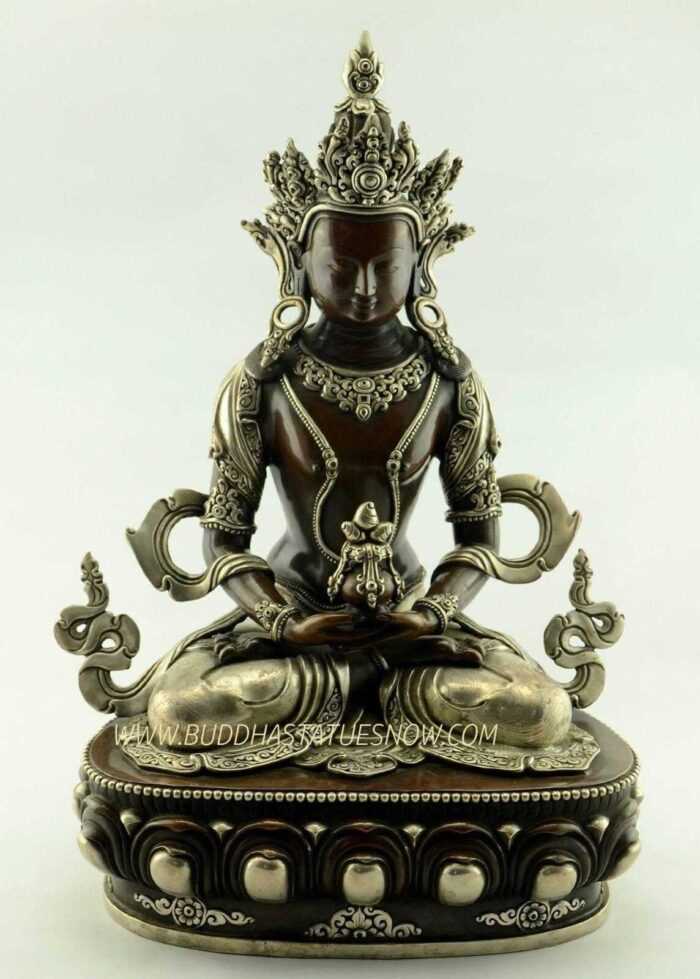
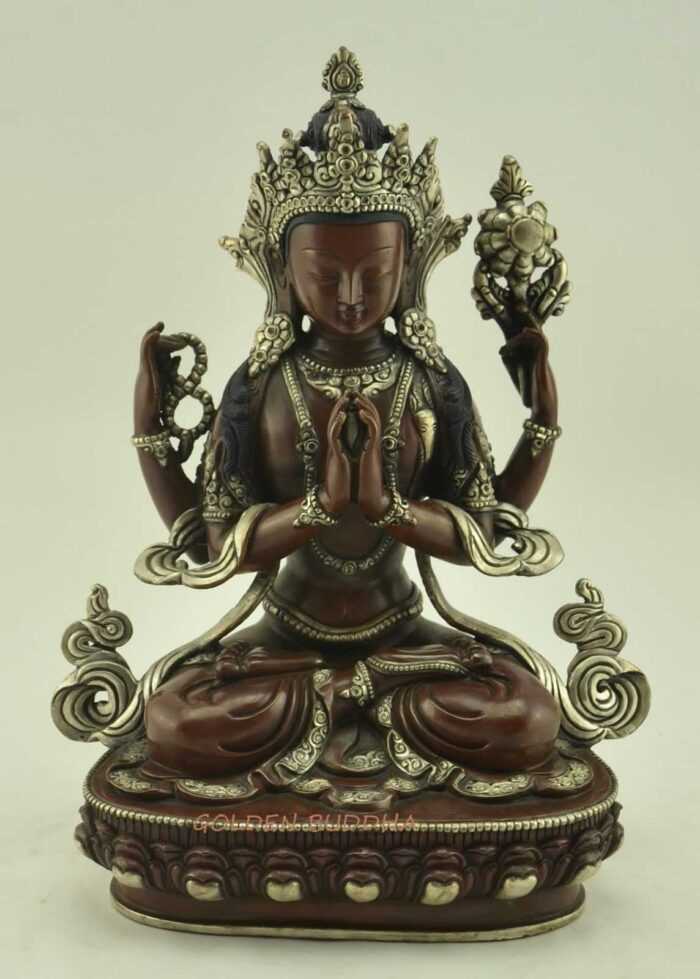
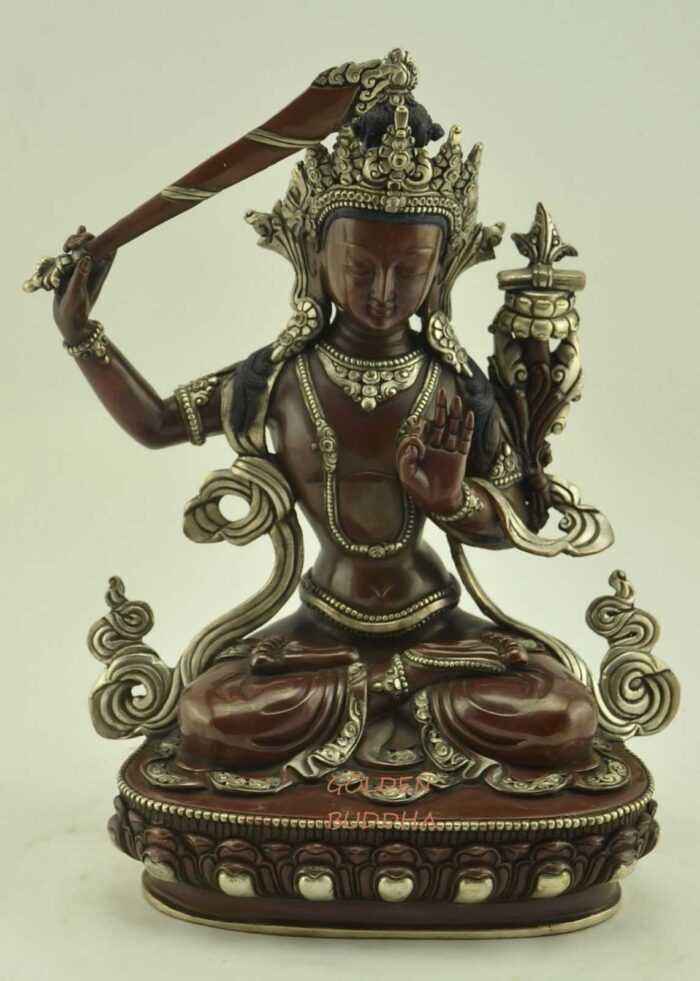
This Silver Green Tara statue forms a visually coordinated three-piece shrine set with the matching silver-detail Manjushri statue and silver-detail Chenrezig statue. All three sculptures were created by the same Nepali master artisan in matching 9.75-inch proportions, using copper alloy, antiquated oxidized finishes, silver-plated crowns and ornaments, complementary engraved hemlines and similarly formed single lotus thrones. The repeated silver detailing across their crowns, jewelry, ribbons, sacred attributes, throne rims and lotus petals gives the group the unity of an intentionally designed altar ensemble.
The three figures also create a strong doctrinal arrangement. Manjushri embodies transcendent wisdom, represented by the sword that cuts through ignorance and the wisdom scripture supported by his lotus. Chenrezig, or Avalokiteshvara, embodies limitless compassion for all sentient beings, expressed through his prayer beads, lotus and wish-fulfilling jewel. Green Tara represents that compassionate intention becoming swift, fearless action capable of removing immediate obstacles. Together they express a complete progression: wisdom correctly perceives suffering, compassion responds to it, and Tara’s enlightened activity brings that response into action.
Custom Made Silver Green Tara Statues
Collectors, practitioners and Dharma centers may commission custom made Green Tara statues from our workshop in Nepal. A commissioned sculpture can be adapted in size, proportions and decorative treatment while maintaining the required iconography of Jetsun Dolma. Available options may include an antiquated oxidized finish similar to this statue, additional silver plating, 24K fire gilding, a face hand painted with 18K gold and natural pigments, gemstone settings, enhanced garment engraving or a specially designed lotus throne.
A complete matching trio may also be commissioned so that Green Tara, Manjushri and Chenrezig share identical dimensions, copper finishes, silver accents and pedestal designs. Such a set offers both artistic unity and doctrinal balance: Manjushri contributes the wisdom that understands reality, Chenrezig contributes the compassion that embraces every being, and Green Tara contributes the fearless activity that transforms wisdom and compassion into immediate benefit.
Authentic, Handmade in Nepal
Every statue is handcrafted in Patan, Nepal, using traditional lost wax casting and comes with a certificate of authenticity issued by Nepal’s Department of Archaeology, verifying its materials, technique, and origin.