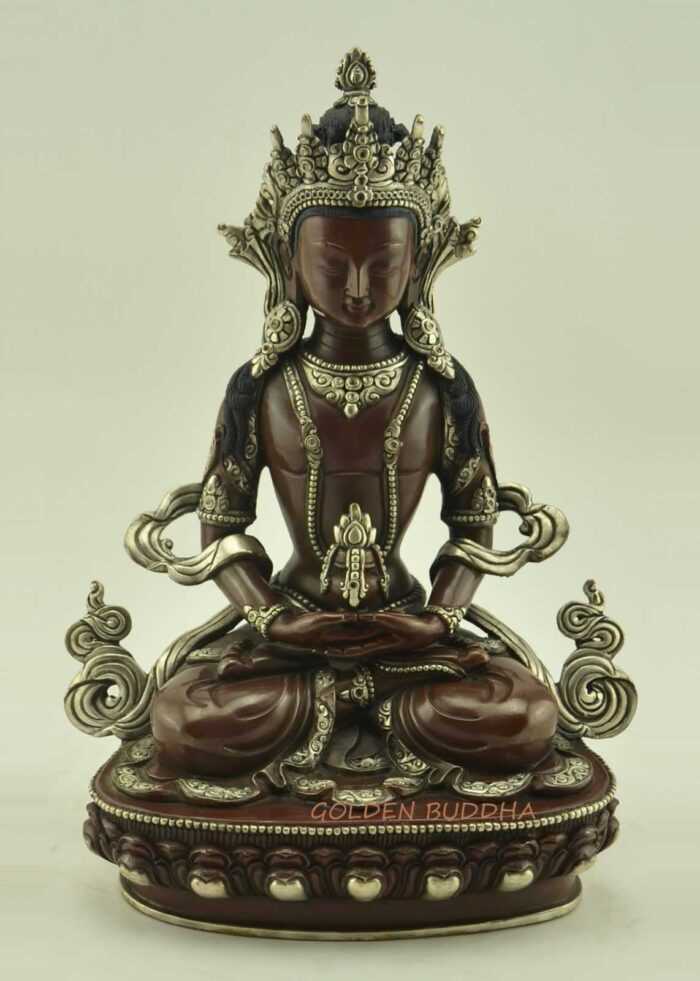
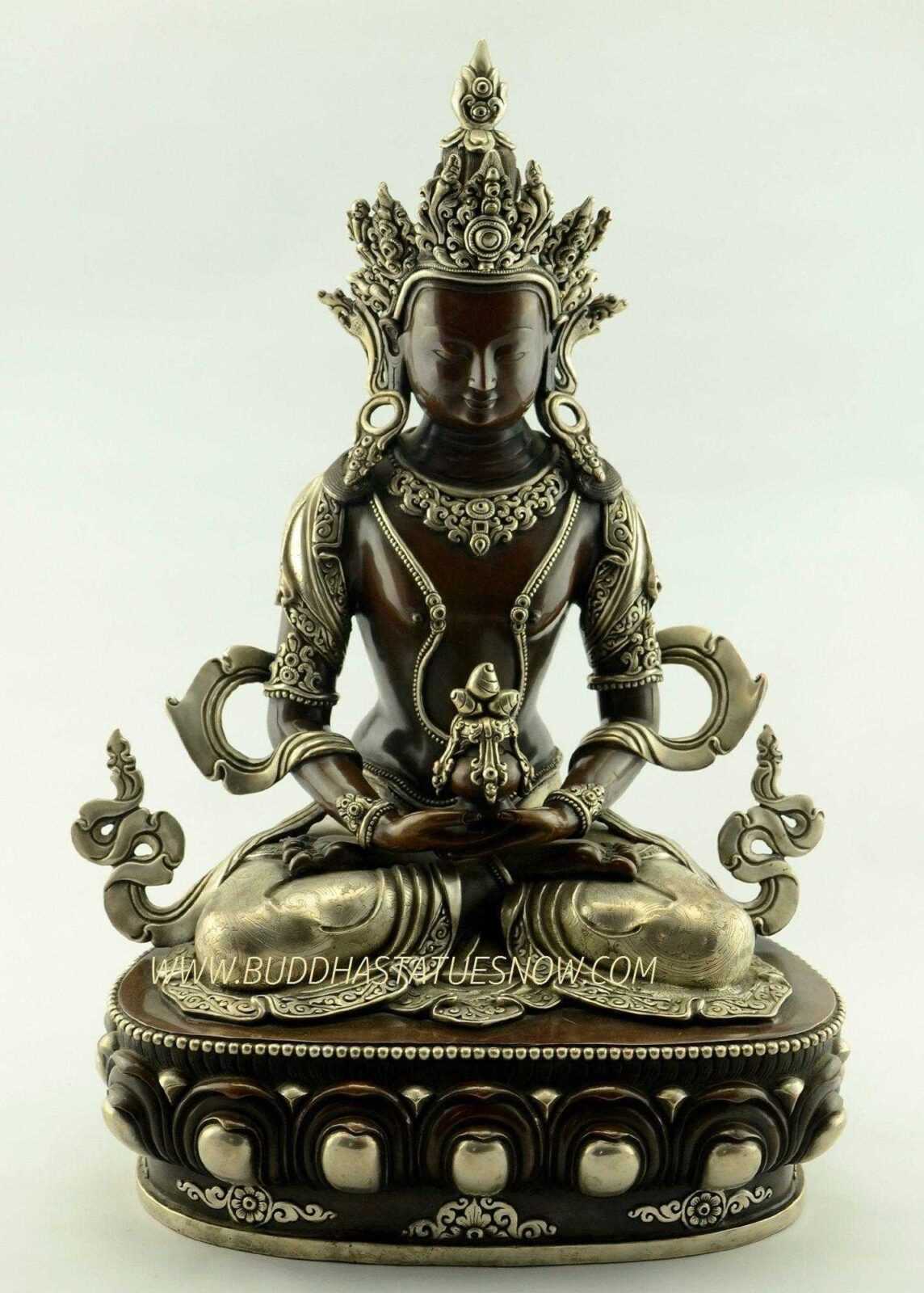
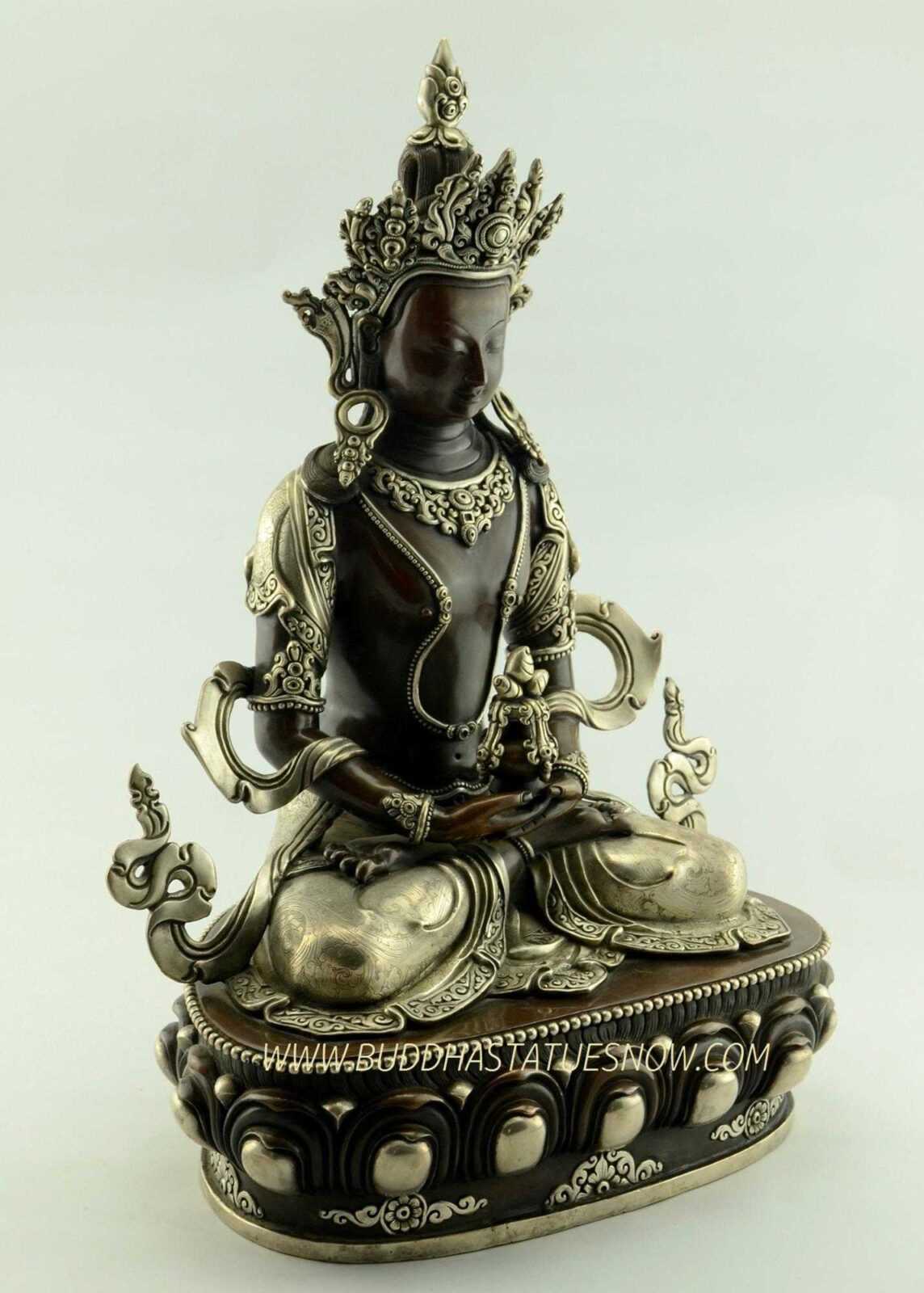
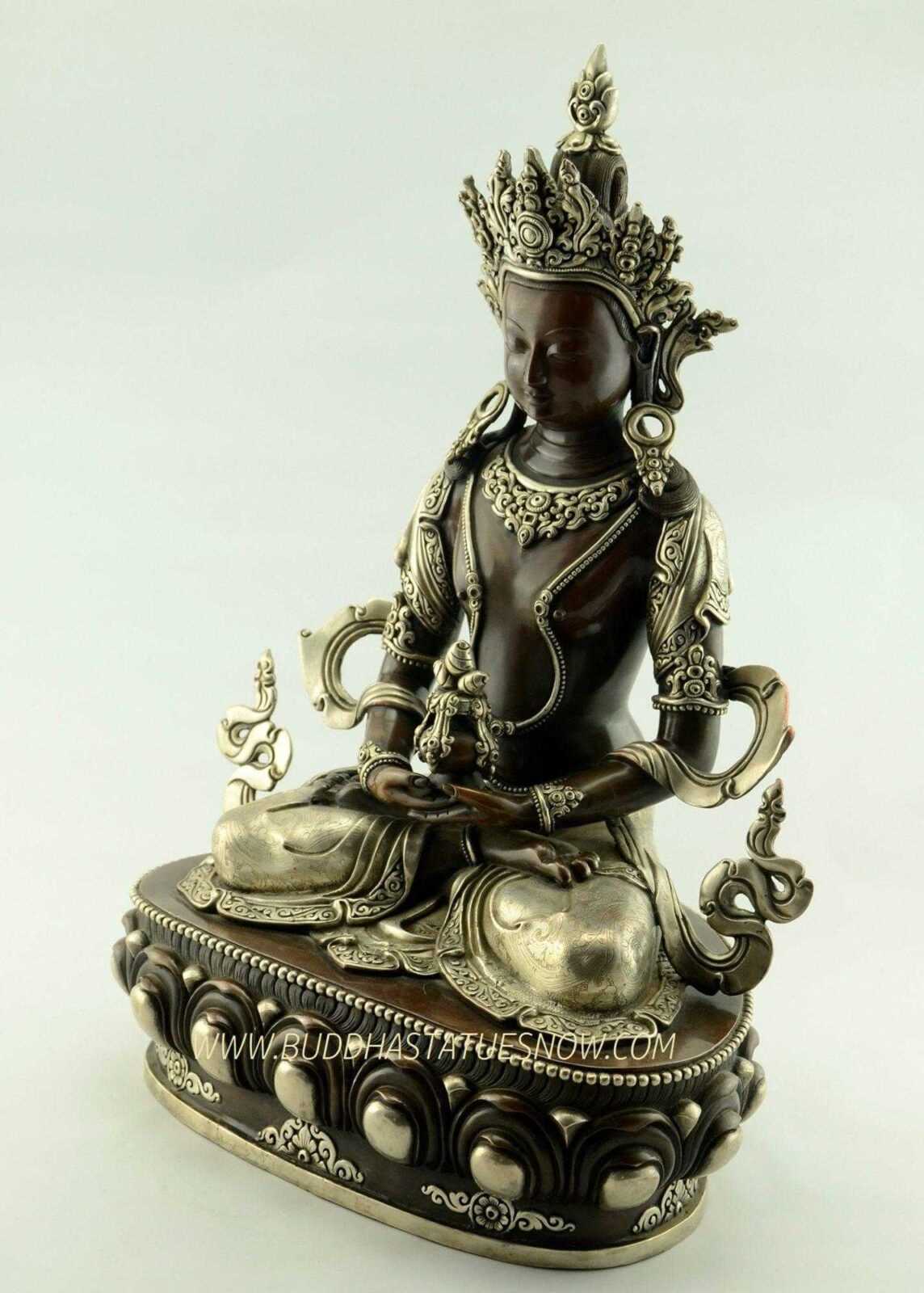
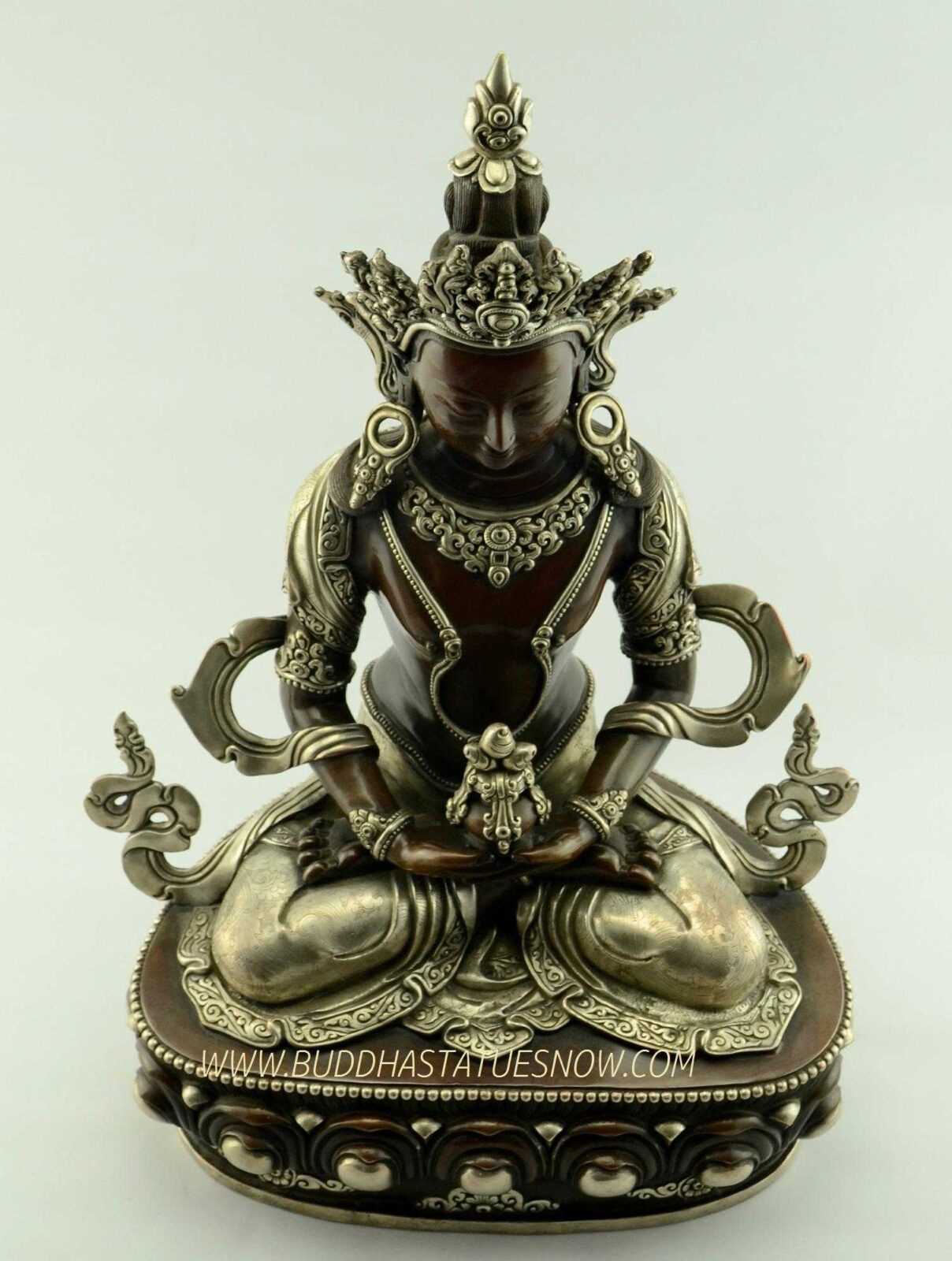
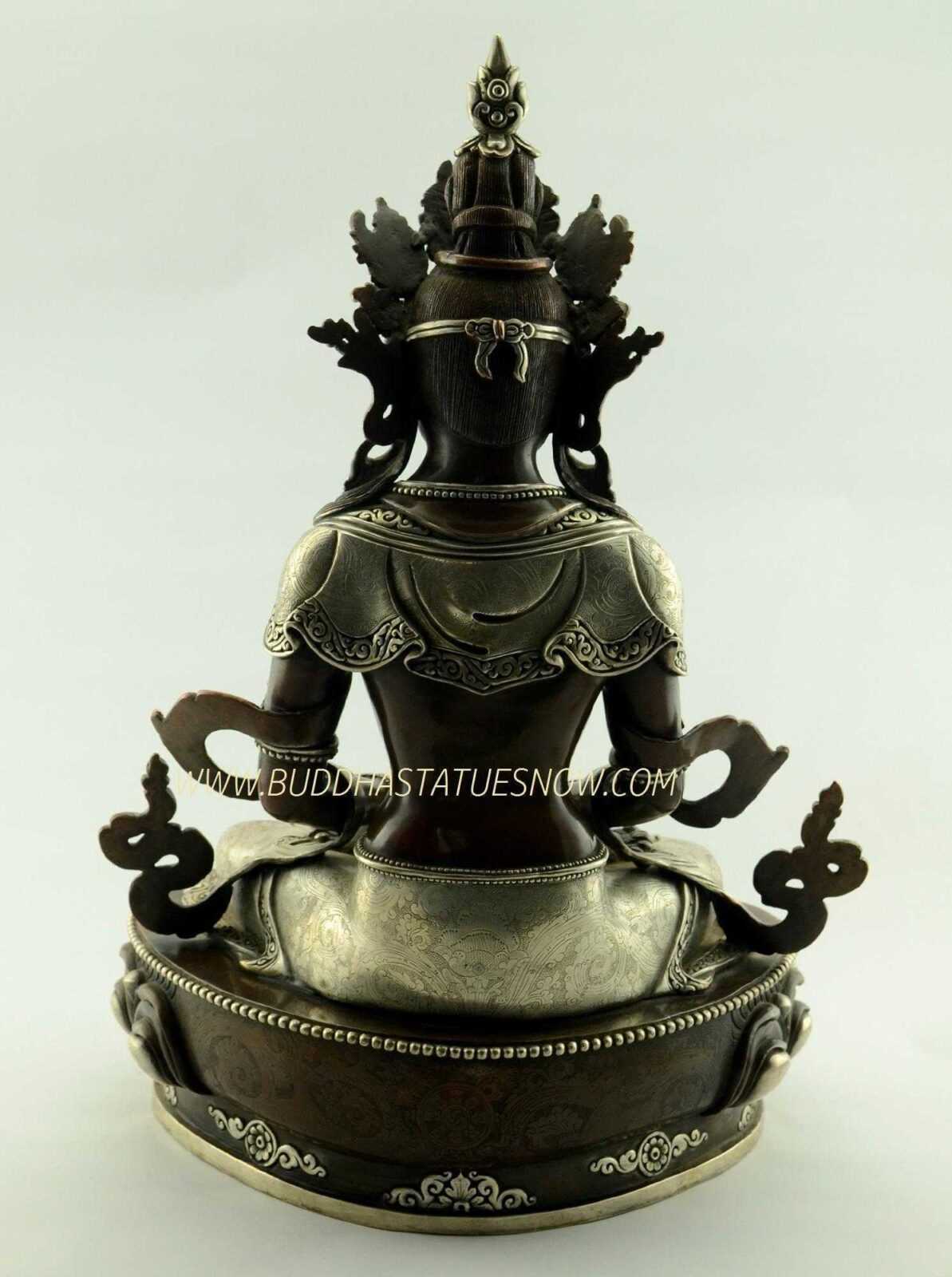
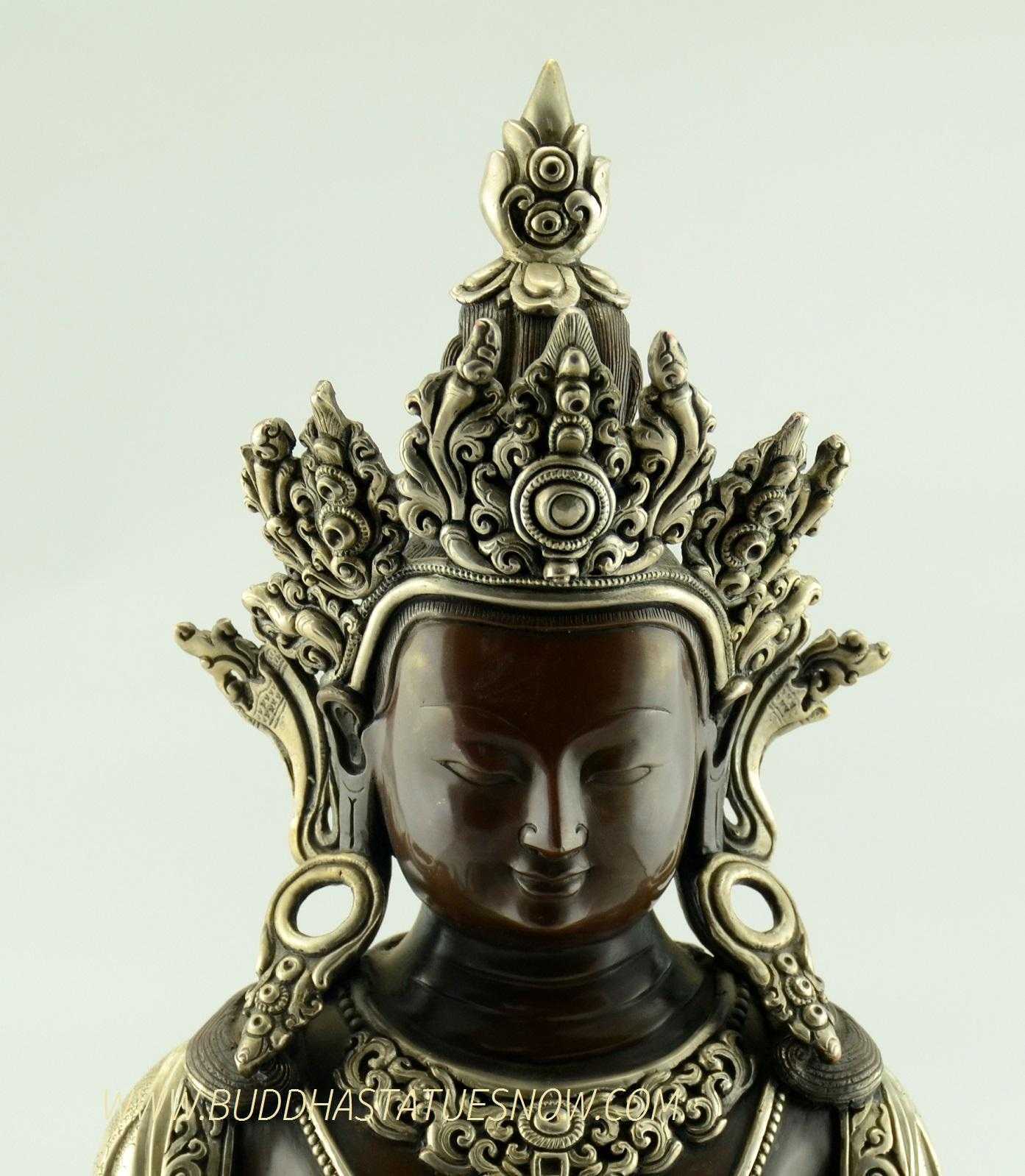
This magnificent 16.5-inch Silver Amitayus statue depicts Tsepame, the Buddha of Immeasurable Life, in an imposing two-tone presentation of oxidized copper alloy and finely worked silver plating. Handmade in Patan, Nepal, the sculpture combines a rich, dark copper finish across the face, torso and arms with luminous silver detailing on the celestial crown, jewelry, garments, flowing ribbons and lotus throne. Its generous proportions and carefully balanced posture give the statue a commanding yet deeply peaceful presence suitable for a principal home altar, Dharma center or collection of Himalayan Buddhist art.
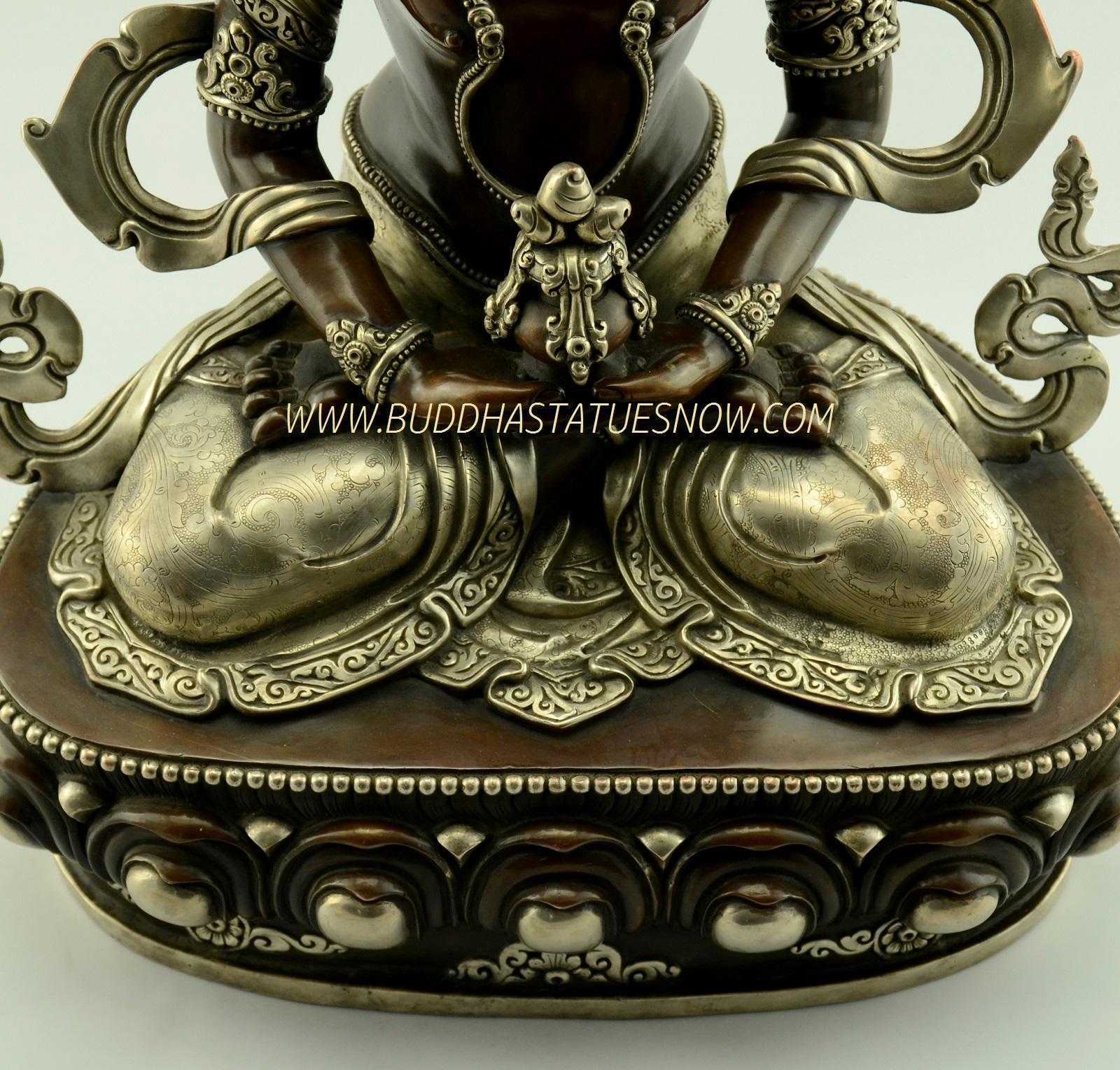
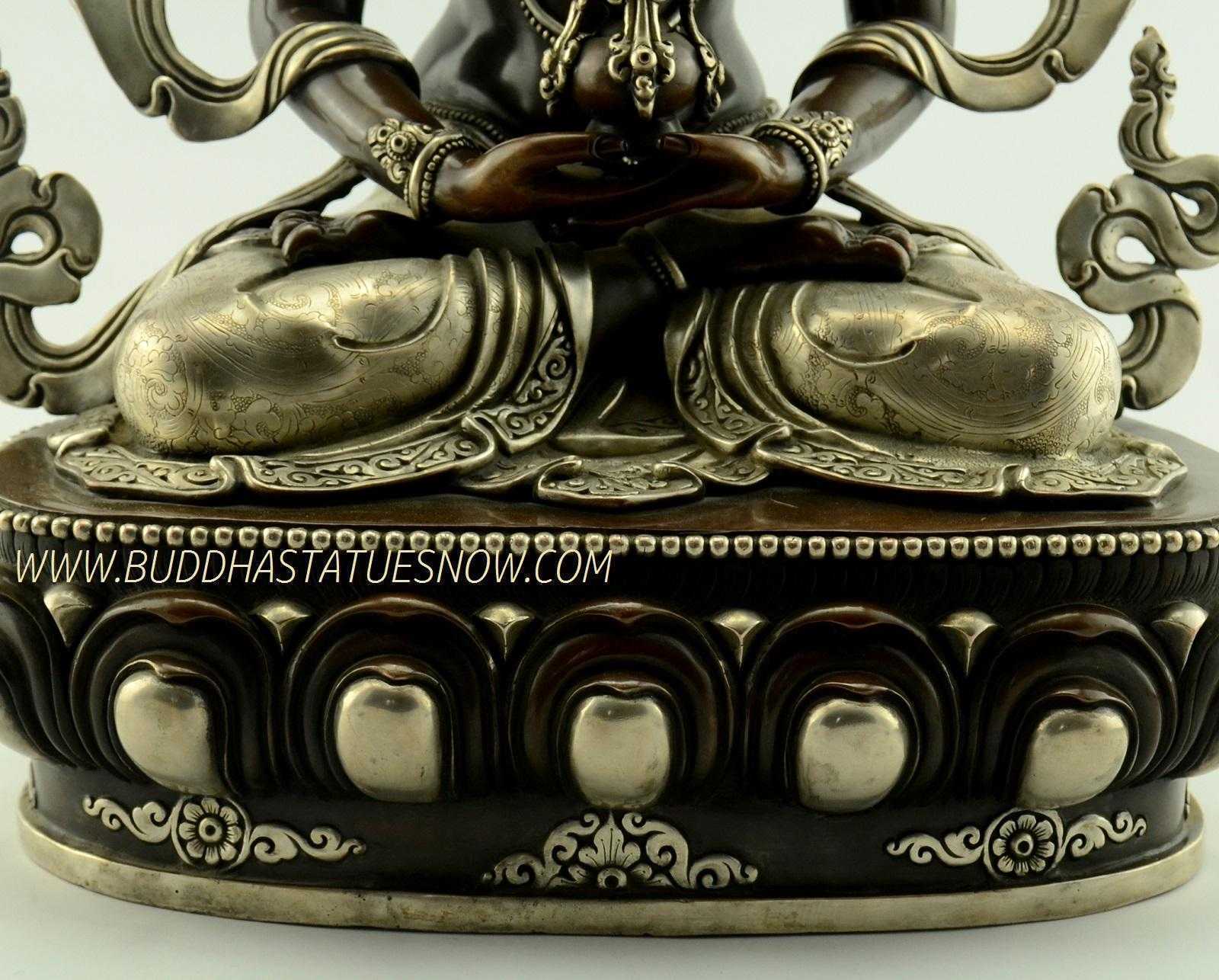
Amitayus sits in the full lotus posture with both hands resting together in the Dhyana Mudra, the gesture of meditative equipoise. Centered above his open palms is the long-life vase, his defining attribute, surmounted by an ornamental plume. Both the vessel and its finely modeled decoration are plated in silver, making the symbol of longevity the visual center of the composition. The stillness of his hands and posture contrasts gracefully with the broad celestial scarves that pass around his elbows and open into silver scrolling forms beside the throne.
Although Amitayus is a fully enlightened Buddha, he appears in the crowned and ornamented Sambhogakaya form traditionally associated with celestial Buddhas and advanced Bodhisattvas. His elaborate adornments therefore do not indicate ordinary royalty or worldly attachment. They symbolize the inexhaustible qualities, merit and enlightened activity of Buddhahood. Learn more about his relationship with Amitabha in our guide to Amitayus, the longevity form of Amitabha Buddha.
Silver Amitayus Statue Crown and Celestial Adornments
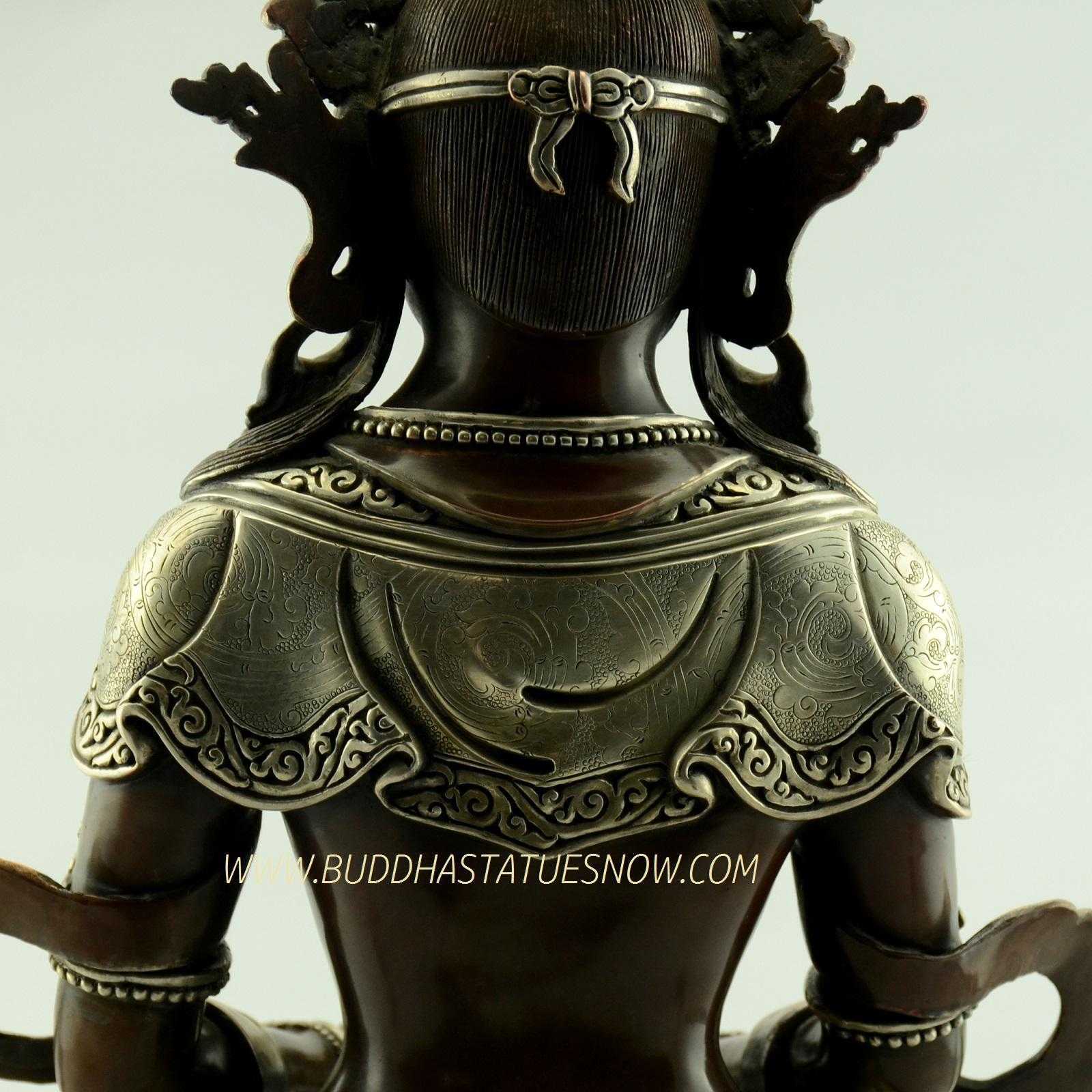
The tall silver-plated crown rises around Amitayus’s gathered hair in a sequence of flame-shaped points, culminating in an ornate finial. Circular ornaments, scrolling foliage and raised borders give the crown visual depth, while the dark hair and oxidized face provide a restrained background for the bright metalwork. Large open earrings frame the face, and the smooth, lowered gaze conveys the calm awareness of a Buddha established in unwavering meditation.
Silver necklaces descend across the chest in layered arrangements. A broad ornamental collar rests close to the neck, while a longer beaded strand follows the contours of the torso toward the waist. Matching silver armbands, bracelets and wrist ornaments repeat the crown’s decorative vocabulary. These elements have been distributed carefully so that the brighter details emphasize the statue’s proportions without obscuring the warm oxidized copper surface.
At the buyer’s request, the crown and jewelry may be further embellished with turquoise or red stones before shipping at no additional charge. Turquoise introduces a traditional Himalayan combination of blue and green, while red stones are especially appropriate for Amitayus because he belongs to the lotus family of Amitabha Buddha. The optional stones would stand out clearly against both the silver ornaments and the dark copper finish while preserving the sculpture’s traditional character.
Finely Engraved Silver Dhoti and Flowing Ribbons
One of the most distinctive features of this Silver Amitayus statue is the extensive silver-plated dhoti covering the crossed legs. Fine foliate engraving moves across the broad garment panels, creating a textile-like surface reminiscent of richly woven Himalayan brocade. Decorative borders follow the folds and hemlines, allowing the design to remain legible even where the cloth gathers over the knees and descends toward the center of the throne.
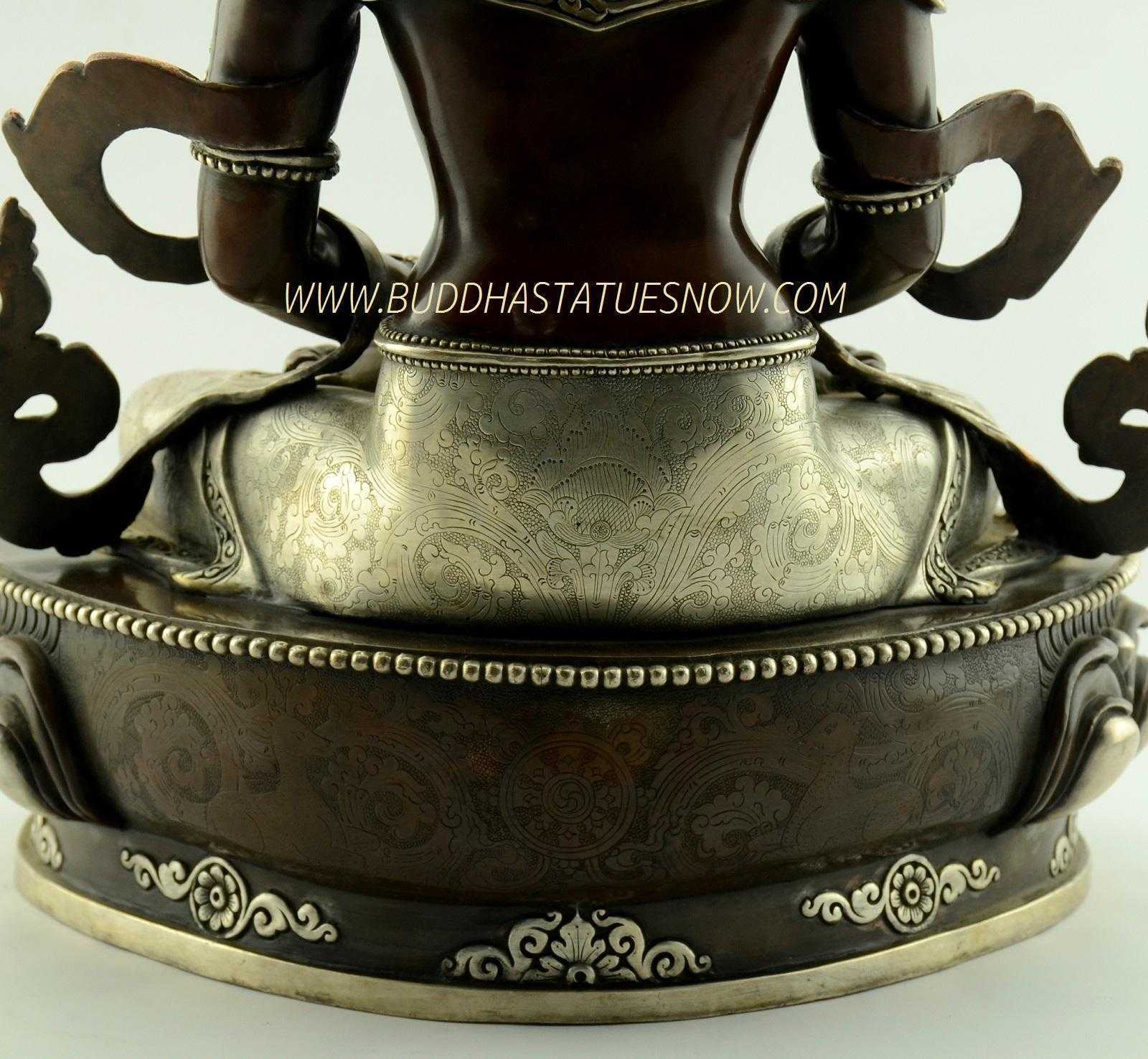
The engraving continues around the sides and across the reverse of the seated figure. Viewed from behind, the silver garment is covered with delicately chased botanical patterns rather than being left plain. This all-around craftsmanship shows that the statue was conceived as a complete sacred sculpture to be appreciated from every direction. The rear shoulder covering is also finished with engraved silver borders, while the gathered hair is secured by a silver band and ornament beneath the tall topknot.
Silver celestial ribbons encircle the forearms before extending outward into large scrolling terminals. Their movement brings a sense of graceful activity to the otherwise stable meditation posture. The silver-plated ribbons also visually connect the crown and upper jewelry with the dhoti and lotus throne, creating a coherent sequence of bright ornamentation from the top of the statue to the pedestal.
Amitayus and the Vase of Immortal Nectar
Amitayus is known in Tibetan as Tsepame, meaning “Immeasurable Life,” and in Sanskrit as the Buddha of Boundless Longevity. He is closely related to Amitabha Buddha: Amitabha emphasizes immeasurable light, Pure Land rebirth and liberation, while Amitayus expresses the long-life and merit-enriching activity of the same enlightened continuum. This form is frequently invoked in Tibetan Buddhist practices intended to remove obstacles to life, restore depleted vitality and create the conditions needed for continued Dharma practice.
The vase resting in Amitayus’s hands contains the nectar of immortality. Its meaning should not be reduced merely to extending ordinary life for its own sake. Within Buddhist practice, longevity is valuable because additional time allows a practitioner to cultivate wisdom, compassion and merit, receive teachings and work for the benefit of others. The ornamental plume rising from the vase suggests an inexhaustible source of life-supporting blessings rather than a finite worldly possession.
His full lotus posture expresses meditative stability, while the symmetrical placement of the vase at the center of the lap conveys balance and continuity. Together, the posture, mudra and sacred vessel make this statue particularly appropriate for long-life prayers, birthday offerings, recovery practices and rituals performed for teachers, family members or members of a Dharma community. Additional questions about his practices and attributes are answered in our Amitayus Buddha Statues FAQ.
Silver-Detailed Lotus Throne
Amitayus is seated upon a substantial single lotus throne with deep sculptural petals arranged around the front and sides. Selected petal centers are plated in silver, producing a measured visual rhythm against the dark oxidized copper. A silver beaded rim encircles the upper edge of the throne, while a matching silver border defines the lower edge of the pedestal.
The lower front of the throne is decorated with silver floral medallions and scrolling botanical motifs. On the reverse, fine engraving and raised repoussé-style ornamentation continue across the throne and the silver-plated garment, reinforcing the sculpture’s carefully finished appearance in the round. Rather than applying silver uniformly, the artisan concentrated it on the lotus petals, borders, medallions and sacred garments, allowing the darker copper fields to frame each decorative element.
Traditional Lost Wax Casting in Patan, Nepal
This Silver Amitayus statue was cast in copper alloy by master Newar artisans in Patan, Nepal, using the traditional lost wax method. The process begins with a detailed wax model formed according to established Himalayan iconometric proportions. The wax is enclosed in a heat-resistant mould and melted away, leaving a cavity into which molten copper alloy is poured.
After cooling, the mould is broken and the metal casting is refined entirely by hand. The artisan chases the contours, cleans the surface, engraves the garments and throne, and prepares the selected areas for silver plating. The sculpture is then finished to create the deep oxidized copper appearance visible across the face, torso and pedestal. Because the wax model is destroyed during casting and the chasing and engraving are completed individually, each handmade statue carries subtle variations that distinguish it from mechanically reproduced objects.
The finished sculpture measures approximately 16.5 inches high, 13 inches wide and 8.5 inches deep. Its broad throne, large ribbons and elevated crown give it a substantial altar presence beyond its stated height. Every statue is accompanied by a certificate of authenticity issued through Nepal’s Department of Archaeology, confirming its traditional production, materials and Nepali origin.
Silver Amitayus and Green Tara Statue Set
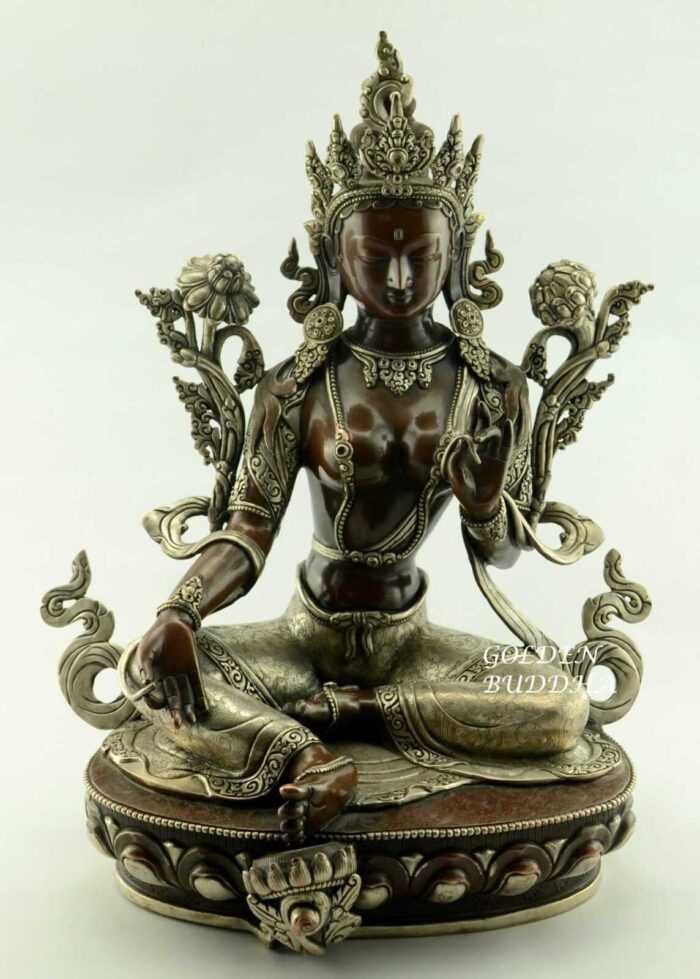
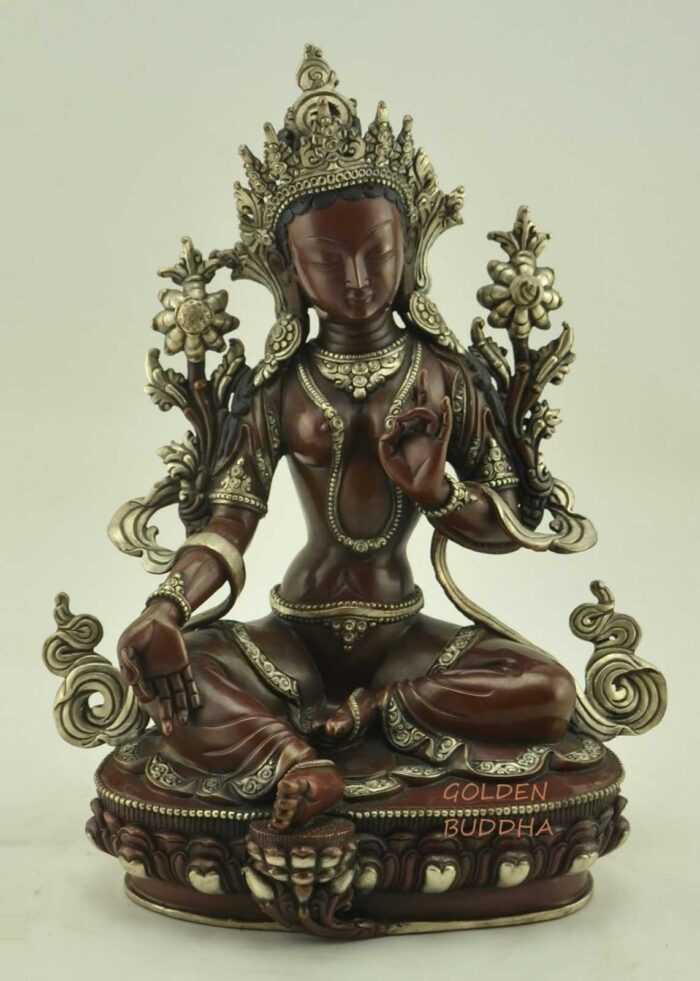
This Silver Amitayus statue forms an exceptional two-piece altar set with the matching Silver Green Tara sculpture. Both statues were created by the same Nepali master artisan in closely related proportions and finishes. Each combines an oxidized copper-alloy body with an elaborate silver crown, jewelry, engraved silver garments, flowing ribbons, silver-detailed lotus petals and ornamental work extending across the reverse of the throne.
Their iconography also creates a meaningful doctrinal relationship. Amitayus embodies immeasurable life, accumulated merit and the preservation of the favorable conditions needed for spiritual practice. Green Tara embodies swift compassion, protection and immediate enlightened activity. Her extended right leg shows her readiness to rise and respond, while Amitayus remains centered in meditative equipoise around the vase of long-life nectar. Together they unite the sustaining quality of longevity with the active compassionate removal of obstacles.
This pairing is especially appropriate for a shrine dedicated to health, long life, protection and the continued opportunity to practice the Dharma. Amitayus represents the extension and enrichment of life’s positive conditions; Green Tara helps protect those conditions from fear, adversity and obstruction. Visually, the similar silver-plated crowns, finely engraved garments, curling ribbons and coordinated lotus thrones allow both sculptures to function as a unified altar ensemble while preserving the distinctive attributes of each deity.
Custom Made Silver Amitayus Statues
A custom made Amitayus statue may be commissioned for a home altar, Buddhist temple, meditation center or long-life ceremony. The artisan can adapt the sculpture to a preferred height while preserving Amitayus’s required iconography, including the full lotus posture, Dhyana Mudra, long-life vase, celestial crown, jewelry and flowing ribbons.
Available custom options may include an oxidized copper finish with silver plating similar to this statue, an antiquated finish without silver, partial gilding, 24K fire gilding, a face hand painted with 18K gold and natural pigments, gemstone settings, additional garment engraving or a specially designed lotus throne. A coordinated two-piece commission may also be created so that Amitayus and the Silver Green Tara sculpture share matching dimensions, silver finishes, throne proportions and ornamental details. Such a commission would unite Amitayus’s blessings of immeasurable life and merit with Green Tara’s swift compassionate activity in a visually and doctrinally coherent altar set.
Authentic, Handmade in Nepal
Every statue is handcrafted in Patan, Nepal, using traditional lost wax casting and comes with a certificate of authenticity issued by Nepal’s Department of Archaeology, verifying its materials, technique, and origin.