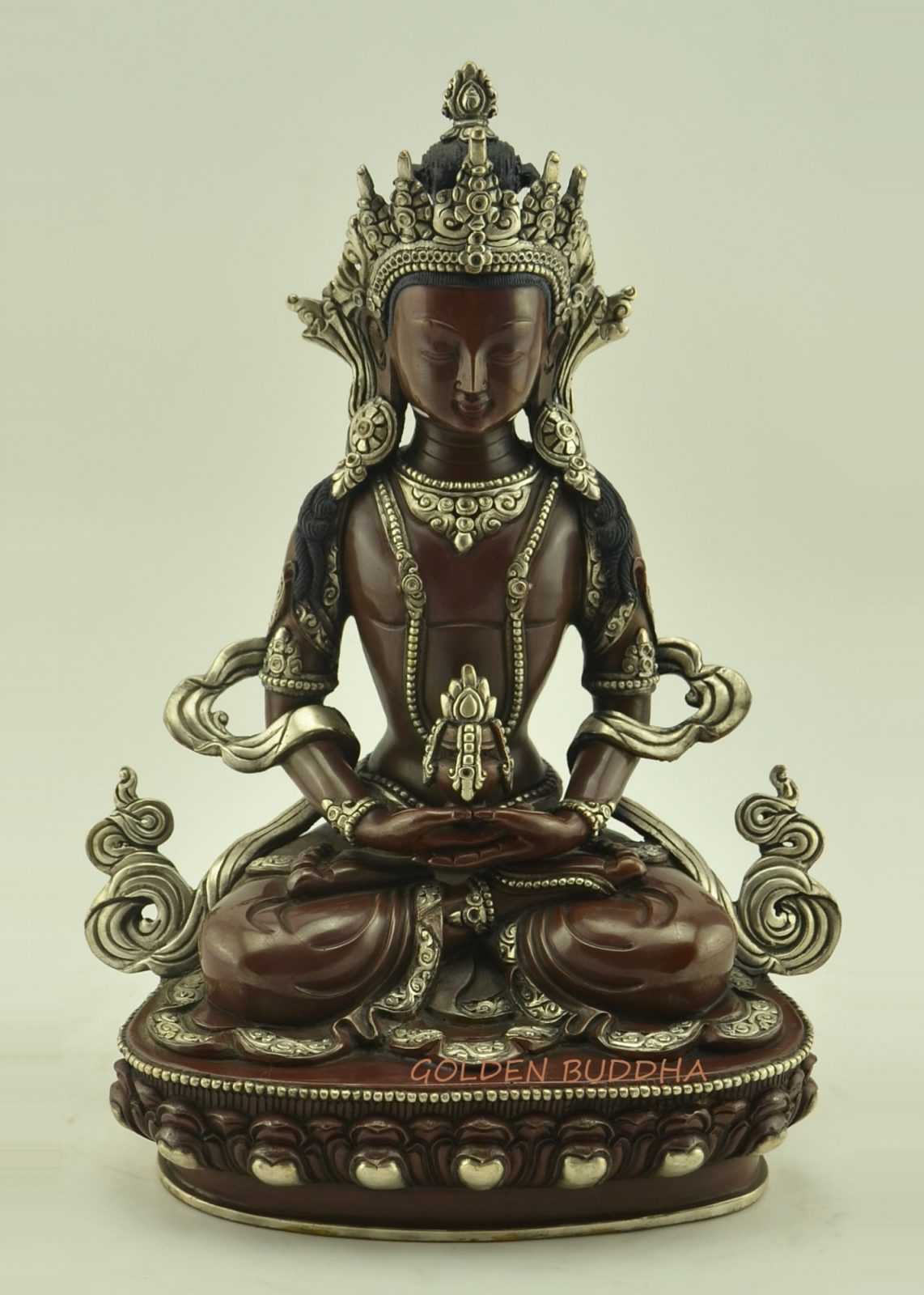
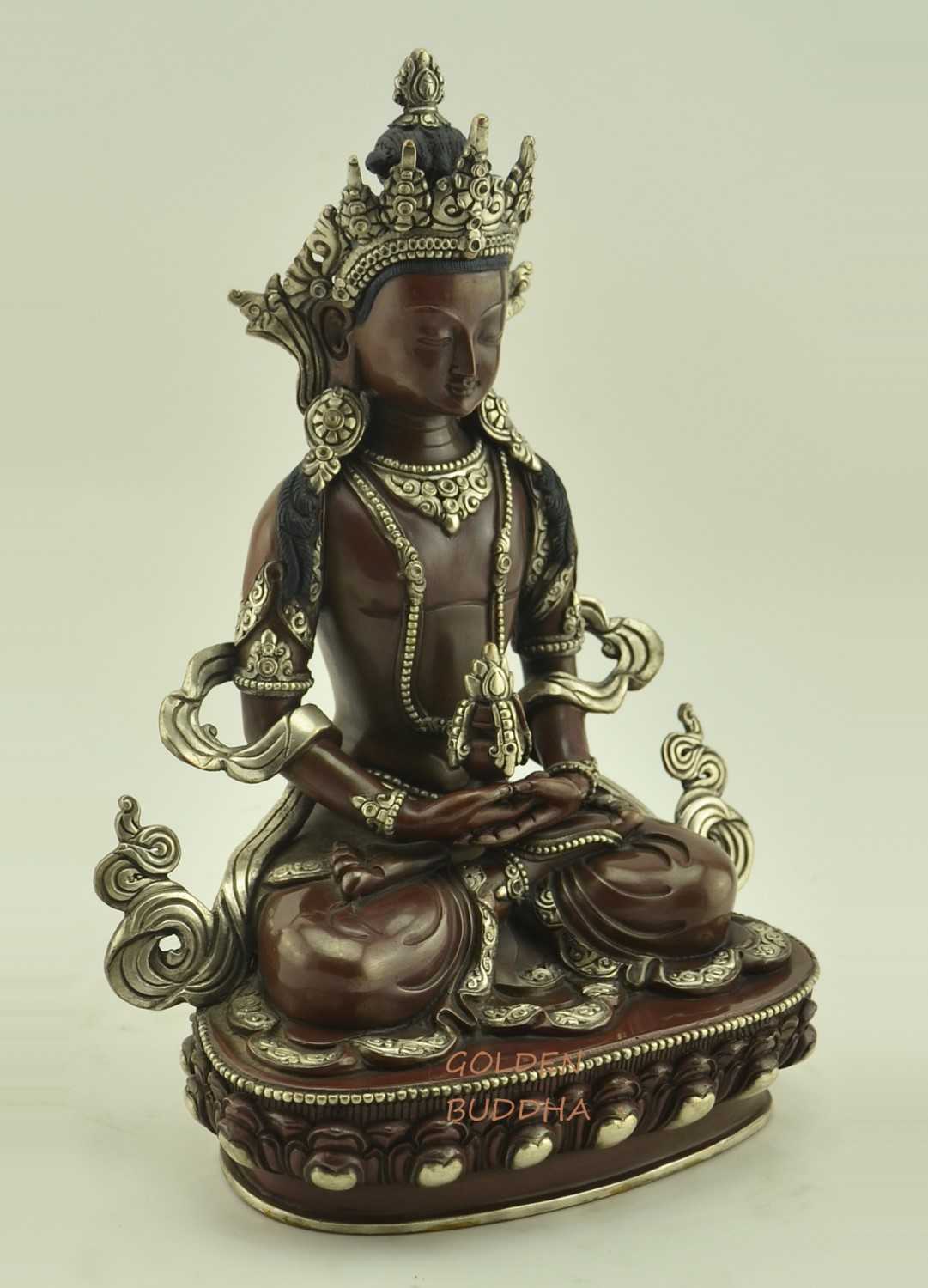

This 9.75″ Amitayus Buddha sculpture represents Tsepame, the Buddha of Infinite Life, in an elegant combination of oxidized copper and silver-plated detail. Handcrafted from copper alloy by a master Newar artisan in Patan, Nepal, the sculpture was created through the traditional lost-wax casting method. Its warm reddish-brown finish gives the body, face, hands, and garments a dignified antiquated character, while carefully placed silver highlights illuminate the Bodhisattva crown, jewelry, celestial scarves, robe borders, longevity vase, throne rim, and selected lotus petals.
The two-tone treatment has been applied with restraint so that the silver enhances rather than overwhelms the sculptural form. Silver outlines the elaborate five-pointed crown and its jewel-like ornaments, brightens the large circular earrings, and continues through the layered necklaces, armbands, bracelets, waistband, and finely bordered dhoti. The dark oxidized copper remains visible across the smooth torso and folded legs, creating a clear visual distinction between Amitayus’s peaceful bodily form and the radiant adornments of his Sambhogakaya appearance.
Amitayus’s blue-black hair is arranged in a tall gathered topknot behind the crown and capped by an ornamental silver finial. His serene face remains unpainted, allowing the gently lowered eyes, softly modeled cheeks, urna, and composed lips to emerge directly from the oxidized copper surface. The sculptor has balanced a youthful, peaceful expression with the formal majesty of the crown and jewelry, giving the statue a contemplative presence suitable for a home altar, longevity shrine, monastery, healing room, or Dharma center.
Amitayus Buddha Sculpture Meaning and Longevity Practice
Amitayus is closely related to Amitabha Buddha, the Buddha of Infinite Light who presides over the Western Pure Land of Sukhavati. Amitayus may be understood as Amitabha’s celestial longevity form, emphasizing infinite life, accumulated merit, spiritual vitality, and the favorable conditions needed to continue practicing the Dharma. His Sanskrit name combines amita, meaning immeasurable or infinite, with ayus, meaning life. In Tibetan he is called Tsepame, while the name Aparmita is also widely used for this long-life manifestation.
Longevity practice in Tibetan Buddhism is not directed solely toward extending life for worldly enjoyment. A long and healthy human life is valued because it provides additional time to study Buddhist teachings, cultivate meditation, accumulate merit, purify harmful tendencies, serve teachers and communities, and benefit sentient beings. Amitayus therefore represents both duration of life and the wisdom to use that life purposefully. Learn more about his role in our guide to the Three Long Life Deities and Tibetan longevity practice.
Amitayus practices are commonly performed when illness, declining vitality, or obstacles threaten to shorten the opportunity for spiritual development. His image may serve as a focus for mantra recitation, visualization, offerings, and long-life ceremonies undertaken for oneself, a teacher, a family member, or an entire community. His relationship with Amitabha and his place among the principal Buddhist deities are discussed further in our guide to Amitayus in the Buddhist pantheon.
Amitayus Buddha Sculpture Iconography
This Amitayus Buddha sculpture portrays Tsepame seated in the full lotus posture, with both legs crossed in meditative equilibrium. His hands rest together in the Dhyana mudra, the gesture of meditation and unwavering concentration. The right hand rests above the left, with both palms facing upward to support his defining attribute: the vessel containing the nectar of immortality.
The longevity vessel, or kalasha, is especially prominent on this statue because it is finished in silver and rises clearly against the darker copper torso. Its rounded body is topped by an ornamental lid and an upward-sprouting plume, traditionally associated with the nectar of long life. The vase represents the inexhaustible store of vitality, merit, wisdom, and favorable conditions embodied by Amitayus. In Tibetan long-life ceremonies, a ritual vessel may be filled with consecrated liquid and symbolically connected with the nectar held by the deity.
Amitayus wears the crown and elaborate jewelry of a celestial Buddha rather than the plain monastic robes commonly seen on Amitabha. His five-pointed crown, earrings, necklaces, armlets, bracelets, and ornaments signify the Sambhogakaya, or enjoyment-body manifestation through which an enlightened Buddha appears in a radiant form accessible to advanced practitioners. At the buyer’s request, suitable settings in the crown and jewelry may be embellished with turquoise and red coral stones before delivery.
Silver Details, Celestial Scarves and Lotus Throne
Long celestial scarves pass around Amitayus’s arms and form broad loops beside the elbows before curling outward into stylized cloud-like forms near the lotus throne. These ribbons are among the most graceful elements of the composition. Their silver finish separates them clearly from the oxidized copper body and creates a sense of movement around the otherwise stable meditative figure. Smaller scarf ends and garment folds continue around the knees, contributing depth without disturbing the statue’s symmetrical balance.
Fine silver edging follows the hemlines of the dhoti across the folded legs and around the layered cloth at the center of the seat. Raised scrolling patterns appear within these borders, while the remaining copper surfaces retain a smooth, softly reflective finish. The silver details also continue around the neckline and shoulder covering, bringing attention to the transition between the elaborate Bodhisattva adornments and the calm simplicity of the torso.
Amitayus sits upon a single lotus throne formed by one principal register of rounded lotus petals. Selected petal centers are highlighted in silver, creating a measured rhythm around the front of the pedestal. A silver beaded border follows the upper rim, while a narrow silver line defines the lower edge. The lotus represents purity and enlightened realization, recalling the flower that rises unstained from muddy water. The oxidized copper ground preserves the antiquated character of the throne, while the silver accents visually connect it with the crown, jewelry, scarves, garments, and longevity vessel.
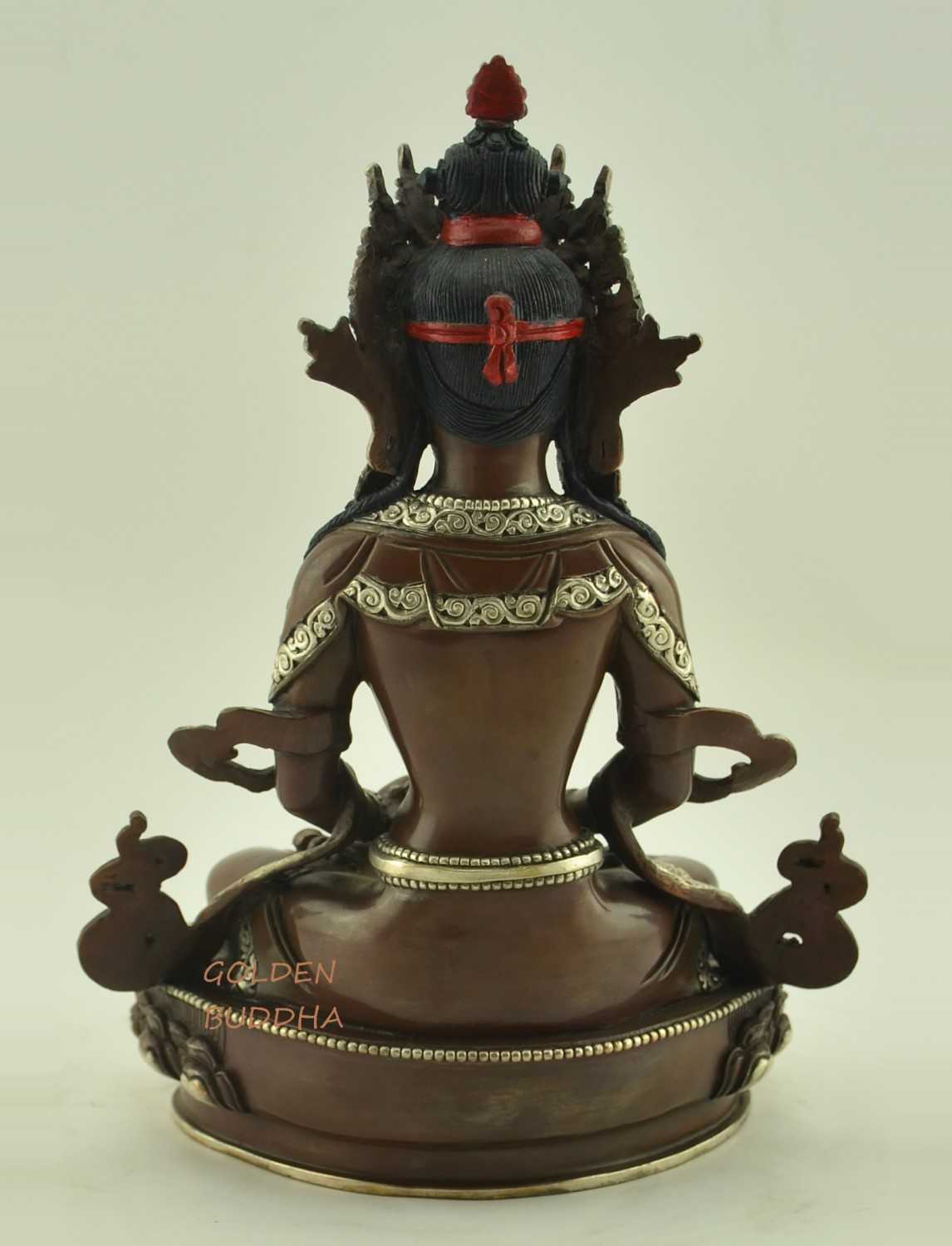
Viewed from behind, the statue reveals the carefully modeled construction of the hair, crown, shoulder covering, waist ornaments, celestial ribbons, and lotus throne. The blue-black hair is gathered into a tall topknot secured by painted red bands, while silver scrollwork follows the rear border of the shoulder wrap. Silver beading encircles the waist and upper throne rim. The reverse is deliberately more restrained than the front, allowing the smooth contours of the back and seated posture to remain prominent while preserving visual continuity with the silver detailing seen from the front.
Traditional Newar Lost-Wax Craftsmanship
This Amitayus Buddha sculpture was individually handcrafted in Patan, Nepal, a historic center of Newar Buddhist metalwork. The artisan first prepared a detailed wax model before encasing it in a clay mould. Heating removed the wax and created a cavity into which molten copper alloy was poured. After casting, the clay mould was broken away and the figure was refined, chased, engraved, assembled, finished, and selectively plated by hand. Because the wax model and clay mould are destroyed during this process, each completed sculpture carries subtle distinctions created by the artisan’s individual work.
The oxidized finish deepens the warm natural tones of the copper alloy and settles into recessed details around the crown, jewelry, garment borders, and pedestal. Silver plating was then applied selectively to the most important ornamental features. This combination gives the statue the presence of an older monastery sculpture while preserving the crisp detail of newly completed craftsmanship. Browse our collection of Amitayus Buddha statues to compare different sizes, finishes, and artistic interpretations.
The Three Long Life Deities Statue Set
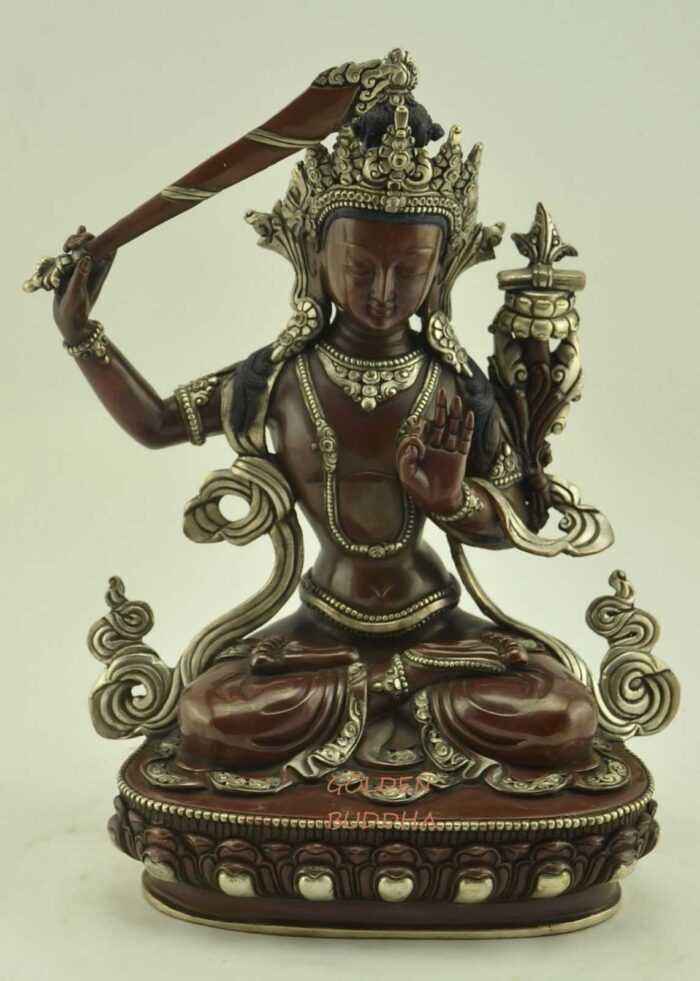
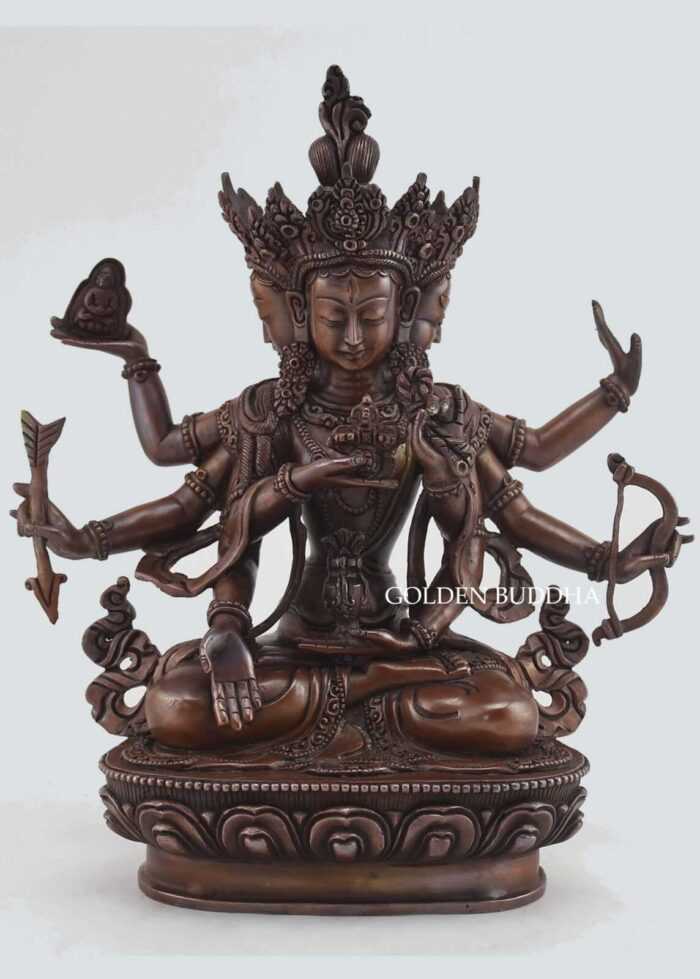
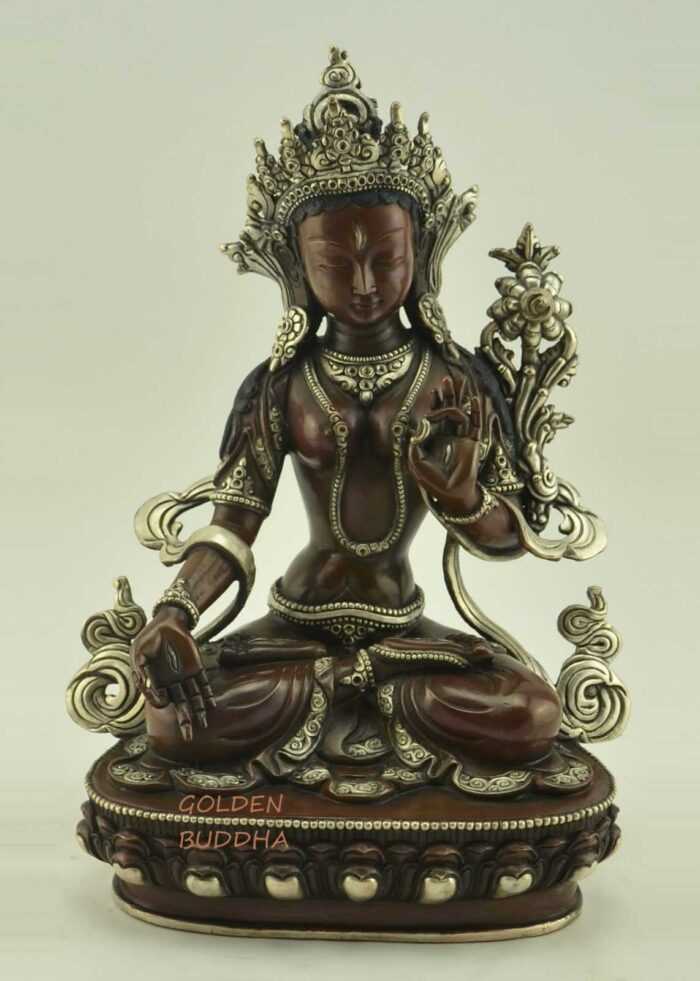
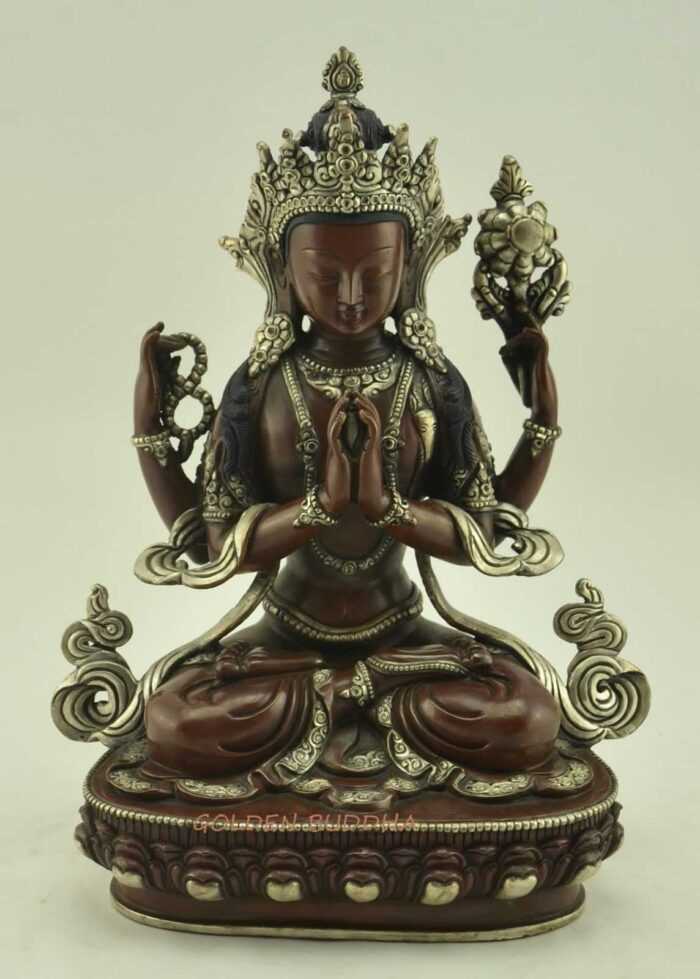
This Amitayus Buddha sculpture may be displayed as part of a coordinated Three Long Life Deities set with the Dolkar sculpture representing White Tara and the Oxidized Namgyalma statue representing Ushnishavijaya. All three figures were created with closely related altar proportions, copper-alloy construction, rich oxidized finishes, traditional Bodhisattva ornamentation, and complementary lotus thrones. Amitayus and Dolkar share extensive silver detailing across their crowns, jewelry, robe borders, ribbons, sacred attributes, throne rims, and selected lotus petals, while Namgyalma’s unified oxidized copper finish provides a dignified visual anchor for her more elaborate three-faced and eight-armed composition.
The three deities also form a complete doctrinal arrangement. Amitayus embodies infinite life, accumulated merit, spiritual vitality, and the extension of favorable conditions for Dharma practice. Dolkar, or White Tara, contributes compassionate healing, serenity, protection, and the restoration of weakened life energy. Namgyalma purifies harmful karma, removes obstacles associated with untimely death, and protects practitioners from conditions leading toward unfavorable rebirth.
Displayed together, Amitayus increases and sustains life, White Tara heals and renews its vital energy, and Namgyalma purifies and protects the karmic circumstances upon which that life depends. Their purpose is not merely to prolong ordinary existence, but to preserve the precious opportunity to cultivate wisdom, compassion, merit, and realization. The shared oxidized copper and silver treatments make the three statues visually harmonious while their individual iconography preserves the distinct function of each deity.
Amitayus Buddha Sculpture ‒ Filling, Blessing and Consecration
The statue includes a consecration opening so that it may be filled with sacred texts, printed mantras, incense, medicinal substances, precious materials, and other traditional contents before being blessed according to the buyer’s Buddhist lineage. This preparation allows the handmade image to become a properly completed object of practice and veneration. Our guide to Buddha statue filling, blessing, and consecration explains the traditional process and available preparation options.
Custom Made Amitayus and Long-Life Deity Statues
Collectors, practitioners, monasteries, and Dharma centers may commission a custom made Tibetan Buddhist statue based upon this Amitayus design. A custom Tsepame sculpture may be produced in a different size with an oxidized copper finish, selective silver plating, another traditional finish, partial 24K fire gilding, or complete 24K fire gilding with the face separately hand painted in 18K gold and natural pigments. Additional options may include personalized crown and jewelry details, turquoise or red coral embellishment, expanded garment engraving, altered silver placement, a different longevity vessel, or a customized lotus throne while preserving the traditional iconography of Amitayus.
A complete custom Three Long Life Deities set may also be commissioned with Amitayus, Dolkar, and Namgyalma designed together so that all three statues share the same height, finish, facial character, silver treatment, decorative language, and lotus-throne proportions. Commissioning the figures as one unified project allows the artisan to coordinate their appearance while preserving their complementary spiritual functions: Amitayus extending life and merit, White Tara healing and renewing life energy, and Namgyalma purifying karma and protecting against untimely death. Each custom statue is individually cast from copper alloy, refined, engraved, finished, and assembled by hand in Nepal according to traditional Himalayan Buddhist proportions.
Authentic, Handmade in Nepal
Every statue is handcrafted in Patan, Nepal, using traditional lost wax casting and comes with a certificate of authenticity issued by Nepal’s Department of Archaeology, verifying its materials, technique, and origin.