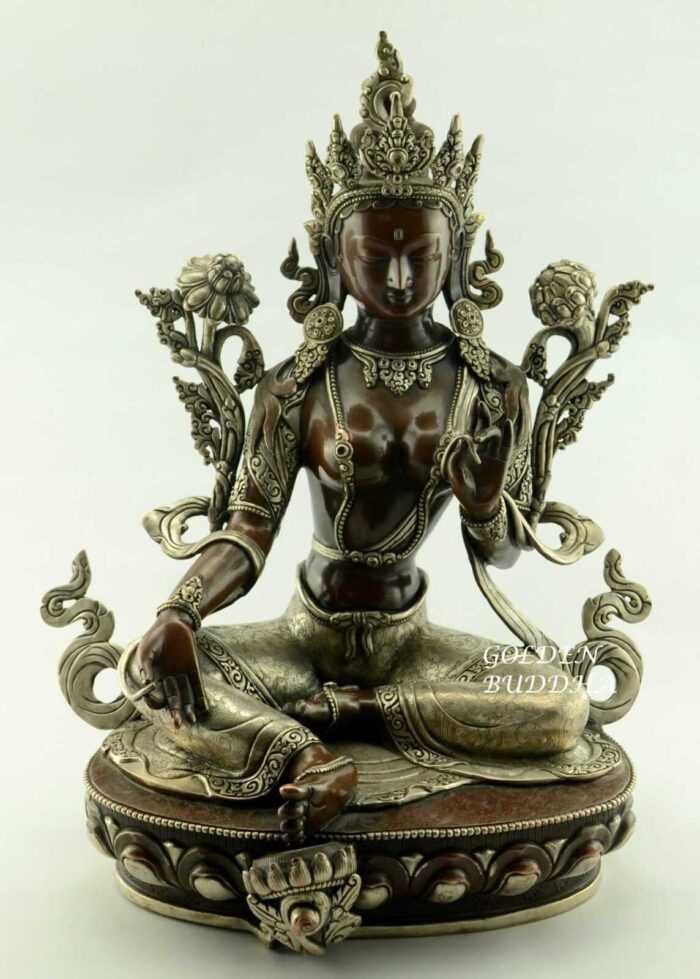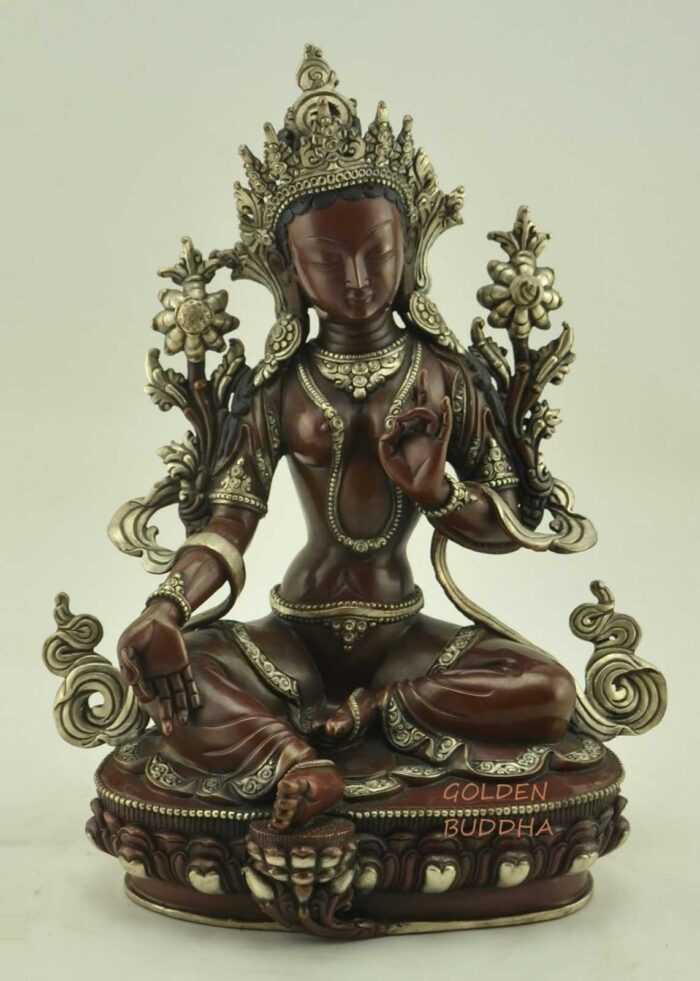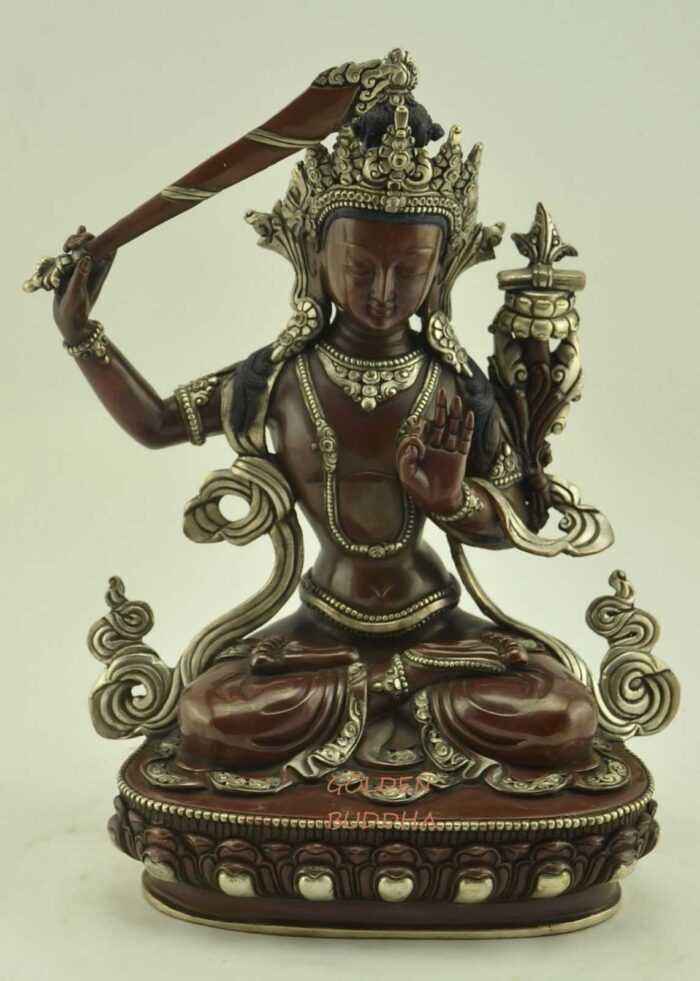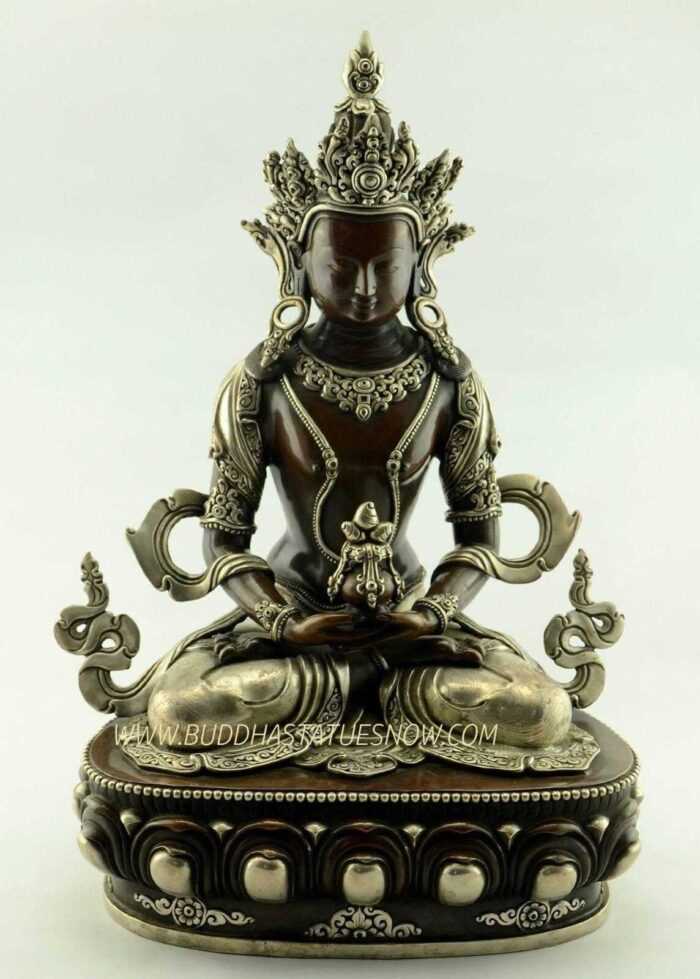
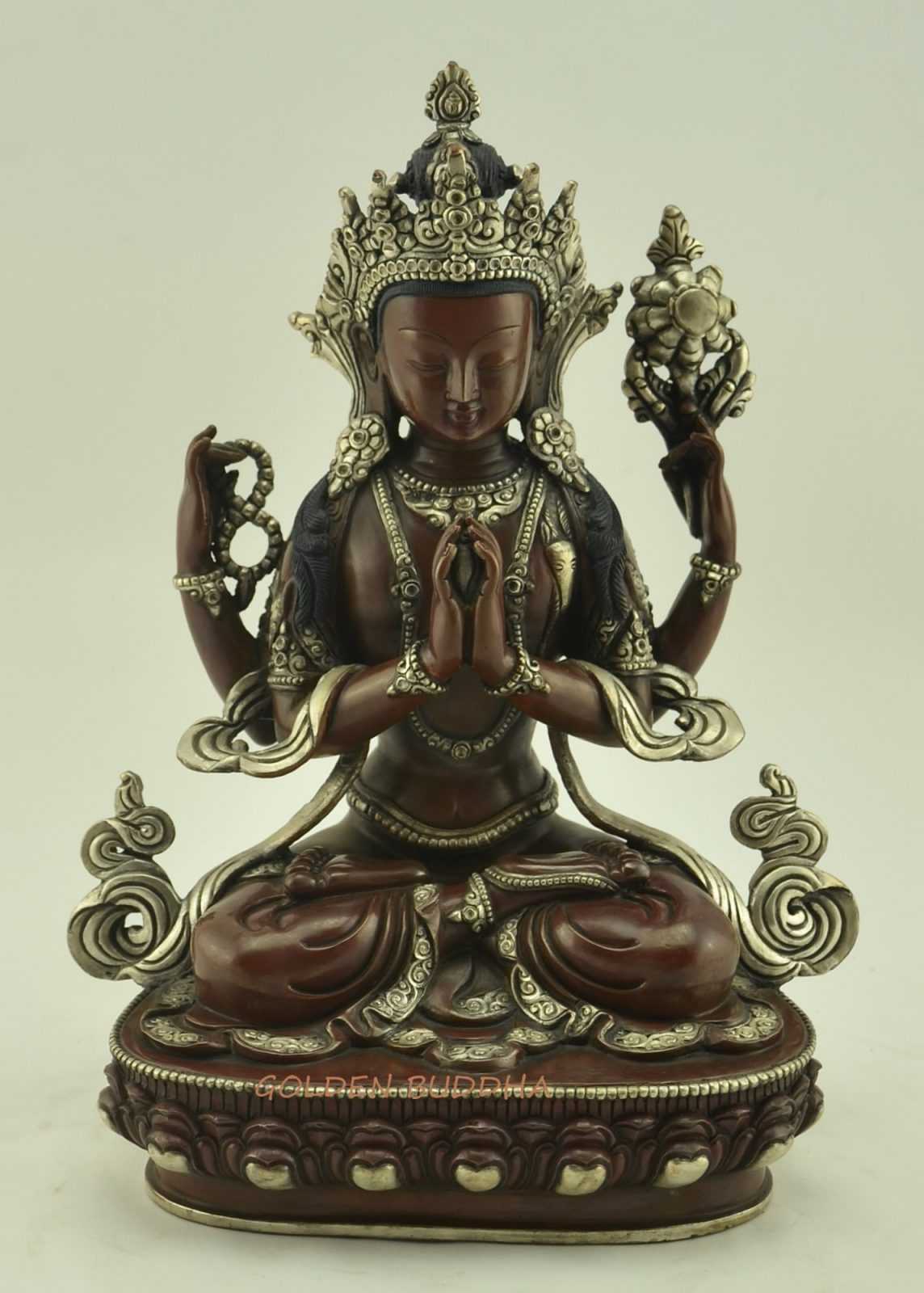
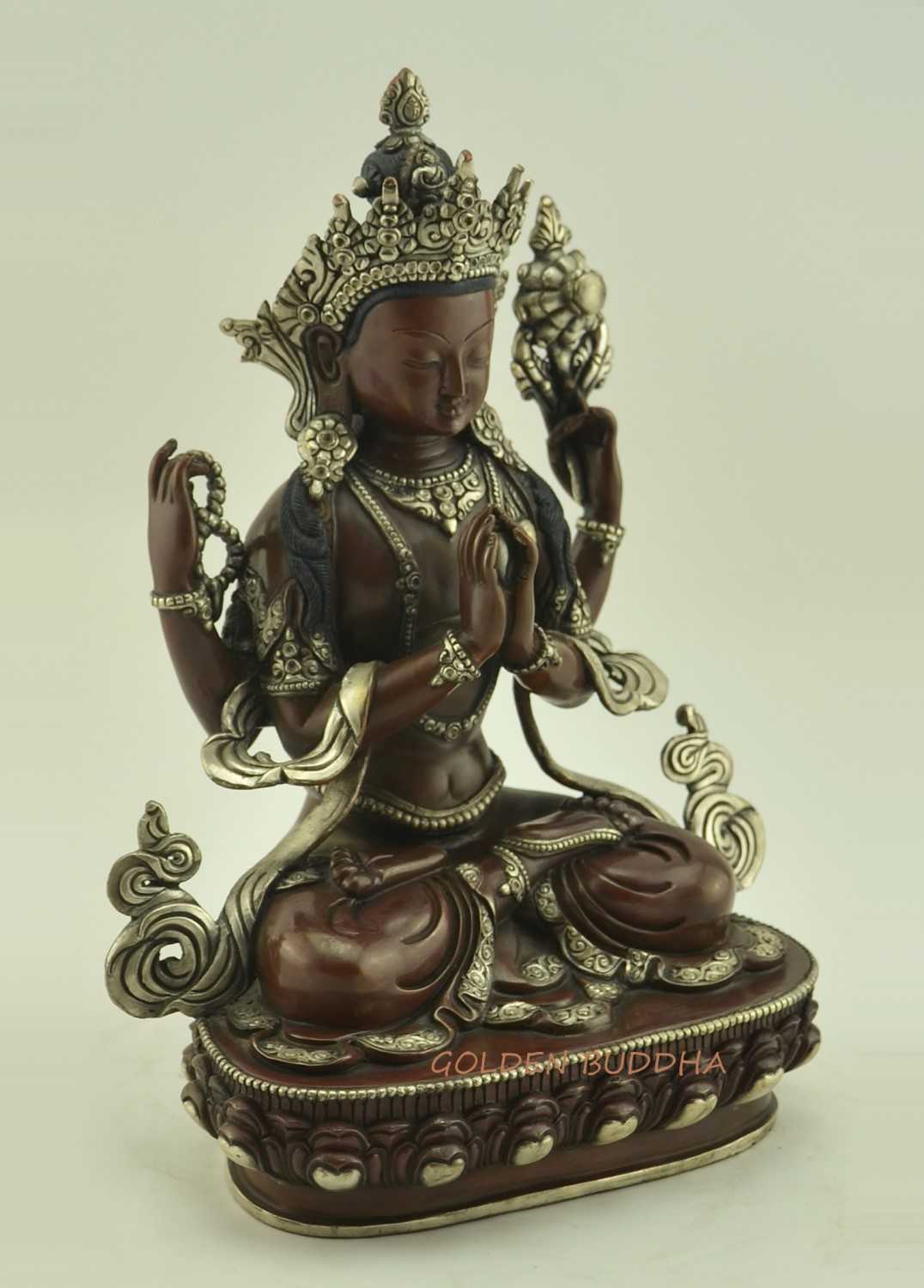
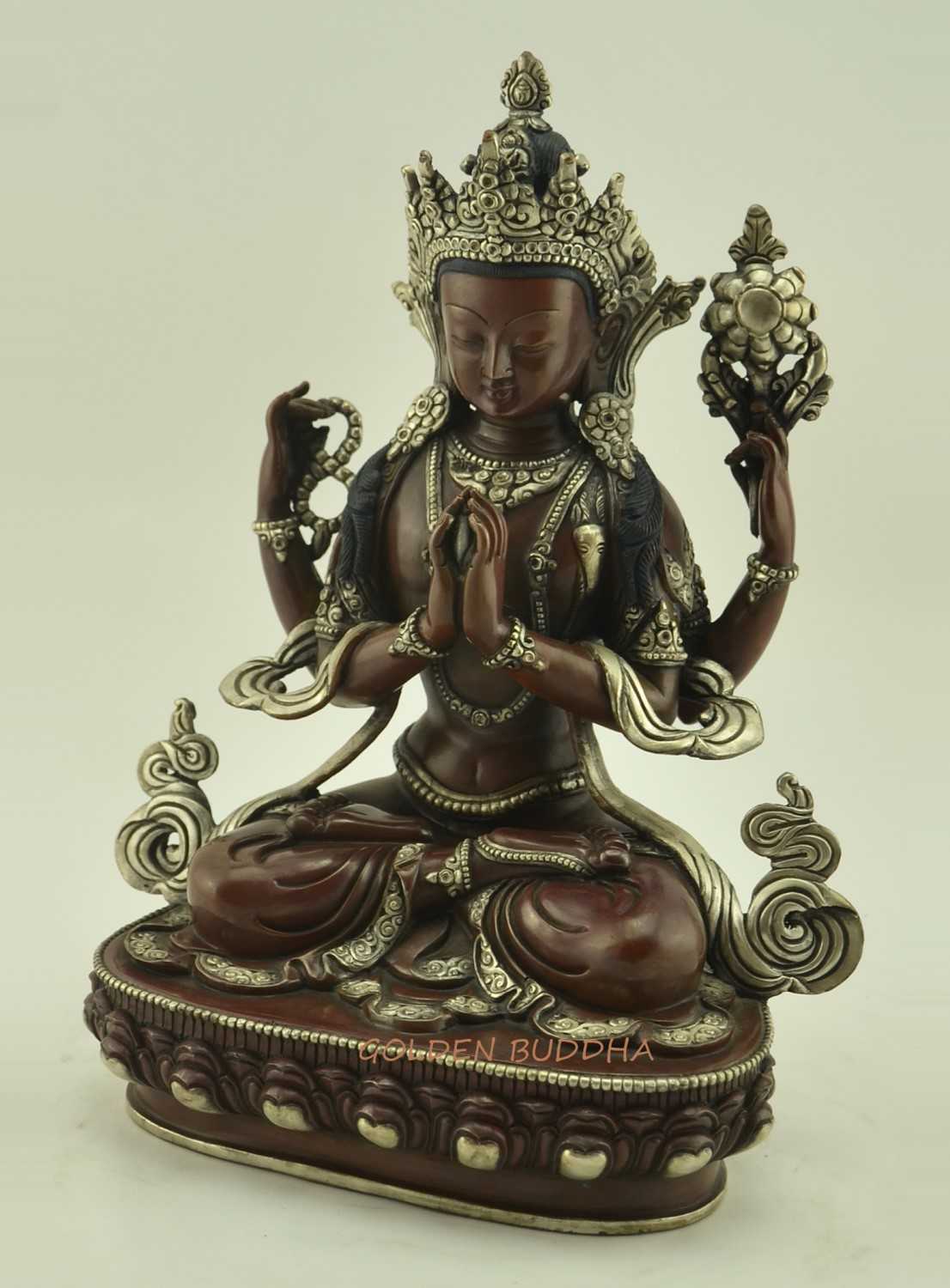
This 9.75-inch Silver Chenrezig statue portrays four-armed Avalokiteshvara, the Bodhisattva who embodies the limitless compassion of all the Buddhas. Handmade in Patan, Nepal, the sculpture was cast in copper alloy using the traditional lost wax method and finished with a rich oxidized surface. Selective silver plating illuminates the Bodhisattva crown, jewelry, celestial ribbons, robe hemlines, sacred attributes and lotus-throne details, creating a balanced contrast between warm antiquated copper and cool silver ornamentation.
The two-tone treatment is carefully integrated throughout the composition. Silver highlights define the elaborate crown, floral earrings, layered necklaces, armbands, bracelets and engraved borders of the garments. The long celestial ribbons emerging beside the arms are also finished in silver, visually connecting the upper body with the curling ornaments beside the lotus throne. A silver beaded rim encircles the pedestal, while selected lotus-petal centers are highlighted to repeat the bright details found in the crown and jewelry.
At the buyer’s request, the crown and ornaments may be further embellished with turquoise and red stones before delivery at no additional charge. These optional stones can introduce traditional Himalayan color without obscuring the statue’s refined oxidized-and-silver appearance. The sculpture’s harmonious proportions, finely modeled hands and peaceful expression make it suitable for a personal shrine, meditation room, Dharma center or collection of authentic Himalayan Buddhist art.
Silver Chenrezig Statue — Bodhisattva of Compassion
Chenrezig is the Tibetan name for Avalokiteshvara, the great Bodhisattva whose enlightened awareness responds to the suffering of sentient beings. His name is commonly interpreted as the one who looks upon the world with compassionate eyes. Rather than remaining absorbed in personal liberation, Chenrezig represents the Mahayana aspiration to attain enlightenment so that every being may be guided beyond suffering.
Tibetan Buddhism places Chenrezig at the heart of compassion practice. His six-syllable mantra, Om Mani Padme Hum, is recited throughout the Himalayan world as a method for cultivating loving concern, purifying obscurations and awakening the compassionate nature of the mind. A Chenrezig image placed on an altar can therefore serve as more than a decorative sculpture: it provides a visible focus for mantra recitation, meditation and the daily intention to benefit others. Learn more about Chenrezig and Avalokiteshvara in Tibetan Buddhism.
Four-Armed Chenrezig Iconography
This Silver Chenrezig statue presents the Bodhisattva with four arms, traditionally associated with the four immeasurable qualities of loving-kindness, compassion, sympathetic joy and equanimity. These qualities describe a mind that wishes all beings to possess happiness, remain free from suffering, rejoice in wholesome conditions and live beyond attachment and aversion. The four arms also communicate the breadth of Chenrezig’s activity, extending compassion in every direction rather than toward a limited group of beings.
His principal hands meet before the heart in a devotional gesture surrounding the cintamani, or wish-fulfilling jewel. In Buddhist iconography, the jewel does not represent the granting of ordinary material desires alone. It symbolizes the awakened qualities capable of fulfilling the deepest aspiration of sentient beings: freedom from ignorance, suffering and cyclic existence. Its position at Chenrezig’s heart shows that compassionate activity arises from the innermost enlightened intention.
The upper right hand holds a mala used for the continuous recitation of compassionate prayers and mantras. Its circular succession of beads suggests uninterrupted activity, reminding practitioners that compassion must be renewed repeatedly rather than expressed only on rare occasions. The upper left hand holds the stem of a lotus blossom, which rises beside the shoulder. The lotus represents purity because it grows from muddy water without becoming stained by it, just as an awakened being remains active within samsara without being overcome by its confusion.
Amitabha Buddha and the Antelope Skin
A small image of Amitabha Buddha appears at the crown of Chenrezig’s head. Amitabha is regarded as Chenrezig’s spiritual source and identifies him with the lotus family of enlightened compassion. This miniature Buddha also distinguishes Chenrezig from other crowned Bodhisattvas whose seated postures and ornaments may appear similar at first glance.
An antelope skin rests over Chenrezig’s left shoulder, with its small head visible against the chest. The gentle animal is traditionally associated with peace, sensitivity and harmlessness. Its presence emphasizes that Chenrezig’s compassion is neither forceful nor self-serving. It responds to suffering with patience and tenderness while remaining alert to the needs of every being.
The Bodhisattva’s calm, lowered gaze reinforces this quality. His expression is attentive without appearing troubled, reflecting compassion joined with meditative stability. This is an important distinction in Buddhist practice: enlightened compassion does not become overwhelmed by suffering but perceives it clearly and responds with wisdom, courage and skillful means.
Silver Crown, Jewelry and Celestial Ribbons
Chenrezig wears the crown and jewelry of a celestial Bodhisattva rather than the plain robes of a monastic Buddha. The tall silver-plated crown surrounds the dark gathered hair and frames the central Amitabha image. Floral earrings descend beside the face, while layered necklaces, a jeweled collar, armbands and bracelets follow the graceful contours of the body. These ornaments do not signify attachment to luxury. Within Buddhist iconography, they represent the perfected qualities and inexhaustible virtues of an enlightened being.
Silver borders define the shoulder covering and garment hemlines, emphasizing the carefully modeled folds without covering the broad oxidized copper surfaces. Long silver ribbons pass around the forearms before opening into broad, curling forms beside the body. Their rhythmic movement prevents the seated figure from appearing static and suggests compassionate activity radiating outward from a stable meditative center.
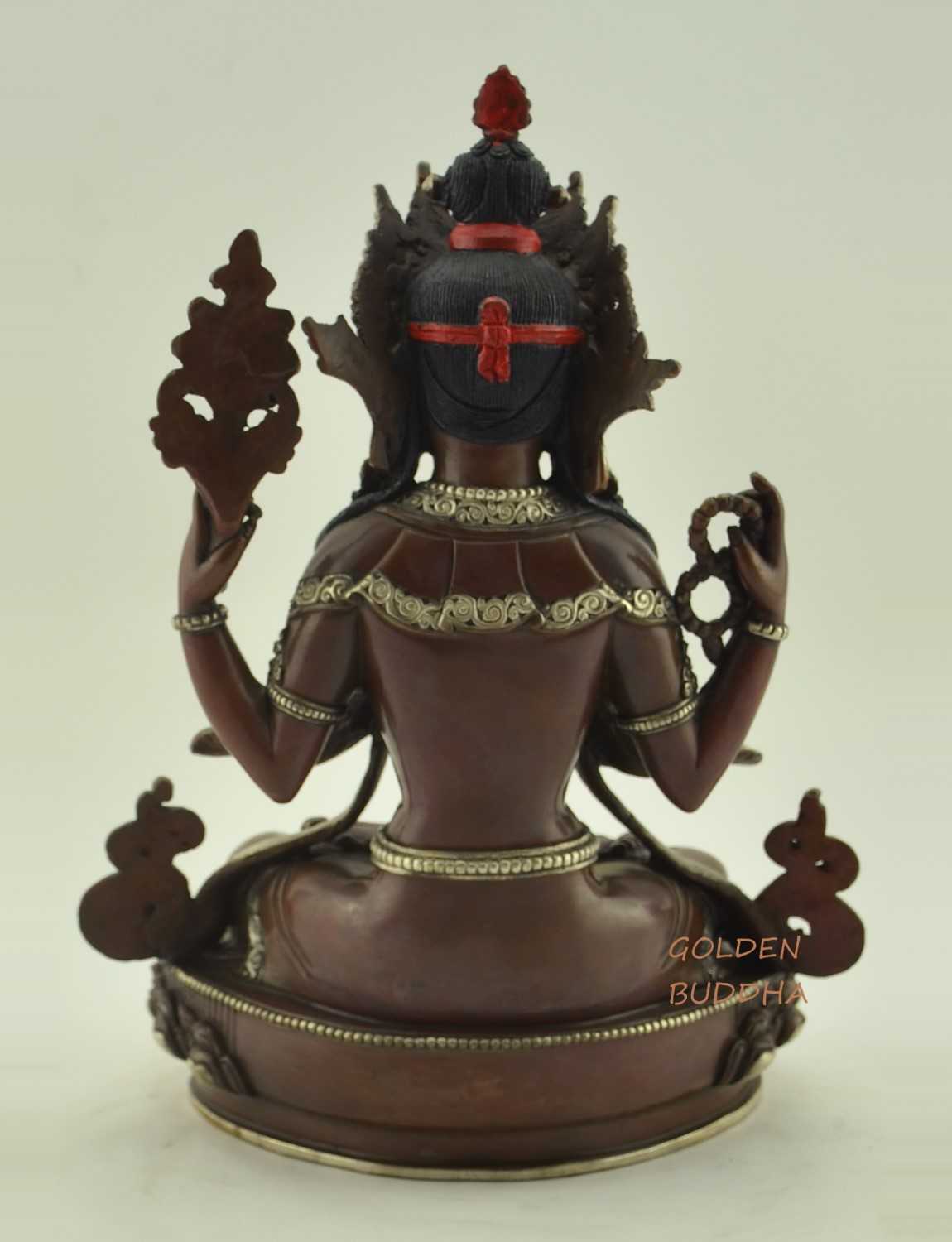
Viewed from behind, the dark ribbed hair is gathered into a high topknot secured with painted red bands. Silver scrollwork continues along the collar and shoulder borders, while the beaded silver waist ornament follows the base of the torso. These rear details show that the sculpture was completed as a devotional object intended to be appreciated from every side rather than decorated only across its front-facing surfaces.
Full Lotus Posture and Silver-Detailed Throne
Chenrezig sits in the full lotus posture with both feet turned upward and the legs arranged in meditative balance. This stable position expresses unwavering concentration and the inner composure required for compassion to remain universal and impartial. The dhoti is arranged in broad folds across the crossed legs, with silver ornamentation following the visible borders and central panels.
The figure rests upon a single lotus throne encircled by a silver beaded rim. Deeply modeled petals form the lower register, with selected centers plated in silver to create a measured visual rhythm around the pedestal. The silver detailing is concentrated where it clarifies the sculpture’s design—the rim, petal centers and ornamental borders—while the broader pedestal surfaces retain the warm oxidized finish.
Traditional Lost Wax Casting in Patan, Nepal
This statue was cast in copper alloy by Newar artisans in Patan, Nepal, using the traditional lost wax method. The process begins with a carefully sculpted wax model created according to established Himalayan iconometric proportions. The model is enclosed within a heat-resistant mould and fired so that the wax melts away, leaving a cavity into which molten copper alloy can be poured.
Once the metal has cooled, the mould is broken and the raw casting is chased, filed, engraved and refined by hand. The completed sculpture is then finished to develop its deep oxidized surface. Silver plating is selectively applied to the crown, jewelry, ribbons, garment borders, sacred attributes and throne details. Because the original wax model is destroyed during casting and the finishing work is performed individually, each statue retains subtle handmade variations.
The completed sculpture measures approximately 9.75 inches high, 7 inches wide and 4 inches deep, with an approximate shipping weight of 3,000 grams. Its scale is substantial enough to serve as the central figure of a home shrine while remaining suitable for a standard altar, display cabinet or meditation room.
Silver Chenrezig, Green Tara and Manjushri Statue Set
This Silver Chenrezig statue forms a beautifully coordinated three-piece set with the matching Silver Green Tara statue and Silver Manjushri statue. All three were created by the same Nepali master artisan with closely matched 9.75-inch proportions, oxidized copper-alloy bodies, silver-plated crowns and jewelry, engraved garment borders, flowing celestial ribbons and complementary single lotus thrones.
Together, the three deities express a balanced sequence of enlightened qualities. Chenrezig embodies the boundless compassion that recognizes and responds to suffering. Manjushri embodies the transcendent wisdom that sees the causes of suffering and cuts through ignorance. Green Tara embodies swift enlightened activity, overcoming obstacles and bringing compassionate intention into immediate action. Wisdom prevents compassion from becoming confused, compassion ensures that wisdom is used for the welfare of others, and Tara’s activity transforms both qualities into practical benefit.
The trio can be arranged with Chenrezig at the center to emphasize universal compassion, with Manjushri and Green Tara placed on either side. Green Tara may also serve as the central figure when the shrine is dedicated primarily to protection and swift compassionate activity. Their shared dimensions and silver detailing allow the three sculptures to function as a unified altar ensemble while their individual attributes remain clearly recognizable.
Custom Made Silver Chenrezig Statues
Collectors, practitioners and Dharma centers may commission custom made Chenrezig statues directly from our workshop in Nepal. A custom sculpture may be created in a different size while preserving the required four-armed iconography, including the central cintamani jewel, mala, lotus, Amitabha image and antelope skin. Available options may include an oxidized finish with silver details similar to this statue, an antiquated finish without silver, partial gilding, 24K fire gilding, a face hand painted with 18K gold and natural pigments, gemstone settings or more elaborate garment and throne engraving.
A coordinated three-statue commission may also be arranged so that Chenrezig, Green Tara and Manjushri share identical dimensions, finishes, silver ornamentation and pedestal proportions. Such a set unites Chenrezig’s universal compassion, Manjushri’s discerning wisdom and Green Tara’s swift liberating activity in a coherent visual and doctrinal arrangement for a home altar, temple or meditation center.
Authentic, Handmade in Nepal
Every statue is handcrafted in Patan, Nepal, using traditional lost wax casting and comes with a certificate of authenticity issued by Nepal’s Department of Archaeology, verifying its materials, technique, and origin.