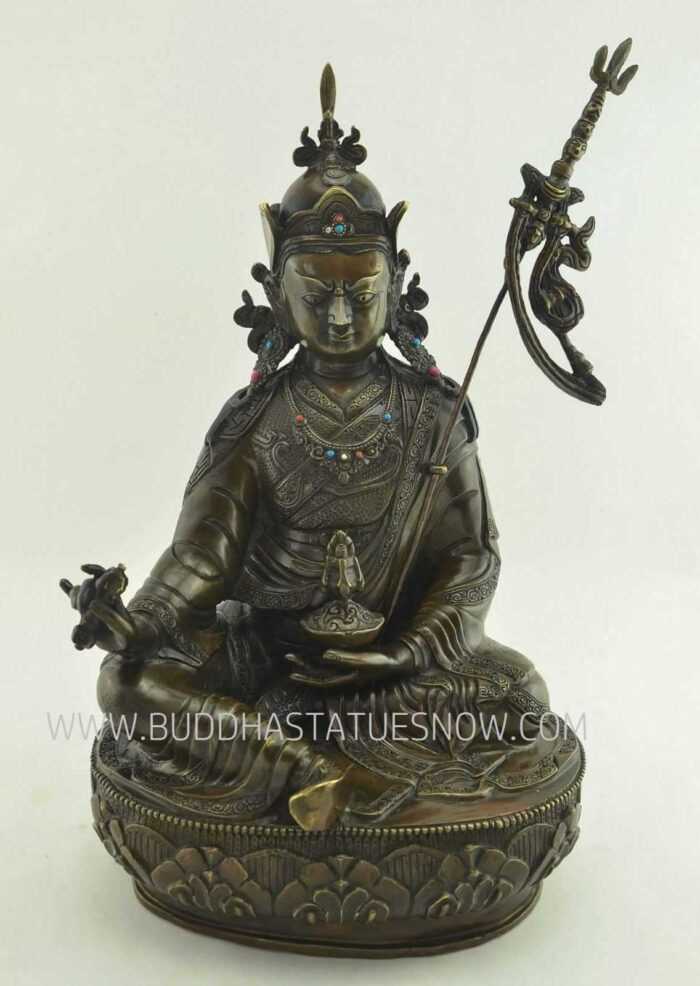
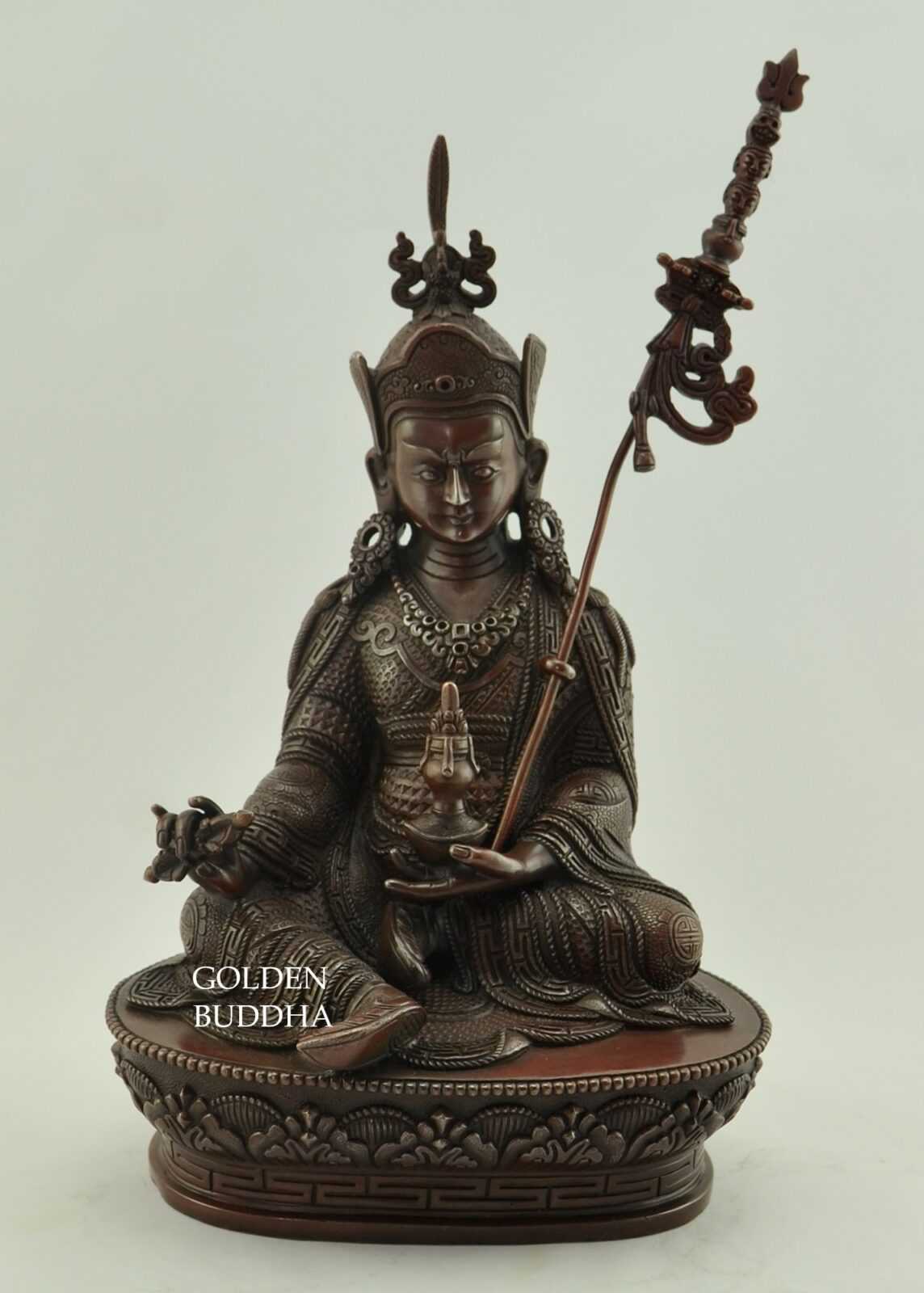
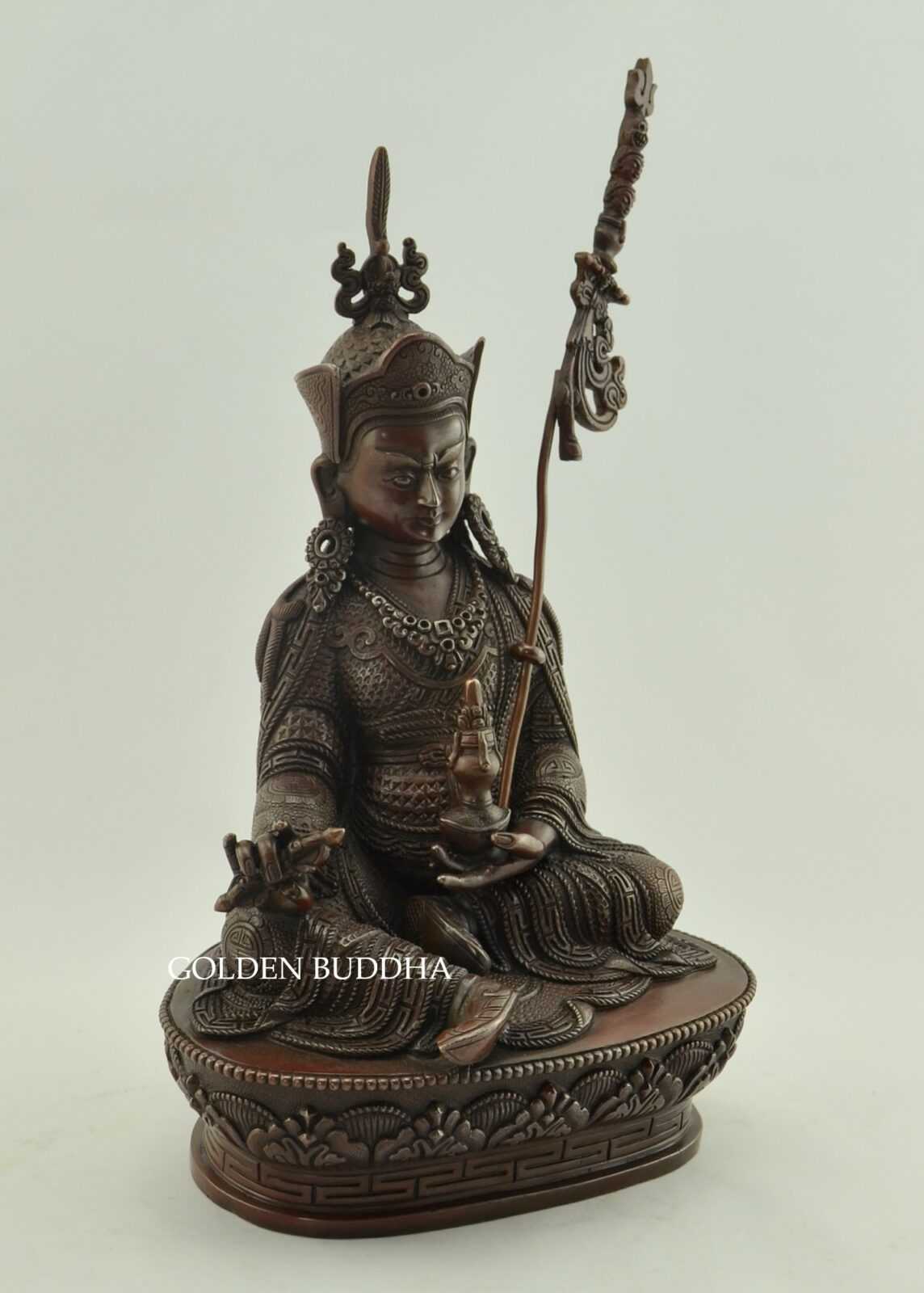
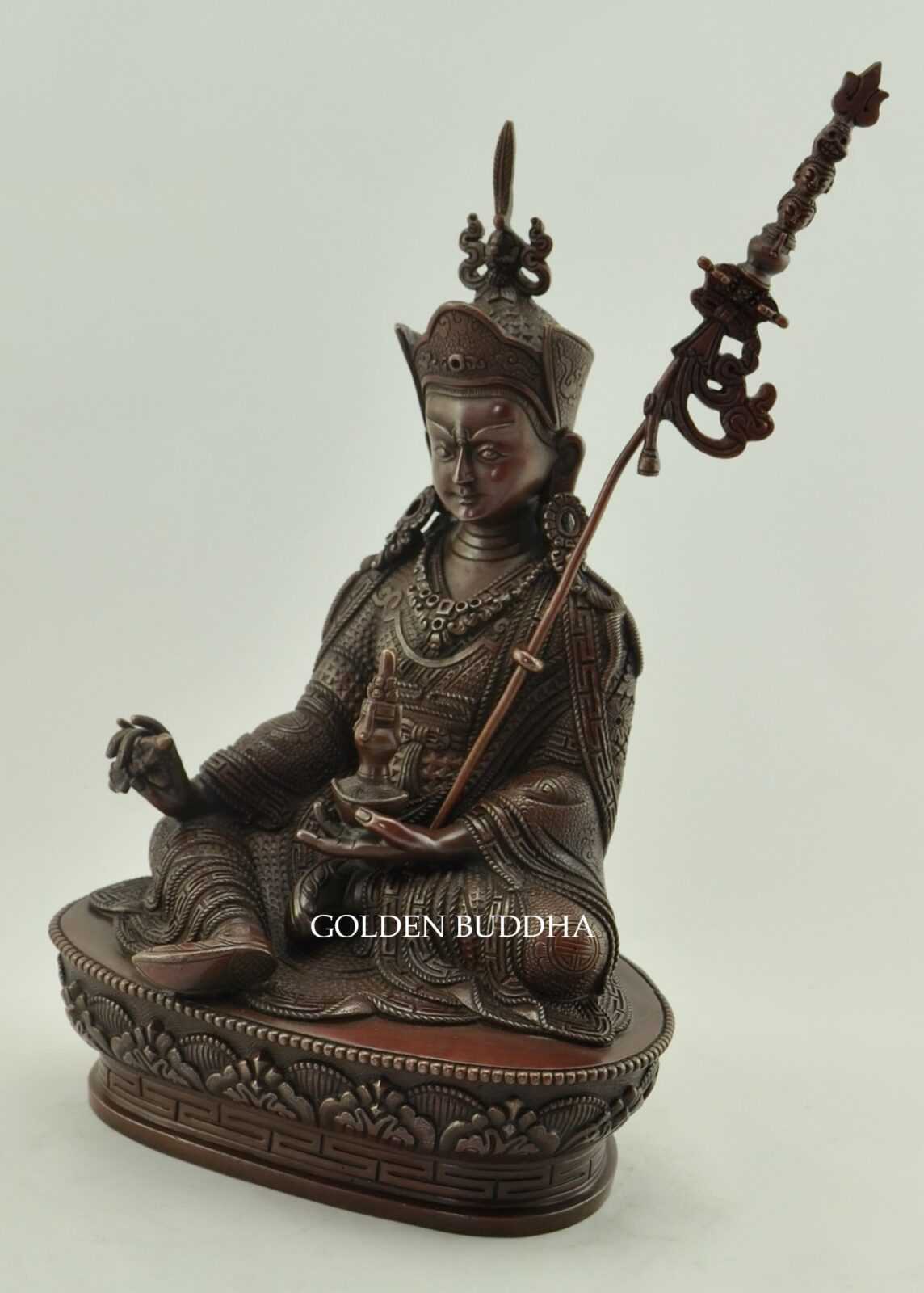
This handcrafted Antiquated Guru Rinpoche Statue portrays Padmasambhava, “The Lotus Born,” in an exceptionally detailed 9-inch sculpture measuring 10 inches high with its khatvanga. Cast from copper alloy using the traditional lost wax method, the statue has an antiquated oxidized finish that settles naturally into its extensive hand-carved ornamentation. Darkened recesses contrast with warmer copper highlights across the face, garments, jewelry and lotus throne, giving the sculpture considerable depth while preserving the character of traditionally finished Himalayan Buddhist art.
Antiquated Guru Rinpoche Statue Craftsmanship
The craftsmanship is especially impressive across Guru Rinpoche’s ceremonial robes. The front combines finely textured geometric fields with scrolling ornament, layered borders and carefully delineated folds. His cuffs, mantle and lower garments are edged with repeating geometric meander patterns, while jewelry and ornamental elements are individually modeled across his chest and shoulders. The lotus throne beneath him incorporates raised repoussé petals bordered by beaded detailing.
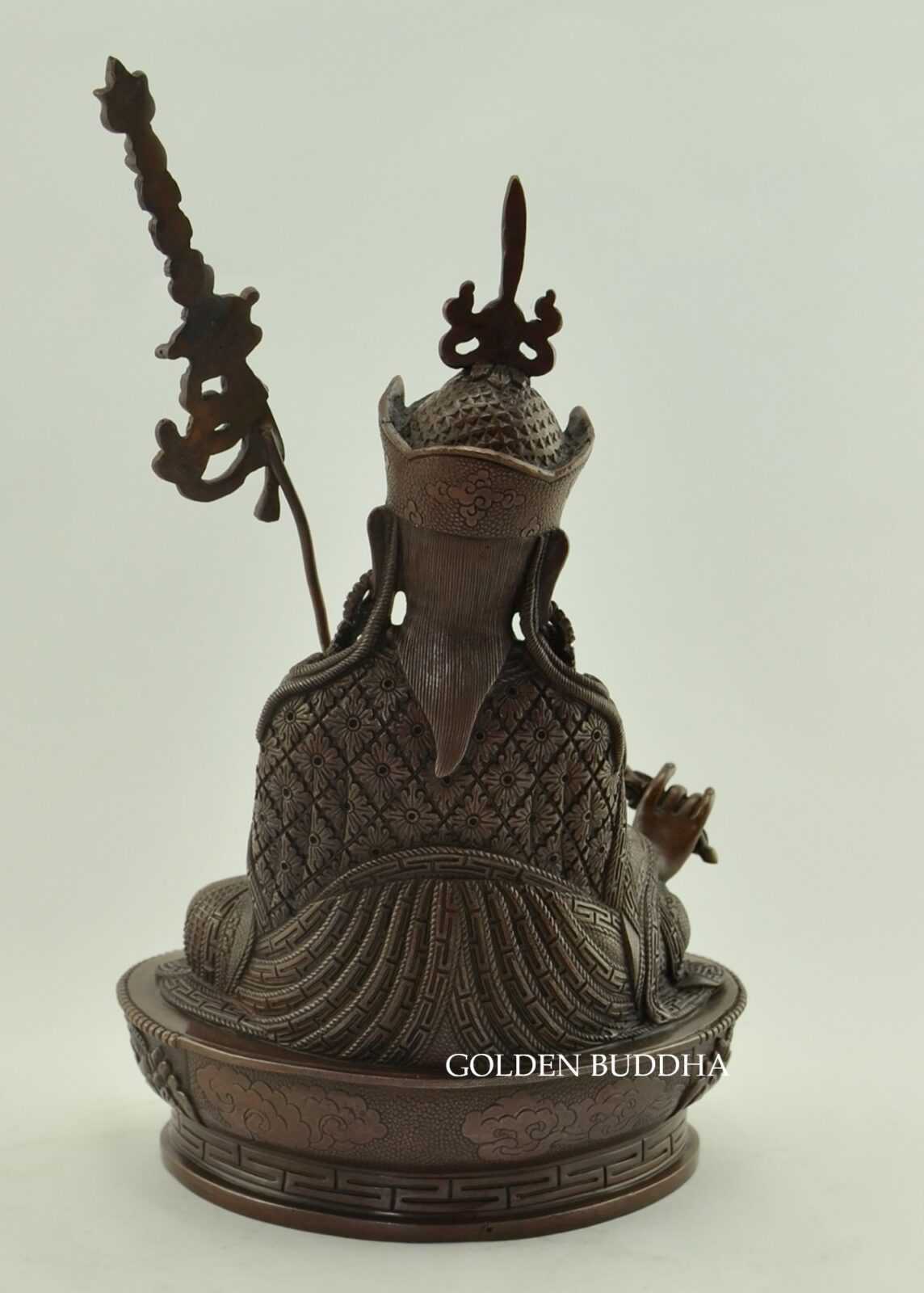
Viewed from behind, the complexity becomes even more apparent. The upper robe is covered by a geometric lattice containing repeating floral rosettes, while the lower garment falls in deeply defined vertical pleats surrounded by decorative borders. Cloud motifs are engraved around the rear of the lotus throne. These contrasting floral, geometric and textile-inspired patterns give the sculpture a richly finished appearance from every viewing angle.
Sacred Iconography of Padmasambhava
Guru Rinpoche is depicted with the principal attributes associated with his traditional form. His right hand holds the vajra, symbolizing the indestructible nature of awakened realization. His left hand supports the kapala skull cup containing the longevity vase, an attribute associated with deathless wisdom and spiritual accomplishment. Rising beside his left shoulder is the khatvanga, surmounted by three impaled heads and a trident. The three heads traditionally express transcendence of the realms of desire, form and formlessness. Learn more about these attributes in our Guru Rinpoche statue meaning and iconography section.
His distinctive lotus hat is crowned by the long vulture feather associated with realization of the highest view. The direct, piercing gaze gives this Antiquated Guru Rinpoche Statue an alert presence appropriate to the great tantric master. Padmasambhava is revered throughout Tibetan Buddhism and especially within the Nyingma tradition as Guru Rinpoche, the “Precious Master.” Discover more about Guru Rinpoche and the Lotus Born Master.
Guru Rinpoche and the Establishment of Tibetan Buddhism
Padmasambhava occupies a unique position between Buddhist history and sacred biography. Tibetan tradition records his arrival during the eighth century, when he worked alongside Śāntarakṣita during the establishment of Buddhism in Tibet. He is particularly associated with overcoming obstacles surrounding the construction of Samye, Tibet’s first Buddhist monastery, and with establishing the tantric teachings that became foundational to Tibetan Vajrayana Buddhism. His name Padmasambhava means “Lotus Born,” recalling accounts of his miraculous appearance upon a lotus in Oddiyana.
Pairing Antiquated Guru Rinpoche with Amitabha Buddha
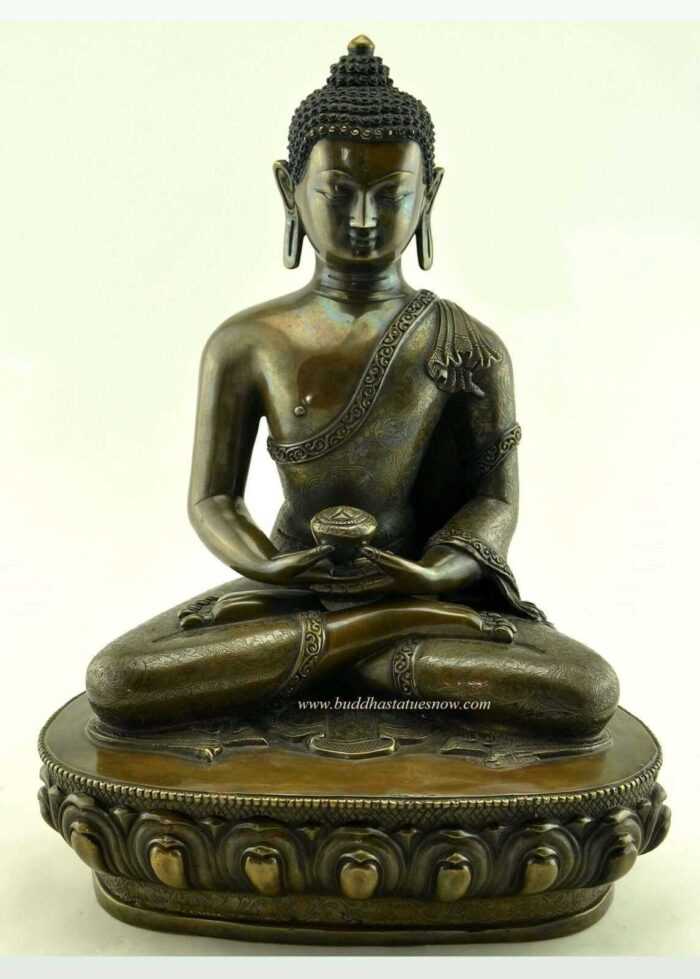
This sculpture makes an especially harmonious companion to our Antiquated Amitabha Buddha Statue. Tibetan Buddhist tradition identifies Guru Rinpoche as a speech emanation of Amitabha, the Buddha of Infinite Light. Pairing them therefore connects the transcendent Buddha with the tantric master through whom enlightened teachings are actively transmitted. Their complementary antiquated copper finishes and lotus thrones also create visual continuity. On an altar, Amitabha may traditionally be positioned slightly higher or to the left of Guru Rinpoche while each retains his distinct iconography.
Custom Made Guru Rinpoche and Amitabha Statues
Collectors, practitioners and Dharma centers seeking particular dimensions, finishes or coordinated altar figures can commission custom Tibetan Buddhist statues handmade by our master artisans in Patan, Nepal. Guru Rinpoche and Amitabha can be commissioned as a complementary pair with coordinated proportions, lotus thrones and finishes while preserving the proper iconography of each figure. Amitabha embodies Infinite Light, meditative wisdom and the Pure Land of Sukhavati, while Guru Rinpoche expresses enlightened tantric activity and the transmission of Vajrayana teachings. Together they form a doctrinally meaningful pairing connecting the enlightened source with its dynamic manifestation in the world.
Authentic, Handmade in Nepal
Every statue is handcrafted in Patan, Nepal, using traditional lost wax casting and comes with a certificate of authenticity issued by Nepal’s Department of Archaeology, verifying its materials, technique, and origin.