
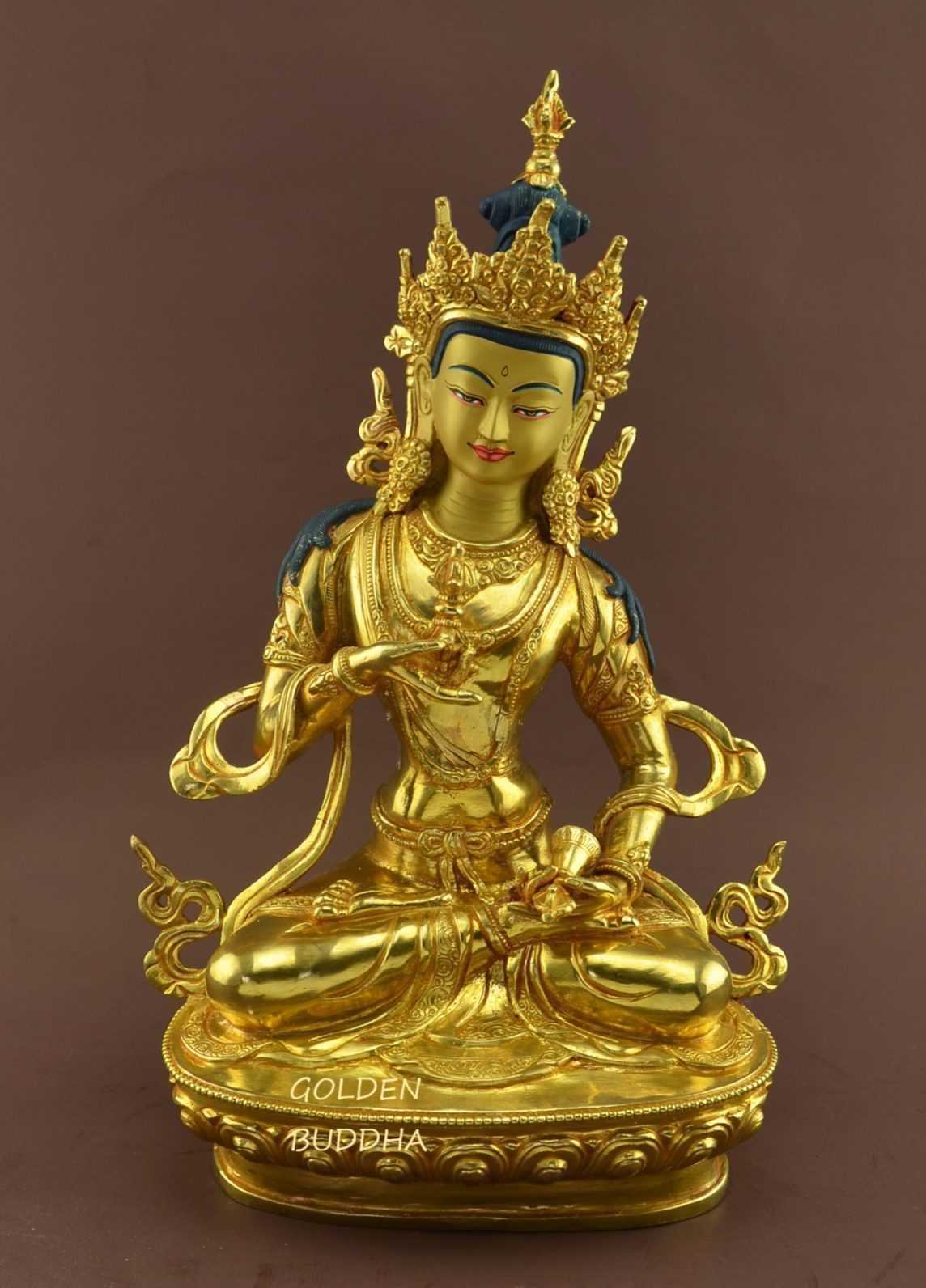

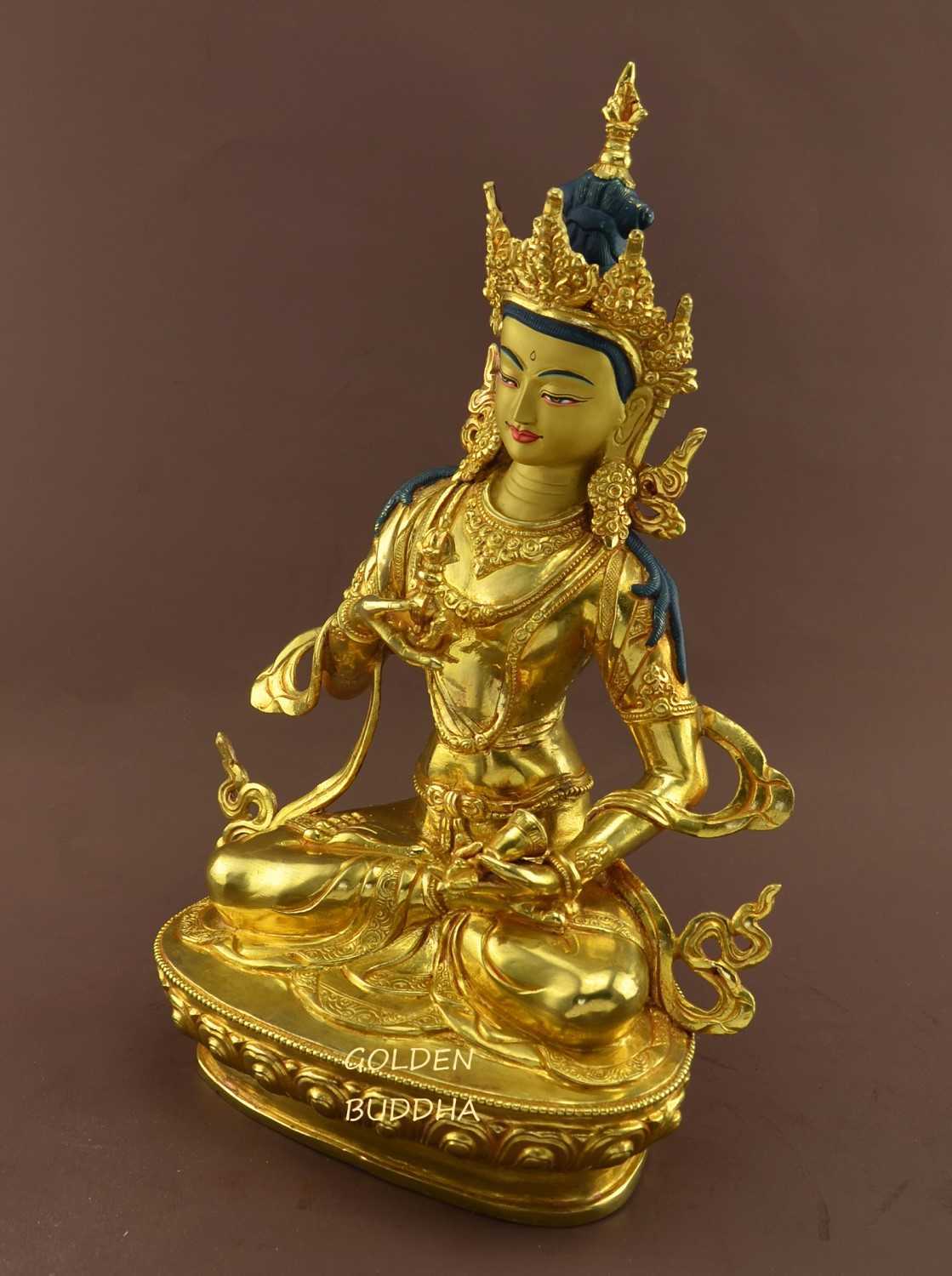
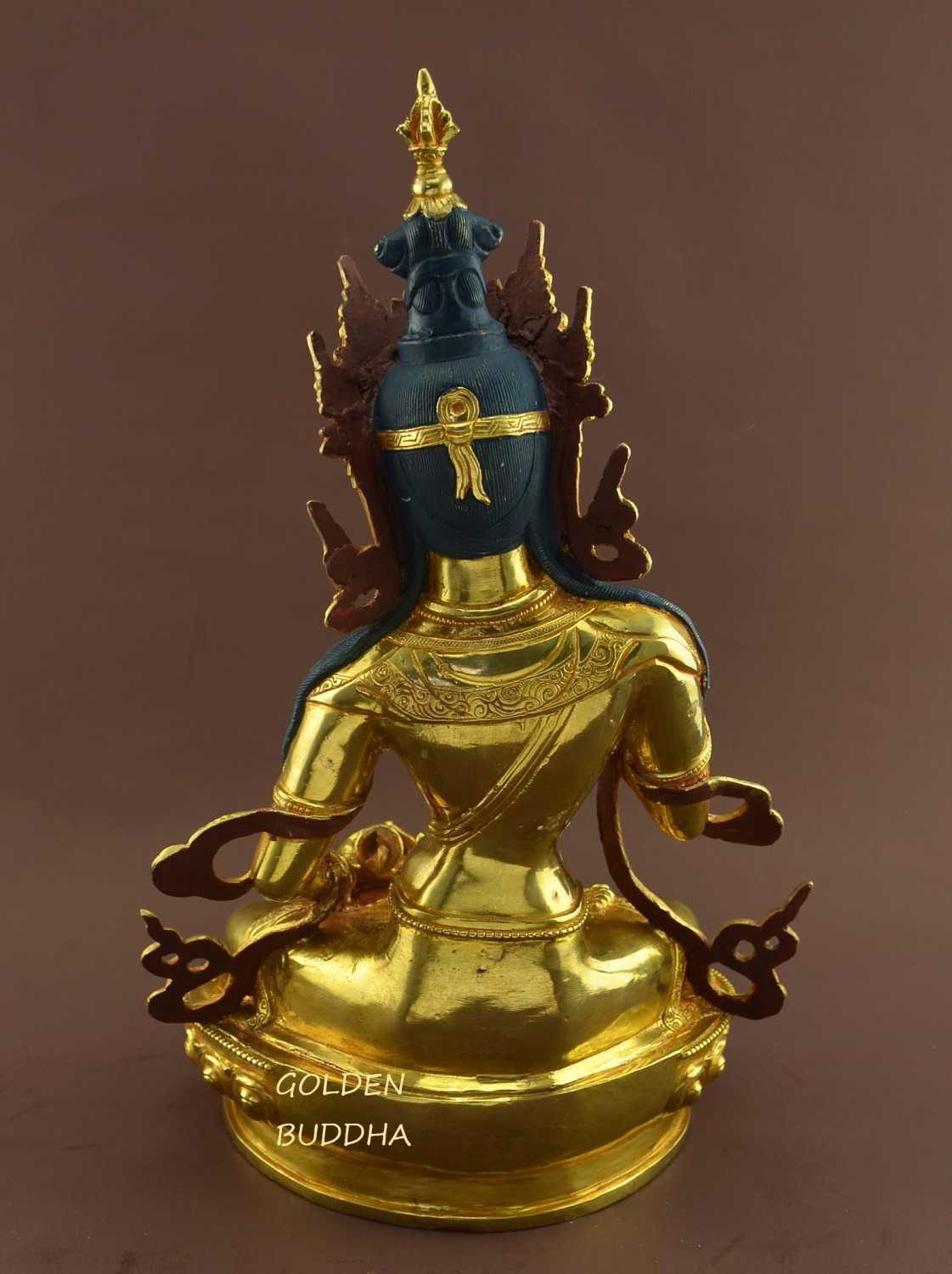
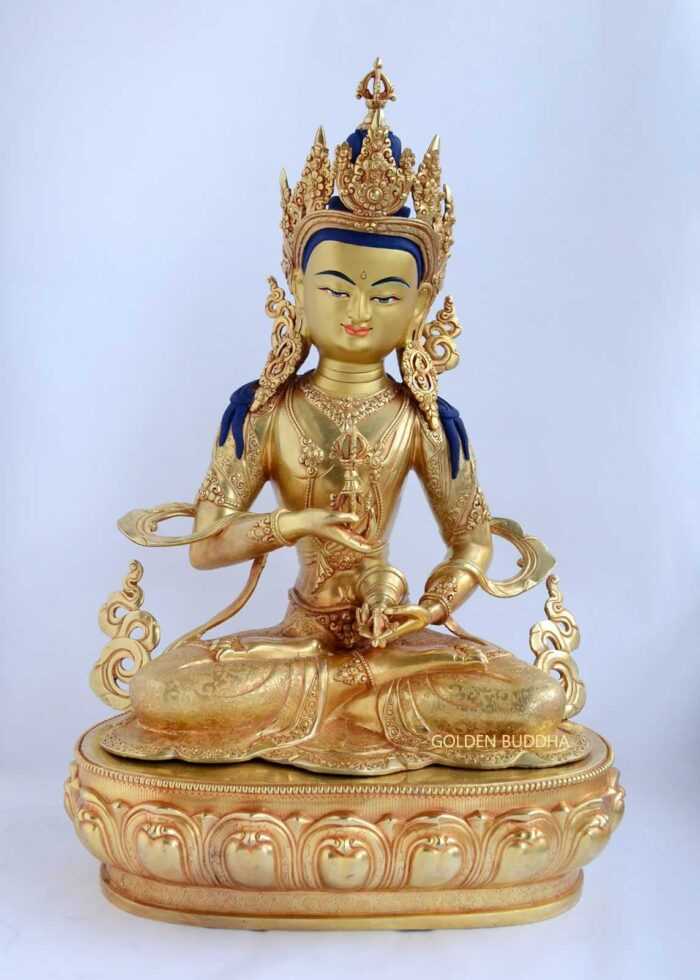
Tall, slender proportions give this 13.5-inch Fully Gilded Vajrasattva Sculpture a distinctly graceful presence. Dorje Sempa sits upright in full lotus posture, the torso rising from a narrow waist toward an elaborate five-point crown and tall blue-black topknot. His right hand presents the vajra vertically before the heart while his left hand supports the ghanta bell near the lap, immediately establishing his traditional Vajrayana identity. The copper-alloy sculpture was handmade in Patan, Nepal using the lost-wax casting method and subsequently fire gilded in 24K gold. The face is treated separately, hand painted with 18K gold and natural pigments to preserve the subtle eyes, brows and softly colored lips.
Fully Gilded Vajrasattva Sculpture Iconography
Vajrasattva, known in Tibetan as Dorje Sempa, is closely associated with purification practice and the restoration of damaged samaya commitments. His principal implements express one of the central complementary relationships of Vajrayana Buddhism. The vajra held at his heart represents indestructibility and skillful means, while the ghanta bell is associated with wisdom and emptiness. Their union points toward the indivisibility of method and wisdom in awakening. A more detailed explanation can be found in our guide to Vajrasattva iconography and symbolism.
The sculpture is especially refined in its ornamentation. A richly modeled crown surrounds the tall topknot, with curling side ornaments framing the face. Large circular earrings descend beside the jaw, while layered necklaces, armlets and bracelets continue the jeweled Bodhisattva appearance across the upper body. The photographs show engraved borders along the short sleeves and lower garments rather than heavy engraving over every surface. Long celestial scarves emerge beside the arms and curve outward behind the seated figure, giving the composition movement without disturbing its meditative symmetry. The robe folds and decorative borders around the crossed legs are more restrained, allowing the brilliant gold surface to remain visually dominant.
Purification and the Sambhogakaya Form
Vajrasattva occupies an important place in Tibetan Buddhist preliminary and purification practices, particularly through the Hundred-Syllable Mantra and shorter forms of his mantra. He is also described in Dzogchen lineage presentations as a sambhogakaya Buddha. In traditional accounts of the Great Perfection transmission, the primordial realization of the dharmakaya is communicated through sambhogakaya figures including Vajrasattva before entering the human lineage. This association helps explain his regal appearance: rather than monastic robes, he wears the crown, jewelry and celestial garments characteristic of an enlightened sambhogakaya form.
Vajrasattva and Guru Rinpoche as a Matching Set
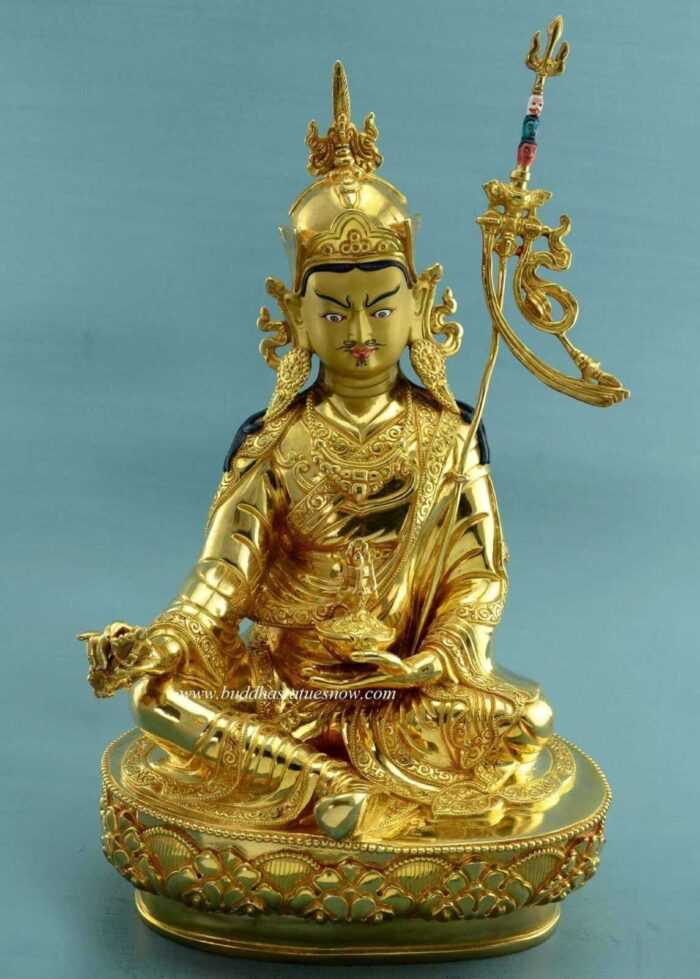
This Vajrasattva also pairs meaningfully with our fully gold gilded Guru Rinpoche statue. The relationship is especially appropriate for a Nyingma or Dzogchen-oriented altar. Vajrasattva represents the sambhogakaya dimension within the early transmission of Dzogchen, while Guru Rinpoche represents the appearance of enlightened activity within the human world and became one of the principal transmitters of Dzogchen teachings in Tibet. Traditional lineage histories trace Dzogchen through Vajrasattva to early masters such as Garab Dorje, Manjushrimitra and Shri Singha, with Padmasambhava later carrying these teachings into Tibet. Visually, the two sculptures are also compatible because both employ brilliant 24K fire gilding, elaborate Vajrayana ornamentation and hand-painted faces.
Fully Gilded Vajrasattva Sculpture | Finishing Details
Vajrasattva rests upon a single lotus throne with a beaded upper border and a continuous row of raised lotus petals. The comparatively simple pedestal keeps attention on the intricate figure above it. Buyers may also request genuine turquoise and red coral gemstones to be embedded into suitable settings in the crown, earrings or jewelry before shipment, adding color while preserving the traditional design of the sculpture.
Filling and Consecration in Kathmandu
For a statue intended for active Buddhist practice, traditional filling and consecration in Nepal can be arranged before shipment. Sacred mantra rolls, fragrant woods, incense powders, metals and other appropriate substances may be installed within the hollow figure before it is resealed and blessed by a qualified Buddhist guru in Kathmandu. :contentReference[oaicite:3]{index=3}
Custom Tibetan Buddhist Statues
Collectors, practitioners and Dharma centers requiring a different scale or finish may commission custom Tibetan Buddhist statues handmade in Nepal. Vajrasattva can be ordered in alternative dimensions, coordinated with a Guru Rinpoche statue, or finished with specified gilding and gemstone treatments while retaining the correct traditional iconography. Custom commissions are produced by Shakya artisans in Patan using copper alloy and the lost-wax casting tradition.
Authentic, Handmade in Nepal
Every statue is handcrafted in Patan, Nepal, using traditional lost wax casting and comes with a certificate of authenticity issued by Nepal’s Department of Archaeology, verifying its materials, technique, and origin.
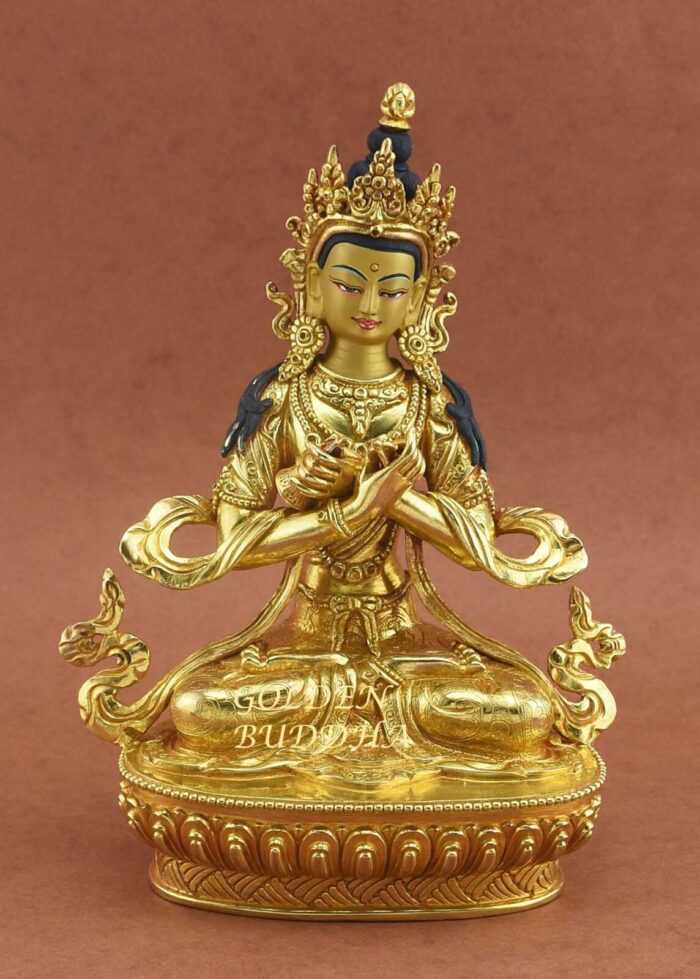
manuel.wagner86 (verified owner) –
Very nice sculpture, best quality!!! Manuel from Germany
Sylvie Turchet (verified owner) –
Thank you very much Edwin, this statue is very beautiful. And sends it very fast. I recommend.
Sylvie, from France