
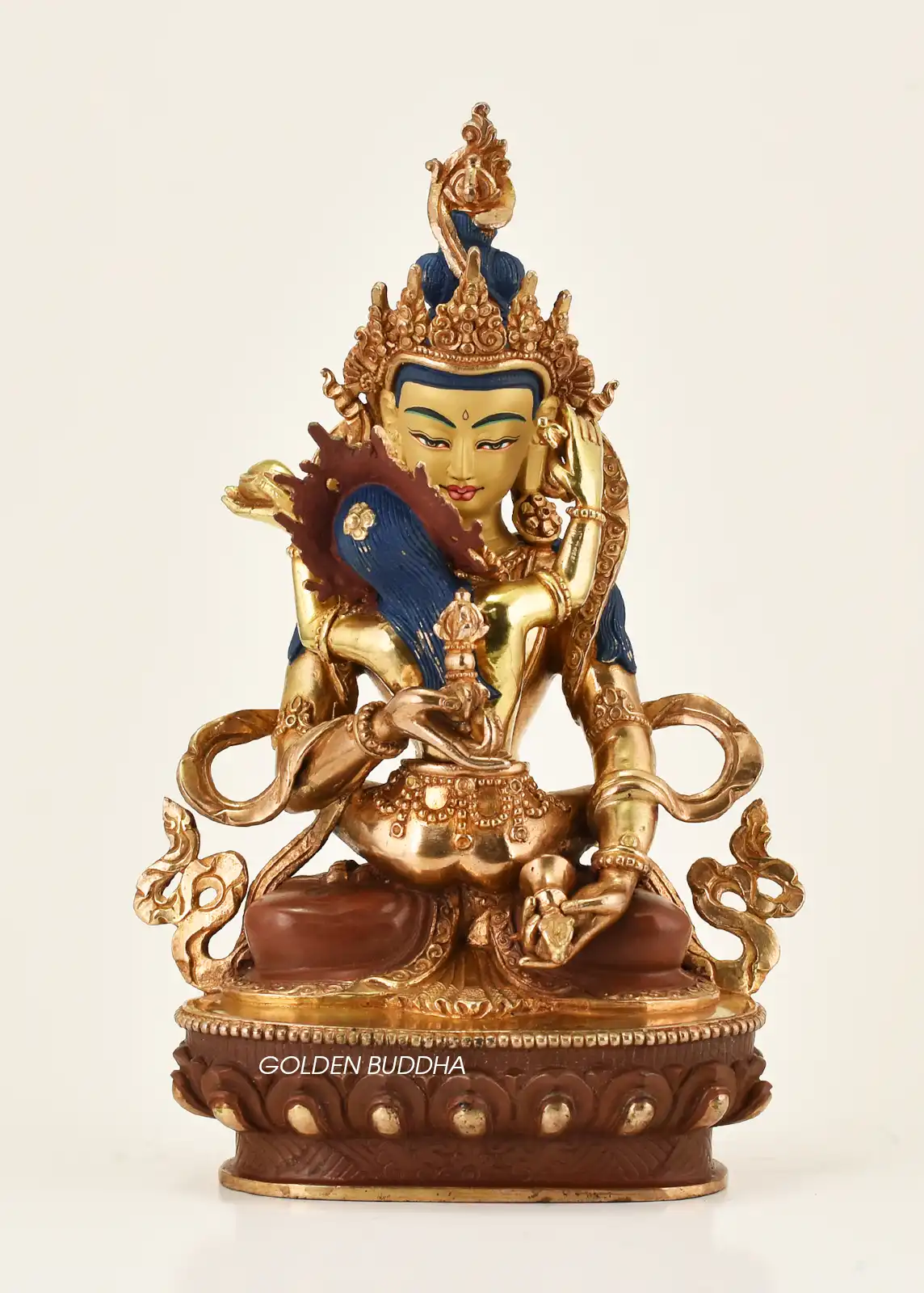
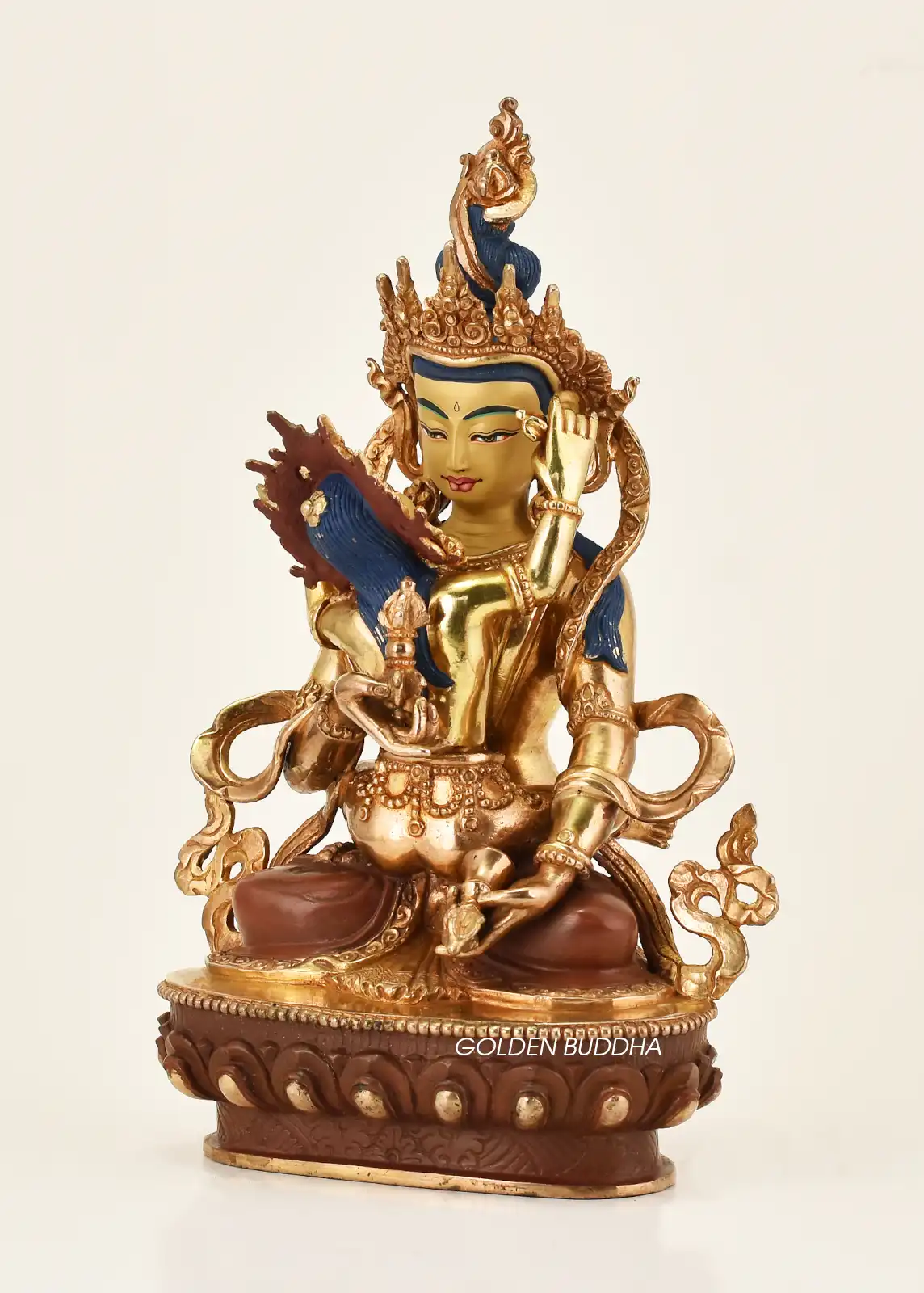
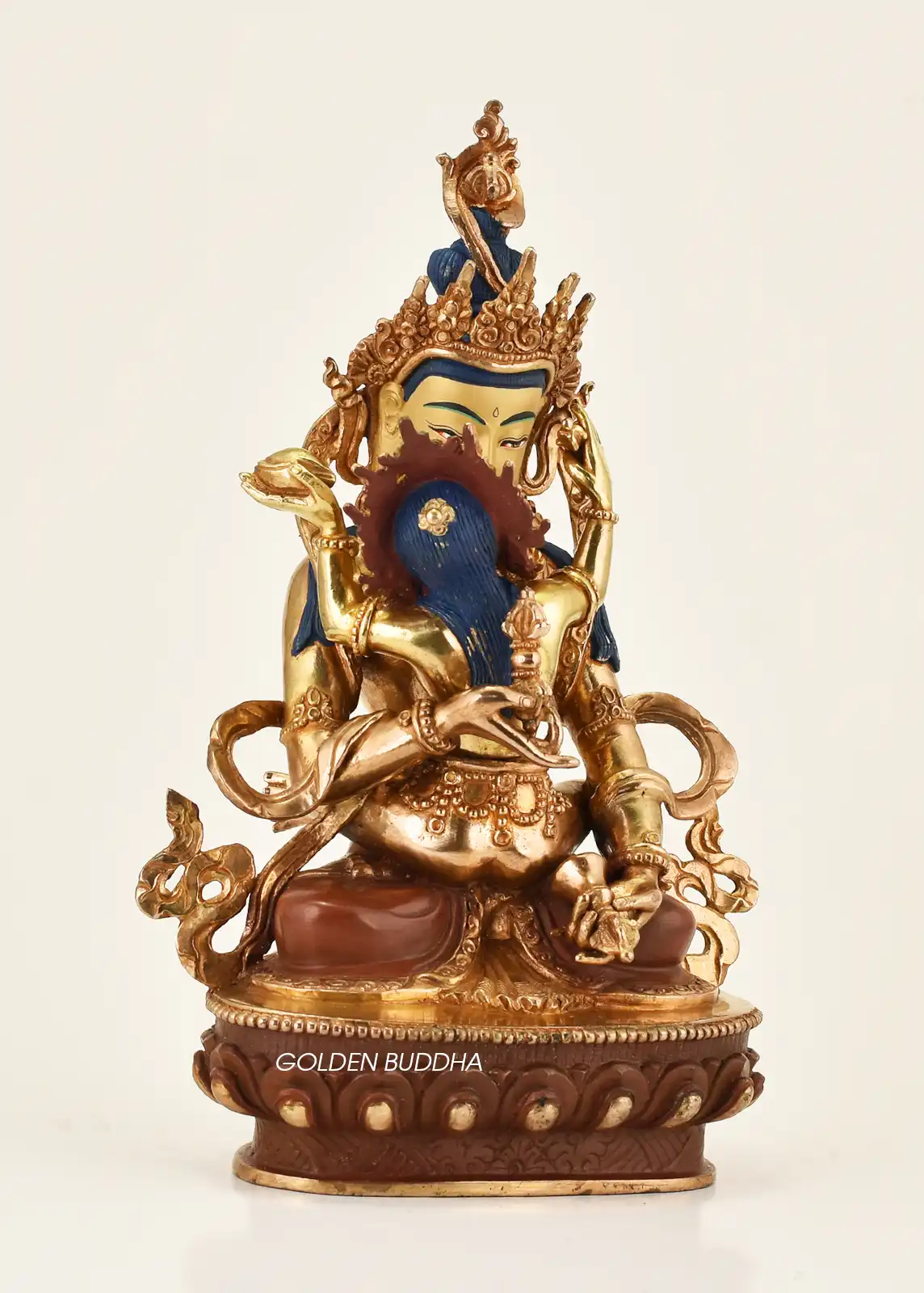
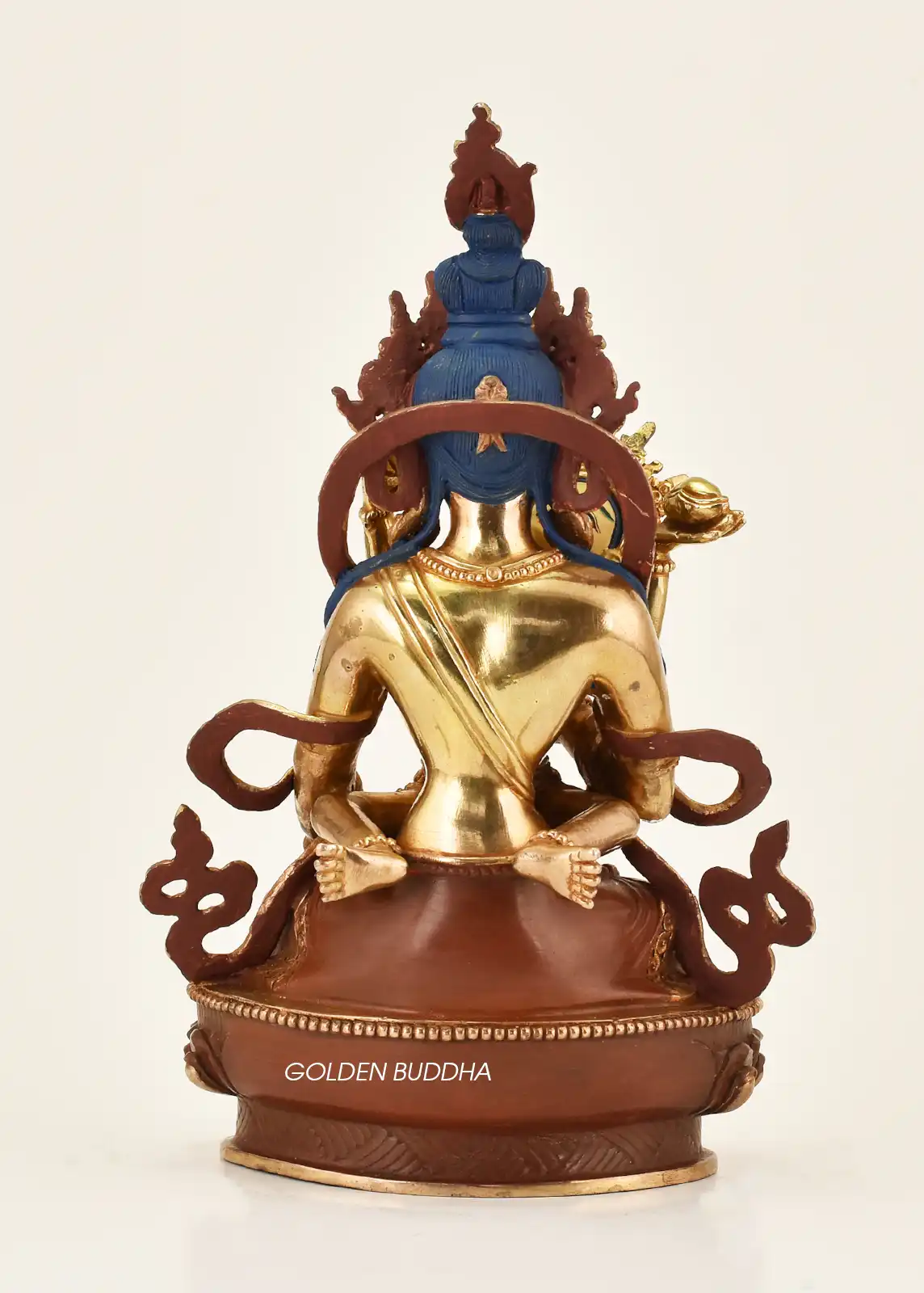
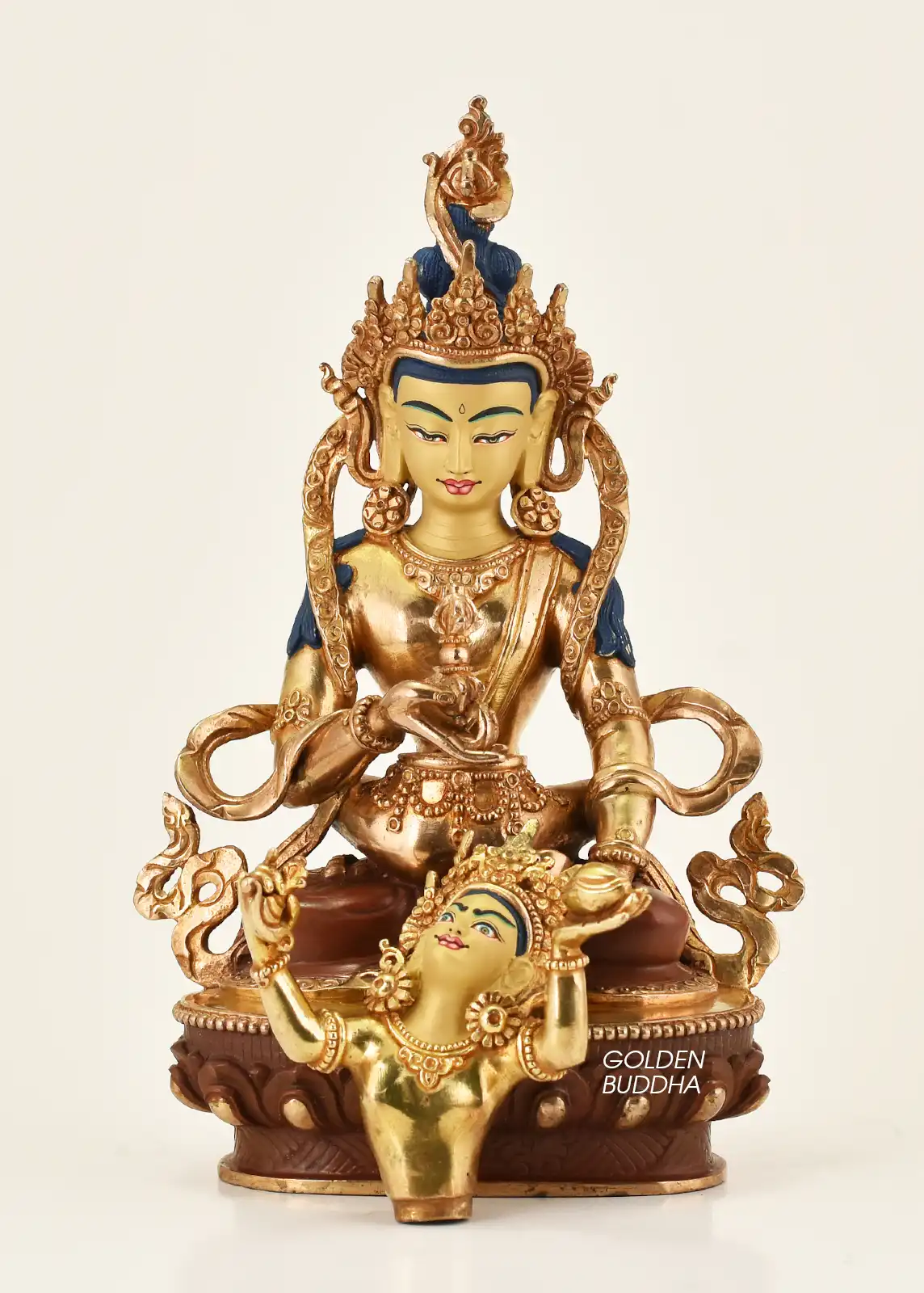
This exquisite Vajrasattva Shakti Statue (Dorje Sempa) portrays the Bodhisattva of Purification united in sacred Yab Yum with his wisdom consort Vajragarvi. Rich in tantric symbolism, the sculpture expresses the inseparable union of enlightened compassion and transcendent wisdom—the realization that lies at the heart of Vajrayana Buddhism. Vajrasattva sits serenely in full vajra posture upon a beautifully sculpted single lotus pedestal while embracing Vajragarvi, whose removable figure allows collectors to appreciate both the complete Yab Yum composition and Vajrasattva individually.
Handcrafted by master Newar artisans in Patan, Nepal, every component of the sculpture—including Vajrasattva, Vajragarvi, the lotus pedestal, decorative back frame, and removable assembly—is traditionally cast from a base of copper alloy using the centuries-old lost wax casting method. The figures are then fire gilded in 24K gold, accented with an antiquated oxidized copper finish, while the peaceful faces are carefully hand painted with 18K gold and natural pigments. The result is a museum-quality representation of one of Tibetan Buddhism’s most revered tantric deities.
Vajrasattva Shakti Statue Depicting Dorje Sempa in Yab Yum
The Sanskrit name Vajrasattva literally means “Diamond Being,” while his Tibetan name, Dorje Sempa, conveys the same meaning. Throughout Vajrayana Buddhism, Vajrasattva is revered as the embodiment of complete purity and is the central deity of purification practice. His famous one-hundred-syllable mantra is recited daily by practitioners to purify negative karma, obscurations, broken commitments, and mental afflictions before engaging in higher tantric practices.
This Vajrasattva Shakti Statue portrays the deity in Yab Yum, the sacred union of male and female enlightened principles. Contrary to ordinary interpretation, this iconography is not intended to represent worldly desire. Instead, it illustrates the perfect union of method and wisdom, compassion and emptiness, skillful means and ultimate realization. The embrace symbolizes the non-dual nature of enlightenment, where all apparent dualities dissolve into awakened awareness.
The Vajra and Ghanta Bell
Behind the embrace, Vajrasattva holds the vajra in his right hand and the ghanta bell in his left. The vajra represents indestructible compassion, enlightened method, spiritual power, and the unchanging nature of awakened mind. The ghanta symbolizes transcendent wisdom, emptiness, and perfect insight into ultimate reality. Neither attribute is complete without the other. Together they express the inseparable qualities that culminate in Buddhahood.
The positioning of these ritual implements behind Vajragarvi emphasizes that enlightened wisdom and compassionate activity operate simultaneously. This subtle iconographic arrangement is one of the defining characteristics of traditional Vajrasattva Yab Yum imagery preserved within the highest yoga tantra traditions.
Vajragarvi, the Wisdom Consort
Vajragarvi embraces Vajrasattva while raising the kartika, or curved flaying knife, in her right hand and holding a kapala, or skull cup, in her left. These are classic tantric implements symbolizing the cutting through of ego-clinging and the transformation of ignorance into awakened wisdom. Her peaceful expression mirrors Vajrasattva’s own serene countenance, reinforcing that wrathful symbolism within Vajrayana always serves compassionate transformation rather than violence.
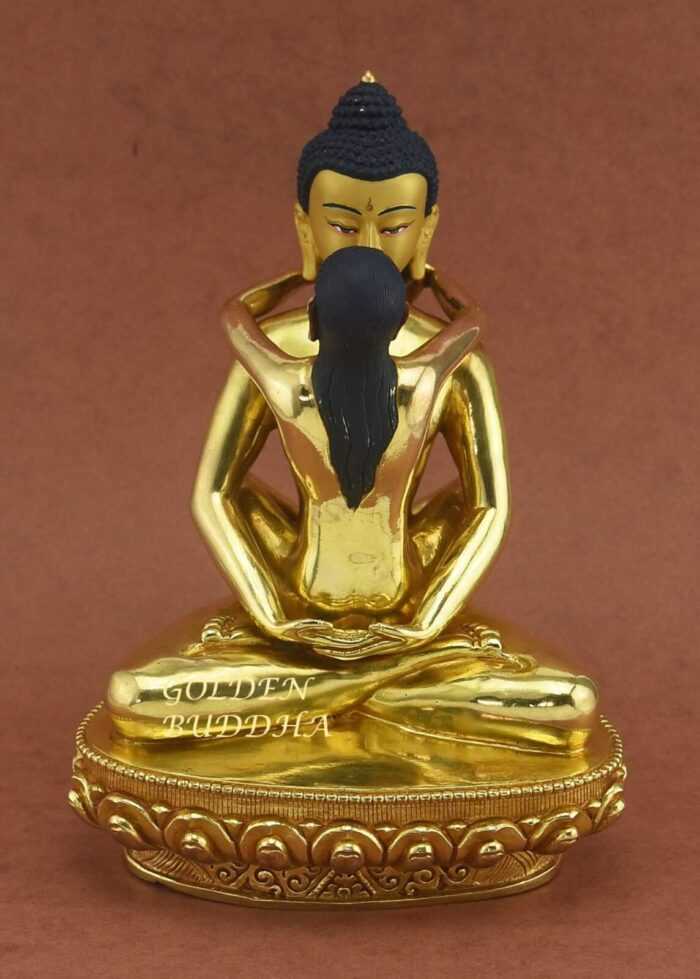
An exceptional feature of this sculpture is the removable Vajragarvi figure. As shown in the accompanying photographs, collectors may display the complete Yab Yum composition or remove the consort to appreciate Vajrasattva independently. The precision with which the removable assembly fits demonstrates the remarkable engineering and craftsmanship of Nepal’s master metal artists.
Iconography of the Vajrasattva Shakti Statue
Vajrasattva wears the magnificent five-jeweled Bodhisattva crown, elaborate earrings, necklaces, armlets, bracelets, anklets, and celestial silks that identify him as a fully adorned Sambhogakaya Buddha. His ushnisha rises gracefully above the crown, while the urna upon his forehead symbolizes transcendent wisdom. Three auspicious neck lines, delicately carved jewelry, and elegantly flowing scarves further demonstrate the exceptional skill of the Newar artisans.
The statue rests upon a finely detailed single lotus pedestal, symbolizing purity arising unstained from the ordinary world. Throughout the sculpture, polished fire gilding contrasts beautifully with antiquated oxidized copper details, giving greater visual depth while emphasizing the intricate carvings surrounding the lotus base, jewelry, garments, and ornamental ribbons.
Traditional Lost Wax Craftsmanship
Every component of this sculpture is individually created using Nepal’s traditional lost wax casting process. After casting in copper alloy, the artisans spend countless hours refining every decorative detail by hand before applying 24K fire gilding and carefully painting the facial features with 18K gold and natural pigments. The removable frame, removable consort, lotus pedestal, and ornamental ribbons all demonstrate the extraordinary level of precision required to produce complex Himalayan Buddhist sculpture of this quality.
At the buyer’s request, our artisans can further embellish the crown and jewelry with genuine turquoise and red coral in traditional settings before shipment. These custom additions complement the rich gold finish while preserving the statue’s authentic iconography. To learn more about authenticity and traditional craftsmanship, please visit our Vajrasattva Statue FAQ.
Meaning of the Vajrasattva Shakti Statue in Vajrayana Buddhism
The Vajrasattva Shakti Statue presents purification not merely as the removal of wrongdoing, but as the recovery of the mind’s originally unstained nature. Vajrasattva practice is traditionally associated with confession, purification of karmic obscurations, restoration of damaged samaya commitments, and preparation for advanced Vajrayana meditation. His luminous form reminds practitioners that defilements are temporary and that awakened awareness is fundamentally pure.
The Yab Yum embrace gives this meaning an explicitly tantric dimension. Vajrasattva embodies enlightened method, compassionate activity, and indestructible awareness, while Vajragarvi represents the wisdom that directly realizes emptiness. Their union demonstrates that compassion without wisdom remains incomplete and that wisdom without compassionate activity cannot fully express Buddhahood. The sculpture therefore presents purification as a non-dual awakening in which wisdom and method arise together.
A Three-Piece Tantric Buddha Statue Set
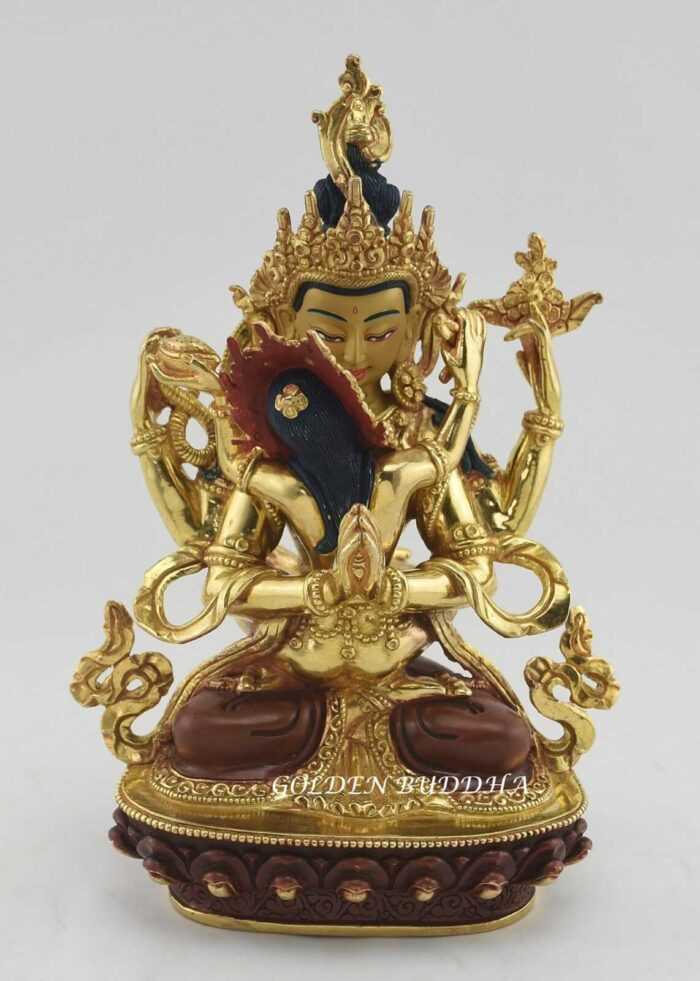
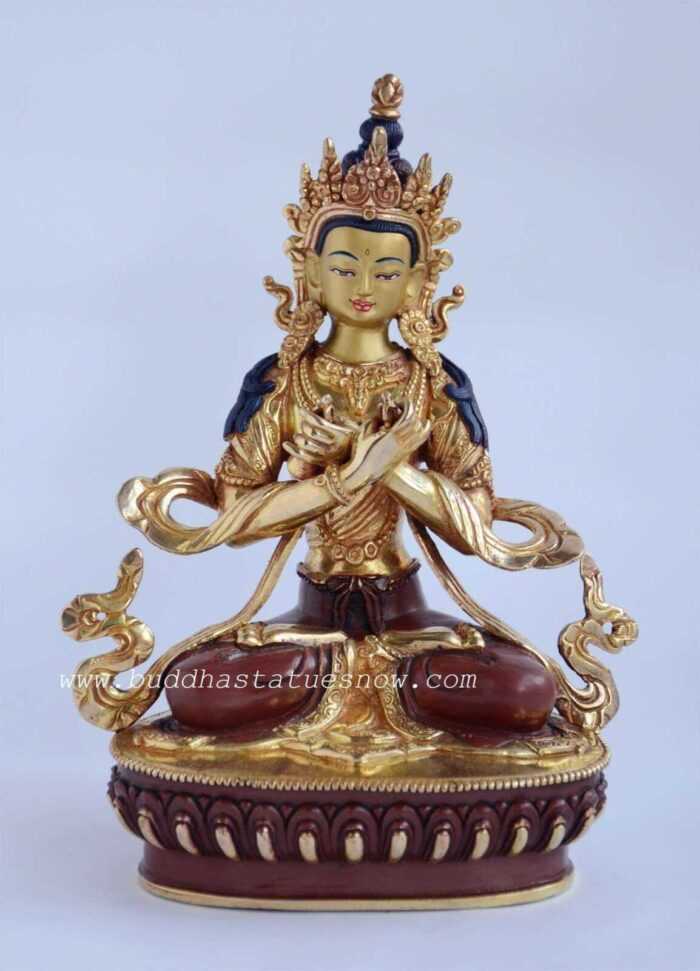
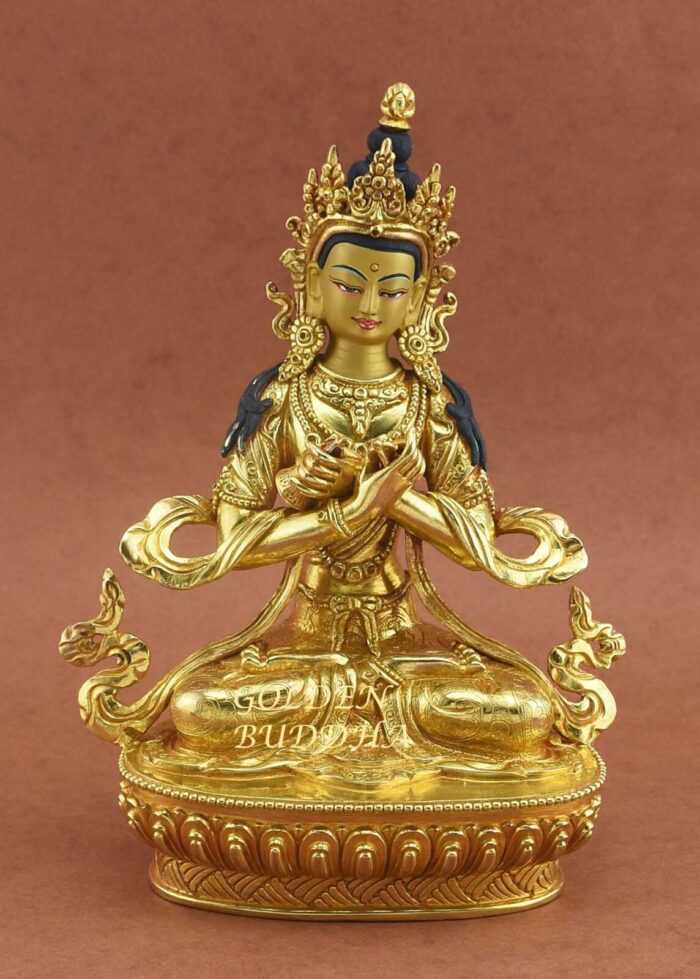
This sculpture can form a meaningful three-piece arrangement with our Samantabhadra statue with consort and our partly gold gilded Vajradhara statue. All three compositions are rooted in Vajrayana symbolism, yet each emphasizes a distinct aspect of awakened realization.
Vajrasattva represents purification, the restoration of spiritual commitments, and the stainless nature of awakened mind. His vajra and ghanta express the inseparability of compassionate method and wisdom, while his embrace with Vajragarvi makes that union visible in bodily form.
Samantabhadra in union with Samantabhadri represents primordial Buddhahood and the indivisibility of awareness and emptiness. Their unadorned bodies distinguish this iconography from the jeweled Sambhogakaya form of Vajrasattva and point toward the original, unfabricated purity of mind before conceptual elaboration.
Vajradhara is regarded in many Tibetan Buddhist traditions as the primordial or tantric Buddha and the source of numerous esoteric teachings. His crossed hands hold the vajra and bell at the heart, expressing the complete integration of method and wisdom within enlightened awareness. Displayed together, Vajrasattva, Samantabhadra, and Vajradhara create a doctrinally coherent meditation set centered on purification, primordial purity, and the perfected union of wisdom and compassionate activity.
Removable Copper-Alloy Components
The removable elements add both artistic interest and practical versatility. Vajragarvi can be detached from the central figure, revealing Vajrasattva’s complete seated form, ritual implements, jewelry, garments, and lotus posture. The ornamental frame is also removable. Importantly, the entire sculpture—including Vajrasattva, Vajragarvi, the pedestal, the removable frame, ritual attributes, and fitted structural components—is made from a base of copper alloy rather than a different secondary metal.
The rear view reveals the smooth gilded back, carefully modeled crossed legs, flowing ribbons, blue-painted hair, and fitted frame structure. These details demonstrate that the sculpture was designed as a fully realized three-dimensional work rather than solely as a frontal altar image.
Custom Made Vajrasattva Shakti Statues
Golden Buddha can arrange a custom-made Vajrasattva Shakti Statue through our network of experienced Newar artisans in Nepal. A commissioned sculpture may be created in a preferred size, with a particular balance of 24K fire gilding and oxidized copper contrast, additional hand engraving, or traditional ornament settings using genuine turquoise and red coral. The statue may also be commissioned with a removable consort and removable copper-alloy frame similar to the example shown here.
Collectors may also commission Vajrasattva, Samantabhadra, and Vajradhara as a coordinated three-piece set. Matching proportions, pedestal profiles, gilding tones, facial painting, crown details, and ornamental treatment can give the arrangement visual harmony while preserving the distinct iconography of each deity. Such a set would unite three complementary themes: Vajrasattva’s purification of obscurations, Samantabhadra’s revelation of primordial purity, and Vajradhara’s embodiment of the fully integrated tantric path.
Because every custom statue is individually modeled, cast, chased, gilded, painted, and assembled by hand, slight variations are natural. These differences are part of the character of authentic Himalayan metal sculpture and ensure that each commission is a unique work rather than a mechanically reproduced object.
An Exceptional Representation of Dorje Sempa
With its removable Vajragarvi figure, detachable copper-alloy frame, 24K fire gilding, oxidized copper contrast, hand-painted faces, and finely modeled tantric attributes, this Vajrasattva Shakti Statue is an exceptional representation of Dorje Sempa in sacred union. It is equally suited to a dedicated Vajrayana shrine, a coordinated tantric Buddha set, or a serious collection of traditional Himalayan Buddhist art.
Authentic, Handmade in Nepal
Every statue is handcrafted in Patan, Nepal, using traditional lost wax casting and comes with a certificate of authenticity issued by Nepal’s Department of Archaeology, verifying its materials, technique, and origin.
Matthew Wilkey (verified owner) –
A wonderful masterpiece which will make a good support and motivation for Ngöndro practice. The painting is exceptional and the details are very nice. Edwin was very supportive throughout the entire process. Very pleased with the whole process from purchase to arrival.
Edwin –
Hi Mathew, thank you very much for your kind words. I hope the statue helps you to accomplish all of your spiritual goals. -Edwin