
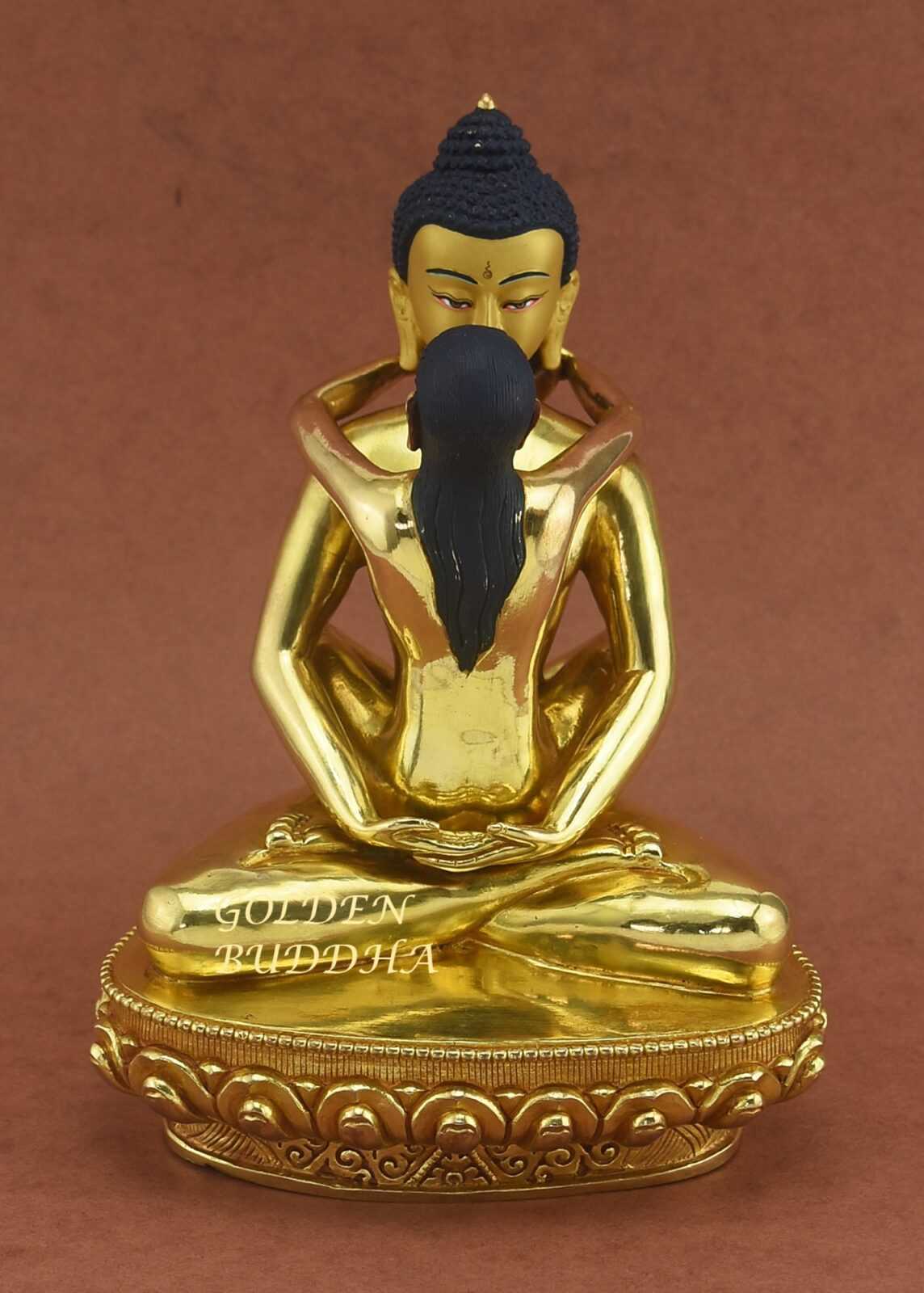


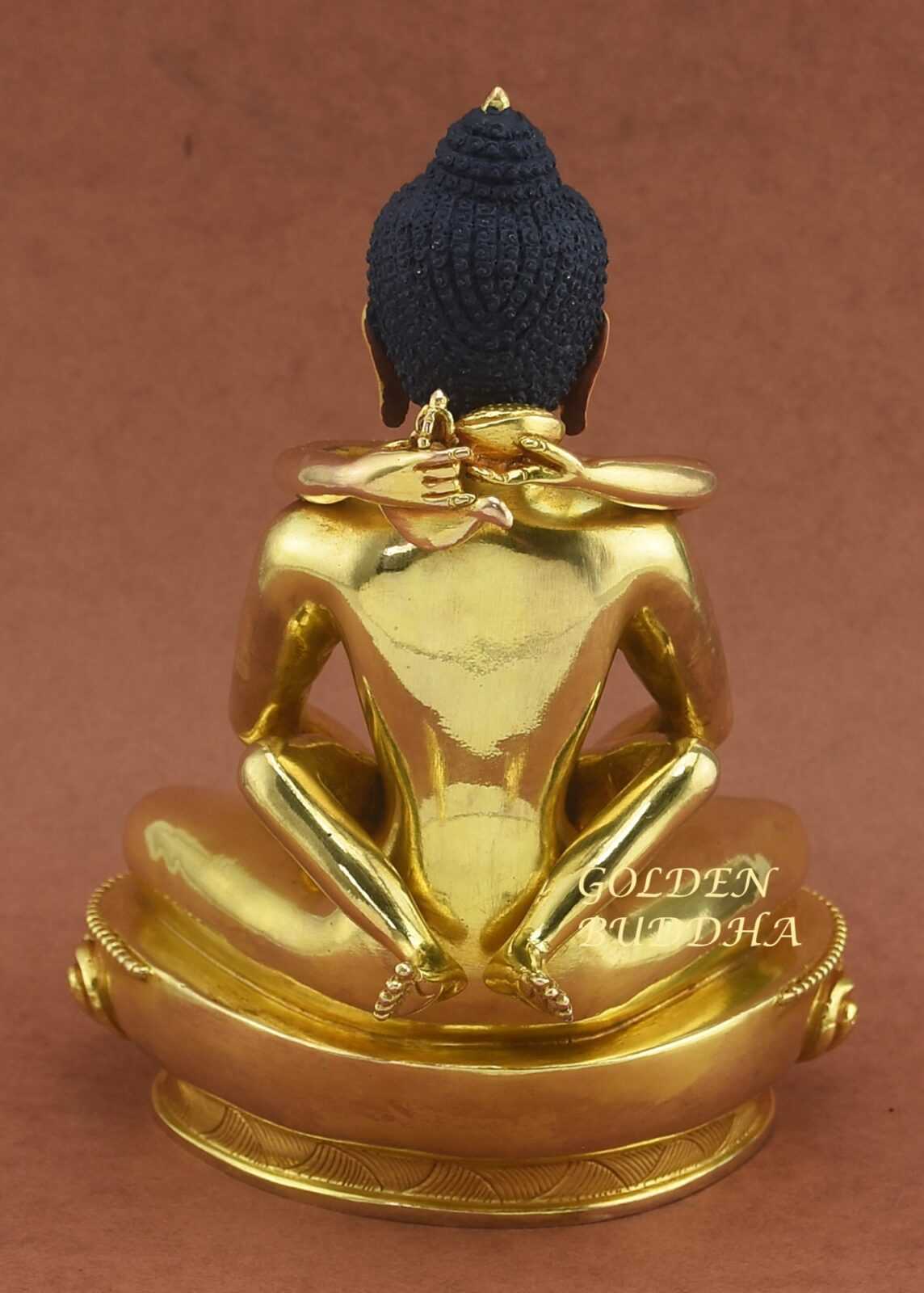
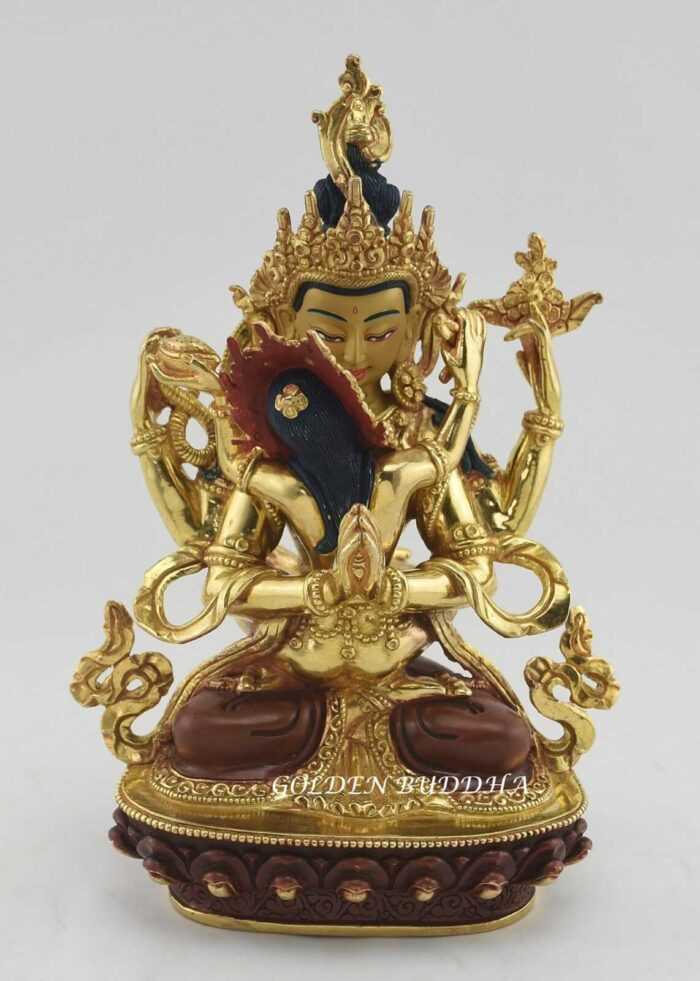
This 9-inch Samantabhadra Yab Yum Statue presents the primordial Buddha Samantabhadra, Kuntu Zangpo, in sacred union with his consort Samantabhadri, Kuntu Zangmo. Handmade in Patan, Nepal from copper alloy using the traditional lost-wax casting method, the sculpture is fire gilded in 24K gold, while the face is carefully gold painted with natural pigments and the hair is rendered in a deep blue-black tone. The luminous gold surface is especially appropriate to this subject: within the Nyingma tradition of Tibetan Buddhism, Samantabhadra represents primordial awakening and the uncompounded ground of Dzogchen realization.
Samantabhadra Yab Yum Statue | Primordial Buddha of Dzogchen
The photographs show Samantabhadra seated in full vajra posture on a broad single lotus throne. His hands rest together in the meditation gesture at his lap while Samantabhadri faces him in an intimate embrace, her arms encircling his shoulders and her legs wrapping around his body. Her long blue-black hair descends down her back, creating a strong visual contrast with the brilliant gold of both figures. Samantabhadra displays the serene features of a Buddha, including elongated earlobes, a carefully defined urna, tightly curled blue-black hair and a small gilded finial above the ushnisha. The lotus pedestal is finished with a beaded upper rim, large raised lotus-petal carvings around the front and sides, and engraved scrolling ornament along the lower register.
Sacred Union of Kuntu Zangpo and Kuntu Zangmo
Samantabhadra and Samantabhadri are known in Tibetan as Kuntu Zangpo and Kuntu Zangmo, the “All-Good Father and Mother.” Their yab-yum embrace is not simply a representation of two separate figures. It expresses inseparability: primordial awareness and emptiness, compassionate presence and wisdom, appearing as a single non-dual reality. Their unclothed bodies also carry an important symbolic meaning in traditional iconography, indicating primordial purity free from conceptual fabrication and the obscurations of conditioned existence.
For Nyingma practitioners, Samantabhadra occupies a foundational place in the Dzogchen transmission. Traditional lineage accounts identify him with the dharmakaya source of the teachings, from which wisdom is communicated to sambhogakaya buddhas and then transmitted through the great masters of the human lineage. This makes the statue particularly suitable for a Dzogchen altar, meditation space or collection centered on the nature of mind and the transmission of the Great Perfection.
Samantabhadra Yab Yum Statue | A Dzogchen-Inspired Altar Group
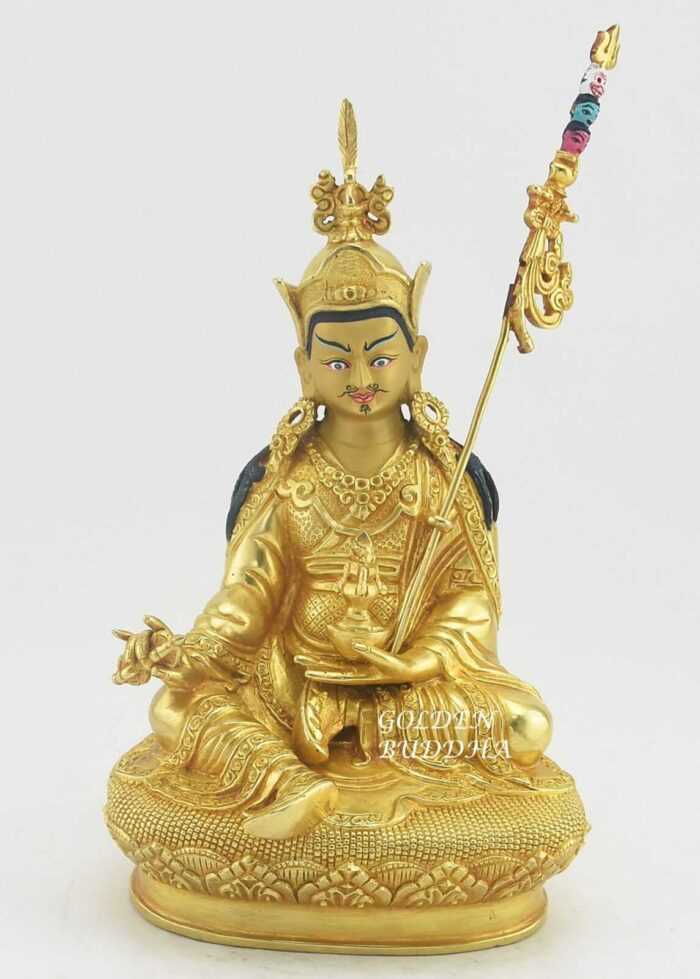
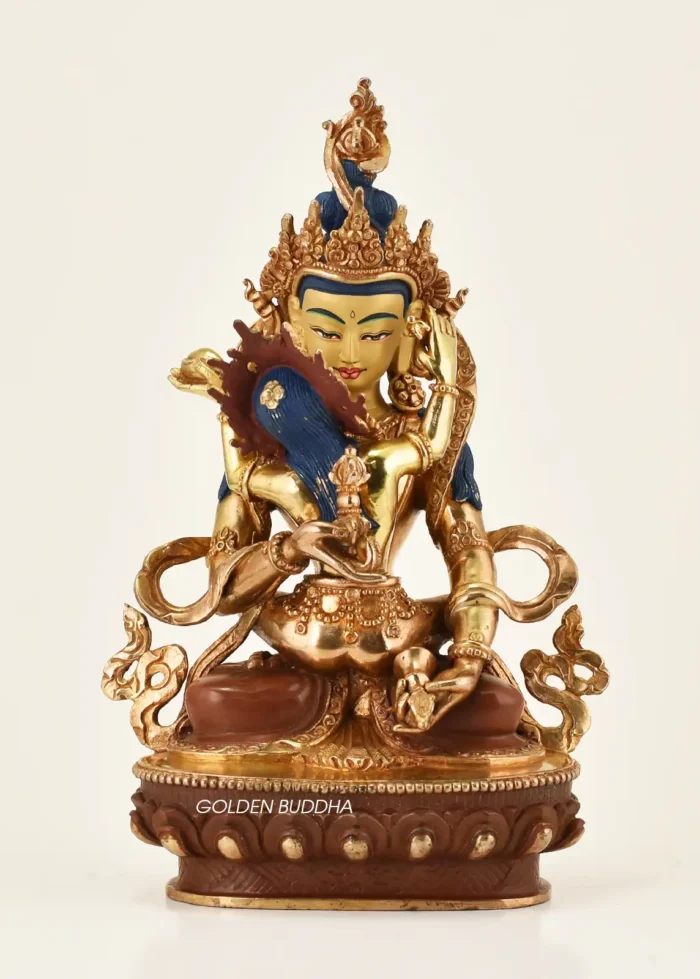
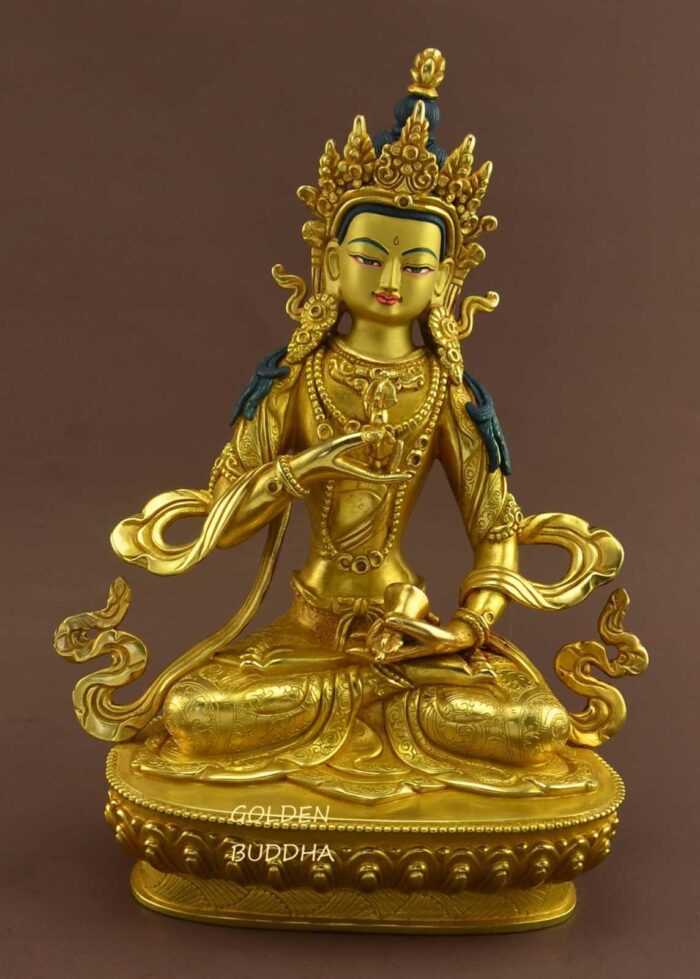
For a coordinated three-statue arrangement, this statue pairs especially well with the matching 9-inch Vajrasattva statue and Tibetan Padmasambhava statue. The relationship is doctrinal as well as aesthetic. Vajrasattva appears in Nyingma Dzogchen lineage accounts among the sambhogakaya buddhas receiving the direct wisdom transmission associated with Samantabhadra. Guru Rinpoche, Padmasambhava, stands as the great tantric master through whom Vajrayana and Dzogchen teachings became firmly established in Tibet. Arranged together, Samantabhadra can occupy the center as the primordial dharmakaya source, with Vajrasattva and Guru Rinpoche flanking him as closely related figures of transmission and practice.
This should be understood as a Dzogchen-inspired altar grouping rather than a fixed canonical trikaya triad. Its strength lies in the authentic lineage relationship among the three figures and in their unusually close visual compatibility. Each statue is approximately 9 inches in scale, handmade in copper alloy, and finished with 24K gold fire gilding, allowing the three pieces to read as a deliberate ensemble rather than unrelated sculptures.
Custom Tibetan Buddhist Statues
Collectors, practitioners and Dharma centers may also commission custom Tibetan Buddhist statues handmade in Nepal. A custom Samantabhadra and Samantabhadri image can be created in copper alloy using the lost-wax casting method, with options for different dimensions, 24K gold fire gilding, antiquated finishes and other traditional decorative treatments. Custom commissions can also be planned as coordinated altar groups so that Samantabhadra, Vajrasattva, Guru Rinpoche or other lineage figures share compatible proportions, finishes and pedestal designs for a unified shrine presentation.
Authentic, Handmade in Nepal
Every statue is handcrafted in Patan, Nepal, using traditional lost wax casting and comes with a certificate of authenticity issued by Nepal’s Department of Archaeology, verifying its materials, technique, and origin.
Reviews
There are no reviews yet.