
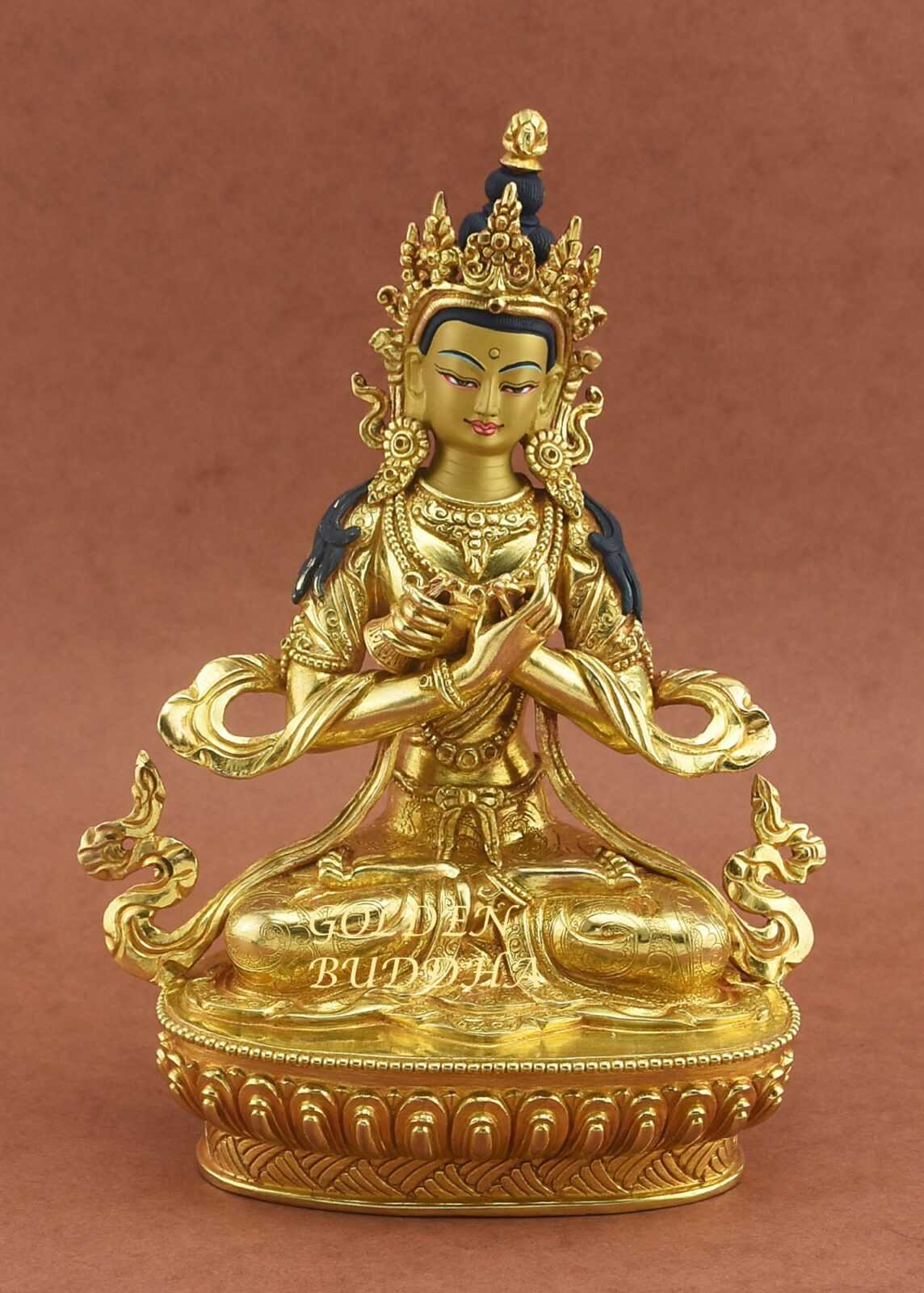
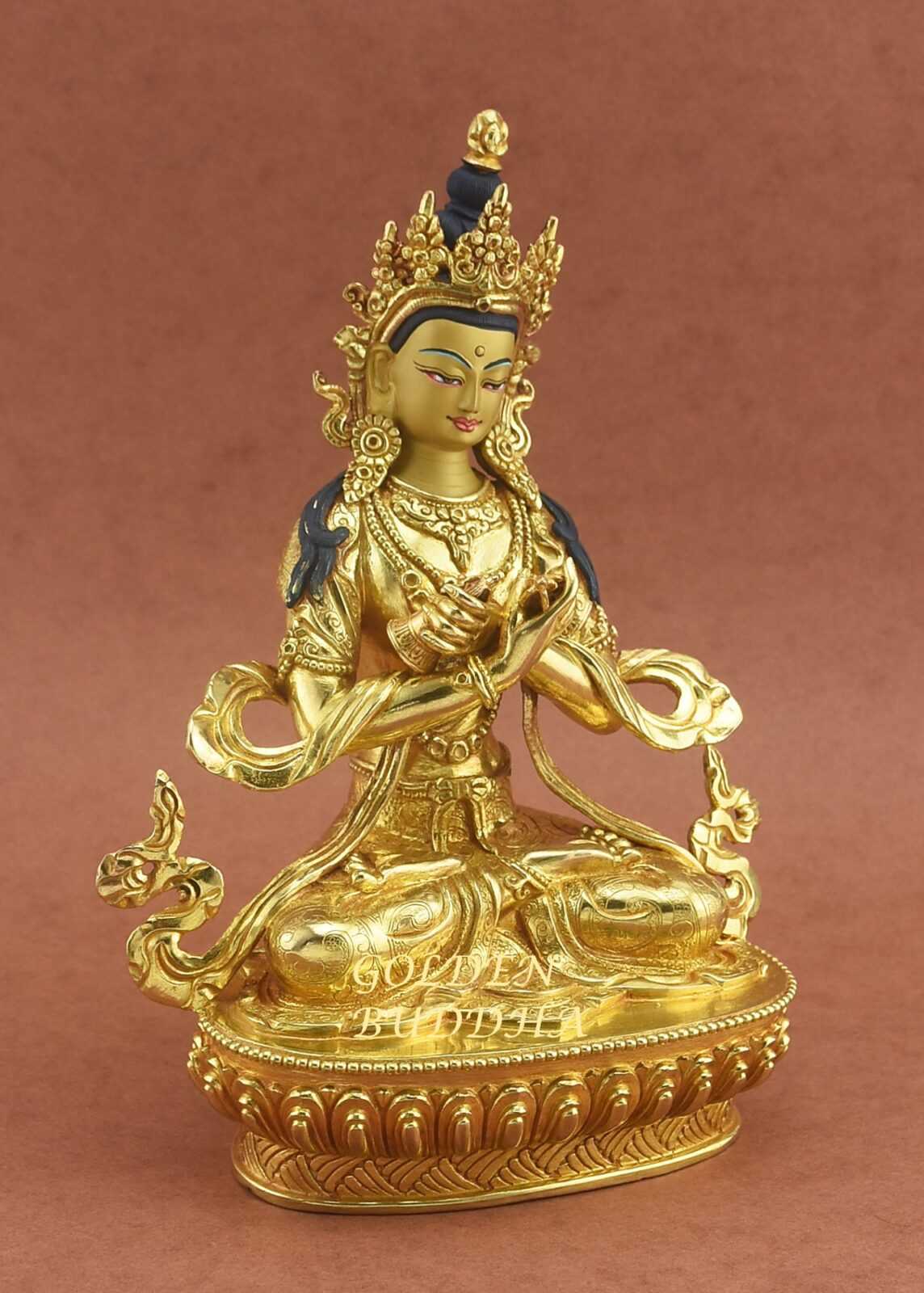
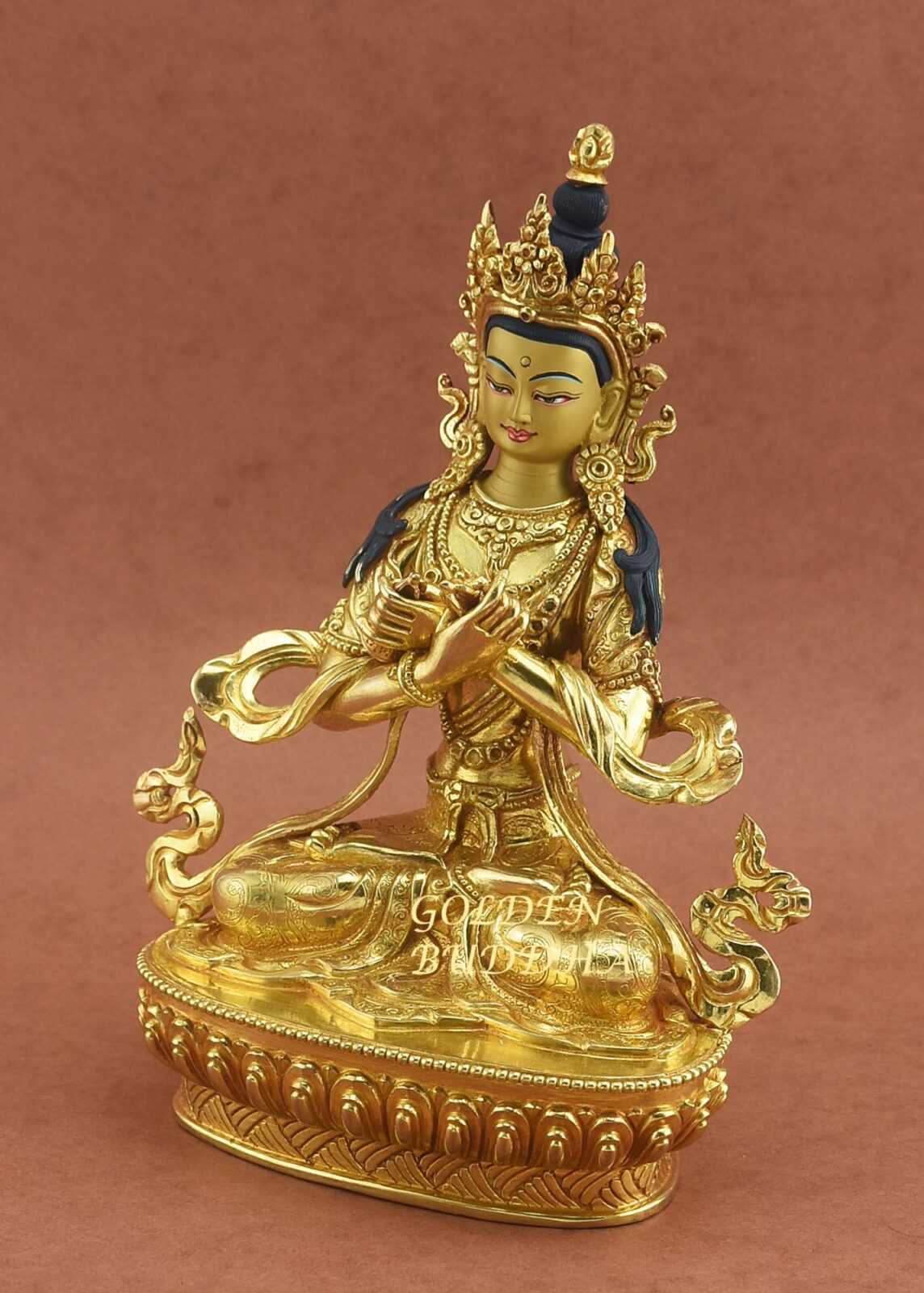


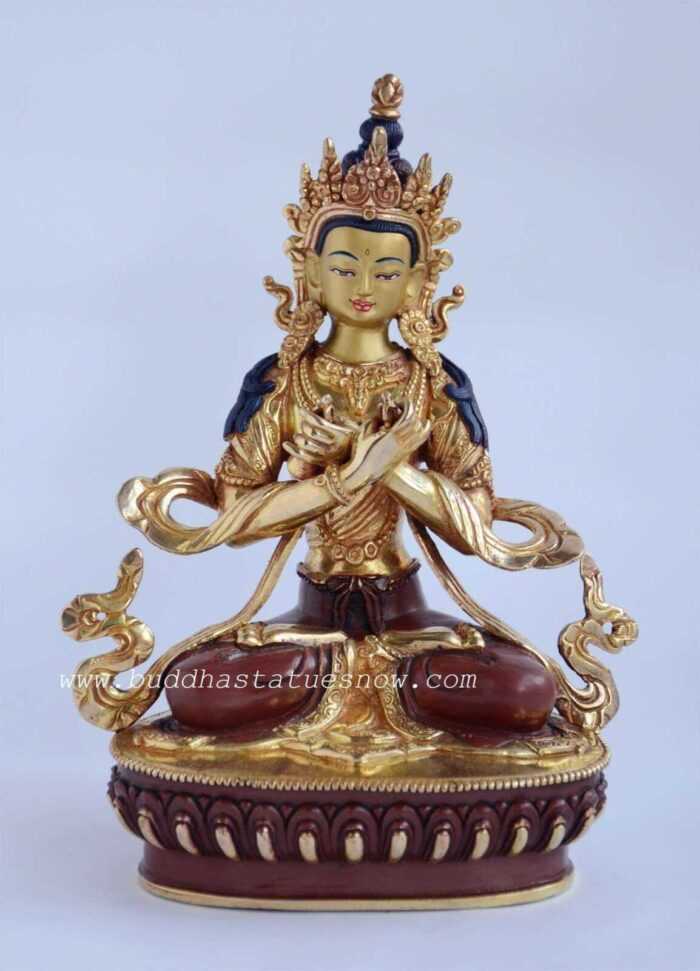
This magnificent Vajradhara Buddha statue portrays Dorje Chang, the Primordial Buddha (Adi-Buddha) revered throughout the Kagyu and Sakya traditions as the original source of the Vajrayana teachings. Fully fire gilded in 24K gold from the lotus throne to the ushnisha, this museum-quality sculpture radiates the brilliance traditionally reserved for the most sacred images enshrined within Himalayan monasteries. Vajradhara sits serenely in full vajra posture with his arms crossed in the sacred Vajrahumkara Mudra while holding the vajra and ghanta at his heart, expressing the inseparable union of enlightened compassion and transcendent wisdom that defines complete Buddhahood.
Handcrafted in Patan, Nepal, by master Newar artisans, the entire sculpture is traditionally cast from a base of copper alloy using the centuries-old lost wax casting process before being completely fire gilded in 24K gold. The peaceful face is hand painted with 18K gold and natural pigments, while the elaborate crown, ornaments, lotus pedestal, flowing scarves, and ritual implements display exceptionally fine engraving throughout. Every detail reflects the artistic heritage that has made Nepalese craftsmen the preferred sculptors for Tibetan Buddhist monasteries for centuries.
Vajradhara Buddha Statue Representing Dorje Chang
The Sanskrit name Vajradhara means “Holder of the Vajra,” while the Tibetan name Dorje Chang carries the same meaning. Rather than representing a historical Buddha, Vajradhara embodies the timeless Dharmakaya—the ultimate enlightened nature that transcends birth, death, and conceptual limitation. Within the Kagyu and Sakya schools of Tibetan Buddhism, he is regarded as the Adi-Buddha from whom the highest tantric teachings ultimately originate.
Many traditional lineage histories describe Vajradhara as the primordial source from whom profound Vajrayana instructions were transmitted through successive generations of realized masters. Because of this role, he occupies a unique position within Tibetan Buddhism, standing at the beginning of the authentic lineage of tantric realization. Learn more about his place within the Buddhist pantheon in our guide to Vajradhara (Dorje Chang).
Vajrahumkara Mudra and Sacred Implements
One of the defining features of this Vajradhara Buddha statue is the Vajrahumkara Mudra, in which both arms cross before the heart while holding the vajra and ghanta. The vajra, held in the right hand, symbolizes indestructible compassion, skillful means, enlightened activity, and the unchanging nature of awakened awareness. The ghanta, held in the left hand, represents transcendent wisdom and direct realization of emptiness. Their union at the heart expresses the inseparability of wisdom and compassionate method—the complete realization of Buddhahood.
Unlike many peaceful Buddhas, Vajradhara is adorned with the magnificent ornaments of a Sambhogakaya Buddha. The five-jeweled crown, necklaces, celestial scarves, bracelets, armlets, earrings, and flowing robes identify him as the fully adorned manifestation of enlightened awareness. The urna upon the forehead, graceful ushnisha, and three auspicious neck lines complete the classical iconography preserved by generations of Himalayan artists.
Master Newar Craftsmanship
Every surface of this sculpture displays the extraordinary precision of traditional Newar metalworking. The rear view reveals beautifully engraved robes, decorative borders, flowing scarves, and refined ornamentation that continue uninterrupted around the entire figure. Unlike sculptures finished only for frontal display, this Vajradhara Buddha statue has been completed with equal care from every angle, making it suitable for placement where the entire sculpture can be appreciated.
After casting the copper alloy using the traditional lost wax process, the artisans spend countless hours refining every detail before applying successive layers of traditional 24K fire gilding. The resulting finish possesses remarkable depth, warmth, and permanence that distinguishes authentic Himalayan fire gilding from modern electroplated alternatives. At the buyer’s request, the crown and jewelry may also be embellished with genuine turquoise and red coral before shipment. To learn more about this remarkable tradition, please visit our article on Newar artisan sculpting traditions.
Meaning of the Vajradhara Buddha Statue in Vajrayana Buddhism
This Vajradhara Buddha statue represents the timeless source of Vajrayana realization rather than a historical manifestation of the Buddha. As the Adi-Buddha, Dorje Chang embodies the enlightened mind that is beyond birth, death, and conceptual limitation. Within the Kagyu and Sakya traditions, all authentic tantric transmissions ultimately trace their origin to Vajradhara, making him the symbolic fountainhead of the complete Vajrayana path. His serene expression and perfectly balanced posture remind practitioners that enlightenment is not something created anew, but the direct recognition of the mind’s originally pure nature.
Although the Nyingma tradition commonly presents Samantabhadra as the Primordial Buddha, Vajradhara fulfills an equivalent doctrinal role within the Kagyu and Sakya schools. Both deities represent primordial awareness itself, yet each expresses this realization through a different iconographic language. Vajradhara appears adorned with the crown and jewels of a Sambhogakaya Buddha, emphasizing the perfected manifestation of enlightened qualities, while Samantabhadra is traditionally depicted without ornamentation to symbolize the innate purity of awareness before conceptual elaboration.
A Traditional Kagyu Lineage Statue Set
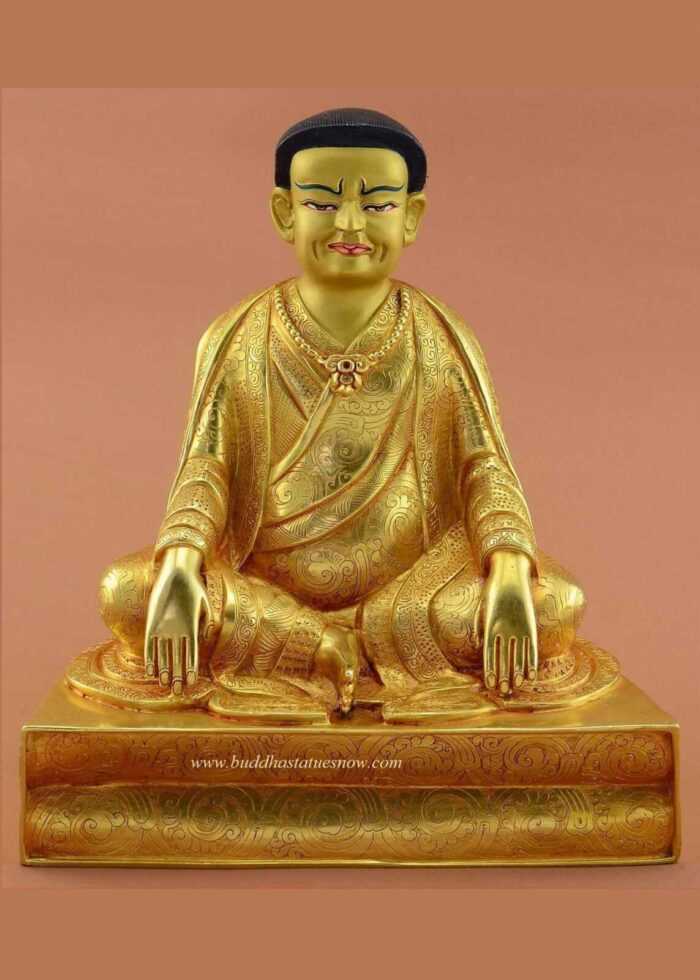
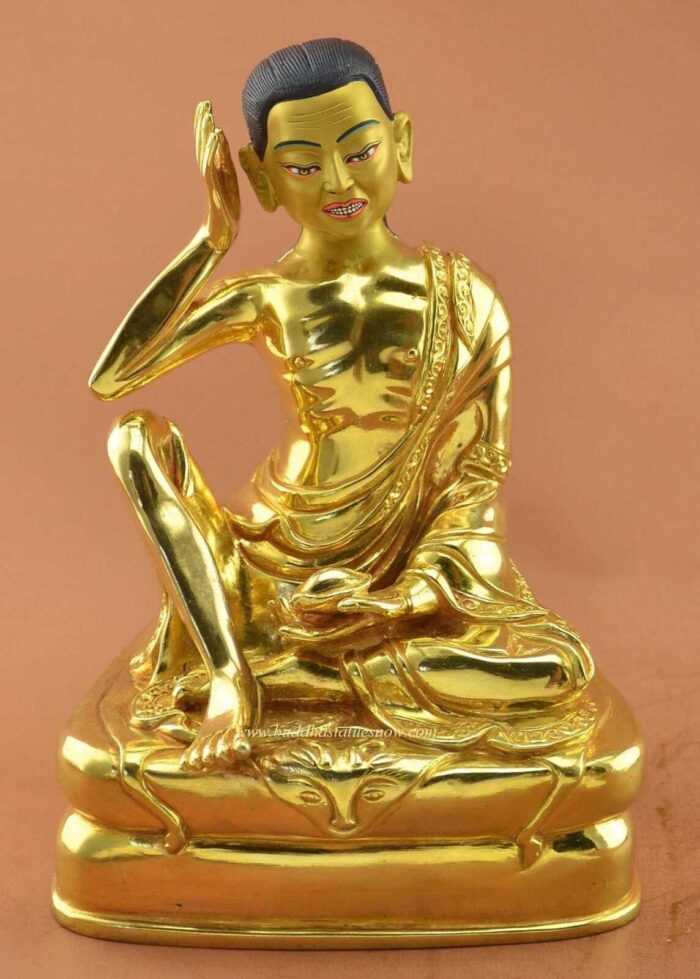
This Vajradhara Buddha statue forms a particularly meaningful three-piece shrine arrangement when displayed with our handcrafted Guru Marpa statue and Guru Milarepa statue. Unlike decorative groupings assembled simply for visual balance, these three figures represent one of Tibetan Buddhism’s most revered transmission lineages and beautifully illustrate the continuity of enlightened wisdom from its primordial source to realized human masters.
Vajradhara stands at the beginning of the lineage as the Primordial Buddha and source of the highest tantric teachings. Guru Marpa Lotsawa, the great Tibetan translator, journeyed repeatedly to India where he received profound Vajrayana transmissions from celebrated Mahasiddhas before faithfully bringing those teachings to Tibet. His foremost disciple, Jetsun Milarepa, transformed a life burdened by negative karma into complete enlightenment through unwavering meditation and became Tibet’s most celebrated yogi. Together these three figures symbolize the origin, transmission, and complete realization of the Vajrayana path.
Displayed on a shrine, this arrangement carries deep doctrinal meaning. Vajradhara represents the ultimate enlightened source, Marpa embodies the faithful preservation and transmission of authentic teachings, and Milarepa demonstrates the transformative power of sincere practice. Their combined presence reflects one of the foundational spiritual lineages of the Kagyu tradition while creating a visually harmonious altar centered on the Primordial Buddha.
Custom Made Vajradhara Buddha Statues
Every Vajradhara statue offered by Golden Buddha is individually handcrafted by experienced Newar artisans using traditional lost wax casting techniques preserved in the Kathmandu Valley for centuries. If you would like this sculpture commissioned in a different size or with additional repoussé work, hand engraving, or custom ornamentation, our workshop can create a bespoke statue while preserving the traditional iconography of Dorje Chang. Genuine turquoise and red coral may also be added to the crown and jewelry before shipment upon request.
Many collectors commission Vajradhara together with Guru Marpa and Guru Milarepa in matching dimensions to create a complete Kagyu lineage shrine. This combination is both artistically balanced and doctrinally significant. Vajradhara represents the fully awakened Dharmakaya and the origin of tantric realization, Marpa symbolizes the faithful transmission of that realization from India to Tibet, and Milarepa demonstrates its complete embodiment through meditation, perseverance, and direct experience. Together they illustrate the entire progression of the Vajrayana path—from primordial enlightenment to living realization—and form one of the most meaningful statue sets within Tibetan Buddhist art.
Because each commission is individually modeled, cast from copper alloy, fire gilded in 24K gold, hand painted with 18K gold and natural pigments, and finished entirely by hand, every sculpture possesses subtle artistic distinctions that reflect authentic Himalayan craftsmanship rather than mass production. This individuality is one of the defining characteristics of traditional Newar Buddhist sculpture.
A Museum-Quality Representation of Dorje Chang
With its complete 24K fire gilding, refined Newar craftsmanship, accurate Vajrayana iconography, and exceptional engraved detail throughout the front, sides, and rear, this Vajradhara Buddha statue is an outstanding representation of Dorje Chang. Whether displayed as the centerpiece of a Kagyu lineage shrine, combined with Guru Marpa and Guru Milarepa, or appreciated as a collector’s example of authentic Himalayan Buddhist art, it serves as a timeless expression of primordial wisdom and the unbroken transmission of enlightenment.
Authentic, Handmade in Nepal
Every statue is handcrafted in Patan, Nepal, using traditional lost wax casting and comes with a certificate of authenticity issued by Nepal’s Department of Archaeology, verifying its materials, technique, and origin.
Reviews
There are no reviews yet.