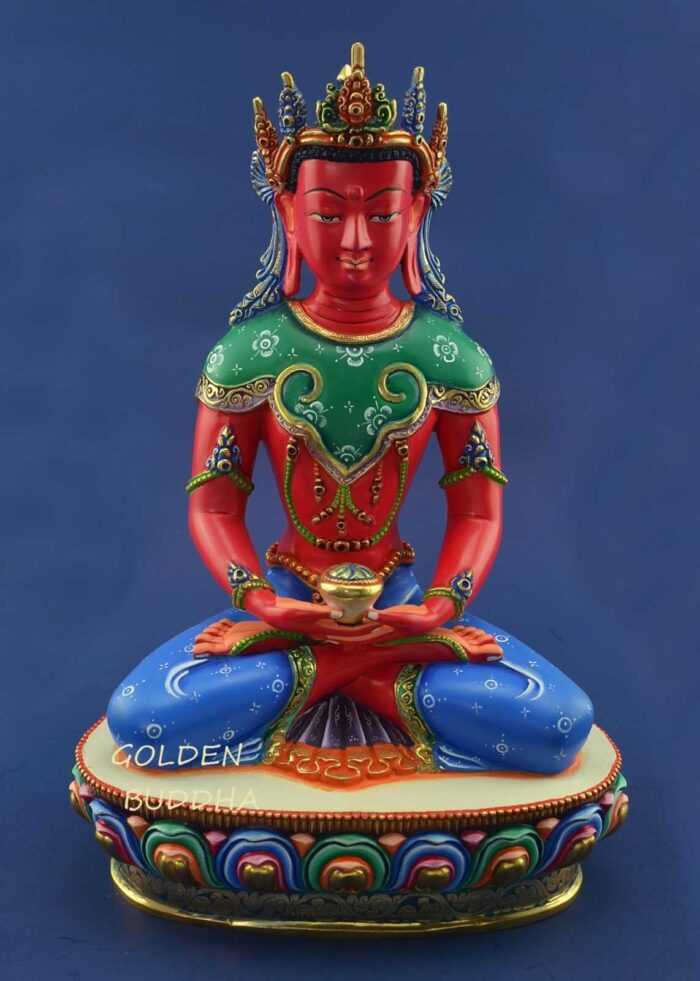
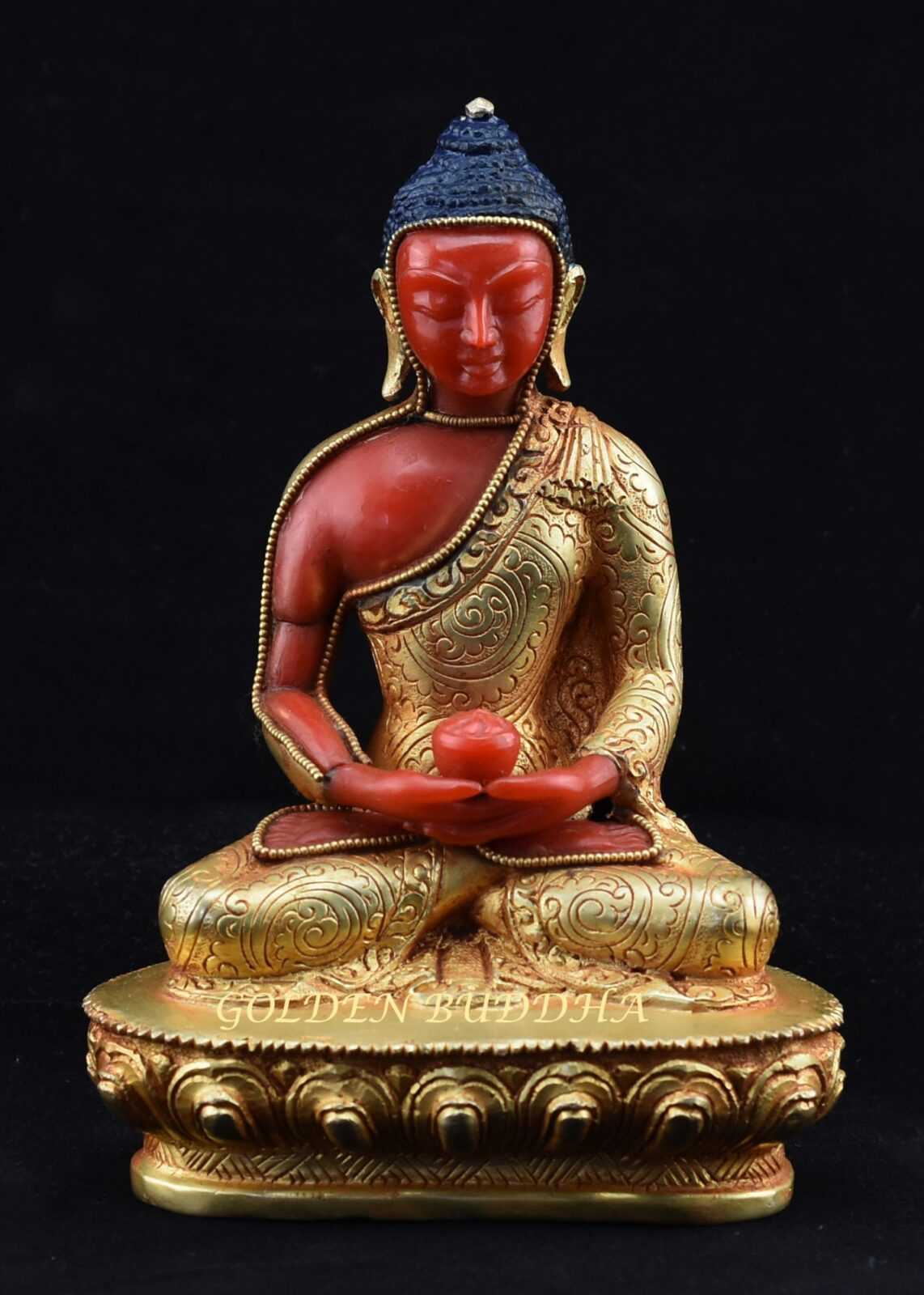
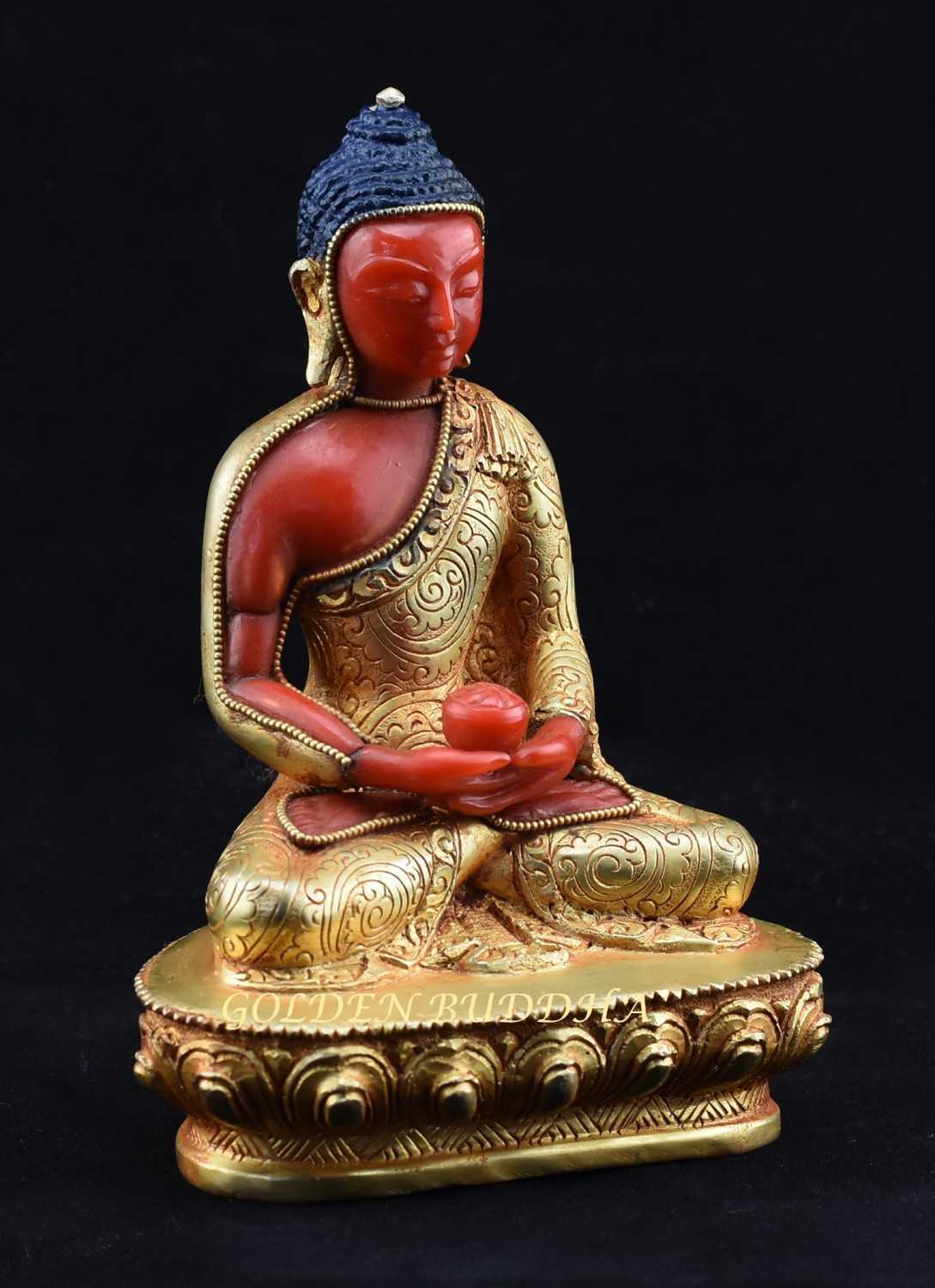
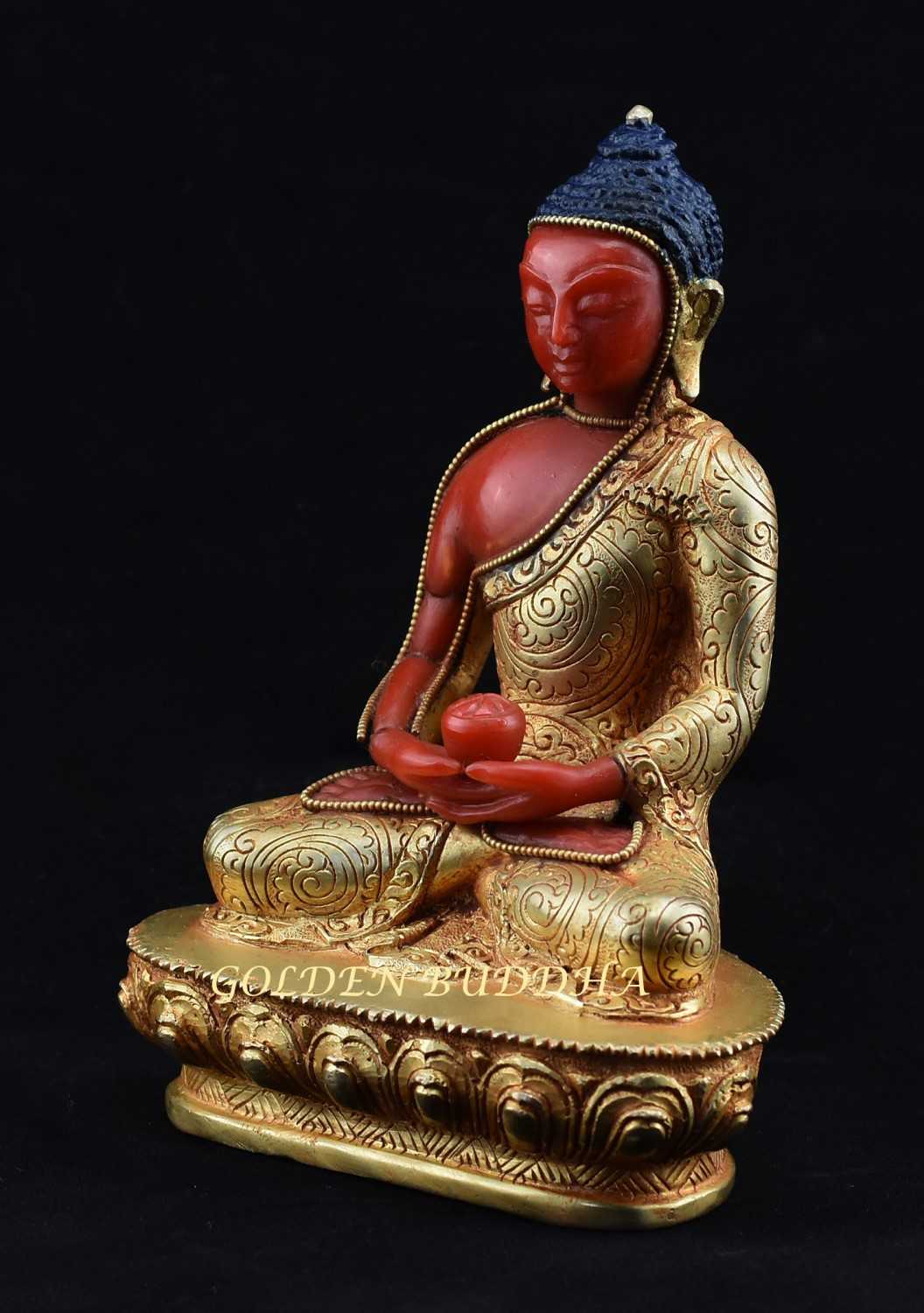
This distinctive Red Coral Amitabha Statue portrays Opame, the Buddha of Infinite Light, with a deep red body produced through the application of natural red coral paste. Handmade in Patan, Nepal, the 5.75-inch sculpture was cast from copper alloy through the traditional lost-wax method. Its richly colored face, torso, hands and alms bowl contrast dramatically with the bright 18K gold-plated robe and single lotus pedestal.
Amitabha sits in the full lotus posture with both hands resting in his lap in Dhyana mudra, the gesture of meditation and one-pointed concentration. His palms support the rounded alms bowl of a Buddhist monk, here finished in the same red coral color as his body. The centered hands, symmetrical posture and gently lowered gaze create an image of profound meditative stability.
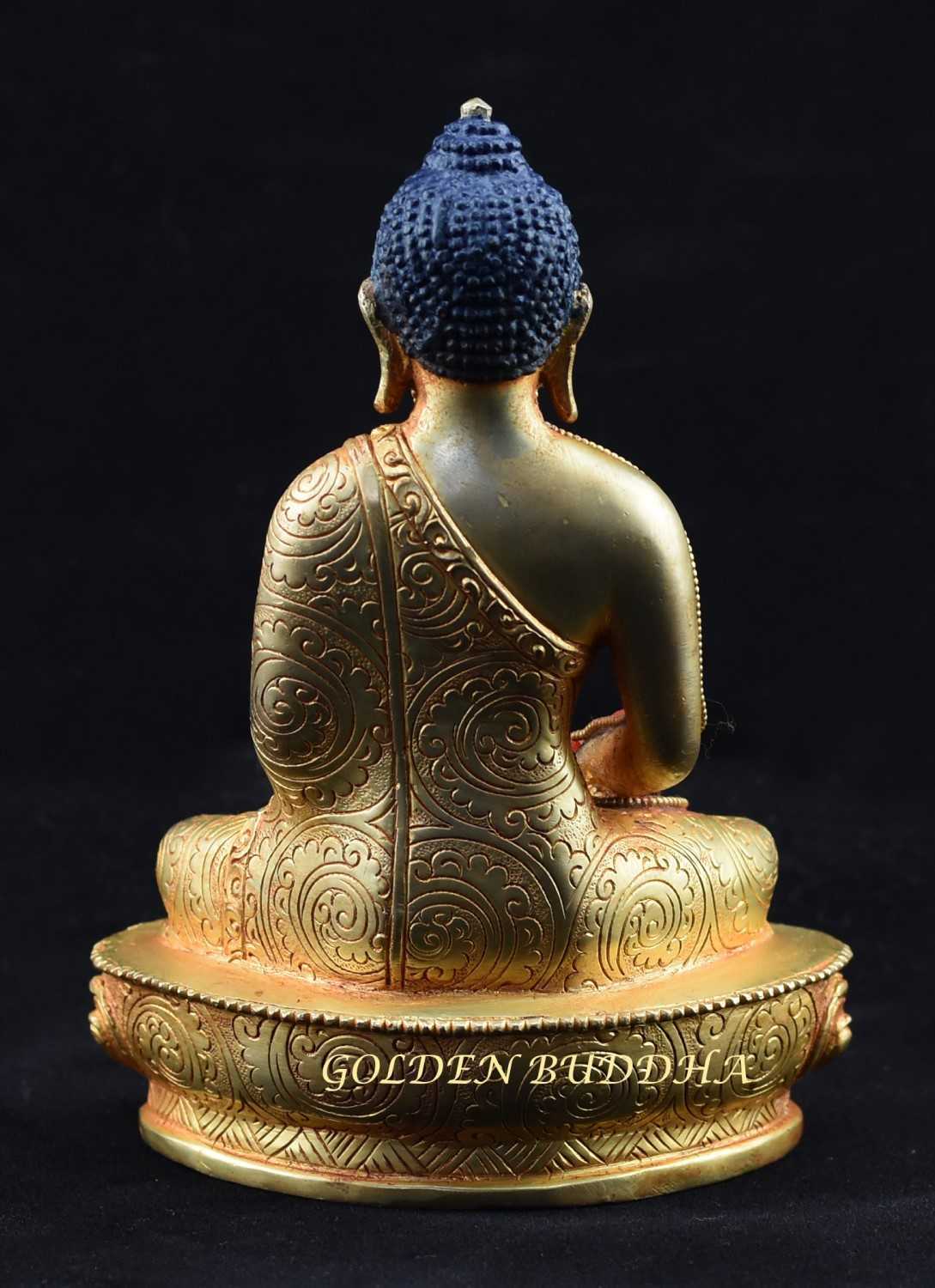
The monastic robe is embellished with extensive hand-carved hemlines, floral scrollwork and large swirling cloud motifs. These engravings cover the garment across the chest, shoulder, sleeve and folded legs before continuing around the reverse. The rear of the robe and lotus throne receive the same detailed treatment, making the sculpture suitable for display on a freestanding altar where it may be appreciated from several directions.
Measuring approximately 5.75 inches high, 4 inches wide and 2.5 inches deep, this Red Coral Amitabha Statue is ideally sized for a personal shrine, meditation shelf or compact Pure Land altar. It was made by the same master artisan as the matching Lapis Medicine Buddha Statue, allowing the two mineral-colored images to form a visually coordinated and doctrinally meaningful Buddha set.
Red Coral Amitabha Statue of Opame
Amitabha is known in Tibetan as Opame, meaning “Infinite Light.” He is among the most widely venerated Buddhas in Tibetan, Chinese, Japanese and other Mahayana Buddhist traditions. His enlightened activity is associated with limitless compassion, meditative awareness and the aspiration to guide beings toward awakening.
Before attaining Buddhahood, Amitabha practiced as the Bodhisattva Dharmakara. According to the Pure Land sutras, he generated a series of profound vows concerning the creation of a pure realm in which beings could continue their spiritual development under exceptionally favorable conditions. Through immeasurable practice and accumulated merit, those vows were fulfilled in the establishment of Sukhavati, the Western Pure Land.
The red color of this Red Coral Amitabha Statue reflects his traditional iconographic identity. Within the symbolism of the Five Buddha Families, Amitabha is associated with the lotus family, the western direction and discriminating wisdom—the awakened capacity to recognize the unique qualities of phenomena without falling into attachment or aversion.
Learn more about Amitabha’s long path from Dharmakara to Buddhahood and the vows that established his Pure Land.
Red Coral Finish of the Amitabha Statue
The deep red body is the defining artistic feature of this sculpture. Red coral paste has been applied over selected areas of the copper-alloy surface, creating a saturated mineral color across Amitabha’s face, torso, arms, hands and visible portions of the folded legs.
The alms bowl is completed in the same red finish, visually connecting the sacred vessel with the Buddha who holds it. The consistent color across the body and bowl creates a unified composition rather than using red merely as a decorative accent.
Amitabha’s traditional red color is associated with the transformation of desire and attachment into discriminating wisdom. This does not mean suppressing all perception or emotion. Discriminating wisdom recognizes the distinctive qualities of experience clearly while remaining free from grasping and possessiveness.
The red coral surface also creates a striking contrast with the bright gold robe. Amitabha’s body remains immediately visible within the densely engraved garment, while the red bowl becomes a clear focal point at the center of the meditative posture.
Dhyana Mudra on the Red Coral Amitabha Statue
Amitabha rests both hands in his lap in Dhyana mudra. The palms face upward, with one hand supported by the other to create a stable meditative gesture beneath the alms bowl. This arrangement is among the most recognizable identifying features of Amitabha Buddha.
Dhyana mudra represents concentration, inner balance and the one-pointed awareness developed through sustained meditation. The gesture reflects a mind that is neither distracted by external appearances nor disturbed by passing thoughts and emotions.
The placement of the hands at the center of the body reinforces the sculpture’s symmetrical composition. Amitabha’s folded legs, upright torso and lowered gaze all converge around the bowl, creating a visual axis of contemplative stillness.
The mudra also reminds practitioners that the realization represented by Amitabha is cultivated through practice. Faith and devotion are joined with meditation, ethical conduct and the repeated recollection of awakened qualities.
Alms Bowl and Monastic Simplicity
A rounded alms bowl rests within Amitabha’s open palms. Despite the statue’s richly ornamented robe and luminous gold finish, the bowl recalls the disciplined simplicity of Buddhist monastic life.
The alms bowl symbolizes renunciation, humility and freedom from possessiveness. A monastic accepts what is freely offered rather than accumulating unnecessary possessions. In Amitabha’s hands, the vessel therefore balances the visual richness of the sculpture with a reminder that awakening depends upon releasing attachment.
Its placement within Dhyana mudra also connects renunciation with meditation. The bowl does not interrupt the gesture but rests naturally within it, showing that ethical discipline and contemplative practice support one another.
The red coral finish applied to the vessel visually unites it with Amitabha’s body. It remains distinct from the engraved gold garment and becomes one of the principal identifying elements of the frontal view.
Full Lotus Posture and Meditative Stability
Amitabha sits in the full lotus posture with both legs folded symmetrically before him. This stable position creates a broad foundation beneath the upright torso and centered meditation hands.
The full lotus pose represents concentration, equanimity and the unshakable nature of awakened awareness. Amitabha’s posture is completely composed, reflecting the serenity of Sukhavati and the contemplative discipline associated with Pure Land practice.
The folded legs also provide broad surfaces for the artisan’s detailed engraving. Large spiraling cloud and foliate patterns follow the rounded knees, while narrow borders trace the garment edges and separate individual textile sections.
Although the robe is visually elaborate, Amitabha’s body remains still and balanced. The contrast suggests that awakened awareness remains undisturbed amid the complexity of appearances.
Ushnisha and Blue-Black Buddha Hair
Amitabha’s tightly arranged curls rise into the ushnisha, the cranial protuberance associated with the wisdom and spiritual attainment of a fully awakened Buddha. The hair is finished in a deep blue-black color that complements the red body while remaining clearly distinct from it.
The textured curls contrast with the comparatively smooth face and torso. Their carefully modeled pattern continues around the back of the head, demonstrating that the artisan completed the hair fully in the round rather than simplifying the reverse.
A small light-colored finial appears at the summit of the ushnisha, adding a restrained highlight above the dark curls. The elongated ears are finished in gold and frame the red face, while a narrow beaded border outlines the hairline and lower jaw.
The elongated earlobes recall the heavy earrings worn by Prince Siddhartha before his renunciation. They symbolize the Buddha’s royal origins and his abandonment of worldly luxury in pursuit of liberation.
Hand-Engraved Robe of the Red Coral Amitabha Statue
The gold-plated monastic robe is one of the most accomplished features of this Red Coral Amitabha Statue. Fine hand-carved scrollwork covers the garment across the chest, shoulder, sleeve and folded legs.
A raised beaded hemline follows the robe around Amitabha’s open chest and continues along the exposed arm. This border sharply separates the red body from the gold garment and emphasizes the flowing edge of the monastic robe.
Across the front, large cloud-like spirals are combined with smaller floral curls and layered borders. The patterns follow the contours of the torso and knees, reinforcing the three-dimensional form rather than appearing as flat decoration.
The shoulder cloth includes a folded ornamental panel with a serrated edge, giving additional depth to the upper garment. Around the forearm and wrist, the engravings become narrower and more closely arranged to accommodate the reduced surface area.
Swirling Cloud Engravings Across the Reverse
The rear photograph reveals the full extent of the engraving. Large swirling cloud and foliate forms cover the back of the robe from the shoulder to the lower hem, creating an interlocking field of circular motifs.
Each spiral contains layered borders, curling tips and smaller internal details. The designs vary in scale so that the broad central back carries larger forms while the shoulder, sash and folded legs receive more compact patterns.
A narrow vertical garment edge descends from the shoulder and is defined by a continuous scrolling border. This creates a strong line through the complex rear decoration and helps clarify the way the robe wraps around the body.
The extensive treatment of the reverse distinguishes the sculpture from figures decorated primarily for frontal display. Even when viewed from behind, Amitabha presents a complete arrangement of blue-black hair, smooth gold shoulder and densely engraved robe.
Single Lotus Pedestal and Engraved Rear Throne
Amitabha sits upon a broad single lotus pedestal formed by one prominent row of deeply modeled petals. A beaded border traces the upper seating platform, while a lower geometric course completes the architectural base.
The rounded centers of the petals catch the light, while the recessed divisions remain darker. This contrast gives the lotus course substantial depth despite the statue’s compact dimensions.
The rear of the lotus throne is extensively engraved with the same swirling motifs used across Amitabha’s robe. These patterns continue around the broad pedestal band and visually unite the deity with the sacred seat beneath him.
A repeating woven or diagonal-leaf pattern appears around the lowest tier. This geometric border contrasts with the organic cloud and floral designs above it and provides a stable visual foundation for the composition.
The lotus represents purity arising within samsara. Although it grows from muddy water, its flower opens unstained above the surface. As Amitabha’s throne, it symbolizes awakened awareness that remains free from attachment while compassionately engaging with beings.
18K Gold-Plated Copper-Alloy Finish
The robe, elongated ears, ornamental borders and lotus pedestal are finished with bright 18K gold electroplating. This treatment differs from traditional fire gilding and is especially effective in combination with the rich red coral paste applied to the body.
The reflective gold surface brings clarity to the dense hand engraving. Raised hemlines and carved scrolls catch the light, while deeper recesses appear more shadowed and defined.
The combination of red and gold creates a strong two-color composition. The mineral-red body establishes Amitabha’s iconographic identity, while the gold robe provides warmth, luminosity and visual continuity with the matching Medicine Buddha sculpture.
The blue-black hair introduces a third color that frames the face and defines the ushnisha. Together, the red body, dark hair and gold garment make the statue immediately recognizable even at personal shrine scale.
Red Coral Amitabha Statue and the Pure Land of Sukhavati
Amitabha presides over Sukhavati, the Western Pure Land. Buddhist scriptures describe this realm as possessing exceptionally favorable conditions for hearing the Dharma, practicing without severe obstruction and progressing toward awakening.
Pure Land practice centers upon recollection of Amitabha, faith in his vows and the aspiration to be reborn in Sukhavati. Depending upon the tradition, practitioners may recite Amitabha’s name, chant his mantra, visualize his form or combine these methods with ethical conduct and meditation.
Amitabha’s vows do not present Sukhavati as a reward for passive belief. The Pure Land is understood as an environment supporting continued Dharma practice, free from many of the conditions that ordinarily distract or discourage beings.
This Red Coral Amitabha Statue may serve as a visual support for such recollection and aspiration. The meditative posture, alms bowl and peaceful gaze encourage practitioners to cultivate concentration, renunciation and confidence in the possibility of awakening.
Explore Amitabha statue iconography, color and mudra, or browse our complete selection of Amitabha Buddha statues.
Amitabha as the Buddha of Infinite Light
The name Amitabha means “Infinite Light,” while Amitayus, a closely related form, means “Infinite Life.” The symbolism of light represents wisdom that illuminates the causes of suffering and compassion that reaches beings without limitation.
Amitabha is also one of the Five Dhyani Buddhas and is traditionally associated with the western direction. Within this mandala system, he embodies discriminating wisdom and the transformation of attachment.
His peaceful appearance reflects a mind that recognizes every phenomenon clearly without clinging to it. Discernment remains precise, but it is free from the possessiveness and preference that ordinarily turn perception into attachment.
Read more about Amitabha Buddha as the embodiment of Infinite Light and Life in our guide to the Buddhist pantheon.
Traditional Lost-Wax Casting in Patan, Nepal
This Red Coral Amitabha Statue was handmade in Patan, Nepal, through the traditional lost-wax casting method. The process begins with a wax model prepared according to established Buddhist iconometric proportions. The artisan forms Amitabha’s face, meditation hands, alms bowl, full lotus posture, monastic robe and pedestal before preparing the image for casting.
The wax sculpture is enclosed within a heat-resistant mould and fired so that the wax melts away, leaving a cavity in its form. Molten copper alloy is poured into the mould and allowed to cool. After the mould is broken, the raw metal casting is chased, filed and refined by hand.
The artisan sharpens the fingers, facial contours, robe edges, alms bowl and individual lotus petals before engraving the garment and pedestal. Large spiraling clouds and foliate motifs are carved across the front and reverse, accompanied by raised hemlines and geometric lower borders.
The body and bowl are then prepared for the red coral-paste finish, while the robe and pedestal receive 18K gold electroplating. The hair is completed separately in blue-black mineral color. Because the original wax model is destroyed and the surface decoration is performed by hand, each sculpture retains subtle individual variations.
Matching Red Coral Amitabha Statue and Medicine Buddha Set
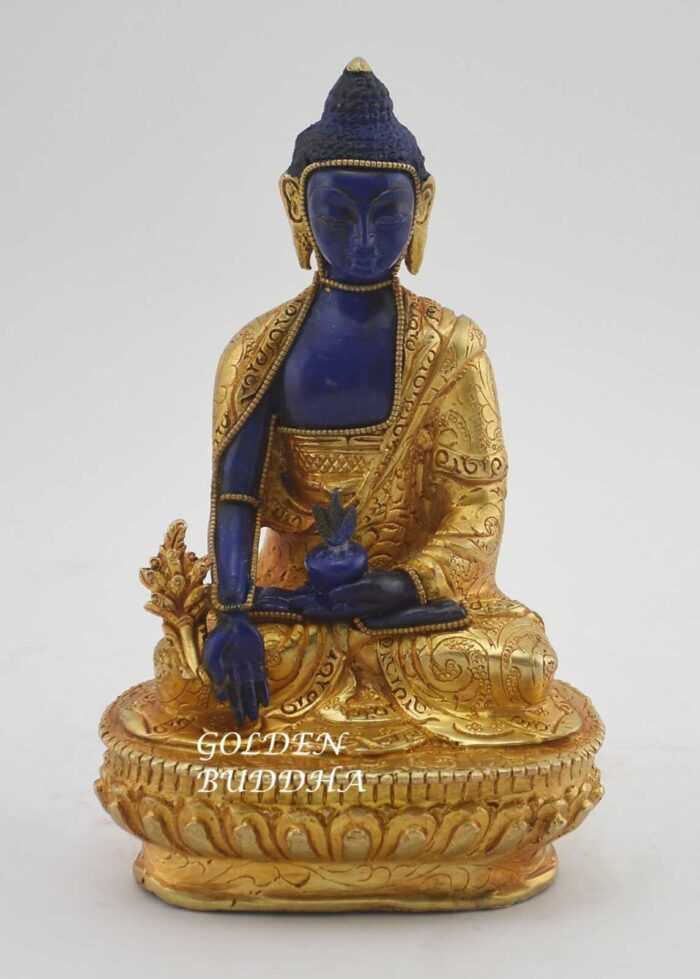
This Red Coral Amitabha Statue would form a striking two-piece shrine set with the matching Lapis Medicine Buddha Statue. Both sculptures were created by the same master artisan using copper alloy, natural mineral pastes, bright 18K gold electroplating and closely related proportions.
The 5.75-inch Amitabha and 6-inch Medicine Buddha are sufficiently close in height to appear as an intentionally planned pair. Their saturated red and lapis-blue bodies offer complementary color, while the gold monastic robes, engraved hemlines, single lotus pedestals and blue-black hair establish strong artistic continuity.
Both statues carry bowls, but their gestures and meanings remain distinct. Amitabha holds his monastic alms bowl within both hands in Dhyana mudra, expressing meditative concentration and renunciation. Medicine Buddha supports a lapis medicine bowl in his left meditation hand while extending his right hand in Varada mudra with the myrobalan plant.
Medicine Buddha embodies healing, clarity and the removal of physical, mental and spiritual suffering. His medicine bowl and myrobalan plant represent remedies guided by wisdom and compassion. Amitabha embodies Infinite Light and the compassionate vows that established Sukhavati as a favorable realm for continued progress toward awakening.
Together, the two Buddhas express complementary dimensions of the path. Medicine Buddha supports healing and the transformation of present suffering, while Amitabha represents meditative refuge and the aspiration to continue Dharma practice under the pure conditions of Sukhavati.
Their colors also carry complementary symbolism. The lapis-blue Medicine Buddha is associated with mirror-like clarity, while red Amitabha embodies discriminating wisdom and the transformation of attachment. The pair therefore unites healing, clear awareness, meditation and liberation within a visually balanced shrine arrangement.
Custom-Made Red Coral Amitabha Statues
A custom-made Amitabha statue may be commissioned in a preferred size, finish and level of ornamentation. Available options include small personal shrine images, larger temple-scale sculptures, antiquated oxidized copper finishes, partial gold decoration and statues fire gilded in 24K gold.
A custom red Amitabha may be completed with red coral paste, traditional mineral pigment or another iconographically appropriate surface treatment. The alms bowl may be coordinated with the body, while the monastic robe can receive gold plating, 24K fire gilding or a contrasting antiquated oxidized finish.
Customers may request smooth monastic robes or extensive engraving similar to this sculpture, including raised hemlines, swirling cloud motifs, foliate scrollwork and coordinated decoration around the rear pedestal. The lotus petals and proportions of the lower base may also be adapted to suit the commissioned height.
Traditional attributes—including the full lotus posture, Dhyana mudra, monastic alms bowl, ushnisha, elongated ears and monastic robe—are preserved throughout the design process. Custom Amitabha sculptures may be created for private collectors, home shrines, Buddhist temples, Dharma centers and monasteries.
A coordinated two-piece set may also be commissioned with Amitabha and the matching Lapis Medicine Buddha Statue. Their heights, mineral colors, gold finishes, robe engravings, hair treatments and lotus pedestals can be planned together so the completed statues form a unified altar ensemble.
Such a custom pairing would unite Amitabha’s Infinite Light and Pure Land aspiration with Medicine Buddha’s healing activity. Medicine Buddha addresses suffering and its causes within present experience, while Amitabha represents compassionate refuge and favorable conditions for continued progress toward awakening. Together, they form a visually distinctive and doctrinally meaningful expression of healing, meditation and liberation.
Authentic, Handmade in Nepal
Every statue is handcrafted in Patan, Nepal, using traditional lost wax casting and comes with a certificate of authenticity issued by Nepal’s Department of Archaeology, verifying its materials, technique, and origin.