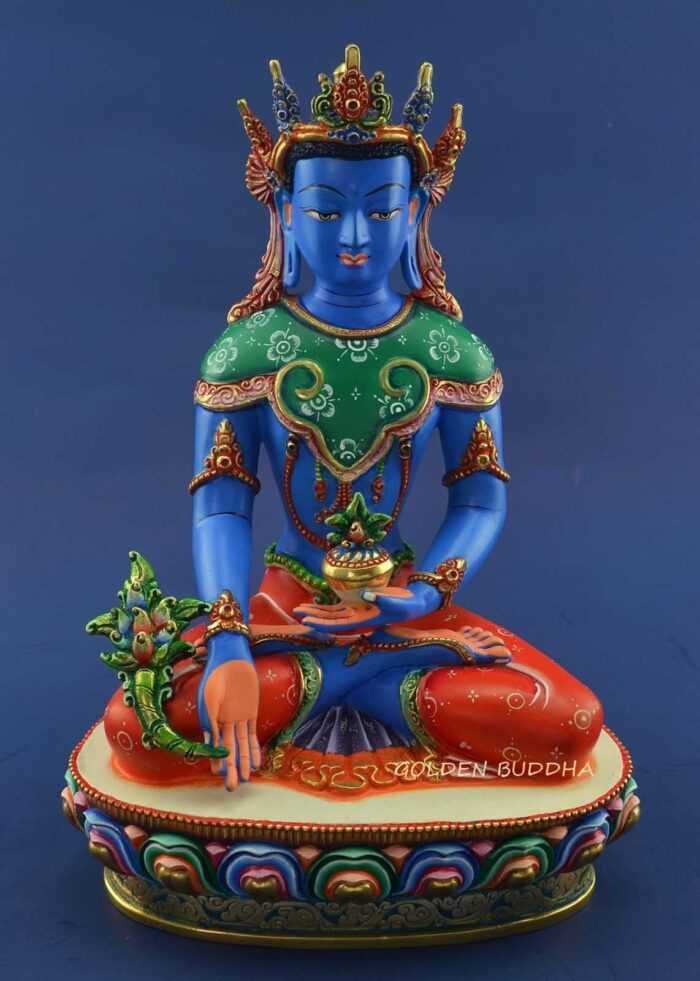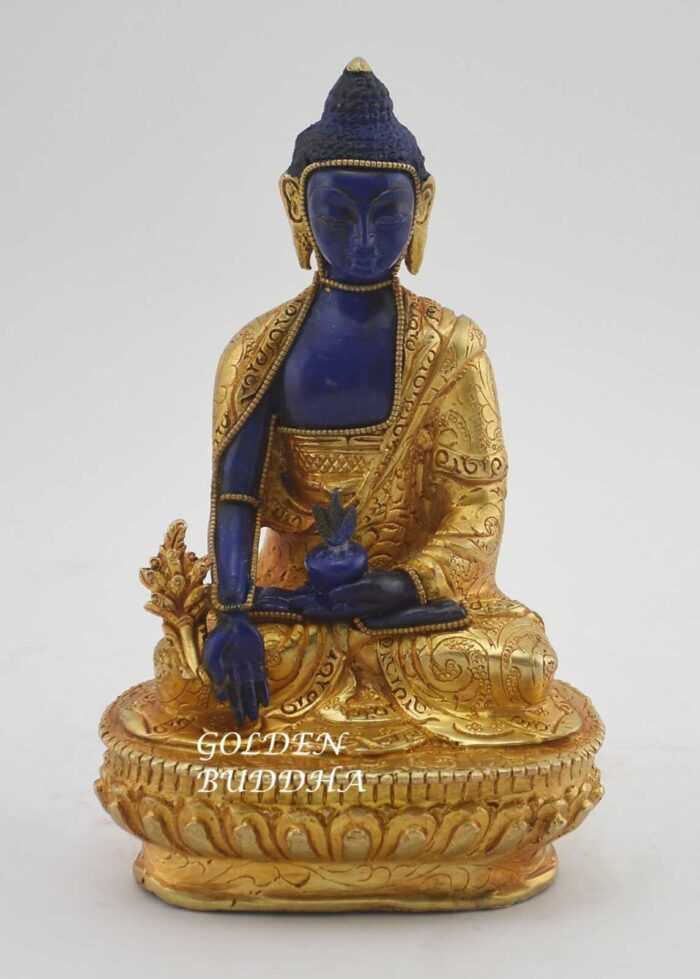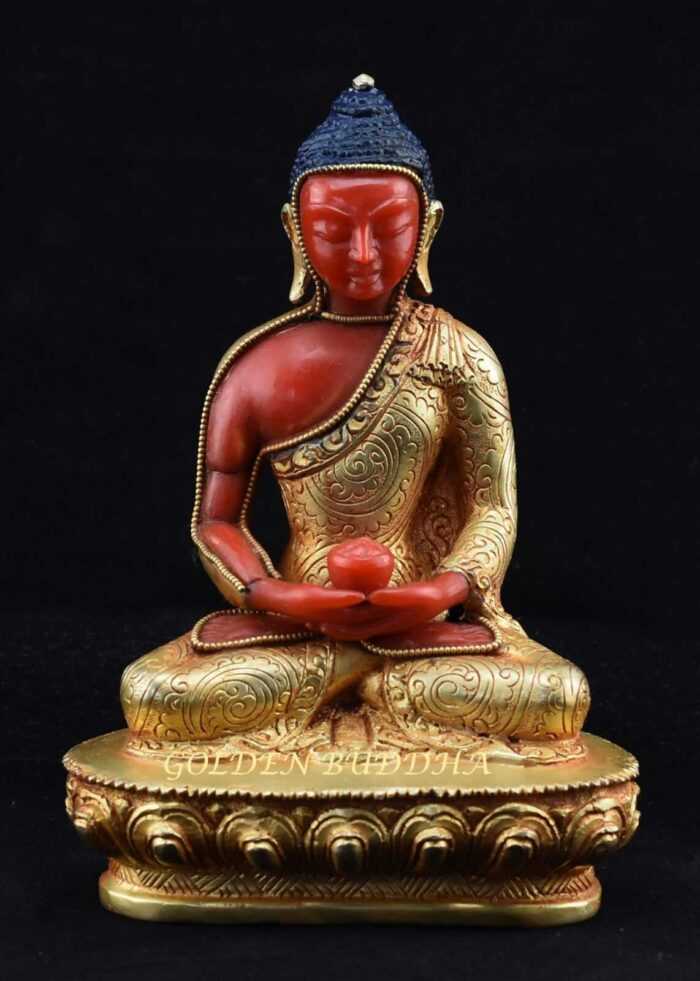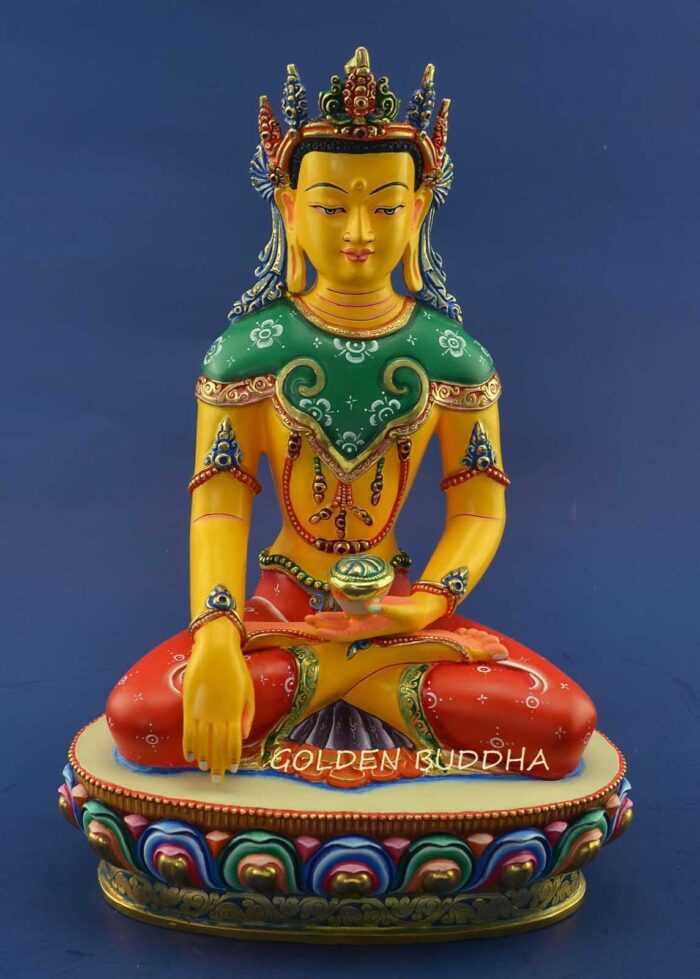

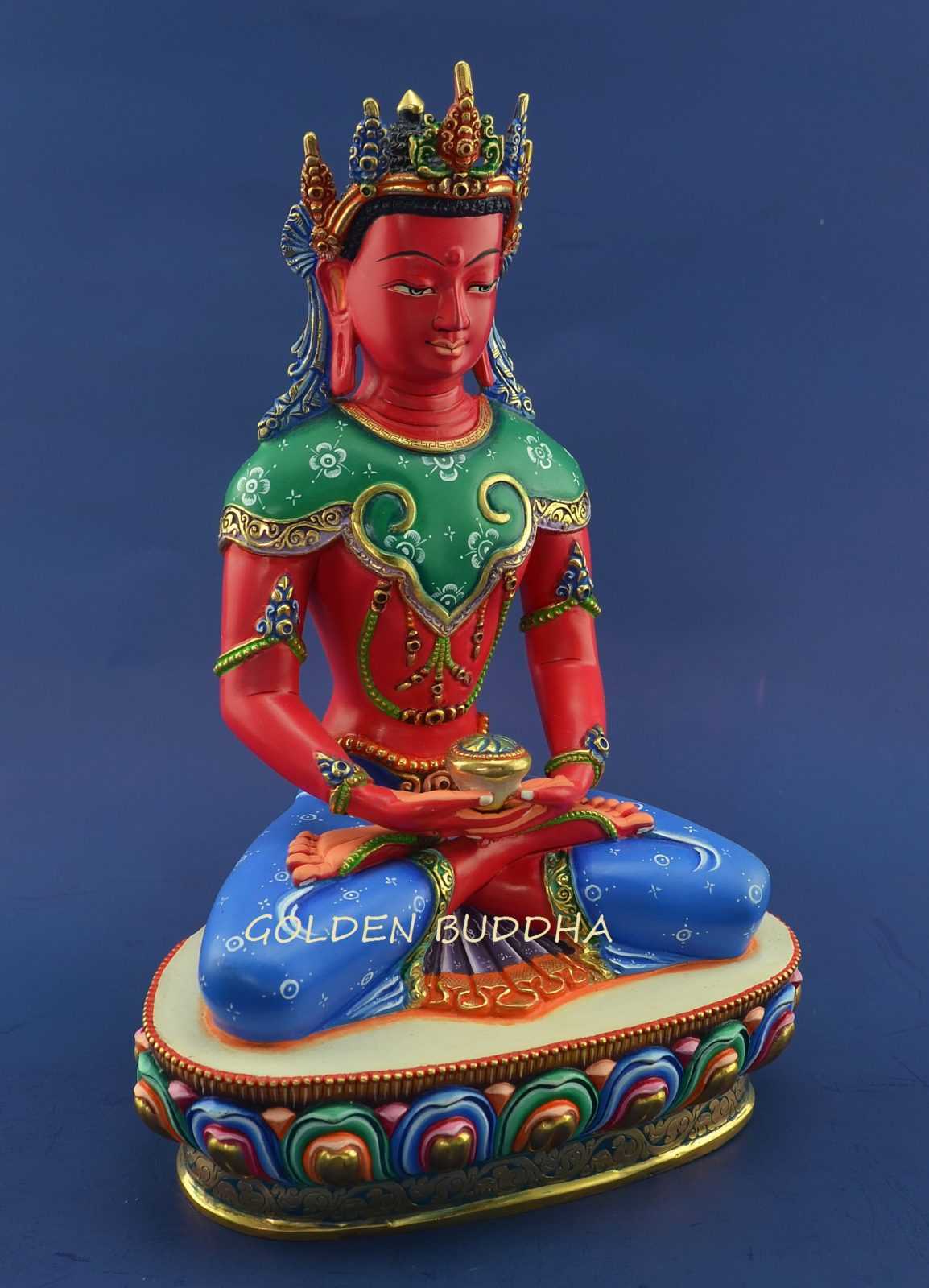
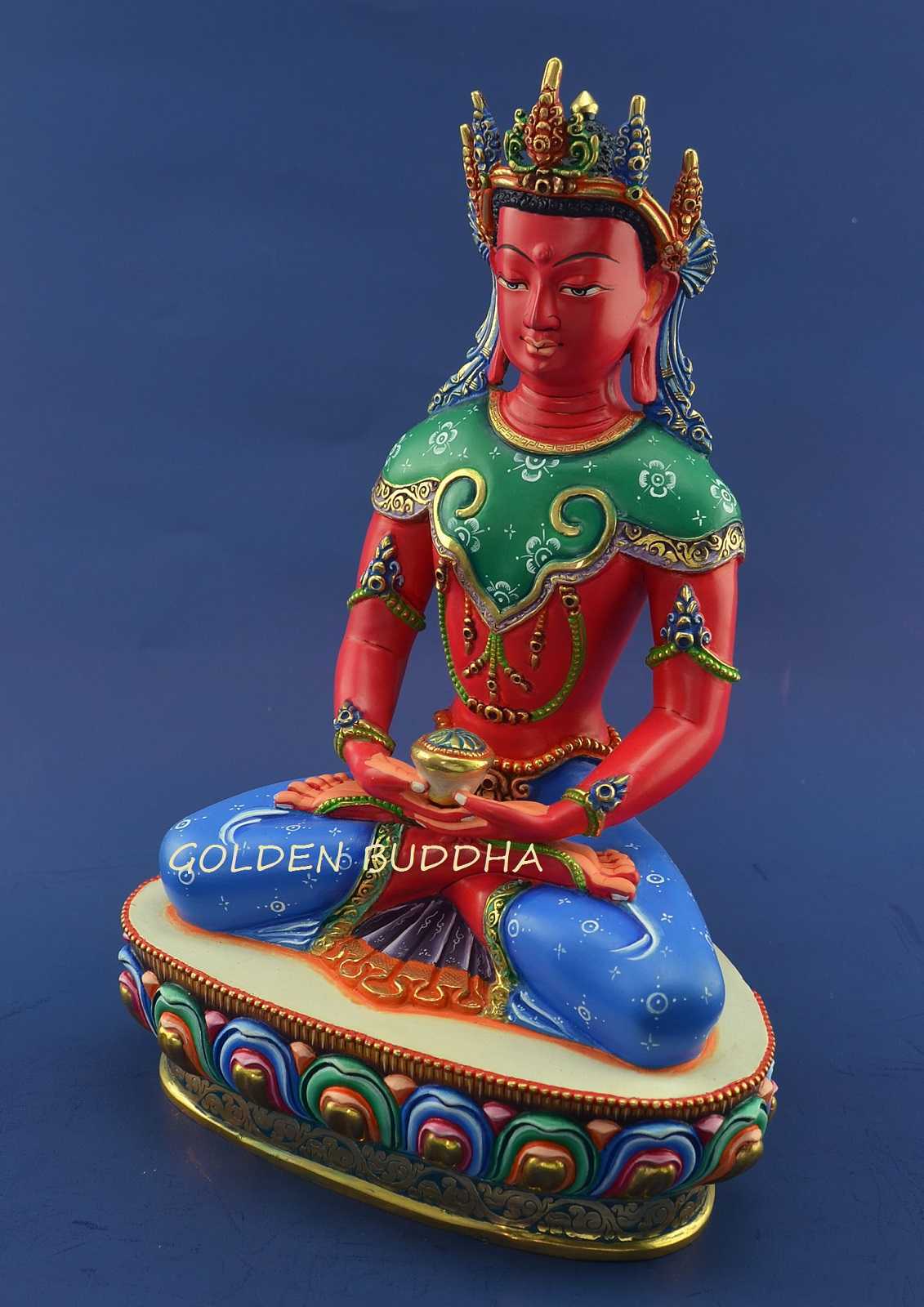
This vivid Multicolored Amitabha Statue portrays Opame, the Buddha of Infinite Light, in an elaborately adorned Himalayan form. Handmade in Patan, Nepal, the sculpture was cast from copper alloy through the traditional lost-wax method and completed with a rich polychrome finish. Amitabha’s deep red body is framed by a green shoulder covering, blue lower robe, multicolored crown and jewelry, and a brightly painted lotus throne. Selected ornamental details are fire gilded in 24K gold, creating luminous accents throughout the crown, jewelry, garment borders, alms bowl and pedestal.
Amitabha sits in the full lotus posture with both hands resting in his lap in Dhyana mudra, the gesture of meditation and one-pointed concentration. A rounded monastic alms bowl rests within his open palms. The symmetrical hands, stable posture and gently lowered gaze express meditative awareness free from distraction, while the red body identifies Amitabha with the lotus family and the transformation of attachment into discriminating wisdom.
The statue combines smooth painted surfaces with carefully modeled hemlines, celestial jewelry and architectural details. A green shoulder garment decorated with white floral motifs frames the upper torso, while the blue robe across the folded legs is embellished with fine white crescents, circles and small linear designs. The multicolored crown and ornaments incorporate red, blue, green and gold, giving the image the visual richness of a traditional Tibetan thangka translated into three-dimensional sculpture.
Measuring approximately 10.25 inches high, 7 inches wide and 4.25 inches deep, this Multicolored Amitabha Statue has a substantial shrine presence while remaining suitable for a home altar or meditation room. It was created by the same master artisan as the matching Multicolored Shakyamuni sculpture and Multicolored Medicine Buddha Statue, allowing the three images to form a coordinated and doctrinally meaningful Buddha set.
Multicolored Amitabha Statue of Opame
Amitabha is known in Tibetan as Opame, meaning “Infinite Light.” He is among the most widely revered Buddhas in Tibetan, Chinese, Japanese and other Mahayana traditions. His enlightened activity is associated with immeasurable compassion, profound meditative awareness and the aspiration to guide beings toward liberation.
Before attaining Buddhahood, Amitabha practiced as the Bodhisattva Dharmakara. According to the Pure Land sutras, Dharmakara generated a series of extraordinary vows to establish a pure realm where sentient beings could hear the Dharma, practice without severe obstruction and progress steadily toward awakening. After immeasurable cultivation of merit and wisdom, those vows were fulfilled in Sukhavati, the Western Pure Land.
This Multicolored Amitabha Statue emphasizes the majestic, celestial qualities of the Buddha of Infinite Light. The ornate crown and jewelry represent the abundance of enlightened qualities rather than worldly status. The alms bowl and meditative gesture, however, preserve Amitabha’s connection with renunciation, discipline and inward realization.
Learn more about Amitabha Buddha as the embodiment of Infinite Light and Life, or browse our complete collection of Amitabha Buddha statues in different sizes and finishes.
Red Body of the Multicolored Amitabha Statue
The saturated red body is the defining color of this sculpture. Red covers Amitabha’s face, neck, torso, arms and visible portions of the folded legs, distinguishing him immediately from the blue Medicine Buddha and golden-yellow Shakyamuni in the matching three-piece set.
Within the symbolism of the Five Buddha Families, Amitabha is associated with the lotus family, the western direction and discriminating wisdom. This awakened wisdom recognizes the unique qualities of every phenomenon without transforming those distinctions into attachment, preference or possessiveness.
Red therefore represents the transformation of ordinary desire. Attachment is not overcome by becoming indifferent or unresponsive; it is transformed into clear discernment that appreciates experience without grasping at it. Amitabha’s peaceful face expresses this balance of sensitivity and freedom.
The intense red body also establishes a strong contrast with the green shoulder covering, blue robe and gilded ornaments. This separation of color fields makes the hands, torso and facial expression clearly visible within the richly decorated composition.
Dhyana Mudra on the Multicolored Amitabha Statue
Amitabha rests both hands in his lap in Dhyana mudra. The palms face upward and are positioned one above the other beneath the monastic bowl. This balanced arrangement is one of the primary iconographic features distinguishing Amitabha from other seated Buddhas.
Dhyana mudra represents meditation, concentration and an awareness that remains undisturbed by passing thoughts and appearances. The centered hands form a visual axis beneath Amitabha’s upright torso and lowered gaze, reinforcing the contemplative stillness of the sculpture.
The gesture also reflects the role of meditation in transforming attachment. Discriminating wisdom does not arise through intellectual analysis alone. It develops through sustained awareness capable of observing thoughts, emotions and perceptions without immediately grasping or rejecting them.
The warm peach-colored palms contrast gently with the red arms and blue lower robe. Fine gilded bracelets frame the wrists, drawing additional attention toward the meditation gesture and the sacred bowl resting within it.
Alms Bowl and Spiritual Nourishment
A rounded alms bowl rests within Amitabha’s open palms. The vessel is painted in cream, green, blue and gold, with a decorative lid or upper rim that gives it greater visual prominence at the center of the statue.
The alms bowl recalls the disciplined simplicity of Buddhist monastic life. A monk accepts what is freely offered and avoids accumulating unnecessary possessions. In Amitabha’s hands, the vessel therefore symbolizes renunciation and freedom from the grasping that keeps beings bound to samsara.
The bowl may also be understood as containing the nectar of Dharma—the spiritual nourishment that supports beings on the path toward liberation. Its placement within Dhyana mudra joins ethical discipline with meditation and wisdom.
Although the sculpture presents Amitabha with a lavish crown and jewelry, the monastic bowl prevents the image from becoming a simple display of royal abundance. It reminds practitioners that the splendor of Buddhahood arises from complete freedom from attachment.
Ornate Crown and Celestial Jewelry
The elaborate five-point crown is one of the most visually prominent features of this Multicolored Amitabha Statue. Its central red ornament is surrounded by green scrollwork, while alternating red and blue points rise around the dark Buddha curls. Selected ridges, settings and borders are fire gilded in 24K gold.
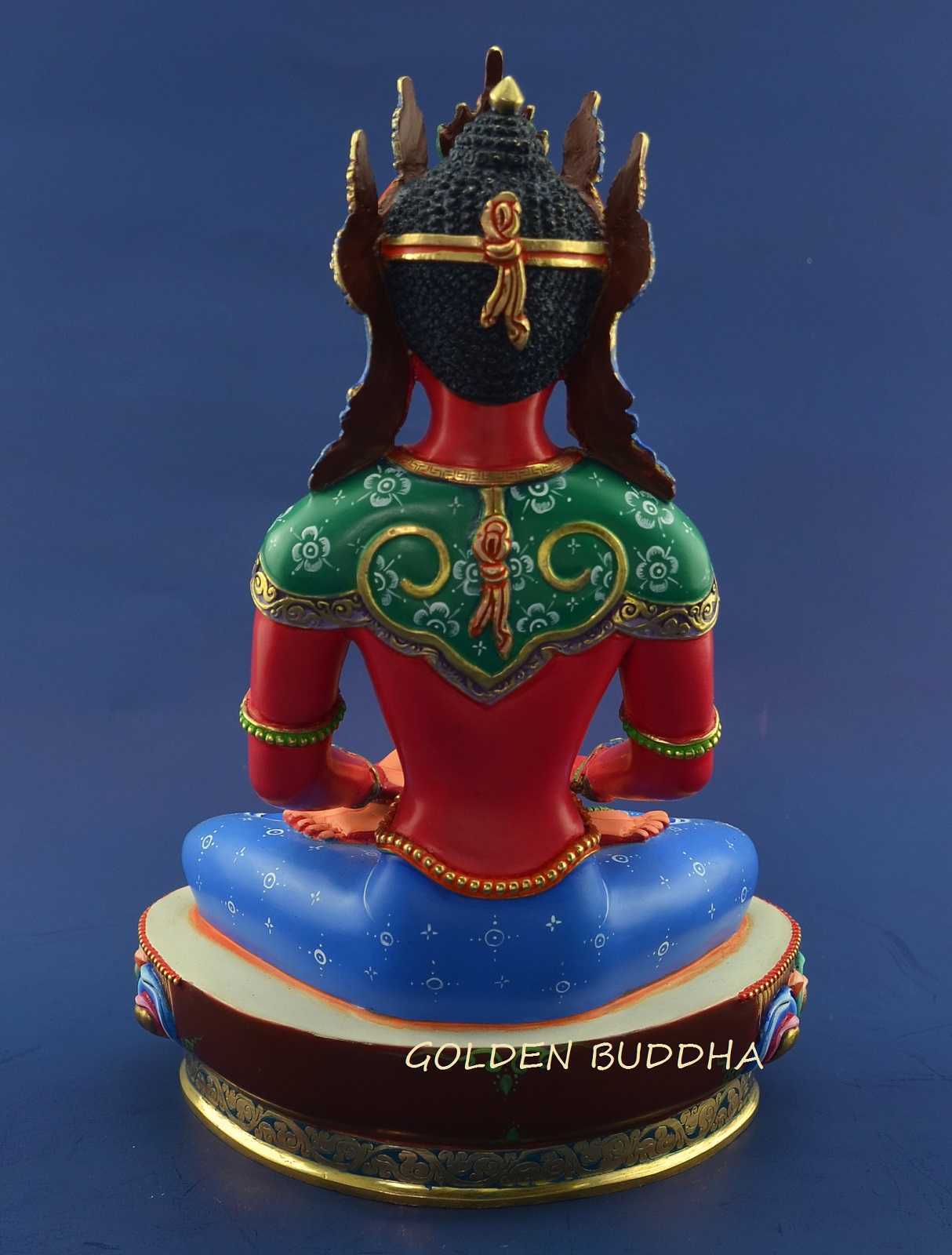
The crown is fully modeled around the head. The reverse photograph reveals the individual points, the gilded securing band and a central fastening ornament placed against the textured black hair. This complete construction ensures that the crown remains convincing from the front, sides and back.
Long earrings frame Amitabha’s red face, while additional ornaments appear at the upper arms, wrists, waist and chest. Blue, red and green settings are bordered with gold, giving the jewelry a richly layered appearance.
At the buyer’s request, the crown and jewelry may be additionally embellished with genuine turquoise and red coral before shipping. The stones can be placed selectively within the existing ornamental settings while preserving the original balance of the multicolored design.
Ushnisha, Urna and Marks of Buddhahood
Amitabha’s dark curls rise into the ushnisha, the cranial protuberance traditionally associated with the wisdom and spiritual attainment of a fully awakened Buddha. The crown surrounds the ushnisha while leaving the textured upper form visible from behind.
A small urna appears between the brows. This auspicious mark symbolizes transcendent vision and the Buddha’s capacity to perceive the circumstances and spiritual needs of sentient beings.
Three horizontal lines appear across the neck, another traditional feature of Buddha iconography. The elongated earlobes recall the heavy royal jewelry worn before renunciation and symbolize the relinquishment of worldly status.
These traditional marks preserve Amitabha’s identity as a fully enlightened Buddha despite the unusual polychrome colors and richly adorned presentation.
Green Shoulder Garment and Floral Decoration
A deep green shoulder covering extends across Amitabha’s upper chest and back. Its broad curved form frames the red torso and creates a strong visual transition between the multicolored crown and blue lower robe.
White floral motifs and delicate linear marks are distributed across the green surface. These painted patterns resemble embroidery and bring the statue closer to the visual language of Tibetan thangka painting.
Gold-edged scrolls curl inward over the chest and meet at a pointed central panel. Small red and green pendants descend below this border, visually connecting the garment with the necklaces and waist ornaments.
The covering continues across the reverse, where two gold-edged curls form a symmetrical design around a central red fastening ornament. White flowers remain clearly visible across both shoulders, demonstrating that the garment was fully decorated from every side.
Blue Robe and Hand-Finished Hemlines
The lower robe is painted in a vivid blue color and covers both folded legs. White crescents, circles, small crosses and delicate linear motifs decorate the garment, giving it the appearance of a patterned Himalayan textile.
Green and gold borders trace the robe around the knees, ankles and center of the seated posture. These narrow hemlines clarify the structure of the fabric and separate the blue garment from Amitabha’s red body.
A red central panel descends between the folded legs and is bordered with gold and green. Its warm color visually connects the torso with the pedestal and prevents the blue robe from appearing as a single uninterrupted field.
The robe’s white painted motifs continue across the reverse. This complete treatment allows the statue to be viewed from behind without exposing an undecorated surface.
24K Fire-Gilded Details
Selected ornamental elements are fire gilded in 24K gold, creating bright highlights against the red, green and blue painted surfaces. Gold appears throughout the crown, jewelry, garment borders, alms bowl and lotus pedestal.
The gilding helps define the boundaries between adjacent colors. Narrow gold courses separate the green shoulder garment from the red torso, the blue robe from the folded legs and the colored lotus petals from the darker architectural base.
Raised crown points, jewelry settings and beaded borders catch reflected light and draw the viewer’s attention toward Amitabha’s face and central meditation gesture. The gold is therefore used structurally rather than simply as an additional color.
Because the statue is selectively gilded instead of being covered uniformly in gold, the polychrome treatment remains the dominant artistic feature. The result combines the brilliance of gilded Newar metalwork with the vivid narrative color of Himalayan painted art.
Full Lotus Posture of the Buddha of Infinite Light
Amitabha sits in the full lotus posture with both legs crossed symmetrically before him. The broad triangular arrangement creates a stable foundation beneath the upright torso, crown and centered hands.
The full lotus posture symbolizes meditative concentration, equilibrium and the unshakable nature of awakened awareness. Amitabha’s stillness reflects the peaceful qualities of Sukhavati and the disciplined contemplation associated with Pure Land practice.
The broad folded legs provide the principal surface for the bright blue robe and its white painted designs. Peach-colored feet remain visible near the center, while green and gold hemlines define the garment edges.
The calm symmetry of the posture balances the visual energy of the crown, jewelry and multicolored throne. Despite the richness of the finish, Amitabha remains composed and deeply meditative.
Multicolored Lotus Throne and Architectural Base
The statue rests upon a broad lotus throne decorated in green, blue, red, pink, cream and gold. A pale seating platform supports Amitabha and is bordered by a narrow red-and-gold beaded course.
Large stylized petals surround the front and sides. Green outer forms frame blue and pink inner layers, while rounded 24K fire-gilded centers provide luminous focal points. Small red diamond shapes appear between the principal petals and strengthen the repeating rhythm.
The lotus symbolizes purity arising within samsara. Although its roots develop beneath muddy water, the blossom opens unstained above the surface. Amitabha’s lotus throne therefore represents awakened awareness that remains free from attachment while continuing to benefit beings.
The lowest architectural band is decorated with scrolling gilded foliate motifs against a darker blue-green field. This decorative course continues around the reverse and creates a stable foundation beneath the bright lotus petals.
Finished Across the Front and Reverse
The rear photograph confirms that the multicolored finish extends throughout the sculpture. Amitabha’s crown, dark hair, green shoulder covering, red body, blue robe and lotus throne remain carefully finished from behind.
The dark curls cover the complete rear of the head, while a gilded horizontal band and central fastening ornament secure the crown. Each crown point remains individually modeled around the ushnisha.
The green shoulder covering is decorated with white floral motifs and symmetrical gold-edged curls. A central red ornament descends between the shoulder blades and visually anchors the reverse design.
The blue robe wraps around the folded legs and retains its white painted patterns across the back. The pedestal’s multicolored petals and gilded lower border also continue around the full base, making the statue suitable for freestanding shrine placement.
Multicolored Amitabha Statue and the Pure Land of Sukhavati
Amitabha presides over Sukhavati, the Western Pure Land. Buddhist scriptures describe this realm as possessing exceptionally favorable conditions for hearing the Dharma, practicing without severe obstruction and progressing steadily toward awakening.
Pure Land practice centers upon recollection of Amitabha, confidence in his vows and the aspiration to be reborn in Sukhavati. Practitioners may recite his name, chant his mantra, visualize his form or combine these methods with ethical conduct and meditation.
Sukhavati is not presented merely as a reward or final resting place. It is a pure environment where beings may continue their progress toward complete Buddhahood under conditions free from many ordinary distractions and dangers.
This Multicolored Amitabha Statue can serve as a visual support for recollection, meditation and Pure Land aspiration. The centered Dhyana mudra, alms bowl and peaceful gaze encourage concentration, renunciation and confidence in the possibility of liberation.
Explore Amitabha statue iconography, mudra, color and form for a more detailed explanation of his traditional attributes.
Amitabha and the Transformation of Attachment
As a member of the Five Buddha Families, Amitabha transforms attachment into discriminating wisdom. Ordinary attachment grasps at pleasant experiences and attempts to possess people, objects and identities. Discriminating wisdom perceives their distinct qualities clearly without becoming bound by them.
This transformation does not eliminate appreciation, beauty or emotional sensitivity. Instead, it removes the possessiveness that turns them into sources of anxiety and suffering. Amitabha’s red body symbolizes this awakened relationship with experience.
His Dhyana mudra emphasizes that such transformation requires meditative awareness. Practitioners learn to recognize desire as it arises, understand its impermanent nature and release the assumption that lasting fulfillment can be obtained through grasping.
The lotus family further reinforces this teaching. Like a lotus growing from mud, wisdom arises by understanding and transforming the very emotions that once supported confusion.
Traditional Lost-Wax Casting in Patan, Nepal
This Multicolored Amitabha Statue was handmade in Patan, Nepal, through the traditional lost-wax casting process. The artisan begins with a wax model formed according to established Buddhist iconometric proportions, creating Amitabha’s posture, face, hands, bowl, crown, jewelry, garments and lotus pedestal.
The wax sculpture is enclosed within a heat-resistant mould and fired until the wax melts away, leaving a cavity in its shape. Molten copper alloy is poured into the mould and allowed to cool. After the mould is broken, the raw casting is chased, filed and refined entirely by hand.
The artisan sharpens the fingers, facial contours, crown points, jewelry, garment borders and lotus petals before preparing the sculpture for its painted finish. Separate color fields are applied to the red body, green shoulder garment, blue robe, crown and pedestal.
Selected ornamental details are then fire gilded in 24K gold. Because the original wax model is destroyed during casting and the chasing, painting and gilding are completed individually, each sculpture retains subtle variations characteristic of handmade Newar metalwork.
Multicolored Amitabha, Shakyamuni and Medicine Buddha Set
This Multicolored Amitabha Statue would form a vibrant three-piece shrine set with the matching Multicolored Shakyamuni sculpture and Multicolored Medicine Buddha Statue. All three were created by the same master artisan and share copper-alloy construction, lost-wax casting, hand-painted polychrome finishes and selective 24K fire-gilded details.
The statues have closely coordinated dimensions and artistic treatments. Each features an elaborate multicolored crown, celestial jewelry, a green shoulder garment, vividly painted lower robes and a multicolored lotus pedestal. Their repeated colors and related proportions allow them to appear as an intentionally designed altar ensemble.
Each Buddha nevertheless retains his own defining mudras and attributes. Amitabha holds his alms bowl in Dhyana mudra. Shakyamuni touches the earth in Bhumisparsha mudra while supporting a bowl in his meditation hand. Medicine Buddha extends Varada mudra beside the myrobalan plant and holds the medicine bowl in Dhyana mudra.
Amitabha Buddha embodies Infinite Light, discriminating wisdom and the compassionate vows associated with Sukhavati. His centered meditation gesture expresses concentration, renunciation and Pure Land aspiration.
Shakyamuni Buddha is the Historical Buddha who attained awakening in our world and taught the Dharma. His Bhumisparsha mudra recalls the moment he overcame Mara and called the earth to witness his enlightenment.
Medicine Buddha embodies healing, clarity and the removal of physical, emotional and spiritual suffering. His medicine bowl and myrobalan plant represent remedies selected and applied with wisdom and compassion.
Together, the three Buddhas create a coherent doctrinal arrangement. Shakyamuni reveals the path and establishes the teachings. Medicine Buddha helps heal suffering and remove obstacles encountered while following that path. Amitabha represents compassionate refuge and favorable conditions for continued spiritual progress.
Shakyamuni may serve naturally as the central figure because he is the Buddha of our present historical era. Medicine Buddha and Amitabha may flank him as complementary images of healing and Pure Land aspiration. The matching crowns, garments, colors, gilded details and lotus thrones give the group exceptional visual unity.
Custom-Made Multicolored Amitabha Statues
A custom-made Amitabha statue may be commissioned in a preferred size, color scheme, finish and degree of ornamentation. Available options include compact personal shrine statues, larger temple-scale sculptures, antiquated oxidized copper finishes, partially gilded images and statues fire gilded in 24K gold.
A custom polychrome Amitabha may be produced with traditional mineral pigments or another coordinated Himalayan color palette. The body, shoulder garment, lower robe, crown, jewelry, alms bowl and lotus pedestal can be finished in complementary tones while preserving Amitabha’s established red identity.
The crown and jewelry may be embellished with genuine turquoise and red coral. Stone placement may remain restrained within selected settings or be expanded across the crown, earrings, necklace, armlets, bracelets and waist ornaments according to the commissioned design.
Customers may request smooth painted robes, hand-carved textile patterns, fire-gilded hemlines or additional ornament across the rear garments and pedestal. Traditional Amitabha attributes—including the red body, Dhyana mudra, alms bowl, full lotus posture, urna, elongated ears and ushnisha—are preserved throughout the design process.
Custom statues can be created for private collectors, home shrines, Dharma centers, Buddhist temples and monasteries. Larger commissions may include deeper lotus-petal carving, more elaborate architectural bases and fully coordinated reverse decoration for freestanding display.
A complete three-piece set may also be commissioned with Amitabha, the Multicolored Shakyamuni sculpture and the Multicolored Medicine Buddha Statue. Their heights, crown designs, painted colors, gilded details, garments and lotus pedestals can be planned together so the completed statues form a unified shrine ensemble.
Such a custom set would unite Amitabha’s Infinite Light and Pure Land aspiration with Shakyamuni’s teaching and Medicine Buddha’s healing activity. Shakyamuni reveals the path, Medicine Buddha supports the relief of suffering and removal of obstacles, and Amitabha represents compassionate refuge and continued progress toward awakening. Together, the three figures create a visually vibrant and doctrinally complete expression of Buddhist teaching, healing and liberation.
Authentic, Handmade in Nepal
Every statue is handcrafted in Patan, Nepal, using traditional lost wax casting and comes with a certificate of authenticity issued by Nepal’s Department of Archaeology, verifying its materials, technique, and origin.